
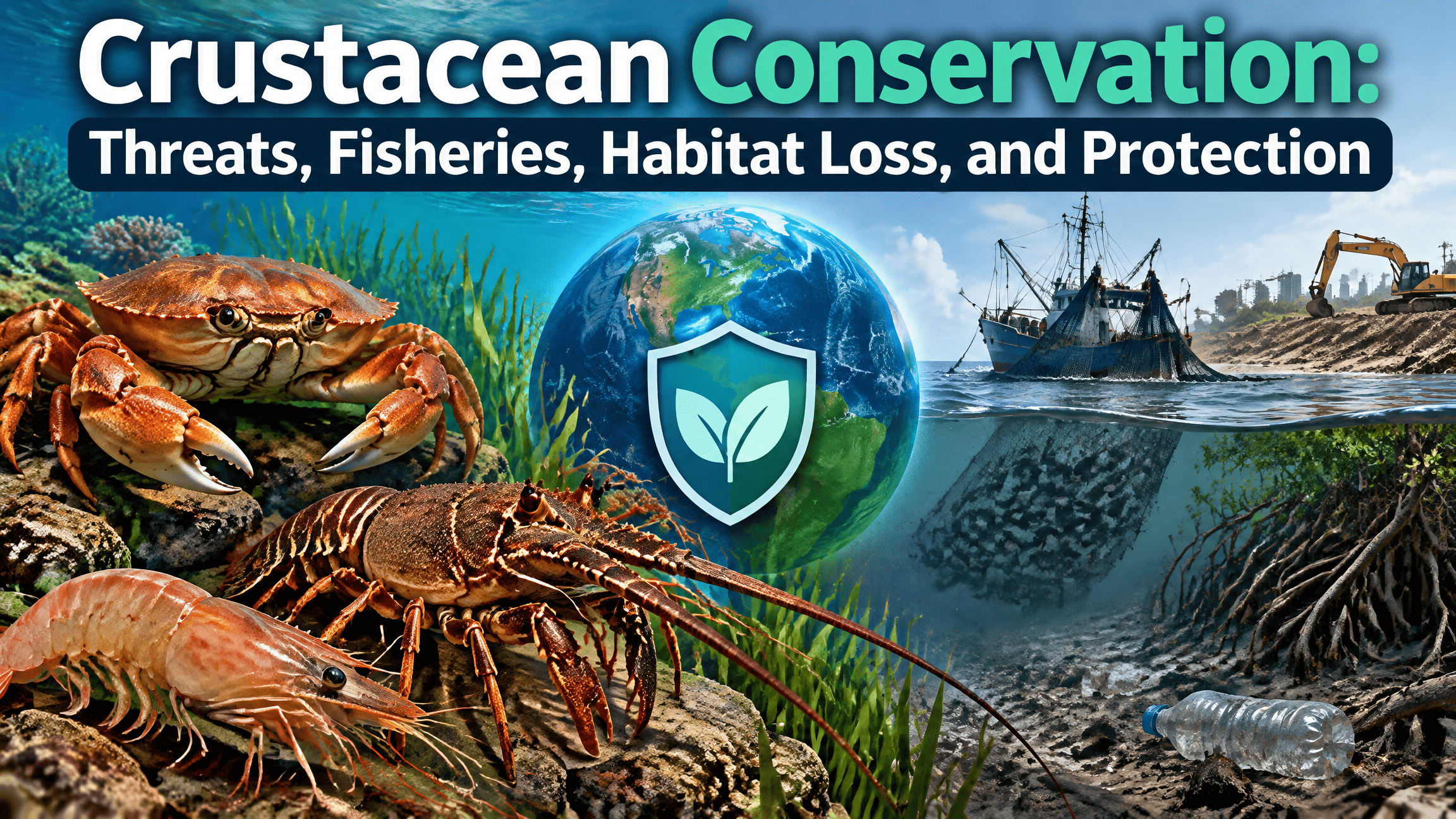
Crustacean conservation is complicated because there is no single conservation status for crabs, lobsters, shrimp, crayfish, copepods, amphipods, isopods, branchiopods, barnacles, krill, or the many smaller lineages grouped under the familiar crustacean label. Some species are widespread and abundant. Others live in one spring, one cave system, one river basin, one island, or a narrow strip of coastal habitat. Some are managed as fisheries, while others are barely known to science.
The most useful way to understand crustacean conservation is to separate different kinds of risk. Extinction risk, fishery stock status, habitat degradation, bycatch, invasive-species impacts, climate stress, and data gaps are related, but they are not interchangeable. A commercially harvested stock can be depleted without the entire species being globally threatened, while a tiny groundwater amphipod can face extinction risk even though it has no commercial value at all.
Quick Overview
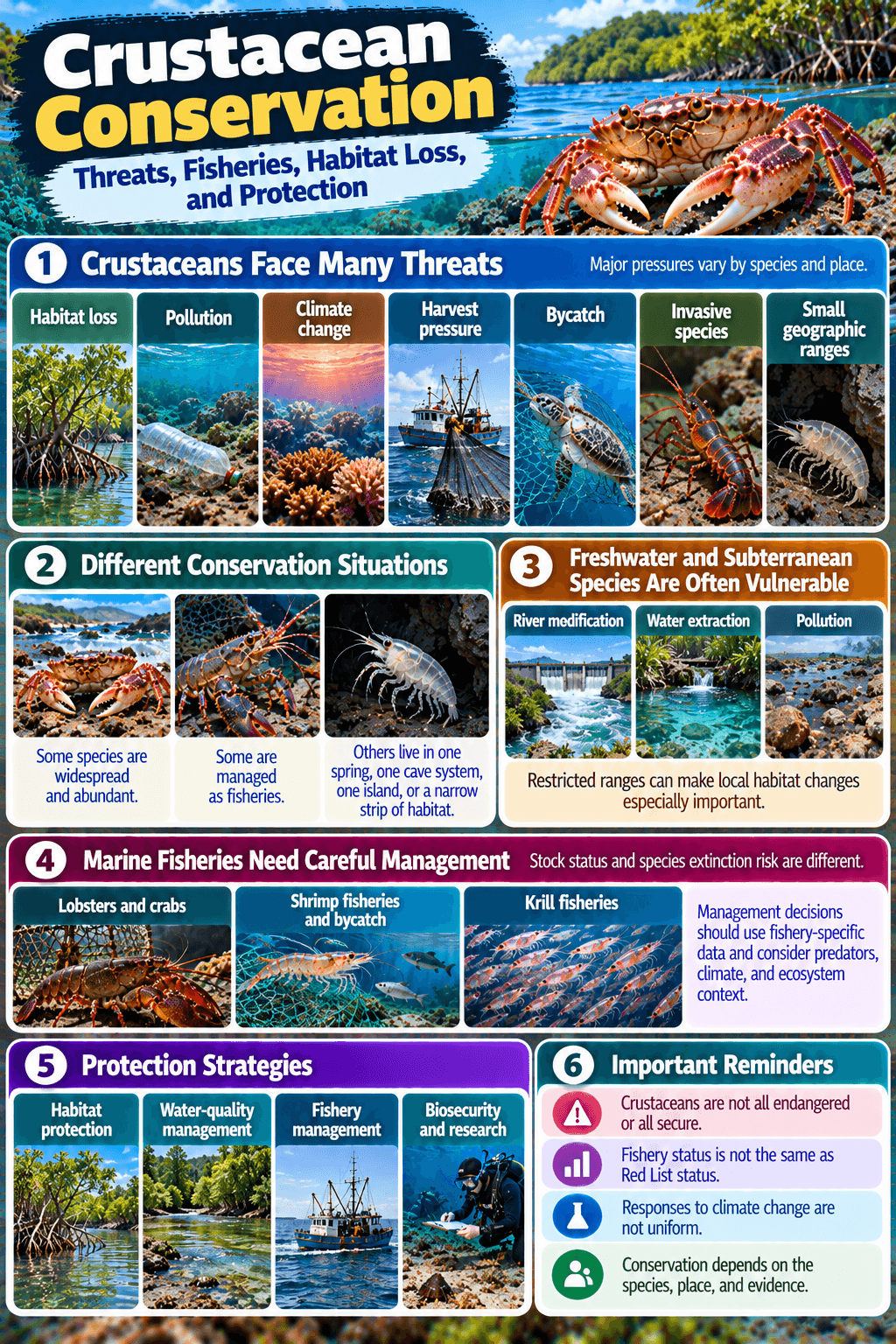
Major conservation pressures on crustaceans can include habitat loss, wetland drainage, river modification, groundwater extraction, pollution, sedimentation, pesticides, coastal development, warming, deoxygenation, ocean acidification, harvest pressure, bycatch, disease, invasive species, introduced predators, and very small geographic ranges. Which threats matter most depends on the species and place. For the broader biology behind the species and lineages discussed here, see the crustacean overview.
Freshwater and subterranean crustaceans often deserve special attention because restricted ranges can make local habitat changes unusually important. Marine fisheries require a different kind of analysis, using stock assessments and fishery-specific data rather than assuming that a species-level Red List category tells managers whether a particular stock is being overfished.
Why Crustaceans Do Not Have One Conservation Status
Described, assessed, threatened, data-deficient, and unassessed species
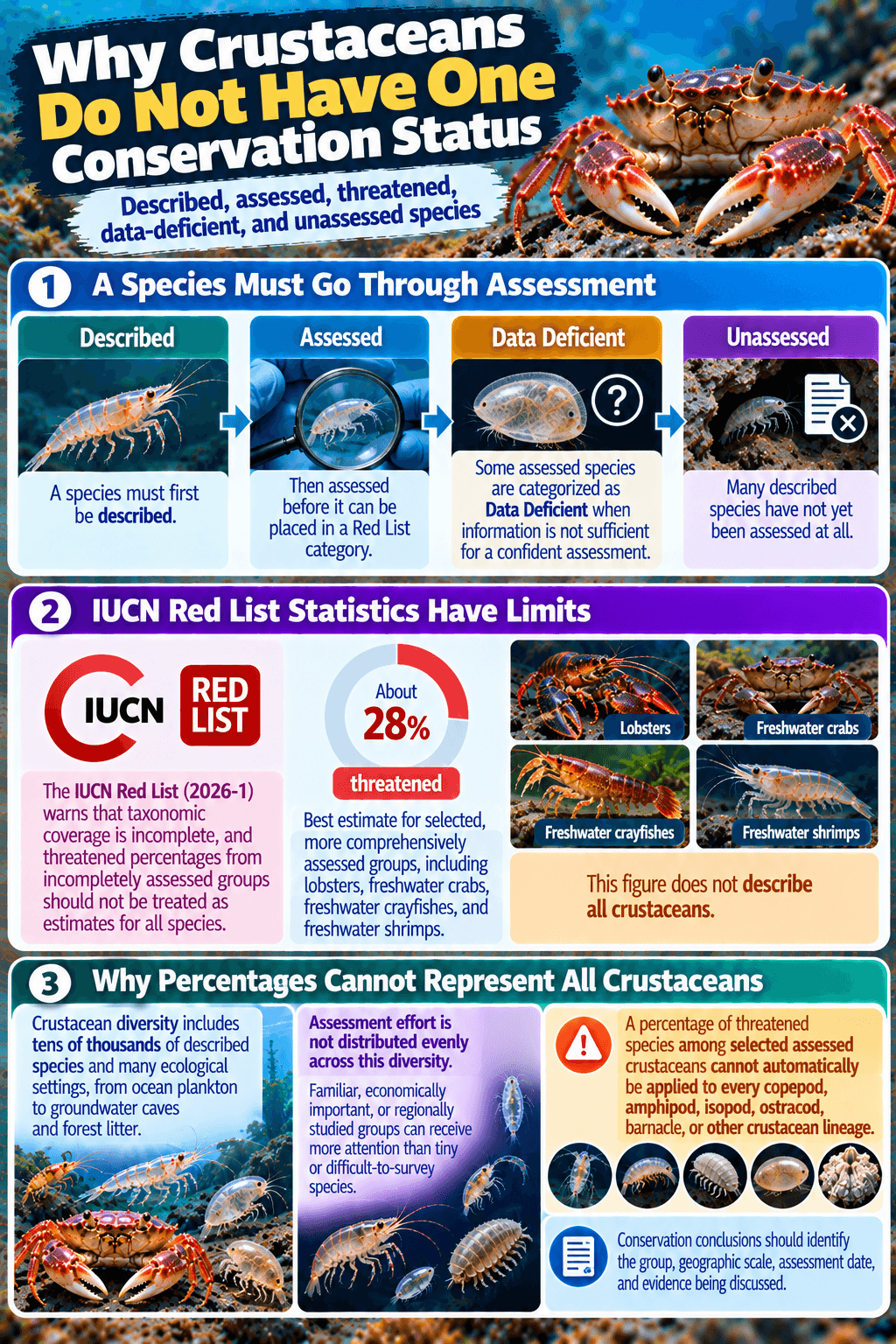
Conservation statistics can be misleading when the denominator is ignored. A species must first be described, then assessed, before it can be placed in a Red List category. Some assessed species are categorized as Data Deficient because available information is not sufficient for a confident extinction-risk assessment. Many described species have not yet been assessed at all.
The current IUCN Red List summary statistics for version 2026-1 explicitly warn that taxonomic coverage is incomplete and that threatened percentages from incompletely assessed groups should not be treated as estimates for all species in those groups. IUCN reports a best estimate of about 28 percent threatened for selected, more comprehensively assessed crustacean groups, including lobsters, freshwater crabs, freshwater crayfishes, and freshwater shrimps. That figure does not describe all crustaceans.
Why assessed percentages cannot represent all crustaceans automatically
Crustacean diversity includes tens of thousands of described species and many ecological settings, from ocean plankton to groundwater caves and forest litter. Assessment effort is not distributed evenly across that diversity. Familiar, economically important, or regionally studied groups can receive more attention than tiny or difficult-to-survey species.
That creates an important interpretation rule: a percentage of threatened species among selected assessed crustaceans cannot automatically be applied to every copepod, amphipod, isopod, ostracod, barnacle, or other crustacean lineage. Conservation conclusions should identify the group, geographic scale, assessment date, and evidence being discussed.
Habitat Loss and Degradation
Wetlands, rivers, groundwater, and cave systems
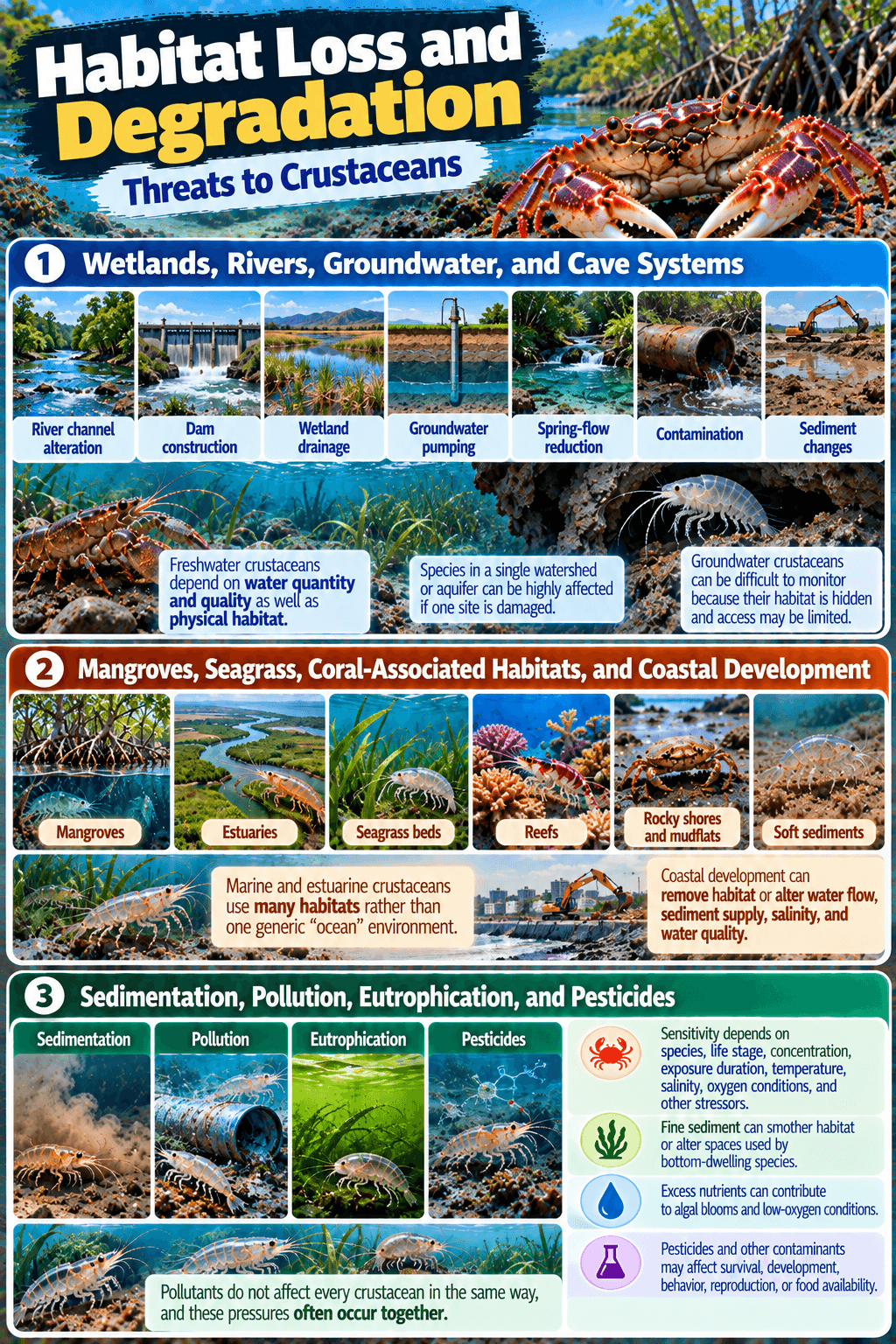
Freshwater crustaceans depend on water quantity and quality as well as physical habitat. River channel alteration, dam construction, wetland drainage, groundwater pumping, spring-flow reduction, contamination, and sediment changes can all affect habitat. For species that occupy a single watershed or aquifer, damage to one site can represent damage to a large fraction of the entire known range. Many of these pressures are easiest to understand in the context of the crustacean habitats they alter.
Groundwater crustaceans can be especially difficult to monitor because their habitat is hidden and access may be limited. Their distributions can also be naturally fragmented. A narrow distribution does not automatically mean a species is threatened, but it can increase vulnerability when the same small area is exposed to water extraction, pollution, urbanization, or other disturbance.
Mangroves, seagrass, coral-associated habitat, and coastal development
Marine and estuarine crustaceans use many habitats rather than one generic “ocean” environment. Juvenile shrimp may depend on estuaries or vegetated shallows. Crabs can use mangroves, salt marshes, mudflats, rocky shores, seagrass beds, reefs, and soft sediments. Amphipods and small isopods may live among algae, vegetation, sediments, or attached organisms.
Coastal development can remove habitat directly or alter water flow, sediment supply, salinity, and water quality. The effect on crustaceans depends on which habitat features a species requires during feeding, reproduction, shelter, or juvenile development. Conservation therefore works best when it protects ecological functions, not just a line around a map.
Sedimentation, pollution, eutrophication, and pesticides
Pollutants do not affect every crustacean in the same way. Sensitivity depends on species, life stage, concentration, exposure duration, temperature, salinity, oxygen conditions, and other stressors. Fine sediment can smother habitat or alter the spaces used by bottom-dwelling species. Excess nutrients can contribute to algal blooms and low-oxygen conditions. Pesticides and other contaminants may affect survival, development, behavior, reproduction, or food availability.
Because these pressures often occur together, conservation decisions need local monitoring rather than a simple list of universal crustacean threats.
Freshwater Crustaceans Need Major Attention
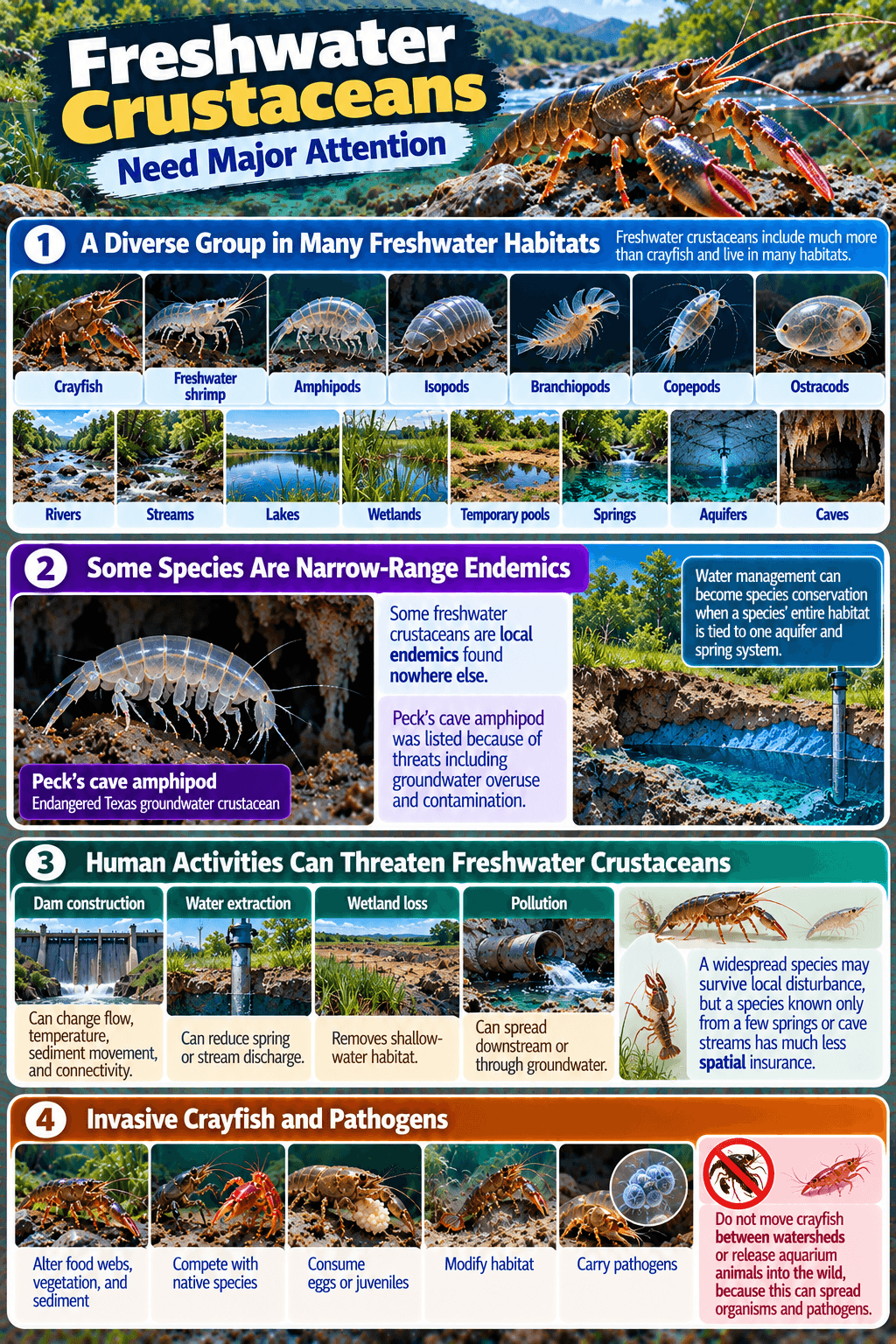
Crayfish, freshwater shrimp, amphipods, isopods, branchiopods, and groundwater crustaceans
Freshwater crustaceans include much more than crayfish. Rivers, streams, lakes, wetlands, temporary pools, springs, aquifers, and caves can contain shrimp, amphipods, isopods, branchiopods, copepods, ostracods, and other groups. Some are widespread. Others are local endemics found nowhere else.
The vulnerability of narrow-range species is illustrated by the U.S. Fish and Wildlife Service profile for Peck’s cave amphipod. This endangered Texas groundwater crustacean was listed because of threats including groundwater overuse and contamination. It is a useful example of how water management can become species conservation when an animal’s entire habitat is tied to one aquifer and spring system.
River modification, water extraction, wetland loss, and small endemic ranges
Freshwater species often live in habitats that are physically connected but heavily modified by people. Dams can change flow, temperature, sediment movement, and connectivity. Water extraction can reduce spring or stream discharge. Wetland loss removes shallow-water habitat. Pollution can spread downstream or through groundwater.
A widespread crustacean may survive local disturbance by persisting elsewhere. A species known only from a few springs or cave streams has much less spatial insurance. This is one reason conservation assessments often consider both range size and the number of locations exposed to threats.
Invasive crayfish and pathogens where regionally supported
Introduced crayfish can alter food webs, vegetation, sediment, and native-crayfish communities in some regions. They may compete with native species, consume eggs or juveniles, modify habitat, or carry pathogens. Crayfish plague is an important example in regions where susceptible native crayfish are exposed to the oomycete Aphanomyces astaci.
These effects should not be generalized to every nonnative crayfish in every setting. Impact depends on the introduced species, receiving ecosystem, native community, disease history, and management context. People should not move crayfish between watersheds or release aquarium animals into the wild, because translocation can spread both organisms and pathogens.
Marine Fisheries and Crustaceans
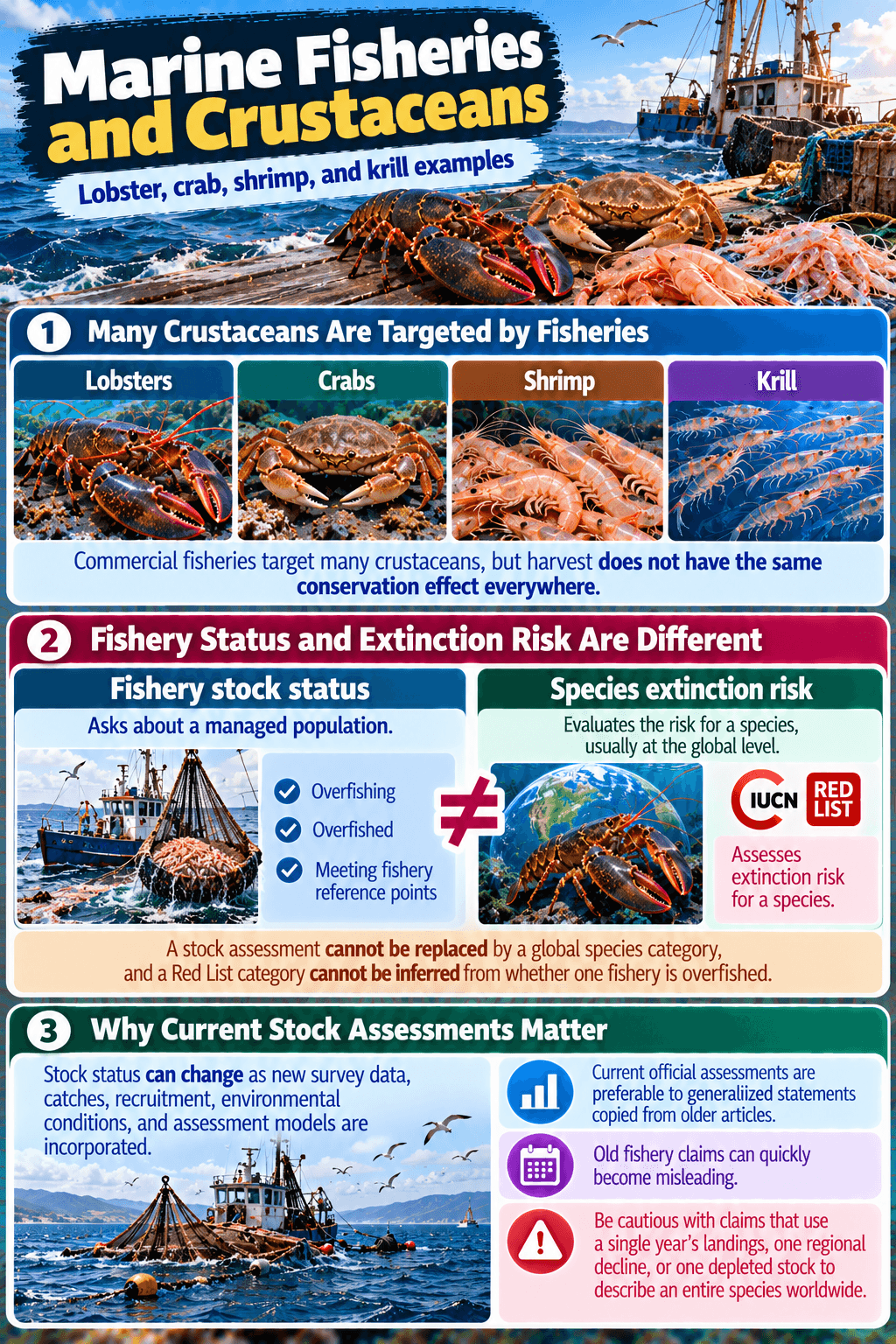
Lobster, crab, shrimp, and krill examples
Commercial fisheries target many crustaceans, but harvest does not have the same conservation effect everywhere. A lobster stock under effective management can have a different trajectory from an overfished stock of the same species in another region. Crab fisheries can vary by species, population, gear, recruitment, climate conditions, and management rules. Shrimp fisheries range from small local operations to industrial trawl fisheries. Antarctic krill fisheries operate within a wider predator-prey ecosystem that managers also monitor.
This is why broad statements such as “lobsters are overfished” or “crab fisheries are sustainable” are too vague to be reliable. The relevant unit is usually a named stock or fishery in a defined area and time period.
Fishery stock status versus species extinction risk
Fishery stock status and extinction risk answer different questions. A stock assessment asks whether a managed population is experiencing overfishing, is overfished, or is meeting fishery reference points. A Red List assessment evaluates extinction risk for a species, usually at the global level unless a regional assessment is explicitly identified.
NOAA’s 2026 fishery stock status updates show why the distinction matters. U.S. stock status is updated repeatedly and reported by managed stock. That framework cannot be replaced by a global species category, and a Red List category cannot be inferred from whether one fishery is overfished.
Why current official stock assessments matter
Stock status can change as new survey data, catches, recruitment, environmental conditions, and assessment models are incorporated. Old fishery claims can quickly become misleading. Current official assessments are therefore preferable to generalized statements copied from older articles.
This also means readers should be cautious with claims that use a single year’s landings, one regional decline, or one depleted stock to describe an entire species worldwide.
Shrimp Fisheries and Bycatch
Gear, region, management, and time period shape outcomes
Shrimp trawls can capture non-target animals because nets move through habitats containing many species. Bycatch can include fish, sea turtles, sharks, rays, and other organisms. The amount and composition of bycatch depend on gear design, fishing grounds, tow duration, season, regulations, observer coverage, and the species present.
In U.S. federal shrimp fisheries, gear modifications are part of bycatch management. NOAA explains that bycatch reduction devices used in Gulf and South Atlantic shrimp trawls are designed to let finfish escape and are certified for different fishing conditions. This is a good example of why shrimp-fishery impacts should be discussed by region and gear rather than with one worldwide number.
Why one historical bycatch percentage cannot be universalized
High historical bycatch estimates from one fishery are often repeated as if they apply to every modern shrimp trawl. That approach ignores decades of changes in gear, regulation, fishing effort, monitoring, and management.
The conservation question is not whether shrimp fishing “has bycatch” in the abstract. It is how much non-target catch occurs in a specific fishery today, which species are affected, how much survives, what mitigation is required, and whether the available data are adequate.
Krill Fisheries and Ecosystem-Based Management
Harvest concentration, climate, sea ice, predator needs, and management
Antarctic krill are both a harvested crustacean and major prey for penguins, seals, whales, seabirds, and fish. That combination makes management an ecosystem question as well as a harvest question.
NOAA Fisheries’ Antarctic krill and oceanographic research program examines krill distribution and abundance in relation to environmental conditions, predator demand, fishery demand, and climate variability. This kind of monitoring is important because the ecological effect of harvest depends not just on total catch but also on where and when fishing overlaps with predators and changing habitat conditions.
Avoiding simplistic whale-starvation claims
It is too simple to say that krill fishing automatically causes whales or penguins to starve. Predator outcomes can reflect prey distribution, local harvest concentration, sea-ice conditions, warming, competition, breeding location, and other ecological changes.
That does not mean harvest is irrelevant. It means the strongest conservation analysis separates multiple drivers and asks how they interact at the scale where predators and fisheries actually overlap.
Climate Change and Ocean Chemistry
Warming, marine heatwaves, deoxygenation, and habitat change
Climate change can affect crustaceans directly through temperature and oxygen stress and indirectly through food availability, predator-prey relationships, disease, habitat change, and shifting geographic ranges. Species near physiological limits or tied to narrow habitats may have fewer options for responding.
Warming can also interact with fisheries. A stock can shift geographically while management boundaries, ports, markets, and fishing practices remain in place. Marine heatwaves may affect recruitment or survival differently from gradual warming, and low oxygen can add another layer of stress.
Ocean acidification responses vary by species and life stage
Ocean acidification is sometimes summarized as “acid dissolves crustacean shells,” but that is not an accurate universal rule. Crustaceans actively regulate acid-base balance and mineralization, and experimental responses vary among taxa, life stages, temperatures, food conditions, exposure durations, and interacting stressors.
A recent academic synthesis of ocean-change effects on crustaceans reviews warming, acidification, hypoxia, invasive species, and physiological adaptation across multiple species and life stages. The broad message is variability, not a single shell-dissolution response.
Some studies report reduced growth, altered mineralization, or lower survival under particular conditions, while others find tolerance or more complex effects. Conservation projections therefore need species-specific evidence and realistic combinations of environmental stressors.
Invasive Crustaceans and Introduced Predators
Documented impacts versus blanket invasive-equals-bad framing
Some introduced crustaceans have major ecological impacts. Invasive crayfish can alter vegetation, prey on native animals, compete with native crayfish, and spread disease. Introduced crabs can change predation pressure or compete with native species. Amphipods and copepods can also establish outside their native ranges.
But “nonnative” is a geographic description, not a complete impact assessment. Management decisions should be based on documented effects, spread potential, feasibility of control, and official guidance. It is not appropriate to encourage people to kill or remove animals simply because a species is labeled invasive somewhere else.
Moving live crustaceans between watersheds can create new problems by spreading organisms, parasites, or pathogens. Prevention and biosecurity are often more effective than trying to reverse a well-established invasion.
Cave and Narrow-Range Crustaceans
Groundwater disturbance and tiny ranges
Cave and groundwater crustaceans illustrate why range size matters. Some amphipods, isopods, shrimp, crayfish, copepods, and remipedes occupy very small subterranean systems. These habitats can be stable over long periods but highly sensitive to groundwater extraction, contamination, quarrying, urbanization, or changes in recharge.
Low dispersal can make recolonization difficult after local loss. Cave specialists may also have small populations and slow life histories, although those traits should be confirmed for the species involved rather than assumed for every subterranean crustacean.
Why exact sensitive locations should not be publicized
Detailed locality information can be useful to scientists and managers, but publishing exact coordinates for rare cave species can create collection or disturbance risks. Public conservation writing can explain the habitat type, general region, and threats without revealing sensitive locations.
This is especially important for species known from only a handful of sites. Protecting groundwater quality and hydrology can matter more than direct handling of the animals themselves.
What Protection Can Look Like
Habitat protection and restoration
Protecting crustaceans often means protecting the systems that support them. Wetland restoration, spring protection, mangrove and seagrass conservation, stream restoration, coastal-habitat protection, and cave or groundwater safeguards can preserve feeding, breeding, refuge, and dispersal habitat at the same time.
Effective habitat work should match the biology of the species. Restoring surface vegetation may not help a groundwater amphipod if aquifer flow continues to decline. Protecting a nursery estuary may matter more for one shrimp population than protecting offshore adult habitat alone.
Water-quality and watershed management
Because freshwater and estuarine crustaceans respond to conditions upstream, watershed-scale management can be important. Reducing contaminant inputs, protecting recharge areas, maintaining environmental flows, controlling erosion, and monitoring oxygen and nutrient conditions can address pressures that cannot be solved at one small site.
Fishery management and monitoring
Fishery tools can include catch limits, size limits, seasonal closures, protected areas, trap rules, bycatch-reduction gear, observer programs, stock assessments, and adaptive management. The right combination depends on the fishery.
Monitoring matters because management cannot respond to changes that are not detected. Recruitment failures, range shifts, altered growth, increased mortality, or new bycatch problems may require different actions than conditions that existed a decade earlier.
Biosecurity, research, and assessment gaps
Preventing spread of invasive crayfish or pathogens can involve rules on bait, aquarium releases, transport, and equipment decontamination. Research can fill gaps in taxonomy, distribution, life history, and population trends. Red List assessments can identify extinction risk, while fishery surveys answer different management questions.
For poorly known crustaceans, basic field surveys may be the most important conservation step. A species cannot be protected effectively if its distribution, habitat needs, and major threats are still unknown.
Common Conservation Misunderstandings
Crustaceans are not all endangered or all secure
Some crustaceans are threatened, some are widespread, some are locally depleted, and many have not been assessed thoroughly. Group-wide labels hide that variation.
Fishery status is not the same as Red List status
A managed stock can be overfished without the entire species meeting a global threatened category. Conversely, a rare species may face extinction risk even though it is never harvested commercially. Always identify the assessment system and geographic unit.
Shell-building responses to acidification are not uniform
Crustaceans do not all respond to lower pH in the same way. Mineralization, growth, survival, reproduction, and acid-base regulation can respond differently across taxa and life stages. Conservation claims should reflect that variability.
Conservation Questions Across Habitats and Fisheries
Habitat and ecological-role context
Conservation becomes clearer when it is connected to how crustaceans actually live. A filter-feeding barnacle, planktonic copepod, burrowing crab, freshwater crayfish, terrestrial isopod, and cave amphipod experience different pressures because they use different habitats and ecological resources.
The same is true for life history. Species with broad dispersal may recover from local disturbance differently from species confined to one spring or cave. Understanding habitat, diet, movement, reproduction, and ecological roles helps explain why the same environmental change can have very different outcomes.
Broader overfishing, bycatch, and ocean-conservation mechanisms
Crustacean-specific conservation often intersects with wider marine issues such as habitat loss, overfishing, bycatch, pollution, and climate change. Those broader mechanisms affect many animal groups, while this crustacean-focused view asks how they operate through particular crustacean populations, fisheries, and habitats.
Keeping that scale clear prevents one shrimp-fishery statistic, one lobster stock, or one regional crayfish decline from becoming a claim about all crustaceans.
FAQ
Are crustaceans endangered?
Some crustacean species are threatened with extinction, while many others are not, and a large share of crustacean diversity has incomplete assessment coverage. The IUCN Red List reports results for individual species and selected comprehensively assessed groups. It is not accurate to describe all crustaceans as endangered or all crustaceans as secure.
Why are freshwater crustaceans often vulnerable?
Freshwater crustaceans can be vulnerable because rivers, springs, wetlands, caves, and aquifers are strongly affected by water extraction, pollution, dams, wetland loss, invasive species, and land-use change. Some species also have very small geographic ranges, so damage to one watershed or spring system can affect much of the known population.
Does fishing threaten all crabs, lobsters, and shrimp?
No. Fishing pressure varies among species, stocks, regions, gears, and management systems. Some stocks are well managed, while others can be overfished or affected by environmental change. Current stock assessments and fishery-specific monitoring are needed before making a conservation claim.
Has the IUCN assessed all crustaceans?
No. IUCN explicitly states that many taxonomic groups have incomplete assessment coverage. Current Red List statistics can describe assessed species and selected better-assessed crustacean groups, but those results should not be treated as a complete census of extinction risk across all crustacean diversity.
Final Thoughts
Crustacean conservation is not one problem with one solution. Freshwater endemics may depend on groundwater protection. Coastal species may be affected by habitat loss and pollution. Commercial stocks require current fishery assessments. Shrimp fisheries can require bycatch mitigation. Antarctic krill management must consider predators, climate, and harvest together. Cave species may need protection of a tiny hydrological system that most people never see.
The most reliable approach is to be specific about species, place, threat, and assessment system. Extinction risk should not be confused with fishery status, assessed percentages should not be applied to unassessed diversity, and climate effects should not be universalized across all crustaceans. With careful monitoring, habitat protection, responsible fishery management, biosecurity, and better assessment coverage, conservation can focus effort where the biological evidence shows it is most needed.

Ethan Walker is the founder and research editor of Animal Fact Central. He creates and reviews educational animal facts content using trusted wildlife, pet care, and science-based sources. His work focuses on making animal behavior, adaptations, habitats, and species facts clear, accurate, and engaging for everyday readers.
Read More Details About Ethan Walker: https://animalfactcentral.com/ethan-walker/