
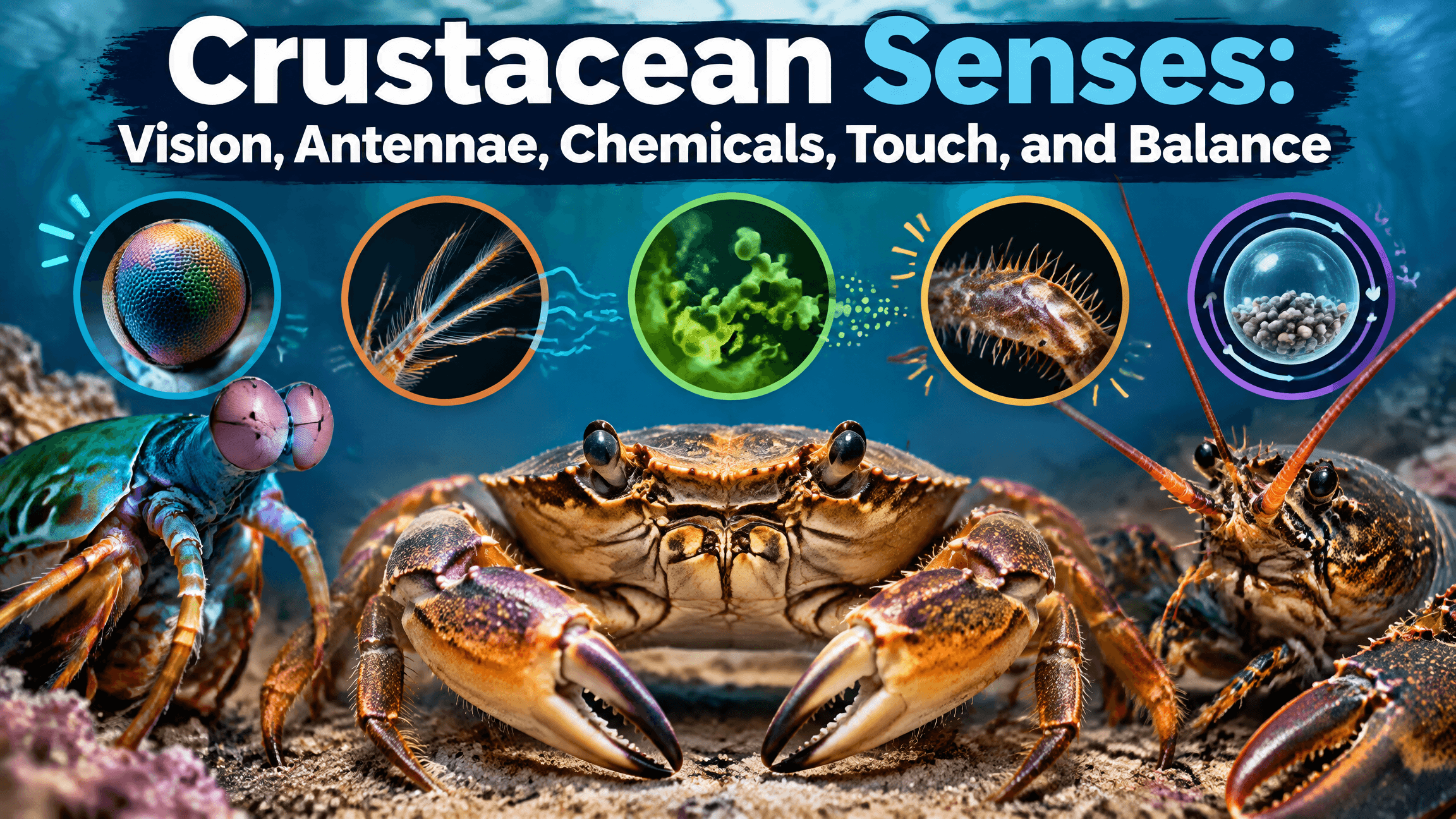
Crustaceans do not rely on a single dominant sense. A crab crossing a tidal flat, a copepod suspended in open water, a lobster searching the seafloor, and a barnacle larva looking for a place to settle all receive different combinations of visual, chemical, mechanical, and orientation cues. Their nervous systems combine that information to guide feeding, movement, predator avoidance, mating, shelter choice, and other behaviors.
That sensory diversity is easy to oversimplify. Not every crustacean has stalked compound eyes. Antennae are not simply underwater noses. Statocysts are important balance organs in some groups but are not universal. Even mantis shrimps, famous for unusual eyes, should not be described with a simple ranking such as “best vision on Earth.” Crustacean senses make more sense when each structure is connected to the job it performs and the habitat in which it operates.
Quick Answer

Crustaceans sense their surroundings through several systems working together. Eyes can detect light, movement, shape, polarization, and color where those abilities are present. Antennules and antennae can carry specialized sensory hairs called sensilla that respond to chemicals, touch, vibration, or water movement. Other sensilla occur on mouthparts, walking legs, and additional body surfaces. In some crustaceans, statocysts provide information about body orientation and acceleration. Chemical cues can help animals locate food, recognize mates or competitors, assess predators, and choose habitats. For the wider context around these sensory systems, see the broader crustacean overview.
There is no universal crustacean sensory package. A visually active shore crab, a cave amphipod with reduced eyes, a planktonic copepod, and an adult barnacle face different information problems. Sensory structures have therefore been modified, reduced, or specialized many times across crustacean lineages.
How Crustaceans Build a Sensory Picture of Their World
Multiple sensory channels working together
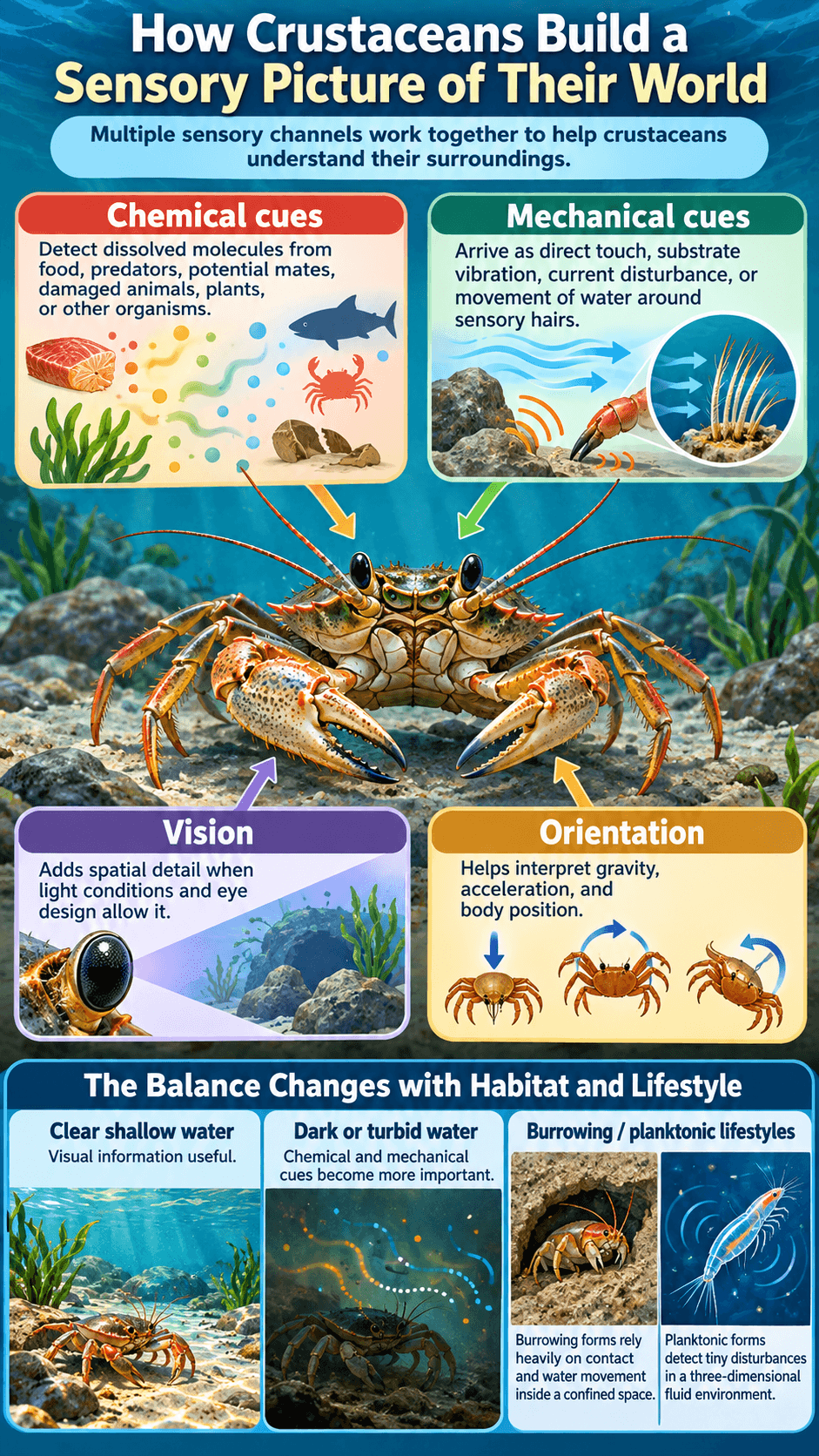
An animal rarely has to answer only one question at a time. A crustacean searching for food may need to detect dissolved chemicals, determine the direction of water flow, avoid obstacles, monitor nearby movement, and decide whether a shelter is safer than an exposed patch. Different sensory systems can provide different pieces of that problem.
Chemical information is especially important in aquatic environments because molecules released by food, predators, potential mates, damaged animals, plants, or other organisms can move through the water. Mechanical information can arrive as direct touch, substrate vibration, current disturbance, or movement of water around sensory hairs. Vision can add spatial detail when light conditions and eye design allow it. Orientation organs can help the animal interpret gravity, acceleration, and body position.
The balance among these inputs changes with habitat and lifestyle. Clear shallow water may make visual information useful for one species, while darkness or turbid water increases the value of chemical and mechanical cues for another. A burrowing crustacean may depend heavily on contact and water movement inside a confined space. A planktonic form must detect tiny disturbances in a three-dimensional fluid environment where danger can approach from almost any direction.
Vision in Crustaceans
Compound eyes and stalked eyes where present
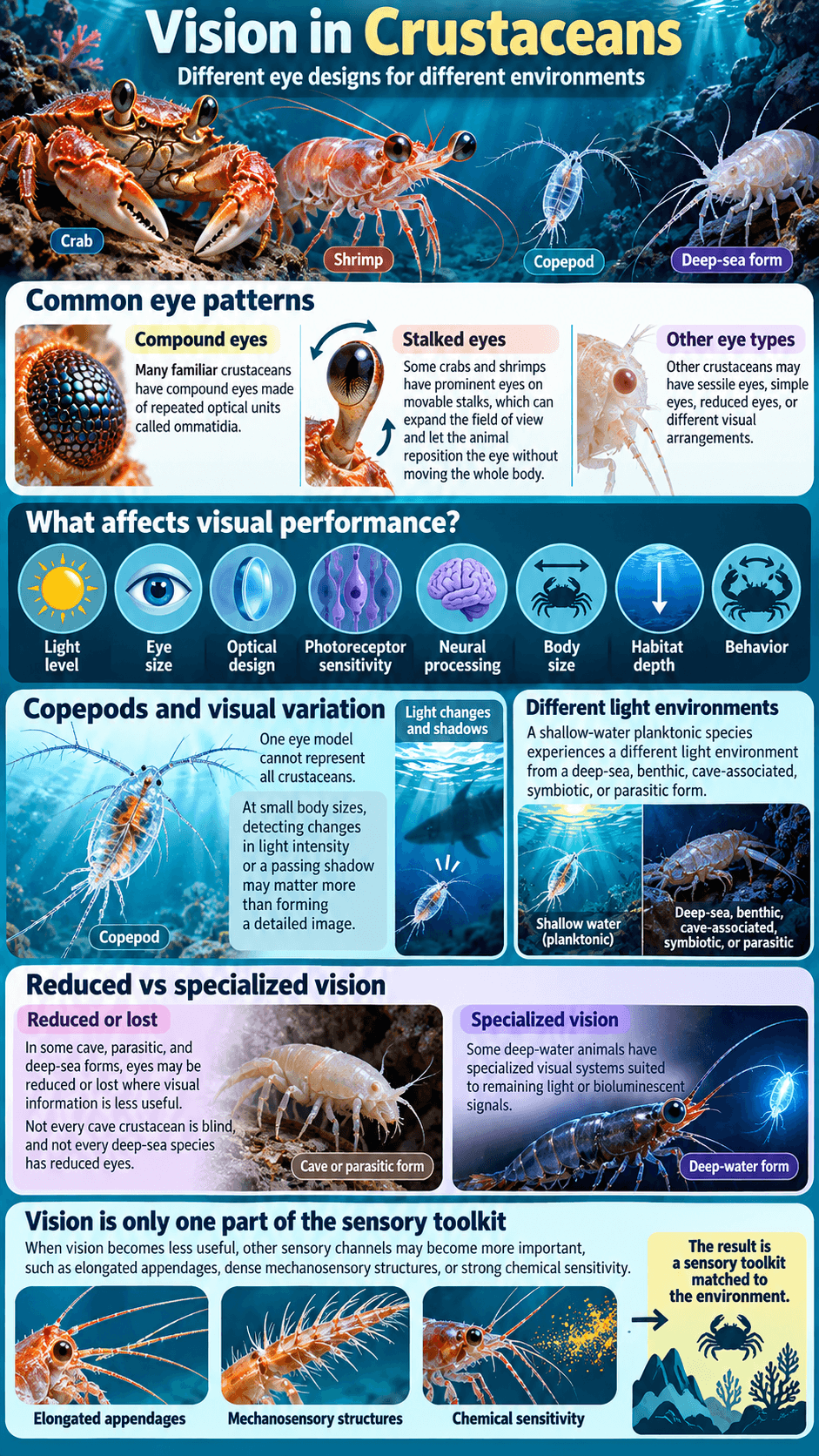
Many familiar crustaceans have compound eyes built from repeated optical units called ommatidia. Compound-eye design varies widely, so the presence of a compound eye does not tell us exactly what an animal can see. Some crabs and shrimps have prominent eyes on movable stalks, which can expand the field of view and allow the animal to reposition the eye without moving the whole body. Other crustaceans have sessile eyes, simple eyes, reduced eyes, or very different visual arrangements.
Visual performance depends on more than the number of ommatidia. Light level, eye size, optical design, photoreceptor sensitivity, neural processing, body size, habitat depth, and behavior can all matter. A system optimized to detect movement in dim water is solving a different problem from one used for fine color discrimination in a bright reef environment.
Crustacean vision also extends beyond the human idea of “seeing colors.” Some species can detect polarized light, ultraviolet wavelengths, or patterns of light intensity that humans do not naturally perceive. Those abilities are lineage-specific, not general features of every crustacean.
Copepod and other visual-system variation
Copepods show why a single eye model cannot represent crustaceans. Some have relatively simple median eyes, others possess more elaborate visual structures, and many depend strongly on nonvisual information. The usefulness of vision also changes with where a copepod lives. A shallow-water planktonic species experiences a different light environment from a deep-sea, benthic, cave-associated, symbiotic, or parasitic form.
At small body sizes, detecting changes in light intensity or the approach of a shadow may be more immediately useful than producing a detailed image. A sudden decrease in light can indicate that a larger animal has moved overhead. Combining visual changes with water disturbances can help a tiny crustacean decide whether to make an escape movement.
Reduced vision in some cave, parasitic, and deep-sea forms
Eye reduction or loss occurs in some crustaceans living where visual information is limited or less useful, including selected cave, groundwater, parasitic, and deep-sea forms. That pattern should not be turned into another universal rule. Not every cave crustacean is blind, and deep-sea species do not all have reduced eyes. Some deep-water animals possess highly specialized visual systems suited to the light that remains or to bioluminescent signals.
When vision becomes less useful, selection can favor greater investment in other sensory channels. Elongated appendages, dense mechanosensory structures, or strong chemical sensitivity can help an animal gather information without relying on image-forming vision. The result is not a “weaker” sensory system, but a sensory toolkit matched to a different environment.
Mantis Shrimp Vision Without the Viral Myths
Unusual photoreceptor and channel specializations
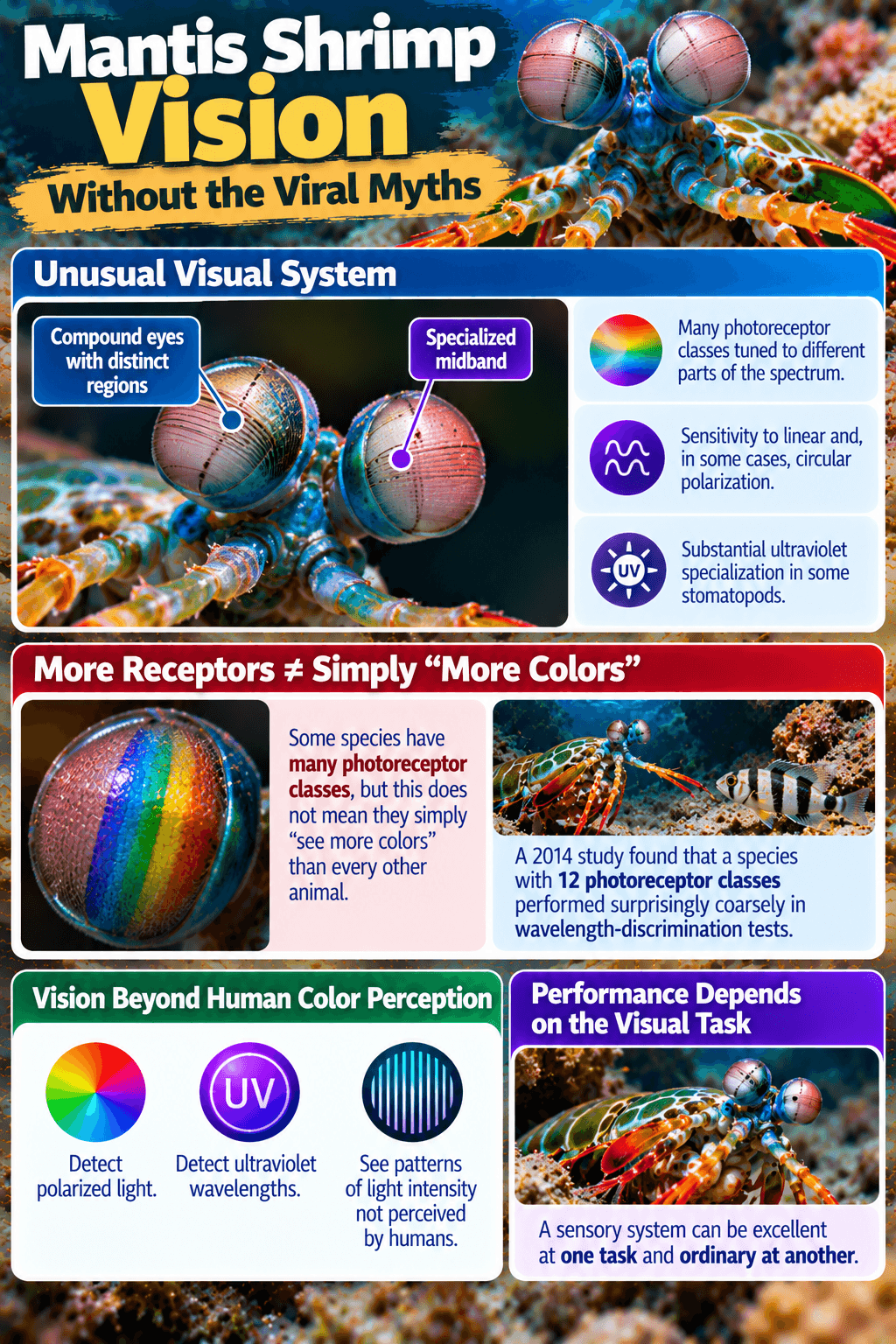
Mantis shrimps, or stomatopods, have some of the most unusual visual systems known among crustaceans. Species differ, but the best-studied forms have compound eyes divided into distinct regions, including a specialized midband. Some possess many photoreceptor classes tuned to different parts of the spectrum, along with sensitivity to linear and, in some cases, circular polarization.
This complexity is real, but popular summaries often convert receptor counts into an unsupported statement that mantis shrimps simply “see more colors” than every other animal. Behavioral work complicates that story. A classic 2014 study found that a species with 12 spectral photoreceptor classes performed surprisingly coarsely in wavelength-discrimination tests compared with color systems that use fewer receptor classes. The Science study on mantis shrimp color vision suggested a different processing strategy rather than a straightforward version of human-like color comparison with more channels.
There is also substantial ultraviolet specialization in some stomatopods, and polarization sensitivity adds another dimension to visual information. Smithsonian Ocean highlights polarized vision in mantis shrimps and other marine animals as a way of detecting light properties invisible to human eyes. Smithsonian Ocean’s overview of polarized vision is useful context for understanding why “color vision” alone does not describe everything these eyes do.
Why performance depends on the visual task
A sensory system can be excellent at one task and ordinary at another. It may detect a wide spectral range, recognize categories quickly, analyze polarization, track motion, or estimate distance without producing exceptionally fine wavelength discrimination. That is why ranking animal vision with one word such as “best” is usually misleading.
The scientific picture also continues to develop. Research published in 2025 reported behavioral evidence of spectral opponent processing in a stomatopod, suggesting that color processing may combine more than one mechanism rather than fitting a single simple model. The recent stomatopod color-processing study reinforces the need for cautious wording when describing how mantis shrimps interpret their many photoreceptor channels.
So the useful fact is not that a mantis shrimp experiences “16 primary colors” the way a person might imagine 16 human color channels. Different photoreceptor types and visual pathways process information according to stomatopod biology. Human color categories are not a direct translation of that system.
Antennules and Antennae as Sensory Appendages

Chemoreception
Crustaceans conventionally have two pairs of antennal appendages: the first pair, called antennules, and the second pair, usually called antennae. Their functions vary among lineages. Antennules are especially important in the chemosensory biology of many malacostracans, but both pairs can participate in sensing, and sensory structures are also distributed elsewhere on the body.
Chemoreception means detecting chemicals in the environment. In aquatic crustaceans, that often means molecules dissolved in water rather than airborne odors. The closest familiar words are “smell” and “taste,” but crustacean chemical senses do not map perfectly onto the human versions of those senses. A 2024 review of animal olfaction and gustation describes crustaceans as having several distinct chemical-sensing pathways, including an antennular olfactory system and more widely distributed chemosensory systems. The Chemical Senses review of olfaction and gustation explains why the broader term chemoreception is often useful when discussing invertebrates.
Chemical cues can reveal the presence of food, another individual, a predator, a suitable settlement surface, or a damaged animal. What a crustacean actually does with that information depends on species, life stage, prior experience, current motivation, and the mixture of other sensory cues.
Mechanoreception and water movement
Antennules and antennae can also carry mechanosensory structures that respond to physical displacement. Water moving past a hair-like sensillum can bend it and stimulate receptor cells. That allows the animal to detect currents, nearby motion, turbulence, or the direction from which a disturbance arrives.
This is especially valuable underwater because a moving animal creates hydrodynamic disturbances. A predator, prey item, competitor, or potential mate may alter local water flow before direct contact occurs. The same appendage can therefore support several kinds of information gathering, with different sensilla tuned for different stimuli.
Mechanoreception does not mean crustaceans possess one equivalent of a vertebrate ear. Mechanical sensing is distributed across multiple structures. Direct touch, flexion at a joint, vibration of the substrate, pressure changes, and water flow can be detected through different receptor systems.
Aesthetascs and specialized sensilla
Aesthetascs are specialized chemosensory sensilla associated with the antennules of many crustaceans. In well-studied decapods such as spiny lobsters, olfactory sensory neurons within aesthetascs send information into specialized regions of the nervous system. Other chemosensory sensilla occur on antennules and across mouthparts, legs, and body surfaces.
This division matters because saying “the antennae smell” hides important biology. Some structures are primarily chemosensory, some mechanosensory, and some sensilla combine chemical and mechanical sensitivity. A crustacean can sample the chemical environment while also interpreting how water carries those chemicals.
Research on crustacean chemoreception has identified ionotropic receptors as important molecular components in several crustacean chemical-sensing systems. A comparative review of crustacean chemoreception summarizes the molecular and peripheral processes involved without reducing them to a vertebrate-style sense of smell.
Touch, Vibration, and Sensory Setae
Detecting contact and flow
Crustacean bodies are covered with many cuticular projections, commonly called setae when they have a hair-like form. Some serve mechanical, feeding, cleaning, or locomotor functions, while others contain sensory neurons. Their external appearance alone does not always reveal their function, so it is risky to label every hair-like structure as a touch receptor.
Mechanosensory setae can respond when they bend. On appendages, that can provide information about direct contact with the substrate, another animal, or a food item. In water, bending can also indicate local flow. Joint receptors can tell the nervous system about limb position and movement, which helps coordinate walking, swimming, grooming, or handling food.
Vibration sensing is particularly useful when visibility is poor. A crayfish under a rock or an isopod in leaf litter can receive mechanical information through nearby surfaces. Aquatic forms can detect pressure and flow disturbances in the surrounding water. The meaningful stimulus depends on where the receptor is located and how it is built.
Balance and Orientation
Statocysts in selected groups
A statocyst is an orientation organ found in various invertebrates, including many crustaceans. In a simplified crustacean example, sensory hairs line a cavity that contains or interacts with a dense mass called a statolith. As gravity and acceleration shift the position of that mass relative to the sensory surface, different receptor cells are stimulated.
The basic principle resembles an inertial sensor: the body moves, while the statolithic mass responds according to gravity and acceleration. A comparative review of inertial sensing describes crustacean statocysts as important model systems for understanding how animals encode body orientation and self-motion. The Integrative and Comparative Biology review of statocyst function places crustacean examples in a wider animal context.
Gravity and movement cues
Orientation information helps an animal determine which way is up, how the body is tilted, or whether it is accelerating. That becomes especially important in water, where a swimming animal can rotate in three dimensions and where visual reference points may disappear in darkness or turbid conditions.
Some decapods have statocysts associated with the antennules. In certain species, particles from the environment can contribute to the statolith system. That striking detail is real for selected animals, but it should not be generalized to all crustaceans or even to every crustacean with a statocyst.
Why statocysts are not universal
Crustacean lineages differ greatly in sensory anatomy. Statocysts are well studied in some decapods and occur in other groups, but the term should not be used as though every crustacean carries the same organ in the same location. Different body plans and lifestyles can solve orientation problems differently.
This is another reason a lobster or shrimp anatomy diagram cannot stand in for all Crustacea. A copepod, barnacle, isopod, branchiopod, and decapod may differ in both the structures present and the sensory information emphasized.
Chemical Communication
Food detection
Dissolved molecules can help crustaceans detect food before touching it. A plume released by prey, carrion, algae, or other food can be transported by currents, broken into patches by turbulence, and sampled as the animal moves its sensory appendages. Locating the source then becomes a combined chemical and hydrodynamic problem.
Chemical detection does not guarantee that an animal can identify a food item with perfect precision at a distance. Concentration changes, current direction, competing odors, hunger, and the presence of predators can all influence the response. Contact chemoreceptors near the mouth or on appendages can provide additional information once the animal reaches the item.
Mate recognition and reproductive cues
Chemical signals can contribute to mate finding and reproductive behavior in several crustacean groups. In some species, compounds associated with reproductive condition change how potential mates behave. Touch and visual signals can then add further information at close range.
There is no single crustacean pheromone system shared across every lineage. Barnacles, copepods, crabs, lobsters, amphipods, and isopods have very different life histories and mating systems. Reproductive chemical communication must therefore be described at the species or lineage level when details matter.
Predator, social, and settlement cues
Chemical information can influence decisions about predators, competitors, shelters, and habitat. A 2026 study of rusty crayfish found that behavior changed with information associated with predator risk and refuge quality, illustrating how sensory decisions combine multiple kinds of environmental information rather than depending on one signal alone. The Journal of Crustacean Biology study of fear and safety cues provides a recent example of that decision-making context.
Settlement-stage crustaceans can also use chemical information when choosing where to live. Responses may involve metabolites from habitat-forming organisms, conspecifics, hosts, biofilms, or other environmental features. The exact cue and response must be verified for the species because attraction in one life stage or setting may not apply to another.
Senses Across Different Lifestyles
Active predators
Predatory crustaceans often need rapid integration of several senses. Vision can track motion or estimate direction, mechanoreception can reveal nearby disturbance, and chemoreception can help locate prey or feeding opportunities. Raptorial mantis shrimps provide a highly specialized visual example, but predatory crabs, lobsters, amphipods, and other crustaceans may place different weights on each sensory channel.
A predator hunting in daylight on an open reef faces a different sensory landscape from one searching under rocks at night. The relevant question is therefore not which crustacean sense is “strongest,” but which combination supplies reliable information under a particular set of conditions.
Planktonic crustaceans
Planktonic crustaceans operate in moving water where local hydrodynamics can be as important as vision. Copepods can detect disturbances caused by approaching predators or prey, while light level and chemical cues may influence orientation and vertical movement. Their small size means that tiny changes in water motion can carry useful information.
Planktonic larvae of larger crustaceans also face a sensory problem very different from the adult stage. A larva may need to remain in suitable water, avoid predators, feed on small particles, and eventually detect environmental signals associated with settlement or metamorphosis.
Sessile barnacles and parasites
Adult barnacles cannot solve problems by walking toward every stimulus. Their sensory systems must operate from an attached position, helping coordinate feeding, withdrawal, reproduction, and responses to the immediate environment. Their mobile larvae, by contrast, use sensory information while swimming and selecting settlement surfaces.
Parasitic crustaceans may undergo even stronger sensory shifts as they locate hosts and then adopt a host-associated lifestyle. Structures useful during a free-living stage can be reduced or transformed after attachment. This reinforces a broader rule: sensory anatomy must be interpreted in relation to life stage as well as taxonomic group.
Cave and deep-sea forms
Low-light and no-light environments create strong pressure to gather information without ordinary vision. Some cave crustaceans have reduced pigmentation and eyes together with elongated sensory appendages, but those traits vary and should be described only where documented. Deep-sea crustaceans range from eyeless forms to species with sophisticated eyes adapted to very faint light.
Chemical and mechanical sensing can become especially important where vision is limited, yet darkness does not make every animal sensory-equivalent. A cave amphipod navigating groundwater, a deep-sea copepod, and a large benthic isopod occupy very different physical and ecological settings.
Common Sensory Myths
All crustaceans do not see color
Color vision requires more than simply having eyes. It depends on photoreceptor sensitivities and neural mechanisms that compare spectral information. Some crustaceans have well-documented color vision, while others may rely mainly on intensity, motion, polarization, or other visual cues. Reduced-eye species may use little visual information at all.
Antennae are not simply noses
Crustacean antennules and antennae can carry multiple sensory structures. Chemoreception is important, but mechanoreception, touch, water-flow detection, and other functions can occur on these appendages as well. Chemical receptors are also found outside the antennae. Calling an antenna a nose may be a useful first analogy for a child, but it is not a complete biological description.
Crustaceans do not “smell fear” in the human sense
Crustaceans can respond to chemical cues associated with predators, damaged animals, stressed conspecifics, or other biologically meaningful situations. That does not mean they detect an abstract emotion called fear. The safer wording is that they detect specific chemical or mechanical cues and alter behavior in response to the information those cues provide.
How Sensory Information Guides Feeding, Movement, and Reproduction
Eye and antenna anatomy sets the sensory possibilities
Sensory function starts with structure. The position of eyes changes the available field of view. The number and type of photoreceptors affect which wavelengths can be detected. The placement and construction of sensilla determine whether an appendage responds to dissolved chemicals, direct touch, water flow, or combinations of those stimuli. The antennae, eyes, setae, and other sensory structures are compared in crustacean anatomy.
That anatomical foundation does not determine behavior by itself. Neural processing filters, compares, and combines sensory input. Two crustaceans can therefore possess superficially similar structures but use the resulting information differently because their nervous systems, habitats, and behaviors differ.
Feeding, movement, and reproduction are guided by sensory cues
Feeding begins before a mouthpart contacts food. Chemical plumes can guide search, flow sensing can reveal direction, and vision can help locate prey or competitors. Movement also depends on sensory feedback from joints, touch receptors, statocysts where present, and the surrounding environment. Reproduction can involve combinations of chemical signals, visual displays, contact cues, and species-specific courtship behavior. Chemical and mechanical cues are especially important when animals search for and evaluate food, linking the senses directly to crustacean feeding strategies.
These systems are therefore interconnected in the living animal even though they can be explained separately. A sensory cue matters because it changes a decision: move toward, move away, hide, feed, inspect, mate, settle, or remain still. The same sensory channels can also shape mate finding and courtship during crustacean reproduction.
FAQ
Can crustaceans see color?
Some can, but it is not safe to assume that all crustaceans have color vision. Color vision has been demonstrated in selected crabs, stomatopods, and other groups, while visual systems vary greatly across Crustacea. Some species emphasize motion, brightness, ultraviolet, polarization, or other information, and some cave or parasitic forms have reduced vision.
What do crustacean antennae sense?
Depending on the lineage and the specific sensory structures present, antennules and antennae can detect chemicals, touch, water movement, vibration, or other mechanical stimuli. In many decapods, aesthetascs on the antennules are important for olfactory chemoreception. Other sensory hairs on antennules, antennae, mouthparts, legs, and body surfaces can perform different functions.
What is a statocyst?
A statocyst is an invertebrate orientation organ that can provide information about gravity, acceleration, and body position. In many crustacean examples, a dense statolithic mass interacts with sensory hairs as the animal tilts or moves. Statocysts are important in selected groups, but they are not an identical universal organ in every crustacean.
Do mantis shrimps have the best vision on Earth?
There is no single scientific measure that makes one animal’s vision “best.” Mantis shrimps have exceptionally specialized eyes, with multiple spectral receptor classes and, in some species, sensitivity to ultraviolet and polarized light. Yet behavioral studies show that having many receptor classes does not automatically produce finer color discrimination than animals with fewer classes. Their visual system is unusual and highly specialized rather than simply superior at every visual task.
Final Thoughts
Crustacean senses are best understood as a collection of specialized information systems rather than one standard package. Eyes can detect different aspects of light, antennules and antennae can carry chemical and mechanical receptors, sensory setae can register contact and water movement, and statocysts can help selected groups interpret orientation and acceleration. Those systems work together with the nervous system to guide behavior.
The diversity matters as much as the shared pattern. A mantis shrimp, copepod, lobster, barnacle, cave amphipod, and woodlouse do not experience the world in the same way. Their sensory biology reflects the problems each lineage must solve, from finding food and avoiding predators to choosing habitat, coordinating movement, and reproducing successfully.

Ethan Walker is the founder and research editor of Animal Fact Central. He creates and reviews educational animal facts content using trusted wildlife, pet care, and science-based sources. His work focuses on making animal behavior, adaptations, habitats, and species facts clear, accurate, and engaging for everyday readers.
Read More Details About Ethan Walker: https://animalfactcentral.com/ethan-walker/
1 thought on “Crustacean Senses: Vision, Antennae, Chemicals, Touch, and Balance”