
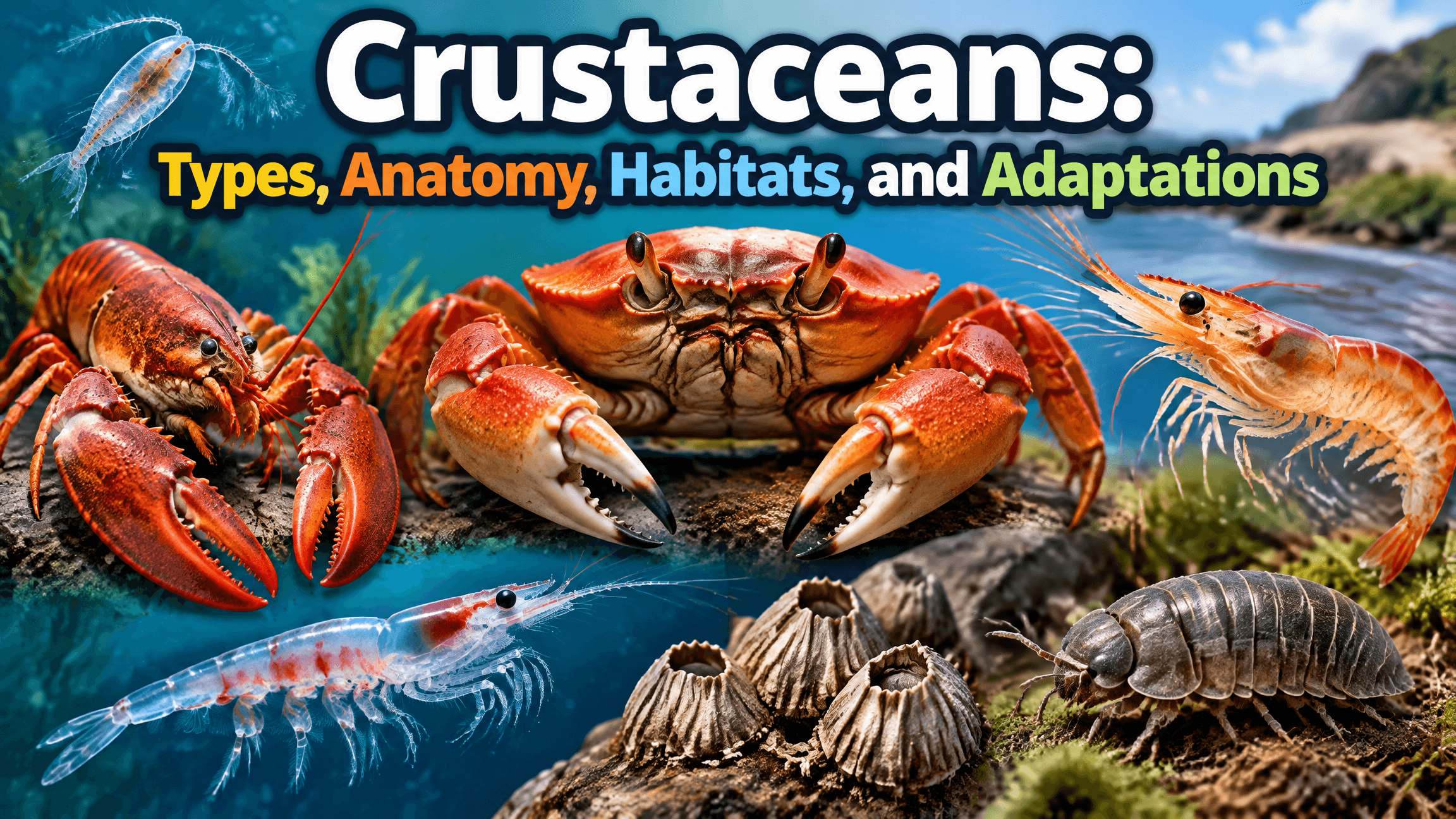
Crustaceans are arthropods best known through animals such as crabs, shrimp, lobsters, and crayfish, but those familiar forms show only part of the group. The animals conventionally called crustaceans also include copepods drifting through lakes and oceans, barnacles fixed to hard surfaces as adults, krill moving through open water, terrestrial pill bugs beneath logs, tiny ostracods enclosed by shell-like coverings, and highly specialized cave-dwelling remipedes.
That variety is the most useful starting point for understanding crustaceans. They share an arthropod heritage of segmented bodies, jointed appendages, an external cuticle, and molting, yet their bodies have been reshaped for very different ways of life. Some walk across the seafloor, some swim, some burrow, some graze on microscopic food, some hunt, and some spend their adult lives attached to a surface.
Modern evolutionary research adds one important complication. In everyday zoological use, “crustaceans” usually means the non-hexapod animals traditionally grouped as Crustacea. Current phylogeny places insects and other hexapods within the wider pancrustacean radiation, so the familiar Crustacea grouping is useful but does not represent a simple branch entirely separate from Hexapoda. That distinction matters because it keeps the biology accurate without changing the ordinary meaning of crustacean for most readers.
Quick Overview of Crustaceans

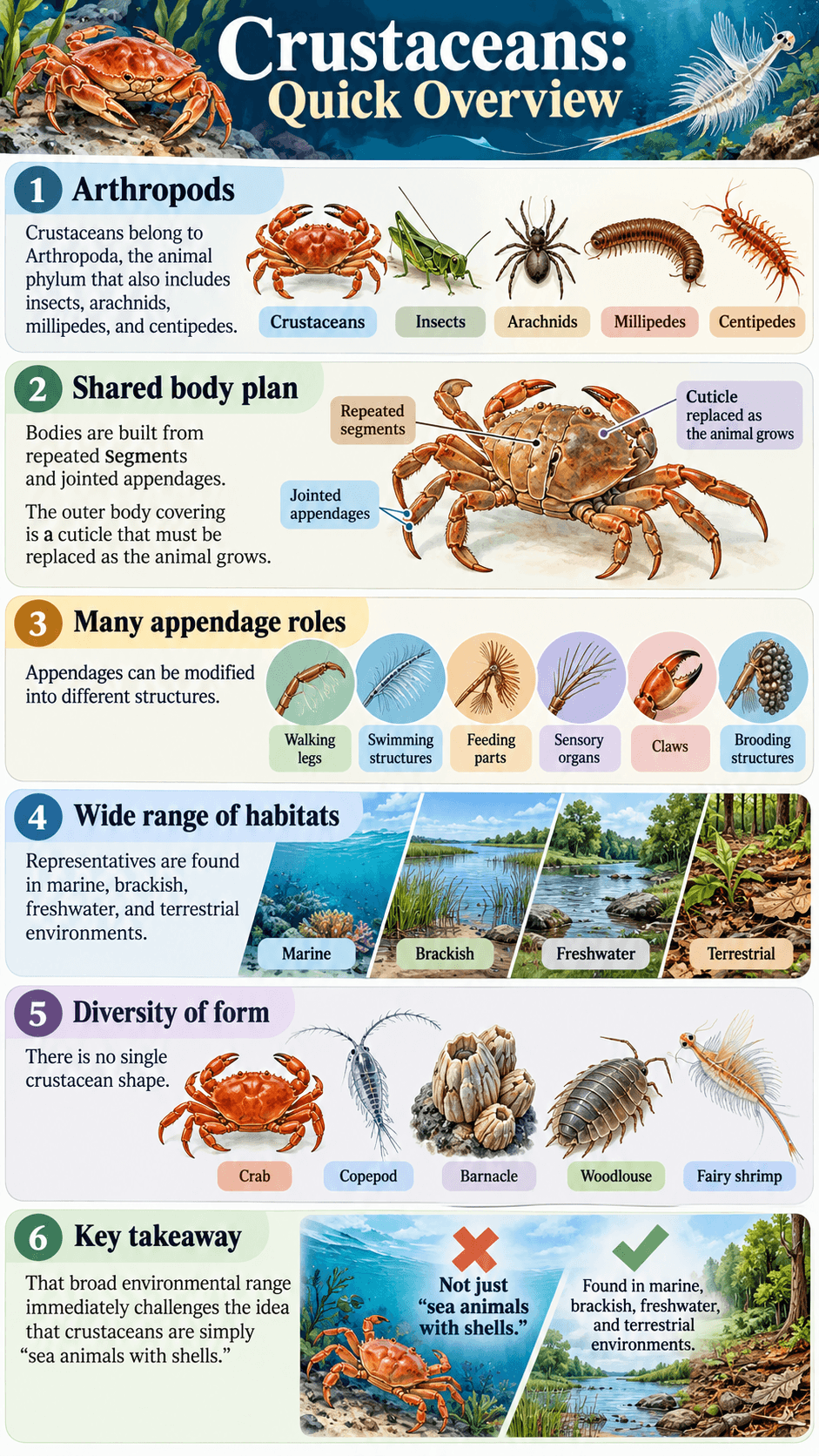
Crustaceans belong to Arthropoda, the animal phylum that also includes insects, arachnids, millipedes, and centipedes. Their bodies are built from repeated segments and jointed appendages, but those appendages can be modified into walking legs, swimming structures, feeding parts, sensory organs, claws, or brooding structures. The outer body covering is a cuticle that must be replaced as the animal grows.
The World Register of Marine Species treatment of Crustacea recognizes the group as an accepted and convenient assemblage and records representatives in marine, brackish, freshwater, and terrestrial environments. That broad environmental range immediately challenges the idea that crustaceans are simply “sea animals with shells.”
There is no single crustacean shape. A crab, copepod, barnacle, woodlouse, and fairy shrimp can look so different that their relationship is not obvious at first glance. The shared pattern becomes clearer when anatomy, development, and evolutionary relationships are considered together rather than relying on one feature such as claws, ten legs, or a hard shell.
What Counts as a Crustacean?
Crustaceans as arthropods
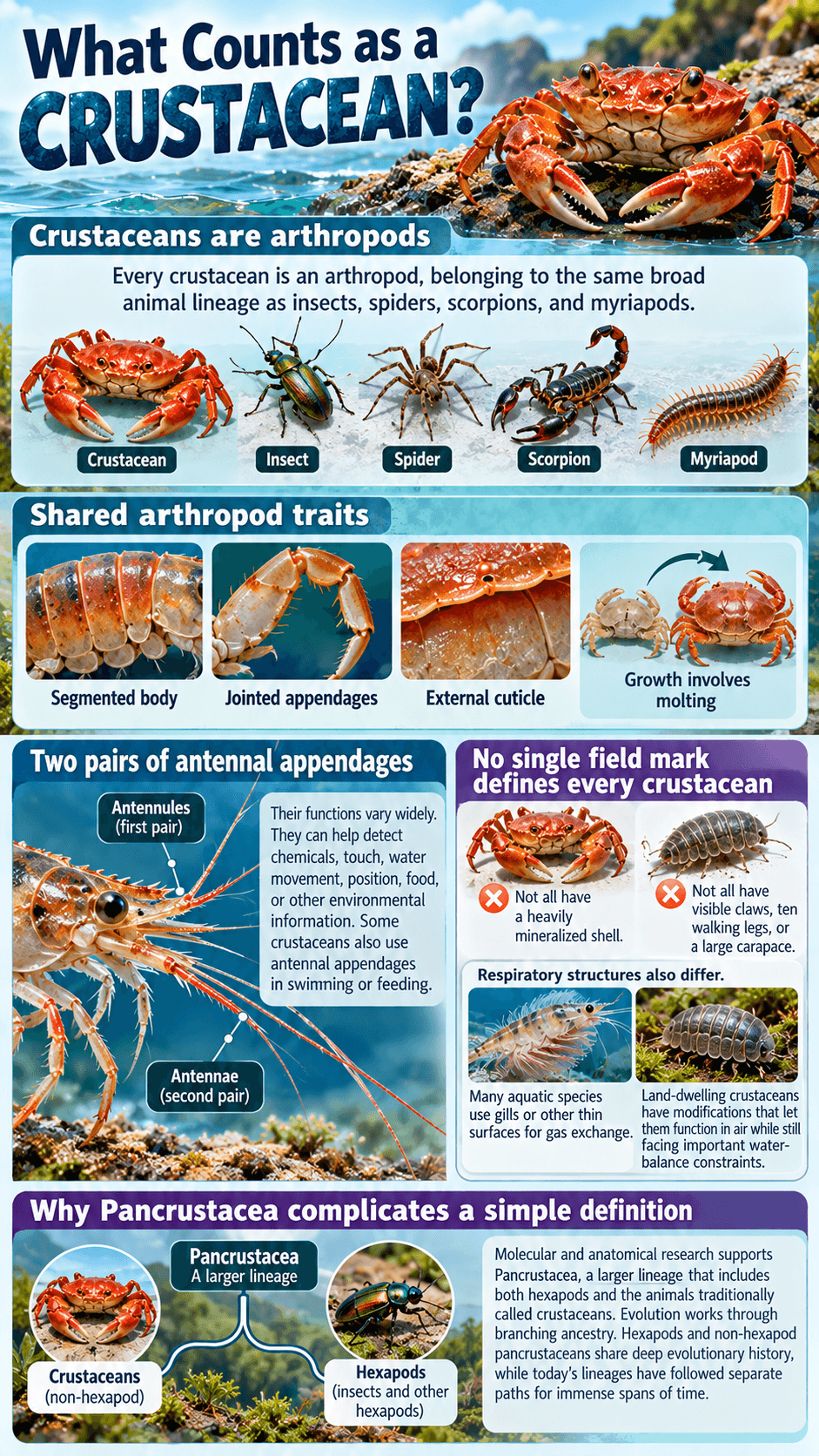
Every crustacean is an arthropod, which means it belongs to the same broad animal lineage as insects, spiders, scorpions, and myriapods. Arthropod traits include a segmented body, paired jointed appendages, an external cuticle, and growth that involves molting. Crustaceans share those foundations but show their own recurring body-plan themes. A fuller explanation of the shared traits appears in our guide to what makes an animal a crustacean.
Two pairs of antennal appendages are a particularly useful traditional crustacean feature. The first pair is commonly called the antennules, while the second pair is the antennae. Their functions vary widely. Depending on the species, they can help detect chemicals, touch, water movement, position, food, or other environmental information. Some crustaceans also use antennal appendages in swimming or feeding.
No single field mark defines every crustacean. Not all have a heavily mineralized shell, visible claws, ten walking legs, or a large carapace. Respiratory structures also differ. Many aquatic species use gills or other thin surfaces for gas exchange, while land-dwelling crustaceans have modifications that let them function in air while still facing important water-balance constraints.
Why Pancrustacea complicates a simple definition
The evolutionary picture is more complicated than older diagrams that showed insects and crustaceans as two completely separate branches. Molecular and anatomical research supports Pancrustacea, a larger lineage that includes both hexapods and the animals traditionally called crustaceans. A recent phylogenomic study in Molecular Biology and Evolution discusses how modern datasets continue to revise relationships among major pancrustacean groups.
This does not mean that a modern shrimp is an insect ancestor, that insects are literally shrimp, or that living crabs turned into insects. Evolution works through branching ancestry. Hexapods and non-hexapod pancrustaceans share deep evolutionary history, while today’s lineages have followed separate paths for immense spans of time.
For general animal biology, it remains practical to use “crustaceans” for the familiar non-hexapod pancrustaceans. The phylogenetic detail becomes most important when discussing classification and ancestry, not when deciding whether a barnacle, crayfish, or woodlouse belongs among the animals commonly called crustaceans.
Major Crustacean Groups at a Glance

Decapods and other malacostracans
Malacostraca contains many of the crustaceans people recognize immediately. Decapods include true crabs, lobsters, crayfish, many shrimp, hermit crabs, and related forms. The name “decapod” refers to the characteristic five pairs of thoracic walking appendages in the standard body plan, but that pattern should not be extended to crustaceans as a whole.
Malacostraca is much broader than Decapoda. It also includes isopods, amphipods, krill, mantis shrimps, and other lineages. Krill are shrimp-like malacostracans, but they are not simply small versions of familiar shrimp. Mantis shrimps are stomatopods, not true mantises and not ordinary shrimp. These common names can be useful, but they do not always reflect close taxonomic relationships. The diversity becomes easier to organize when the major types of crustaceans are compared as distinct lineages.
Even the word “crab” can hide major differences. True crabs belong to Brachyura, while hermit crabs and king crabs are anomurans. The repeated evolution of crab-like forms among decapods is a reminder that similar body shapes can evolve in related lineages without making every crab-shaped animal a true crab.
Copepods, barnacles, branchiopods, and ostracods
Copepods are among the clearest examples of why crustacean diversity cannot be represented by seafood species. They occur in marine and freshwater habitats and include planktonic, bottom-dwelling, symbiotic, and parasitic forms. The Smithsonian’s copepod research overview describes them across habitats ranging from freshwater and ocean water to caves and other specialized environments.
Barnacles look very different from mobile crabs or shrimp because familiar adults are attached to surfaces and protected by calcareous plates. They are crustaceans, not mollusks. In many familiar barnacles, free-moving larvae settle before the adult attached stage develops, so a motionless adult does not represent the entire life cycle.
Branchiopods include animals such as water fleas, fairy shrimp, brine shrimp, and tadpole shrimp. Some are strongly associated with temporary or variable waters, while others live in more persistent aquatic habitats. Ostracods, often called seed shrimps, have a bivalved covering enclosing much of the body. Their shell-like appearance can make them look superficially mollusk-like even though they are arthropods.
Isopods, amphipods, krill, remipedes, and other lineages
Isopods occupy marine, freshwater, and terrestrial settings. Woodlice, sowbugs, and pill bugs are terrestrial isopods, which makes them crustaceans living on land rather than insects. The group also includes deep-sea forms, freshwater species, scavengers, predators, detritivores, and parasites.
Amphipods are another diverse group, often small and laterally compressed, but their ecologies range widely. They occur in marine and fresh water, groundwater, and some semi-terrestrial environments. Calling them “tiny shrimp” may be convenient in casual speech, but it hides their distinct evolutionary identity.
Krill, especially euphausiids, are important pelagic crustaceans in many marine food webs. Remipedes are much less familiar and are associated particularly with anchialine and subterranean aquatic cave systems. Their elongated, many-segmented bodies look unlike typical decapods, which helps illustrate just how far crustacean body plans can diverge.
Shared Body-Plan Themes and Major Exceptions
Appendages and two antennal pairs
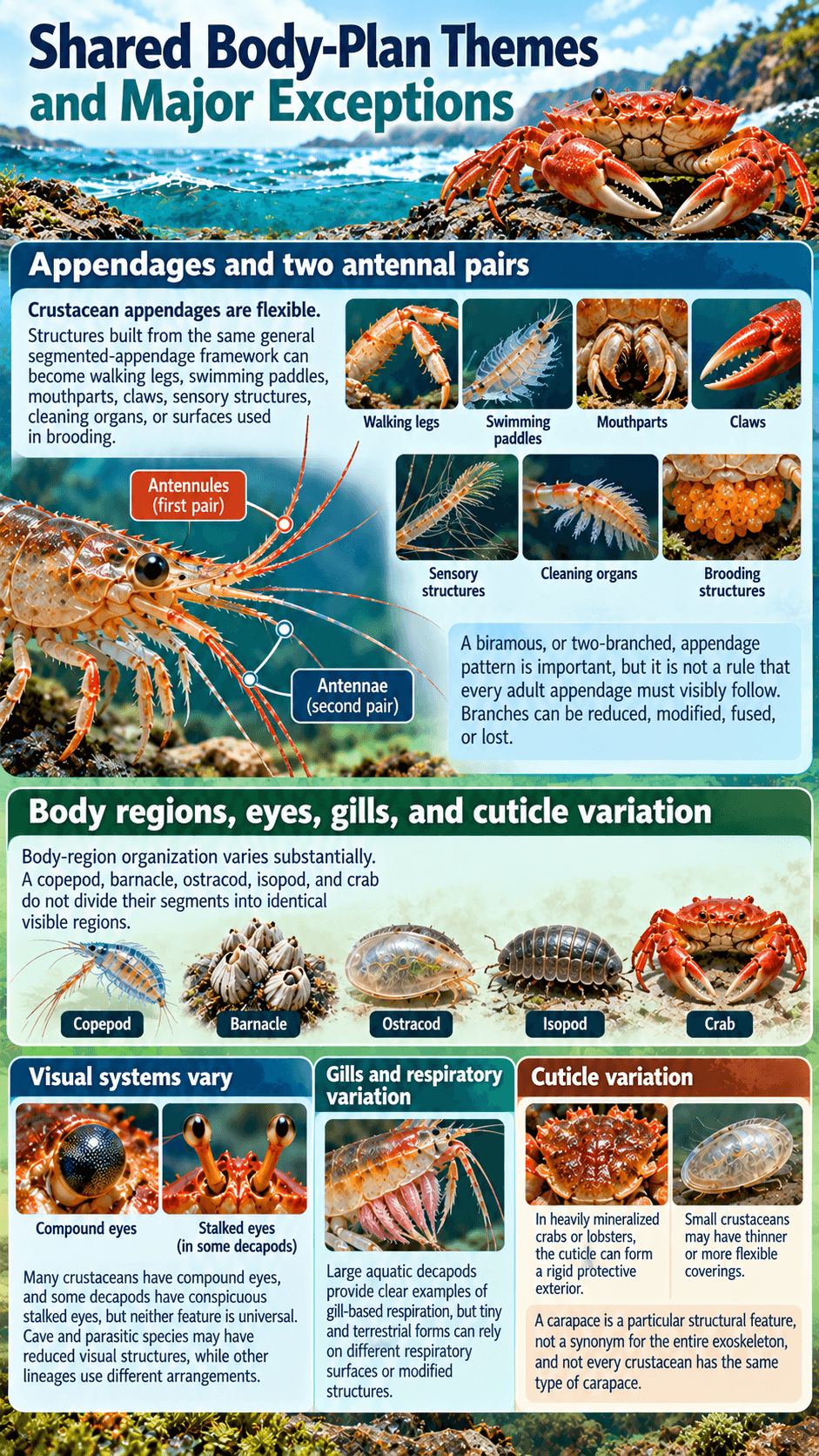
Crustacean appendages are one of the group’s most flexible anatomical systems. Structures built from the same general segmented-appendage framework can become walking legs, swimming paddles, mouthparts, claws, sensory structures, cleaning organs, or surfaces used in brooding. This repeated specialization helps explain how related animals can occupy very different ecological roles.
A biramous, or two-branched, appendage pattern is important in crustacean evolutionary anatomy, but it is not a rule that every adult appendage must visibly follow. Branches can be reduced, modified, fused, or lost. Anatomy makes more sense when these structures are viewed as evolutionary variations on a common framework instead of a checklist that every species must match.
Body regions, eyes, gills, and cuticle variation
Textbook diagrams often emphasize a cephalothorax and abdomen because that arrangement works well for many familiar decapods. Across crustaceans, however, body-region organization varies substantially. A copepod, barnacle, ostracod, isopod, and crab do not divide their segments into identical visible regions. The differences among respiratory structures are explored further in our guide to how crustaceans breathe.
Visual systems vary too. Many crustaceans have compound eyes, and some decapods have conspicuous stalked eyes, but neither feature is universal. Cave and parasitic species may have reduced visual structures, while other lineages use different arrangements. The same caution applies to gills. Large aquatic decapods provide clear examples of gill-based respiration, but tiny and terrestrial forms can rely on different respiratory surfaces or modified structures. Those shared structures are compared in greater detail in our guide to crustacean anatomy.
The cuticle is another source of visual diversity. In heavily mineralized crabs or lobsters it can form a rigid protective exterior, while small crustaceans may have thinner or more flexible coverings. A carapace is a particular structural feature, not a synonym for the entire exoskeleton, and not every crustacean has the same type of carapace.
How Crustaceans Grow, Move, Sense, and Feed
Molting and growth overview
Because the external cuticle cannot simply stretch forever, crustacean growth involves ecdysis, the shedding of the old cuticle. Before and after a molt, the animal undergoes physiological changes that prepare a new covering and later harden it. In heavily mineralized species, mineral handling and calcification can be important parts of the process.
A newly molted crustacean is not “without a skeleton.” A new cuticle is already present, but it may be softer and less rigid than it will become later. Growth is also more complex than a brief moment of expansion. Water uptake after ecdysis can create room, while tissues continue developing within the larger body space before another molt occurs. The growth process is explored step by step in our guide to how crustaceans molt.
Walking, swimming, burrowing, climbing, and sessile life
Crustaceans move in many ways because appendages and body regions can be specialized for different tasks. Many crabs are efficient lateral walkers, but “all crabs walk sideways” is too absolute. Shrimp can swim with abdominal appendages and perform rapid tail-flip escapes, while lobsters and crayfish commonly walk along the bottom and can use powerful abdominal flexion during escape.
Copepods can actively swim and make rapid escape movements even when they are part of plankton. Being planktonic does not mean being motionless. Isopods and amphipods may crawl, swim, burrow, or walk on land, depending on the species. Barnacles provide the opposite contrast: many familiar adults are sessile even though their earlier larval stages move through the water. The mechanics behind walking, swimming, burrowing, and other movement are covered in our guide to crustacean locomotion.
Vision, chemical cues, touch, and balance
Crustaceans gather information through combinations of vision, chemical detection, touch, water-motion sensing, and orientation systems. Antennules and antennae often carry sensory structures, but it is misleading to say that every crustacean simply “smells with its antennae.” Different segments and sensory hairs can respond to different kinds of stimuli. The sensory side of this biology is examined more closely in our guide to crustacean senses.
Some crustaceans use statocysts, sensory structures that help detect orientation and movement. Compound eyes are common in many groups, while visual abilities vary widely among species. Mantis shrimps are famous for unusually complex visual systems, but broad claims that rank one animal as having the “best vision on Earth” oversimplify performance across different visual tasks.
Predation, grazing, filtering, scavenging, and detritivory
There is no single crustacean diet. Crustaceans can be predators, grazers, omnivores, scavengers, detritivores, suspension feeders, parasites, or participants in symbiotic feeding relationships. Even within familiar groups such as crabs or shrimp, feeding strategies differ among species and habitats.
Many barnacles capture suspended food with modified thoracic appendages. Terrestrial isopods often consume decaying plant material and associated microorganisms. Copepods include phytoplankton grazers, predators, omnivores, and parasitic forms. NOAA Fisheries describes copepods as important links in aquatic food webs in its overview of copepods and marine food-web energy transfer.
Reproduction and Development in Brief
Eggs, brooding, larvae, and direct development
Crustacean reproduction is as varied as crustacean anatomy. Depending on the lineage, reproduction can involve different forms of courtship, sperm transfer, egg attachment, brood chambers, or brood pouches. Females of some groups carry eggs on appendages or beneath the body, while peracarids such as many isopods and amphipods brood developing young in a marsupium, a crustacean brood pouch unrelated to the pouch of marsupial mammals.
Larval development cannot be reduced to one universal sequence. Nauplius larvae occur in many crustacean lineages, but not every species hatches as a free-swimming nauplius. Some crabs pass through zoeal stages and a megalopa before becoming juveniles, while other crustaceans follow very different routes. Many peracarids release juveniles that resemble small versions of later stages rather than passing through a long series of free-swimming larvae.
This developmental diversity matters because life stages may occupy different habitats and face different predators, food sources, and dispersal opportunities. An attached adult barnacle and its swimming larva demonstrate how one species can use dramatically different strategies within a single life cycle.
Where Crustaceans Live
Marine and brackish habitats
Marine environments contain enormous crustacean diversity, from coastal tide pools and estuaries to open water, deep seafloor habitats, coral reefs, polar seas, and submarine caves. Crabs, shrimp, amphipods, copepods, krill, barnacles, ostracods, isopods, and many other groups occupy different layers of those environments. The full environmental range is mapped in our guide to crustacean habitats.
Not every marine crustacean is a bottom-dweller. Copepods and krill can be major components of the water column, while some amphipods and other lineages live pelagically. Others burrow in sediment, attach to rock, live among reef structures, or associate with other animals.
Freshwater habitats
Freshwater crustaceans occur in rivers, streams, lakes, ponds, wetlands, temporary pools, springs, and groundwater. Crayfish may be among the most familiar examples in North America, but freshwater systems also contain shrimp, amphipods, isopods, copepods, branchiopods, and ostracods.
Temporary waters create a special challenge because habitat may disappear seasonally. Some branchiopods produce resistant or dormant eggs that persist through unfavorable periods, although the ability to tolerate drying differs among species. Groundwater crustaceans face a different set of conditions, including darkness, restricted food, and often very limited ranges.
Terrestrial and subterranean habitats
Terrestrial crustaceans show that the group is not confined to water. Woodlice and pill bugs live on land, often in humid microhabitats where water loss can be reduced. Smithsonian research on a terrestrial isopod from Maryland also highlights the ecological role of woodlice in litter decomposition and nutrient processing.
Some crabs spend extensive periods on land, although their respiratory biology and reproduction differ among lineages and often retain links to moist environments. Cave and groundwater crustaceans include remipedes, amphipods, isopods, copepods, shrimp, and crayfish. Traits such as reduced eyes, reduced pigmentation, or elongated sensory structures occur in some cave specialists, but they should not be treated as universal features of every subterranean crustacean.
Why Crustaceans Matter in Ecosystems
Food-web roles
Crustaceans occupy many positions in food webs rather than one fixed “level.” Some consume algae or microscopic plankton, some prey on other animals, and many become prey for fish, birds, mammals, reptiles, and larger invertebrates. Copepods can transfer energy from microscopic producers and consumers to larger animals, while krill are major prey in several high-latitude and upwelling systems.
The importance of a crustacean depends on the ecosystem. A copepod bloom in coastal water, a krill swarm in the Southern Ocean, a burrowing crab on a tidal flat, and a woodlouse in forest litter affect very different communities. Treating food webs as networks is more accurate than imagining one universal ladder with crustaceans in a single place.
Decomposition, grazing, predation, and habitat effects
Detritivorous isopods and amphipods help process dead organic material. Grazing crustaceans can influence algae and microbial films. Predatory crustaceans affect prey populations, while suspension feeders remove particles from water. Burrowing species can alter sediments and water movement, although the stronger term “ecosystem engineer” is best reserved for cases where those physical changes have demonstrated effects on other organisms or resources.
Crustaceans also participate in symbioses and parasitic relationships. Cleaner shrimp can remove ectoparasites or other material from fish in some systems, while parasitic copepods, isopods, and modified barnacle relatives exploit hosts in very different ways. These interactions are another reason it is misleading to define the group by a single ecological role such as scavenging.
Conservation at a Glance
Why one conservation status cannot represent all crustaceans
Crustaceans do not share one conservation status. The group contains abundant planktonic species, heavily harvested fishery species, freshwater endemics, cave specialists with tiny ranges, invasive species, and many organisms whose populations are poorly documented. A statement such as “crustaceans are endangered” or “crustaceans are doing fine” is therefore too broad to be useful.
Threats also vary by place and lineage. Freshwater species may be affected by altered rivers, water extraction, pollution, wetland loss, introduced species, or disease. Coastal and marine species may face habitat degradation, pollution, warming, deoxygenation, harvest pressure, or changing food webs. Cave species can be vulnerable to groundwater disturbance and extremely limited geographic ranges.
For harvested crabs, lobsters, shrimp, or krill, fishery stock status is not the same thing as global extinction risk. Management decisions may refer to a particular stock, region, season, or fishery, while conservation assessments operate at different biological and geographic scales. Specific claims should therefore name the species or population and the system used to assess it. Threats, fisheries, habitat pressures, and protection are examined in more detail in our guide to crustacean conservation.
Common Crustacean Myths and Misunderstandings
Not all have ten legs, claws, or heavily calcified shells
Ten walking legs are characteristic of decapods, not crustaceans as a whole. Copepods, barnacles, branchiopods, ostracods, isopods, amphipods, and other groups follow different appendage arrangements. Claws are also specialized structures, not a universal requirement.
The same is true of the familiar hard “shell.” Many crabs and lobsters have strongly mineralized cuticles, but crustacean body coverings vary in thickness and rigidity. A crustacean is not defined simply as an animal with a hard shell.
Barnacles are crustaceans and pill bugs are not insects
Barnacles can look more like tiny volcano-shaped shells than relatives of crabs, especially once the adult is permanently attached. Their anatomy and development reveal their crustacean identity. A Smithsonian Ocean example shows barnacles feeding with modified appendages, a useful reminder that the plates around them do not make them mollusks.
Pill bugs and sowbugs create the opposite confusion because they live on land and crawl through leaf litter alongside insects. They are terrestrial isopod crustaceans. Not every woodlouse rolls into a ball, and living on land has not erased the group’s need to manage moisture carefully.
Horseshoe crabs are not crustaceans
The word “crab” in a common name does not guarantee crustacean membership. Horseshoe crabs belong to Chelicerata and are more closely related to arachnids than to true crabs. The Smithsonian’s horseshoe crab profile places them with arthropod relatives such as spiders and scorpions rather than within Crustacea.
This is a useful example of why classification depends on the full body plan and evolutionary evidence rather than appearance or common names. Porcelain crabs, hermit crabs, and king crabs are crustaceans even though they are not true crabs in Brachyura, while horseshoe crabs fall outside crustaceans altogether.
Crustaceans Within the Wider Arthropod World
Shared arthropod foundations and crustacean specializations
Crustaceans make the most sense when seen as one major expression of the arthropod body plan. Segmentation, jointed appendages, cuticle, and molting connect them to other arthropods. Their characteristic antennal arrangement, diverse appendage specializations, aquatic evolutionary history, and distinctive developmental patterns help explain why a copepod, barnacle, crab, and woodlouse can still belong to a recognizable biological grouping.
Comparisons with insects are useful when they clarify differences, but they should not erase the Pancrustacea relationship. Modern evidence does not support a simple story in which insects and crustaceans arose as entirely separate neighboring branches. At the same time, the animals conventionally called crustaceans retain enough shared biology and historical usage to remain a practical subject for natural-history education.
Crustaceans across ocean, freshwater, and land ecosystems
Thinking across habitats also prevents a common bias. Ocean species are highly visible in popular culture, yet freshwater and terrestrial crustaceans are essential parts of the group’s story. Crayfish in streams, branchiopods in temporary pools, groundwater amphipods, and forest-floor isopods show that crustacean evolution has produced solutions far beyond life in the sea.
The same animal group can therefore illuminate many broader biological questions: how arthropods molt, how animals exchange gases in water and air, how appendages become specialized, how sensory systems work in dark or open habitats, how larvae disperse, and how food webs transfer energy. Crustaceans are valuable not because they follow one biological blueprint, but because they reveal how flexible a shared evolutionary framework can become.
FAQ
Are crustaceans insects?
No. Insects and the animals conventionally called crustaceans are different groups, although modern evolutionary research places both within Pancrustacea. Insects have the characteristic hexapod body plan, while crustaceans show a much broader range of appendage numbers, body regions, habitats, and developmental patterns. Their relationship reflects deep shared ancestry, not the idea that living crustaceans are insects or that modern shrimp became insects.
Are all crustaceans aquatic?
No. Most crustacean diversity is associated with aquatic environments, but terrestrial lineages exist. Woodlice, including pill bugs and sowbugs, are land-dwelling isopods. Some crabs also spend extensive periods on land. Terrestrial crustaceans generally remain strongly influenced by moisture and water balance, so living on land does not necessarily mean complete independence from humid conditions or aquatic ancestry.
Are shrimp, crabs, and lobsters the main crustacean groups?
They are among the most familiar crustaceans, but they represent only part of the group. Copepods, barnacles, isopods, amphipods, krill, branchiopods, ostracods, remipedes, and other lineages add enormous anatomical and ecological diversity. A crustacean overview focused only on decapods would miss many of the animals that are especially important in plankton, freshwater systems, subterranean habitats, and terrestrial litter.
Why are barnacles considered crustaceans?
Barnacles are classified as crustaceans because their anatomy, development, and evolutionary relationships place them within the crustacean branch of Pancrustacea. The attached adult form is highly modified, which can hide those relationships. Their larval stages are mobile, and their feeding structures are modified arthropod appendages. The calcareous plates surrounding many adult barnacles do not make them mollusks.
Final Thoughts
Crustaceans are far more diverse than the familiar trio of crabs, shrimp, and lobsters. They include microscopic plankton, attached barnacles, freshwater branchiopods, terrestrial isopods, open-water krill, cave specialists, and many other forms. Their shared arthropod heritage is expressed through remarkably flexible appendages, body regions, sensory systems, feeding strategies, life cycles, and habitats.
The most accurate way to understand crustaceans is to keep both unity and diversity in view. They share evolutionary foundations, but few simple statements apply to every species. Not all have ten legs, claws, hard shells, identical gills, or aquatic lifestyles. Modern Pancrustacea research also shows that their relationship with insects is deeper and more complex than older textbook divisions suggest. That combination of shared ancestry and extreme variation is what makes crustacean biology so useful for understanding animal evolution and adaptation.

Ethan Walker is the founder and research editor of Animal Fact Central. He creates and reviews educational animal facts content using trusted wildlife, pet care, and science-based sources. His work focuses on making animal behavior, adaptations, habitats, and species facts clear, accurate, and engaging for everyday readers.
Read More Details About Ethan Walker: https://animalfactcentral.com/ethan-walker/
3 thoughts on “Crustaceans: Types, Anatomy, Habitats, and Adaptations”