
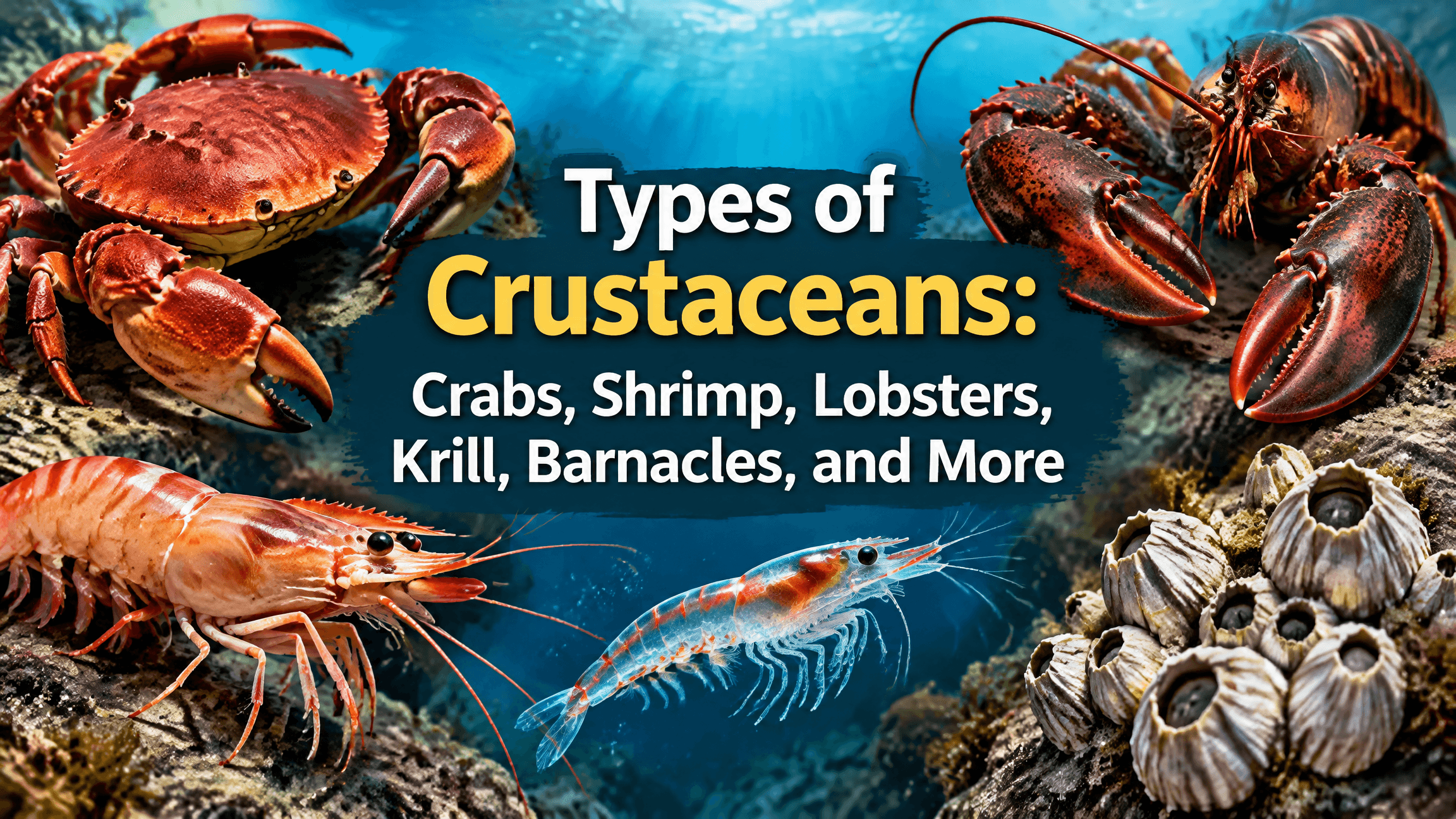
Crabs, shrimp, and lobsters are the crustaceans most people recognize first, but they represent only a fraction of the group. The major types of crustaceans also include copepods, barnacles, isopods, amphipods, krill, branchiopods, ostracods, remipedes, mantis shrimps, and many other lineages. Some are large and heavily armored. Others are nearly transparent, microscopic or near-microscopic, permanently attached as adults, parasitic, or adapted to life on land.
That range of forms is why crustacean classification can feel confusing. Familiar names do not always match one formal taxonomic branch, and older textbooks may use categories that have changed as molecular and morphological evidence improved. A useful way to understand crustacean diversity is to start with recognizable groups, then place those groups inside the larger classification without assuming that every “shrimp,” “crab,” or “lobster” is the same kind of animal.
Quick Guide to Crustacean Diversity
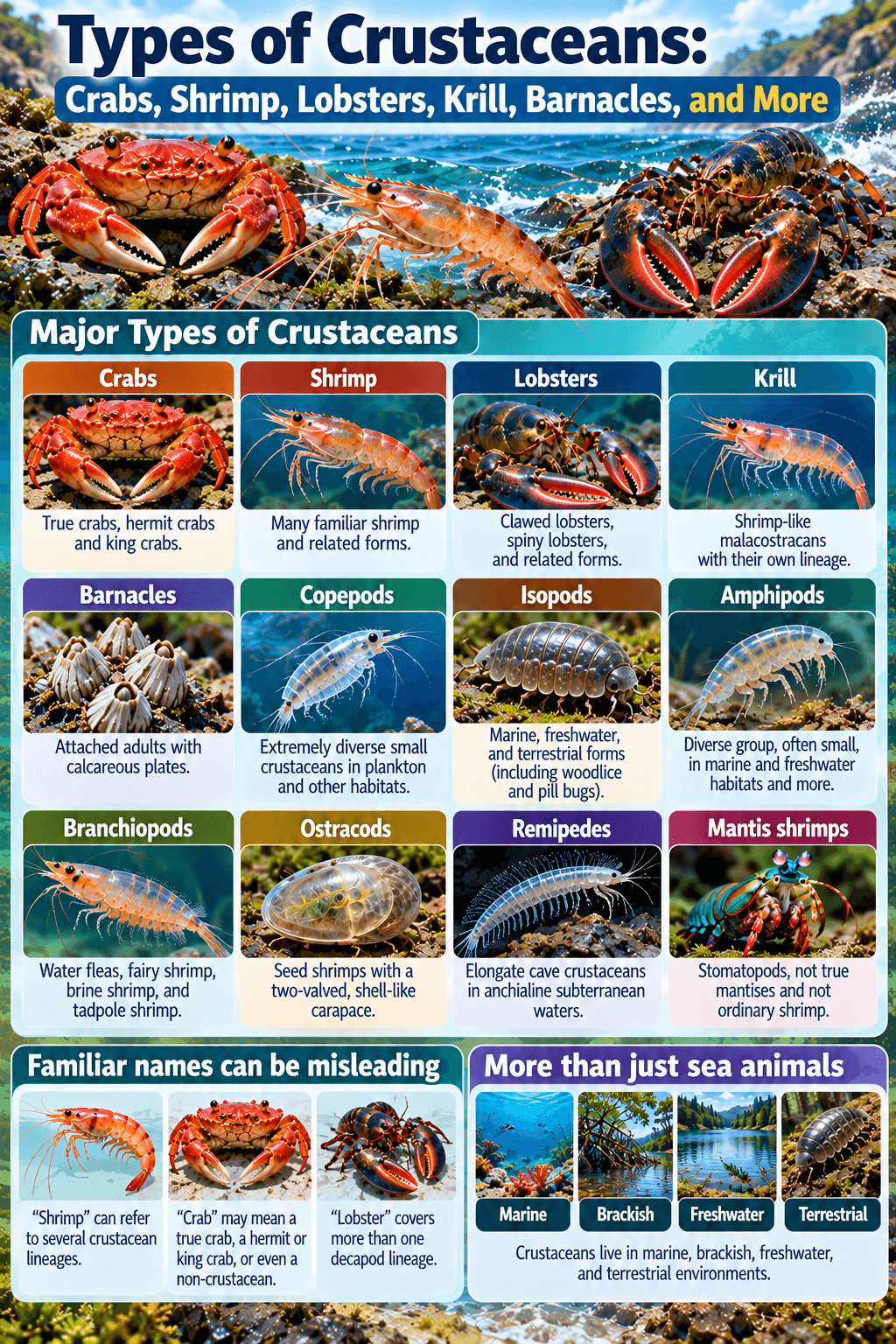
The World Register of Marine Species treatment of Crustacea places the familiar non-hexapod crustaceans within a broad evolutionary radiation that includes marine, brackish, freshwater, and terrestrial forms. At a practical level, readers can think of crustacean diversity as several large branches plus many smaller ones, each with its own body plan and life history.
| Major group | Familiar examples | What makes the group easy to recognize |
|---|---|---|
| Malacostraca | Crabs, lobsters, crayfish, many shrimp, krill, isopods, amphipods, mantis shrimps | Contains many of the largest and most familiar crustaceans, but also small and unusual forms |
| Copepoda | Calanoid copepods, harpacticoids, parasitic copepods | Extremely diverse small crustaceans in plankton, sediments, fresh water, and host-associated habitats |
| Thecostraca | Acorn barnacles, goose barnacles, parasitic barnacle relatives | Includes strongly modified adults, often very different from a mobile crustacean body shape |
| Branchiopoda | Daphnia, fairy shrimp, brine shrimp, tadpole shrimp | Mostly freshwater forms with several distinctive swimming, filtering, or temporary-water lifestyles |
| Ostracoda | Seed shrimps | Much of the body is enclosed within a two-valved, shell-like carapace |
| Remipedia | Remipedes | Elongate cave crustaceans associated especially with anchialine subterranean waters |
This table is a map, not a complete catalogue. Crustacean taxonomy includes additional orders, classes, and smaller lineages, and the exact arrangement of higher groups can change as new studies are published. The important point is that the group extends far beyond the animals found at a seafood counter.
How to Read Crustacean Classification Without Getting Lost
Familiar names versus formal taxonomic groups
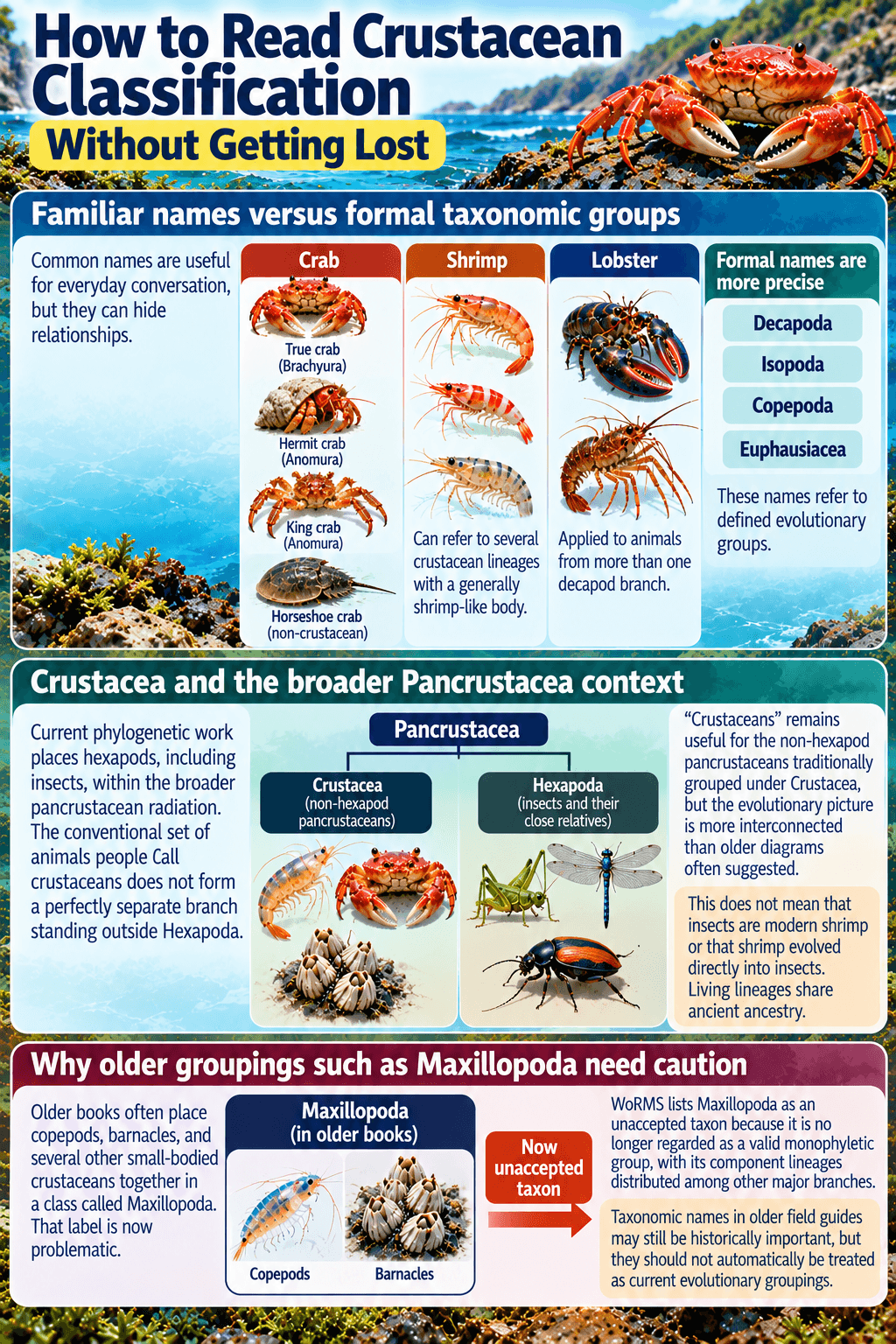
Common names are useful for everyday conversation, but they can hide relationships. “Crab” may refer to a true crab in Brachyura, an anomuran such as a hermit or king crab, or even a non-crustacean such as a horseshoe crab. “Shrimp” can refer to several crustacean lineages with a generally shrimp-like body. “Lobster” is also applied to animals from more than one decapod branch.
Formal names such as Decapoda, Isopoda, Copepoda, and Euphausiacea are more precise because they refer to defined evolutionary groups. A reader does not need to memorize every rank, but knowing a few of these names makes it much easier to understand why similar-looking animals can be only distantly related and why very different-looking animals can still belong to the same broad crustacean radiation.
Crustacea and the broader Pancrustacea context
There is an important modern complication behind the word “crustacean.” Current phylogenetic work places hexapods, including insects, within the broader pancrustacean radiation. In other words, the conventional set of animals people call crustaceans does not form a perfectly separate branch standing outside Hexapoda. For general natural-history writing, “crustaceans” remains useful for the non-hexapod pancrustaceans traditionally grouped under Crustacea, but the evolutionary picture is more interconnected than older diagrams often suggested. Before comparing lineages, it helps to understand the traits that define a crustacean.
This does not mean that insects are modern shrimp or that shrimp evolved directly into insects. Living lineages share ancient ancestry. The useful takeaway is simply that crustacean classification combines long-standing zoological names with a phylogenetic framework that has been revised as evidence has improved.
Why older groupings such as Maxillopoda need caution
Older books often place copepods, barnacles, and several other small-bodied crustaceans together in a class called Maxillopoda. That label is now problematic. WoRMS lists Maxillopoda as an unaccepted taxon because it is no longer regarded as a valid monophyletic group, with its component lineages distributed among other major branches.
That change illustrates a wider rule for reading crustacean classification: taxonomic names in older field guides may still be historically important, but they should not automatically be treated as current evolutionary groupings. This is especially relevant for diverse small crustaceans that were once bundled together because they shared a few convenient features.
Malacostraca: The Familiar but Diverse Branch
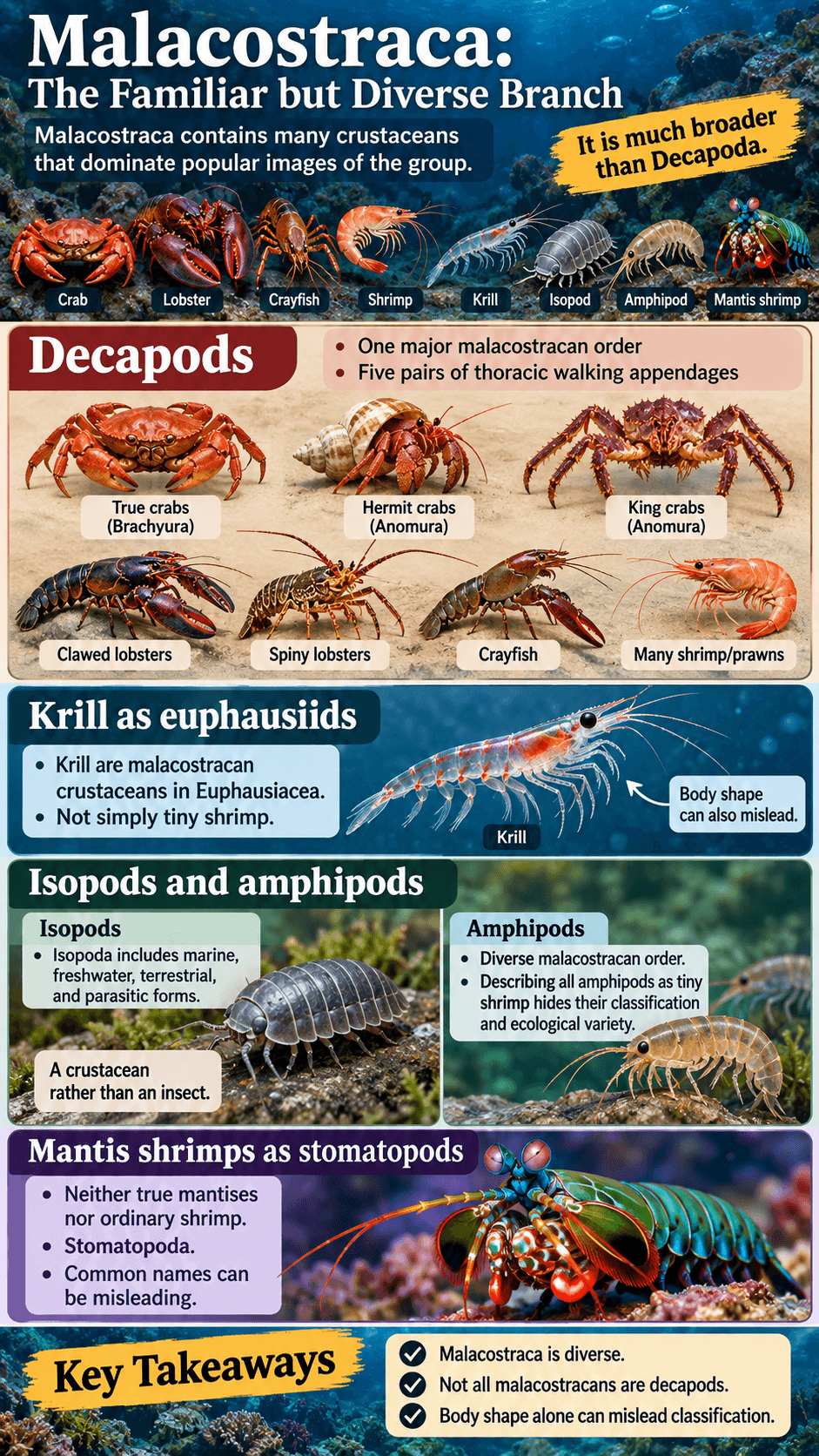
Malacostraca contains many crustaceans that dominate popular images of the group, including crabs, lobsters, crayfish, many shrimp, krill, isopods, amphipods, and mantis shrimps. It is much broader than Decapoda. That distinction matters because it prevents one of the most common classification mistakes: treating all malacostracans as ten-legged crab or shrimp relatives.
Decapods: true crabs, lobsters, crayfish, many shrimp, and anomurans
Decapoda is one major malacostracan order. The name refers to a characteristic arrangement involving five pairs of thoracic walking appendages in the standard decapod body plan. The group includes true crabs, hermit crabs, king crabs, clawed lobsters, spiny lobsters, crayfish, and many animals commonly called shrimp or prawns.
The higher classification of decapods is complex, but one practical distinction is especially useful: true crabs belong to Brachyura, while hermit crabs and king crabs belong to Anomura. The Decapoda research catalogue reflects the long history of revising these relationships and shows why common body shapes should not be used as the only guide to classification.
Krill as euphausiids
Krill are malacostracan crustaceans in Euphausiacea. They may look shrimp-like, but calling them simply “tiny shrimp” blurs a real taxonomic distinction. Krill have their own lineage, their own developmental and anatomical patterns, and their own ecological roles. Antarctic krill are famous because of their importance to Southern Ocean food webs, but Euphausiacea includes more than one species and is not limited to Antarctica.
Their shrimp-like appearance is a good example of why body shape can mislead. Several crustacean groups have elongate bodies, prominent antennae, and swimming appendages. Those similarities can reflect shared ancestry at a broad level, but they do not collapse all of those animals into the same order.
Isopods and amphipods
Isopoda includes marine, freshwater, terrestrial, and parasitic forms. Woodlice, pill bugs, and sowbugs are terrestrial isopods, which means the familiar roly-poly under a log is a crustacean rather than an insect. Other isopods live in shallow seas, the deep ocean, fresh water, or on and inside animal hosts. Giant isopods are only one dramatic corner of a much broader group.
Amphipods are another diverse malacostracan order. Many have laterally compressed bodies, but the group includes swimmers, burrowers, scavengers, grazers, predators, and species associated with other organisms. They occur in marine and freshwater habitats, groundwater, and some semi-terrestrial settings. Describing all amphipods as “tiny shrimp” hides both their distinct classification and their ecological variety.
Mantis shrimps as stomatopods
Mantis shrimps belong to Stomatopoda. They are neither true mantises nor ordinary shrimp. Their common name comes from a superficial resemblance of the front limbs to the raptorial forelegs of a praying mantis and from their general crustacean appearance. Stomatopods are best treated as their own malacostracan lineage, famous for specialized predatory appendages but not defined by the exaggerated viral claims sometimes attached to them.
They are useful in a classification guide because they show how misleading common names can be. A mantis shrimp is a crustacean, but neither half of its common name identifies its closest formal taxonomic placement.
Decapoda Without Turning All Crustaceans into Decapods
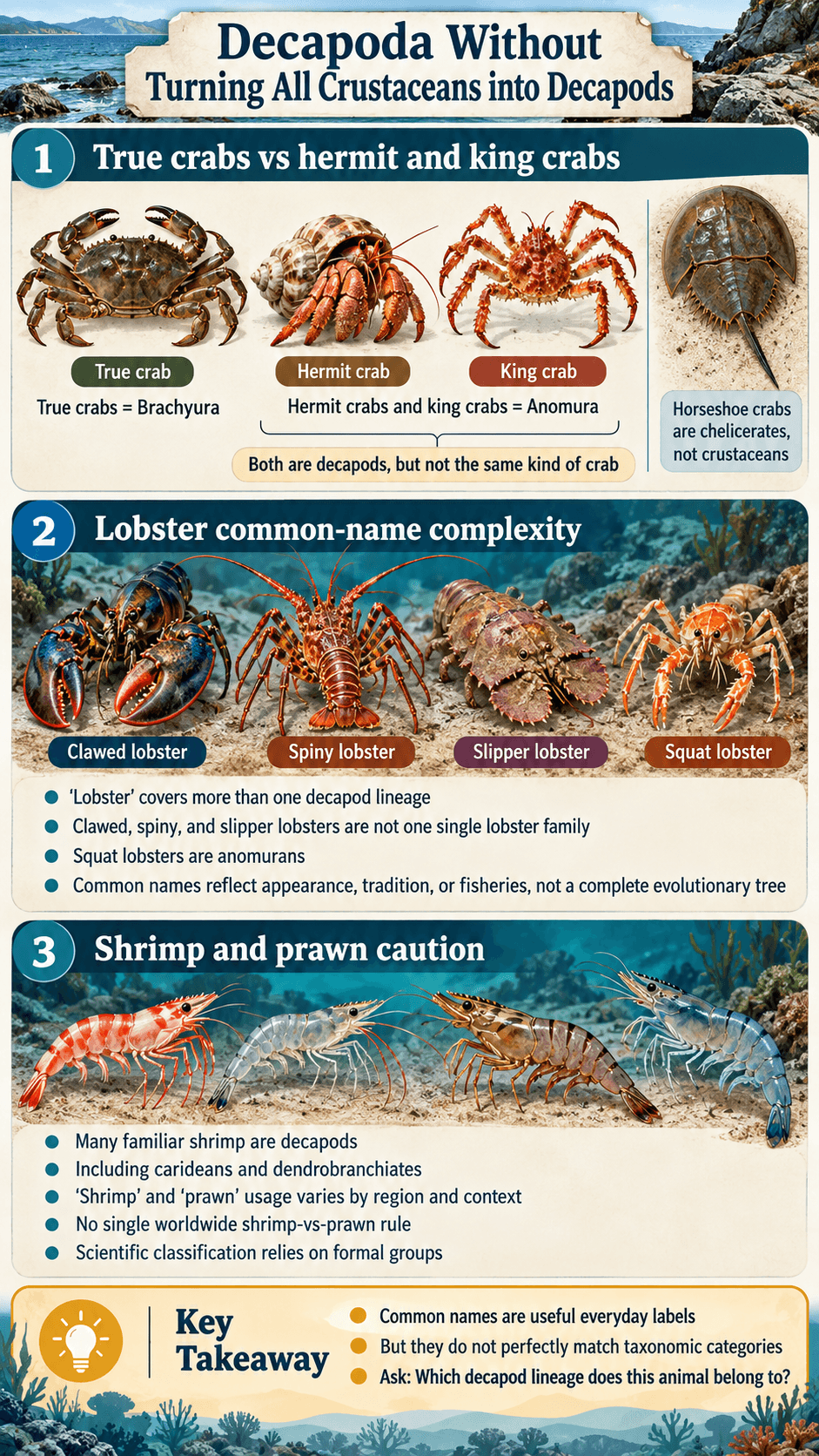
True crabs versus hermit and king crabs
True crabs belong to Brachyura. Hermit crabs and king crabs belong to Anomura, another major decapod branch. Both groups are unquestionably crustaceans and decapods, but they are not the same kind of crab in formal classification. This distinction becomes especially useful when reading about repeated evolution of crab-like body forms among decapods.
The word “crab” therefore has two levels of meaning. In everyday language it can describe several crab-shaped decapods. In a stricter taxonomic sense, “true crab” means Brachyura. Horseshoe crabs are outside this discussion entirely because they are chelicerates, more closely associated with the arthropod branch that includes spiders and scorpions than with crustaceans.
Lobster common-name complexity
“Lobster” also covers more than one decapod lineage. Clawed lobsters, spiny lobsters, and slipper lobsters are not simply members of one single lobster family. Squat lobsters add another layer because they are anomurans and are more closely tied to the hermit-crab side of decapod classification than their name suggests.
This does not make common names wrong. It means they are labels built around appearance, tradition, fisheries, or regional usage rather than a complete evolutionary tree. For a general reader, the safest question is not “Does its name say lobster?” but “Which decapod lineage does this animal belong to?”
Shrimp and prawn common-name caution
Shrimp and prawn are especially difficult common names because usage varies by region and context. Many familiar shrimp are decapods, including carideans and dendrobranchiates, but “shrimp-like” body plans also appear outside the narrow set people imagine when they hear the word. There is no single worldwide rule in which prawns are always larger, always freshwater, or anatomically separated from shrimp by one easy visible feature.
Scientific classification relies on formal groups rather than a universal shrimp-versus-prawn shortcut. That is why a crustacean diversity guide should treat those names as useful everyday labels, not as perfectly matched taxonomic categories.
Copepods
Copepods are among the crustacean groups most likely to be overlooked because many are tiny. Yet their diversity of form and lifestyle is enormous. The Smithsonian overview of copepods describes forms from fresh water, hypersaline environments, caves, streams, lakes, seafloor sediments, open-ocean waters, polar settings, and hydrothermal environments, along with free-living, symbiotic, and parasitic species.
Planktonic, benthic, symbiotic, and parasitic forms
Many copepods are planktonic and swim within the water column, but “copepod” does not mean “plankton.” Other species live on or within sediments, cling to surfaces, associate with plants or animals, or become highly modified parasites. Some parasitic adults look so unlike a textbook free-swimming copepod that their identity is easiest to understand through development and detailed anatomy.
Copepods are also a reminder that crustacean importance is not tied to body size. Small planktonic species can be major grazers and prey in aquatic food webs, while host-associated species can participate in complex symbiotic or parasitic relationships. Those ecological roles belong in deeper articles, but classification alone already shows why copepods deserve equal attention beside larger decapods.
Barnacles and Other Thecostracans
Barnacles are crustaceans despite having adult bodies that can look more like armored cones or stalked shells than mobile arthropods. They belong within Thecostraca, a branch that also includes highly modified forms. The adult body can be so specialized that classification makes more sense when development is considered alongside adult anatomy.
Sessile adults and free-moving larvae
Many familiar barnacles settle on hard surfaces and remain attached as adults. Their life cycle, however, includes free-moving larval stages before settlement. This is one reason the old idea that barnacles are mollusks fails. Their developmental pattern and appendages reveal their crustacean identity even though the adult covering is strongly modified.
A Smithsonian account notes that barnacles are crustaceans, including specialized species that attach to whales. That example also shows how attachment does not mean a lineage lacks dispersal. Larvae can move before the adult becomes fixed to a surface or host.
Highly modified and parasitic forms
Thecostracan diversity extends beyond ordinary acorn and goose barnacles. Some relatives are parasites with bodies so transformed that the familiar plates and feeding appendages of a shoreline barnacle may be reduced or absent. Rhizocephalan barnacles, for example, parasitize other crustaceans and develop highly unusual adult structures inside or on their hosts.
These forms are important for understanding classification because they demonstrate a general evolutionary principle: adult appearance can change radically while ancestry remains traceable through development, anatomy, and molecular evidence. A crustacean does not have to look like a crab or shrimp to belong within the same broad radiation.
Branchiopods
Branchiopoda includes a collection of mostly freshwater crustaceans familiar from ponds, temporary waters, salt lakes, and laboratory cultures. Daphnia and related water fleas, fairy shrimp, brine shrimp, and tadpole shrimp all belong here, although their exact relationships and higher classification are more complex than those common names suggest.
Daphnia, fairy shrimp, brine shrimp, and tadpole shrimp
Daphnia are cladocerans, commonly called water fleas even though they are not insects and not true fleas. Fairy shrimp and brine shrimp belong to Anostraca, while tadpole shrimp belong to Notostraca. A recent review of large branchiopod systematics emphasizes that the classification of these animals continues to be refined and that modern taxonomic definitions require careful evidence.
Branchiopods also show why habitat should not be used as a taxonomic shortcut. Some are associated with temporary pools, but others occupy permanent waters or saline environments. Dormant or resistant eggs are important in several lineages, yet no single life-history strategy defines every branchiopod.
Ostracods
Ostracods are often called seed shrimps because many have a compact, seed-like outline. Much of the body sits inside a two-valved carapace that can resemble a tiny bivalve shell from the outside. They are crustaceans, not miniature clams, and the resemblance comes from a different evolutionary route.
Seed-shrimp body form and bivalved covering
The enclosing carapace makes ostracods visually distinctive among crustaceans. Appendages extend between the valves for swimming, walking, feeding, or sensing, depending on the species. Ostracods occur in marine and freshwater settings, with both living and fossil forms making the group especially familiar to micropaleontologists.
Their shell-like exterior is another warning against classifying animals by one visual feature. A two-valved covering can make an ostracod look superficially mollusk-like, but the appendages and internal organization are arthropod features.
Remipedes and Smaller Lineages
Remipedes are elongate crustaceans with many similar trunk segments and repeated swimming appendages. They are a small and specialized lineage compared with enormous groups such as copepods or decapods. Their shape can look worm-like at first glance, which makes them another useful example of crustacean diversity beyond the standard crab-and-shrimp image.
Cave and anchialine specialists
Known remipedes are strongly associated with submerged anchialine cave systems, which are coastal subterranean waters influenced by both marine and groundwater conditions. Research in the Journal of Crustacean Biology on anchialine systems describes these habitats as subterranean estuaries with distinctive physical and chemical layering and a crustacean-rich fauna.
Remipedes should not be labeled “primitive crustaceans” simply because their bodies are long and segmented. Modern phylogenetic work treats them as a specialized lineage whose relationships are important for understanding pancrustacean evolution. Other less familiar crustacean groups, including cephalocarids, mystacocarids, branchiurans, tanaidaceans, cumaceans, and mysids, add still more diversity that cannot be captured by a short list of seafood species.
Why Common Names Can Mislead
Krill are not simply tiny shrimp
Krill and many shrimp share a generally elongated swimming body, but krill belong to Euphausiacea rather than the decapod shrimp groups most readers know. Calling them “tiny shrimp” may be convenient in casual speech, yet it erases the distinction that makes classification useful.
Pill bugs are isopod crustaceans
Pill bugs, woodlice, sowbugs, and roly-polies are terrestrial isopods. They are crustaceans that have moved onto land while retaining strong dependence on moisture and crustacean-style respiratory structures. They are not insects, even though people often find them alongside insects under logs, stones, and leaf litter.
Not every woodlouse can roll into a ball, so even the name “pill bug” should not be projected onto all terrestrial isopods. The rolling behavior called conglobation occurs in some lineages and is not a defining feature of Isopoda.
Horseshoe crabs are chelicerates, not crustaceans
Horseshoe crabs are one of the clearest examples of a misleading common name. They are arthropods, but they belong to Chelicerata rather than Crustacea. Their closest broad affinities are with arachnid-related chelicerates, not with true crabs or other decapods.
The name comes from their crab-like outline and marine lifestyle, not from membership in Brachyura or any other crustacean group. For classification, evolutionary relationships matter more than a familiar silhouette.
How Body Form and Habitat Differ Across Crustacean Groups

Anatomy can vary dramatically among lineages
A true crab, a copepod, a barnacle, an ostracod, and a pill bug can all be crustaceans while looking almost nothing alike. Their body regions, appendages, eyes, respiratory surfaces, and external coverings have been modified in different ways. That diversity is why a single crab diagram cannot serve as a universal picture of crustacean anatomy.
Classification helps organize those differences. Decapods emphasize one style of malacostracan body plan, copepods another, thecostracans another, and ostracods another. Detailed anatomy deserves its own treatment, but even a classification overview shows that variation is expected rather than exceptional.
Habitat and ecology extend far beyond the ocean floor
Crustaceans live in open water, seafloor sediments, rivers, lakes, ponds, temporary pools, groundwater, caves, damp terrestrial habitats, and on or inside other animals. Copepods can be planktonic or benthic. Isopods include marine, freshwater, and terrestrial species. Branchiopods include temporary-pool specialists and species from more persistent waters. Barnacles may attach to rocks, floating structures, or animals. Many of these differences also occur across the wide range of crustacean habitats.
Those habitats do not define the major groups, but they help explain why crustacean bodies have diversified so strongly. Classification tells us who is related to whom. Habitat, feeding, movement, and life history explain how those related animals became so different.
FAQ
What are the main types of crustaceans?
Major crustacean groups commonly introduced to general readers include Malacostraca, which contains decapods, krill, isopods, amphipods, and mantis shrimps; Copepoda; Thecostraca, including barnacles; Branchiopoda; Ostracoda; and Remipedia. There are additional smaller lineages as well, so no short list is completely exhaustive.
Are all shrimp decapods?
Many familiar animals called shrimp are decapods, including caridean shrimp and dendrobranchiate shrimp. However, common names do not map perfectly onto taxonomy, and “shrimp-like” is also used loosely for crustaceans outside those familiar decapod branches. It is safer to identify the formal group than to assume every animal called a shrimp belongs to the same lineage.
Are barnacles really crustaceans?
Yes. Barnacles are thecostracan crustaceans. Their attached adult form looks very different from a crab or shrimp, but their appendages, development, and evolutionary relationships place them within Crustacea. Free-moving larval stages make that connection especially clear.
What is the difference between true crabs and crab-like crustaceans?
True crabs belong to the decapod infraorder Brachyura. Several other decapods have crab-like bodies but belong elsewhere, especially within Anomura. Hermit crabs and king crabs are anomurans, not brachyuran true crabs. Horseshoe crabs are not crustaceans at all, despite their common name.
Final Thoughts
The major types of crustaceans are far more diverse than a list of crabs, shrimp, and lobsters suggests. Malacostracans include many familiar large-bodied forms, but copepods, barnacles, branchiopods, ostracods, remipedes, and other lineages are equally important parts of the picture. Common names are useful starting points, not reliable taxonomic boundaries.
Once the major groups are separated clearly, crustacean diversity becomes easier to understand. True crabs can be distinguished from anomuran crab-like forms, krill from decapod shrimp, barnacles from mollusks, pill bugs from insects, and horseshoe crabs from crustaceans altogether. That framework makes later questions about crustacean anatomy, habitats, feeding, movement, and life cycles much easier to place in context.

Ethan Walker is the founder and research editor of Animal Fact Central. He creates and reviews educational animal facts content using trusted wildlife, pet care, and science-based sources. His work focuses on making animal behavior, adaptations, habitats, and species facts clear, accurate, and engaging for everyday readers.
Read More Details About Ethan Walker: https://animalfactcentral.com/ethan-walker/