

What makes an animal an arachnid is not simply having eight legs. Arachnids are chelicerate arthropods, a branch of the arthropod family tree that includes spiders, scorpions, harvestmen, ticks, mites, pseudoscorpions, solifuges, whip spiders, vinegaroons, and several smaller lineages. Their identity comes from ancestry plus a characteristic body plan: chelicerae near the mouth, a second pair of appendages called pedipalps, no true antennae, and usually four pairs of walking legs after the earliest larval stages.
That combination matters because arachnids are much more varied than the familiar spider model. A tick larva can have six legs. A scorpion has large pincer-like pedipalps but delivers venom through a stinger at the end of its tail-like metasoma. A harvestman does not have the narrow waist of a spider. A whip spider can use its first pair of legs mainly as sensory structures rather than ordinary walking legs. To recognize an arachnid accurately, it helps to look at the whole anatomical pattern instead of relying on one visible feature.
Quick Answer

An animal is considered an arachnid when it belongs to Arachnida within the chelicerate branch of Arthropoda. In practical terms, arachnids are characterized by chelicerae, pedipalps, four pairs of walking legs in the typical post-larval body plan, and the absence of true antennae. They also lack wings. Their bodies are commonly described using the regions prosoma and opisthosoma, but those regions can look very different among spiders, scorpions, harvestmen, ticks, mites, and other groups. These shared features form only the starting point for understanding the broader biology of arachnids, which includes substantial variation among lineages.
The American Arachnological Society’s overview of arachnid orders illustrates how diverse the class is and also notes that the exact higher-level treatment of some groups, especially mites and ticks, can vary. That is why a definition based only on the number of legs or on a spider-like body shape is too narrow.
Where Arachnids Fit in Animal Classification

Animalia to Arthropoda to Chelicerata to Arachnida
Arachnids are animals, so they belong to Animalia. Within animals, they are arthropods, meaning they share the broad arthropod framework of a segmented body, jointed appendages, and an external cuticle that serves as the skeleton. The more useful step for identifying arachnids comes one level deeper: arachnids are chelicerates.
Chelicerata is a major arthropod lineage defined in part by the presence of chelicerae, the first pair of appendages associated with feeding. Chelicerates differ fundamentally from insects and other mandibulate arthropods in their appendage organization. The Smithsonian National Museum of Natural History’s arthropod display places arachnids within the chelicerates and contrasts their lack of antennae and typical four pairs of legs with the six-legged, antenna-bearing insect body plan.
Within Chelicerata, the conventional working category Arachnida contains the terrestrial groups most people recognize as spiders, scorpions, ticks, mites, and their relatives. Scientists continue to investigate some of the deepest relationships within Chelicerata, so the boundaries of higher groups can be discussed differently in modern phylogenetic research. For everyday biological identification, though, Arachnida remains a useful and widely used framework.
Why chelicerate ancestry matters
Ancestry explains why one trait by itself cannot define an arachnid. Two unrelated animals can evolve superficially similar features if they face similar environmental pressures. Long legs, hard body coverings, or small size do not prove close relationship. Classification instead uses shared evolutionary history together with suites of anatomical and developmental features.
For arachnids, the arrangement of the first appendages is especially informative. Chelicerae sit in front of the pedipalps, and behind them are the walking legs. This sequence is part of the chelicerate body plan. The exact shapes of those appendages can change dramatically through evolution, but their underlying positions and relationships help biologists compare very different groups.
The Core Traits Used to Recognize Arachnids

Chelicerae as the first feeding appendages
Chelicerae are the first pair of appendages near the mouth. Their job varies with the lineage. In spiders, each chelicera typically includes a fang-bearing structure involved in prey capture, and in many spiders venom is delivered through the fangs. In scorpions, by contrast, the chelicerae are much smaller feeding structures used to handle food, while venom is delivered from the telson at the end of the metasoma.
Ticks have chelicerae too, but these form part of a highly specialized feeding apparatus along with other structures, including the hypostome. Solifuges have conspicuously large chelicerae that can cut, crush, or manipulate food. Harvestmen also possess chelicerae, but they are not spider-like venom fangs. The shared feature is not one universal shape. It is the presence of chelicerae as the first appendage pair in the chelicerate plan.
Pedipalps and how their form varies
Pedipalps are the second pair of appendages, immediately behind the chelicerae. They are one of the best examples of how a shared structure can be modified for very different functions. In many spiders they help with sensing and manipulating food. Adult male spiders also have specialized reproductive structures on the pedipalps that are used during sperm transfer.
Scorpion pedipalps form the large grasping pincers that are often the animal’s most obvious front structures. Pseudoscorpions also have prominent pincer-like pedipalps, although their overall body form is very different from that of true scorpions. Tailless whip spiders, or amblypygids, have raptorial pedipalps armed with spines for capturing prey. The American Arachnological Society’s Amblypygi profile also describes the greatly elongated first leg pair of these animals as sensory rather than ordinary walking appendages.
This diversity is why “pedipalp” should not be treated as another word for claw. A pedipalp can be leg-like, sensory, reproductive, grasping, or raptorial depending on the lineage and life stage.
Typically four pairs of walking legs after the larval stage
The familiar adult arachnid pattern is four pairs of walking legs, for a total of eight. Spiders, adult scorpions, adult harvestmen, and many other arachnids fit this simple picture. It is a useful recognition clue, especially when combined with the absence of antennae and the presence of chelicerae and pedipalps.
But “typically” matters. Development can temporarily produce a different count, some appendages can become specialized for sensing rather than ordinary locomotion, and individual animals can lose legs through injury or defensive autotomy. An eight-leg count is therefore a clue, not a complete biological definition.
No true antennae and no wings
Arachnids do not have true antennae. That is a major difference from insects, which have one pair of antennae, and from crustaceans, which have two pairs. Some arachnids have appendages that function in antenna-like ways, but those structures are modified legs or other appendages rather than true antennae.
Amblypygids make this distinction especially clear. Their front legs can be very long and covered with sensory receptors, so they act as exploratory feelers. They may look antenna-like, but developmentally and anatomically they are legs. Arachnids also lack wings. Some spiders can disperse through the air by releasing silk and being carried by air currents, but that behavior is not powered flight and does not involve wings.
Why Eight Legs Alone Does Not Define an Arachnid

Six-legged tick and mite larvae
Ticks provide one of the clearest reasons not to define arachnids as “animals with eight legs.” After hatching, a tick normally enters a six-legged larval stage before molting into an eight-legged nymph. The CDC’s tick life-cycle overview describes the common sequence as egg, six-legged larva, eight-legged nymph, and adult.
Many mites also have a six-legged larval stage, although mite development is diverse and should not be reduced to one simple universal sequence. The important lesson is that an arachnid’s developmental stage can change the visible leg count. A six-legged larval tick does not become an insect simply because it temporarily has the same number of legs as an adult insect.
Injury, leg loss, and developmental exceptions
Leg counts can also change for reasons unrelated to normal development. Some arachnids can shed a leg during an escape response, and others may simply lose a leg through injury. Regeneration ability varies with species and life stage. An adult specimen with seven visible legs is not automatically outside Arachnida.
Specialized anatomy can make counting less straightforward too. In whip spiders, the front pair functions mainly as sensory appendages while the rear three pairs do most of the walking. Those animals still belong to Arachnida because classification depends on the full body plan and evolutionary relationship, not on how many appendages happen to touch the ground during ordinary locomotion.
Classification uses ancestry and anatomy, not a field count alone
A useful identification approach is to combine several traits. First ask whether the animal has the typical chelicerate arrangement of chelicerae followed by pedipalps and walking legs. Then look for the absence of true antennae, the structure of the main body regions, the developmental stage, and other lineage-specific features. No single character should be treated as infallible in every situation.
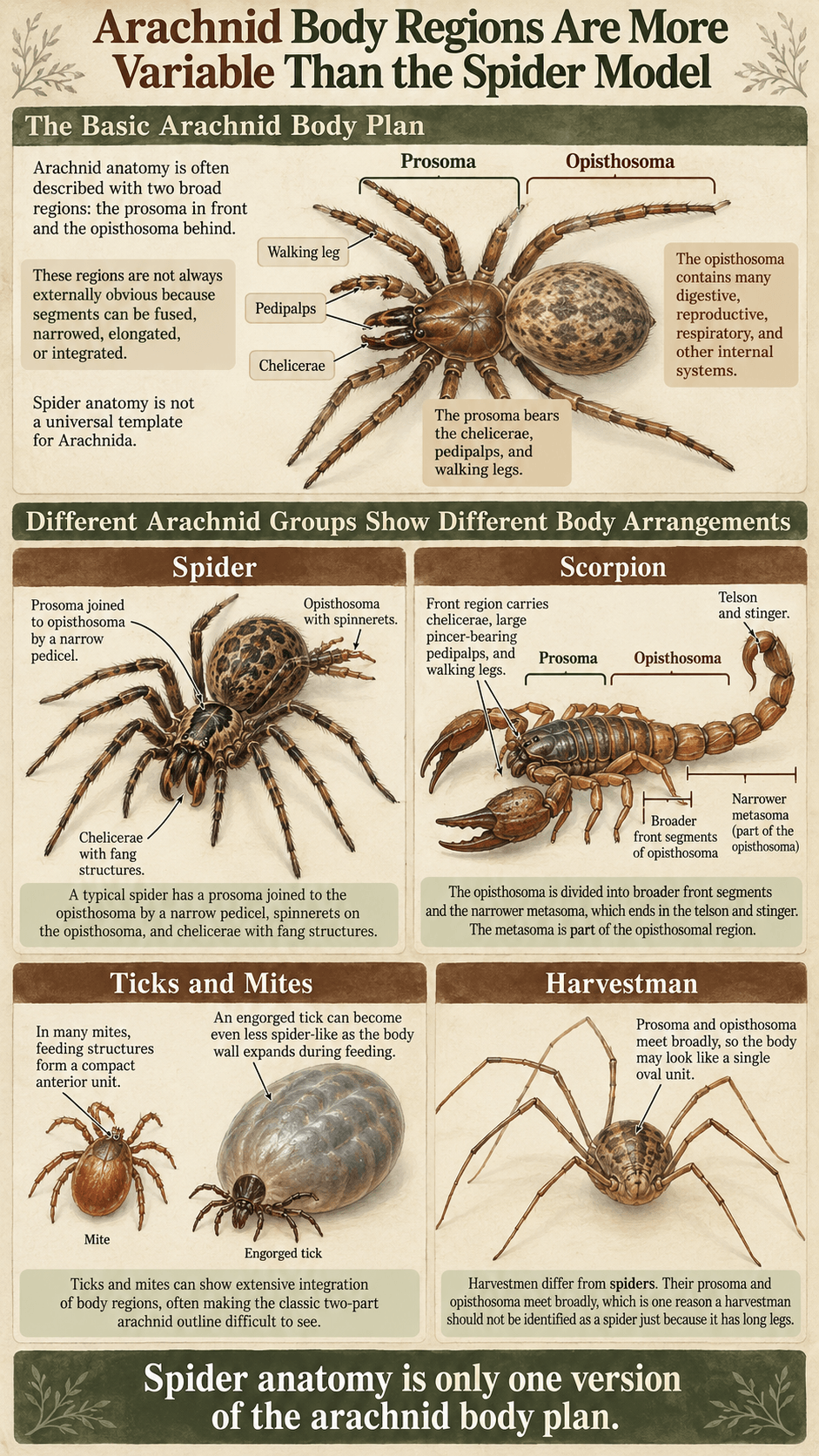
Arachnid Body Regions Are More Variable Than the Spider Model
Prosoma and opisthosoma
Arachnid anatomy is often described using two broad regions: the prosoma in front and the opisthosoma behind. The prosoma bears the chelicerae, pedipalps, and walking legs. The opisthosoma contains many of the digestive, reproductive, respiratory, and other internal systems. These terms are more flexible than simply saying “head” and “abdomen,” because arachnid segments and body regions have been modified in different ways among lineages.
Those regions are not always externally obvious because segments can be fused, narrowed, elongated, or integrated. Spider anatomy is therefore not a universal template for Arachnida.
Spiders compared with scorpions
A typical spider has a prosoma joined to the opisthosoma by a narrow connection called a pedicel. That visible waist is one of the reasons spiders look so different from harvestmen. Spiders also carry their silk-producing spinnerets on the opisthosoma and have chelicerae associated with fang structures.
Scorpions have a different arrangement. Their front region carries the chelicerae, large pincer-bearing pedipalps, and walking legs. Behind it, the opisthosoma is divided into broader front segments and the narrower metasoma, which ends in the telson and stinger. Calling a scorpion’s metasoma simply a “tail” is convenient in everyday language, but anatomically it is part of the opisthosomal region.
Body-region fusion in ticks, mites, and harvestmen
Ticks and mites can show extensive integration of body regions, often making the classic two-part arachnid outline difficult to see. In many mites, feeding structures form a compact anterior unit while the rest of the body can be strongly fused and modified. An engorged tick can become even less spider-like as the body wall expands during feeding.
Harvestmen also differ from spiders. Their prosoma and opisthosoma meet broadly, so the body may look like a single oval unit rather than two sections connected by a narrow waist. This visible integration is one of several reasons a harvestman should not be identified as a spider just because it has long legs.
Chelicerae Are Not Always Fangs
Spider chelicerae and fang-bearing structures
Spiders are the group most likely to make people equate chelicerae with fangs. In spiders, each chelicera includes a fang-bearing terminal element, and most spider lineages possess venom systems associated with those structures. The fangs can help seize prey and deliver venom, but spider venom biology varies widely. The existence of a venom system does not by itself tell you how medically significant a species is to humans.
Scorpion chelicerae versus the telson stinger
Scorpions demonstrate the distinction clearly. Their chelicerae are small structures near the mouth that help tear and manipulate food. The large pincers are pedipalps, not chelicerae. The venom apparatus is associated with the telson at the end of the metasoma, not with the mouthparts.
Appendage position keeps the anatomy straight: scorpion pincers are pedipalps, while the stinger belongs to the telson.
Tick mouthparts, harvestman chelicerae, and solifuge chelicerae
Ticks use a specialized mouthpart complex that includes chelicerae and a hypostome. Their feeding system is adapted for prolonged attachment to hosts, so it looks very different from the fang system of a spider. Harvestmen use chelicerae in feeding but generally do not have the spider-style venom-delivery arrangement that fuels the familiar daddy-longlegs myth.
Solifuges, sometimes called camel spiders or wind scorpions, have extremely prominent chelicerae that are mechanically important in feeding. Their size can look dramatic, but large chelicerae do not automatically indicate a venom system. This is another reason function should be verified rather than guessed from appearance.
Pedipalps Are Not Always Pincers
Spider sensory and reproductive palps
In spiders, pedipalps usually resemble short leg-like appendages near the mouth. They help sense and manipulate nearby objects and food. In adult males, the ends of the pedipalps are modified into reproductive structures used to transfer sperm during mating. These reproductive modifications can be important for identifying adult male spiders because their shapes vary among groups.
Calling every pedipalp a pincer would therefore be wrong. In a spider, the most obvious pincer-like structures are usually absent, yet the pedipalps are still present and biologically important.
Scorpion and pseudoscorpion chelae
Scorpions represent the opposite extreme. Their pedipalps are enlarged into powerful chelae, or pincers, used for grasping prey, defense, and other interactions. Pseudoscorpions also have large pincer-bearing pedipalps relative to body size, which contributes to their superficial resemblance to tiny scorpions.
Despite that resemblance, pseudoscorpions lack the long segmented metasoma and terminal stinger of true scorpions. The shared pincer-like pedipalps reflect modification of the same appendage pair, not proof that the two animals have identical body plans.
Raptorial pedipalps in whip spiders
Tailless whip spiders provide another variation. Their pedipalps are built as spiny grasping structures that can snap around prey. At the same time, the first walking-leg pair has become extremely elongated and sensory. The result is an animal whose front end includes multiple specialized appendages, each with a different job.
Chelicerae, pedipalps, and legs are not interchangeable labels. They are corresponding appendage positions that evolution can reshape for different functions.
Arachnids Compared Briefly with Insects
Chelicerates versus pancrustacean hexapods
Arachnids and insects are both arthropods, but they belong to different major branches. Arachnids are chelicerates. Insects are hexapods within the pancrustacean branch. Their shared arthropod ancestry explains features such as jointed appendages and an external cuticle, while their deeper lineage differences explain why their front appendages and body organization are not the same.
This is why an arachnid should not be described as an insect with two extra legs. The difference goes far beyond six versus eight legs. The two groups inherited different appendage arrangements and then evolved their own enormous diversity from those starting points.
Leg pattern, antennae, and body organization
An adult insect normally has three pairs of legs attached to the thorax and one pair of antennae on the head. Many insects have wings, although numerous lineages are wingless. Arachnids usually have four pairs of walking legs in the post-larval stages, lack true antennae, and do not have wings.
Insects are commonly described with three main body regions: head, thorax, and abdomen. Arachnids are more often discussed in terms of prosoma and opisthosoma, but the visible expression of those regions varies substantially. A spider’s narrow waist, a harvestman’s broadly joined body, and a tick’s compact form all show why a single silhouette is not enough.
Why a short comparison works better than a full insect lesson
For quick identification, compare insect antennae and six adult legs with arachnid chelicerae, pedipalps, and the typical four-pair leg arrangement. Deeper comparisons become much more complex because both branches contain enormous diversity.
Spiders, scorpions, ticks, mites, and harvestmen belong together because they share chelicerate ancestry and a related appendage plan, not because they all look alike.
Common Mistakes and Myths
Arachnids are insects with two extra legs
This shortcut hides the real biology. Arachnids and insects are both arthropods, but their appendages are organized differently and they belong to different major lineages. Leg number is useful for quick recognition of many adults, yet chelicerae, pedipalps, antennae, body-region organization, and developmental history provide the stronger explanation.
All arachnids have fangs or venom
They do not. Spider chelicerae commonly include fangs, and scorpions have a venom-delivering stinger, but other arachnids use very different feeding and defensive systems. Harvestmen do not have spider-style venom fangs. Amblypygids lack venomous fangs. Solifuge chelicerae can be large and powerful without fitting the familiar spider venom model.
Even among venom-bearing groups, venom should not be treated as a synonym for danger to people. Biological function, delivery system, dose, species, and exposure context all matter.
Every arachnid has two obvious body sections
The prosoma-opisthosoma framework is useful, but the boundary can be obvious, subtle, or heavily modified. Spiders usually show a conspicuous narrow connection. Harvestmen are more broadly joined. Ticks and mites can have extensive fusion that obscures the familiar two-part outline. A body that looks like one rounded unit can still belong to Arachnida.
Edge Cases and Taxonomy Cautions
Acari and changing higher-level classification
Mites and ticks are traditionally grouped under Acari, but their higher-level classification has been revised repeatedly. Modern treatments often distinguish major acariform and parasitiform lineages, and researchers have debated whether traditional Acari represents one natural evolutionary group. The American Arachnological Society’s Acari summary explicitly notes that acarid ranks have changed and that relationships among mites, ticks, and other arachnids remain an active research area.
For general readers, the safest formulation is that mites and ticks are arachnids traditionally grouped within Acari, while the exact higher-level arrangement can vary among modern classifications. That keeps the biology clear without pretending a complicated systematic question has one timeless answer.
Horseshoe crabs as chelicerates and why their placement needs qualification
Horseshoe crabs are chelicerates, not crustacean crabs. Their exact relationship to the traditional terrestrial arachnid groups has become a notable phylogenetic question. Some molecular analyses have placed horseshoe crabs within a broader arachnid assemblage, while other analyses recover them outside a monophyletic Arachnida.
A Nature Communications phylogenomic study of Chelicerata recovered horseshoe crabs as a sister lineage outside a monophyletic terrestrial Arachnida under its preferred analyses, while also discussing why other datasets have produced different placements. For a general identification guide, it is therefore better to describe horseshoe crabs securely as chelicerates and avoid presenting them as an ordinary, uncontested example of an arachnid.
Why These Traits Matter Across Arachnid Biology
Diversity extends far beyond spiders
Once chelicerae, pedipalps, appendage organization, and development are understood, many unfamiliar arachnids become easier to place. A pseudoscorpion’s tiny body and large palps, a harvestman’s integrated outline, and a tick’s compact shape no longer look like exceptions that break the category. They become different expressions of the same deeper chelicerate framework.
Spiders are extraordinarily diverse, but they are only one branch among scorpions, harvestmen, mites, ticks, solifuges, pseudoscorpions, whip spiders, vinegaroons, and smaller lineages.
Body structure helps explain function
The defining appendages are not just classification markers. Their modifications affect how arachnids live. Scorpion pedipalps grasp prey and can contribute to defense. Spider palps help with sensing and reproduction. Tick mouthparts are adapted for attachment and feeding. Amblypygid first legs function as sensory probes. Solifuge chelicerae are mechanically powerful tools.
Seeing those structures as modified versions of corresponding appendages makes comparative anatomy much easier to understand. Similar positions can evolve different forms and functions without losing their underlying relationship.
Movement, senses, feeding, and development add context
Arachnid identity becomes even clearer when anatomy is considered together with behavior and development. The same body plan supports web-building, active hunting, burrowing, host seeking, scavenging, parasitism, sensory probing, and many other lifestyles. Developmental stages can alter leg number, while different groups modify appendages for locomotion or sensing.
An arachnid is not defined by being predatory, using venom, having eight eyes, making silk, or looking like a spider. Chelicerate ancestry expressed through a flexible appendage and body-region plan is the more reliable picture.
FAQ
Is a spider an arachnid?
Yes. Spiders belong to the order Araneae within Arachnida. They show the classic arachnid arrangement of chelicerae, pedipalps, and four pairs of walking legs in adults. However, spider features such as a narrow pedicel, silk-producing spinnerets, and fang-bearing chelicerae should not be assumed to occur in every other arachnid group.
Are ticks and mites arachnids?
Yes. Ticks and mites are arachnids traditionally grouped within Acari. Their higher-level classification is complex and has been revised over time, but they are part of the arachnid branch rather than insects. Their compact bodies and tiny size can make the usual arachnid features less obvious at a glance.
Can an arachnid have six legs?
Yes, at certain developmental stages. Tick larvae are six-legged, and many mites also pass through a six-legged larval stage. Later stages typically have four pairs of legs. An arachnid can also appear to have fewer than eight legs after injury or leg loss, so visible leg count alone is not enough for reliable classification.
Do arachnids have antennae?
No true antennae are part of the arachnid body plan. Some arachnids have appendages that perform antenna-like sensory jobs. Tailless whip spiders, for example, use their very long first leg pair as sensory organs. Those are modified legs, not antennae.
Are harvestmen spiders?
No. Harvestmen belong to the order Opiliones, while true spiders belong to Araneae. Both are arachnids, which is why they share broad features such as chelicerae, pedipalps, and a typical adult eight-leg pattern. Harvestmen generally lack the spider’s narrow waist, and they should not be treated as long-legged spiders.
Final Thoughts
What makes an animal an arachnid is a combination of ancestry and anatomy, not one easy visual rule. Arachnids are chelicerate arthropods with chelicerae, pedipalps, no true antennae, and usually four pairs of walking legs after early larval development. Their body regions, mouthparts, sensory structures, and appendages can be modified so strongly that a tick, scorpion, harvestman, mite, and spider may look only loosely similar.
The most useful takeaway is to replace the phrase “eight-legged animal” with a fuller biological picture. Eight legs are common, but chelicerate ancestry, appendage position, development, and body organization explain the group much better. Once those traits are recognized, the remarkable variety within Arachnida becomes easier to see without forcing every member into a spider-shaped mold.

Ethan Walker is the founder and research editor of Animal Fact Central. He creates and reviews educational animal facts content using trusted wildlife, pet care, and science-based sources. His work focuses on making animal behavior, adaptations, habitats, and species facts clear, accurate, and engaging for everyday readers.
Read More Details About Ethan Walker: https://animalfactcentral.com/ethan-walker/