
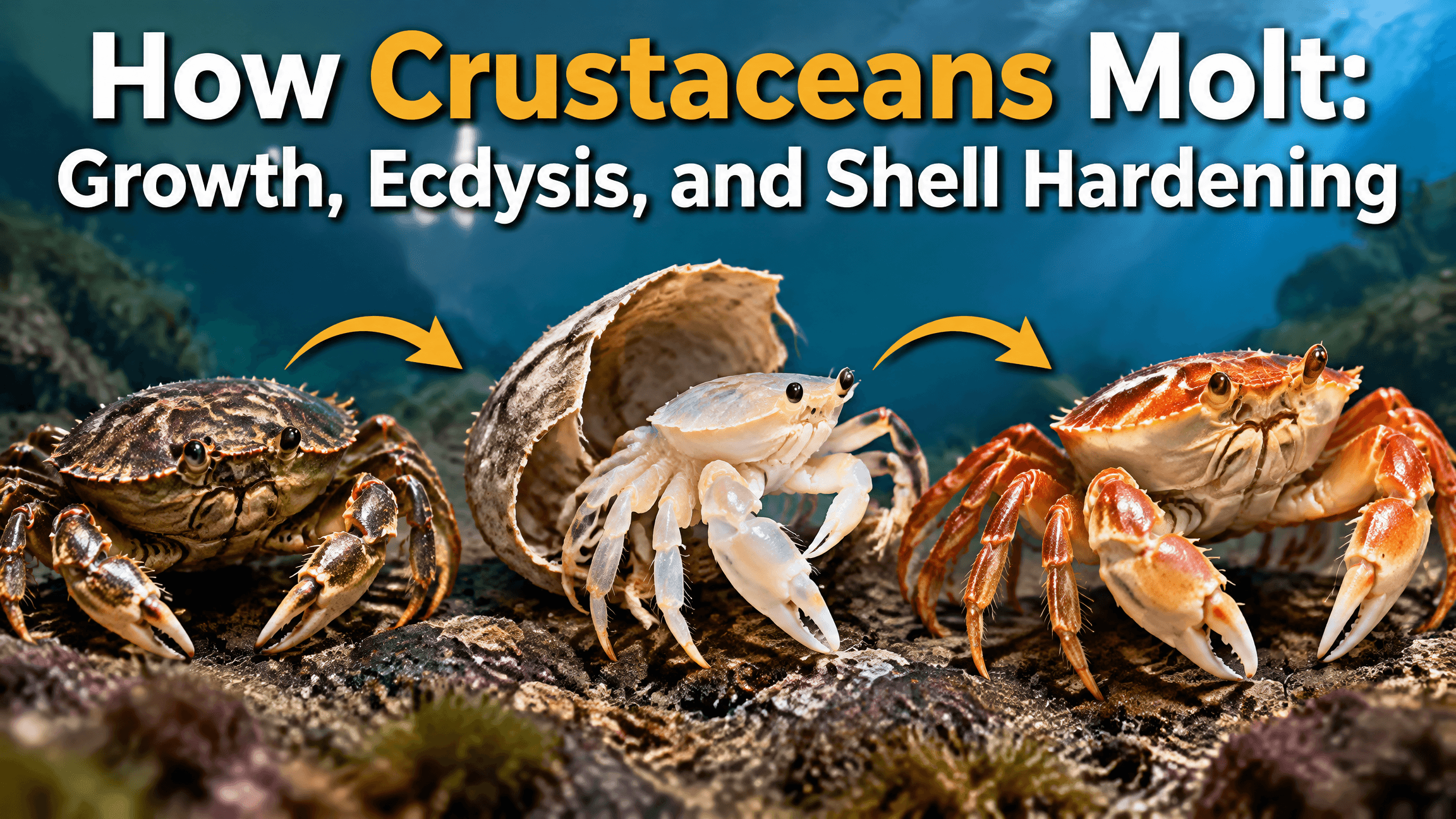
Crustaceans grow by periodically replacing their external cuticle, the body covering that forms much of the exoskeleton. The shedding event itself is called ecdysis, but molting is a longer cycle. Before ecdysis, the animal separates from parts of the old cuticle and prepares a new one underneath. During ecdysis it withdraws from the old covering. Afterward, the new cuticle expands and gradually becomes tougher and, in many crustaceans, more heavily mineralized.
This process is easy to oversimplify because familiar crabs and lobsters have strongly calcified shells. Crustaceans, however, include shrimp, crayfish, isopods, amphipods, copepods, barnacles, branchiopods, ostracods, and many other lineages. Their molt timing, mineral use, behavior, and adult growth patterns differ. Understanding how crustaceans molt means looking at the shared cycle without turning one crab or lobster pattern into a rule for the entire group.
Quick Answer
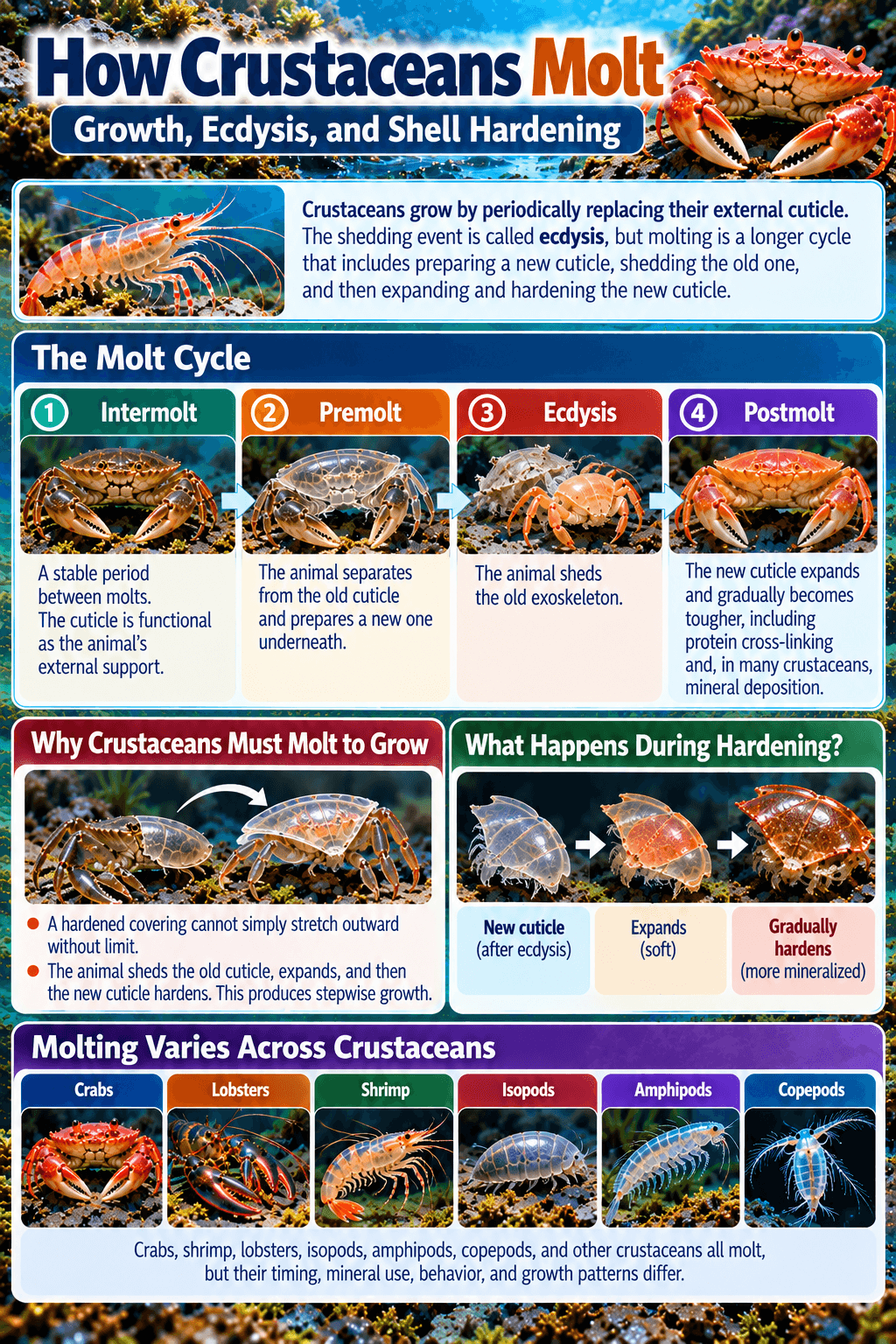
How do crustaceans molt? They pass through a repeating sequence that can be summarized as intermolt, premolt, ecdysis, and postmolt. During premolt, the epidermis begins preparing the next cuticle beneath the old one and may reclaim some materials from the old cuticle. Ecdysis is the moment when the animal sheds the old exoskeleton. During postmolt, the new cuticle expands and hardens through processes that include protein cross-linking and, in many lineages, mineral deposition. For a broader view of the animals that share this growth strategy, see the crustacean overview.
The biology behind that outline is highly regulated. In decapod crustaceans, steroid hormones called ecdysteroids and signaling from the Y-organs are central to controlling progression through the molt cycle. A review of hormonal control of the crustacean molting gland describes molting as a coordinated physiological transition rather than a single shedding event. Other crustacean groups share the need to replace cuticle, but the details of timing and regulation can differ.
Why Crustaceans Must Molt to Grow

Cuticle constraints and stepwise growth
A crustacean’s external cuticle protects and supports the body, but a hardened covering cannot simply stretch outward without limit. Growth therefore requires a periodic reset. The animal constructs a new cuticle beneath the old one, sheds the old covering, and expands before the replacement has reached its later stiffness.
This produces stepwise external growth. Measurements such as carapace width or body length may jump noticeably after a molt rather than increasing smoothly every day. That does not mean the animal’s living tissues are inactive between molts. Muscle, internal organs, stored nutrients, and other tissues can change throughout the cycle. What changes abruptly at ecdysis is the space available inside the external cuticle.
Why tissue growth is not limited to the minutes after shedding
A common misconception is that a crustacean grows only during the brief period when it is leaving the old shell. The immediate expansion after ecdysis is important, especially in many decapods, because the new cuticle is still flexible. But that expansion creates room for later tissue growth. Body composition and mass can continue changing after the cuticle stops stretching substantially.
Molting is therefore better understood as a cycle of preparation, shedding, expansion, hardening, and growth within the new body envelope. The amount of size increase depends on species, life stage, nutrition, temperature, reproductive condition, and other environmental and physiological factors.
The Molt Cycle

Intermolt
Intermolt is the relatively stable part of the cycle between postmolt hardening and the next premolt. The cuticle is functional as the animal’s external support, and normal feeding, movement, and other activities may dominate this period. Intermolt length varies greatly. A small rapidly growing crustacean may cycle quickly, while a larger or older individual may spend much longer between molts.
Researchers often divide crustacean molt cycles into finer stages, but those staging systems are tools rather than universal clocks. A recent Journal of Crustacean Biology study of Atlantic ditch shrimp used postmolt, intermolt, premolt, and ecdysis stages, while also emphasizing that detailed visible criteria differ among species.
Premolt and preparation of a new cuticle
Premolt begins well before the old cuticle is shed. One important event is apolysis, the separation of the epidermis from the old cuticle. The epidermis then helps build new cuticular layers underneath. Enzymatic and mineral-handling processes can also change as the animal prepares to discard the old covering.
In some heavily mineralized crustaceans, parts of the old cuticle lose mineral before ecdysis and some of that material may be retained inside the body. The exact storage site and importance of this recycling differ among lineages. It is not accurate to imagine the entire old exoskeleton dissolving into the animal.
Ecdysis
Ecdysis is the actual shedding event. The old cuticle splits at species-specific weak points or sutures, and the animal withdraws its body and appendages. Because legs, antennae, mouthparts, and other projections are covered by cuticle too, the animal must free far more than a simple dorsal shell.
The time required for ecdysis differs among species and circumstances. It can be relatively rapid compared with the much longer premolt and postmolt periods, but a difficult molt can be dangerous. The animal must coordinate muscular movements, fluid balance, and withdrawal from a complex three-dimensional casing.
Postmolt expansion and hardening
Immediately after ecdysis, the new cuticle is already present. It is not correct to say a freshly molted crustacean has no skeleton at all. The new covering is simply much more flexible and less fully hardened than it will become later.
Many decapods expand by taking up water after ecdysis. That temporary increase stretches the soft cuticle and creates a larger body envelope. As the cuticle stiffens, the animal progressively shifts back toward relying on a rigid external skeleton for support. Later, tissue growth occupies more of the space initially created by expansion.
What Happens to Minerals Before a Molt?
Reabsorption and temporary storage in some lineages
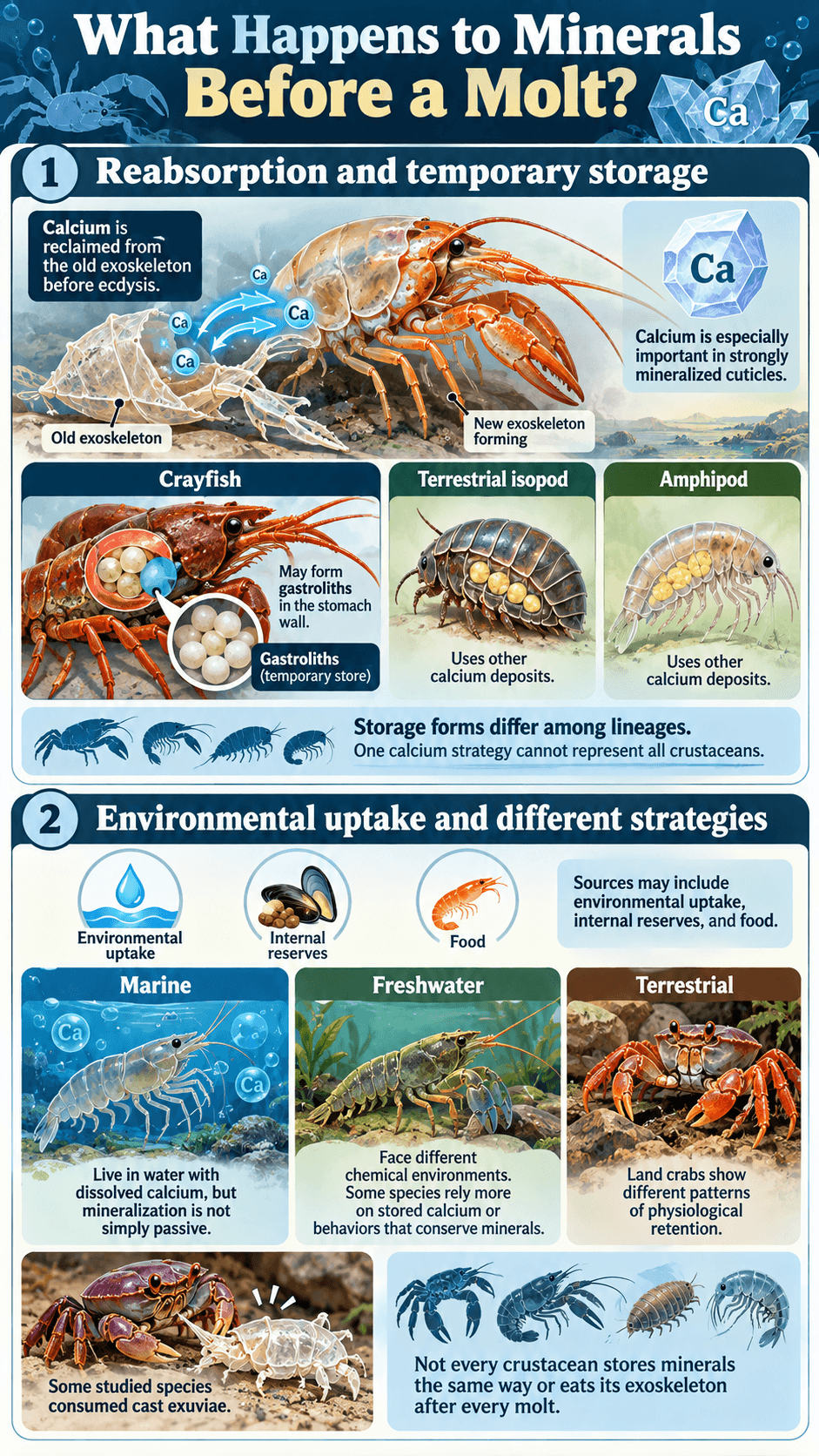
Calcium is especially important in crustaceans with strongly mineralized cuticles. Before ecdysis, some species reclaim part of the calcium associated with the old exoskeleton and place it in temporary internal stores. These stores can take very different forms. Some crayfish form gastroliths in the stomach wall, while various terrestrial isopods and amphipods use other calcium deposits.
A broad review of crustacean biomineralization shows why one calcium strategy cannot represent all crustaceans. Sources may include environmental uptake, internal reserves, and food, and their relative importance changes with lineage and habitat.
Environmental mineral uptake and why strategies differ
Marine crustaceans live in water that contains dissolved calcium, but even there, mineralization is not simply passive. Freshwater and terrestrial crustaceans face different chemical environments, and some species rely more heavily on stored calcium or behavioral strategies that help conserve minerals.
Land crabs provide a useful example of this diversity. A Journal of Crustacean Biology study of calcium and magnesium balance in land crabs found different patterns of physiological retention and also documented consumption of cast exuviae in the species examined. That does not mean every crustacean stores minerals the same way or eats its exoskeleton after every molt.
The Soft-Shell Stage After Ecdysis
A new cuticle is present but not fully hardened
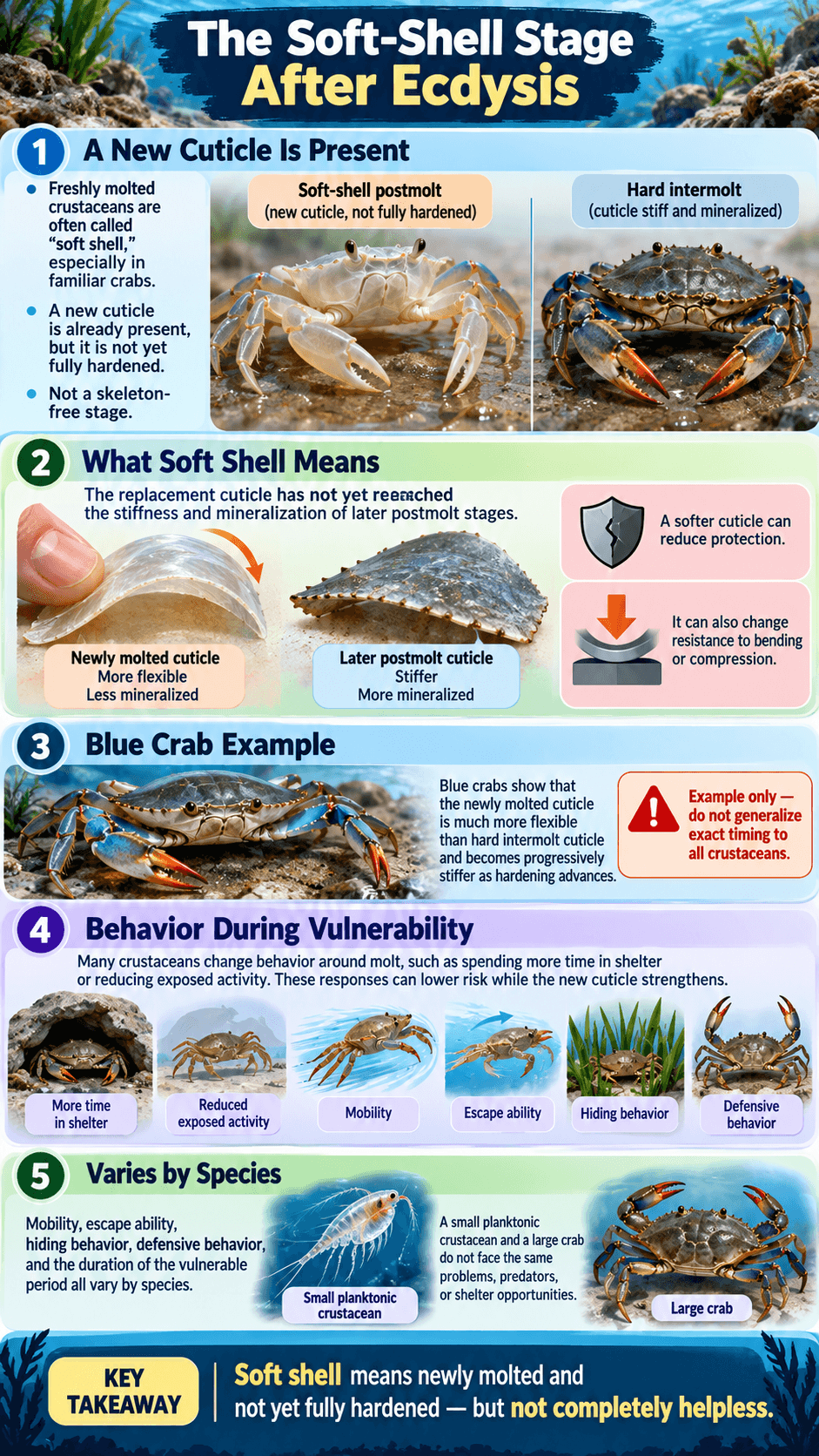
Freshly molted crustaceans are often described as “soft shell,” especially in familiar crabs. Biologically, this means the replacement cuticle has not yet reached the stiffness and mineralization of later postmolt stages. It is not an empty period between skeletons.
Work on blue crabs illustrates how dramatic the mechanical change can be. A Journal of Experimental Biology study of molting blue crabs found that the newly molted cuticle was far more flexible than hard intermolt cuticle and became progressively stiffer as hardening advanced. Blue crabs are a useful example, but their exact timing should not be generalized to all crustaceans.
Vulnerability and behavior vary by species
A softer cuticle can reduce protection and change how effectively the body resists bending or compression. Many crustaceans alter their behavior around molt, for example by spending more time in shelter or reducing exposed activity. These responses can lower risk while the new cuticle strengthens.
Still, “soft” does not mean completely helpless. Mobility, escape ability, hiding behavior, defensive behavior, and the duration of the vulnerable period all vary. A small planktonic crustacean and a large crab do not face the same mechanical problems, predators, or opportunities for shelter.
How the New Cuticle Hardens
Sclerotization and mineralization concepts
Hardening is not a single chemical event. Sclerotization involves cross-linking molecules within the cuticular matrix, which makes the material tougher and less flexible. Many crustaceans also add mineral, especially calcium carbonate, to parts of the cuticle. These processes work together in different proportions across species and body regions.
Even within one animal, cuticle properties are not uniform. Joints need flexibility, gill surfaces must remain suitable for gas exchange, and different appendages may experience different mechanical loads. A heavily reinforced claw and a thin articulating membrane cannot be built to the same specifications.
Calcification in heavily mineralized crustaceans
Calcification is especially conspicuous in crabs, lobsters, crayfish, and many other decapods. After ecdysis, calcium carbonate is deposited within an organic framework containing chitin and proteins. Mineral content rises as the cuticle matures, increasing stiffness and resistance to deformation.
However, not every crustacean has a thick, strongly calcified external covering. Many tiny crustaceans and specialized lineages have thinner or differently reinforced cuticles. It is more accurate to say that calcification is an important crustacean strategy than to make heavy mineralization part of a one-size-fits-all definition.
Marine versus freshwater mineral constraints without overgeneralizing
Habitat influences access to dissolved ions, but simple labels such as marine, freshwater, and terrestrial do not predict one fixed hardening strategy. Water chemistry varies among habitats, and crustaceans differ in physiology, diet, mineral storage, and the permeability of respiratory surfaces.
Freshwater species can face lower external calcium availability than many marine species, which makes internal storage and efficient uptake especially important in some taxa. Terrestrial crustaceans must solve mineral balance while also limiting water loss. The important point is variation: evolution has produced multiple ways to rebuild a functional cuticle after each molt.
How Much Does a Crustacean Grow at Each Molt?
Species, age, sex, temperature, food, and reproductive condition
There is no universal percentage increase per molt. A juvenile in a rapid growth phase may gain proportionally more size than an older individual. Temperature can affect metabolism and molt interval in ectothermic crustaceans. Food availability influences the energy and materials available for growth. Reproductive condition can also shift how resources are allocated.
Sex differences may matter in species where males and females mature at different sizes or follow different reproductive schedules. Environmental stress, salinity, oxygen, season, and social conditions can also change molting patterns in some species. Because these effects interact, a precise growth increment from one laboratory population should not be treated as a rule for an entire species, much less for all crustaceans.
Why there is no fixed percentage increase
The size increase at molt depends on how much the new cuticle expands and how the animal’s tissues fill the new space afterward. Growth is therefore influenced by both the mechanics of ecdysis and the animal’s physiological condition before and after the molt.
This is why statements such as “crustaceans grow 20 percent every molt” are misleading unless they refer to a specific species, size class, experiment, and measurement. Even within a species, molt increments often change as animals age.
Molting and Regeneration
Regrowth across multiple molt cycles
Many crustaceans can regenerate lost or damaged appendages, but regeneration is tightly connected to the molt cycle. New tissue develops before it can emerge and expand as part of a later molt. Depending on the species and the severity of injury, a replacement limb may be smaller at first and approach normal proportions over additional molts.
A review of limb regeneration across Pancrustacea describes crustacean appendage regrowth as a developmental process coordinated with molting. This is one reason it is inaccurate to promise that a missing claw will be fully restored after exactly one molt.
Why a lost claw does not always return perfectly after one molt
Regeneration depends on the location and extent of damage, developmental stage, health, species, and number of future molts available. A young crustacean that molts frequently may have more opportunities for progressive regrowth than an adult that molts rarely or has reached a terminal molt.
Regeneration should not be treated as a harmless experiment. Deliberately removing a limb stresses and injures the animal, can reduce feeding or defense, and may alter later molting. Observing natural regeneration is biologically informative without causing damage to demonstrate the process.
Molting and Reproduction
Why timing can be linked in some species
In many crustaceans, reproductive events are coordinated with molt state because the condition of the cuticle affects mating, brooding, body expansion, and access to reproductive openings. Some decapods mate when a female is newly molted or near a molt, while other species follow different timing.
Hormonal systems also connect growth and reproduction. Ecdysteroids are central to molting, and reproductive tissues can respond to or interact with endocrine signals associated with the molt cycle. The relationship is biologically important, but it is not the same in crabs, shrimp, lobsters, isopods, copepods, barnacles, and branchiopods.
Why one crab or lobster pattern is not universal
Popular explanations often describe a single sequence such as “female molts, then mates” as if it defines crustacean reproduction. That can be accurate for particular species but fails as a group-wide rule. Some crustaceans brood young between molts, some coordinate reproduction with seasonal cycles, and some lineages have reproductive systems very different from those of decapods.
The safest general statement is that molting and reproduction often interact, while the direction and timing of that interaction must be checked at the species or lineage level.
Molting Across Different Crustaceans
Decapods
Crabs, lobsters, crayfish, and many shrimp are the best-known examples because their molts are conspicuous and many species have strongly mineralized cuticles. Decapod studies provide much of what is known about premolt calcium handling, postmolt water uptake, Y-organ control, cuticle calcification, and mechanical changes during hardening.
That research is valuable, but decapods are only one branch of crustacean diversity. Their body size, gill systems, heavy mineralization, and large walking limbs make some of their molting challenges especially visible.
Isopods, amphipods, and smaller crustaceans
Isopods show why even the act of shedding can differ. Many terrestrial isopods perform a biphasic molt, shedding the rear and front portions of the body in separate phases rather than leaving the entire old cuticle at once. Amphipods include aquatic and semi-terrestrial species with their own mineral-storage strategies and molt timing.
Copepods, branchiopods, ostracods, and other small crustaceans also molt as they develop, but their body proportions, cuticle thickness, number of juvenile stages, and adult patterns differ widely. Barnacles add another striking contrast because their adult bodies are highly modified for attached life, yet their development still includes cuticle replacement and stage transitions.
Why staging and timing differ
The familiar A, B, C, D, and E style of molt staging arose from detailed observations and remains useful in many studies, particularly for decapods. But visible markers that work well for one species may not map neatly onto another. Researchers may use setal changes, cuticle appearance, hormone levels, behavior, or other anatomical features to determine molt stage.
This variation is not a problem with the concept of the molt cycle. It reflects the fact that a shared arthropod process has been modified across many crustacean body plans and life histories.
Common Molting Myths
The old shell is not simply dissolved and fully reused
Some crustaceans reclaim part of the mineral associated with the old cuticle before ecdysis, and some may consume the shed exuvia afterward. Neither process means the entire old shell is dissolved and turned directly into the next one. Large parts of the old exoskeleton are discarded, while calcium and other materials can come from internal stores, the environment, and food.
A freshly molted animal does not have no skeleton
The new cuticle is already in place when the old one is shed. Early postmolt cuticle is softer and more flexible, and in many species it is less mineralized than later stages. Its mechanical role changes during hardening, but it is still a real body covering that contains structural molecules and separates the animal from its environment.
All crustaceans do not molt on one schedule
Molt interval can change with species, age, body size, temperature, food, season, reproductive state, and other factors. Some species continue molting after sexual maturity. Others have a terminal molt or greatly reduce molting as adults. Any claim about exact molt frequency needs a clearly identified species and life stage.
How Molting Relates to Anatomy, Growth, and Reproduction
Anatomy and cuticle structure
Molting makes more sense when the cuticle is viewed as a whole-body structure rather than as a removable shell sitting on top of the animal. Cuticle covers body segments and appendages, forms joint surfaces, lines parts of the digestive tract, and varies in thickness and mineralization. Those anatomical differences influence where the old covering can split, how flexible the new cuticle must be, and how quickly different regions can return to full mechanical strength.
Reproduction, growth, and behavior around molt
The molt cycle can reshape everyday behavior. Feeding may change, shelter use may increase, and mating opportunities may be tied to particular stages in some species. Growth and regeneration are also constrained by how often an individual molts. A juvenile with frequent molts can change body size and replace damaged structures more rapidly than an animal with long intervals between ecdyses.
These connections are why crustacean molting is more than a shell-changing trick. It is a recurring physiological event that reorganizes how the animal grows, moves, defends itself, uses minerals, repairs injuries, and sometimes reproduces.
FAQ
Do crustaceans eat their old exoskeleton?
Some do. Eating the shed exuvia can help certain crustaceans recover minerals and other materials, and this behavior has been documented in some land crabs and other groups. It is not universal, and the nutritional importance of the exuvia varies. Many crustaceans also obtain minerals from water, food, or internal stores.
How long does a crustacean stay soft after molting?
There is no single answer. Hardening time depends on the species, body size, temperature, water chemistry, mineral availability, and what part of the cuticle is being considered. In some decapods, major changes begin within hours, while full maturation of the cuticle takes longer. Exact times from blue crabs, lobsters, or shrimp should not be applied automatically to other crustaceans.
Can crustaceans regrow lost limbs?
Many crustaceans can regenerate appendages, but regrowth usually depends on future molts. A replacement may appear smaller at first and improve over later molt cycles. Regenerative ability varies with species, age, injury, and molt pattern, so a lost claw or leg is not guaranteed to return perfectly after one molt.
Do crustaceans stop molting when they become adults?
Not all of them. Some crustaceans continue to molt after sexual maturity, while others have a terminal molt or show major reductions in adult molting. Adult molt patterns are lineage- and species-specific. That difference is another reason group-wide statements about crustacean molt frequency are unreliable.
Final Thoughts
Crustacean molting is a full physiological cycle, not just the instant when an animal climbs out of an old shell. Premolt prepares a new cuticle and, in some species, recovers useful minerals. Ecdysis removes the old covering. Postmolt expansion and hardening then rebuild a mechanically effective exoskeleton through sclerotization, mineralization, or both.
The broad sequence is shared, but the details are diverse. Crabs, shrimp, crayfish, isopods, amphipods, copepods, barnacles, and other crustaceans differ in mineral storage, timing, adult molt patterns, regeneration, and reproductive links. Keeping those differences in view gives a more accurate answer to how crustaceans molt than any single crab-based model can provide.

Ethan Walker is the founder and research editor of Animal Fact Central. He creates and reviews educational animal facts content using trusted wildlife, pet care, and science-based sources. His work focuses on making animal behavior, adaptations, habitats, and species facts clear, accurate, and engaging for everyday readers.
Read More Details About Ethan Walker: https://animalfactcentral.com/ethan-walker/