
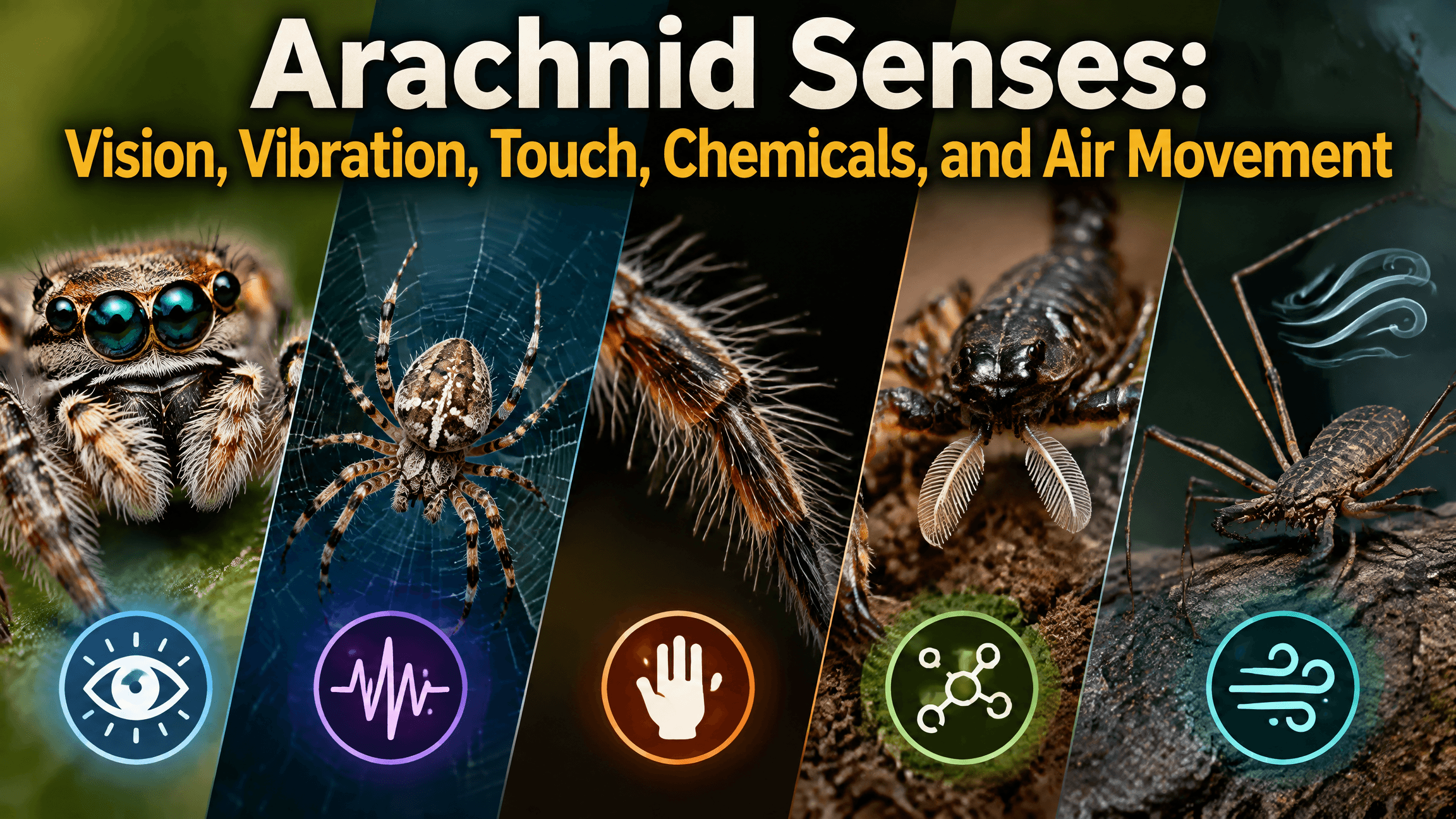
Arachnids do not experience the world through one standard set of senses. A jumping spider can rely heavily on vision, a web-building spider may depend more on vibration, a scorpion can sample the ground with comb-like pectines, a tick carries Haller’s organ on its first pair of legs, and a tailless whip spider sweeps its surroundings with extraordinarily long sensory legs. Mites add even more variation because they occupy habitats ranging from soil and plants to water and animal hosts.
That diversity makes arachnid senses especially useful for understanding how anatomy, habitat, and behavior fit together. Eyes, hairs, slits in the cuticle, chemical receptors, humidity sensors, and temperature-sensitive structures can all contribute information. Different groups combine those channels in different proportions, so statements such as “spiders have poor eyesight” or “ticks smell with their feet” are too simple to describe the biology accurately.
Quick Answer
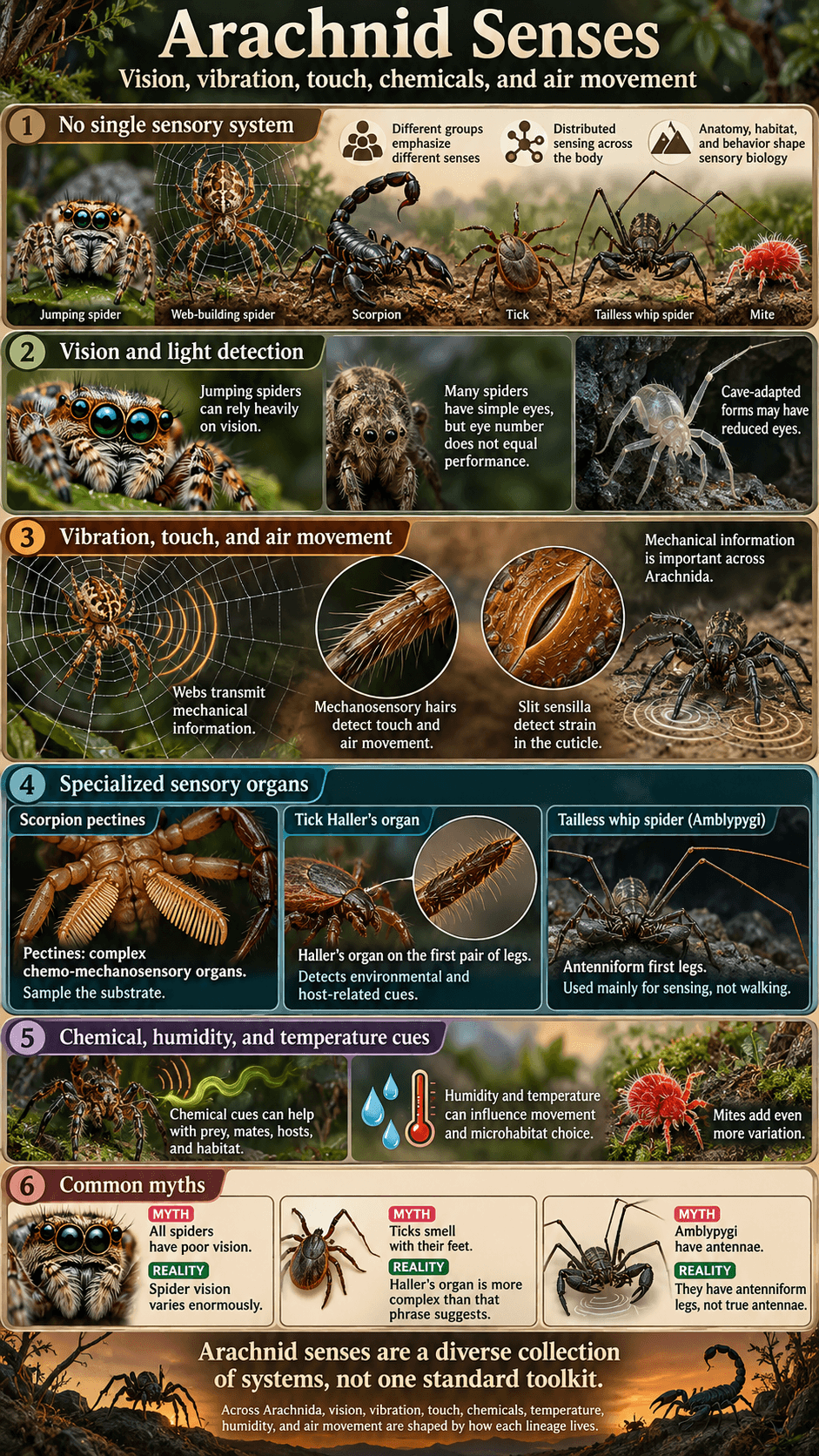
Arachnids can detect light, movement, substrate vibration, touch, air movement, chemicals, humidity, temperature, and other environmental cues through specialized sensory structures. Which senses matter most depends on the lineage and lifestyle. Many spiders use simple eyes plus mechanosensory hairs and slit sensilla. Scorpions have eyes but also rely strongly on mechanoreception and pectines. Ticks use sensory structures on the first legs, including Haller’s organ, to detect chemical and physical cues associated with their environment and potential hosts. Amblypygids devote their elongated first legs largely to sensing rather than walking. This sensory diversity is one more reason the broader arachnid group cannot be explained through a single spider-centered model.
No single sensory organ defines Arachnida. The important pattern is distributed sensing: information comes from eyes, appendages, cuticle, hairs, and specialized organs spread across the body.
Arachnids Do Not Share One Identical Sensory System
Sensory diversity across spiders, scorpions, ticks, mites, harvestmen, and whip spiders
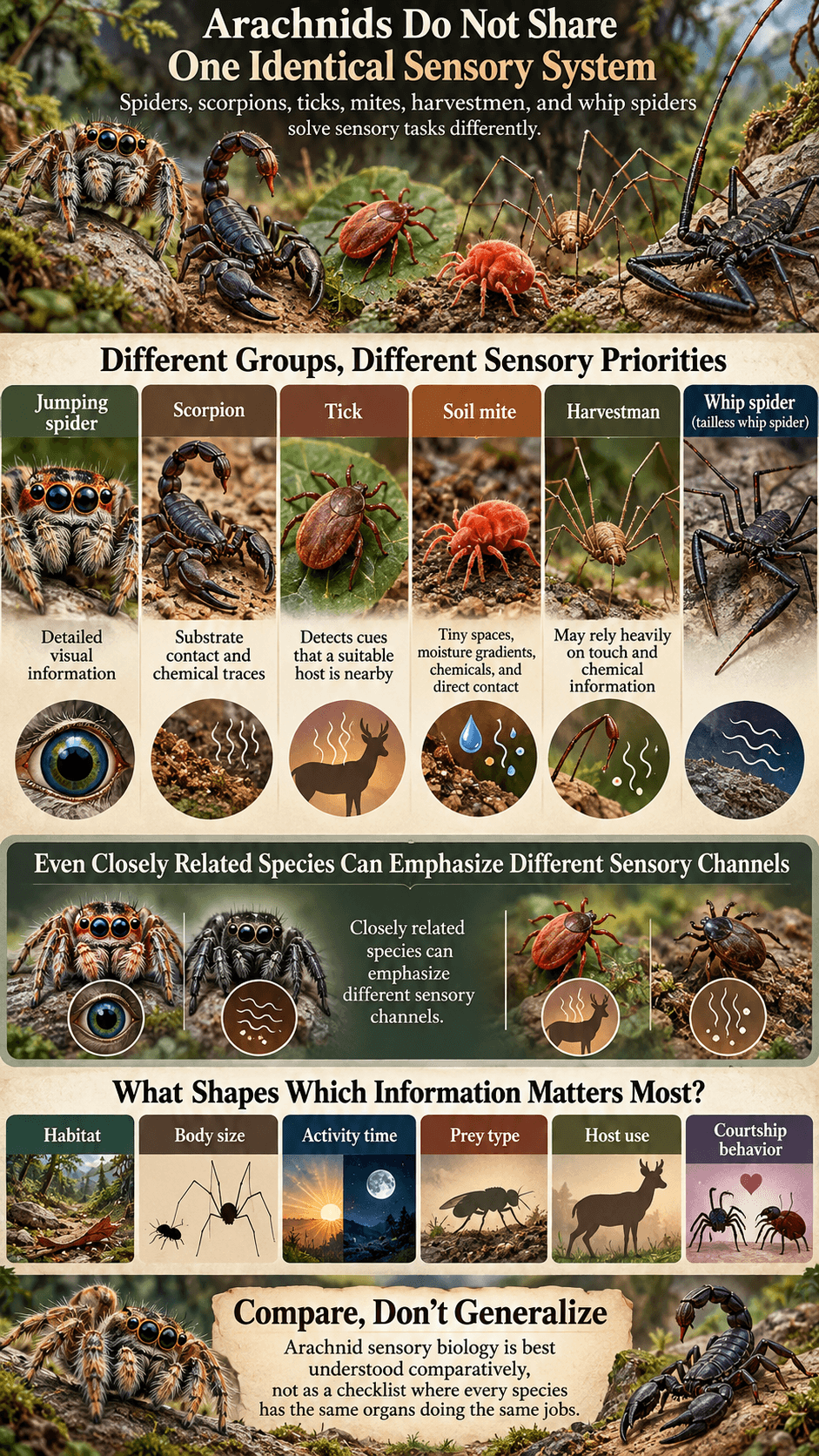
All arachnids must locate resources, avoid hazards, orient through their habitat, and interact with members of their own species, but they solve those tasks differently. A visually hunting salticid spider benefits from detailed visual information. A nocturnal scorpion moving over soil gains more from substrate contact and chemical traces. A tick waiting for a vertebrate host must detect cues that indicate a suitable animal is nearby. A soil mite may live in a world dominated by tiny spaces, moisture gradients, chemicals, and direct contact.
Even closely related species can emphasize different sensory channels. Habitat, body size, activity time, prey type, host use, and courtship behavior all influence which information is most valuable. Arachnid sensory biology is therefore best understood comparatively, not as a checklist in which every species has the same organs performing the same jobs.
Vision and Light Detection
Spider visual diversity
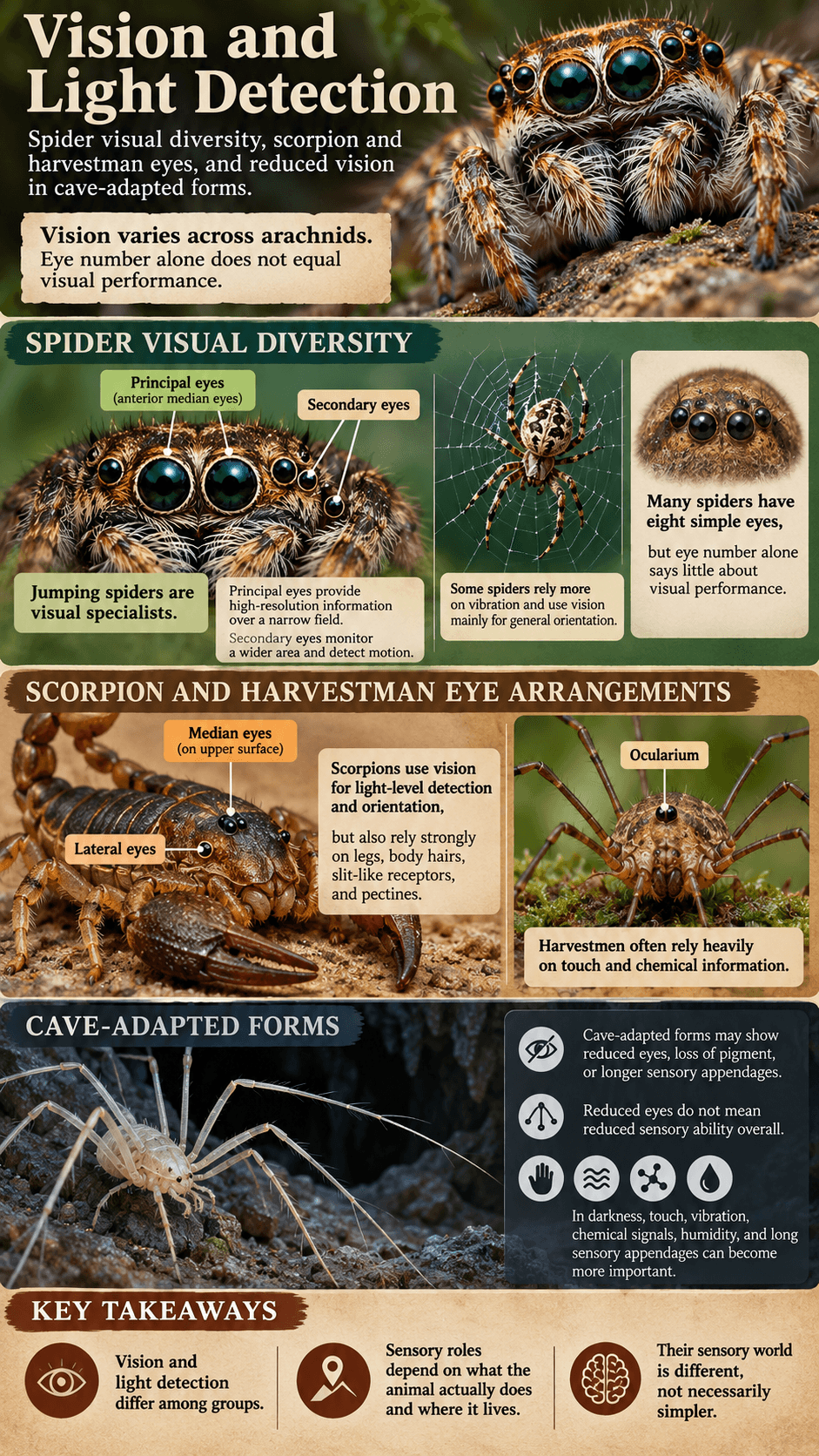
Spider vision ranges from highly developed image-forming systems to limited light detection. Many spiders have eight simple eyes, but eye number alone says little about visual performance. Web-associated species can rely heavily on vibration and may use vision mainly for general orientation, while visually active hunters can extract much more detailed information from their surroundings.
Jumping spiders are the best-known visual specialists. Their large anterior median eyes, often called principal eyes, provide high-resolution information over a relatively narrow field, while the secondary eyes help monitor a wider area and detect motion. Research on salticid vision shows that these eye pairs perform different tasks rather than producing eight identical visual streams. A peer-reviewed study of jumping spider vision also illustrates why broad statements about how all salticids see should be made cautiously, because even within this visually oriented family sensory performance varies by species and light environment.
Other spider groups use vision differently. Wolf spiders, lynx spiders, crab spiders, orb weavers, cave spiders, and trapdoor spiders occupy different visual environments. Eye arrangement can help identify families, but the ecological role of vision depends on what the animal actually does.
Scorpion and harvestman eye arrangements
Scorpions usually have median eyes on the upper surface of the prosoma and may also have lateral eyes, with number and arrangement varying among taxa. Vision can help with light-level detection and orientation, but scorpions also depend strongly on information gathered through the legs, body hairs, slit-like receptors, and pectines.
Many harvestmen have a pair of eyes mounted on a raised structure called an ocularium. Some lineages show reductions or modifications. Harvestmen may also rely heavily on touch and chemical information, especially when moving through litter, vegetation, caves, or other structurally complex habitats.
Reduced vision in cave-adapted forms
Cave environments provide little or no light, so eyes can become reduced over evolutionary time in cave-adapted arachnids. Some cave spiders, harvestmen, pseudoscorpions, and other groups show reduced eyes, loss of pigment, or elongation of sensory appendages, although the exact combination differs among lineages.
Reduced eyes do not mean reduced sensory ability overall. Animals living in darkness can shift emphasis toward touch, vibration, chemical signals, humidity, and long sensory appendages. Their sensory world is different, not necessarily simpler.
Vibration and Substrate-Borne Signals
Web vibration in some spiders
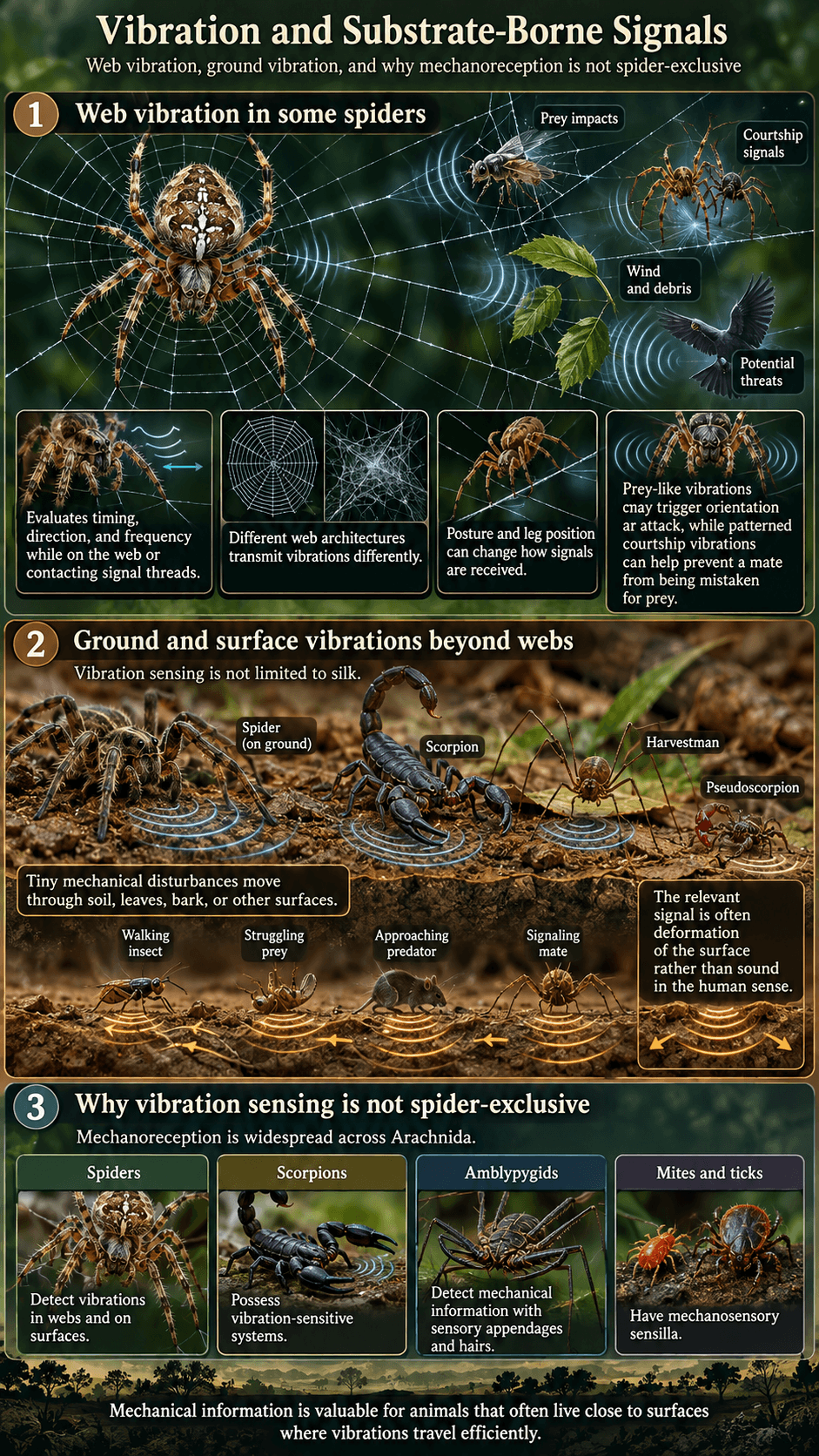
A spider web can function as much more than a trap. For many web-building spiders, silk transmits mechanical information from prey impacts, courtship signals, wind, debris, and potential threats. The spider can evaluate timing, direction, frequency, and other features of those vibrations while standing on the web or contacting signal threads.
Different web architectures transmit vibrations differently, and spiders also alter posture and leg position to change how they receive signals. A vibration that indicates trapped prey may trigger orientation or attack, while patterned courtship vibrations can help prevent a potential mate from being mistaken for prey.
Ground and surface vibrations beyond webs
Vibration sensing is not limited to silk. Wandering spiders detect mechanical disturbances through soil, leaves, bark, and other surfaces. Scorpions can sense substrate-borne cues through receptors in their legs and cuticle. Harvestmen, pseudoscorpions, and other arachnids also respond to mechanical contact and vibration in ways suited to their habitats.
The relevant signal is often deformation of the surface rather than a sound in the human sense. A walking insect, struggling prey item, approaching predator, or signaling mate can generate tiny movements that travel through the substrate and reach the arachnid’s mechanoreceptors.
Why vibration sensing is not spider-exclusive
Spiders have been studied intensively because webs and large sensory organs make experiments practical, but mechanoreception is widespread across Arachnida. Scorpions possess vibration-sensitive systems, Amblypygi detect mechanical information with sensory appendages and hairs, and mites and ticks have various mechanosensory sensilla.
The structures and sensitivities are not identical across groups. What is shared is the value of mechanical information in animals that often live close to surfaces where vibrations travel efficiently.
Mechanosensory Hairs and Air Movement
Trichobothria and hair-based mechanoreception
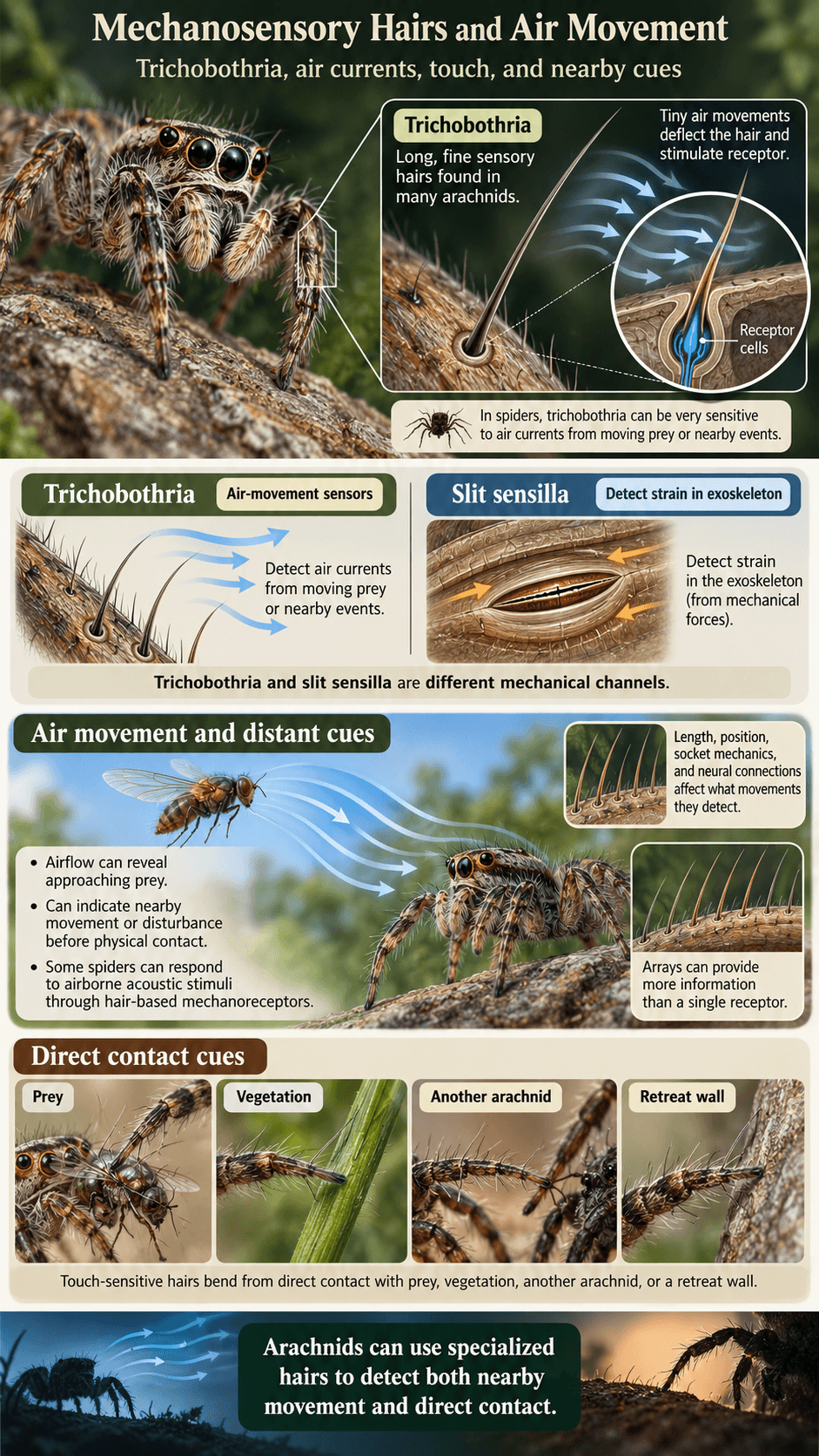
Trichobothria are long, fine sensory hairs found in many arachnids. Their sockets allow tiny air movements to deflect the hair and stimulate receptor cells. In spiders, these hairs can be extremely sensitive to air currents produced by moving prey or other nearby events.
A review of spider external sensory organs describes trichobothria as air-movement sensors and slit sensilla as strain detectors. These are different mechanical channels: one responds primarily to movement of the surrounding air, while the other detects deformation within the exoskeleton.
Trichobothria are not simply decorative hairs. Their length, position, socket mechanics, and neural connections influence what kinds of movements they detect. Arrays of hairs can provide information that a single receptor could not.
Air movement, touch, and prey or predator cues
Airflow can reveal an approaching flying insect, a nearby moving animal, or a disturbance that arrives before physical contact. Experimental work with wandering spiders has shown that air movement generated by flying prey can be sufficient to trigger oriented attack behavior under controlled conditions.
Some spiders can also respond to airborne acoustic stimuli through hair-based mechanoreceptors even though they do not possess tympanic ears like many insects. This does not mean every arachnid “hears” in the same way or across the same distances. It means airborne particle movement can become biologically useful information when the sensory hairs and nervous system are suited to detecting it.
Touch-sensitive hairs provide a more direct mechanical channel. Contact with prey, vegetation, another arachnid, or the walls of a retreat can bend these structures. Together, touch hairs and airflow-sensitive hairs allow an arachnid to monitor both immediate contact and nearby movement.
Slit Sensilla and Mechanical Strain in Spiders
What slit sensilla detect
Slit sensilla are narrow openings in the cuticle associated with mechanosensory neurons. They respond when the exoskeleton is strained by forces such as muscle action, body loading, movement, gravity, or vibrations transmitted through a surface.
Some slits occur alone, while others form groups. Parallel groups are often called lyriform organs because their arrangement resembles the strings of a lyre. Their position near joints and on leg segments allows them to detect mechanical changes generated both inside and outside the body.
This gives spiders information about forces rather than simply telling them that something touched a hair. Cuticular strain can help coordinate posture, walking, prey capture, and responses to substrate vibration.
Why this specialization should not be generalized to every arachnid
Slit sensilla are strongly associated with arachnid mechanoreception, but their distribution, number, and functional importance differ among lineages. The well-studied spider systems should not be copied directly onto mites, ticks, scorpions, or harvestmen as though all groups had identical sensory maps.
Comparative anatomy matters because a receptor can be shared broadly while still being modified, reduced, expanded, or combined with other sensory structures in different groups.
Scorpion Pectines
Structure and substrate exploration
Scorpions have a pair of distinctive comb-like appendages called pectines on the underside of the body. As a scorpion walks, the pectines can contact or sweep close to the substrate. Each bears many small sensory structures, giving the animal a specialized interface with the ground.
Pectines are especially important in a sensory system that operates at close range. They allow a scorpion to sample features of the surface while moving through soil, sand, rock, or other ground-level habitats.
Mechanosensory and chemosensory roles
Pectines should not be described simply as “noses.” Their peg sensilla include chemical and mechanical receptors. Research on scorpion pectinal peg sensilla shows that these organs can process chemical information while also receiving mechanical input.
That mixed function can help scorpions evaluate chemical traces, substrate properties, and signals associated with activities such as mate searching. The exact role varies with species and behavioral context, so it is safer to describe pectines as complex chemo-mechanosensory organs than to equate them with one vertebrate sense.
Tick Haller’s Organ
Location on the first pair of legs
Ticks possess a highly specialized sensory structure called Haller’s organ on the tarsus of each first leg. Its position matters because ticks frequently raise or extend the first legs while exploring their surroundings or questing for hosts.
Haller’s organ contains multiple sensilla arranged in specialized regions. These receptors contribute to the detection of chemical and physical cues in the environment. Because the structure sits on the forelegs, popular descriptions sometimes say ticks “smell with their feet,” but that phrase compresses a complex sensory system into an analogy.
Environmental and host-related cues
A detailed review of tick Haller’s organ describes it as a unique foreleg sensory system strongly involved in chemosensation and host detection. Tick behavior can be influenced by host-related odors and by environmental conditions that help determine when and where questing occurs.
Chemical sensing is especially important because a tick does not chase a host using long-range vision the way a visually hunting spider might pursue prey. Instead, the tick integrates sensory cues while moving, waiting, and responding to nearby opportunities for contact.
Why “smelling with their feet” is too simplistic
Human smell is based on a nasal olfactory system. Tick chemoreception uses sensilla on the first legs, especially Haller’s organ, and operates within a very different body plan and nervous system. The analogy can help a beginner remember the organ’s location, but it should not be treated as a literal equivalence.
Ticks also respond to more than odors. Physical cues, contact, humidity, temperature, and movement can contribute to host-seeking and orientation depending on the species and situation. There is no scientifically useful single distance at which “a tick detects a person,” because detection depends on the cue, environment, tick species, life stage, and host.
Chemical, Humidity, and Temperature Cues
Chemoreception and mate or food cues
Chemical information can reveal food, prey, hosts, mates, competitors, or a familiar environment. Arachnids detect chemicals through receptors associated with hairs, pegs, pores, mouthparts, legs, pectines, or other structures depending on the group.
Spiders can use contact chemicals on silk or surfaces during courtship and prey assessment. Scorpions can evaluate substrate chemicals through pectines. Ticks use foreleg sensory structures when locating hosts and mates. Amblypygids possess chemosensory sensilla on their antenniform legs. Mites encompass such a wide range of diets and habitats that their chemical ecology cannot be summarized by tick biology.
Moisture and temperature sensitivity
Humidity and temperature are not background conditions for small terrestrial arthropods. They directly affect water loss, activity, development, and the suitability of shelters. Sensitivity to moisture and temperature can therefore influence when an arachnid moves, where it rests, and which microhabitats it selects.
Some sensory appendages combine several receptor types in the same region. Amblypygid antenniform legs, for example, carry mechanosensory and chemosensory sensilla as well as structures associated with temperature and humidity detection. Ticks also integrate environmental conditions with chemical information during host-seeking.
Sensory First Legs in Amblypygi
Antenniform legs and how they function
Tailless whip spiders, or amblypygids, have an extraordinary first pair of legs that is much longer and thinner than the rear three pairs used for ordinary walking. These first legs are called antenniform because they function in an antenna-like way, sweeping through space and across surfaces to collect sensory information.
The appendages are highly articulated and covered with many receptor types. A review of Amblypygi sensory biology and navigation describes mechanosensory, chemosensory, and likely humidity-sensitive sensilla on the antenniform legs, including multiporous sensilla associated with olfaction.
This rich sensory equipment helps explain how nocturnal and cave-associated amblypygids can navigate complex environments even without relying primarily on detailed vision.
Why they are not true antennae
Amblypygids do not have insect antennae. Their sensory appendages are modified legs, derived from the first walking-leg pair of the arachnid body plan. They remain homologous to legs even though their main function has shifted away from supporting the body.
Calling them antennae without qualification hides an important evolutionary distinction. “Antenniform legs” is the more accurate term because it describes their antenna-like function while preserving their actual anatomical identity.
Mite Sensory Diversity
Why tick biology cannot stand in for mites as a whole
Ticks are part of the broader acariform and parasitiform diversity traditionally discussed with mites, but tick sensory biology should not be used as the template for all mites. Mites include predators, plant feeders, fungivores, detritivores, parasites, scavengers, and species living in soil, freshwater, vegetation, nests, stored foods, and animal bodies.
That ecological range produces substantial sensory variation. Different mites may depend on contact chemicals, volatile cues, humidity, temperature, light, touch, or substrate signals in different combinations. The American Arachnological Society’s overview of Acari emphasizes the biological breadth of mites and ticks and the complexity of their classification.
Haller’s organ is a tick specialization. It should not be presented as a universal mite organ, just as spider principal eyes or scorpion pectines should not be treated as universal arachnid equipment.
Common Sensory Myths
All spiders have poor vision
Many spiders do rely more heavily on mechanical cues than on detailed vision, but the statement fails for visual hunters such as jumping spiders. Some salticids can discriminate shapes, colors, rivals, prey, and courtship displays with impressive precision.
The better rule is that spider vision varies enormously. Habitat and hunting style matter more than the word “spider” alone.
Eight eyes means eight complete pictures
A spider with eight eyes does not simply receive eight identical copies of the scene. Different eye pairs can have different fields of view, sensitivities, retinal structures, and behavioral roles. In jumping spiders, principal and secondary eyes are functionally specialized.
Eye count therefore cannot be translated directly into “how many pictures” the brain sees. The nervous system integrates information from multiple receptors into behavior.
Ticks detect people from one universal distance
There is no single reliable distance that applies to every tick, host, cue, weather condition, and habitat. Chemical plumes change with wind and humidity, heat gradients vary, vegetation alters airflow, and tick species differ in host-seeking behavior.
A fixed distance stated without species and experimental context creates false precision. It is more accurate to say that ticks integrate several local environmental and host-related cues during questing and contact.
Amblypygi have antennae
The long feeler-like appendages of Amblypygi are legs modified for sensory use. They are called antenniform legs because they resemble antennae in function, but they are not homologous to insect antennae.
How Sensory Biology Shapes Arachnid Life
Anatomy of sensory structures
Sensory performance starts with anatomy. A jumping spider’s principal eyes, a scorpion’s pectines, a tick’s Haller’s organ, and an amblypygid’s antenniform legs are physically different solutions to different information problems. Their location on the body determines what they encounter first and how the animal positions them.
Even small structures such as trichobothria and slit sensilla can transform mechanical events into nervous signals. Understanding where receptors sit and what deforms them is essential for understanding what information an arachnid can obtain.
Movement and hunting behavior
Movement changes what an arachnid senses, and sensory feedback changes movement in return. A spider adjusts leg position while tracking web vibrations. Amblypygids sweep sensory legs ahead while walking. A tick raises its first legs during questing. A scorpion places pectines close to the ground as it explores. Sensory information is closely tied to arachnid movement because animals constantly adjust locomotion in response to what they detect.
Predation also depends on this feedback loop. Vision can guide a jumping spider toward prey, airflow can alert a wandering spider to a nearby flying insect, vibration can reveal prey in a web, and chemical or mechanical traces can influence hunting and orientation in other groups. Those signals directly shape arachnid behavior during hunting, host seeking, courtship, shelter use, and threat avoidance.
Habitat and host-seeking context
Sensory systems make the most sense in their environmental setting. Cave arachnids face darkness, web spiders occupy a vibrating silk structure, soil mites move through humid microscopic spaces, desert scorpions encounter heat and exposed substrates, and ticks wait for hosts in vegetation or ground-level habitats. The importance of each sensory channel often reflects where arachnids live and the signals available in that habitat.
Host seeking in ticks is especially dependent on context. A sensory organ may detect useful cues, but wind, humidity, vegetation, temperature, host movement, and the tick’s own position determine whether those cues reach the animal strongly enough to change behavior.
FAQ
Can arachnids hear?
Some arachnids can detect airborne acoustic information, but they do not necessarily hear with ears comparable to those of humans or tympanate insects. Experiments with jumping spiders have shown behavioral and neural responses to airborne sound, with sensory hairs implicated in detection. Other arachnids may respond mainly to air particle movement, substrate vibration, or near-field disturbances. The answer therefore depends on what “hear” means and which arachnid is being discussed.
How do spiders sense vibrations?
Spiders use several mechanosensory structures. Slit sensilla detect strain in the exoskeleton, including strain caused by substrate vibration, while touch-sensitive hairs respond to direct mechanical contact. Web-building spiders can also use their legs and associated receptors to monitor vibrations traveling through silk.
What are scorpion pectines?
Pectines are paired, comb-like sensory appendages on the underside of a scorpion. They carry numerous receptors that detect chemical and mechanical information from the substrate. They are involved in close-range environmental sampling and can contribute to navigation and reproductive behavior.
What is Haller’s organ?
Haller’s organ is a specialized sensory structure on the first pair of tick legs. It contains sensilla involved especially in chemoreception and contributes to detecting environmental and host-related cues. It is a tick specialization, not a general organ shared by all mites or arachnids.
Do all arachnids see well?
No. Visual ability ranges from highly developed image-forming vision in some spiders to reduced eyes or little reliance on vision in cave-dwelling and other lineages. Many arachnids compensate by relying strongly on vibration, touch, chemical cues, humidity, air movement, or specialized sensory appendages.
Final Thoughts
Arachnid senses are best understood as a diverse collection of systems rather than one standard toolkit. Jumping spiders can be visually sophisticated, web and wandering spiders use mechanical information extensively, scorpions probe the substrate with pectines, ticks sample environmental and host cues through foreleg sensory organs, and Amblypygi devote an entire leg pair largely to sensory exploration.
Those differences explain why simple slogans usually fail. Eight eyes do not mean eight identical pictures, pectines are not just noses, Haller’s organ is more complex than “smelling with the feet,” and antenniform legs are not true antennae. Across Arachnida, the combination of vision, vibration, touch, chemicals, temperature, humidity, and air movement is shaped by how each lineage lives.

Ethan Walker is the founder and research editor of Animal Fact Central. He creates and reviews educational animal facts content using trusted wildlife, pet care, and science-based sources. His work focuses on making animal behavior, adaptations, habitats, and species facts clear, accurate, and engaging for everyday readers.
Read More Details About Ethan Walker: https://animalfactcentral.com/ethan-walker/