
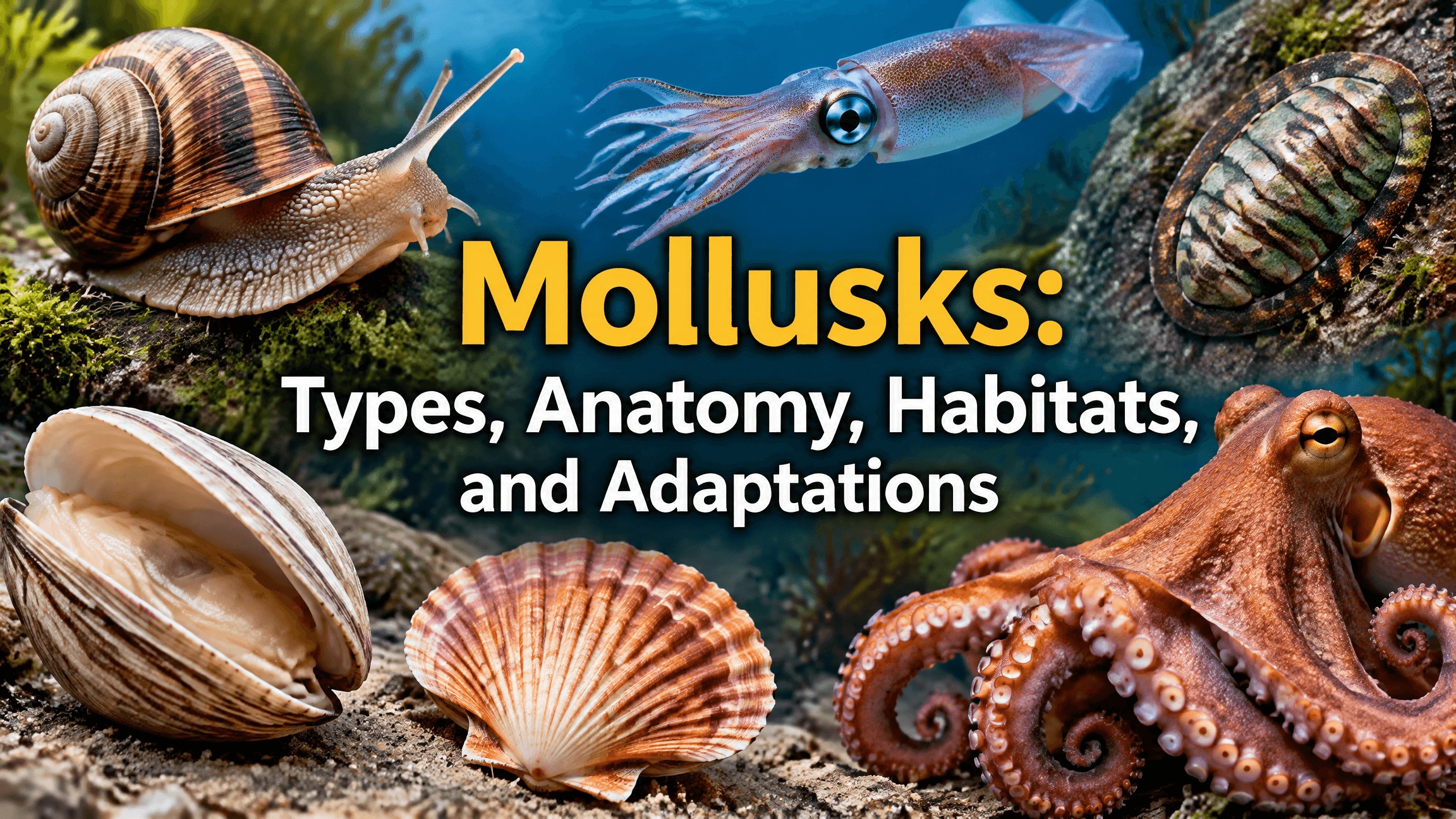
Mollusks are invertebrate animals in the phylum Mollusca, a remarkably diverse group that includes snails, slugs, clams, mussels, oysters, scallops, octopuses, squid, cuttlefish, nautiluses, chitons, tusk shells, and several less familiar lineages. They do not all look alike, and they do not all have shells. What connects them is a shared evolutionary history and a body plan that has been modified in very different ways.
That variety is the main reason mollusks are easy to misunderstand. A garden snail, a buried clam, and a swimming octopus seem like animals from different worlds, yet all belong to Mollusca. The best way to understand them is not to search for one feature that every species displays in the same form. Instead, look at recurring structures such as the mantle, visceral mass, and an evolutionarily modified muscular foot, then see how each lineage has transformed those structures for its own way of life.
Quick Overview of Mollusks
Mollusca in the Animal Kingdom
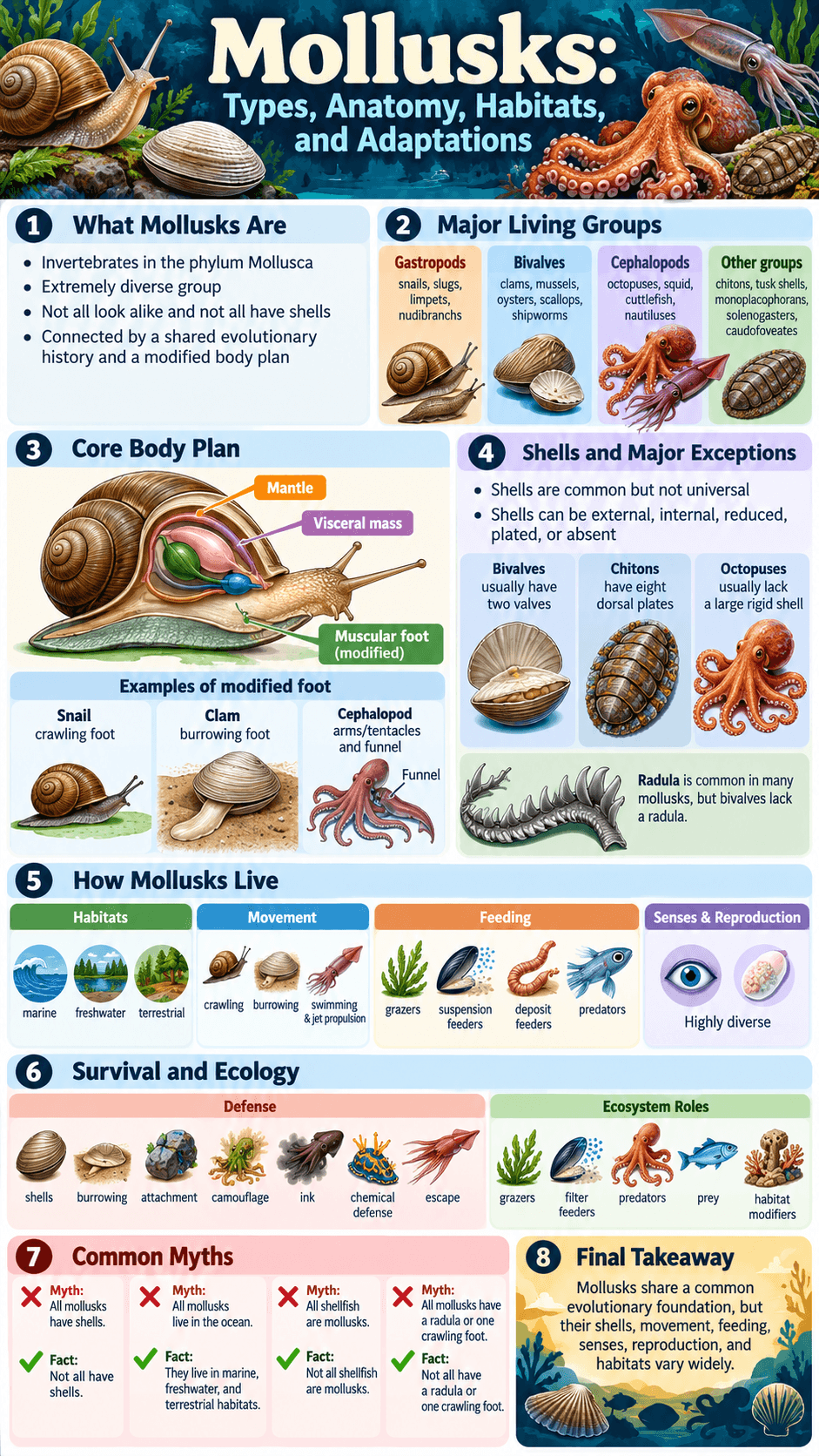
Mollusks are animals without backbones, so they are invertebrates. They form their own phylum rather than a branch of the arthropods. Modern mollusk diversity spans marine, freshwater, and terrestrial environments, and the taxonomic picture continues to be updated as specialists revise names and relationships. MolluscaBase maintains a continuously updated taxonomic account of mollusks across living and fossil groups, which is one reason exact species totals should be treated as changing database values rather than timeless numbers.
The familiar members of Mollusca are only part of the story. Gastropods include snails, slugs, limpets, nudibranchs, and many other forms. Bivalves include clams, mussels, oysters, scallops, and shipworms. Cephalopods include octopuses, squid, cuttlefish, and nautiluses. Chitons belong to Polyplacophora, tusk shells to Scaphopoda, and other living lineages include Monoplacophora, Solenogastres, and Caudofoveata.
Why Mollusks Are Not the Same as Arthropods or Shellfish
A shell does not make an animal an arthropod. Arthropods such as insects, spiders, and crustaceans are characterized by a segmented body plan, jointed appendages, and an external cuticle that is shed during growth. Mollusks follow a different evolutionary pattern centered on structures such as the mantle, visceral mass, and modified foot. A clam shell and a crab’s external skeleton can both contain mineral material, but they develop from different tissues and belong to different body plans.
“Shellfish” is also a human food and fishery term, not a precise taxonomic group. Many edible bivalves and cephalopods are called shellfish, but crustaceans such as crabs, shrimp, and lobsters are commonly included under the same label even though they are arthropods. At the same time, many mollusks have no obvious external shell and may never be called shellfish at all.
What the Mollusk Body Plan Includes
The Mantle, Visceral Mass, and Modified Foot
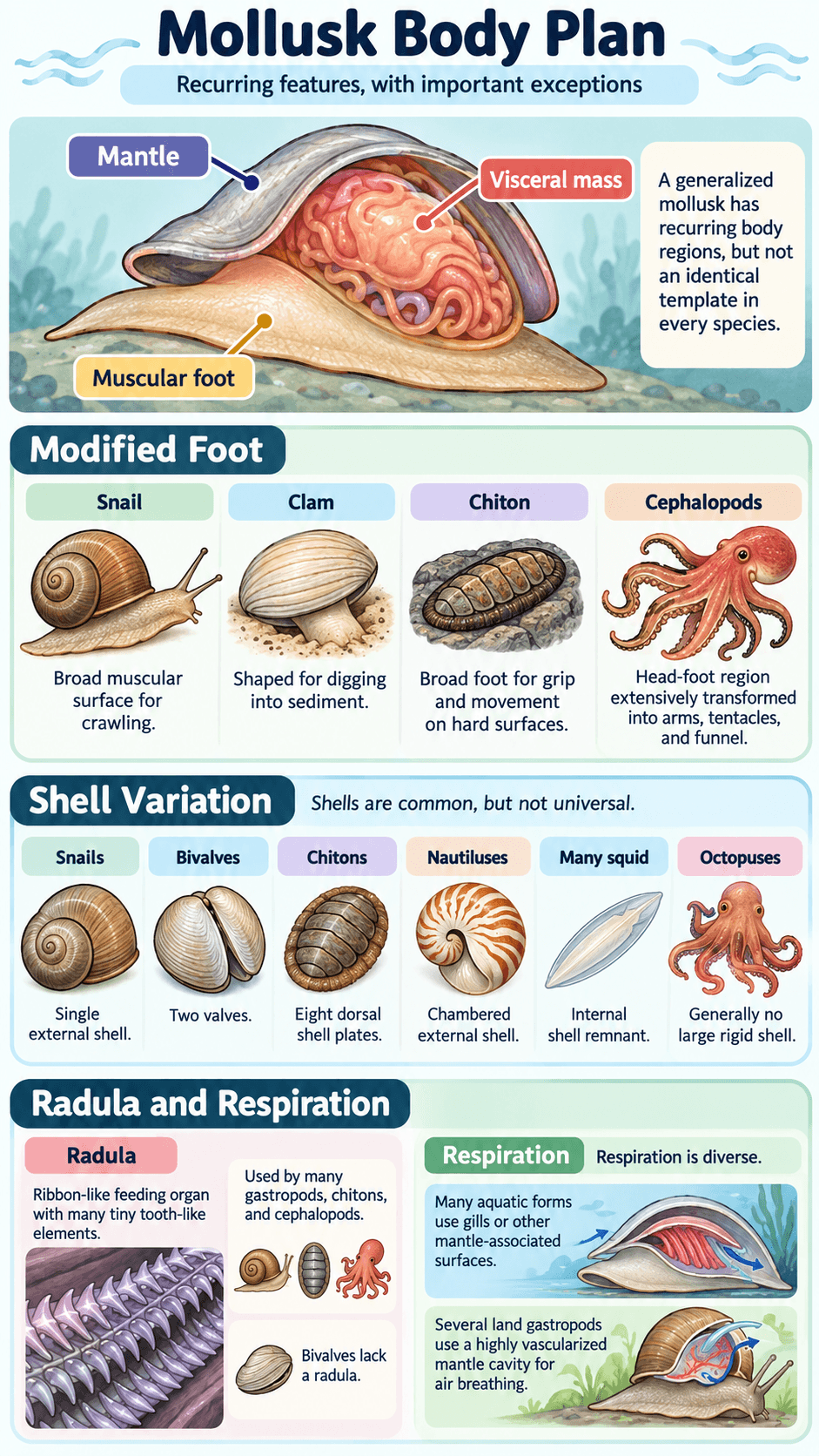
A generalized mollusk can be described using a few recurring body regions, but none should be imagined as an identical template stamped onto every species. The mantle is a specialized tissue layer associated with the visceral mass and, in shell-bearing forms, with shell production. The visceral mass contains many of the internal organs. The muscular foot is an ancestral feature that has been reshaped for crawling, burrowing, attachment, swimming, or other functions. A Smithsonian overview of the mollusk body plan highlights the mantle, soft internal body, shell variation, and muscular foot as recurring features that take different forms across the phylum.
In a snail, the foot forms the broad muscular surface used for crawling. In many clams, it is shaped for digging into sediment. Chitons use a broad foot to grip and move across hard surfaces. In cephalopods, structures of the head-foot region have been extensively transformed, contributing to the arms, tentacles, and funnel that make an octopus or squid look so unlike a snail.
Shells, Radulas, Gills, and Major Exceptions
Shells are common in Mollusca, but they are not universal. A shell may be external, internal, reduced, divided into plates, represented by tiny mineralized elements, or absent in the obvious adult form. Snails often have a single external shell, bivalves typically have two valves, chitons usually carry eight dorsal shell plates, nautiluses retain a chambered external shell, and many squid have an internal shell remnant. Octopuses generally lack a large rigid shell.
The radula is another famous molluscan structure. It is a ribbon-like feeding organ bearing many tiny tooth-like elements and is used in different ways by many gastropods, chitons, and cephalopods. It should not be treated as a defining feature present in every mollusk, because bivalves lack a radula. Respiration is equally diverse: many aquatic forms use gills or other mantle-associated surfaces, while several land gastropods exchange gases through a highly vascularized mantle cavity adapted for air breathing.
The Major Living Types of Mollusks
Gastropods
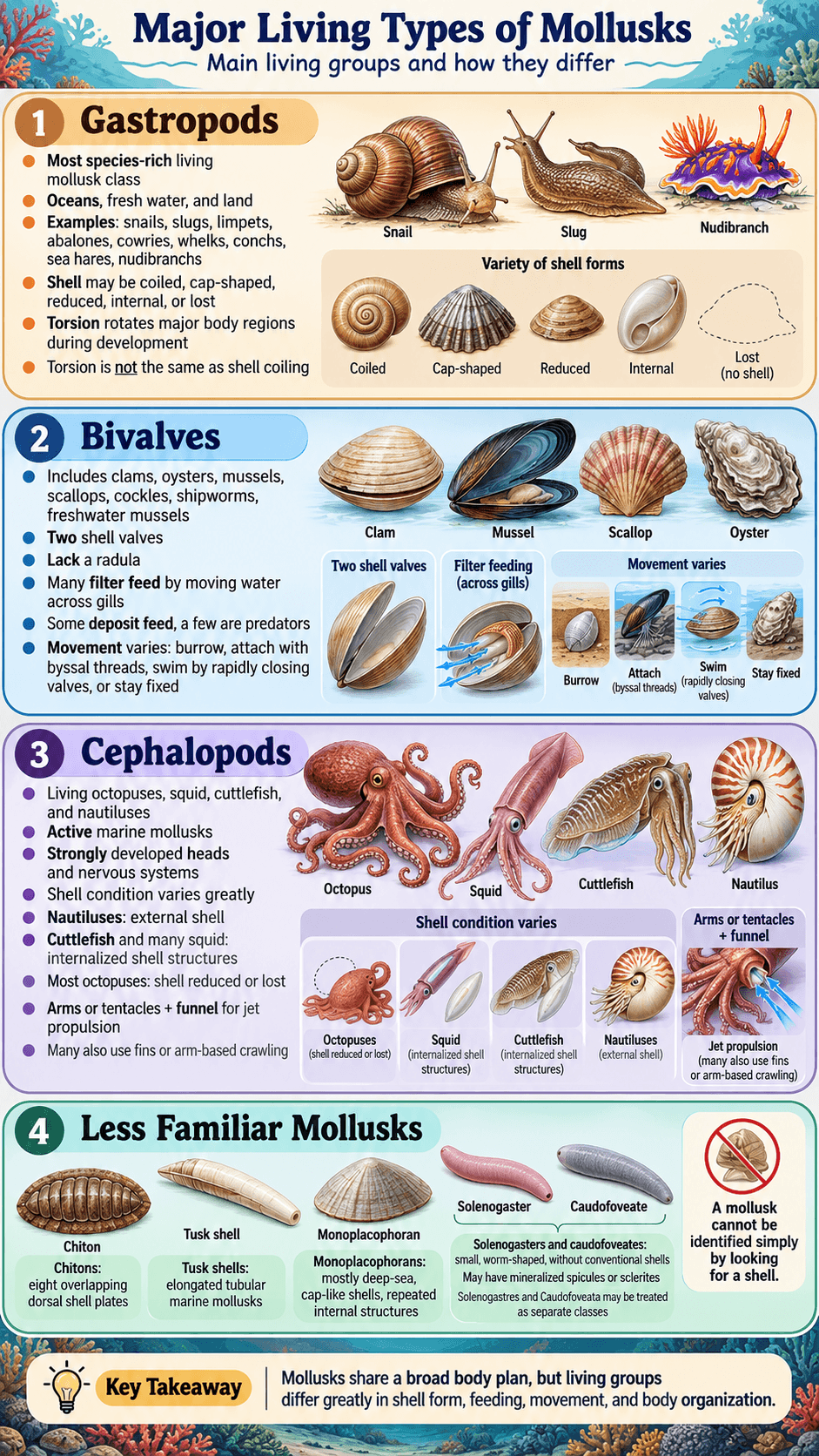
Gastropoda is the most species-rich living mollusk class in current taxonomic databases. Its members occupy oceans, fresh water, and land. Familiar examples include snails and slugs, but gastropod diversity also includes limpets, abalones, cowries, whelks, conchs, sea hares, and nudibranchs. The shell may be coiled, cap-shaped, reduced, internal, or lost, so “gastropod” does not simply mean “animal with a spiral shell.”
Gastropods also show how strongly a molluscan body plan can be reorganized. During development, a process called torsion rotates major body regions relative to one another. Torsion is not the same thing as shell coiling, and some lineages show substantial secondary modification of the torsion pattern.
Bivalves
Bivalvia includes clams, oysters, mussels, scallops, cockles, shipworms, and many freshwater mussels. Typical bivalves have two shell valves and lack a radula. Many obtain food by moving water across their gills and trapping suspended particles, but filter feeding is not the only feeding strategy in the class. Some bivalves deposit feed, and a few are predators.
Bivalves are also more mobile than their reputation suggests. Some clams use a muscular foot to burrow, mussels can attach to surfaces with byssal threads, and scallops can swim by rapidly closing their valves and expelling water. Other species, including many oysters, spend much of adult life fixed to one place.
Cephalopods
Cephalopoda contains living octopuses, squid, cuttlefish, and nautiluses. These are active marine mollusks with strongly developed heads and nervous systems. Their shell condition varies greatly. Nautiluses retain a conspicuous external shell, cuttlefish and many squid have internalized shell structures, and most octopuses have greatly reduced or lost the hard shell inherited from distant ancestors.
Cephalopods combine arms or tentacles with a funnel that can expel water for jet propulsion. Many also use fins or arm-based crawling, so jet propulsion is not their only mode of travel. The Smithsonian Ocean overview of cephalopods highlights the mixture of mantle, funnel, arms, eyes, and altered shell structures that distinguishes this branch of Mollusca.
Chitons, Tusk Shells, Monoplacophorans, Solenogasters, and Caudofoveates
Less familiar mollusks are essential for understanding how broad the phylum really is. Chitons usually carry eight overlapping dorsal shell plates and use a broad foot to cling to hard surfaces. Tusk shells are elongated, tubular marine mollusks that often live in sediment. Monoplacophorans are mostly deep-sea animals with cap-like shells and repeated internal structures.
Solenogasters and caudofoveates are small, worm-shaped mollusks without conventional shells. They may possess mineralized spicules or sclerites in the body covering. Older references sometimes place these animals together under “Aplacophora,” but current classifications may treat Solenogastres and Caudofoveata as separate classes. Their existence is a useful reminder that a mollusk cannot be identified simply by looking for a shell.
How Mollusk Body Plans Vary
External, Internal, Reduced, and Absent Shells
The mollusk shell is produced by mantle tissue rather than being a separate object that the animal finds and occupies. In shell-bearing species, growth occurs as the mantle deposits organic and mineral material. The Smithsonian’s explanation of bivalve shell formation shows how the mantle contributes to shell building, but shell structure and mineral layers vary widely among mollusk lineages.
Evolution has repeatedly altered the shell. A slug may have a greatly reduced internal remnant or no conspicuous shell. A cuttlefish has a cuttlebone inside the body. Squid often have an internal pen. An octopus can squeeze through narrow spaces partly because it lacks a large rigid external shell. Chitons use multiple plates rather than a single coiled or paired shell. These differences reflect different trade-offs involving protection, flexibility, buoyancy, movement, and habitat.
Radula Present in Many Lineages but Absent in Bivalves
The radula is one of the most distinctive feeding tools in many mollusks, yet its form changes with diet. Grazing snails may scrape algae or biofilm from surfaces. Predatory gastropods can use specialized radular teeth in very different ways. Chitons often have robust teeth suited to scraping hard substrates. Cephalopods combine a radula with a beak when processing prey.
Bivalves are the major living exception. They do not have a radula, and many rely on gill-based suspension feeding instead. That exception matters because it shows why biological classification depends on ancestry and the complete body plan rather than on a checklist requiring every member to retain every ancestral feature.
Open Circulation and the Cephalopod Exception
Most mollusks have an open circulatory system in which hemolymph leaves fully enclosed vessels and passes through body spaces before returning to the heart. Cephalopods are a major exception, with a largely closed circulatory system suited to their active lifestyle. This distinction should not be simplified into the claim that all mollusks have “blue blood.” Hemocyanin, a copper-containing oxygen transport protein, occurs widely in mollusks, but blood chemistry and appearance should be described with attention to the particular lineage.
How Mollusks Move, Feed, Sense, and Reproduce
Movement Strategies at a Glance
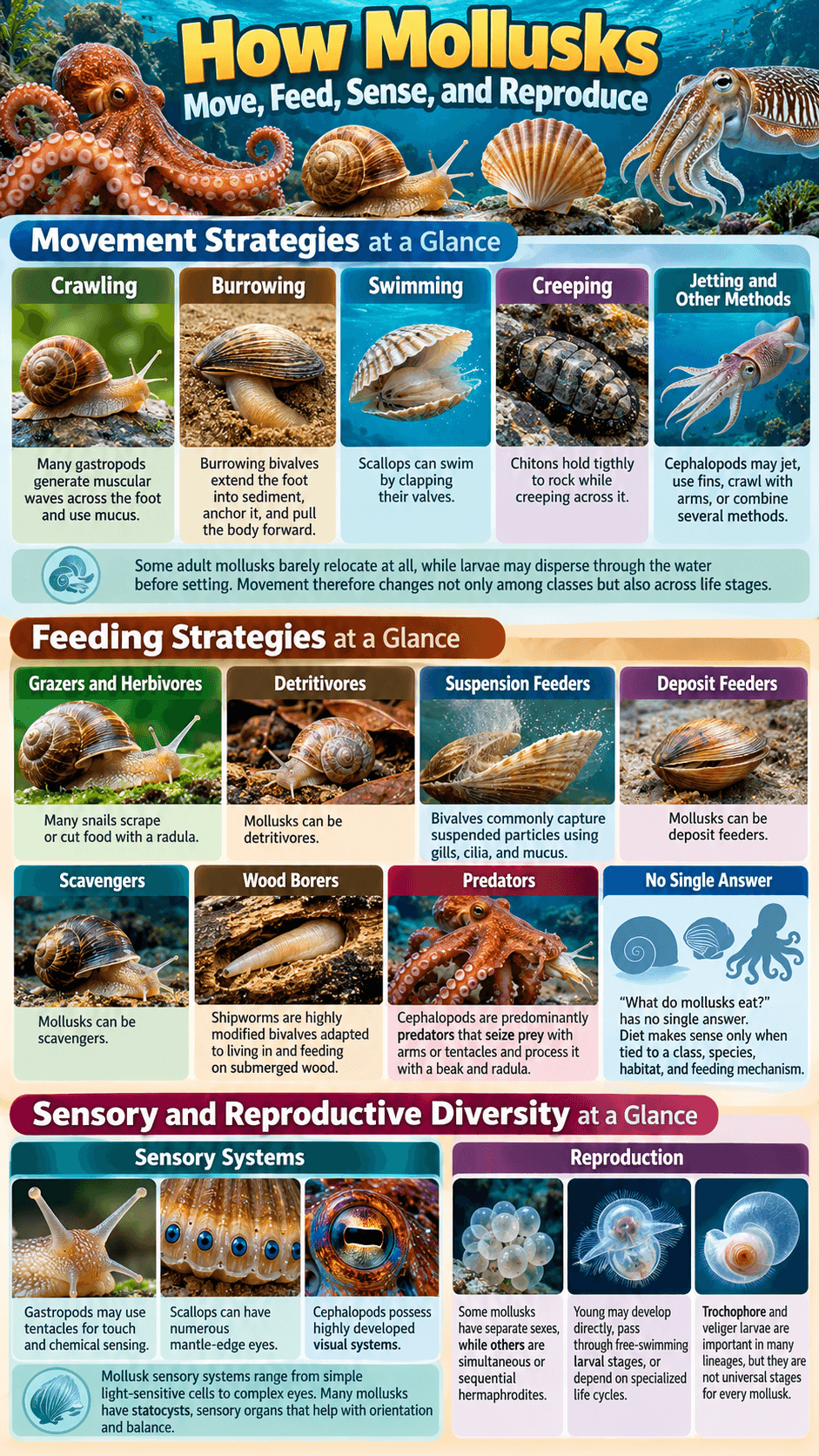
Mollusk movement ranges from slow crawling to rapid swimming. Many gastropods generate muscular waves across the foot and use mucus to manage contact with the surface. Burrowing bivalves extend the foot into sediment, anchor it, and pull the body forward. Scallops can swim by clapping their valves. Chitons hold tightly to rock while creeping across it. Cephalopods may jet, use fins, crawl with arms, or combine several methods.
Some adult mollusks barely relocate at all, while larvae may disperse through the water before settling. Movement therefore changes not only among classes but also across life stages.
Feeding Strategies at a Glance
Mollusks can be grazers, herbivores, detritivores, suspension feeders, deposit feeders, scavengers, wood borers, and predators. Many snails scrape or cut food with a radula. Bivalves commonly capture suspended particles using gills, cilia, and mucus. Cephalopods are predominantly predators that seize prey with arms or tentacles and process it with a beak and radula. Some gastropods are specialized predators, while shipworms are highly modified bivalves adapted to living in and feeding on submerged wood.
Because feeding structures differ so dramatically, asking “What do mollusks eat?” has no single answer. Diet makes sense only when tied to a class, species, habitat, and feeding mechanism.
Sensory and Reproductive Diversity at a Glance
Mollusk sensory systems range from simple light-sensitive cells to complex eyes. Gastropods may use tentacles for touch and chemical sensing. Many mollusks have statocysts, sensory organs that help with orientation and balance. Scallops can have numerous mantle-edge eyes, while cephalopods possess highly developed visual systems. These differences should not be arranged as a simple ladder from “primitive” to “advanced” because each system is shaped by the ecological tasks the animal faces.
Reproduction is just as varied. Some mollusks have separate sexes, while others are simultaneous or sequential hermaphrodites. Fertilization may be external or internal. Young may develop directly, pass through free-swimming larval stages, or depend on specialized life cycles. Trochophore and veliger larvae are important in many lineages, but they are not universal stages for every mollusk.
Where Mollusks Live
Marine Mollusks
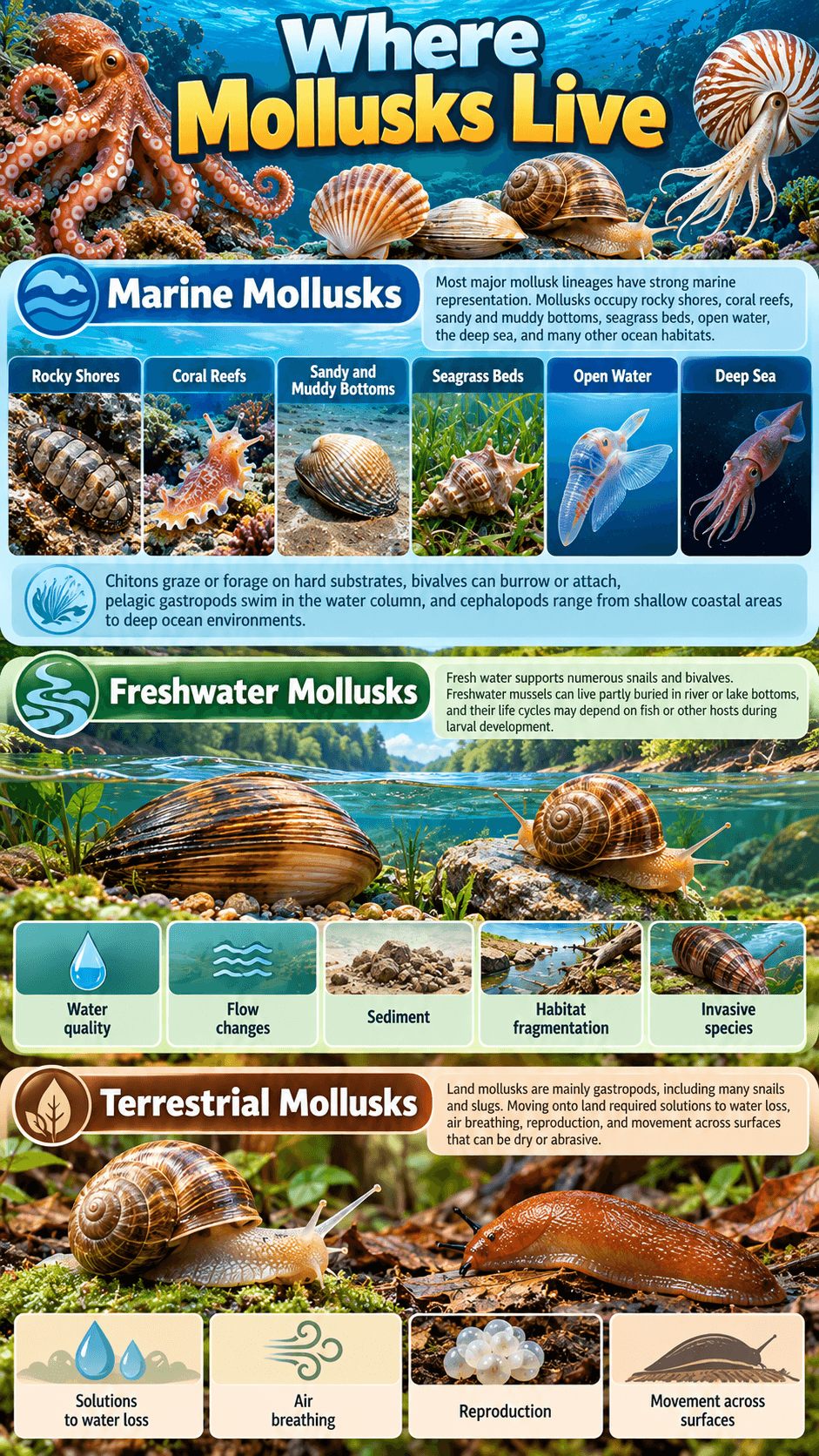
Most major mollusk lineages have strong marine representation. Mollusks occupy rocky shores, coral reefs, sandy and muddy bottoms, seagrass beds, open water, the deep sea, and many other ocean habitats. Chitons graze or forage on hard substrates, bivalves can burrow or attach, pelagic gastropods swim in the water column, and cephalopods range from shallow coastal areas to deep ocean environments.
Marine conditions place different demands on shell strength, buoyancy, oxygen exchange, camouflage, feeding, and reproduction. That is why even closely related marine species can have very different lifestyles.
Freshwater Mollusks
Fresh water supports numerous snails and bivalves. Freshwater mussels can live partly buried in river or lake bottoms, and their life cycles may depend on fish or other hosts during larval development. Freshwater mollusks face strong local pressures from water quality, flow changes, sediment, habitat fragmentation, and invasive species.
In North America, the conservation concern around native freshwater mussels is especially important. The U.S. Fish and Wildlife Service describes widespread declines linked to altered rivers, blocked host-fish movement, excess sediment, contamination, and invasive species. Those problems apply unevenly by species and watershed, so conservation status should always be checked for the particular mussel being discussed.
Terrestrial Mollusks
Land mollusks are mainly gastropods, including many snails and slugs. Moving onto land required solutions to water loss, air breathing, reproduction, and movement across surfaces that can be dry or abrasive. Many terrestrial gastropods are active when humidity is favorable and seek sheltered microhabitats during dry conditions.
Shells can help some land snails reduce water loss and protect the body, but shell reduction has also evolved repeatedly in terrestrial slugs. The success of both forms shows that there is no single best solution for life on land.
How Mollusks Survive Predators and Environmental Challenges
Shells, Burrowing, and Attachment
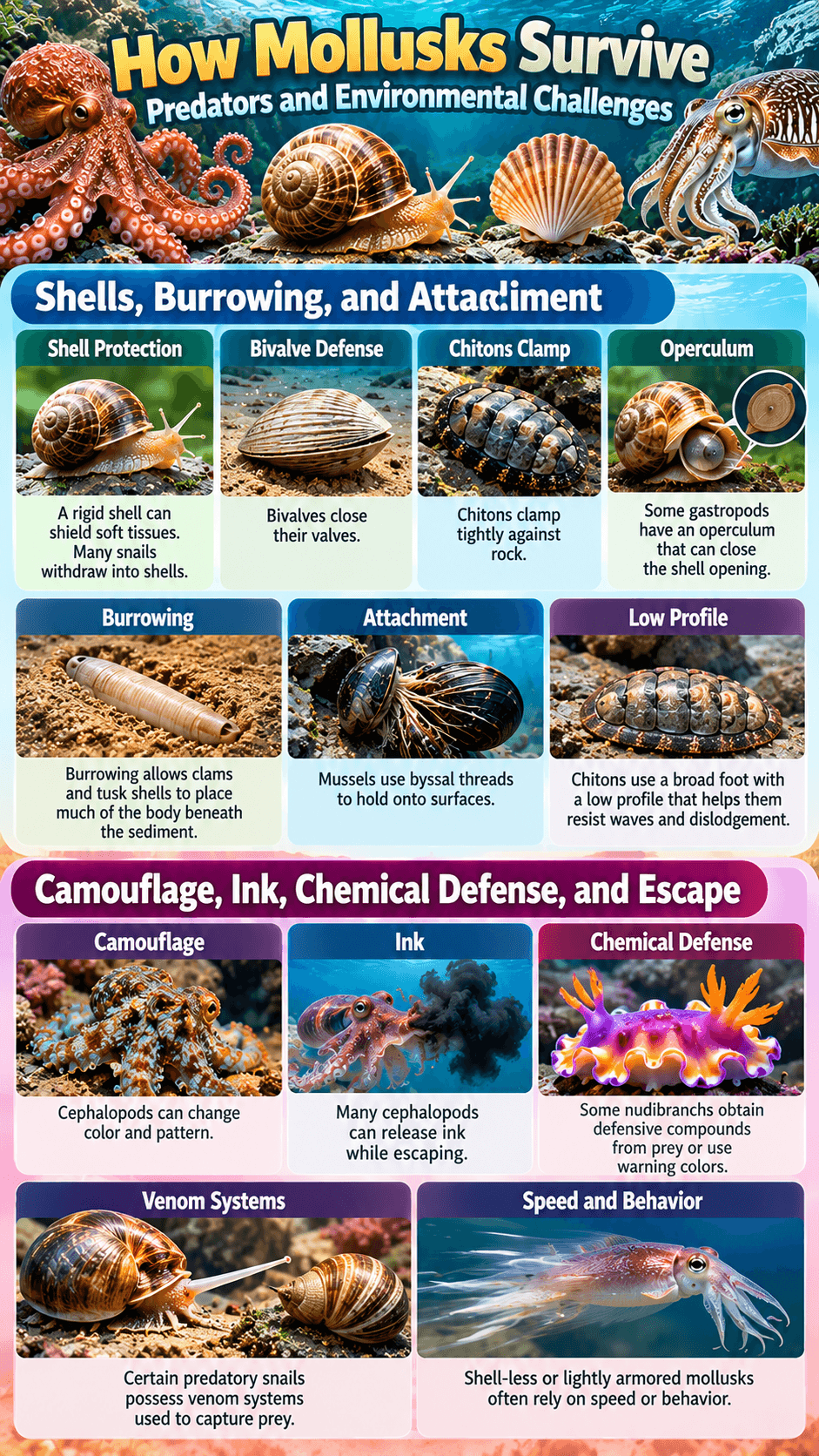
A rigid shell can shield soft tissues, but protection takes many forms. Bivalves close their valves, chitons clamp tightly against rock, and many snails withdraw into shells. Some gastropods possess an operculum, a hard or leathery structure that can close the shell opening. Burrowing allows clams and tusk shells to place much of the body beneath the sediment, where predators and physical disturbance may be reduced.
Attachment can also be defensive. Mussels use byssal threads to hold onto surfaces, while chitons combine a broad foot with a low profile that helps them resist waves and dislodgement. These strategies may protect against both predators and environmental forces.
Camouflage, Ink, Chemical Defense, and Escape
Shell-less or lightly armored mollusks often rely more heavily on concealment, speed, chemicals, or behavior. Cephalopods are famous for rapid changes in color and pattern, and many can release ink while escaping. Some nudibranchs obtain defensive compounds from prey or use warning colors. Certain predatory snails possess venom systems used to capture prey.
These examples should not be generalized to every mollusk. Ink is not a phylum-wide defense, venom is restricted to particular lineages, and camouflage can mean anything from a shell that resembles the background to active skin pattern changes in some cephalopods.
Why Mollusks Matter in Ecosystems
Grazers, Filter Feeders, Predators, and Prey
Mollusks occupy many positions in food webs. Grazing snails and chitons can remove algae and microbial films from surfaces. Bivalves can move suspended particles from the water column into sediments and animal tissues. Predatory gastropods and cephalopods influence prey populations. In turn, mollusks are eaten by fish, birds, mammals, crustaceans, sea stars, and other predators.
Because they fill such different feeding roles, the ecological effect of a mollusk depends on the species and setting. A mussel bed in a river functions very differently from a pelagic squid population or a land snail community in a forest.
Habitat and Nutrient-Cycling Roles
Mollusks can also modify habitat. Dense bivalve beds change the physical structure of the bottom and affect water flow, sediment, and nutrient movement. Empty shells can provide hard surfaces or shelter for other organisms. Burrowing species mix sediments. Grazers alter the amount and composition of algae on rocks and plants.
These effects are not uniformly beneficial or harmful. Ecological roles depend on abundance, species identity, native or introduced status, and the surrounding ecosystem.
Mollusk Conservation in Brief
Freshwater Species and Habitat Sensitivity
Freshwater mollusks can be unusually sensitive to changes in rivers and lakes because many species have limited ranges, specialized habitat needs, or life cycles tied to host animals. Dams can alter flow and block the movement of fish that carry mussel larvae. Pollution, sedimentation, channel modification, and invasive species can further reduce suitable habitat.
Conservation language needs to remain species-specific. Some freshwater mollusks are legally protected or assessed as threatened with extinction, while others remain common. It is inaccurate to apply one conservation label to all freshwater mussels or all mollusks.
Terrestrial and Marine Pressures
Land mollusks can be affected by habitat loss, altered moisture conditions, invasive predators, pollution, and collection pressure in particular places. Marine mollusks may face habitat disturbance, harvest, pollution, invasive species, warming, changing carbonate chemistry, or combinations of these pressures. The effects vary by species, life stage, shell mineralogy, physiology, and local environment.
Ocean acidification is often described too simply. Lower carbonate availability can make calcification more difficult for some shell-building organisms, especially at sensitive life stages, but responses differ substantially among species and conditions. A careful explanation avoids claiming that every mollusk shell simply dissolves as seawater chemistry changes.
Common Myths About Mollusks
Do All Mollusks Have Shells?
No. Many mollusks have external shells, but others have internal or reduced shells, and some lack an obvious shell as adults. Slugs, many nudibranchs, octopuses, solenogasters, and caudofoveates show why a shell cannot be used as the single defining test for Mollusca.
Do All Mollusks Live in the Ocean?
No. Marine environments contain enormous mollusk diversity, but freshwater snails and mussels are widespread, and many gastropods live on land. A complete picture of Mollusca must include oceans, rivers, lakes, wetlands, forests, gardens, caves, and other terrestrial habitats.
Are All Shellfish Mollusks?
No. The everyday term “shellfish” commonly includes both mollusks and crustaceans. Clams, oysters, and scallops are mollusks, while shrimp, crabs, and lobsters are arthropods. The word is useful in food and fishery contexts but not as a substitute for biological classification.
Do All Mollusks Have a Radula or One Crawling Foot?
No. Bivalves lack a radula, and the molluscan foot has been modified in many ways. It can form a crawling sole, a burrowing organ, an adhesive surface, or structures that contribute to cephalopod arms and the funnel. Looking for one unchanged “foot” in every species misses the evolutionary flexibility of the group.
Where Mollusk Diversity Becomes More Specialized
What Defines a Mollusk?
The broad answer is evolutionary ancestry plus a shared body-plan framework, not one visible feature. The mantle, visceral mass, modified foot, shell-secreting ancestry, and radula in many lineages are useful clues, but major exceptions are expected. A detailed definition becomes clearer when these structures are compared across classes rather than treated as a checklist.
How the Major Mollusk Classes Differ
The class-level differences are large enough to deserve separate attention. Gastropods show extensive shell and habitat diversity. Bivalves have two valves and lack a radula. Cephalopods combine active predation with profoundly modified head-foot structures. Chitons, tusk shells, monoplacophorans, solenogasters, and caudofoveates reveal body forms that are often overlooked in simplified introductions.
Why Shells, Movement, Senses, Diet, Reproduction, Defense, Habitats, Ecology, and Conservation Need Separate Explanations
Each of these subjects changes across the phylum. A single description of shell growth cannot cover a shell-less octopus. A single account of locomotion cannot explain both a burrowing clam and a swimming squid. A single life cycle cannot represent every gastropod, bivalve, and cephalopod. The same principle applies to senses, defenses, ecological roles, and conservation.
The broad view is useful because it shows the recurring evolutionary structures. The detailed view is necessary because those structures have been modified so extensively.
FAQ
Are mollusks vertebrates or invertebrates?
Mollusks are invertebrates. They do not have a vertebral column or internal bony spine like vertebrates do. Some have hard shells, plates, beaks, or other rigid structures, but those features are not backbones.
Are snails, clams, and octopuses really related?
Yes. They belong to the same phylum, Mollusca, although they represent different branches within it. Their common ancestry is reflected in underlying features such as the mantle and modified foot, even though evolution has transformed those structures so strongly that the adult animals can look completely different.
Are mollusks the same as shellfish?
No. Mollusca is a biological phylum. “Shellfish” is an everyday term that often groups edible mollusks with crustaceans. It therefore includes animals from more than one phylum and excludes many mollusks that are not normally discussed as seafood.
Final Thoughts
Mollusks make sense once their diversity is treated as part of the answer rather than a problem to be explained away. Snails, clams, octopuses, chitons, tusk shells, and the less familiar worm-shaped mollusks are related through a common evolutionary foundation, but each lineage has modified that foundation in different ways. Shells may be external, internal, reduced, or absent. The foot may crawl, burrow, grip, or be transformed into structures used by cephalopods. Feeding, senses, reproduction, movement, and habitat use vary just as widely.
That combination of shared ancestry and extreme modification is what makes Mollusca such an important animal group to understand. A broad overview gives the framework. Looking more closely at anatomy, shells, movement, feeding, reproduction, defenses, habitats, ecology, and conservation reveals how many different biological solutions can emerge from the same deep evolutionary history.

Ethan Walker is the founder and research editor of Animal Fact Central. He creates and reviews educational animal facts content using trusted wildlife, pet care, and science-based sources. His work focuses on making animal behavior, adaptations, habitats, and species facts clear, accurate, and engaging for everyday readers.
Read More Details About Ethan Walker: https://animalfactcentral.com/ethan-walker/