
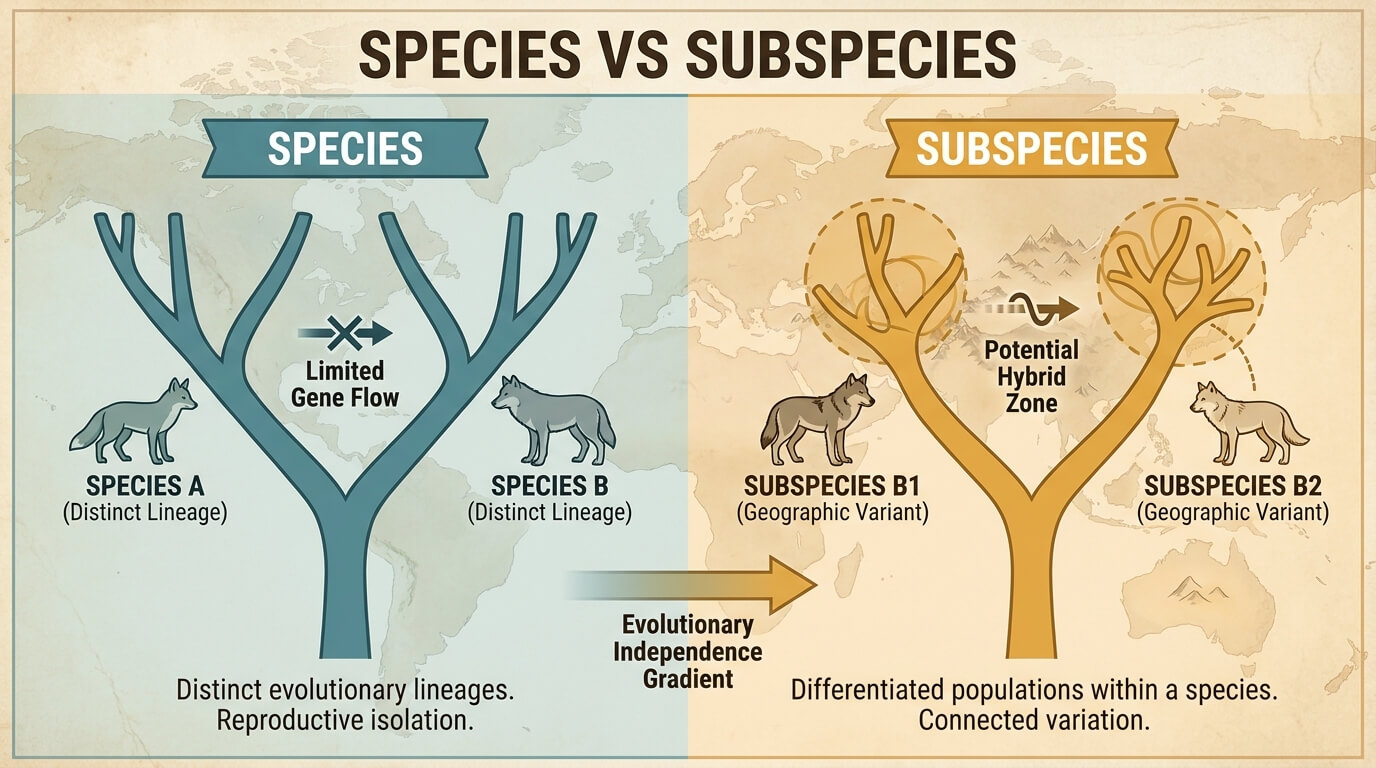
The difference between a species and a subspecies is mainly about evolutionary independence. A species is treated as a distinct evolutionary lineage, while a subspecies is a named, consistently different population within a species. Subspecies usually occupy part of a species’ geographic range and remain more closely connected to other populations of that species than separate species do.
That sounds simple, but real animal populations often form gradients rather than clean boxes. Neighboring populations may exchange genes, distant populations may look different, and a narrow hybrid zone may connect otherwise distinct forms. Scientists therefore compare geography, anatomy, genetics, ecology, behavior, and historical specimens before deciding whether a population should be called a species, a subspecies, or neither.
Quick Difference Between Species and Subspecies
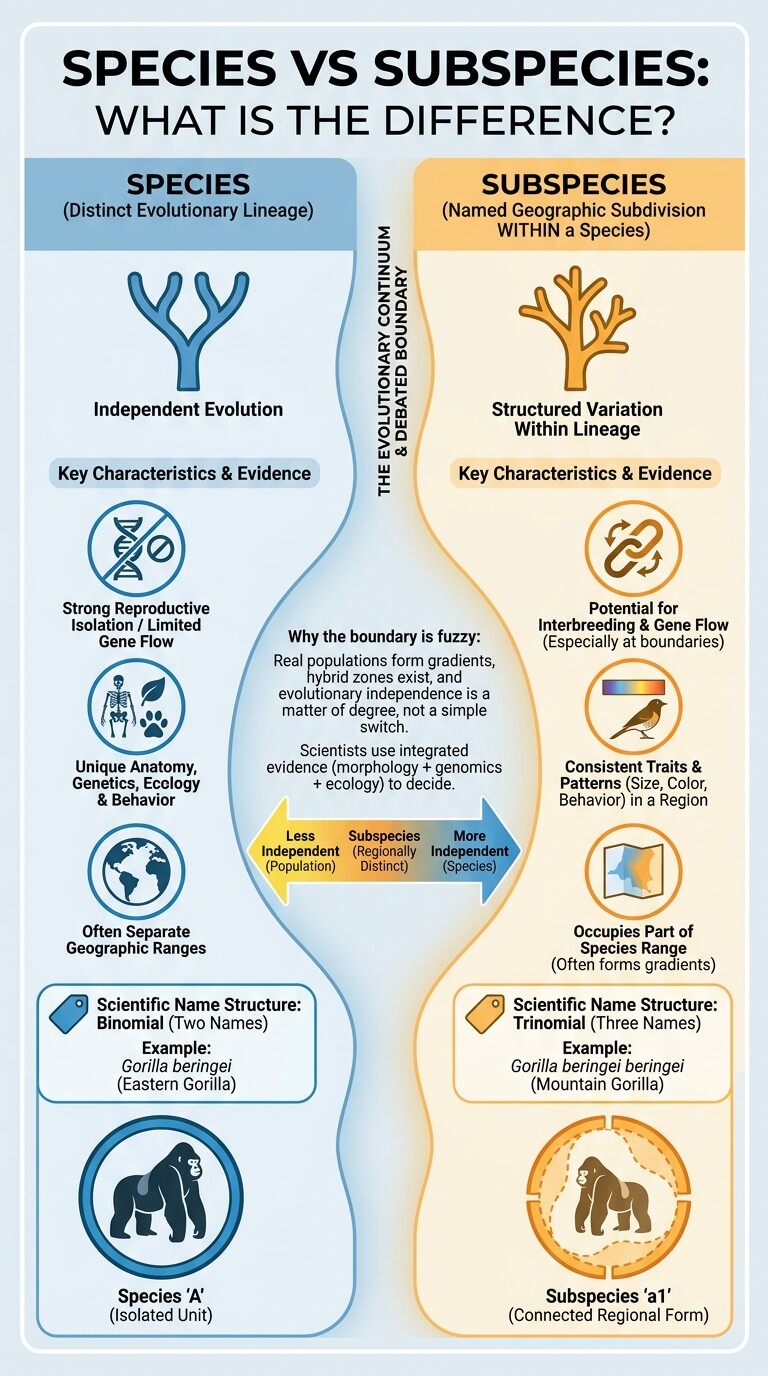
Species represent distinct evolutionary lineages
A species is generally recognized when a population or connected set of populations has an evolutionary identity that remains distinct from other lineages. Evidence may include reproductive isolation, consistent genetic separation, unique anatomy, different ecological roles, or a combination of these patterns. No single measurement works for every animal.
Complete isolation is not always required. Closely related species can sometimes hybridize, yet remain separate because most mating occurs within each lineage, hybrids have lower success, or only limited parts of the genome move between them. The important question is whether the lineages continue to evolve mainly as separate units.
Subspecies are differentiated populations within a species
A subspecies is a formally named population, or group of populations, below the species level. It usually has a geographic pattern and can be distinguished from other populations by a repeatable combination of traits. Those traits may involve size, coloration, body proportions, behavior, genetics, physiology, or adaptations to local conditions. Species and subspecies are nested within the wider animal kingdom classification system.
The label does not mean that every individual looks different from every individual in another subspecies. Populations can overlap in their measurements, and some animals near a geographic boundary may be intermediate. The diagnosis must describe a population pattern, not promise perfect identification of every specimen.
Why the boundary can be debated
Species formation is gradual, but scientific names create discrete categories. A population may be strongly differentiated in one part of its genome while still exchanging other genes with its neighbors. Another may look distinctive because of local climate, even though its genetic separation is weak. Different researchers can weigh those signals differently.
A National Academies review of principles for identifying species and subspecies emphasizes combining morphological, genomic, ecological, and behavioral evidence. That integrated approach is more reliable than using a single color pattern, one DNA sequence, or an arbitrary percentage of genetic difference.
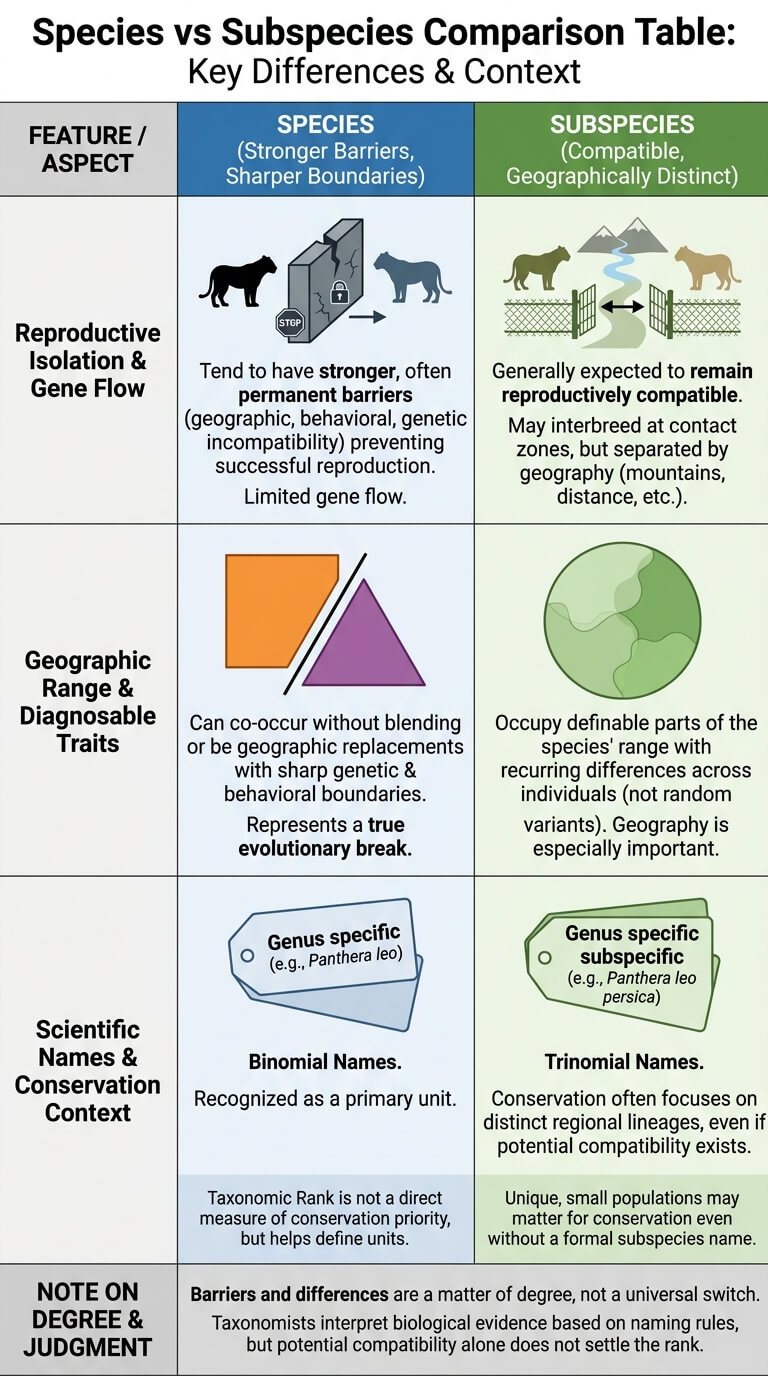
Species vs Subspecies Comparison Table
| Feature | Species | Subspecies |
|---|---|---|
| Basic meaning | A distinct evolutionary lineage | A named subdivision within a species |
| Gene flow | Usually limited enough for lineages to remain distinct | May continue with other populations of the same species |
| Geographic pattern | Ranges may be separate or overlapping | Often associated with a particular region |
| Diagnosis | Supported by multiple lines of evidence showing independent evolution | Supported by consistent population-level differences below the species boundary |
| Zoological name | Two words, such as Gorilla beringei | Three words, such as Gorilla beringei beringei |
| Universal acceptance | Species limits may still be disputed | Use of the rank varies greatly among animal groups |
Reproductive isolation and gene flow
Species tend to have stronger barriers to gene flow than subspecies, but this is a matter of degree rather than a universal switch. Barriers can involve geographic separation, mate choice, breeding time, habitat preference, genetic incompatibility, or reduced survival and fertility of hybrids.
Subspecies are generally expected to remain reproductively compatible with other subspecies in the same species. They may interbreed where their ranges meet, although actual contact can be rare if mountains, rivers, deserts, or distance keep them apart. Potential compatibility alone does not settle the rank, because populations that never meet cannot be tested directly in nature.
Geographic range and diagnosable traits
Geography is especially important for subspecies. A credible subspecies should usually occupy a definable part of the species’ range and show differences that recur across many individuals. A random local variant, one unusual specimen, or a temporary color phase is not enough.
Species can also be geographic replacements, but they may occur together without blending, use different habitats in the same region, or maintain sharper genetic and behavioral boundaries. Researchers must distinguish a true evolutionary break from ordinary isolation by distance, in which populations become gradually less similar as the distance between them increases.
Scientific names, conservation use, and disagreement
Species names are binomials, meaning they contain a genus name and a specific name. Subspecies names are trinomials with a third word. The International Code of Zoological Nomenclature sets rules for names, not the biological evidence required to choose a rank. Taxonomists decide whether the recognized unit is a species or subspecies, then apply the naming rules.
Conservation programs may pay close attention to subspecies because a distinctive regional lineage can face serious threats even when the species as a whole is more widespread. However, a taxonomic label is not a direct measure of conservation priority. Small, unique populations may matter even when they do not receive a formal subspecies name.
What Is a Species?
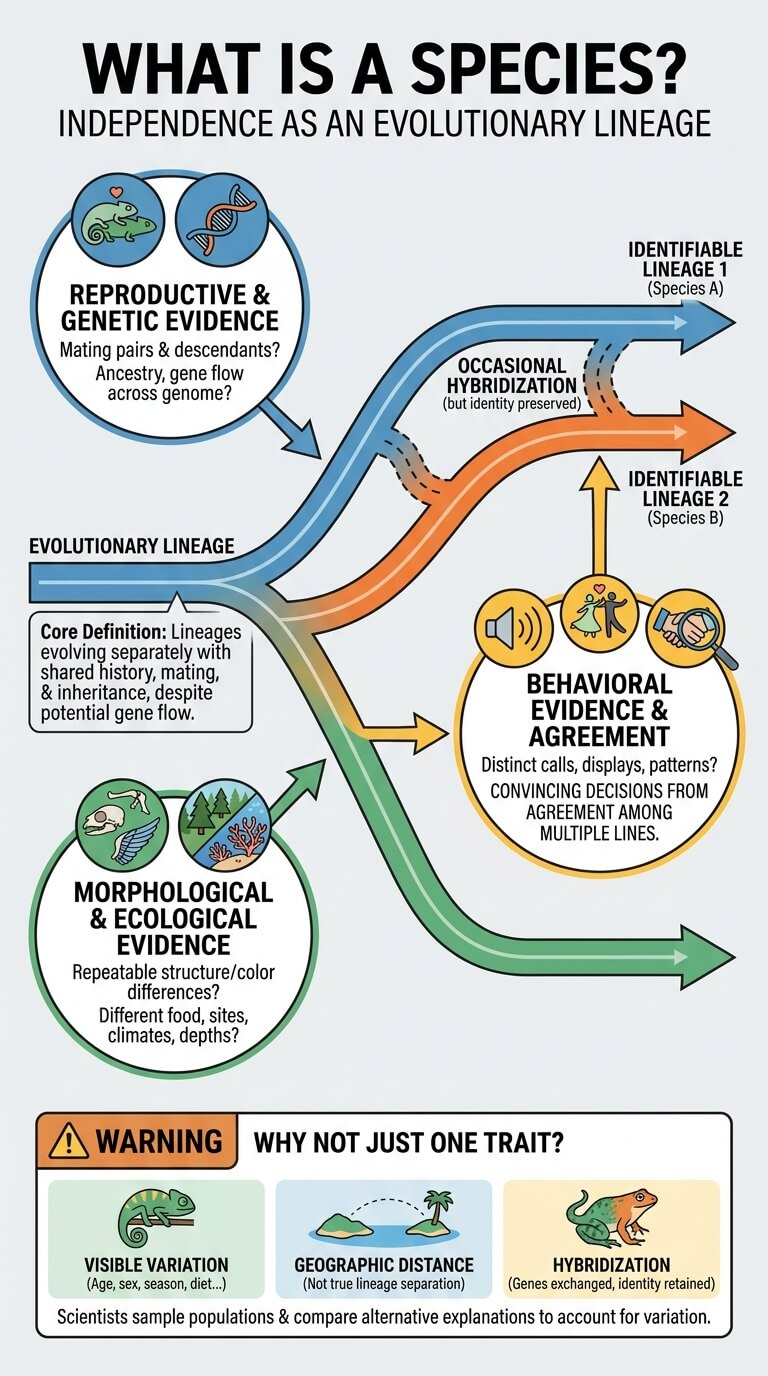
Independence as an evolutionary lineage
The broadest modern idea is that species are lineages evolving separately from other lineages. Separate evolution does not require that every gene be isolated forever. It means that population history, mating patterns, selection, and inheritance preserve an identifiable lineage despite occasional contact or hybridization.
This view explains why a species can be recognized through different evidence in different animals. Bird songs may reveal mate recognition, insect host plants may divide breeding populations, and marine animals may require genomic evidence because their external anatomy changes little.
Reproductive, genetic, morphological, and ecological evidence
Reproductive evidence asks whether populations mate naturally and whether their descendants contribute genes to later generations. Genetic evidence tests ancestry, population structure, and gene flow across many independent parts of the genome. Morphological evidence compares repeatable differences in structures, measurements, coloration, and development.
Ecological evidence can show that populations use different food, breeding sites, climates, depths, or host species. Behavioral evidence may reveal distinct calls, courtship displays, activity patterns, or migration routes. The most convincing decisions usually come from agreement among several of these lines of evidence. This is one example of how animals are classified using anatomy, genetics, ecology, behavior, and geography together.
Why species status is not based on one trait
A visible difference may be caused by age, sex, season, diet, temperature, or individual variation. A genetic difference may reflect geographic distance rather than an independently evolving lineage. Even the ability to hybridize is not decisive, because some accepted species exchange genes while retaining their identity.
For that reason, scientists sample across populations and compare alternative explanations. A good species diagnosis should account for variation within the proposed species as well as differences from its closest relatives.
What Is a Subspecies?
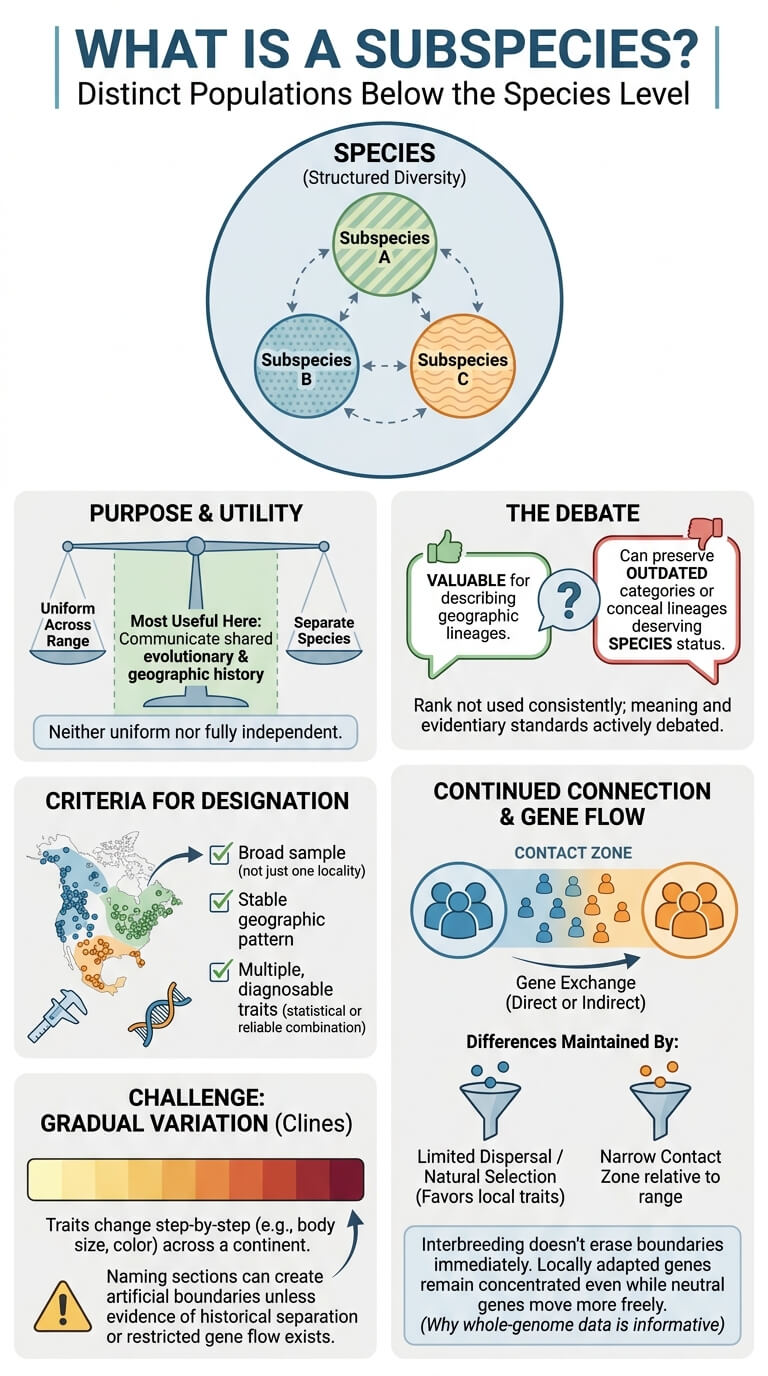
Distinct populations below the species level
Subspecies recognize structured diversity inside a species. They are most useful when populations are neither uniform across the range nor sufficiently independent to be treated as separate species. A subspecies name can communicate that animals from one region share a particular evolutionary and geographic history.
The rank is not used consistently across zoology. Some researchers consider subspecies valuable for describing geographic lineages, while others argue that poorly defined subspecies can preserve outdated categories or conceal lineages that deserve species status. A peer-reviewed discussion of problems with the subspecies rank shows why its meaning and evidentiary standards remain actively debated.
Geographic pattern and consistent differences
A proposed subspecies should be based on a broad sample, not a few animals from one locality. Researchers look for a stable geographic pattern in multiple traits. Those traits do not need to be dramatic, but they should be repeatable enough to diagnose the population statistically or through a reliable combination of characters.
Gradual variation creates difficulty. Body size, color, or shape may change step by step across a continent without a clear break. Naming several sections of that gradient can create artificial boundaries unless there is additional evidence of historical separation or restricted gene flow.
Continued connection with other populations
Subspecies may exchange genes directly where their ranges meet or indirectly through populations between them. Their differences can remain recognizable if dispersal is limited, if natural selection favors local traits, or if the contact zone is narrow relative to the full range.
Interbreeding does not mean every boundary disappears immediately. Locally adapted genes may remain concentrated in different regions even while neutral genes move more freely. This is one reason whole-genome patterns and ecological data can be more informative than a single genetic marker.
How Scientists Evaluate Subspecies
Sampling across the full range
Reliable evaluation begins with geography. Scientists need specimens, observations, photographs, measurements, or genetic samples from the center and edges of each proposed range, plus the areas between them. Sparse sampling can make a smooth gradient look like two distinct groups simply because intermediate populations were missed.
Researchers also account for sex, age, season, and life stage. Comparing adult males from one region with females or juveniles from another can manufacture differences that have nothing to do with geography.
Morphology, coloration, measurements, and behavior
Traditional subspecies were often described from museum skins, skulls, shells, plumage, scales, or body measurements. Museum collections remain valuable because they preserve material from many places and time periods. Modern studies can test whether historical diagnoses hold up when larger samples are analyzed.
Behavior can add evidence when it is consistent and inherited or culturally stable. Regional songs, migration routes, breeding times, and courtship patterns may reveal limited mixing, but behavior can also change quickly. It should be interpreted alongside anatomy and population history.
Genetic structure and gene flow
Genetic studies ask whether a population forms a repeatable genetic grouping, how long it has been separated, and whether genes continue to move across its borders. Researchers prefer many independently inherited markers or genome-wide data because one gene can tell an incomplete history.
A distinct mitochondrial lineage, for example, may reflect female ancestry while nuclear genes show broader mixing. Conversely, recently separated populations can be ecologically and behaviorally distinct before large genetic differences accumulate. Genetic data are powerful, but their meaning depends on sampling and biological context.
Ecological differences and geographic barriers
Mountains, rivers, islands, deserts, glaciers, and habitat gaps can reduce movement and allow regional populations to diverge. Local climate, prey, vegetation, elevation, or disease pressure may favor different traits. Researchers ask whether these ecological differences are stable and whether they help explain the observed geographic pattern.
A barrier does not guarantee a subspecies. Some highly mobile animals cross it regularly, while other populations remain distinct without an obvious physical barrier because of behavior or habitat choice.
Historical evidence and museum specimens
Older specimens can show whether a pattern existed before recent habitat changes, translocations, or human-assisted mixing. Labels and field notes may reveal original locations, but historical data must be checked carefully because locality errors, small samples, and faded colors can mislead.
Type specimens are particularly important for names. They anchor a zoological name to a physical reference, even if later research changes the rank or the set of populations associated with that name.
How Naming Conventions Differ
Binomial names for species
A zoological species name has two parts: the genus and the specific name. In Gorilla beringei, Gorilla is the genus and beringei is the specific name. The genus begins with a capital letter, while the second word is lowercase. Both are italicized in standard scientific writing.
Trinomial names for subspecies
A subspecies adds a third lowercase word. The mountain gorilla is commonly written Gorilla beringei beringei, while Grauer’s gorilla is Gorilla beringei graueri. The first two words identify the species, and the third identifies the subspecies.
Article 5 of the zoological naming code specifies two names for a species and three for a subspecies. The code governs how animal names are formed and applied, but it does not force scientists to agree on where a biological boundary belongs.
Nominate subspecies and repeated epithets
When a species is divided into subspecies, the population containing the name-bearing type of the species receives a repeated third word. This is called the nominotypical, often informally called nominate, subspecies. Thus, Gorilla beringei beringei repeats beringei.
The repeated word does not mean that this subspecies is more typical, more important, or more ancestral than the others. It is a consequence of naming rules and the history of the original species description.
Examples and Case Studies
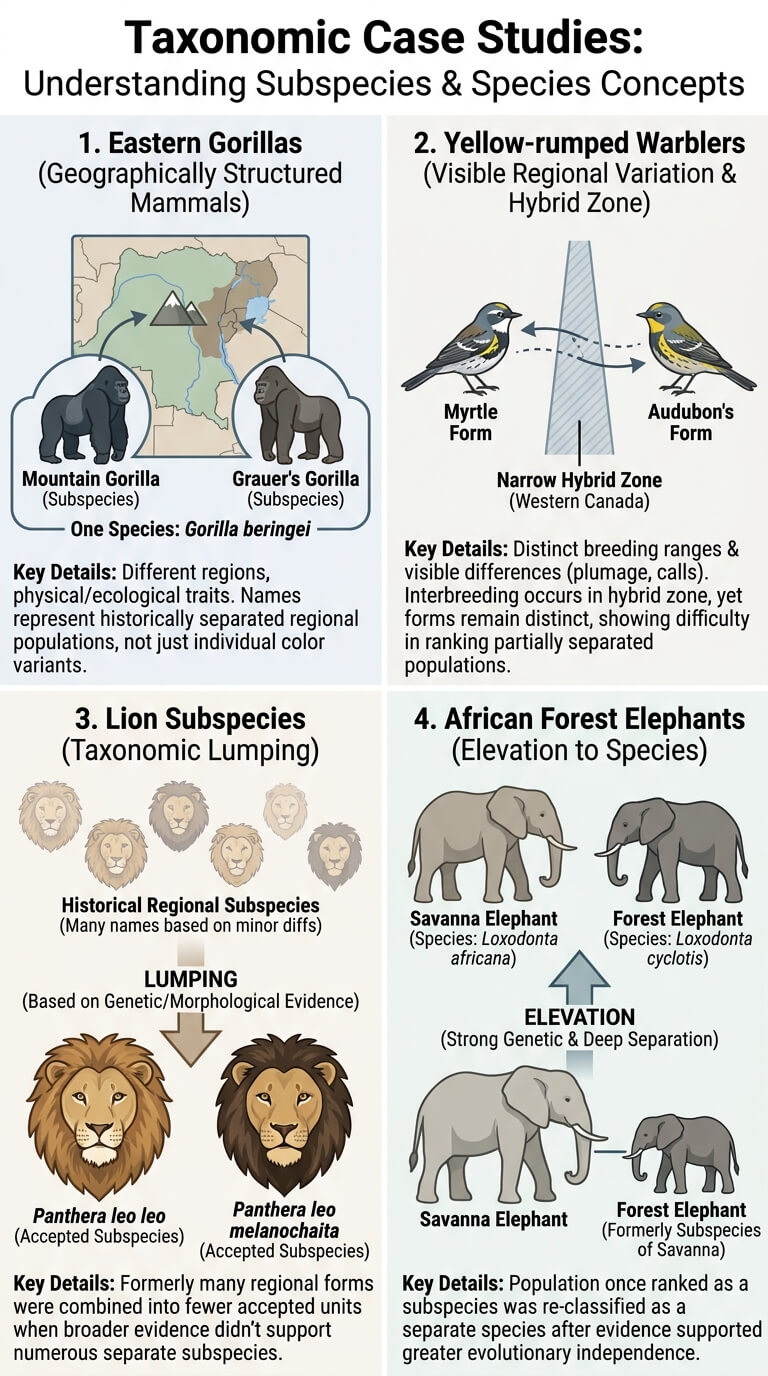
Eastern gorillas as geographically structured mammals
The eastern gorilla provides a clear naming example. Mountain gorillas and Grauer’s gorillas occupy different regions and are commonly treated as subspecies of Gorilla beringei. They differ in geography and a number of physical and ecological characteristics, yet are placed within one species under that treatment.
This example also shows why a subspecies is not simply a color morph. The names represent broad, historically separated regional populations, not occasional individual variants. Taxonomic treatments can still be revised if future evidence changes the interpretation of their independence.
Yellow-rumped Warblers and visible regional variation
Yellow-rumped Warblers include geographically structured forms with differences in plumage, range, migration, and calls. Myrtle and Audubon’s forms meet in a relatively narrow hybrid zone in western Canada. Their mixture of visible differences and continuing hybridization has made the complex a useful example of the difficulty of ranking partially separated populations.
A Cornell Lab account of Yellow-rumped Warbler research describes distinct breeding ranges, genomic differences, and the hybrid zone. The case shows that interbreeding can occur even when selection and geography preserve recognizable forms.
Lion subspecies and taxonomic lumping
Many regional lion subspecies were named historically from differences in mane, body size, skull shape, and geography. Later reviews found that several old divisions were not supported as separate subspecies when broader genetic and morphological evidence was considered.
A widely used recent treatment recognizes two lion subspecies, Panthera leo leo and Panthera leo melanochaita. The ITIS lion classification lists those two names. This is an example of lumping, where multiple previously named regional forms are combined into fewer accepted units.
African forest elephants elevated to species
African forest elephants were long treated by many authorities as a subspecies of a broadly defined African elephant. Genetic and other evidence supported a deeper separation between forest and savanna lineages, leading major modern mammal authorities to recognize Loxodonta cyclotis and Loxodonta africana as separate species.
The Mammal Diversity Database entry for the African savanna elephant notes that the species previously included the forest elephant, while acknowledging that some authorities have treated them as one. This demonstrates how a population once ranked below species can be elevated when evidence supports greater evolutionary independence.
Species, Subspecies, Breeds, and Populations
Why domestic breeds are not automatically subspecies
A breed is a human-managed population selected for particular traits. Dog, cattle, pigeon, and rabbit breeds can differ dramatically in appearance, yet those differences arose through selective breeding within domesticated lineages. Breed standards are maintained by people, registries, and controlled mating rather than by natural geographic separation alone.
Some domestic animals have complicated scientific naming histories, but a breed name does not function like a zoological subspecies name. A Great Dane and a Chihuahua are not separate subspecies merely because they differ in size and form.
Why every local population is not a subspecies
A population is simply a group of animals of the same species living and breeding in a particular area. Every species contains populations, but most populations are not formally named. To justify subspecies recognition, the differences should be consistent, geographically structured, and meaningful in the context of the species as a whole.
Small differences in gene frequencies are expected among local populations. Naming each detectable grouping would make subspecies depend heavily on sampling scale and could produce unstable classifications.
Ecotypes and color morphs are different concepts
An ecotype is a locally adapted form associated with particular environmental conditions. It may or may not correspond to a subspecies. A color morph is a recurring appearance within a population, such as light and dark forms, and may occur in the same breeding population without geographic separation.
These labels describe different biological patterns. A researcher should not promote an ecotype or morph to subspecies solely because it is visually distinctive.
Why Scientists Disagree
Different species concepts and thresholds
Taxonomists may agree on the data but disagree on the rank. One may view two populations as young species because they form distinct lineages, while another may retain them as subspecies because gene flow continues and reproductive isolation is incomplete.
There is no universal genetic distance that separates species from subspecies. Thresholds that seem useful in one group may fail in another because mutation rates, population sizes, dispersal, and histories differ.
Uneven sampling and limited historical data
Taxonomic conclusions can change when researchers sample areas that were previously missing. A supposed gap may contain intermediate populations, or a seemingly continuous range may hide a sharp genetic break. Museum series can also be biased toward accessible locations or unusual specimens.
Genomic methods improve resolution, but more data do not automatically produce a simple answer. They can reveal past hybridization, multiple periods of isolation, and conflicting histories among genes.
Conservation consequences of splitting or lumping
Splitting one species into several can reveal that a lineage has a much smaller range than previously understood. Lumping several names can redirect attention toward populations, habitats, or management units rather than formal subspecies. Either decision can affect laws, recovery planning, captive breeding, and public communication.
Taxonomy should not be changed merely to create or remove protection. At the same time, researchers should explain how uncertainty affects conservation and avoid treating an unresolved name as evidence that a population lacks biological value.
Edge Cases That Blur the Boundary
Hybrid zones
A hybrid zone is a region where differentiated populations meet and interbreed. A narrow, stable zone can persist when hybrids have lower success or when each parental form performs better in its own environment. Gene flow may occur without erasing the larger geographic pattern.
Hybrid zones can occur between species or subspecies, so their presence does not automatically determine rank. Scientists examine width, movement, hybrid fitness, mate choice, and genomic mixing.
Ring-like geographic variation
In ring-like patterns, neighboring populations around a barrier exchange genes, but populations at the ends of the geographic chain may differ strongly where they meet. Famous examples have often proved more complicated than a perfect ring because contact is irregular and population history includes breaks and secondary contact.
The idea remains useful because it shows how gradual geographic divergence can make categorical names difficult. Researchers must describe the actual pattern rather than forcing it into an ideal model.
Rapid divergence and recently isolated populations
Recently separated populations may differ in habitat, behavior, or a few selected genomic regions while remaining similar across most of the genome. These populations can sit near the species boundary for long periods, especially if occasional migration continues.
Calling them species or subspecies depends on the evidence, the standards used for that animal group, and whether their evolutionary paths remain independently maintained.
Common Mistakes and Myths
Subspecies are not unfinished species by definition
A subspecies is not automatically a species waiting to happen. Some regional forms may become more isolated over time, others may remain connected, and still others may merge if barriers disappear. The name describes a present taxonomic judgment, not a guaranteed evolutionary future.
Visible differences alone may be insufficient
Color, size, and pattern can vary with climate, food, age, sex, and season. A striking photograph can exaggerate separation if it compares unusually different individuals. Researchers need representative samples and evidence that the pattern persists across geography.
Interbreeding does not make every classification simple
Subspecies are generally compatible, but some accepted species also hybridize. The frequency and evolutionary consequences of gene flow matter more than the bare fact that a cross is possible. Captive mating is especially weak evidence because animals may reproduce under conditions they would not encounter in nature.
How Species and Subspecies Fit Into Classification
Species concepts define the upper boundary
Deciding whether a lineage is a species comes first conceptually. Scientists ask whether the population is evolving independently under reproductive, phylogenetic, ecological, or integrative evidence. If the evidence supports meaningful structure but not a separate species, subspecies may be considered. The comparison depends first on the evidence used to decide what makes an animal a species.
Taxonomic ranks place the names in context
Species sits below genus in the familiar hierarchy, while subspecies is a rank below species. Subspecies does not replace population biology, phylogeography, or conservation units. It is one way to name part of the variation that those fields investigate. Species and subspecies occupy different positions within the taxonomic hierarchy.
Formal names can change after classification is revised
When populations are split into species, the third word of a former trinomial may become the second word of a new binomial. When taxa are lumped, some names become synonyms or remain available for a different rank. Databases preserve these name histories so older studies and museum records can still be interpreted.
The biological animals do not change when their names change. The revision reflects a new interpretation of their relationships, supported by the evidence available at that time.
FAQ
Can different subspecies interbreed?
Yes, subspecies are generally considered reproductively compatible with other subspecies of the same species. They may interbreed where ranges meet, although geography or behavior can limit contact. The amount of gene flow varies, and compatibility does not mean that regional differences will immediately disappear.
Is an animal breed the same as a subspecies?
No. A breed is usually a domesticated population shaped and maintained by human selection. A subspecies is a zoological rank for naturally structured populations within a species. Breed standards, pedigrees, and controlled mating do not provide the same evidence as long-term geographic and evolutionary differentiation in the wild.
Can a subspecies become recognized as a species?
Yes. New genetic, anatomical, behavioral, or ecological evidence may show that a named subspecies is an independently evolving lineage. Taxonomists can then elevate it to species rank. African forest elephants are a well-known example of populations formerly treated within a broader African elephant classification that are now recognized separately by major mammal authorities. Changes in evidence can lead researchers to describe a new species or revise an existing subspecies.
Why do scientists sometimes eliminate subspecies names?
A subspecies may be merged when broader sampling shows that its supposed traits overlap widely with neighboring populations, follow a smooth gradient, reflect age or sex, or are not supported by genetic and ecological evidence. Names can also be combined when several historical labels describe parts of the same regional lineage.
Final Thoughts
In the species vs subspecies comparison, the central distinction is evolutionary independence. Species are treated as distinct lineages, while subspecies describe consistent geographic or evolutionary variation within a species. Neither rank can be assigned responsibly from one photograph, one unusual specimen, or one genetic marker.
The strongest classifications combine representative sampling with morphology, behavior, ecology, geography, and genome-wide evidence. Disagreement is expected near the boundary because evolution is continuous and naming systems are categorical. A careful explanation should therefore show both the evidence behind a rank and the uncertainty that remains.

Ethan Walker is the founder and research editor of Animal Fact Central. He creates and reviews educational animal facts content using trusted wildlife, pet care, and science-based sources. His work focuses on making animal behavior, adaptations, habitats, and species facts clear, accurate, and engaging for everyday readers.
Read More Details About Ethan Walker: https://animalfactcentral.com/ethan-walker/