
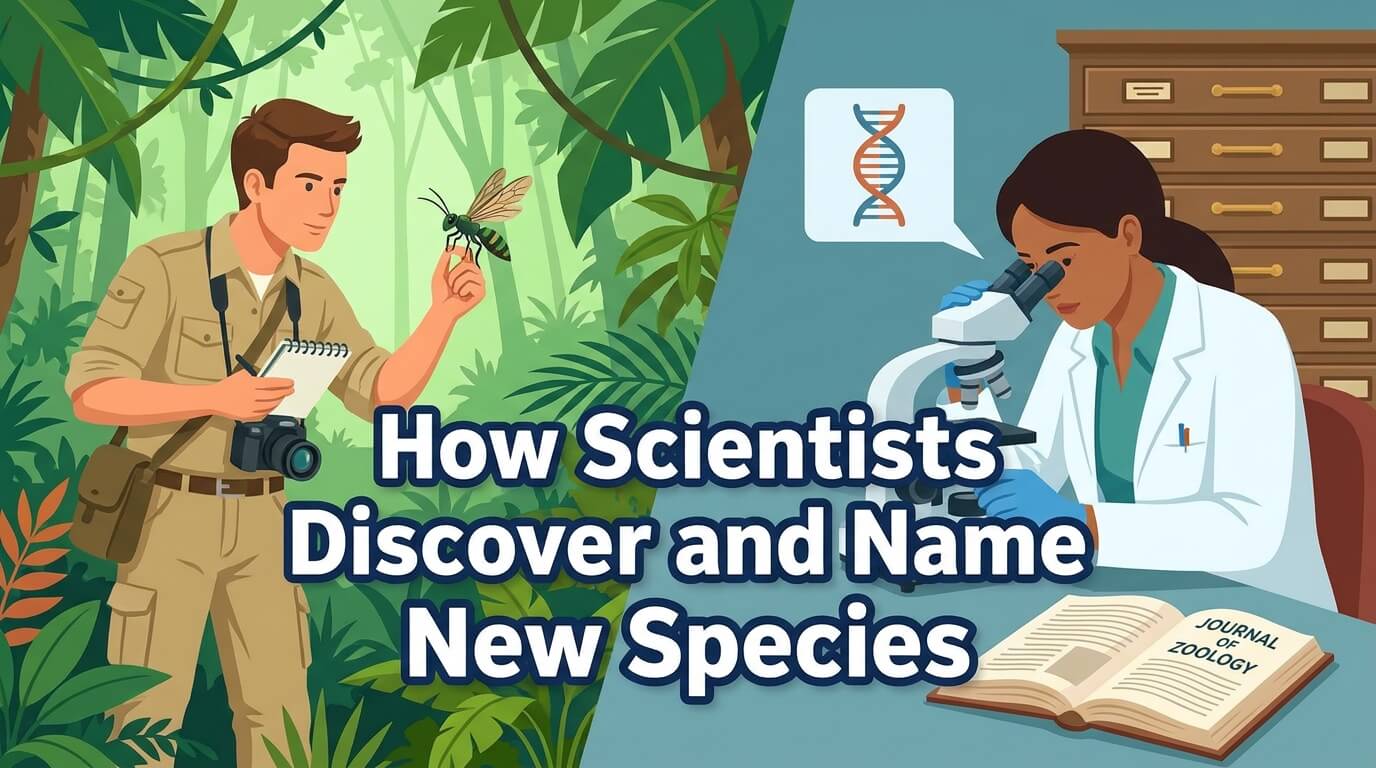
Finding an animal that looks unfamiliar is only the beginning of discovering a new species. Scientists must document where it was found, compare it with known animals, test whether the differences are consistent, decide whether the evidence supports a separate species, and publish a formal description that follows zoological naming rules.
The process can begin in a rainforest, a cave, the deep sea, a fish market, a museum drawer, or a DNA dataset. It may take months or years because a new name should represent a defensible biological conclusion, not a quick reaction to one unusual specimen. The strongest studies combine anatomy, genetics, geography, ecology, behavior, sound recordings, and carefully preserved reference material.
Quick Answer
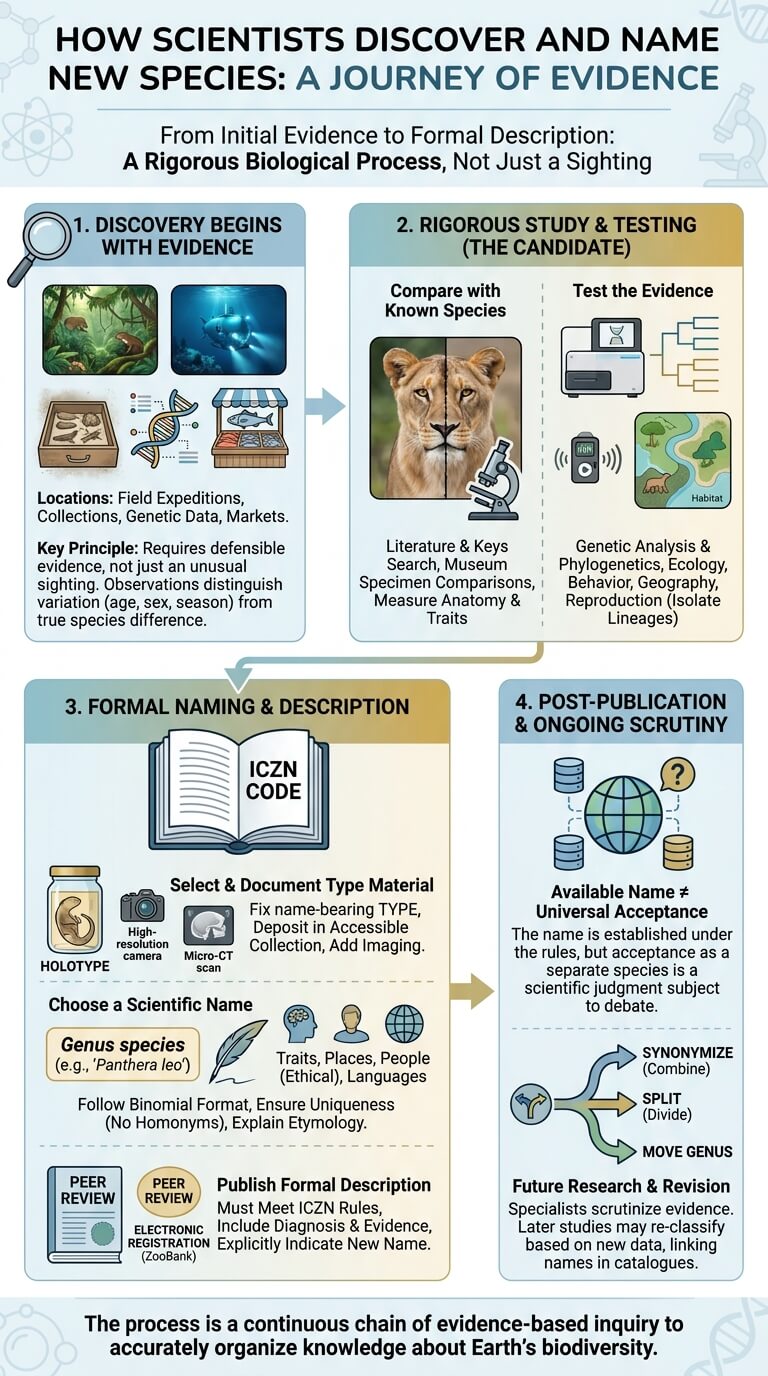
Discovery begins with evidence, not simply seeing an unfamiliar animal
A possible new species is called a candidate until researchers can show that it differs from every species already described. A strange color, unusual size, damaged body part, juvenile appearance, seasonal coat, or difference between males and females can make a familiar species look new. Scientists therefore collect enough observations to separate individual variation from a population-level pattern.
Discovery also does not require finding a living animal in a place no one has visited. Researchers regularly recognize species among old museum specimens, in photographs that lead to follow-up work, or in genetic samples that reveal several hidden lineages inside what was thought to be one species.
A scientific name appears only after a formal description
Informal announcements, news stories, specimen labels, social-media posts, and photographs do not by themselves establish a zoological name. The authors must publish a work that meets the International Code of Zoological Nomenclature, commonly called the ICZN Code. The work normally identifies the new species, gives characters that distinguish it, fixes name-bearing type material, and provides the information required for the name to become available under the rules.
Available is a technical word in zoological nomenclature. It means that a name was established in a way recognized by the Code. It does not mean that every specialist agrees the animal is a separate species. Taxonomists may later accept the species, question it, combine it with another species as a synonym, or move it to a different genus.
Where New Species Are Found
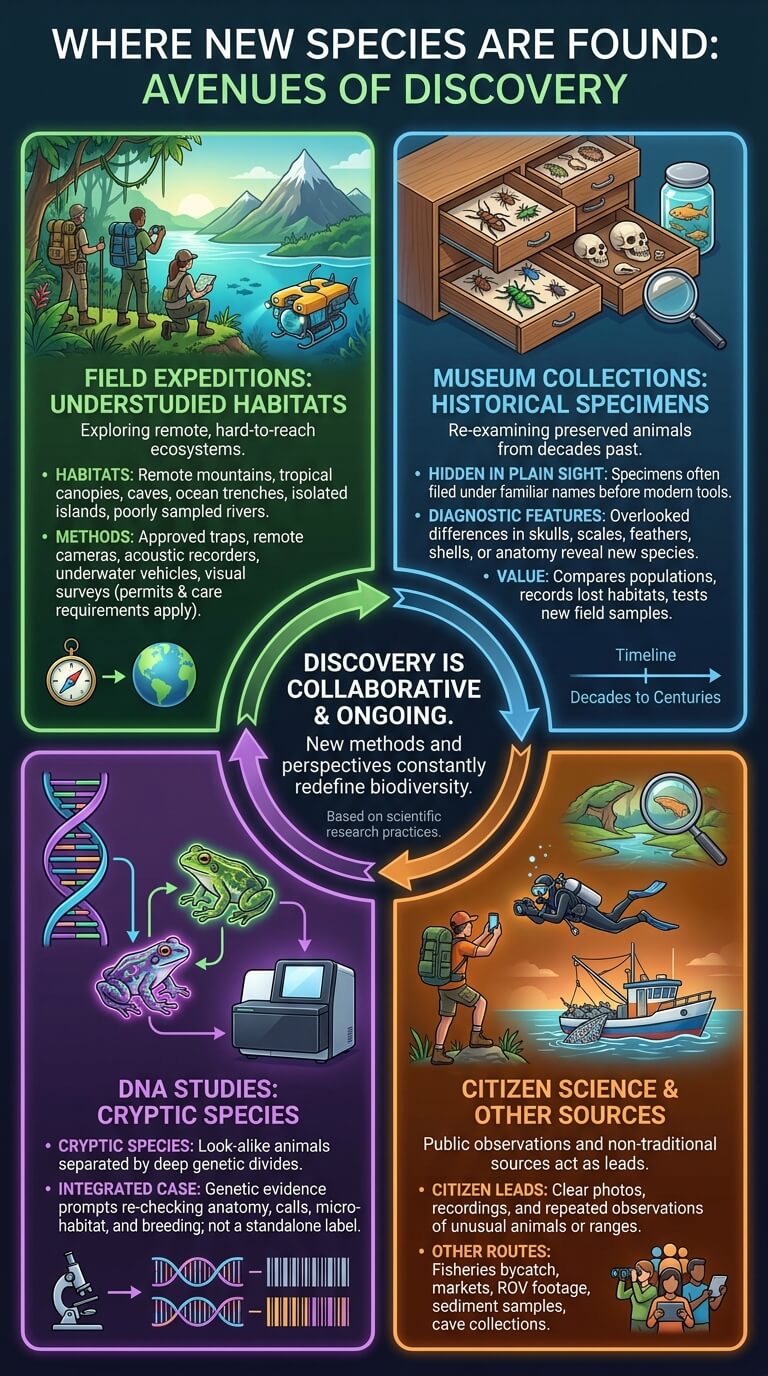
Field expeditions in understudied habitats
Remote mountains, tropical forest canopies, caves, groundwater systems, ocean trenches, isolated islands, and poorly sampled rivers can hold animals that have rarely been collected or observed. Field teams may use nets, traps approved for scientific sampling, remote cameras, acoustic recorders, underwater vehicles, environmental sensors, or direct visual surveys. The method depends on the animal and must follow permits and animal-care requirements.
Museum drawers and historical collections
Natural history collections preserve animals gathered across decades or centuries, together with labels recording place, date, collector, and habitat. A specimen may have been filed under a familiar name before modern identification tools existed. When a specialist compares a large series, overlooked differences in skulls, scales, feathers, shells, genital structures, or other diagnostic features may reveal a species hidden in plain sight.
Museum material also lets scientists compare populations that are difficult or impossible to revisit. Historical specimens can preserve evidence from habitats that have changed dramatically, and they provide a record against which new field samples can be tested. Discovery in a collection is still discovery, even though the animal was physically collected long before anyone recognized its scientific importance.
DNA studies that reveal cryptic species
Cryptic species are distinct lineages that are difficult to separate by outward appearance alone. DNA sequences may show that animals assigned to one name fall into deeply separated groups. That pattern can prompt scientists to recheck anatomy, mating signals, calls, microhabitat, parasites, geographic barriers, and breeding evidence.
Genetic difference alone is not an automatic species label. Rates of DNA change vary among animal groups, and one short gene may reflect only part of a population’s history. Strong descriptions use genetic evidence as one part of an integrated case, especially when morphology is subtle.
Citizen-science observations and photographs as leads
Birders, divers, anglers, hikers, photographers, and community naturalists sometimes document animals outside known ranges or with unusual features. A clear photograph, call recording, location, date, and repeated observations can alert specialists to a population that deserves investigation. Such reports are particularly useful for conspicuous animals that scientists rarely encounter during short field seasons.
Fisheries, markets, caves, and the deep sea
New species may be recognized in fisheries bycatch, legal market surveys, remotely operated vehicle footage, sediment samples, cave collections, plankton tows, or material recovered from other research projects. These routes can expose animals from habitats that are expensive or dangerous to sample directly.
Step 1: Document the Candidate Species
Record appearance, behavior, habitat, and location
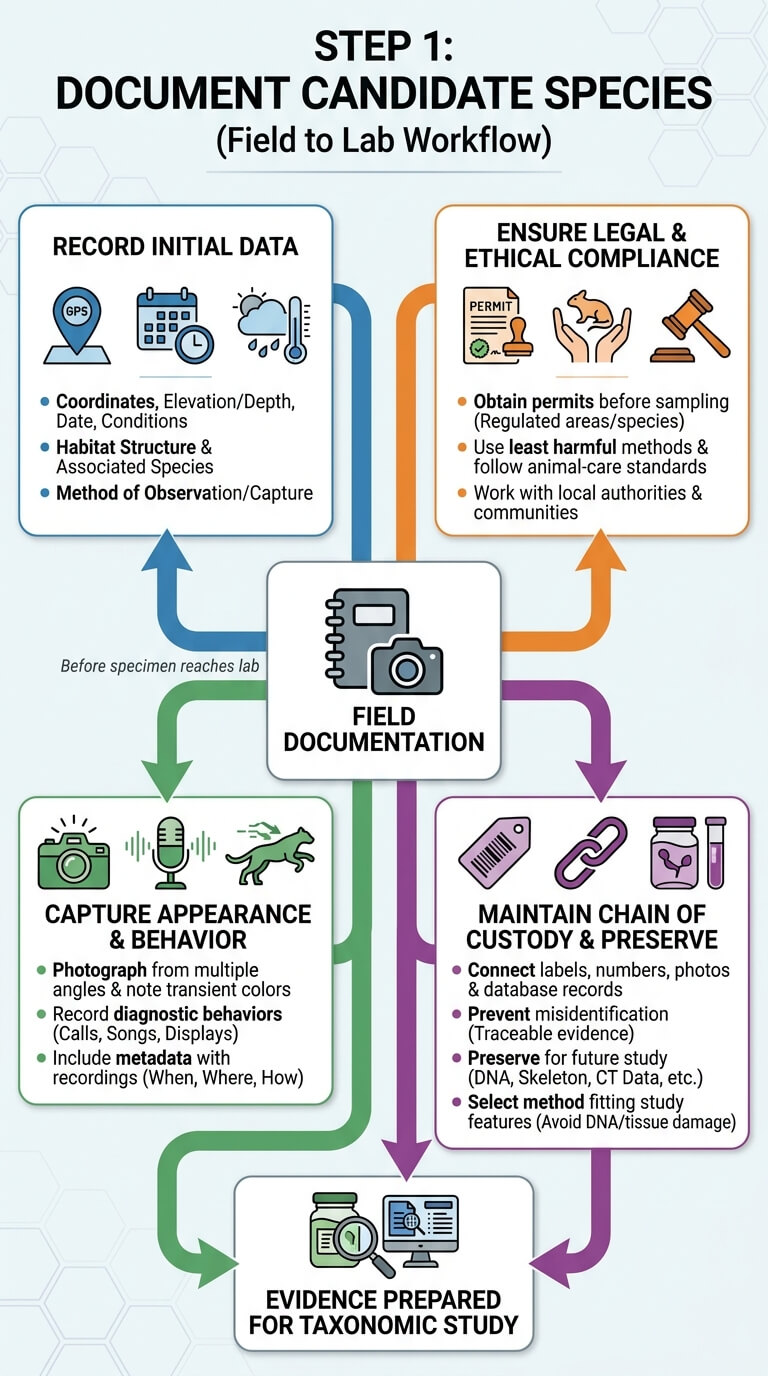
Field documentation begins before a specimen reaches the laboratory. Researchers record coordinates, elevation or depth, date, weather or water conditions, habitat structure, associated species, and the method of observation or capture. They photograph the animal from multiple angles and note colors that may fade after preservation.
Behavior can be diagnostic. Frog calls, bird songs, electric signals, courtship displays, activity times, web designs, host choice, and swimming patterns may distinguish animals that look similar. Recordings should include metadata so later researchers know when, where, and how they were made.
Use permits, ethical sampling, and clear custody records
Collecting wildlife is regulated in many places, and protected areas or threatened species may require additional permissions. Researchers should obtain permits before sampling, use the least harmful method that can answer the question, follow institutional animal-care standards where applicable, and work with local authorities and communities.
Labels, field numbers, tissue numbers, photographs, and database records must remain connected. This chain of documentation prevents a DNA sample from being matched to the wrong body or locality. It also allows museums, reviewers, and later researchers to trace the evidence.
Preserve evidence for future study
A taxonomic study should leave material that others can examine. Depending on the animal, this may include a whole specimen, tissue preserved for DNA, skeleton, shell, slide, parasite sample, sound recording, high-resolution photographs, CT data, or measurements. Preservation methods must fit the features under study because some chemicals damage DNA, fade colors, shrink tissues, or distort soft anatomy.
Step 2: Compare It with Known Species
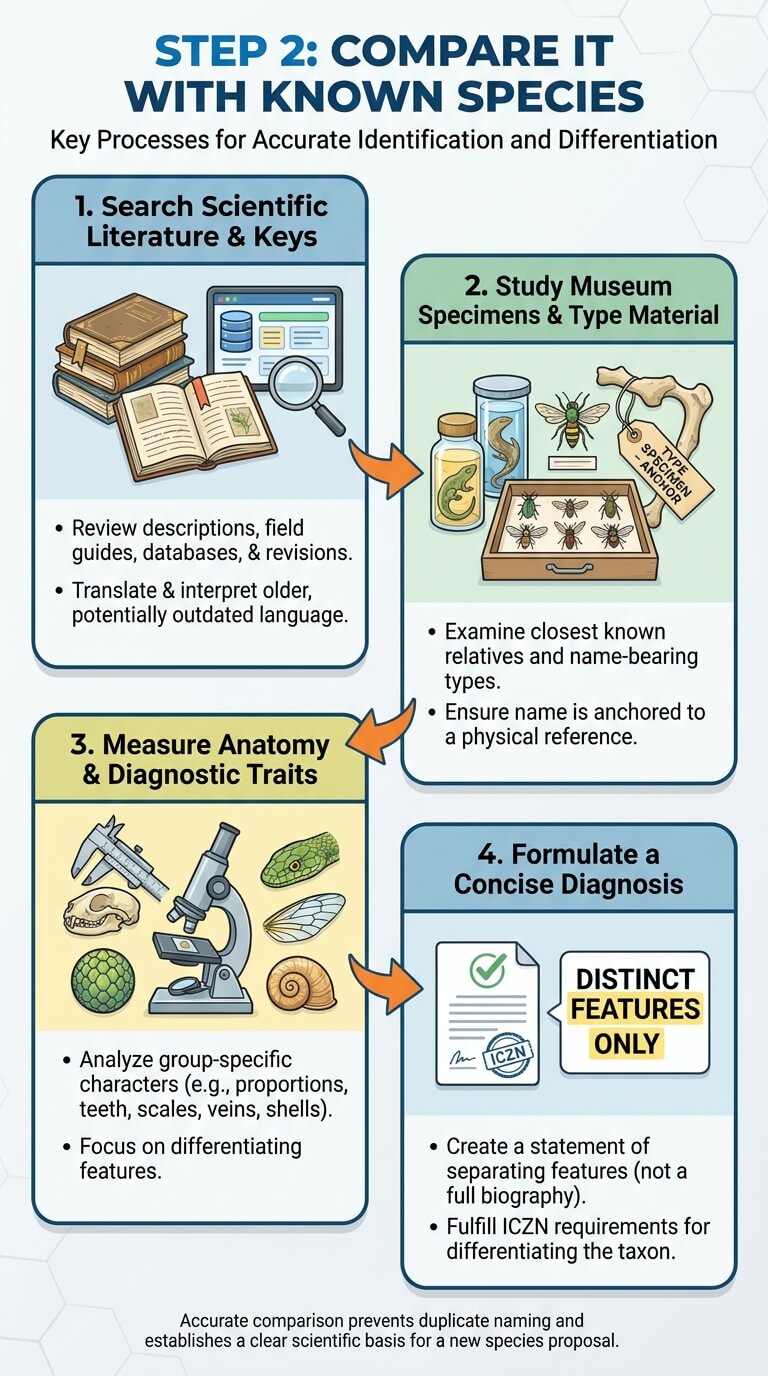
Search scientific literature and identification keys
Before proposing a new name, researchers examine earlier descriptions, revisions, field guides, identification keys, databases, and regional faunal studies. Old literature may use outdated genus names or vague language, so original descriptions sometimes need to be translated and interpreted alongside modern revisions.
Study museum specimens and type material
Comparisons should include the closest known relatives and, when possible, the name-bearing types or reliable images and measurements of them. Type material anchors each scientific name to a physical reference. Without that anchor, two researchers might use the same name for different animals.
Measure anatomy, coloration, and diagnostic traits
Taxonomists choose characters appropriate to the group. Mammal studies may compare skull proportions, teeth, fur, and external measurements. Reptile studies may count scales. Insect studies may examine wing veins, antennae, genital structures, or microscopic surface patterns. Mollusk studies may combine shell form with soft anatomy because shells can change with environment.
A diagnosis is not a complete biography. It is a concise statement of the features that separate the proposed species from its closest relatives. Under ICZN requirements for names published after 1930, a new name generally needs words stating characters intended to differentiate the taxon, or an accepted bibliographic route to such information.
Step 3: Test the Evidence
Use genetic sequencing and phylogenetic analysis
DNA can test whether the candidate groups with a known species or forms a separate lineage. Researchers may sequence a standard barcode region, several genes, complete mitochondrial genomes, or thousands of nuclear markers. A phylogenetic analysis estimates evolutionary relationships, while population analyses examine gene flow and structure.
Combine ecology, behavior, geography, and reproduction
Two lineages may occupy different elevations, feed on different hosts, breed in different seasons, use different calls, or remain separated where their ranges meet. These patterns can support a species boundary because they show how populations maintain distinct identities.
Rule out age, sex, season, injury, and individual variation
Many false starts disappear when researchers expand the sample. Juveniles can have different proportions or colors from adults. Males and females may differ dramatically. Breeding plumage, seasonal fur, pregnancy, parasites, healed injuries, nutritional stress, and preservation can alter appearance.
Step 4: Decide Whether It Is Distinct
Apply an appropriate species concept
A species concept is a framework for deciding what counts as a species. One approach emphasizes reproductive isolation, another focuses on separately evolving lineages, and others use diagnosable traits or ecological differences. Researchers may draw on several concepts rather than force every animal through one test.
Build a diagnosis that separates the species
The diagnosis tells another specialist how to distinguish the proposed species from its nearest relatives. It may use a unique feature, but more often it relies on a combination. For example, no single scale count may be exclusive, yet scale counts combined with body proportions, coloration, call structure, and DNA may identify the lineage reliably.
A useful diagnosis states what was compared and acknowledges overlap. Words such as usually, in the examined sample, and distinguished by the following combination can be more accurate than absolute language. The goal is reproducible identification, not pretending that biological variation disappears.
Handle uncertain species complexes honestly
A species complex contains closely related populations whose boundaries are unclear. Researchers may describe one well-supported species while leaving other lineages unnamed, or publish a revision that identifies candidate species needing more material. Uncertainty is not failure. It shows where future sampling can change the interpretation.
Step 5: Select and Document Type Material
Understand holotypes, paratypes, and type locality
The holotype is the single name-bearing specimen fixed in the original description when an author designates one. Paratypes are other specimens in the type series when a holotype has been designated, but they do not carry the name in the same objective way. The type locality is the place where the name-bearing type was collected or observed.
ICZN Article 73 on holotypes and syntypes explains that an illustration of a single specimen designated as the holotype is treated as designation of the specimen illustrated. This nuance matters when discussing rare animals or historical material, but it does not make a casual photograph equivalent to a complete taxonomic study.
Deposit reference material in an accessible collection
Modern descriptions normally state where the holotype is held so qualified researchers can locate it. A recognized museum or research collection provides stable storage, catalog numbers, preservation expertise, loan procedures, and long-term access. Private possession creates problems if the material is sold, lost, damaged, or unavailable for comparison.
For names established after 1999, the Code includes specific requirements concerning type fixation and statements about the collection where a specimen-based type is or will be deposited. Authors must check the exact rule for the kind of name they are establishing.
Add non-destructive imaging and modern documentation
High-resolution photography, microscopy, micro-CT scanning, 3D surface models, spectrometry, and digital measurements can reveal structures without cutting apart rare material. These records make comparisons easier and can widen access for researchers who cannot borrow a fragile type.
Step 6: Choose a Scientific Name
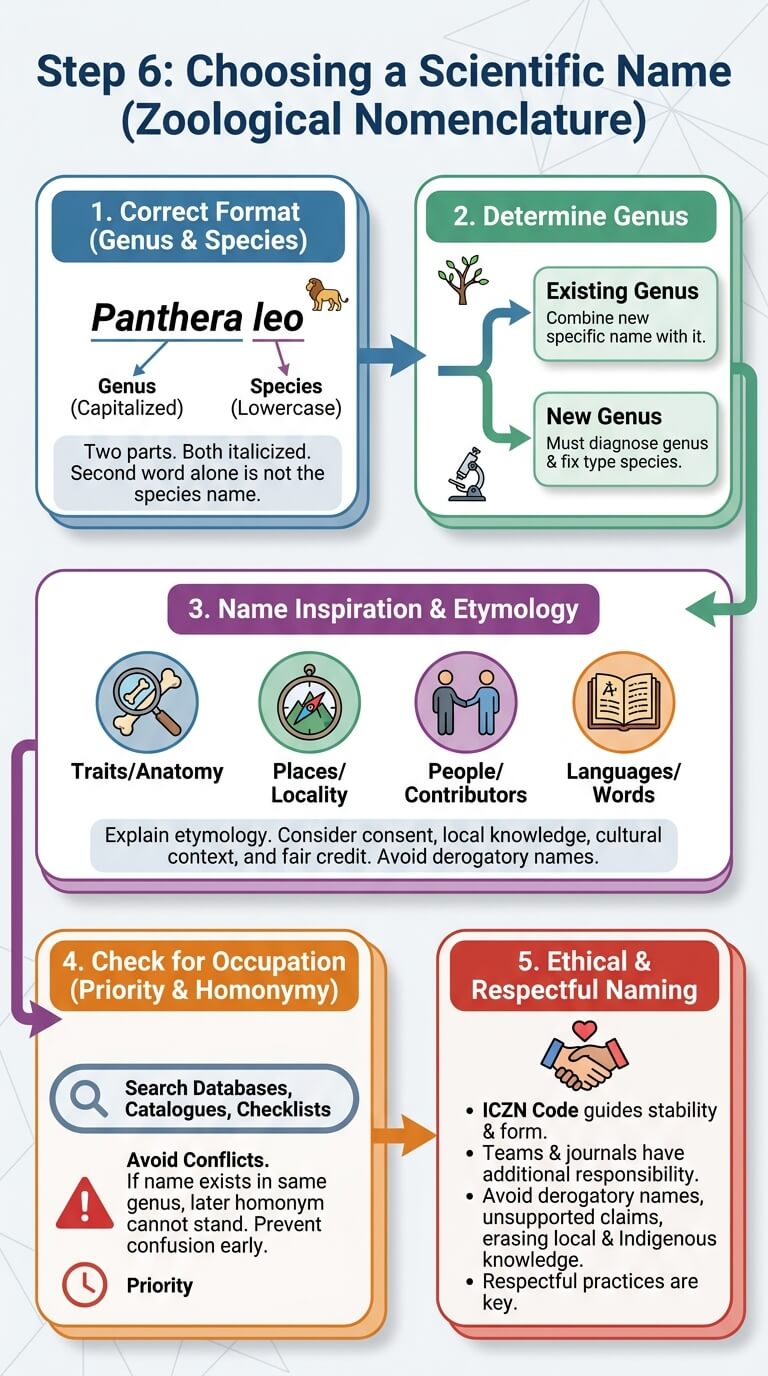
Use the genus and species format correctly
An animal species name has two parts. The genus begins with a capital letter, and the specific name begins with a lowercase letter. Both are normally italicized, as in Panthera leo. The second word alone is not the species name; it must be combined with a genus.
If evidence shows that the animal belongs in an existing genus, authors combine the new specific name with that genus. If the lineage requires a new genus, they must also diagnose the genus and fix a type species under the relevant rules.
Build names from traits, places, people, or languages
Specific names may refer to anatomy, coloration, behavior, habitat, locality, a person, a community, or a word from a language connected to the animal. The word is formed or treated according to zoological nomenclature, which often means latinizing spelling or grammar.
Authors should explain the etymology so readers understand the intended meaning. A name can recognize contributions, but good practice also considers consent, correct spelling, local knowledge, cultural context, and whether credit is shared fairly among field partners, collections staff, and communities.
Check that the proposed name is not already occupied
Zoological names are governed by priority and homonymy. A proposed combination may conflict with an earlier name, especially in large genera or old literature. Authors search nomenclatural databases, catalogues, original publications, and specialist checklists before publication.
If the same species-group name has already been used in the same genus for another animal, the later homonym generally cannot stand and may need a replacement. Checking early prevents a paper from introducing a name that immediately creates confusion.
Write an etymology and use respectful naming practices
The ICZN Code is mainly concerned with stability and form, not with judging every social or ethical choice. Research teams and journals therefore have an additional responsibility to avoid derogatory names, unsupported claims of discovery, or names that erase local and Indigenous knowledge.
Step 7: Publish the Formal Description
Include the diagnosis and essential descriptive information
A species description normally includes the proposed name, authorship, diagnosis, detailed description, comparisons, type information, type locality, etymology, methods, examined material, figures, and evidence supporting distinctness. The exact structure varies among animal groups and journals.
Names published after 1999 must be explicitly indicated as new, and species-group names must meet current type-related requirements. ICZN Article 16 sets out these additional conditions, including explicit intent and information connected to name-bearing types.
Use peer review as quality control, not as a naming shortcut
Most modern descriptions appear in peer-reviewed taxonomic or biological journals. Reviewers may catch overlooked species, weak diagnoses, mislabeled figures, inadequate sampling, naming conflicts, or analytical errors. Editors also enforce journal policies on permits, data access, sequence deposits, and collection information.
Peer review is not itself what makes a zoological name available. The Code focuses on whether the work and name satisfy nomenclatural criteria. A prestigious journal cannot rescue a name that fails those rules, and a compliant work is not guaranteed to contain a biologically correct species decision. Nomenclature and scientific judgment overlap, but they are not identical.
Meet electronic-publication and ZooBank requirements
Electronic-only works can establish zoological names when they meet the amended publication rules. Among other conditions, the work must be registered in ZooBank before publication and contain evidence of that registration. ZooBank is the official register for zoological nomenclature, not a vote confirming that the species is biologically valid.
ICZN Article 8 on published works gives the criteria for electronic publication. Print and electronic routes are not identical, so authors should check the current requirements before release rather than trying to repair an unavailable name afterward.
What Happens After Publication
Other specialists scrutinize the evidence
Publication opens the work to broader testing. Researchers may examine the type, collect new samples, rerun genetic analyses, compare overlooked literature, or study contact zones. Agreement often grows gradually as independent evidence accumulates.
Names enter catalogues, databases, and field guides
Specialist catalogues and biodiversity databases connect names with classifications, synonyms, literature, distributions, specimens, and occurrence records. Inclusion may take time because curators review new publications and reconcile competing treatments.
The Catalogue of Life explanation of species and classification distinguishes names that meet naming rules from the names taxonomists currently accept. That distinction helps readers understand why a database can list both an accepted name and several synonyms. The naming process adds new units to the wider animal kingdom classification system.
Later research may synonymize, split, or move the species
If a new species proves indistinguishable from an older one, its name may become a junior synonym. If one named species contains several independent lineages, later authors may split it. A species can also move to another genus when evolutionary relationships are revised.
Difficult Cases and New Technologies
Cryptic species require more than visible differences
When lineages look nearly identical, researchers may rely on DNA, calls, pheromones, microanatomy, ecology, geography, or breeding patterns. The challenge is translating a genetic pattern into a diagnosis that other scientists can test.
Descriptions should avoid implying that every genetic grouping is a species. Sampling must include close relatives and geographic intermediates, and the authors should explain why the genetic separation represents independent evolution rather than ordinary population structure. Researchers may conclude that a population is better treated as a subspecies rather than a separate species.
Rare species may be known from limited material
Some animals are known from one or a few specimens because their habitat is inaccessible, the population is small, or collecting more would be harmful. Limited material increases uncertainty about sex, age, individual variation, and range, but it does not automatically prevent description.
Authors should document limitations openly and avoid broad claims about behavior, abundance, or conservation status that the material cannot support. Non-destructive study and careful repository planning become especially important when the type is unique.
Environmental DNA can locate evidence but has limits
Environmental DNA, or eDNA, is genetic material recovered from water, soil, air, sediment, or other surroundings rather than directly from a captured animal. It can reveal that an unexpected lineage may be present and help researchers target field surveys.
However, eDNA can move away from its origin, persist after an animal leaves, become contaminated, or match an incomplete reference library. A review of how environmental DNA evidence should be communicated describes it as forensic-type evidence rather than direct possession of the organism. It is powerful for detection, but usually cannot supply the full morphology, type documentation, and integrated diagnosis needed for a robust animal description by itself. Before naming begins, researchers apply the evidence used more broadly in animal classification.
CT scanning, digital morphology, and bioacoustics expand the evidence
Micro-CT scans can reveal bones, teeth, internal shells, and soft structures without dissection. Automated image analysis can compare shapes across many specimens. Bioacoustic tools can quantify call frequency, timing, and pattern in frogs, insects, birds, mammals, and fishes.
Common Myths and Mistakes
The discoverer cannot establish a species by announcement alone
News coverage may call an animal a new species before the formal paper appears, but an announcement does not establish the zoological name. Researchers may use an informal label while the work is under review. The final name, spelling, type information, and diagnosis come from the published description.
A strange color form is not automatically a new species
Color can vary because of genes, age, sex, season, diet, temperature, disease, injury, or preservation. Some species contain several stable color morphs that mate freely. Color becomes stronger evidence when it is consistently associated with other anatomical, genetic, geographic, ecological, or behavioral differences.
Naming a species does not guarantee universal acceptance
The ICZN Code regulates names, not every biological judgment about species boundaries. Two papers can follow the naming rules while specialists disagree over whether the populations deserve separate species status. Later revisions decide which treatment is most useful and best supported.
How Species Boundaries, Names, and Evolution Work Together
Species concepts guide the decision before naming
Scientists first need a reason to treat the candidate as a distinct lineage. Reproductive isolation, diagnosability, ecology, and evolutionary independence are possible parts of that reasoning. The name records the decision, but the biological evidence comes first.
Genus and species ranks structure the scientific name
The first word places the animal in a genus, and the two-word combination identifies the species. Choosing the genus requires comparison with related species and, increasingly, phylogenetic evidence. A later genus change alters the combination but usually preserves the species-group name and authorship history. A valid name must also fit the hierarchy of species, genus, family, and order.
Evolutionary trees help test relationships
A phylogenetic tree tests whether the candidate consistently groups with a known species, forms a separate lineage, or belongs in a different genus. Because the result depends on sampled animals, genes, and analytical models, researchers compare datasets and report uncertainty.
FAQ
Can anyone name a newly discovered species?
The zoological Code does not require a particular academic degree or government license to author a name. In practice, establishing a defensible species requires specialist knowledge, access to literature and collections, careful comparison, legal and ethical sampling, and a publication that meets the rules. Amateur naturalists can make major contributions and sometimes coauthor descriptions, especially when they work with taxonomists and museums.
Can a species be named after a person?
Yes. Zoological names can honor people, places, communities, traits, habitats, or words from many languages. The authors must form and explain the name correctly. Thoughtful teams also consider consent, spelling, cultural meaning, local contributions, and whether the honor is appropriate.
What happens if a proposed name has already been used?
If the same name conflicts with an earlier zoological name under the rules of homonymy, the later name generally cannot remain in use. Authors may need to propose a replacement name. This is why careful searches of catalogues, original literature, and nomenclatural registers are part of the work before publication.
Must every new animal species have a preserved type specimen?
A name-bearing type must be fixed according to the zoological rules, but the details are more nuanced than saying every description must place a newly killed whole animal in a jar. Types can involve specimens in different forms, parts of colonial organisms, fossils, and an illustrated specimen. The Code notes that loss or inability to trace an illustrated specimen does not by itself invalidate its designation.
Even so, modern taxonomists generally favor depositing accessible physical material when legal, ethical, and practical because later researchers may need to examine anatomy, chemistry, parasites, or DNA that images cannot preserve. When material is extremely rare, authors should explain their evidence and choices with exceptional care.
Final Thoughts
How scientists discover and name new species is a chain of evidence rather than a single moment. A field sighting or DNA result raises a question. Museum comparisons, anatomy, genetics, ecology, behavior, and geography test it. Type material anchors the name, and formal publication makes the proposal available for scientific scrutiny.
The process is deliberately demanding because names organize knowledge about biodiversity. A careful description helps researchers identify animals consistently, compare populations, map ranges, interpret evolution, and plan future study. Publication does not end the discussion, but it gives that discussion a stable, documented starting point.

Ethan Walker is the founder and research editor of Animal Fact Central. He creates and reviews educational animal facts content using trusted wildlife, pet care, and science-based sources. His work focuses on making animal behavior, adaptations, habitats, and species facts clear, accurate, and engaging for everyday readers.
Read More Details About Ethan Walker: https://animalfactcentral.com/ethan-walker/