
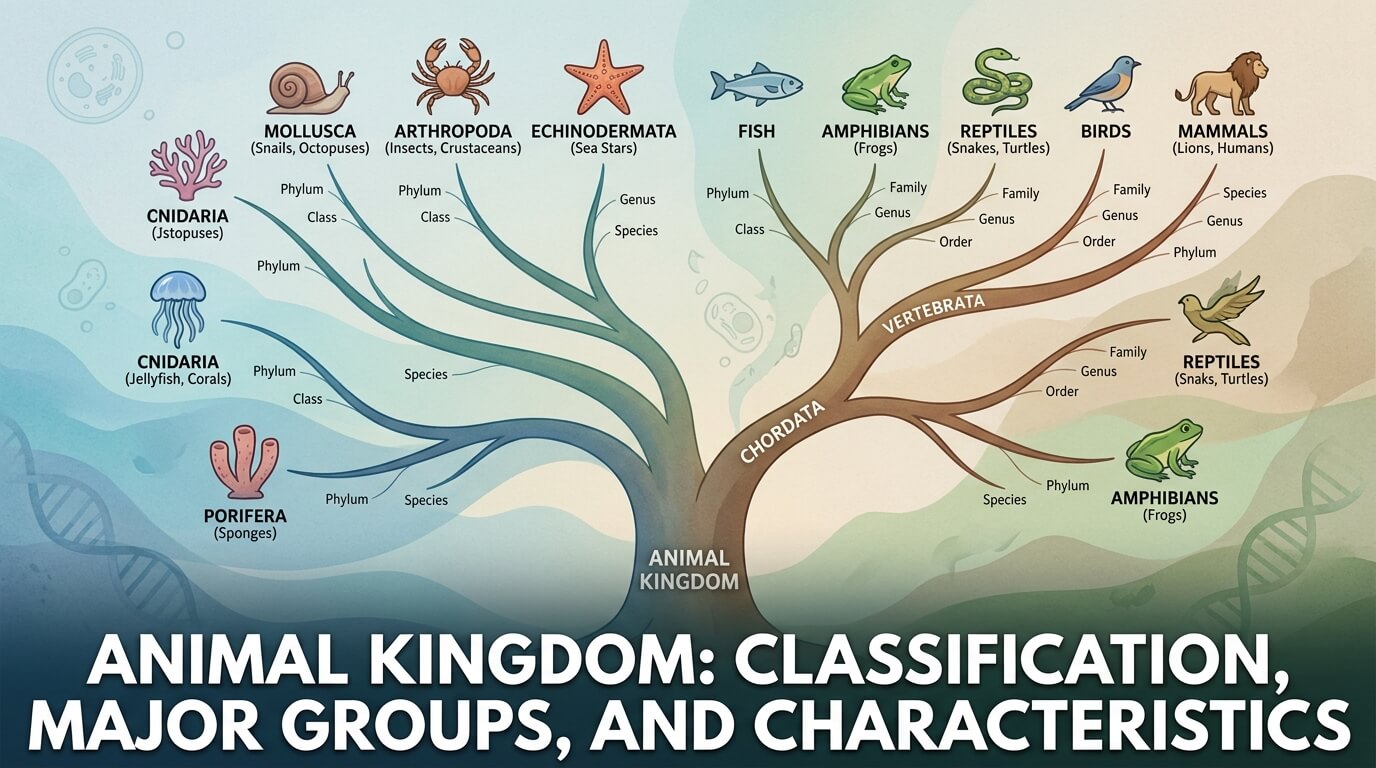
The animal kingdom includes organisms as different as sponges, beetles, sea stars, sharks, frogs, eagles, and humans. Scientists place them together in Kingdom Animalia because they share a deep evolutionary origin and a broad set of biological features. Animals are multicellular eukaryotes, meaning their bodies are made of many cells with nuclei. They obtain energy by consuming organic material rather than making food through photosynthesis, and their cells lack the rigid walls found in plants and fungi.
Animal kingdom classification gives this diversity an organized structure. It helps readers understand why a whale is closer to a deer than to a shark, why birds are part of the reptile branch of the tree of life, and why the word “invertebrate” covers many very different lineages. Classification is not merely a filing system. At its best, it summarizes evidence about body structure, development, genes, fossils, and common ancestry.
This overview explains the major groups and characteristics of animals without treating the living world as a simple ladder. Modern biology views animal history as a branching tree, with each living lineage representing its own long evolutionary path.
Quick Overview of the Animal Kingdom
What Kingdom Animalia Means
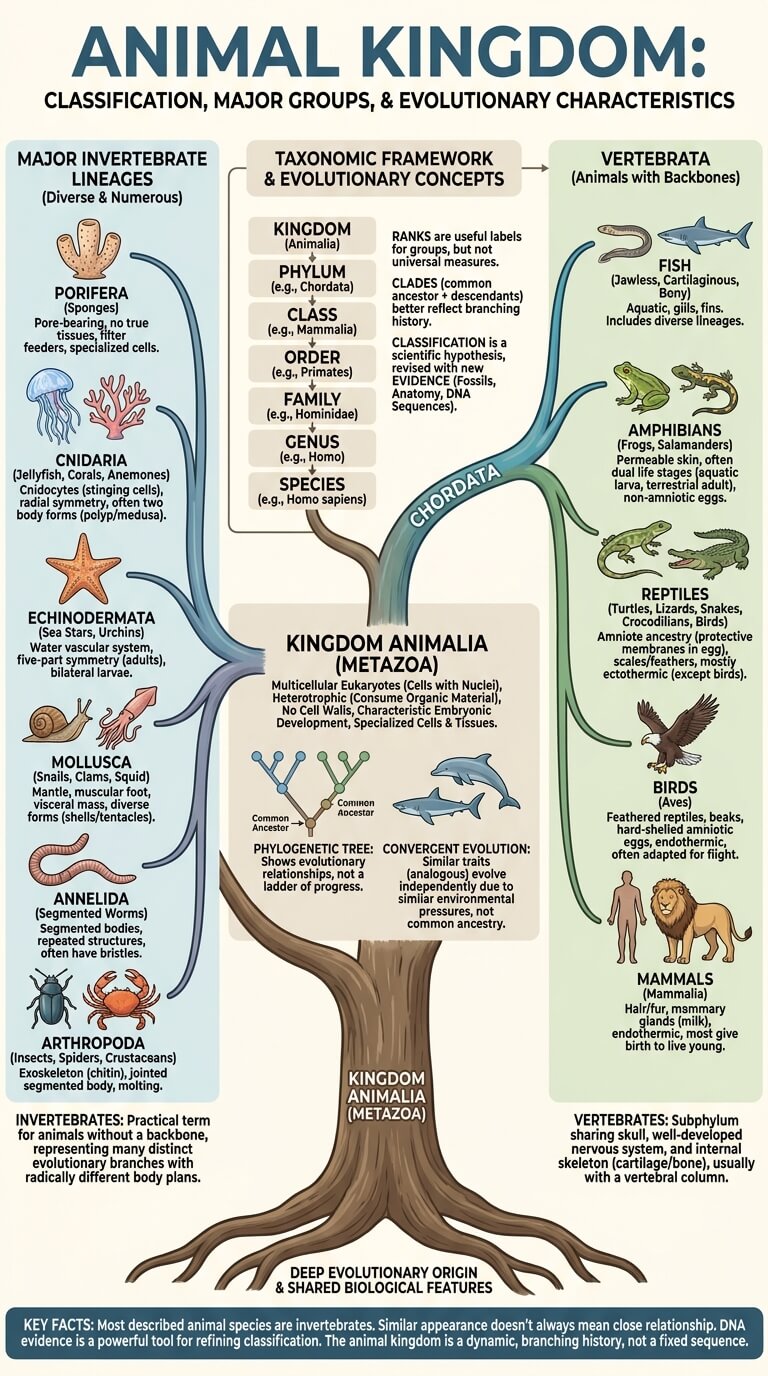
Kingdom Animalia, also called Metazoa in many scientific contexts, is one major branch of eukaryotic life. Its members range from animals with no true organs, such as sponges, to animals with elaborate nervous systems and specialized senses. The Animal Diversity Web overview of Animalia describes the shared pattern of multicellularity, heterotrophic nutrition, specialized cells, and characteristic embryonic development that helps distinguish animals from other organisms.
Animals do not all look active, and they do not all eat in familiar ways. An adult sponge remains attached to a surface and filters tiny particles from water. A coral polyp may stay fixed in one place while capturing food with tentacles. A tapeworm absorbs nutrients within a host. These examples still belong to Animalia because classification depends on the whole body plan, development, cellular organization, and ancestry, not one obvious lifestyle.
Characteristics Most Animals Share
Several traits appear across much of the animal kingdom. Animal cells are eukaryotic and lack cell walls. Animals depend on external organic material for energy. Most have specialized cells, and most organize those cells into tissues such as muscle, nerve, epithelial, or connective tissue. Many animals can move during at least one life stage, even when the adult is attached to a surface.
Animal development also follows recognizable patterns. In many species, a fertilized egg divides into a ball of cells, and those cells reorganize as tissues and organs begin to form. The exact sequence differs among lineages, but developmental evidence remains useful because early body organization can reveal relationships that are less obvious in adult animals.
Why a Few Animal Traits Have Exceptions
Biological definitions often describe a shared pattern rather than a checklist with no exceptions. Sponges, for example, have specialized cell types but lack the true tissues seen in most other animals. Some animals reproduce asexually under certain conditions, although sexual reproduction is widespread. Some adults cannot travel from place to place, yet their larvae are mobile.
Exceptions do not make classification meaningless. They show why scientists use several lines of evidence together. A single trait can be lost, reduced, or altered during evolution. The broader combination of cellular structure, development, genetics, and ancestry usually gives a clearer answer than any isolated feature.
What Animal Classification Includes
Classification, Taxonomy, Systematics, and Phylogenetics in Plain English
Classification is the act of arranging organisms into groups. Taxonomy deals with recognizing, describing, naming, and classifying organisms. Systematics has a wider goal: understanding biological diversity and the relationships among organisms. Phylogenetics focuses on reconstructing evolutionary relationships, usually as branching diagrams called phylogenetic trees.
Why Scientists Organize Animal Diversity
A shared classification lets scientists in different places discuss the same organisms without relying only on common names. “Robin,” “panther,” and “daddy longlegs” can refer to different animals in different regions. Scientific names and classifications provide a more consistent framework.
The Basic Taxonomic Framework
From Kingdom to Species at a Glance
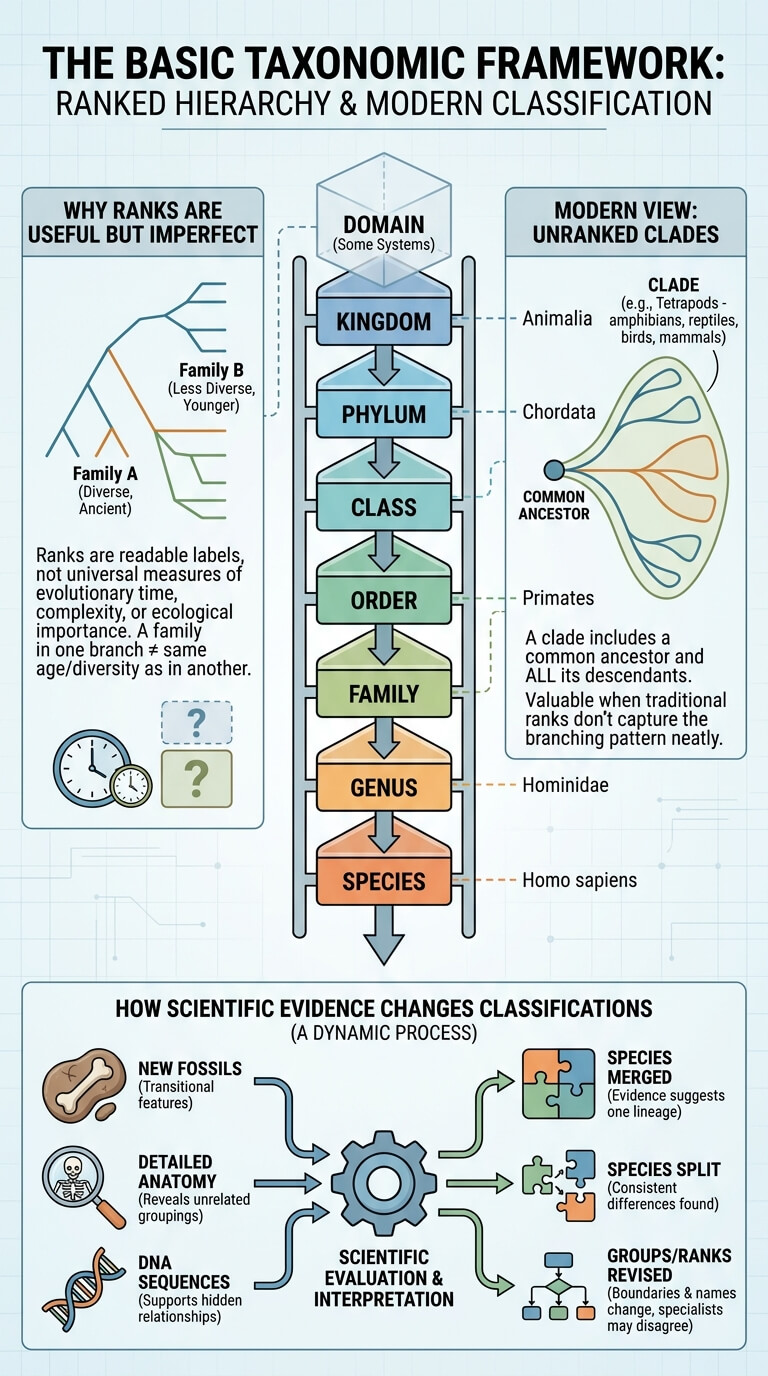
The familiar ranked sequence is kingdom, phylum, class, order, family, genus, and species. Some systems place domain above kingdom, and many groups use added ranks such as subphylum, subclass, superfamily, tribe, or subspecies. A simplified example for humans is Animalia, Chordata, Mammalia, Primates, Hominidae, Homo, and Homo sapiens. Geographic variation and gene flow are especially important when comparing species vs subspecies.
| Rank | What It Usually Represents | Animal Example |
|---|---|---|
| Kingdom | A very broad division of life | Animalia |
| Phylum | A major body-plan lineage | Chordata |
| Class | A large branch within a phylum | Mammalia |
| Order | A group of related families | Primates |
| Family | A group of related genera | Hominidae |
| Genus | A close grouping of species | Homo |
| Species | A basic named unit, defined with evidence appropriate to the group | Homo sapiens |
The Catalogue of Life explanation of species and classification shows how accepted names, synonyms, ranks, and revisions are managed as scientific knowledge changes.
Why Ranked Categories Are Useful but Imperfect
Ranks make large classifications readable, but a family in one branch is not necessarily the same age or level of diversity as a family in another. Ranks are labels placed on branches, not universal measures of evolutionary time, anatomical complexity, or ecological importance.
Modern studies also use unranked groups called clades. A clade includes a common ancestor and all of its descendants. Clades are especially valuable when traditional ranks do not capture the branching pattern neatly. “Tetrapods,” for example, describes the vertebrate lineage that includes amphibians, reptiles, birds, mammals, and their extinct relatives, even though tetrapod is commonly used without treating it as one of the seven standard ranks.
How Scientific Evidence Can Change Classifications
A classification is a scientific interpretation, not a permanent statement carved into nature. New fossils may reveal transitional features. Detailed anatomy may show that an old grouping combined unrelated animals. DNA sequences may support a relationship that appearance alone did not reveal.
Changes can affect names, ranks, or the boundaries of groups. Two named species may be merged when evidence indicates they are one lineage, or one widespread species may be split after researchers find consistent genetic, anatomical, behavioral, and geographic differences. Different specialists can also disagree while the evidence is being evaluated.
Vertebrates and Invertebrates at a Glance
What Defines a Vertebrate
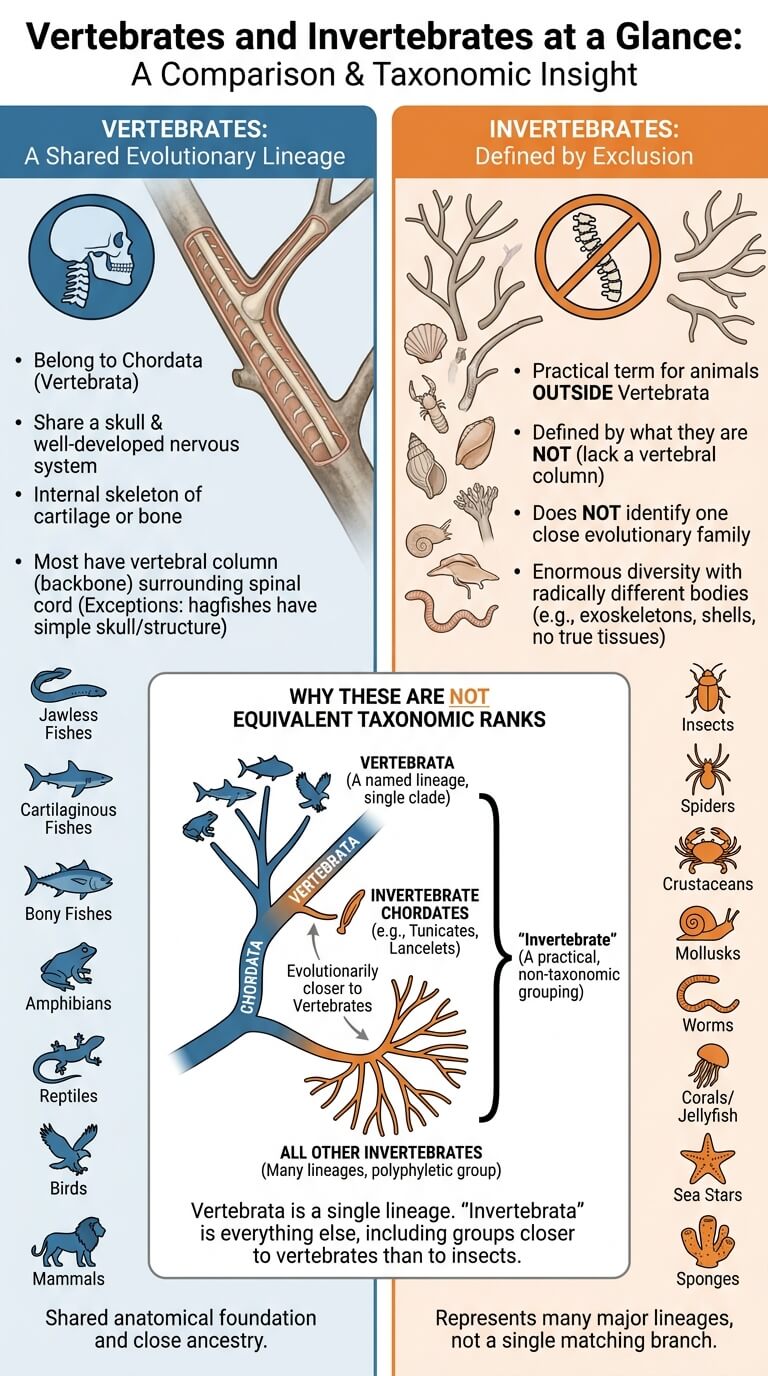
Vertebrates belong to a branch of chordates called Vertebrata. They share a skull, a well-developed nervous system, and an internal skeleton of cartilage or bone. Most also have a vertebral column surrounding the spinal cord, although the earliest branches, especially hagfishes, make a simple “has a backbone” definition less tidy than it first appears.
Living vertebrates include jawless fishes, cartilaginous fishes such as sharks and rays, bony fishes, amphibians, reptiles, birds, and mammals. These groups differ greatly in breathing, reproduction, body covering, temperature regulation, and habitat, but they share a deeper anatomical and developmental foundation.
What the Invertebrate Label Includes
Invertebrate is a practical term for animals outside Vertebrata. It includes insects, spiders, crustaceans, mollusks, worms, corals, jellyfish, sea stars, sponges, and many less familiar animals. Because it is defined by exclusion, it does not identify one close evolutionary family.
The GBIF record for Animalia displays many major descendant groups under the animal kingdom, illustrating how vertebrates occupy only one portion of a much larger branching classification.
Why These Two Labels Are Not Equivalent Taxonomic Ranks
Vertebrata is a named evolutionary lineage within Chordata. Invertebrata is not a single matching branch that contains one common ancestor and every descendant while excluding vertebrates. In fact, some invertebrate chordates, such as tunicates and lancelets, are evolutionarily closer to vertebrates than they are to insects or jellyfish.
This distinction matters because a two-column comparison can hide enormous diversity. Vertebrates share a comparatively close ancestry. “Invertebrates” represent many major lineages with radically different bodies, including animals with exoskeletons, shells, fluid-supported bodies, stinging cells, or no true tissues.
Major Vertebrate Groups
Mammals
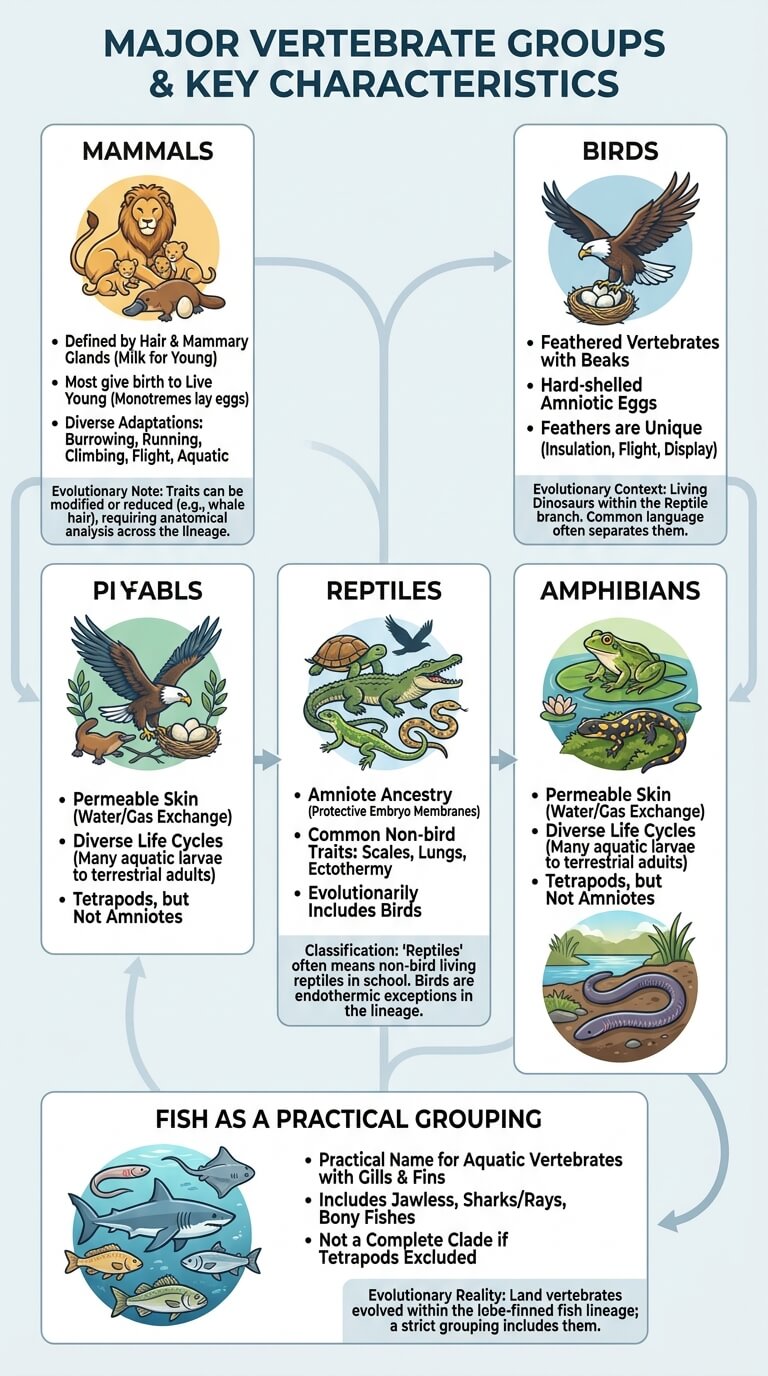
Mammals are vertebrates defined by traits that include hair and mammary glands, which produce milk for young. Most give birth to live young, but monotremes such as the platypus and echidnas lay eggs. Mammals also vary widely in habitat and movement, with lineages adapted for burrowing, running, climbing, powered flight, and fully aquatic life.
Hair may be reduced in whales or modified into structures such as quills. This illustrates a recurring lesson in classification: a defining trait can be subtle or transformed, so scientists consider anatomy and development across the whole lineage.
Birds
Birds are feathered vertebrates with beaks and hard-shelled amniotic eggs. Feathers are unique to living birds and serve roles in insulation, display, protection, sensing, and flight. Not every bird flies, but even flightless birds retain features inherited from flying ancestors.
In evolutionary classification, birds are living dinosaurs and sit within the reptile branch. Everyday language often lists birds and reptiles separately because their modern forms differ so clearly. Both ways of speaking can be useful as long as the context is clear.
Reptiles
Reptiles include turtles, crocodilians, lizards, snakes, tuatara, birds, and their extinct relatives when the group is defined evolutionarily. In many school comparisons, “reptiles” means the living non-bird reptiles. These animals share amniote ancestry, meaning their embryos develop with protective membranes that reduced dependence on open water for reproduction.
Scales, lungs, internal fertilization, and ectothermy are common among non-bird reptiles, but no short list captures every member perfectly. Birds, for example, are endothermic and covered in feathers, yet they remain part of the reptile lineage.
Amphibians
Living amphibians include frogs and toads, salamanders and newts, and limbless caecilians. Many have permeable skin involved in water balance and gas exchange. Numerous species begin life as aquatic larvae and later transform into more terrestrial adults, but amphibian life cycles are diverse and do not all follow the familiar tadpole pattern.
Amphibians are tetrapods, but they are not amniotes. Their eggs generally lack the protective membranes found in reptiles, birds, and mammals, which helps explain why reproduction in many species remains closely tied to moist environments.
Fish as a Practical Grouping
Fish is a useful everyday name for aquatic vertebrates with gills and fins, including jawless fishes, sharks and rays, and the many branches of bony fishes. It is not one complete clade if tetrapods are excluded. Land vertebrates evolved within the lobe-finned fish lineage, so a strictly evolutionary grouping that includes their common ancestor must also include amphibians, reptiles, birds, and mammals.
Major Invertebrate Branches
Arthropods
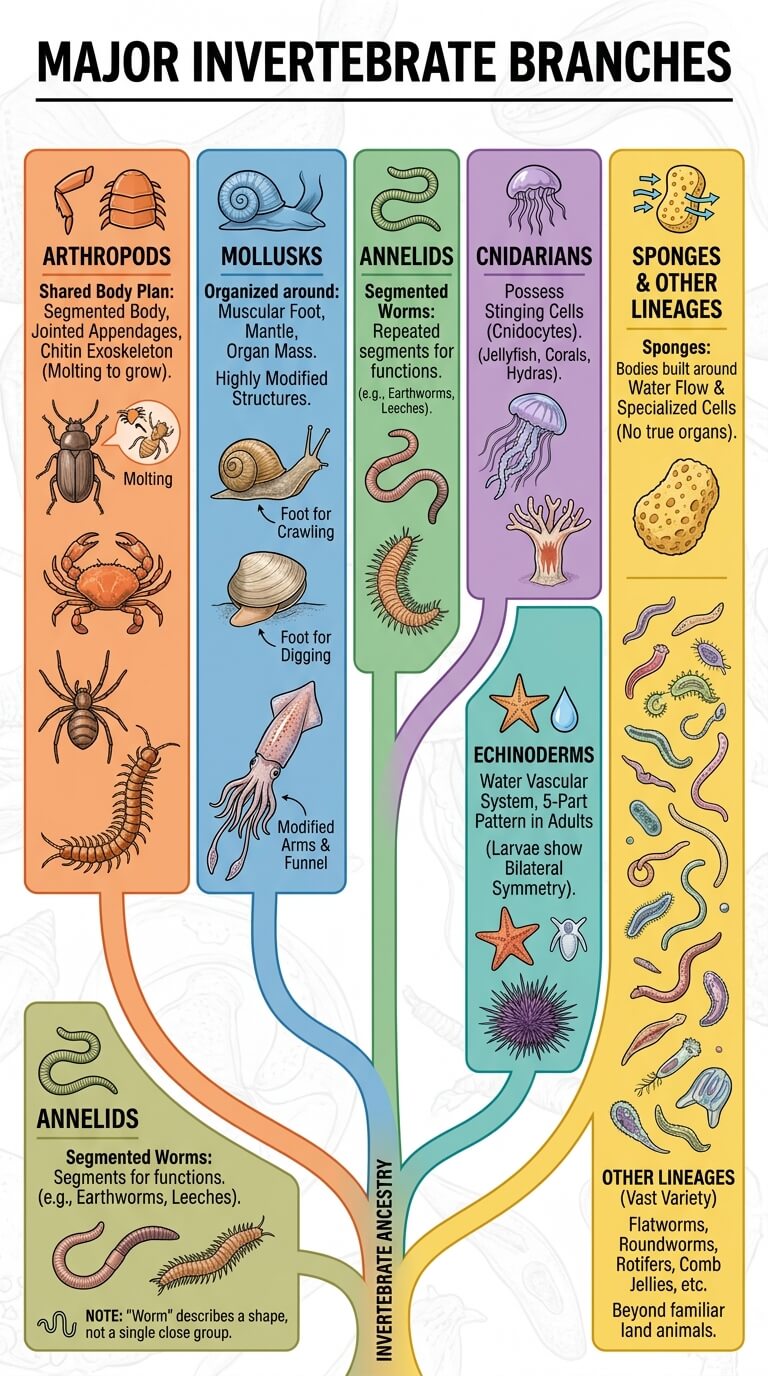
Arthropods include insects, arachnids, crustaceans, centipedes, and millipedes. Their shared body plan includes a segmented body, jointed appendages, and an external skeleton made largely of chitin. Because the exoskeleton does not expand continuously, arthropods grow by molting it and forming a larger one.
Mollusks and Annelids
Mollusks include snails, slugs, clams, mussels, oysters, squid, octopuses, and chitons. Their bodies are commonly organized around a muscular foot, a mantle, and a mass of internal organs, although those structures can be heavily modified. A snail uses the foot to crawl, a clam uses it for digging, and a squid’s arms and funnel reflect major changes to the ancestral plan.
Annelids are segmented worms such as earthworms, leeches, and many marine bristle worms. Their repeated body segments can be specialized for different functions. Annelids are not closely grouped with every animal called a worm. “Worm” describes a body shape found in several independent lineages.
Cnidarians, Echinoderms, Sponges, and Other Lineages
Cnidarians, including jellyfish, corals, hydras, and sea anemones, possess stinging cells called cnidocytes. Echinoderms, including sea stars, brittle stars, sea urchins, sea cucumbers, and crinoids, have a water vascular system and a distinctive five-part pattern in many adults. Their larvae show bilateral symmetry, offering a clue to their evolutionary history.
Sponges have bodies built around water flow and specialized cells rather than true organs. Other animal branches include flatworms, roundworms, ribbon worms, rotifers, bryozoans, comb jellies, and many microscopic or marine groups. Their variety is one reason a complete picture of Animalia cannot be reduced to the most familiar animals on land.
How Classification Connects to Animal Evolution
Common Ancestors and Branching Lineages
Evolution produces branching patterns. When one ancestral population gives rise to separate lineages, those lineages may continue changing in different directions. Classification tries to reflect that history by grouping descendants with their common ancestors.
The Smithsonian resource on animal origins places the rise of animal body plans within Earth’s long history, showing why fossils, cellular biology, development, and environmental change all contribute to understanding early animal evolution.
What a Phylogenetic Tree Shows
A phylogenetic tree is a hypothesis about relationships. A branch point, or node, represents a common ancestor. Two groups that share a more recent node are more closely related to each other than either is to a group branching earlier on the tree.
The tips do not represent higher or lower forms of life. They represent the lineages being compared, which may be living species, extinct species, genes, or larger groups. Rotating branches around a node does not change the relationships, just as turning a mobile above a crib does not change which pieces share the same attachment point.
Why Modern Groups Are Based on Relationships, Not a Ladder of Progress
Older diagrams sometimes placed organisms in a line from “simple” to “advanced.” That image is misleading. Evolution has no final destination, and living species are not unfinished steps toward another living species. A sponge is not trying to become a jellyfish, and a fish is not a primitive mammal.
Some body plans have more cell types or more centralized nervous systems than others, but complexity depends on what is being measured. Parasites may lose organs that their ancestors possessed. Social insects can create highly organized colonies with small individual brains. Each lineage reflects adaptation, constraint, chance, and ancestry.
Key Facts Readers Should Know
Most Described Animal Species Are Invertebrates
Vertebrates dominate zoos, documentaries, and many school lessons, but they represent a small part of described animal diversity. Insects alone include an enormous number of named species, and other arthropods, mollusks, nematodes, and additional lineages add greatly to the total.
Species counts change as new species are described, old names are reviewed, and databases are updated. The safest takeaway is not a fixed percentage. It is that any account focused mainly on mammals, birds, reptiles, amphibians, and fishes leaves out most named animal species.
Similar Appearance Does Not Always Mean Close Relationship
Dolphins, sharks, and extinct marine reptiles evolved streamlined bodies because moving efficiently through water favors similar shapes. Bats, birds, and pterosaurs evolved powered flight with wings built in different ways. These are examples of convergent evolution, where similar environmental pressures produce similar solutions in separate lineages.
Scientists therefore distinguish analogous traits, which perform similar functions but evolved independently, from homologous traits inherited from a common ancestor. A whale flipper, bat wing, horse foreleg, and human arm are homologous as modified tetrapod forelimbs even though they now serve different functions.
DNA Evidence Can Confirm or Overturn Older Groupings
Genetic comparisons allow researchers to test relationships suggested by anatomy and fossils. DNA may confirm that a traditional group is a true clade, reveal that look-alike species are not close relatives, or uncover distinct lineages hidden within one named species.
The NCBI Taxonomy database organizes organisms represented in public sequence databases, demonstrating how biological names and genetic information are connected in modern research. Genetic evidence is powerful, but it is interpreted alongside anatomy, development, geography, behavior, and fossils rather than treated as an automatic answer.
Common Myths and Misunderstandings
Myth: Every Familiar Animal Group Is a Formal Taxonomic Rank
Common names often mix scientific groups with practical labels. Mammalia is a class, but “fish” is a broad everyday category. “Raptor” describes predatory birds from more than one lineage. “Shellfish” includes crustaceans and mollusks that are not close relatives. “Worm” applies to animals in several phyla.
These terms remain useful when their meaning is understood. Problems arise only when a convenient label is mistaken for one evolutionary branch.
Myth: Animals Are Arranged From Simple to Advanced
Classification does not award higher status to animals with backbones, large brains, or familiar behavior. A branching tree records ancestry, not worth. Animals with compact nervous systems can perform complex tasks, while highly specialized vertebrates may depend on narrow environmental conditions.
Words such as basal, early-branching, or ancestral are also easy to misuse. A living animal may belong to a lineage that branched early, but the species itself has continued evolving for the same span of time as every other living species.
Myth: Scientific Classifications Never Change
Revisions are a normal result of better evidence. Researchers may find that a named group excludes some descendants of its common ancestor, that two species names describe the same organism, or that one species contains several independently evolving populations.
Stability is useful, so scientists do not change names casually. Even so, classification must remain open to correction. A revised tree is not proof that biology has failed. It shows that scientific explanations are tested against new observations.
Questions This Framework Helps Answer
How Scientists Decide Where an Animal Belongs
Researchers compare inherited traits across many animals, including anatomy, development, genes, behavior, fossils, and geographic patterns. They test competing family trees and look for the explanation that best fits the evidence with the fewest unsupported assumptions. For a closer look at the evidence and steps researchers use, see how animals are classified.
Why Body Structure Separates Vertebrates and Invertebrates
The distinction draws attention to the skull, spinal cord, internal skeleton, and developmental features of vertebrates. It is useful for broad comparison, provided readers remember that invertebrates are many separate lineages rather than one matching branch. The broadest structural comparison is vertebrates vs invertebrates, although the invertebrate side contains many separate lineages.
How the Five Familiar Vertebrate Groups Compare
Mammals, birds, non-bird reptiles, amphibians, and fishes differ in body covering, breathing, reproduction, development, habitat, and temperature regulation. Their boundaries make more sense when the comparison is placed inside vertebrate ancestry rather than treated as five unrelated boxes.
Why Animals Regulate Body Temperature Differently
Mammals and birds usually produce much of their body heat internally, while many fishes, amphibians, and non-bird reptiles rely more strongly on environmental heat. Real physiology is more varied than the labels warm-blooded and cold-blooded suggest, with regional heating, behavioral control, torpor, and seasonal changes appearing in different lineages. Those physiological differences become clearer when comparing warm-blooded and cold-blooded animals.
How Species, Genus, Family, and Order Fit Together
These ranks create nested groups. A species belongs to a genus, related genera can be placed in a family, and related families can be placed in an order. The hierarchy offers a convenient address, while evolutionary trees explain why those organisms are grouped. The nested sequence of species, genus, family, and order provides a practical framework for organizing animal names.
Why Species and Subspecies Can Be Difficult to Define
Species boundaries can be clear when populations are strongly separated, but nature also contains hybrid zones, gradual geographic variation, asexual organisms, and recently diverged lineages. Subspecies names may recognize consistent regional variation within a species, yet their use can be debated.
How New Species Are Discovered and Named
Scientists document specimens or observations, compare them with known species, analyze distinctive traits, and publish a formal description. Naming rules require a valid scientific name and usually a type specimen or another defined reference that anchors the name. When evidence supports a distinct lineage, researchers follow a formal process to discover and name a new species.
Why Major Invertebrate Groups Have Such Different Bodies
Invertebrate lineages diverged deep in animal history and evolved different structural solutions. Jointed limbs, shells, hydrostatic skeletons, stinging cells, repeated segments, and water vascular systems are not variations of one invertebrate blueprint. They reflect separate branches. The major invertebrate groups reveal how many different body plans exist outside Vertebrata.
How Common Ancestry Shapes Modern Classification
Shared ancestry explains why traits appear in nested patterns. Feathers identify birds, hair identifies mammals, and vertebral features identify most vertebrates because those traits arose in ancestral populations and were inherited, modified, or occasionally reduced in descendants.
FAQ
Is Kingdom Animalia the Same as the Animal Kingdom?
Yes. Animal kingdom is the common English name for Kingdom Animalia. Scientists may also use Metazoa for the animal lineage, although usage can vary slightly by classification system. Both terms refer broadly to the multicellular eukaryotic organisms recognized as animals.
Are Vertebrates a Phylum?
Vertebrates are usually classified as the subphylum Vertebrata within the phylum Chordata. Chordata also includes tunicates and lancelets, which lack the full vertebrate body plan. Rank usage can differ among references, but calling Vertebrata a subphylum is common in zoological classification.
Can an Animal Move From One Classification Group to Another?
An individual animal does not change its ancestry, but scientists can revise where its species is placed. New evidence may show that a species belongs in a different genus, family, or larger clade. The animal has not biologically moved. The scientific model has been corrected to better represent its relationships.
Why Do Scientific Animal Groups Sometimes Have Unfamiliar Names?
Scientific names are designed for precision across languages and often come from Latin, Greek, personal names, or place names. Many refer to a defining feature or historical description. The unfamiliar vocabulary becomes easier when readers recognize repeated endings and ranks, such as family names in zoology often ending in “-idae.”
Final Thoughts
Animal kingdom classification turns a vast range of bodies and lifestyles into a comprehensible pattern. Animals share a deep origin, but their descendants branched into lineages with very different tissues, skeletons, senses, reproductive strategies, and ways of surviving. Ranks such as phylum, class, order, family, genus, and species provide useful labels, while phylogenetic trees explain the ancestry behind those labels.
The most accurate view is neither a row of separate boxes nor a ladder from simple to advanced. It is a branching history. Vertebrates occupy one branch within Chordata, invertebrates span many other branches, and familiar groups such as mammals, birds, reptiles, amphibians, and fishes make sense only when their shared ancestry is kept in view.

Ethan Walker is the founder and research editor of Animal Fact Central. He creates and reviews educational animal facts content using trusted wildlife, pet care, and science-based sources. His work focuses on making animal behavior, adaptations, habitats, and species facts clear, accurate, and engaging for everyday readers.
Read More Details About Ethan Walker: https://animalfactcentral.com/ethan-walker/