
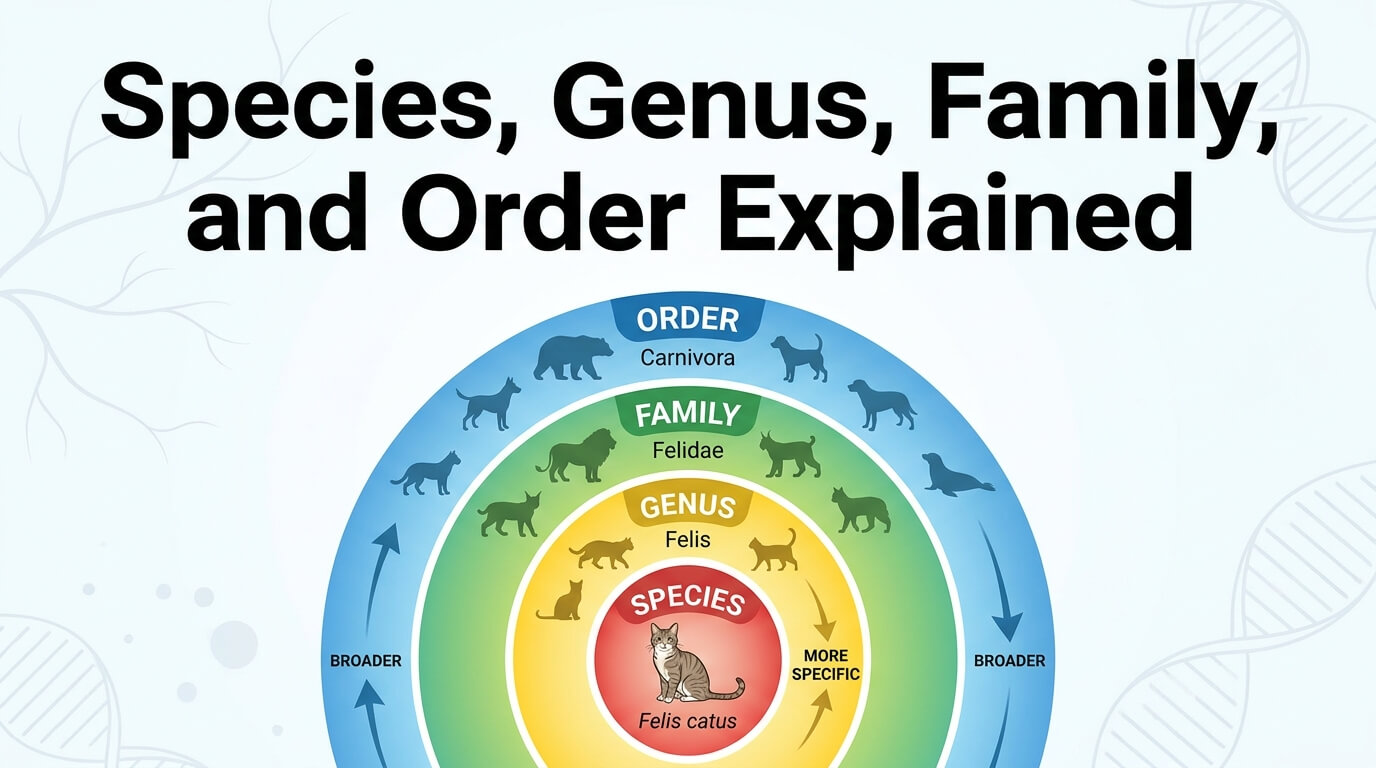
Species, genus, family, and order are taxonomic ranks used to organize animals into nested groups. A species is usually the most specific standard rank, a genus contains one or more closely related species, a family contains related genera, and an order contains related families. Moving upward through the hierarchy creates broader groups that include more kinds of animals.
This system is useful because an animal’s classification can summarize several levels of relationship at once. The domestic cat, for example, belongs to the species Felis catus, the genus Felis, the family Felidae, and the order Carnivora. Each level answers a different question, from the animal’s particular species to the much broader branch of mammals that contains cats, dogs, bears, seals, and other carnivorans.
Quick Answer
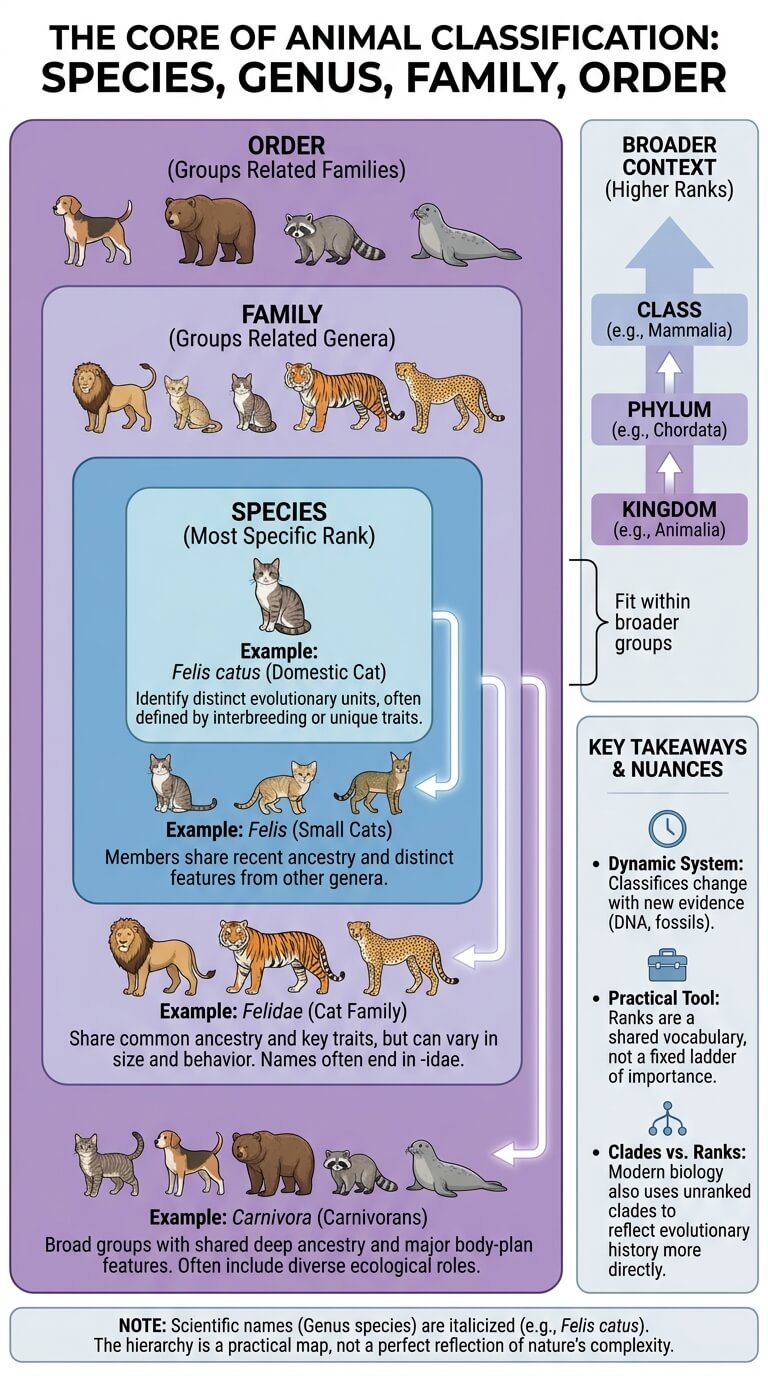
Taxonomic ranks form nested levels
A taxonomic rank is a named level in a biological classification. The main sequence commonly taught is domain, kingdom, phylum, class, order, family, genus, and species. Each group at one level is placed inside a broader group above it. A genus sits inside a family, a family sits inside an order, and an order sits inside a class.
The structure works like nested folders rather than separate labels. An animal does not stop being a member of its family when it is identified to species. It belongs to every level in its classification at the same time. The species name gives the narrowest standard identification, while the higher ranks provide increasingly broad context.
Species, genus, family, and order are central but not the only ranks
These four ranks are especially useful because they appear frequently in field guides, museum labels, databases, and animal reference pages. They are not the complete system. Kingdom, phylum, and class provide broader context, while ranks such as suborder, superfamily, subfamily, tribe, and subspecies may be inserted when scientists need more detail.
The Taxonomic Hierarchy at a Glance
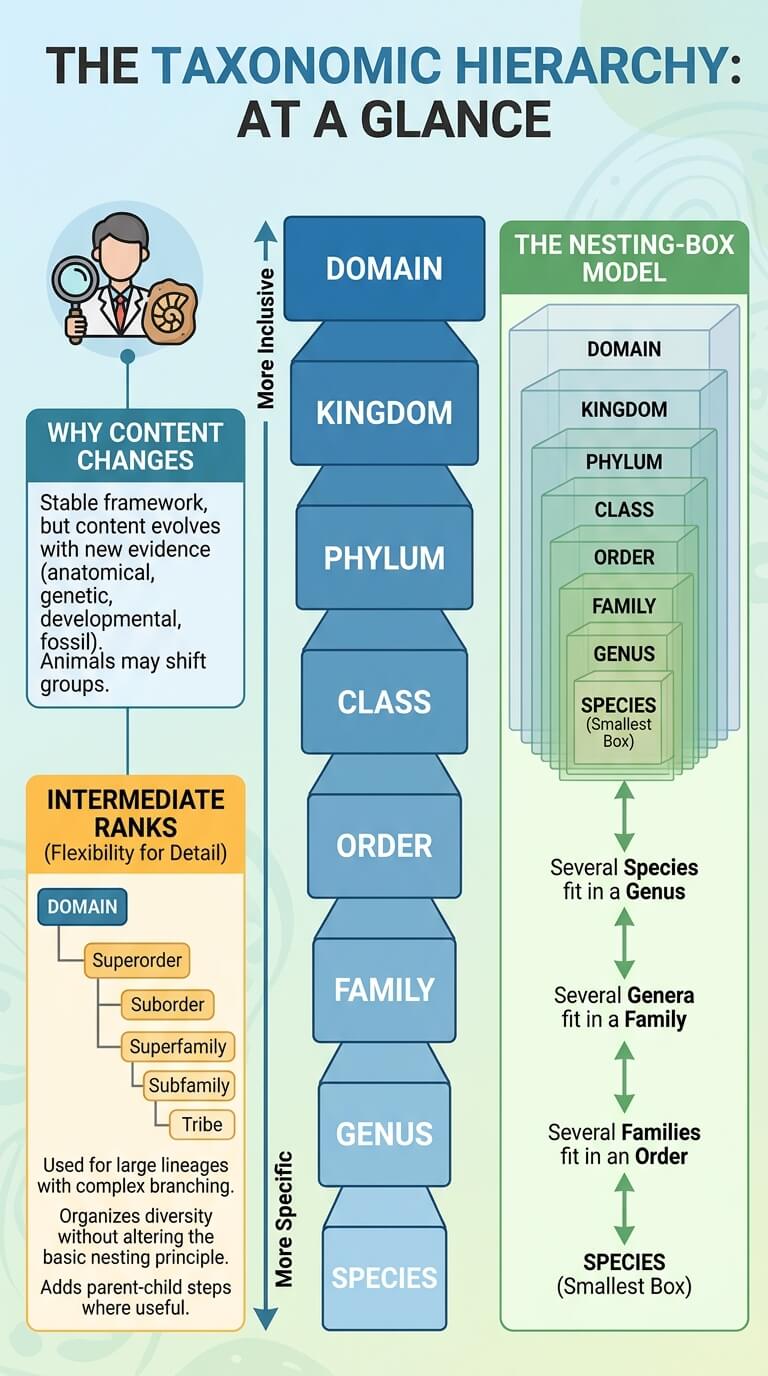
Domain, kingdom, phylum, class, order, family, genus, and species
| Rank | What it generally represents | Domestic cat example |
|---|---|---|
| Domain | The broadest commonly used rank, separating major forms of cellular life | Eukaryota |
| Kingdom | A very broad division of organisms | Animalia |
| Phylum | A major lineage often recognized by deep ancestry and body-plan features | Chordata |
| Class | A large branch within a phylum | Mammalia |
| Order | A grouping of related families | Carnivora |
| Family | A grouping of related genera | Felidae |
| Genus | A grouping of closely related species | Felis |
| Species | The most specific standard rank in the sequence | Felis catus |
The order of the levels is stable as a teaching framework, but the content inside them can change. New anatomical, genetic, developmental, or fossil evidence may show that an animal belongs in a different genus, family, or other group.
A nesting-box model for understanding ranks
Imagine a set of boxes fitted inside one another. The smallest box represents a species. Several species boxes can fit inside a genus box. Several genera can fit inside a family box, and several families can fit inside an order box. The boxes become more inclusive as they become larger.
Why intermediate ranks also exist
Large animal lineages often contain more branching detail than the eight familiar ranks can express. Taxonomists may use superorders above orders, suborders below orders, superfamilies above families, subfamilies below families, and tribes between subfamily and genus. These additions help organize diversity without changing the basic nesting principle.
The ITIS definition of taxonomic parent-child relationships explains that a species usually has a genus as its parent, a genus usually has a family as its parent, and so on. Intermediate ranks simply add more parent-child steps where they are useful.
What Is a Species Rank?
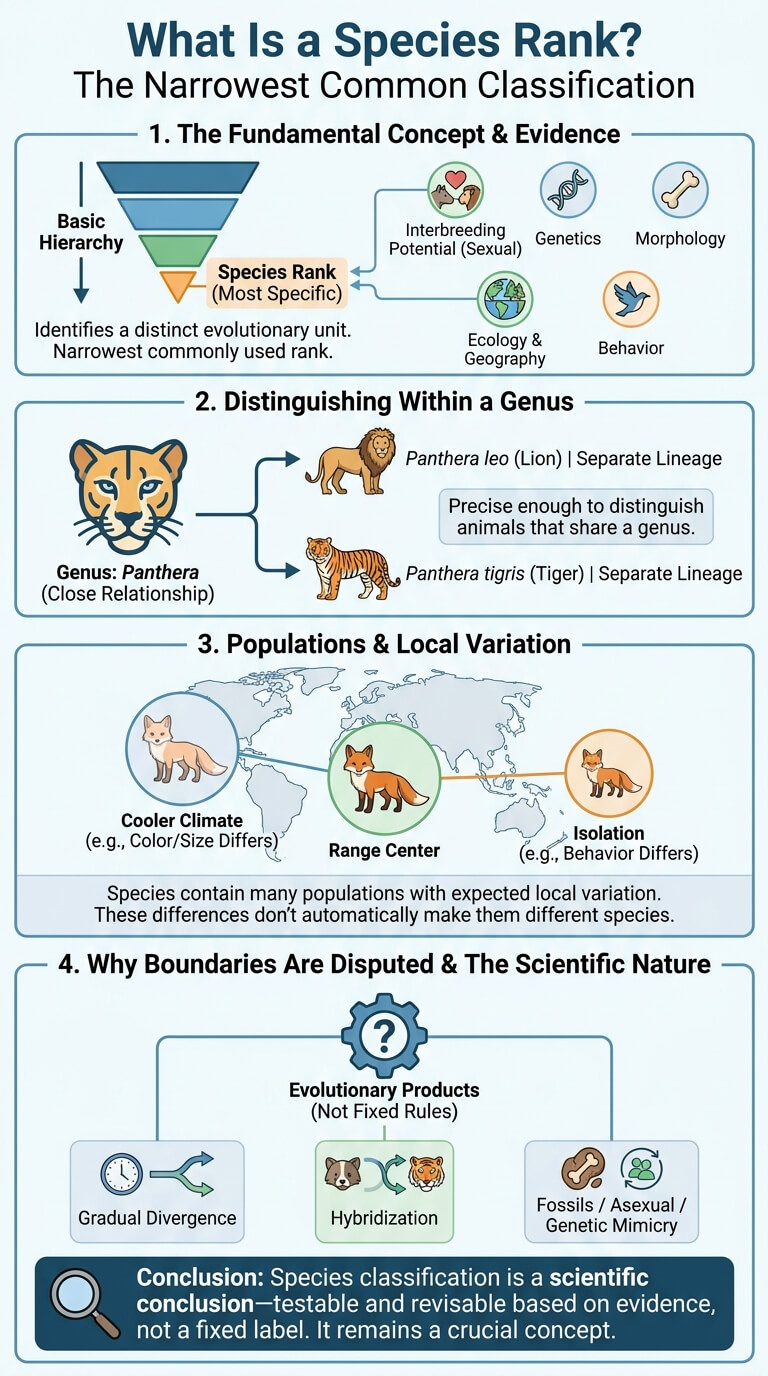
The narrowest commonly used standard rank
Species is usually the most specific rank in the basic hierarchy. A species classification attempts to identify a distinct evolutionary unit, but the exact test depends on the animals involved and the evidence available. Interbreeding may be important for many living, sexually reproducing animals, while morphology, genetics, ecology, geography, and behavior may also help define boundaries. The ranks record a result, while the process of classifying animals depends on evidence about traits and relationships.
The rank is precise enough to distinguish animals that share a genus. A lion and a tiger are both members of Panthera, yet they are recognized as different species, Panthera leo and Panthera tigris. Their shared genus reflects close relationship, while their different species names identify separate lineages.
Species names and populations
A species can contain many populations spread across a range. Those populations may differ in size, color, behavior, seasonal timing, or genetic frequencies without automatically becoming different species. Local variation is expected when populations experience different climates, foods, predators, or degrees of isolation.
Why species boundaries are sometimes disputed
Species are products of evolution, not identical containers manufactured to one rule. Some lineages diverge gradually. Some hybridize after long separation. Others reproduce without mating, are known only from fossils, or look nearly identical despite substantial genetic separation. Different species concepts may therefore emphasize different evidence.
This uncertainty does not make the rank useless. It means that species classification is a scientific conclusion that can be tested and revised. A field guide may present one accepted treatment while a recent research paper proposes a split or merger that has not yet been adopted by major databases.
What Is a Genus?
A genus groups closely related species
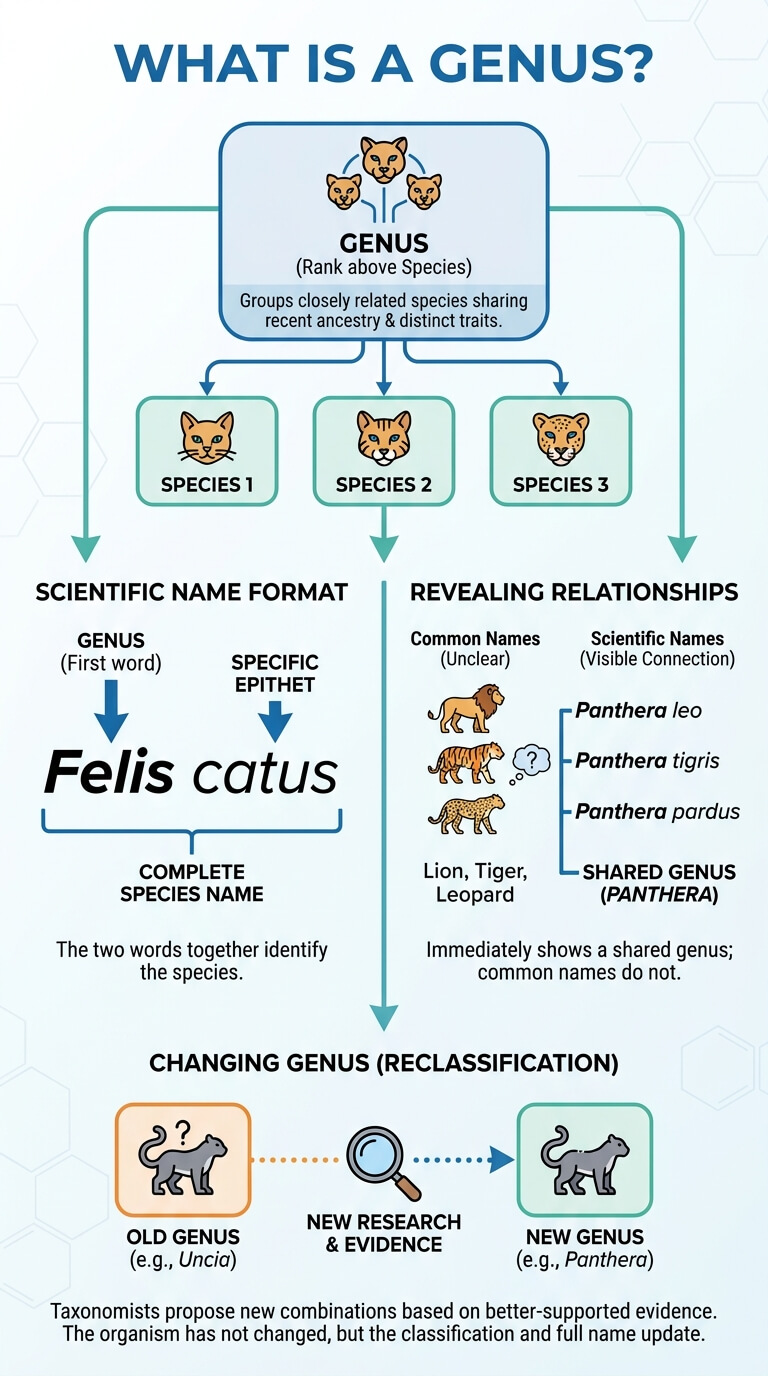
A genus is the rank immediately above species in the standard sequence. It contains one species or multiple species judged to form a meaningful group. Members of a genus usually share relatively recent ancestry and a set of traits that distinguish them from members of neighboring genera.
How genus names appear in scientific names
The genus supplies the first word of an animal’s two-part scientific species name. In Felis catus, Felis is the genus and catus is the specific epithet. The two words together identify the species. The epithet by itself is not a complete species name because the same spelling can occur in combination with different genera. Formal ranks and names are applied during the process scientists use to discover and name new species.
Scientific names make relationships visible. Panthera leo, Panthera tigris, and Panthera pardus immediately show a shared genus. Common names such as lion, tiger, and leopard do not display that information in the same standardized way.
What happens when a species changes genus
New research may show that a species is more closely related to animals in another genus. Taxonomists can then propose a new combination that moves the species epithet to the better-supported genus. The organism has not changed, but the classification and the full scientific name may change.
The Catalogue of Life overview of classification notes that species may be reassigned to new genera or ranks as evidence develops. Nomenclatural rules help determine how the name is handled, while taxonomic research determines which grouping best reflects current knowledge.
What Is a Family?
A family groups related genera
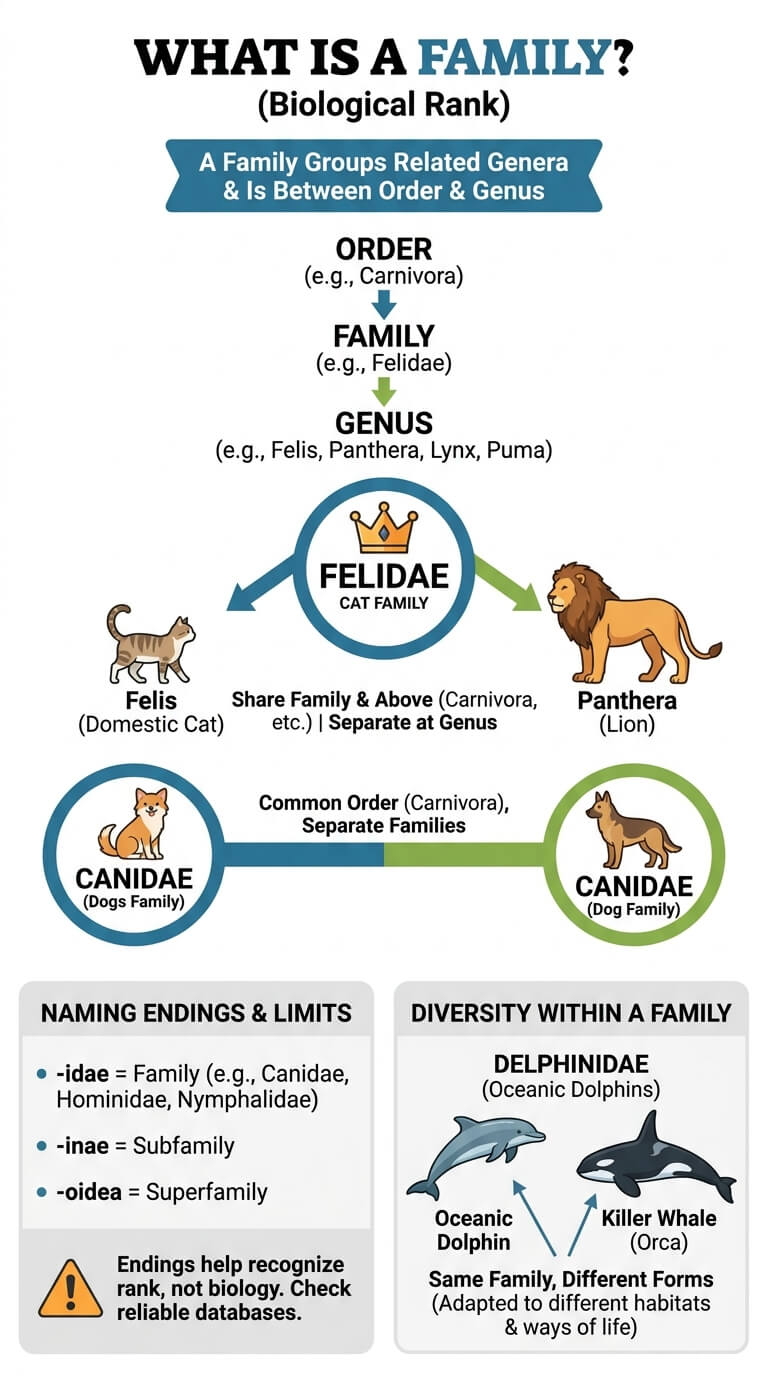
A family is the standard rank above genus and below order. The cat family Felidae contains several genera, including Felis, Panthera, Lynx, Puma, and others. Members share ancestry and important features, but a family can include substantial differences in body size, habitat, hunting style, and social behavior.
Sharing a family is broader than sharing a genus. A domestic cat and a lion belong to Felidae, so they match at family and all ranks above it. They separate at genus. A domestic cat and a dog separate earlier because the dog belongs to Canidae, although both families are placed in Carnivora.
Common animal-family name endings and their limits
Formal zoological family names commonly end in -idae, as in Felidae for cats, Canidae for dogs, Ursidae for bears, Nymphalidae for brush-footed butterflies, and Hominidae for great apes. Subfamily names commonly end in -inae, while superfamily names commonly end in -oidea.
These endings help readers recognize rank, but they do not explain the group’s biology by themselves. Similar-looking words may be unfamiliar, and common English family labels do not always match the formal Latinized name. It is better to check the rank shown in a reliable database than to guess from a name ending alone.
Families can contain surprisingly diverse forms
A family may include animals that look different because its lineages adapted to different habitats or ways of life. Felidae includes small cats that stalk rodents and large cats capable of taking much larger prey. The dolphin family Delphinidae includes oceanic dolphins as well as animals commonly called killer whales and pilot whales.
What Is an Order?
An order groups related families
An order sits above family and below class in the familiar hierarchy. Carnivora contains Felidae, Canidae, Ursidae, Mustelidae, Phocidae, Otariidae, and other families. The order therefore includes cats, dogs, bears, weasels, seals, sea lions, and their relatives.
The name Carnivora can be misleading if treated as a simple diet label. Not every carnivoran eats only meat, and many meat-eating animals belong to other orders. Taxonomic names identify lineages, not everyday categories based on one behavior or food choice.
Orders can be large and internally diverse
Orders often contain major ecological variety. Carnivora includes terrestrial hunters, omnivorous bears, tree-climbing species, burrow users, and fully marine seals. The insect order Coleoptera includes beetles with an enormous range of diets, habitats, sizes, and life histories. Internal diversity grows as a rank becomes broader.
Familiar orders among mammals, birds, insects, and other animals
- Primates includes lemurs, lorises, monkeys, apes, and humans.
- Rodentia includes mice, rats, squirrels, beavers, porcupines, and many other rodents.
- Passeriformes includes the perching birds, the largest order of living birds.
- Lepidoptera includes butterflies and moths.
- Coleoptera includes beetles.
- Octopoda includes octopuses.
Orders are useful for orientation, but readers should not assume that every familiar common-name group equals an order. Sharks span several orders, and the word fish covers multiple major vertebrate lineages rather than one order.
Kingdom, Phylum, and Class for Context
Where Animalia sits
Animalia is the kingdom containing animals. Animals are multicellular eukaryotes, meaning their cells contain nuclei and other membrane-bound structures. They obtain energy by consuming organic material rather than producing food through photosynthesis. These broad features place cats, butterflies, corals, sea stars, and many other forms inside the same kingdom.
How body plans often matter at the phylum level
Phyla represent deep branches of animal evolution. Chordata includes animals that possess a notochord at some stage of development, along with other chordate characteristics. Arthropoda includes animals with jointed appendages, segmented bodies, and an external skeleton. Mollusca, Cnidaria, Echinodermata, and other phyla reflect different body-plan histories.
Why class names are familiar but not always used identically
Mammalia and Aves are familiar class names for mammals and birds. In other lineages, the placement or use of class-level names may vary among taxonomic treatments. A rank called class is not guaranteed to represent the same age, species count, or amount of evolutionary difference in every branch of life.
Two Complete Classification Walkthroughs
Following the domestic cat from kingdom to species
| Rank | Domestic cat classification | What the level adds |
|---|---|---|
| Kingdom | Animalia | Places the cat among animals |
| Phylum | Chordata | Places it among chordates |
| Class | Mammalia | Identifies it as a mammal |
| Order | Carnivora | Groups it with carnivorans |
| Family | Felidae | Places it in the cat family |
| Genus | Felis | Groups it with its closest recognized genus-level relatives |
| Species | Felis catus | Identifies the domestic cat species |
The current GBIF classification for Felis catus displays this path through Animalia, Chordata, Mammalia, Carnivora, Felidae, Felis, and the species. The sequence lets a reader move from a very broad group to a precise name without treating any one rank as the whole story.
Following the monarch butterfly from kingdom to species
| Rank | Monarch classification | What the level adds |
|---|---|---|
| Kingdom | Animalia | Places the monarch among animals |
| Phylum | Arthropoda | Places it among arthropods |
| Class | Insecta | Identifies it as an insect |
| Order | Lepidoptera | Groups it with butterflies and moths |
| Family | Nymphalidae | Places it among brush-footed butterflies |
| Genus | Danaus | Groups it with related milkweed butterflies |
| Species | Danaus plexippus | Identifies the monarch species |
The GBIF record for Danaus plexippus places the monarch in Arthropoda, Insecta, Lepidoptera, Nymphalidae, and Danaus. Its classification follows the same rank sequence as the cat even though the two animals separate at the phylum level.
Comparing where the two examples diverge
The cat and monarch match at kingdom because both are animals. They diverge at phylum: the cat belongs to Chordata, while the monarch belongs to Arthropoda. Every lower rank then follows a different branch. Mammalia and Insecta are different classes, Carnivora and Lepidoptera are different orders, and the family, genus, and species names also differ.
This comparison shows why matching at a broad rank does not imply close similarity. All animals share deep ancestry, but Animalia contains extraordinary diversity. Matching at genus generally signals a much closer relationship than matching only at kingdom or phylum.
Ranked Taxonomy Versus Clades
What a clade represents
A clade is a common ancestor together with all of its descendants. Clades describe branches of an evolutionary tree. They can be very small or extremely large, and they do not require assignment to one of the traditional ranks.
The University of California Museum of Paleontology explanation of nested clades shows that a branch can contain smaller branches within it. This nesting resembles ranked taxonomy, but a clade is defined by ancestry rather than by being labeled order, family, or another particular rank.
Why modern classifications may use unranked groups
Evolutionary trees often contain more branches than the traditional ranks can conveniently name. Scientists may therefore use clade names without assigning them a formal rank, or they may recognize several intermediate groups between two familiar ranks. This allows classification to reflect evidence without forcing every branch into the same limited ladder.
How ranks and phylogenetic trees can coexist
Ranks remain practical for organizing names, databases, collections, and educational materials. Phylogenetic trees show patterns of common ancestry more directly. A modern classification can use both: familiar ranked names provide reference points, while clades reveal the branching structure connecting them.
How to Read and Write an Animal Classification
Capitalization and italics in genus and species
In zoological writing, the genus begins with a capital letter and the specific epithet begins with a lowercase letter. Both are conventionally italicized: Felis catus, Danaus plexippus, and Homo sapiens. Higher names such as Felidae, Carnivora, Mammalia, and Animalia begin with capitals but are not normally italicized.
The ICZN guidance for writing zoological names recommends writing the genus and species in a contrasting typeface, usually italics, and keeps the genus capitalized while the specific name begins with lowercase. These conventions make rank and name structure immediately visible.
Abbreviating a genus after first use
After the full scientific name has appeared, the genus may be shortened to its initial when the meaning is clear. Felis catus can become F. catus in later mentions. The specific epithet remains lowercase and italicized.
Abbreviation should not create confusion. If several genera beginning with the same letter are discussed together, writing the genus in full may be clearer. A scientific name at the start of a paragraph should also be easy for a reader to connect with the animal’s common name.
Common labels in databases and field guides
Databases may show accepted names, synonyms, authorship, publication year, rank, parent taxon, and a full classification. A name followed by a person’s name and year includes nomenclatural authorship, not part of the animal’s two-word species name. Parentheses around authorship can indicate that the species is now placed in a different genus from the one used in its original description.
Common Mistakes and Myths
Myth: genus is broader than family
Family is broader than genus. A family can contain several genera, and each genus can contain one or more species. Remembering the sequence order, family, genus, species keeps the direction clear. Moving toward species narrows the group; moving toward order broadens it.
Myth: common names map neatly to ranks
For example, whale is not a species or genus. It is a common label applied to multiple cetacean families. Fish is even broader and does not correspond neatly to one modern clade when land vertebrates are excluded. Scientific classification provides a more consistent way to state which animals are being discussed.
Myth: every rank contains the same number of subgroups
There is no standard quota. One genus may contain a single recognized living species, while another contains many. One family may contain a few genera, while another is divided into numerous subfamilies, tribes, and genera. Classification reflects branching history and taxonomic judgment rather than equal-sized storage compartments.
Species counts also change as new animals are described, old names are re-evaluated, and lineages are split or merged. Comparing two families by number of species does not tell you which is more advanced, successful, or evolutionarily important.
Myth: classifications are permanent
Scientific names aim for stability, but classifications remain open to revision. DNA evidence, new fossils, improved anatomical study, or broader sampling can alter the inferred relationships among animals. A change is not a failure of classification. It is a correction or refinement based on stronger evidence.
Different authoritative databases may update at different times or follow different expert treatments. For current work, record the database or taxonomic reference used and the date accessed, especially when a group is undergoing active revision.
Why Taxonomic Ranks Matter in Animal Biology
Classification helps scientists compare animals
Ranks give researchers a shared vocabulary for organizing observations. A study can compare species within one genus, genera within one family, or families across an order. The chosen level helps define whether the question concerns close relatives or broad evolutionary patterns. These ranks provide the naming structure within the broader animal kingdom classification system.
Species identification requires more than reading a rank
A classification tells where an identified animal is placed, but it does not by itself identify an unknown specimen. Identification may require anatomy, color pattern, measurements, calls, behavior, location, life stage, or genetic evidence. Closely related species can be difficult to distinguish, while members of one species can vary greatly.
Rank literacy helps readers interpret the result. It clarifies whether two similar animals are members of the same species, different species within one genus, or members of different genera within one family. The hierarchy becomes more detailed below species when scientists compare species vs subspecies.
Scientific names connect information across languages
Common names are useful in daily communication, but scientific names provide a standardized reference for research, collections, wildlife policy, biodiversity records, and international collaboration. A two-part name can point to the same taxonomic concept even when local names differ.
FAQ
Is genus broader or narrower than family?
Genus is narrower than family. A family contains one or more related genera, and a genus contains one or more related species. In the cat family Felidae, Felis, Panthera, Lynx, and Puma are separate genera. Moving from family to genus reduces the number and variety of animals included.
Can two animals share a genus but belong to different species?
Yes. That is one of the main purposes of a genus. Lions and tigers share the genus Panthera but are different species, Panthera leo and Panthera tigris. Sharing a genus indicates close classification, but the different specific epithets identify separate species.
Why do some classifications include suborders or subfamilies?
Intermediate ranks add detail when a lineage contains important branches between the major levels. A suborder divides an order, while a subfamily divides a family. Superfamilies, tribes, and subgenera can provide additional structure. These ranks help organize complex diversity without changing the order-to-family-to-genus-to-species framework.
Are taxonomic ranks used the same way in every animal lineage?
The basic rank names are widely used, but they are not perfectly equivalent across all lineages. An order of insects is not guaranteed to contain the same amount of evolutionary diversity or the same number of species as an order of mammals. Some groups use many intermediate ranks, and modern studies may emphasize clades instead of assigning every branch a traditional rank.
Final Thoughts
Species, genus, family, and order are easiest to understand as nested levels. Species is the narrowest standard rank, genus groups closely related species, family groups related genera, and order groups related families. Kingdom, phylum, and class place those levels inside a broader view of animal diversity.
The hierarchy is a practical map, not a fixed ladder or a measure of biological importance. Classifications can change as evidence improves, and modern phylogenetic trees often include clades that have no traditional rank. Learning how the levels nest, how scientific names are written, and how to check a current classification makes animal names far more informative than a list to memorize.

Ethan Walker is the founder and research editor of Animal Fact Central. He creates and reviews educational animal facts content using trusted wildlife, pet care, and science-based sources. His work focuses on making animal behavior, adaptations, habitats, and species facts clear, accurate, and engaging for everyday readers.
Read More Details About Ethan Walker: https://animalfactcentral.com/ethan-walker/