
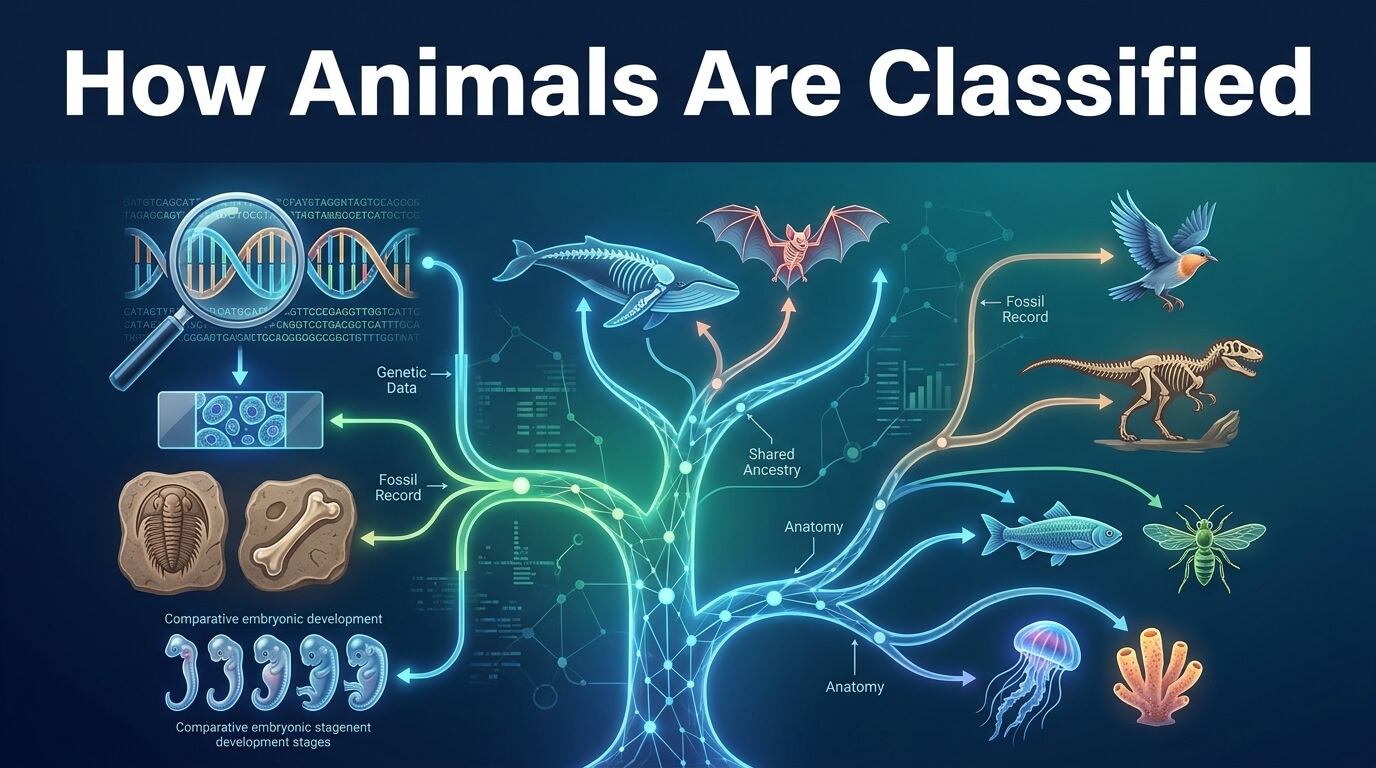
Scientists classify animals by comparing many kinds of evidence, not by choosing one obvious feature such as size, habitat, color, or whether an animal can fly. They examine body structures, development, behavior, ecology, fossils, proteins, and DNA. They then test which grouping best explains the pattern of shared traits and common ancestry.
Modern animal classification is therefore more than sorting creatures into convenient boxes. It is a scientific effort to reconstruct relationships. A useful classification should place close relatives together, separate look-alike animals that evolved similar features independently, and remain open to revision when new evidence changes the best explanation.
This process can feel complicated because several fields overlap. Taxonomy identifies, describes, names, and arranges organisms. Systematics studies biological diversity and relationships more broadly. Phylogenetics tests hypotheses about evolutionary history. Together, these approaches explain how scientists move from an unfamiliar specimen to a carefully supported place on the animal family tree.
Quick Answer
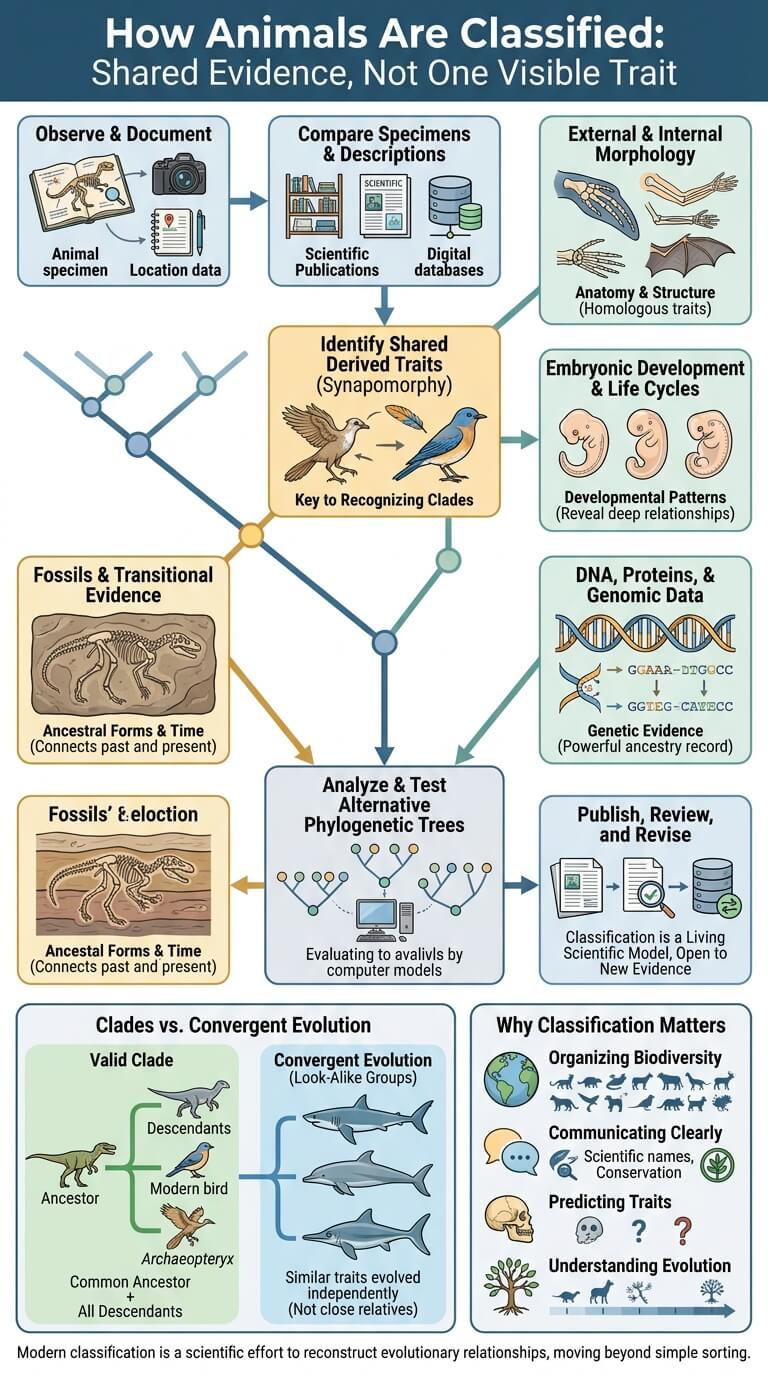
Scientists Classify Animals by Shared Evidence, Not One Visible Trait
An animal is not classified as a close relative of another animal merely because the two look alike. Scientists ask whether their similarities were inherited from a common ancestor or evolved separately in response to similar challenges. They also consider whether multiple independent features point toward the same relationship.
For example, wings alone do not make bats close relatives of birds. Bat wings are modified mammalian forelimbs, while bird wings belong to a different vertebrate branch. The two groups share a distant tetrapod ancestor, but powered flight evolved independently in their lineages. Anatomy beneath the wing surface, embryonic development, fossils, and genetic evidence all reveal this difference.
Modern Classification Aims to Reflect Evolutionary Relationships
Older classifications often emphasized overall resemblance. Modern classifications aim to recognize clades, which are groups containing a common ancestor and all of its descendants. A clade can be small, such as a genus, or enormous, such as vertebrates. The key is ancestry, not whether every member still looks similar.
Classification remains a hypothesis because the complete history of life cannot be observed directly. Scientists infer it from evidence that survives in living organisms, museum specimens, genomes, and fossils. Strong hypotheses are supported by several independent data sets and continue to fit when new animals or characters are added.
Why Animal Classification Matters
Organizing Biodiversity
Millions of animal species have been described, and many more remain unnamed or poorly studied. Classification gives researchers a structure for storing records, comparing species, mapping distributions, and recognizing gaps in knowledge. Without that structure, the same animal might be counted under several names, or different animals might be treated as one.
A well-maintained classification also records accepted names, older combinations, synonyms, and competing placements. The Catalogue of Life explanation of species and classification shows why taxonomic information changes as specialists add evidence, correct errors, and reconcile different expert sources.
Communicating Clearly Across Countries and Languages
Common names are useful in everyday speech, but they vary by region and language. The name “panther” may refer to a black leopard, a black jaguar, a cougar, or a local sports mascot. Scientific names identify a particular taxon more consistently, while the classification around that name shows its recognized relatives.
This shared vocabulary matters in conservation laws, disease monitoring, wildlife trade controls, agriculture, museum collections, and ecological research. A regulation written for the wrong species can fail to protect the intended population. A mistaken identification can also distort a range map or make an invasive animal appear native.
Predicting Traits From Relatedness
Closely related animals often share inherited features. Knowing that an unfamiliar animal belongs to a certain family may suggest aspects of its skull, teeth, development, or reproductive anatomy. These predictions are starting points, not guarantees, because lineages can lose traits, evolve unusual adaptations, or occupy very different environments.
Classification, Taxonomy, Systematics, and Phylogenetics
What Taxonomy Does
Taxonomy is the work of recognizing, describing, naming, and classifying organisms. A taxonomic study may determine whether a specimen matches a known species, whether two named species are actually the same, or whether a population deserves recognition as a separate species. Taxonomists document the features that support their decision and compare them with earlier descriptions.
What Systematics Adds
Systematics places taxonomic work within the broader study of biological diversity and relationships. A systematist may investigate how an entire family diversified, which traits appeared along each branch, or how geography influenced the separation of lineages. The work can combine field surveys, museum collections, anatomy, genetics, ecology, and mathematical models.
What Phylogenetics Tests
Phylogenetics is the study of evolutionary relationships among organisms, populations, or genes. Researchers build data sets of comparable characters, estimate possible branching histories, and test which trees fit the evidence best. A phylogenetic tree is therefore a diagram of an inferred history, not a picture of animals arranged from lower to higher.
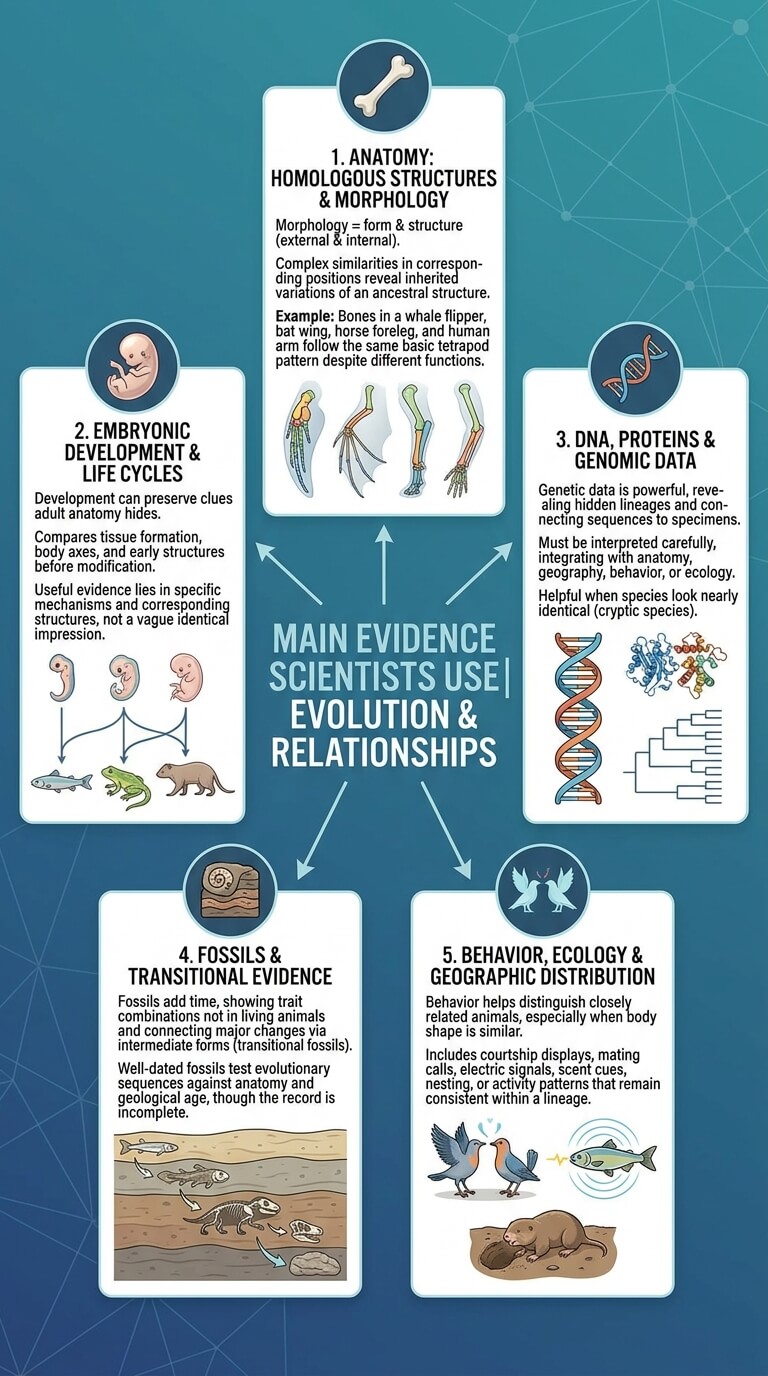
The Main Evidence Scientists Use
External Anatomy and Internal Structures
Morphology means the form and structure of organisms. External characters may include scales, feathers, limb proportions, shell shape, mouthparts, body segmentation, or color patterns. Internal characters can include bones, muscles, organs, nerves, and arrangements that are hidden in a living animal.
Some anatomical similarities are especially informative because they are complex and occur in corresponding positions. The bones inside a whale flipper, bat wing, horse foreleg, and human arm follow the same basic tetrapod pattern despite serving different functions. Such homologous structures are inherited variations of an ancestral structure.
Embryonic Development and Life Cycles
Development can preserve clues that adult anatomy hides. Researchers compare how tissues form, how body axes are established, how larvae develop, and which embryonic structures appear before they are modified or lost. These patterns can help identify deep relationships among groups with very different adult forms.
Developmental evidence must be interpreted carefully. Embryos of related animals are not identical, and the old claim that an embryo simply repeats its species’ evolutionary history is incorrect. The useful evidence lies in specific developmental mechanisms and corresponding structures, not in a vague impression that all embryos look the same.
Behavior, Ecology, and Geographic Distribution
Behavior can help distinguish closely related animals. Courtship displays, mating calls, electric signals, scent cues, nesting behavior, or daily activity patterns may remain consistent within one lineage and differ in another. This is especially valuable when body shape changes little.
DNA, Proteins, and Genomic Data
Genetic data are powerful, but they are not automatic verdicts. Poor sampling, contamination, misidentified specimens, rapidly changing genes, hybridization, and the choice of analytical method can affect results. Strong studies connect sequences to documented specimens and compare genetic findings with anatomy, geography, behavior, or ecology when those data are available.
DNA can be especially helpful when several species look nearly identical. Reviews of cryptic species and their conservation describe how genetic evidence can reveal hidden lineages, while also emphasizing that formal recognition works best when researchers integrate multiple kinds of information.
Fossils and Transitional Evidence
Fossils add time to the classification problem. They can show combinations of traits not found in living animals, reveal when a lineage appeared, and connect major body changes through intermediate forms. A fossil with both ancestral and derived features may clarify which traits evolved first.
The fossil record is incomplete because most organisms never fossilize, many rocks have been destroyed, and preserved material is often fragmentary. Even so, a series of well-dated fossils can test whether a proposed evolutionary sequence matches anatomy and geological age. Fossil evidence is particularly valuable when living members of a lineage are highly specialized.
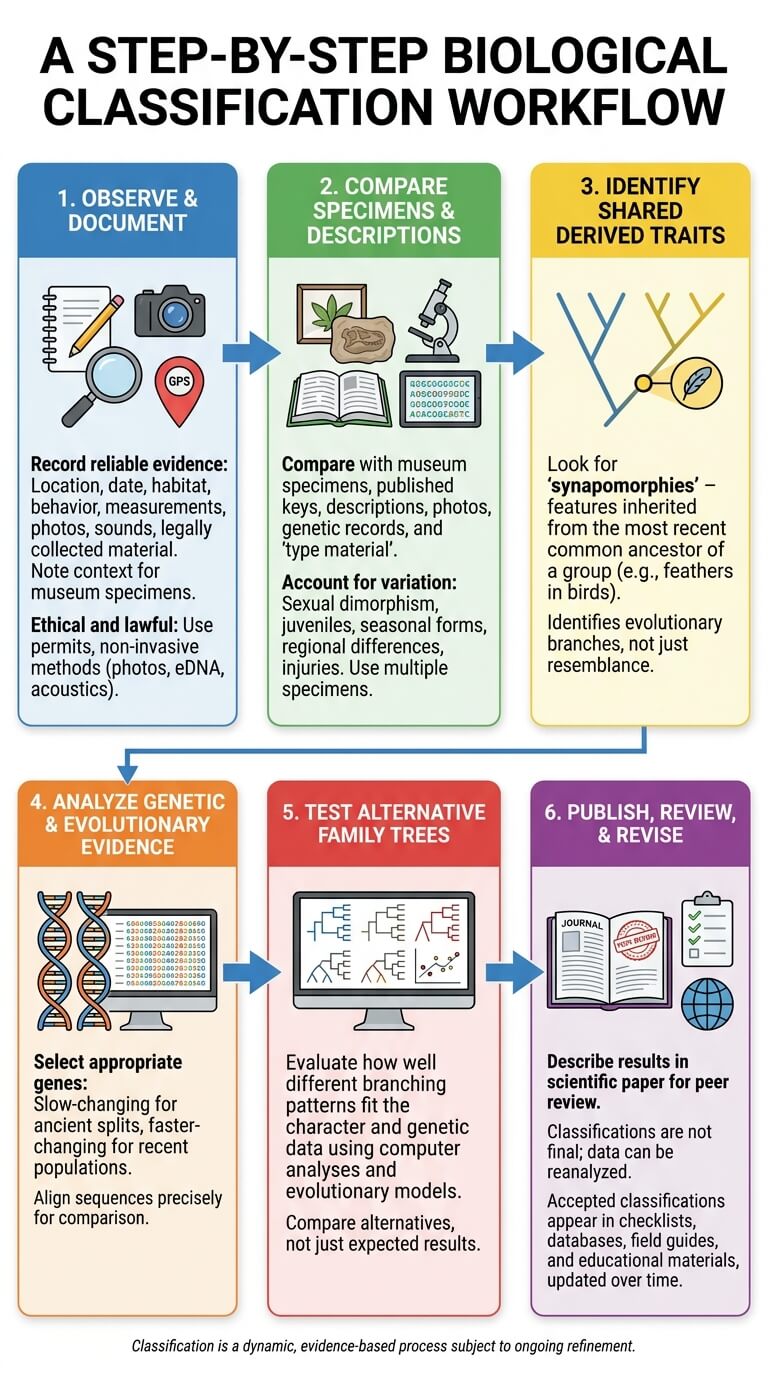
A Step-by-Step Classification Workflow
Observe and Document the Animal
The process begins with reliable evidence. A researcher records where and when an animal was found, its habitat, behavior, measurements, photographs, sounds, and any legally collected material. For museum specimens, notes about location and collection method are essential because a specimen without context loses much of its scientific value.
Observation should be ethical and lawful. Protected wildlife may require permits, and many questions can be answered with photographs, acoustic recordings, shed material, environmental DNA, or existing collections. Readers should not capture animals simply to identify them.
Compare Specimens and Existing Descriptions
A possible new identification is compared with museum specimens, published descriptions, identification keys, photographs, genetic records, and type material. A type specimen is the reference to which a scientific name is permanently attached. It does not need to be the most typical individual, but it anchors the meaning of the name.
Researchers also account for variation within a species. Males and females may look different. Juveniles may lack adult colors. Seasonal coats, regional forms, injuries, disease, and individual variation can create misleading differences. Several specimens are often more informative than one unusual individual.
Identify Shared Derived Traits
A shared derived trait, called a synapomorphy, is a feature inherited from the most recent common ancestor of a particular group. Feathers are a familiar example for living birds, although fossils show that feathers evolved before modern birds. Shared derived traits help identify branches rather than merely describing resemblance.
Analyze Genetic and Evolutionary Evidence
Researchers select genes or genomic regions that can answer the question at the correct scale. Slowly changing sequences may help with ancient splits, while faster-changing regions may distinguish recent populations. The sequences must be aligned so that corresponding positions are compared.
Test Alternative Family Trees
A data set can support several possible trees. Scientists compare alternatives rather than drawing the arrangement they expected to find. Computer analyses evaluate how well each branching pattern fits the characters and the chosen evolutionary model.
Publish, Review, and Revise the Classification
Results are described in a scientific paper so other specialists can inspect the specimens, methods, data, and reasoning. Peer review can catch problems, but publication is not the final word. Other researchers may reanalyze the data, add species, collect new specimens, or test a competing explanation.
Accepted classifications may then be reflected in specialist checklists, museum databases, field guides, and educational materials. Updates do not happen everywhere at once. That is why two reputable references can temporarily use different genus names or recognize different numbers of species.
How Phylogenetic Trees Guide Classification
Branches, Nodes, and Common Ancestors
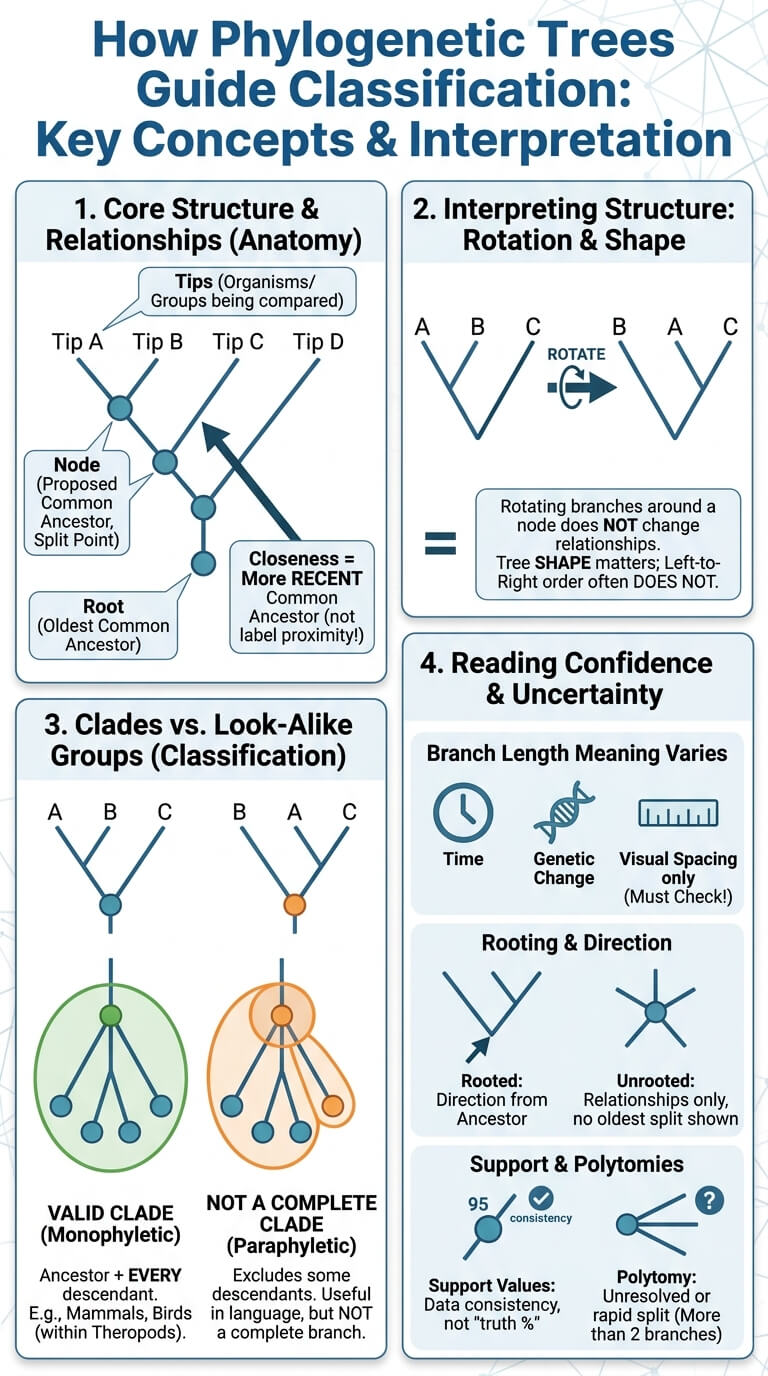
A phylogenetic tree consists of tips, branches, and nodes. Tips represent the organisms or groups being compared. A node marks a proposed common ancestor where one lineage split into two or more descendant branches. Two tips are close relatives when they share a more recent common ancestor, not when their labels happen to be drawn next to each other.
The Understanding Evolution guide to phylogenies explains that rotating branches around a node does not change the relationships. Tree shape matters, while left-to-right order often does not.
Clades Versus Look-Alike Groups
A valid clade contains an ancestor and every descendant of that ancestor. Mammals form a clade. Birds form a clade within theropod dinosaurs. A group that excludes some descendants may remain useful in everyday language, but it does not represent a complete branch under cladistic classification.
Reading Confidence and Uncertainty
Some tree diagrams show branch length, but its meaning must be checked. Length may represent time, amount of genetic change, or nothing beyond visual spacing. A tree can also be rooted, showing the direction from ancestor toward descendants, or unrooted, showing relationships without identifying the oldest split.
Support values summarize how consistently the data favor a branch under a particular method. They are not direct percentages that a relationship is “true” in every sense. Scientists also use polytomies, nodes with more than two descendant branches, when the order of several splits is unresolved or occurred too rapidly to distinguish confidently.
Examples of Classification Changing With New Evidence
Whales Within the Even-Toed Ungulate Lineage
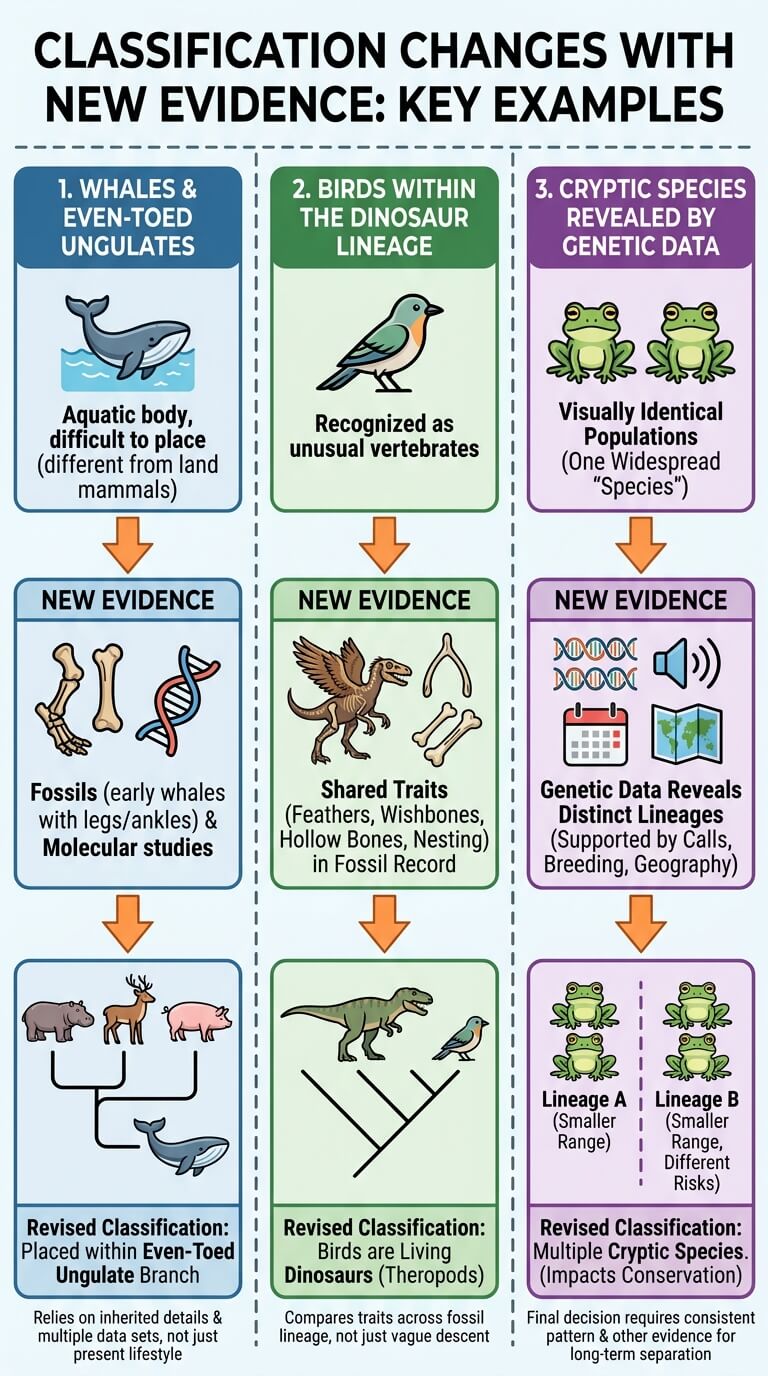
Whales were once difficult to place because their aquatic bodies are so different from those of land mammals. Fossils revealed early whales with functional legs and distinctive ankle structures, while molecular studies connected whales with the even-toed ungulate branch that includes hippos, deer, pigs, and cattle.
The Smithsonian whale evolution resources use fossils and branching diagrams to show the transition from terrestrial ancestors to fully aquatic whales. The case demonstrates why classification relies on inherited details and multiple data sets rather than present-day lifestyle.
Birds Within the Dinosaur Lineage
Birds were long recognized as unusual vertebrates, but a growing fossil record placed them within theropod dinosaurs. Feathers, wishbones, hollow bones, nesting behavior, air-filled skeletal spaces, and detailed wrist and shoulder structures occur across the bird-dinosaur lineage in different combinations.
The Smithsonian Dinosaurs Take Flight materials show how researchers compare traits across fossil dinosaurs and birds to test where flight-related features arose. Birds did not merely descend from something vaguely dinosaur-like. In modern classification, they are living dinosaurs.
Cryptic Species Revealed by Genetic Data
Some animals that appear nearly identical contain genetically distinct lineages with different calls, breeding periods, host preferences, chemistry, or geographic ranges. These are often called cryptic species when visible morphology initially failed to separate them.
Genetic divergence alone does not automatically prove that every population is a separate species. Researchers ask whether the pattern is consistent across samples and whether other evidence supports long-term separation. The final decision may affect conservation because a widespread “species” can turn out to be several smaller-range lineages with different risks.
When Different Evidence Disagrees
Convergent Evolution
Convergent evolution occurs when unrelated lineages independently evolve similar solutions. Wings, camera-like eyes, venom systems, armor, and streamlined bodies have each evolved more than once. If scientists mistake a functional similarity for shared ancestry, the resulting classification can be wrong.
Incomplete Fossil Records
Missing fossils can leave long branches with few visible intermediate forms. Soft-bodied animals preserve poorly, tropical environments can destroy remains quickly, and accessible rock layers cover only part of Earth’s history. Absence from the fossil record is therefore not proof that a lineage did not exist.
Scientists compare the fossils that are available with living anatomy, geological dates, and molecular estimates. A new fossil can alter the timing or placement of a branch, but it is interpreted within the full evidence rather than treated as a single decisive object.
Gene Trees Versus Species Trees
A tree built from one gene may not exactly match the history of the species carrying it. Gene copies can duplicate, disappear, move between populations through hybridization, or retain older variation across several speciation events. As a result, different parts of the genome can support different branching patterns.
A review in Systematic Biology on gene trees and species trees explains why these histories are linked but not identical. Modern analyses often compare many independent genes and use models designed to account for processes such as incomplete lineage sorting.
Common Mistakes and Myths
Classifying by Habitat Alone
Living in the ocean does not make whales fish, and living underground does not make moles close relatives of burrowing reptiles. Habitat can shape anatomy and behavior, sometimes producing strong resemblance among unrelated animals. Classification asks who inherited which traits from which ancestors.
Ecology still matters, especially when it helps explain divergence among close relatives. It simply cannot replace anatomical, developmental, fossil, and genetic evidence. Habitat is one part of the history, not the entire family tree.
Assuming Similar Body Shape Means Close Ancestry
Overall appearance is often a poor guide when natural selection favors the same solution repeatedly. An ichthyosaur, tuna, shark, and dolphin all have streamlined bodies, yet they belong to very different vertebrate lineages. Their internal skeletons and reproductive biology tell different stories.
The opposite problem also occurs. Close relatives can look strikingly different after adapting to different environments. Whales and hippos share a closer evolutionary connection than their adult shapes suggest. Classification depends on patterns of inherited evidence, not visual similarity scores.
Treating Every Common Name as a Scientific Group
Common names often describe lifestyle, appearance, or tradition rather than ancestry. “Worm” can refer to annelids, flatworms, roundworms, ribbon worms, and unrelated larvae. “Fish” is useful in ordinary language but can be defined differently depending on whether the speaker means aquatic vertebrates, jawed fishes, or a complete evolutionary branch.
This does not make common names bad. They are practical and culturally meaningful. Problems arise only when a common label is assumed to be a formal taxonomic group without checking what organisms it includes.
Where Classification Meets Taxonomy, Species, and Evolution
Where Taxonomic Ranks Fit After a Relationship Is Proposed
Once researchers have a supported relationship, they decide how to express it in a classification. Species are placed in genera, genera in families, and families in orders, but not every meaningful branch receives one of these familiar ranks. Many named clades sit between or outside the standard sequence.
Ranks are useful addresses, while the tree carries the relationship. A genus in one lineage is not guaranteed to be the same age or contain the same amount of diversity as a genus in another. The rank helps organize information, but it is not a measurement of evolutionary distance.
Why Species Boundaries Affect Classification
A family tree cannot be built cleanly if researchers disagree about which populations count as separate species. Interbreeding, hybrid zones, gradual geographic variation, asexual reproduction, and recent divergence can make boundaries difficult to draw. Different species concepts emphasize reproduction, ancestry, ecology, or diagnosable differences.
Classification studies often reveal these problems without settling them immediately. Scientists may use cautious labels such as species complex, candidate species, or unresolved lineage while they collect more evidence. Uncertainty is more accurate than forcing a confident name onto an incomplete pattern.
How Common Ancestry Explains Nested Groups
Animal classification is nested because ancestry is nested. A gray wolf is a canid, a carnivoran, a mammal, a vertebrate, a chordate, and an animal at the same time. Each broader group contains the narrower one because each name refers to a branch within a larger branch.
This is why a new discovery can change several labels at once. Moving a genus to a different family alters its position in the hierarchy, but the purpose remains the same: make the named arrangement match the best-supported history.
FAQ
Do Scientists Classify Animals by Appearance Alone?
No. Appearance is useful, especially when structures can be compared carefully, but it is only one source of evidence. Scientists may also use internal anatomy, development, behavior, ecology, fossils, proteins, chromosomes, and DNA. The strongest classification usually comes from several independent lines of evidence that support the same relationship.
Appearance can be misleading because unrelated animals may converge on similar forms, while close relatives may look different after adapting to different environments. Researchers therefore focus on the origin and arrangement of traits, not just the overall look.
How Can DNA Change an Animal Classification?
DNA can reveal inherited similarities that are difficult to see in anatomy. It may show that two look-alike animals are not close relatives, connect a highly modified animal with an unexpected group, or reveal several hidden lineages inside one named species.
A strong revision does not normally depend on one unexplained sequence difference. Scientists check specimen identity, sampling, multiple genetic regions, analytical methods, and any supporting anatomical, ecological, behavioral, or geographic evidence. DNA adds a powerful record of ancestry, but it must be interpreted.
Who Reviews Proposed Classification Changes?
Specialists review the evidence through peer-reviewed publications, taxonomic revisions, museum research, expert checklists, and professional databases. Other scientists may agree, challenge the methods, add new specimens, or propose a better-supported tree. Zoological naming bodies govern whether names follow formal rules, but they do not vote evolutionary relationships into existence.
Because acceptance develops through research, reputable sources may differ for a time. A field guide, museum catalogue, genetic database, and specialist checklist can update on different schedules or follow different taxonomic authorities.
Why Do Textbooks Sometimes Show Different Classifications?
Some textbooks use older arrangements because scientific publishing and curriculum updates take time. Others simplify a complicated tree for beginners or choose one of several defensible classifications. Differences are especially common when a group is being actively revised or when rank names vary among traditions.
Readers should check the publication date, the taxonomic authority being followed, and whether the diagram represents a convenient classroom grouping or a current phylogenetic hypothesis. A difference is not necessarily an error, but it should have a clear reason.
Final Thoughts
Understanding how animals are classified means understanding how scientists evaluate evidence. They document organisms, compare specimens, identify inherited traits, analyze genetic and fossil data, test alternative trees, publish their reasoning, and revise conclusions when stronger evidence appears. No single feature, gene, habitat, or common name can reliably do all of that work alone.
The result is a classification that functions as a living scientific model of animal relationships. Taxonomic names organize the diversity, phylogenetic trees explain common ancestry, and uncertainty remains visible where the evidence is incomplete. That combination of structure and revision is a strength, not a flaw, because it allows animal classification to become more accurate as knowledge grows.

Ethan Walker is the founder and research editor of Animal Fact Central. He creates and reviews educational animal facts content using trusted wildlife, pet care, and science-based sources. His work focuses on making animal behavior, adaptations, habitats, and species facts clear, accurate, and engaging for everyday readers.
Read More Details About Ethan Walker: https://animalfactcentral.com/ethan-walker/