
An animal species is usually understood as a distinct evolutionary lineage: a population, or connected set of populations, that is evolving separately from other such lineages. Scientists test that idea with evidence from reproduction, genes, anatomy, behavior, ecology, and geographic history. No single test works for every animal.
That is why the familiar rule that members of the same species can interbreed is helpful but incomplete. It works best for living animals that reproduce sexually and can be observed where their ranges meet. It cannot be applied directly to fossils, strictly asexual animals, or populations separated by an ocean. Even recognized species sometimes hybridize without merging into one population.
Quick Answer
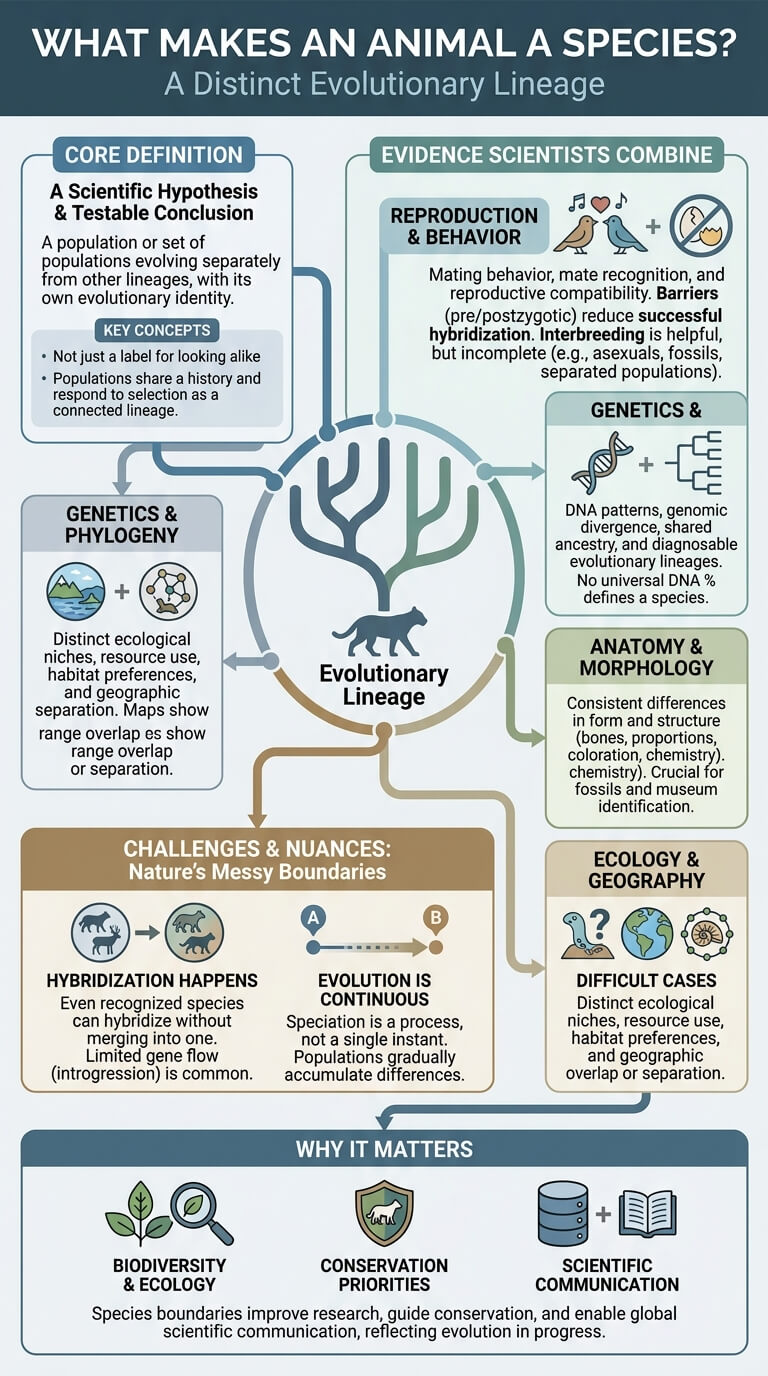
A species is a scientific hypothesis about a distinct evolutionary lineage
Calling a group a species is not merely attaching a label to animals that look alike. It is a testable conclusion that the group has its own evolutionary identity. Its populations may exchange genes with one another, share a history, and respond to natural selection as a connected lineage more than they do with neighboring groups.
Different species concepts answer different biological questions
A species concept is a framework for deciding what evidence matters most. The biological species concept emphasizes reproductive isolation. The morphological concept emphasizes consistent differences in form. Phylogenetic approaches look for diagnosable lineages and ancestry, while ecological and evolutionary concepts emphasize a population’s niche or its independent trajectory through time.
These frameworks often agree when lineages are well separated. Disagreement becomes more likely during recent divergence, hybridization, gradual geographic change, or when only limited specimens are available. Kevin de Queiroz’s influential general lineage account of species treats many familiar criteria as different forms of evidence that lineages are evolving separately, rather than as rival definitions that must always produce different answers.
Why Defining a Species Is Difficult
Nature does not always form sharp boundaries
Some species are easy to distinguish. They may differ strongly in anatomy, mating behavior, habitat, and DNA, with no sign of gene flow between them. Other populations lie along a continuum. Neighboring populations may exchange genes, while populations at opposite ends of a broad range differ substantially.
Evolution is continuous while names are discrete
Speciation is usually a process, not a single instant. Populations accumulate differences in genes, traits, timing, habitat use, and courtship. Barriers to reproduction may strengthen gradually. Human classification, however, requires names that place a specimen or population into one category or another.
Different animals provide different kinds of evidence
Birds may reveal boundaries through songs, plumage, migration routes, and mate choice. Insects may separate through host plants, pheromones, or breeding season. Marine invertebrates may look nearly identical while genetic analyses reveal long-separated lineages. Fossil animals are known mainly from preserved structures, so reproduction and behavior usually cannot be tested directly.
The Biological Species Concept
Interbreeding and reproductive isolation
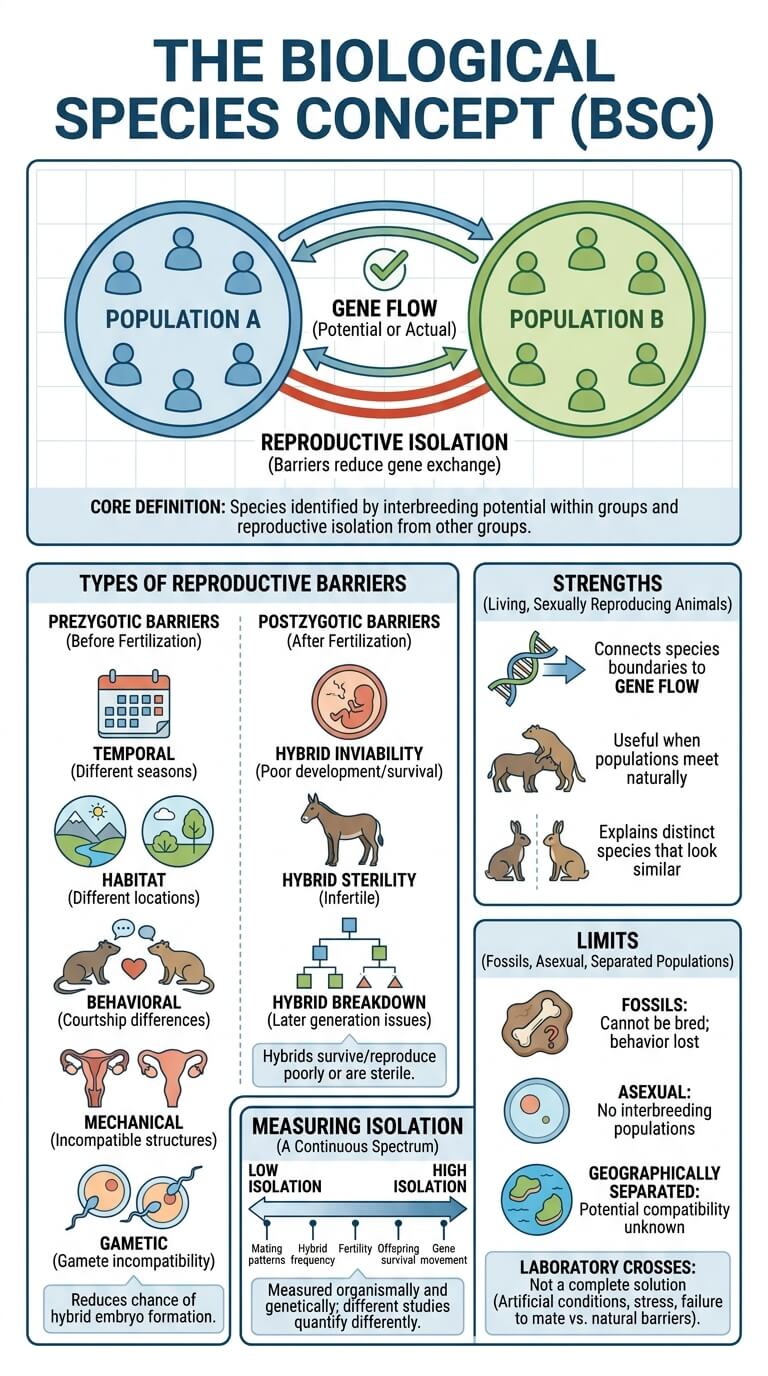
The biological species concept identifies species through actual or potential interbreeding within groups and reproductive isolation between groups. In practice, scientists do not need to observe every possible mating. They study whether populations exchange genes in nature and whether barriers reduce successful reproduction between them.
Reproductive isolation is not simply an on-or-off property. It can be measured through mating patterns, hybrid frequency, fertility, offspring survival, and the movement of genes across contact zones. A modern review of how reproductive isolation is defined and measured emphasizes that it can be viewed from both organismal and genetic perspectives, and that different studies may quantify it in different ways.
Prezygotic and postzygotic barriers
Prezygotic barriers act before fertilization. Populations may breed in different seasons, use different habitats, respond to different songs or scents, or have courtship behaviors that prevent mating. Their reproductive structures or gametes may also be incompatible. These barriers reduce the chance that a hybrid embryo forms.
Postzygotic barriers act after fertilization. Hybrids may develop poorly, survive less well, be sterile, or produce fewer descendants than animals from either parental population. Some barriers appear only in later generations when gene combinations are reshuffled. Several weak barriers can combine to create strong overall isolation.
Strengths for living sexually reproducing animals
This concept connects species boundaries to gene flow, a central part of population evolution. It is especially useful when populations meet naturally, breeding behavior can be observed, and hybrids can be identified. It also explains why two animals can look similar yet remain separate if they do not exchange genes successfully.
Limits for fossils, asexual animals, and separated populations
Fossils cannot be paired in breeding tests, and extinct mating behavior is rarely preserved. Strictly asexual animals do not form interbreeding populations in the usual sense. Populations living on different islands may never meet, so their potential compatibility is difficult to establish.
Laboratory crosses are not a complete solution. Animals may mate under artificial conditions even though they rarely encounter one another, reject one another in nature, or produce hybrids poorly suited to either habitat. Conversely, failure to mate in captivity may reflect stress or unsuitable conditions rather than a natural reproductive barrier.
The Morphological Species Concept
Distinguishing species by form and structure
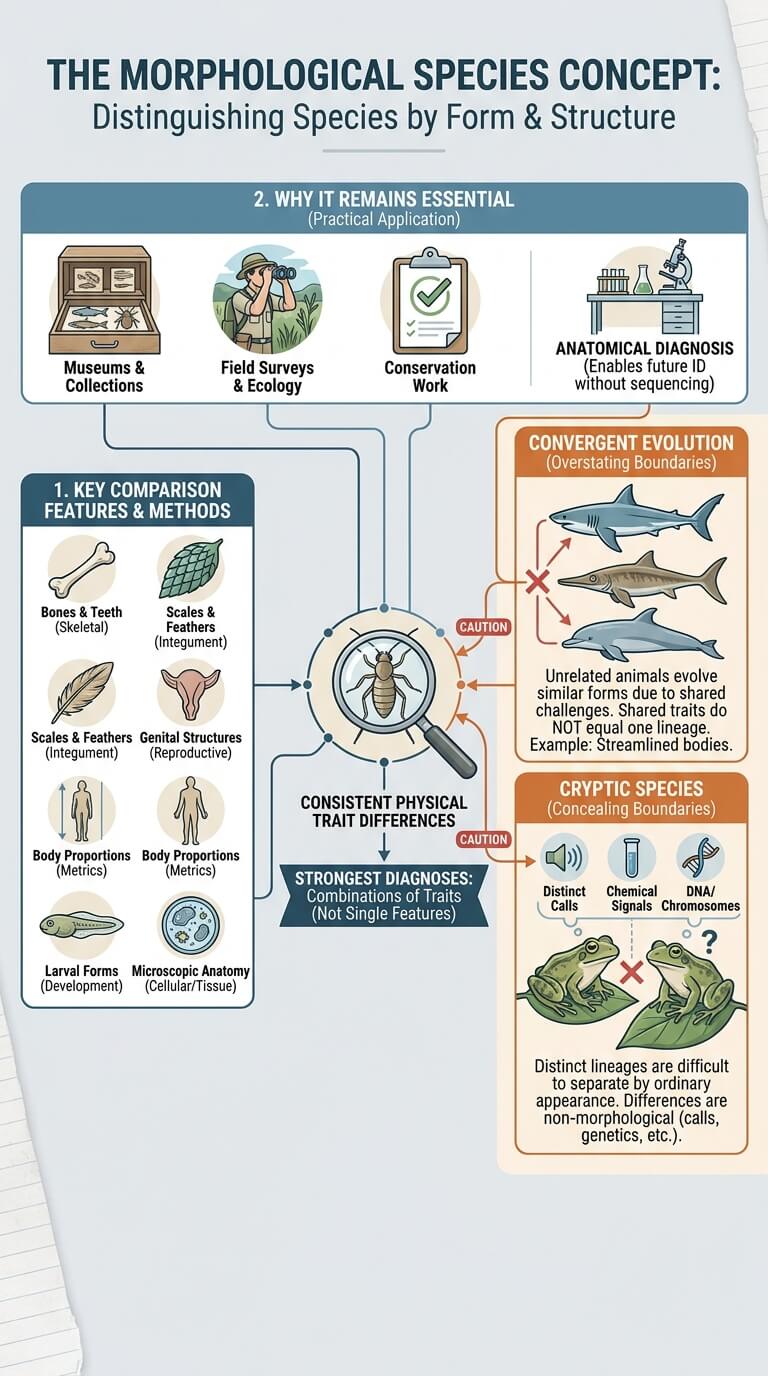
The morphological species concept separates groups by consistent differences in physical traits. Researchers may compare bones, teeth, scales, feathers, genital structures, body proportions, larval forms, or microscopic anatomy. The strongest diagnoses rely on combinations of traits rather than a single color patch or measurement.
Morphology remains essential because animals must be identified in museums, field surveys, ecological studies, and conservation work. A well-supported anatomical diagnosis also lets future researchers recognize specimens without sequencing every individual.
Why museums and fossils rely heavily on morphology
Museum collections allow researchers to compare individuals across geography, seasons, ages, and decades. Large series can reveal whether an apparent difference is consistent or falls within normal variation. Type specimens, the reference specimens tied to scientific names, provide a stable point of comparison when classifications are revised. Species boundaries form the finest widely used level within animal kingdom classification.
Convergent appearance and hidden variation
Unrelated animals can evolve similar forms when they face similar challenges. Streamlined bodies in sharks, extinct marine reptiles, and dolphins do not mean those groups belong to one species or even one close lineage. This is convergent evolution, the independent development of similar solutions.
The opposite problem also occurs. Cryptic species are distinct lineages that are difficult to separate by ordinary appearance. Differences may instead involve calls, chemical signals, chromosomes, fine anatomy, habitat, or DNA. Morphology is powerful, but it can both overstate and conceal boundaries if used alone.
The Phylogenetic Species Concept
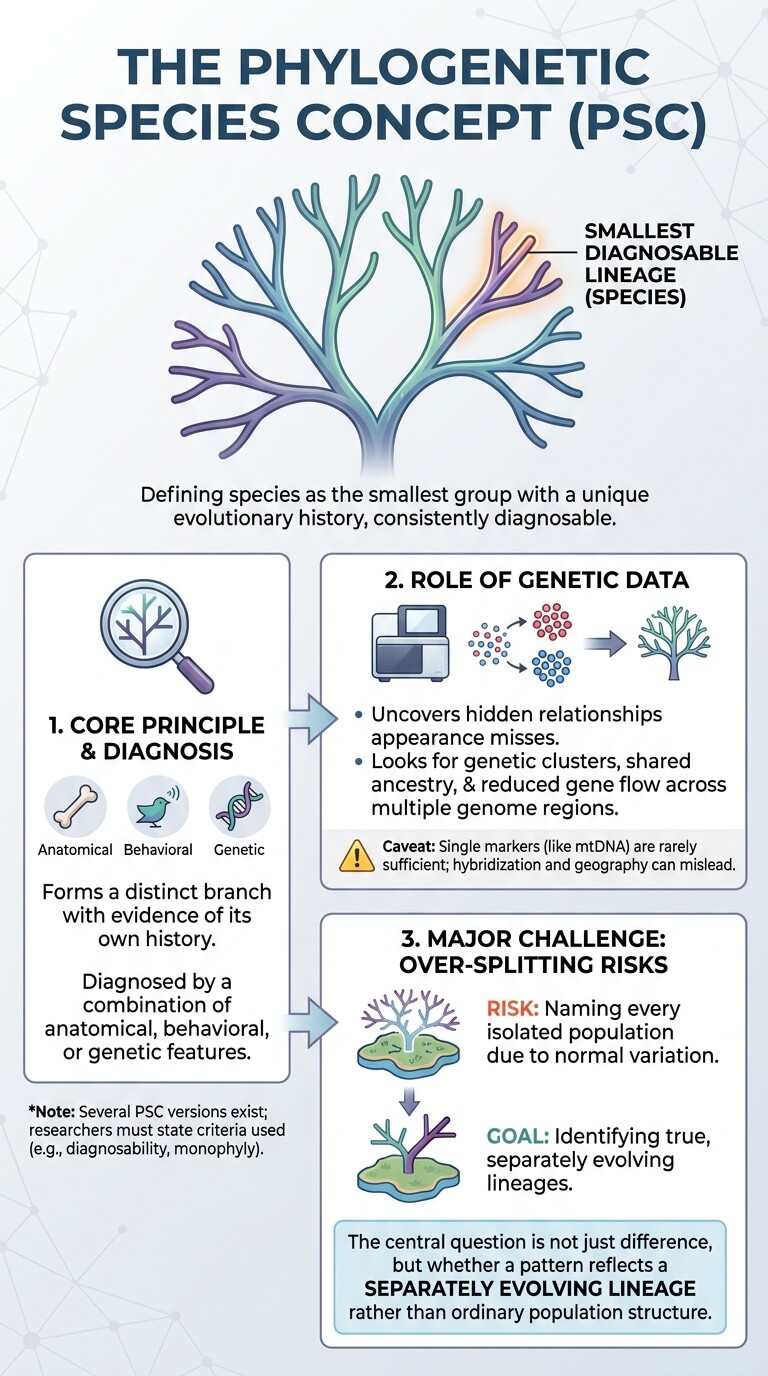
The smallest diagnosable evolutionary lineages
Phylogenetic approaches identify species as the smallest lineages that can be consistently diagnosed and placed on an evolutionary tree. A diagnostic feature might be anatomical, behavioral, genetic, or a combination. The central question is whether the population forms a distinct branch with evidence of its own history. Species concepts are ultimately attempts to describe independently evolving branches within animal evolution.
There are several versions of the phylogenetic species concept, so the phrase does not refer to one universally applied test. Some treatments emphasize diagnosability, others monophyly, and others the smallest exclusive lineage. Researchers must state which criteria they used.
Genetic data and shared ancestry
DNA can uncover relationships that appearance alone misses. Scientists compare many individuals and, increasingly, many regions of the genome. They look for genetic clusters, shared ancestry, reduced gene flow, and consistent differences across independent genes.
A single DNA sequence can be useful for identification, but it rarely settles a difficult species boundary by itself. Mitochondrial DNA follows only one part of an animal’s ancestry and can cross species boundaries through hybridization. Population structure caused by distance can also resemble species separation unless geography and broader sampling are considered.
Risks of splitting populations too finely
Every population contains genetic variation, and isolated populations gradually accumulate differences. If any diagnosable genetic difference were enough, nearly every remote island or valley population could be named separately. Taxonomists therefore ask whether a pattern reflects a separately evolving lineage rather than ordinary population structure.
Ecological and Evolutionary Species Concepts
Ecological niches and adaptation
An ecological species concept emphasizes the niche a lineage occupies, including the resources it uses, conditions it tolerates, predators it faces, and role it plays in an ecosystem. Populations adapted to different niches may remain distinct even where their ranges overlap.
Ecological differences are most persuasive when they are stable and connected to reduced gene flow. A change in food alone does not automatically create a new species. Scientists look for linked differences in timing, habitat choice, physiology, mating, or survival that maintain separate evolutionary paths.
Independent evolutionary trajectories
Evolutionary species concepts focus on lineages that maintain their identity through time and have their own tendencies and historical fate. This view can be applied broadly to sexual, asexual, living, and fossil organisms, although testing independence requires different evidence in each case.
When these concepts clarify ambiguous cases
Ecological and evolutionary evidence is valuable when direct breeding data are missing or incomplete. Two island populations might never meet, but consistent differences in habitat, morphology, genomes, and ancestry may support recognition as separate species. An asexual lineage may be diagnosable and ecologically stable even though interbreeding cannot define it.
These concepts do not eliminate judgment. Researchers still need representative samples, appropriate analyses, and comparisons with related groups. The goal is a conclusion that best explains the full pattern, not the concept that produces the largest or smallest number of species.
Evidence Scientists Combine
Mating behavior and reproductive compatibility
Courtship signals help animals recognize appropriate mates. Researchers may test responses to songs, visual displays, pheromones, electric signals, or breeding colors. They also observe whether mixed pairs form naturally and whether hybrids survive and reproduce.
Behavior can change quickly, and learned signals require careful interpretation. A song difference may restrict mating in one population but not another. Experiments are strongest when combined with field observations and genetic evidence of reduced exchange.
DNA and genomic patterns
Genetic analyses can estimate relationships, reveal contact and hybridization, and distinguish long-isolated lineages. Modern genomic studies examine thousands or millions of positions rather than relying on one marker. They can show whether most of the genome remains distinct even when a few genes cross a boundary.
There is no universal DNA percentage that defines animal species. Rates of genetic change differ among lineages, and the amount of variation within a species can overlap with the distance between young species. Genetic thresholds can flag candidates for study, but they are not a universal verdict.
Anatomy, coloration, calls, and chemistry
Taxonomists compare visible and hidden features, including skeletal proportions, reproductive structures, feather or scale patterns, vocalizations, defensive chemicals, and pheromones. A reliable diagnosis often uses several traits that remain consistent across age, sex, season, and location.
Small differences can matter when they influence mate recognition or ecological function. Large differences may matter less if they are simply male and female forms, juvenile and adult stages, seasonal coats, or environmentally produced variation within one species.
Geography, habitat, and ecological role
Maps help researchers test whether proposed lineages overlap, meet in narrow contact zones, or occupy separate regions. Habitat data can show whether populations use different depths, elevations, host plants, soils, temperatures, or breeding sites.
Geography must be interpreted with genes and biology. Distant populations often differ because gene flow declines with distance, even when they remain parts of one species. Dense sampling between endpoints can reveal whether the transition is abrupt or gradual.
Difficult Cases at Species Boundaries
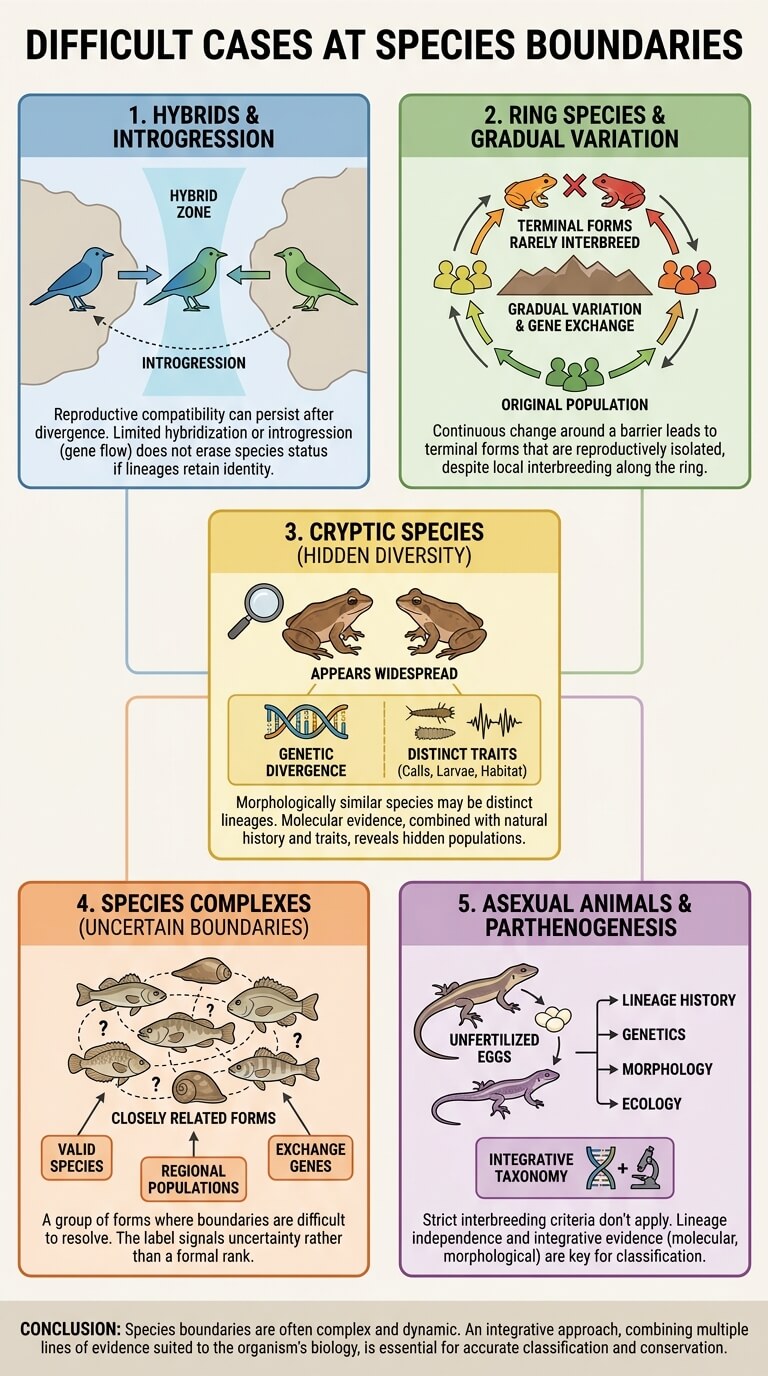
Hybrids between recognized species
Some recognized animal species produce hybrids. Hybridization may be rare, limited to a narrow zone, or followed by selection against hybrid descendants. In other cases, a small number of genes move between otherwise distinct lineages, a process called introgression.
Hybridization therefore does not automatically erase species status. A review of hybridization and the nature of species explains that reproductive compatibility can persist after divergence and that isolation commonly develops by degrees. Scientists examine whether the lineages retain their identity despite exchange.
Ring species and gradual geographic variation
A classic ring-species model begins when a population expands around a geographic barrier. Neighboring populations around the ring exchange genes, but the terminal forms meet after accumulating enough differences that they rarely interbreed. The pattern would show continuous change and a strong break in the same system.
Real examples are uncommon and often less tidy than the textbook diagram. Later genetic studies may reveal historical gaps, multiple contact events, or more complicated branching. Ring-like systems remain useful because they show how local interbreeding can coexist with large differences across a broad range.
Cryptic species that look alike
Cryptic species can remain hidden when researchers depend on easily visible traits. Genetic surveys may reveal several lineages inside one widespread name. Follow-up work then searches for differences in calls, larvae, microscopic structures, depth, habitat, chemistry, or reproduction.
DNA divergence alone should not turn every genetic cluster into a named species. The strongest conclusions combine molecular evidence with natural history and diagnostic traits. A recent review of cryptic species and conservation also highlights why hidden lineages matter: a supposedly widespread species may actually consist of smaller, more vulnerable populations.
Species complexes and recent divergence
A species complex is a group of closely related forms whose boundaries are difficult to resolve. Some may be valid species, some may represent regional populations, and some may exchange genes. The label signals uncertainty rather than a formal taxonomic rank.
Asexual animals and parthenogenesis
Parthenogenetic animals produce offspring from eggs without fertilization. Because strict interbreeding criteria cannot apply, researchers use lineage history, genetics, morphology, ecology, and long-term independence. Some parthenogenetic lineages are genetically uniform, while others contain variation created by mutation, hybrid origin, or occasional sexual reproduction.
Integrative taxonomy is especially important here. Studies of parthenogenetic mites and other animals have combined molecular, morphological, and chemical evidence rather than relying on reproductive compatibility. The same principle applies broadly: use evidence suited to the biology of the organism.
Case Studies in Species Boundaries
Birds separated by song and mate choice
Birdsong can help maintain species boundaries when individuals use it to recognize mates. In some groups, learned songs diverge after populations become separated. Preferences for familiar or lineage-specific songs can then reduce pairing when the populations meet again.
Song is not proof by itself. Plumage, genetics, geography, and actual pairing patterns also matter. Research on genes, song, and the origin of bird species shows how vocal and visual signals can contribute to reproductive isolation while also illustrating that speciation mechanisms differ among bird lineages.
Insects separated by host plant or chemical signals
Plant-feeding insects may mate on or near the plants where they feed and lay eggs. A shift to a new host can change where mates meet, which odors they follow, and when adults emerge. These ecological differences can reduce gene flow even when the populations live in the same region.
Apple maggot flies provide a well-studied example of early divergence. Apple-associated and hawthorn-associated flies prefer odors from their respective host fruits, and mating occurs near those fruits. Experiments on fruit odor discrimination in apple maggot flies found that host preference creates a premating barrier, although the populations are commonly discussed as host races in an ongoing divergence process rather than a simple finished split.
Marine animals revealed as cryptic lineages
The ocean can hide species boundaries because many small animals have few obvious external features and may disperse across large areas. A single named hydrozoan, sea slug, crustacean, or worm may later prove to contain multiple genetic lineages with different ranges or depth preferences.
Researchers first detect candidate lineages with DNA, then examine specimens, ecology, geography, and life history for independent support. Formal description remains important. An unnamed sequence cluster is evidence for investigation, not automatically a complete species account that other scientists can identify in the field.
Common Mistakes and Myths
A fixed DNA percentage does not define every species
DNA barcoding often compares a standardized gene region and can be excellent for matching unknown samples to known species. It can also flag unexpectedly deep divisions. The same percentage cutoff cannot be applied universally because mutation rates and within-species variation differ among animal groups.
A threshold that works reasonably well in one set of insects may split ordinary populations in another group or merge recently separated species elsewhere. Strong studies compare the unknown animals with close relatives and add other evidence.
Ability to hybridize does not automatically erase species status
Lions and tigers can produce hybrids in captivity, and many wild birds, fish, mammals, and insects hybridize under some conditions. The important question is not whether one hybrid is possible. It is whether gene flow is common enough to prevent the lineages from remaining distinct.
Captive crosses remove natural barriers such as distance, habitat, season, and mate choice. They can demonstrate biological compatibility, but they do not recreate the full ecology of wild populations.
Visible difference alone is not always enough
Strong color or size differences can occur within one species because of sex, age, season, diet, temperature, or geography. At the same time, separate species may look almost identical. Appearance must be interpreted in a population context.
A responsible species diagnosis asks whether traits are consistent, inherited, and associated with other evidence of lineage separation. Naming a species from one unusual individual without ruling out variation, injury, or developmental abnormality creates a high risk of error.
Why Species Decisions Matter
Biodiversity counts and ecological research
Species are common units for counting biodiversity, mapping ranges, studying food webs, and comparing communities. Changing one widespread species into several narrower species can alter estimates of local diversity and reveal ecological differences that were previously averaged together.
Accurate boundaries also improve research. If two lineages respond differently to temperature, disease, predators, or habitat loss, treating them as one may hide important patterns.
Conservation priorities and legal protection
Taxonomy can affect conservation because laws, assessments, recovery plans, and trade controls often use species names. Splitting a widespread name may reveal that one lineage has a very small range. Merging names may show that populations are more connected than previously thought.
Taxonomic change does not automatically determine legal status, and naming more species is not a substitute for protecting populations and habitats. Decisions should be transparent, well sampled, and cautious because both over-splitting and under-recognition can redirect limited conservation resources.
Communication, databases, and field identification
A scientific name lets researchers connect observations, museum specimens, genetic sequences, laws, and published studies. When boundaries change, databases must track accepted names and synonyms so older information is not lost.
How Species Fits Into Animal Classification
Where species sits in the taxonomic hierarchy
Species is usually the most specific rank in the familiar sequence of kingdom, phylum, class, order, family, genus, and species. Closely related species may share a genus, while genera are grouped into families. The rank tells readers where a named lineage sits, but the evidence discussed above determines where its boundary is drawn. The species rank sits below genus, family, and order in the taxonomic hierarchy.
How subspecies describe variation below species level
A subspecies is a named geographic or evolutionary subdivision within a species. Its populations are considered distinct enough to recognize, but not separate enough under the chosen treatment to receive full species status. The rank is used unevenly among animal groups and can be controversial.
Species and subspecies are not simply different amounts of visible difference. Researchers consider geographic structure, gene flow, diagnosability, evolutionary history, and the standards used for that group.
How new species are formally described after evidence is assembled
Evidence for a separate lineage is only part of the process. Taxonomists compare prior literature and specimens, prepare a diagnosis, select or designate a name-bearing type specimen, follow zoological naming rules, and publish the description in a permanent scientific work.
A genetic study may identify a candidate species before formal description. Until the lineage is named and diagnosed, connecting it reliably to field records, museum material, and conservation rules can be difficult.
FAQ
Is there one universal definition of species?
No single operational definition works for every animal. Reproductive isolation is valuable for many living sexual species, morphology is essential for fossils and specimen identification, and phylogenetic, ecological, and evolutionary evidence can reveal lineages that other tests miss. Scientists often combine these approaches.
Can two recognized animal species produce offspring?
Yes. Some recognized species hybridize, especially where closely related lineages meet or in captivity. The existence of hybrids does not by itself show that the parents are one species. Researchers examine hybrid fertility, survival, frequency, gene flow, mate choice, habitat, and whether the parental lineages remain distinct. A proposed lineage does not receive a formal name until scientists document and describe it as a new species.
Why are asexual animals difficult to classify as species?
The biological species concept depends on interbreeding and reproductive isolation, so it cannot be applied directly to strictly asexual animals. Scientists instead examine whether asexual lineages are independently evolving and consistently distinguishable through genetics, morphology, ecology, chemistry, or other evidence. Deciding species boundaries is one specialized part of how animals are classified.
Can fossils be assigned to species?
Yes, but fossil species are usually recognized mainly through morphology, geological age, and location. Paleontologists compare repeated anatomical patterns while accounting for growth, sex, individual variation, deformation, and incomplete preservation. They cannot normally test mating behavior or gene flow directly, so the conclusion remains tied to the evidence fossils preserve.
Final Thoughts
What makes an animal a species is not one visible trait, one mating test, or one DNA percentage. A species is best understood as a lineage with its own evolutionary identity, supported by the strongest evidence available for that animal. Reproduction, genes, anatomy, behavior, ecology, and geography each reveal part of the pattern.
The difficult cases are not failures of biology. They reflect evolution in progress, incomplete records, and the many ways animal populations become separated. By combining evidence and stating uncertainty clearly, scientists can draw species boundaries that are useful, testable, and open to revision when better information appears.

Ethan Walker is the founder and research editor of Animal Fact Central. He creates and reviews educational animal facts content using trusted wildlife, pet care, and science-based sources. His work focuses on making animal behavior, adaptations, habitats, and species facts clear, accurate, and engaging for everyday readers.
Read More Details About Ethan Walker: https://animalfactcentral.com/ethan-walker/