
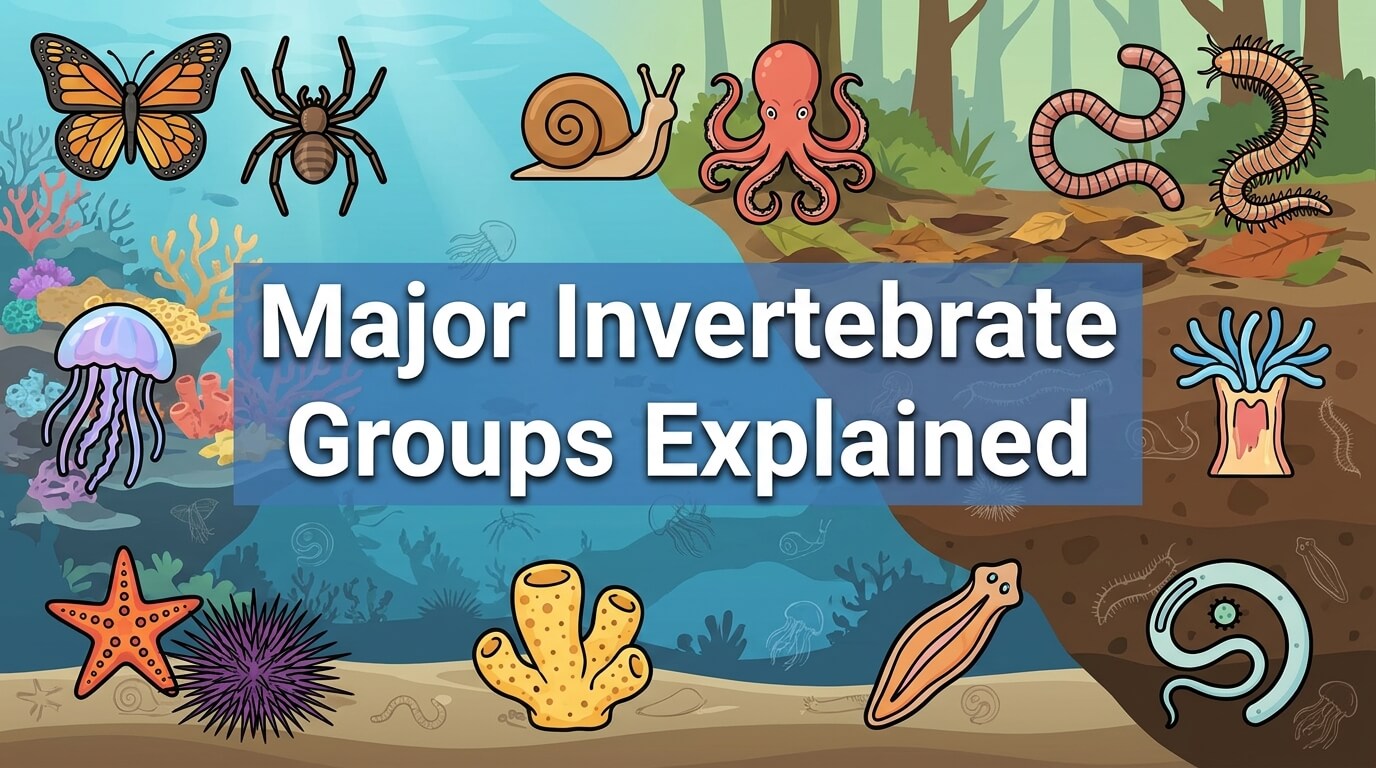
Invertebrates are animals without a vertebral column, but that simple definition covers an extraordinary range of bodies. A butterfly, an octopus, an earthworm, a jellyfish, and a sea star are all invertebrates, yet they move, feed, sense their surroundings, and reproduce in very different ways. Understanding the major invertebrate groups means looking beyond the missing backbone and comparing the body plans that make each lineage distinctive.
Scientists recognize many invertebrate phyla, which are broad branches of animal classification. The Smithsonian’s Department of Invertebrate Zoology studies roughly 30 major invertebrate phyla, illustrating how much animal diversity lies outside the vertebrates. This guide focuses on the groups readers are most likely to encounter in classrooms, gardens, freshwater habitats, and oceans.
Quick Overview
Invertebrates include most animal diversity
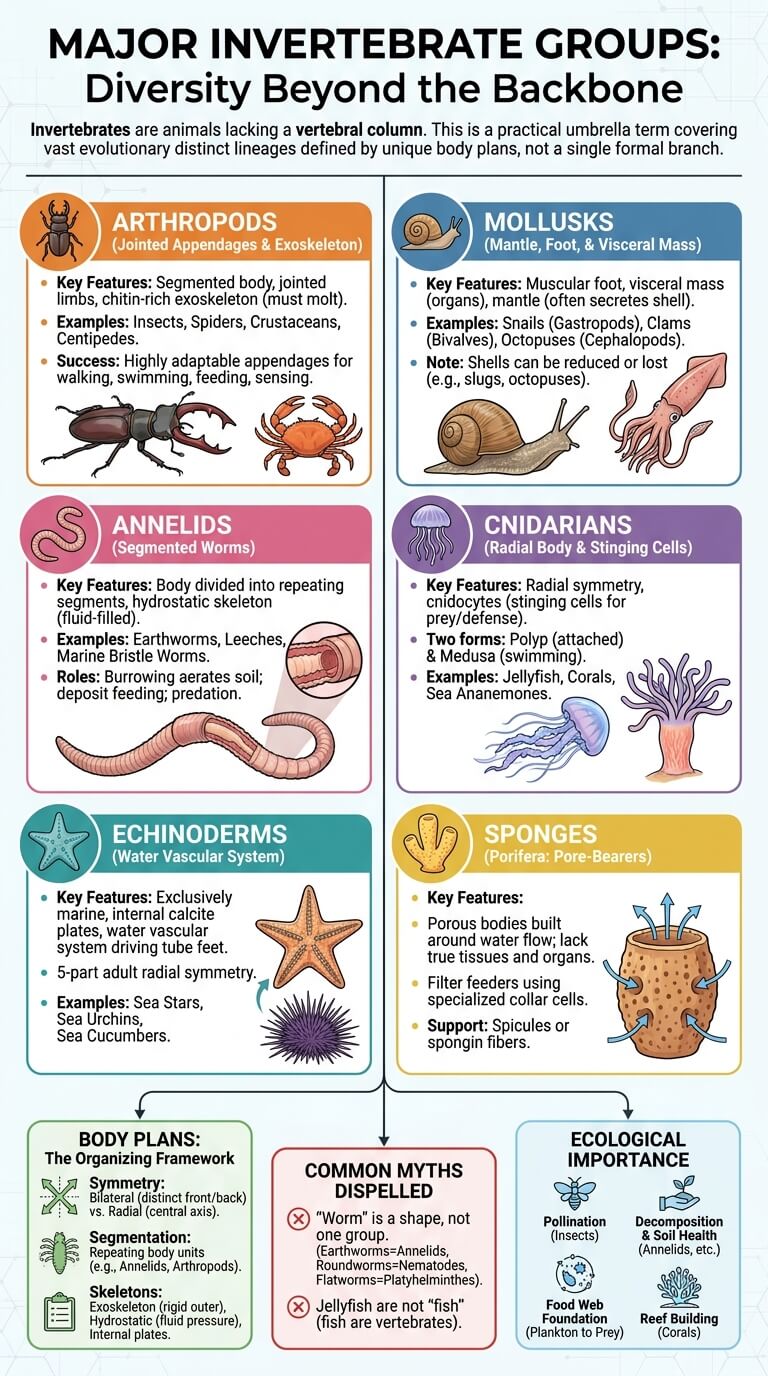
Most named animal species are invertebrates. Arthropods alone include insects, spiders, crustaceans, centipedes, and many other forms. Mollusks range from nearly motionless clams to active, visually guided octopuses. Other phyla include animals that filter water, burrow through soil, drift in the plankton, build reefs, hunt with stinging cells, or crawl across the seafloor on hydraulic tube feet.
This diversity matters because invertebrates perform much of the daily work of ecosystems. They pollinate plants, recycle dead material, aerate soil, filter water, form reefs, control prey populations, and feed countless fish, birds, reptiles, amphibians, and mammals. Some are parasites or agricultural pests, but many others are predators, decomposers, grazers, engineers, and essential links in food webs.
Why invertebrate is not one formal branch
“Invertebrate” is a practical umbrella term, not one natural branch containing a single common ancestor and all of its descendants. Vertebrates are nested within the broader animal family tree, while the animals called invertebrates occupy many separate branches around them. In other words, an octopus is not closely related to a butterfly simply because neither has a backbone. Animal evolution and common ancestors explain why arthropods, mollusks, cnidarians, echinoderms, and sponges occupy separate branches.
This is why zoologists organize invertebrates by phyla and evolutionary relationships rather than treating them as one equivalent group beside vertebrates. Molecular evidence has also changed several older ideas. For example, arthropods are now grouped more closely with molting animals such as nematodes than with segmented annelid worms.
How body plans provide a useful organizing framework
A body plan is the basic structural arrangement of an animal. Useful features include symmetry, number of embryonic tissue layers, presence or absence of a body cavity, segmentation, type of skeleton or support, digestive layout, and nervous-system organization. These traits help explain what an animal can do and how its ancestors are related to other groups. Scientists distinguish these lineages using the same types of evidence that explain how animals are classified.
How to Compare Invertebrate Groups
Symmetry and body layers
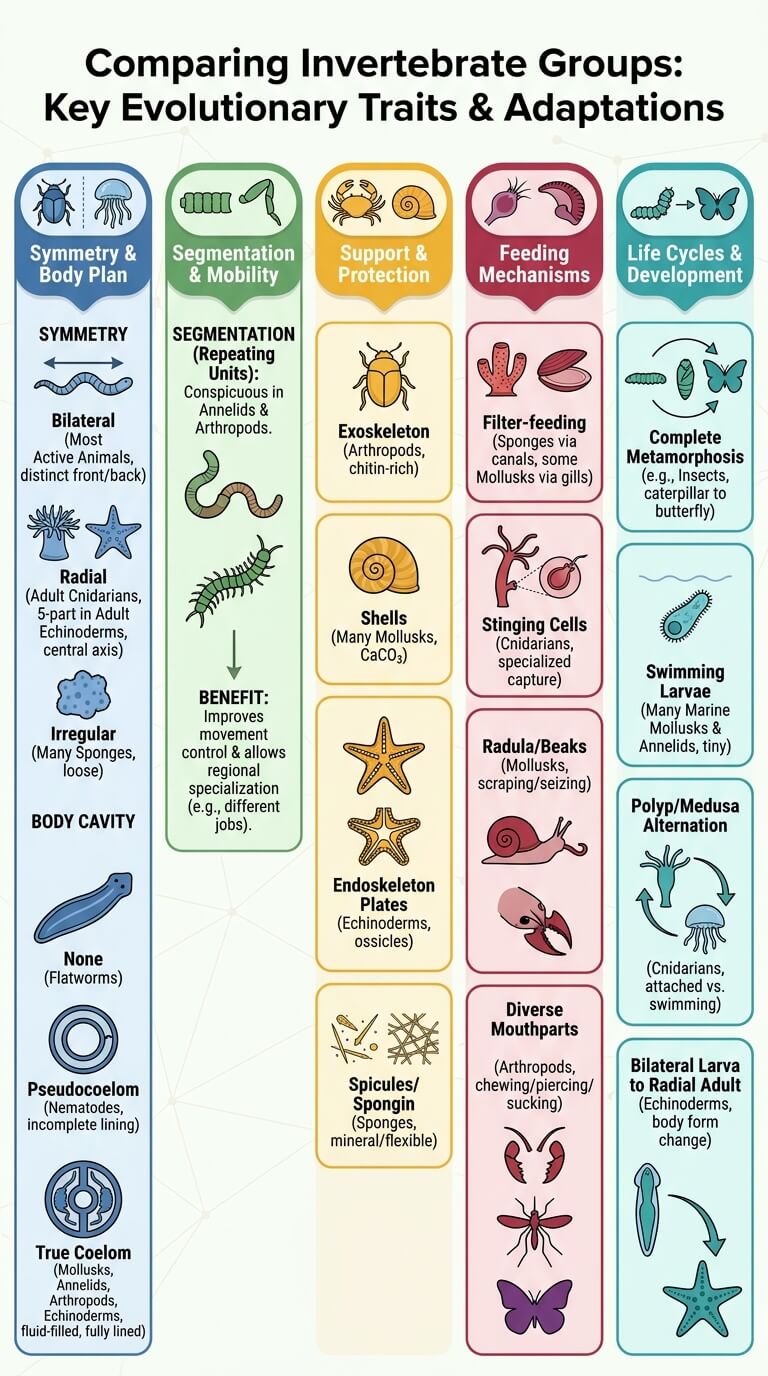
Symmetry describes how body parts are arranged. Many active animals have bilateral symmetry, with left and right sides and a distinct front end. Adult cnidarians often show radial symmetry around a central axis. Adult echinoderms usually have five-part radial organization, even though their larvae are bilateral. Many sponges are irregular or only loosely symmetrical.
Segmentation and body cavities
Segmentation means repeating body units occur along an animal’s length. It is conspicuous in annelid worms and arthropods, although the segments may become specialized or fused. Segmentation can improve control of movement and allow different body regions to perform different jobs.
A body cavity is a fluid-filled space between the digestive tract and body wall. Its arrangement influences organ support and movement. Flatworms lack a true body cavity, nematodes have a cavity not completely lined by mesoderm, and groups such as mollusks, annelids, arthropods, and echinoderms have a true coelom, although it may be reduced or modified.
Skeletons, shells, and support
Animals without backbones are not necessarily soft or unsupported. Arthropods have an external skeleton, usually rich in chitin. Many mollusks secrete calcium carbonate shells. Echinoderms have internal plates called ossicles. Sponges may be supported by mineral spicules, flexible spongin fibers, or both.
Feeding, movement, and nervous systems
Feeding structures are equally varied. Sponges pump water through canals. Cnidarians capture prey with specialized stinging cells. Mollusks may scrape surfaces with a radula, filter particles with gills, or seize prey with arms and beaks. Arthropod mouthparts can be adapted for chewing, piercing, sucking, filtering, or cutting.
Larval development and life cycles
Many invertebrates change body form during development. Caterpillars become butterflies through complete metamorphosis. Many marine mollusks and annelids have tiny swimming larvae. Cnidarians may alternate between attached polyps and swimming medusae. Echinoderm larvae look bilaterally symmetrical before transforming into radially organized adults.
Arthropods
Jointed limbs, segmented bodies, and exoskeletons
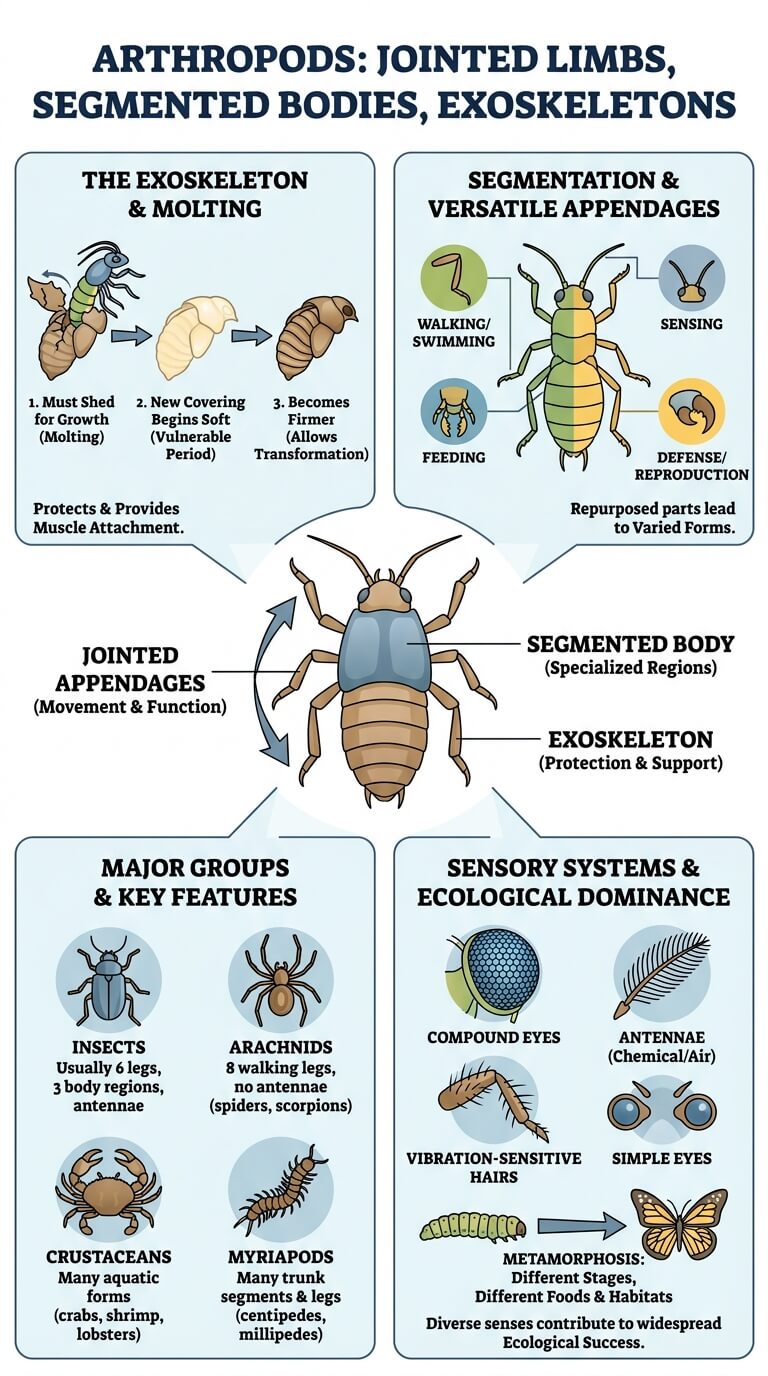
Arthropods are defined by jointed appendages, a segmented body, and an exoskeleton. The external covering protects the animal and provides attachment points for muscles. Because it cannot simply expand as the animal grows, it must be shed during molting. The new covering begins soft and becomes firmer after the arthropod emerges.
The Animal Diversity Web overview of arthropods describes how segments may fuse into specialized regions and how appendages can be modified for walking, swimming, feeding, sensing, reproduction, or defense. This ability to repurpose repeated parts is one reason arthropods have evolved such varied forms.
Insects, arachnids, crustaceans, and myriapods
Insects usually have six legs, three main body regions, and one pair of antennae. Arachnids include spiders, scorpions, ticks, and mites; adults commonly have eight walking legs and no antennae. Crustaceans include crabs, shrimp, lobsters, barnacles, krill, and many tiny aquatic forms. Myriapods include centipedes and millipedes, with many trunk segments and many legs.
Molting, sensory systems, and ecological dominance
Molting creates a temporary vulnerable period, but it also allows major transformations. In insects with complete metamorphosis, the larval and adult stages can use different foods and habitats. Arthropod senses may include compound eyes, simple eyes, vibration-sensitive hairs, antennae, chemical receptors, and organs that detect air or water movement.
Mollusks
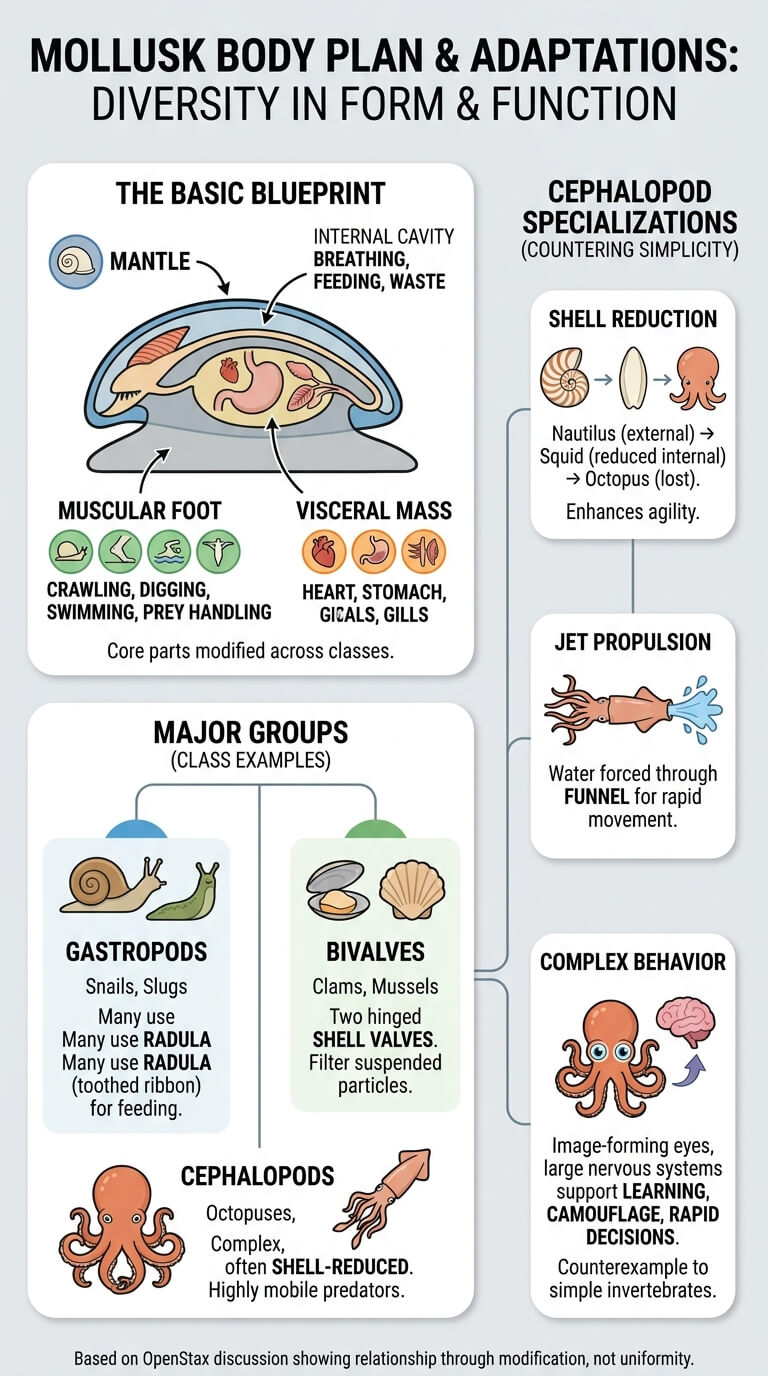
Mantle, muscular foot, and visceral mass
The basic mollusk body includes a mantle, a muscular foot, and a visceral mass containing many internal organs. The mantle is a tissue layer that may secrete a shell and forms a cavity involved in breathing, feeding, or waste removal. The foot can be shaped for crawling, digging, clinging, swimming, or handling prey.
Gastropods, bivalves, and cephalopods
Gastropods include snails, slugs, limpets, and nudibranchs. Many use a toothed feeding ribbon called a radula, although diet and feeding anatomy vary. Bivalves such as clams, mussels, oysters, and scallops have two shell valves and commonly filter suspended particles from water. Cephalopods include octopuses, squids, cuttlefish, and nautiluses.
OpenStax’s discussion of mollusks and annelids shows how the molluscan foot and mantle are modified across these classes. The comparison is useful because it reveals relationship without implying that all mollusks look or live alike.
Shell reduction, jet propulsion, and complex behavior
A shell is common among mollusks but not universal. Slugs and nudibranchs have reduced or lost the external shell. Octopuses lack an external shell, squids retain a reduced internal support, and cuttlefish have a cuttlebone. Nautiluses retain a chambered external shell.
Cephalopods move water through a funnel for jet propulsion and use arms or tentacles to manipulate objects and capture prey. Their nervous systems and image-forming eyes support flexible behavior, learning, camouflage, and rapid decisions. These abilities make them a clear counterexample to the idea that invertebrates must be behaviorally simple.
Annelids
Segmented worms and hydrostatic skeletons
Annelids are segmented worms. Their bodies contain repeating units, but internal partitions and specialized regions make them more than a chain of identical rings. Fluid-filled compartments act as a hydrostatic skeleton, while circular and longitudinal muscles change body shape to produce crawling, burrowing, or swimming movements.
Earthworms, leeches, and marine bristle worms
Earthworms are familiar terrestrial annelids that consume organic-rich material and mix soil as they burrow. Leeches include predators, scavengers, and species that feed on blood or other body fluids. Marine bristle worms, often called polychaetes, are especially diverse and may have paired appendages bearing bristles along many segments.
Not every long, soft animal is an annelid. Flatworms, roundworms, ribbon worms, and many insect larvae have worm-like bodies but belong to different lineages. The word “worm” describes shape more often than close relationship.
Burrowing, decomposition, predation, and filtration
Burrowing annelids move and oxygenate sediments, affecting the organisms and microbes around them. Deposit feeders process material containing organic particles. Tube-dwelling species may extend feathery structures to filter food from water, while mobile hunters use jaws or an eversible throat to seize prey.
Cnidarians
Radial body plans and stinging cells
Cnidarians include jellyfish, corals, sea anemones, and hydroids. Most are aquatic, and nearly all are marine. Their defining cells are cnidocytes, which contain structures called nematocysts. When triggered, a nematocyst can discharge a tiny thread used in prey capture or defense.
The OpenStax overview of Cnidaria explains that these animals typically have radial or biradial organization and two major tissue layers. Their digestive cavity usually has a single opening that serves for both food entry and waste exit.
Jellyfish, corals, sea anemones, and hydroids
Jellyfish are free-swimming medusae with a bell-shaped body. Sea anemones are attached or slow-moving polyps. Corals are mostly colonial polyps that may secrete hard skeletons and build large reef structures over generations. Hydroids include attached colonies and forms with small medusae or specialized floating colonies.
Polyp and medusa life stages
A polyp is generally cylindrical and oriented with the mouth and tentacles upward. A medusa is usually bell-shaped and free-swimming, with the mouth directed downward. Some cnidarians alternate between these forms, while others emphasize one stage or lack the other.
Echinoderms
Water vascular systems and tube feet
Echinoderms are exclusively marine animals with an internal skeleton of calcite plates and a water vascular system. Fluid-filled canals connect to tube feet, which may contribute to movement, attachment, feeding, gas exchange, or sensing. Different groups use them in different ways.
OpenStax’s account of echinoderms among the deuterostomes describes sea stars, brittle stars, sea urchins, sea lilies, and sea cucumbers. Their developmental pattern places them closer to chordates than their adult appearance might suggest.
Sea stars, sea urchins, sea cucumbers, and relatives
Sea stars commonly move with tube feet and include predators, scavengers, and deposit feeders. Brittle stars use flexible arms for much of their movement. Sea urchins have a rigid test made from fused plates and often graze or scrape food. Sea cucumbers have elongated, softened bodies and frequently collect particles from sediment or water.
Adult radial symmetry and bilateral larvae
Most adult echinoderms show five-part radial organization, but their larvae are bilateral. During metamorphosis, the body is extensively reorganized. This developmental change is strong evidence that adult radial symmetry evolved from bilaterally symmetrical ancestors.
Sponges
Porous bodies and filter feeding
Sponges are animals built around water flow. Water enters through many small pores, moves through canals and chambers, and exits through larger openings. Choanocytes, often called collar cells, create currents and capture food particles. Other cells transport nutrients, build support structures, or contribute to reproduction and repair.
Cells without true organs
Sponges have specialized cell types but lack the true tissues and organs found in most other animals. They do not have a digestive tract, centralized nervous system, or muscles organized like those of bilaterian animals. Digestion occurs within cells after particles are captured.
Marine diversity and ecological roles
Sponges may grow as crusts, tubes, fans, branching forms, or irregular masses. Their support can include silica spicules, calcium carbonate spicules, spongin fibers, or combinations. Color and external shape alone may not identify a species because unrelated sponges can look similar.
Flatworms
Flattened bilateral bodies
Flatworms have bilaterally symmetrical bodies that are generally flattened from top to bottom. They lack a true body cavity, and most do not have specialized circulatory or respiratory systems. A thin or flattened form allows gases and dissolved materials to move over relatively short distances through tissues.
Free-living and parasitic forms
Free-living flatworms occur in marine, freshwater, and moist terrestrial habitats. They may crawl with cilia and muscles, hunt small prey, or scavenge. Parasitic forms include flukes, tapeworms, and monogeneans, many of which have attachment structures and complex life cycles involving one or more hosts.
Nervous-system organization and regeneration
Many flatworms have a concentration of nerve tissue near the front and paired longitudinal nerve cords connected by cross branches. This arrangement is more centralized than a diffuse nerve net and supports directed movement toward food or away from harmful conditions.
Roundworms
Unsegmented cylindrical bodies
Roundworms, or nematodes, have slender, unsegmented bodies that are round in cross-section. A tough outer cuticle protects the body and must be molted as the animal grows. Unlike most flatworms, nematodes have a complete digestive tract with a separate mouth and anus.
Free-living and parasitic diversity
Many nematodes are free-living members of soil, freshwater, marine sediment, and decomposing material. Others are parasites of plants or animals. Parasitic species can have highly specialized life cycles, but they represent only part of nematode diversity.
Ecological abundance in soils, water, plants, and animals
Nematodes feed on bacteria, fungi, algae, plant tissues, small animals, or host resources, depending on the species. In soils and sediments, their feeding helps move energy through microbial food webs. Predatory and omnivorous forms also influence populations of other microscopic organisms.
Other Important Invertebrate Lineages
Rotifers and microscopic aquatic animals
Rotifers are mostly microscopic animals common in freshwater, damp soils, films of water, and some marine habitats. A crown of cilia near the head can create currents that draw food toward the mouth. They have a complete digestive tract and a fluid-filled body cavity that functions in support.
Bryozoans and colonial filter feeders
Bryozoans, also called moss animals, usually form colonies made of many small units called zooids. Each feeding zooid extends a crown of ciliated tentacles called a lophophore. Colonies may form branching, encrusting, gelatinous, or lace-like structures in marine or freshwater habitats.
Tardigrades, velvet worms, and lesser-known relatives
Tardigrades are microscopic or near-microscopic molting animals with four pairs of lobed legs. Some can enter a dormant state when conditions become unfavorable, but popular claims about indestructibility are exaggerated. Survival depends on species, life stage, exposure, and whether the animal has entered the appropriate state.
Comb jellies and their distinct body plan
Comb jellies, or ctenophores, are gelatinous marine animals that swim using rows of beating cilia called comb plates. Although they can resemble jellyfish, they do not possess cnidarian stinging cells as their defining feature. Many capture prey with sticky cells called colloblasts.
Comparing the Major Groups
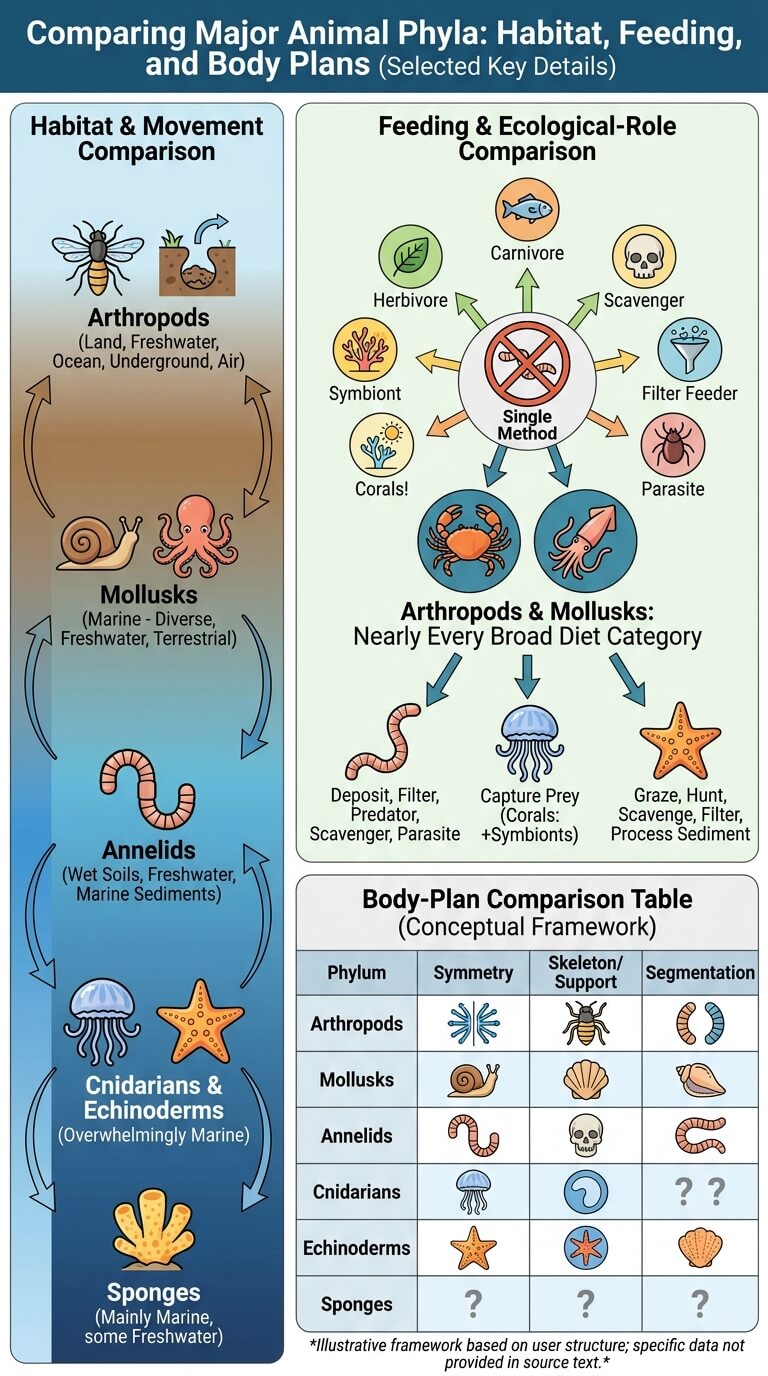
Body-plan comparison table
| Group | Key body feature | Typical support | Representative animals |
|---|---|---|---|
| Arthropods | Segmented body and jointed appendages | Chitin-rich exoskeleton | Insects, spiders, crabs, centipedes |
| Mollusks | Mantle, foot, and visceral mass | Shell, internal support, or muscular body | Snails, clams, octopuses |
| Annelids | Repeated body segments | Hydrostatic skeleton | Earthworms, leeches, bristle worms |
| Cnidarians | Radial body with cnidocytes | Hydrostatic tissues or secreted skeleton | Jellyfish, corals, anemones |
| Echinoderms | Water vascular system and adult radial form | Internal calcite ossicles | Sea stars, urchins, sea cucumbers |
| Sponges | Water-flow canal system | Spicules, spongin, or both | Tube, glass, and encrusting sponges |
| Flatworms | Flattened bilateral body | Muscles and body tissues | Planarians, flukes, tapeworms |
| Roundworms | Cylindrical unsegmented body | Cuticle and fluid pressure | Free-living and parasitic nematodes |
Habitat and movement comparison
Arthropods occur on land, in freshwater, in the ocean, underground, and in the air. Mollusks are especially diverse in marine habitats but also include freshwater and terrestrial forms. Annelids occupy wet soils, freshwater, and marine sediments. Cnidarians and echinoderms are overwhelmingly or entirely marine, while sponges are mainly marine with a smaller freshwater presence.
Feeding and ecological-role comparison
No major phylum has only one feeding method. Arthropods and mollusks include nearly every broad diet category. Annelids include deposit feeders, filter feeders, predators, scavengers, and parasites. Cnidarians commonly capture prey, although corals may also receive nutrients from symbionts. Echinoderms graze, hunt, scavenge, filter, or process sediment.
Common Mistakes and Myths
“Worm” is not one taxonomic group
Earthworms are annelids, roundworms are nematodes, and flatworms belong to Platyhelminthes. Ribbon worms, peanut worms, acorn worms, and velvet worms belong to still other lineages. The shared long body shape often reflects similar movement through sediment, water, hosts, or narrow spaces rather than close ancestry.
Jellyfish are not fish
Jellyfish are cnidarians, while true fishes are vertebrates with a skull and vertebral structures. The word “fish” in jellyfish is a historical common name, not a statement about classification. For the same reason, starfish are more accurately called sea stars, although both common names remain widely understood.
Invertebrates do not all have simple brains or simple behavior
Some invertebrates have no centralized brain, while others have complex nervous systems. Octopuses solve problems and control flexible arms. Bees learn locations and signals. Jumping spiders visually evaluate prey and routes. Behavior depends on the nervous system, sensory demands, ecology, and evolutionary history, not on the presence of vertebrae alone.
Shells and exoskeletons evolved in different ways
A snail shell is secreted by the mantle, an arthropod exoskeleton covers the body and joints, an echinoderm skeleton lies within the skin, and a sponge may use scattered spicules. These structures can all provide support or protection, but they are not the same organ inherited unchanged from one common armored ancestor.
Why Classification Can Change
Groups that look alike because of convergence
Convergent evolution occurs when unrelated lineages develop similar solutions to similar challenges. A streamlined squid and a streamlined fish both move efficiently through water, but their fins, skeletons, and ancestry differ. A coral colony and a bryozoan colony may also look alike while being built from different tissues and body plans.
Molecular evidence reshaping relationships
Modern classification combines anatomy, development, fossils, and DNA. The OpenStax review of animal classification features explains how symmetry, tissues, body cavities, developmental patterns, and molecular data contribute different evidence. DNA comparisons have been especially important where adult bodies were simplified, highly modified, or misleadingly similar.
Why smaller phyla matter despite fewer familiar species
Small or unfamiliar phyla preserve combinations of traits that help scientists test ideas about animal origins and body-plan evolution. They may also perform important local ecological roles. A lineage does not become biologically unimportant because it contains fewer named species or lacks familiar large animals.
Invertebrates in the Animal Family Tree
How invertebrates differ from vertebrates
The most direct difference is that vertebrates belong to a chordate lineage with vertebral structures, while the animals called invertebrates do not. That distinction is useful for a first comparison, but it says little about shell type, intelligence, habitat, reproduction, or ecological role. Those details require phylum-level understanding. A broad vertebrates vs invertebrates comparison is useful, but it hides the deep differences among invertebrate phyla.
How body plans organize animal diversity
Body-plan features let readers compare animals without relying on superficial resemblance. Jointed appendages identify arthropod organization. A mantle and muscular foot reveal molluscan ancestry. Cnidocytes point to cnidarians. A water vascular system identifies echinoderms. These traits connect visible anatomy to evolutionary history.
How common ancestry explains similarities among phyla
Some similarities come from inheritance, while others evolved independently. Bilateral symmetry is widespread because many phyla inherited it from ancient bilaterian ancestors. Molting links arthropods, nematodes, tardigrades, and related animals within Ecdysozoa. Other similarities, such as a shell or worm-like shape, may have appeared more than once.
FAQ
Is invertebrate a formal taxonomic group?
No. Invertebrate is a convenient descriptive term for animals that lack a vertebral column. It includes many separate evolutionary lineages rather than one formal clade. Scientists usually use phyla and more specific ranks when discussing relationships.
Which invertebrate group includes insects?
Insects belong to phylum Arthropoda. They are hexapods characterized in their adult form by three main body regions, six legs, and one pair of antennae, although wings and other features vary. Other arthropods include arachnids, crustaceans, centipedes, and millipedes.
Are jellyfish related to true fish?
They are both animals, but they belong to very different branches. Jellyfish are cnidarians with stinging cells and no backbone. True fishes are vertebrate chordates with a skull and vertebral structures. Their shared common name does not indicate close relationship.
Do all invertebrates have simple nervous systems?
No. Sponges have no nervous system, cnidarians generally have nerve nets, and many bilateral invertebrates have centralized nerve cords and ganglia. Cephalopods and many arthropods show complex sensory processing and flexible behavior. Nervous-system organization varies greatly among phyla.
Final Thoughts
The major invertebrate groups are best understood as separate evolutionary lineages, not as one collection of simple animals. Arthropods use jointed appendages and exoskeletons, mollusks modify a mantle-and-foot body plan, annelids move with segmented hydrostatic bodies, cnidarians use stinging cells, echinoderms operate a water vascular system, and sponges organize life around water flow. Flatworms, nematodes, rotifers, bryozoans, tardigrades, velvet worms, and comb jellies add still more solutions.

Ethan Walker is the founder and research editor of Animal Fact Central. He creates and reviews educational animal facts content using trusted wildlife, pet care, and science-based sources. His work focuses on making animal behavior, adaptations, habitats, and species facts clear, accurate, and engaging for everyday readers.
Read More Details About Ethan Walker: https://animalfactcentral.com/ethan-walker/