
The simplest difference between vertebrates and invertebrates is that vertebrates belong to the animal lineage with a vertebral column, while invertebrates are animals outside that lineage. A dog, eagle, frog, salmon, and snake are vertebrates. A butterfly, earthworm, octopus, sea star, coral, and sponge are invertebrates.
That quick rule is useful, but it does not tell the whole story. Invertebrates are not one uniform group, and many have sophisticated support systems, senses, movements, and behaviors. Some have hard external skeletons, some have shells or internal plates, and others use fluid pressure to hold their bodies in shape. Vertebrates also vary widely, from flexible sharks to flying birds and limbless snakes.
A careful vertebrates vs invertebrates comparison therefore looks beyond the presence of a backbone. It asks how each animal supports its body, protects its nervous system, moves, reproduces, develops, and fills a role in its environment.
Quick Difference
Vertebrates Have a Vertebral Column
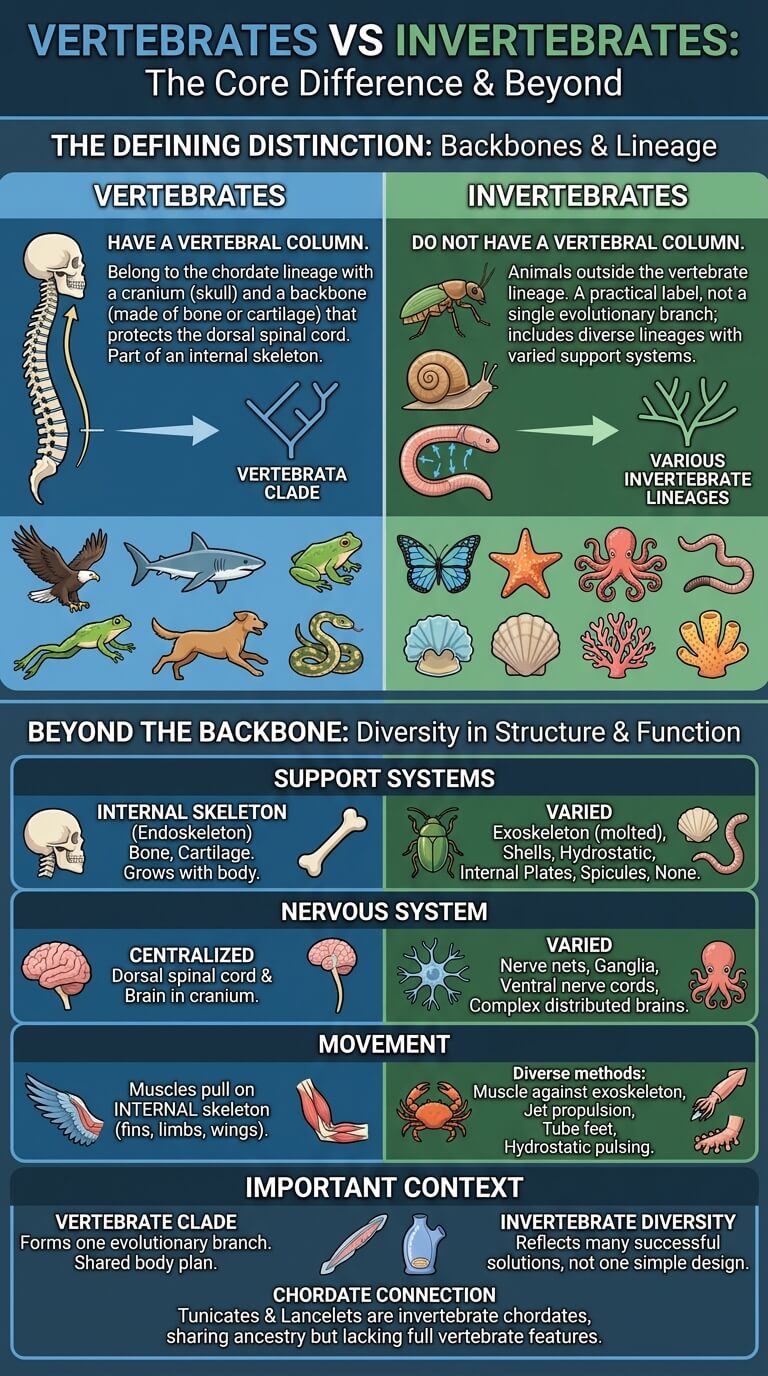
Vertebrates are chordates with a cranium and a vertebral column or its evolutionary equivalent. The cranium protects the brain, while vertebral elements form the main supporting axis around the spinal cord. In many familiar vertebrates, the column consists of repeated vertebrae made of bone or cartilage.
The backbone is part of an internal skeleton. It gives muscles firm attachment points, supports the body, and allows bending at controlled joints. It also protects major nervous tissue without making the entire body rigid.
Invertebrates Include Animals Without a Vertebral Column
Invertebrates are animals that do not belong to Vertebrata. The label includes insects, spiders, crustaceans, mollusks, segmented worms, roundworms, flatworms, jellyfish, corals, sea stars, sponges, and many other lineages. These animals differ from one another far more than a beetle differs from a whale in some aspects of body organization.
Many invertebrates have no hard internal axis at all. Others possess external armor, mineralized shells, tiny internal spicules, or fluid-filled body compartments that provide support. “No backbone” does not mean “no skeleton.”
Why Invertebrate Is a Practical Label Rather Than One Formal Clade
A clade contains a common ancestor and all of its descendants. Vertebrates form such an evolutionary branch. Invertebrates do not form one equivalent branch because the word groups together every animal lineage outside vertebrates.
Some invertebrates are closer relatives of vertebrates than they are of other animals called invertebrates. Tunicates and lancelets, for example, are chordates. Arthropods and mollusks belong to different major branches of bilaterian animals. Modern animal trees separate these lineages rather than treating all animals without backbones as one natural unit, as shown in the OpenStax overview of animal phylogeny.
Vertebrates vs Invertebrates Comparison Table
| Feature | Vertebrates | Invertebrates |
|---|---|---|
| Defining placement | Members of the vertebrate lineage within Chordata | Animals outside Vertebrata |
| Main axial support | Vertebral column associated with a cranium and internal skeleton | May use an exoskeleton, shell, hydrostatic support, internal plates, spicules, or flexible tissues |
| Nervous system | Dorsal spinal cord and a brain protected by the cranium | Ranges from diffuse nerve nets to centralized brains and distributed neural networks |
| Typical movement | Muscles pull on an internal skeleton to move fins, limbs, wings, jaws, or the trunk | Muscles may pull on an exoskeleton, squeeze fluid-filled compartments, move a muscular foot, pulse a bell, or operate tube feet |
| Growth constraint | Internal skeleton can grow with the body | Rigid arthropod exoskeletons must be molted; other support systems grow differently |
| Examples | Fishes, amphibians, reptiles, birds, and mammals | Arthropods, mollusks, annelids, cnidarians, echinoderms, and sponges |
Backbone and Skeletal Support
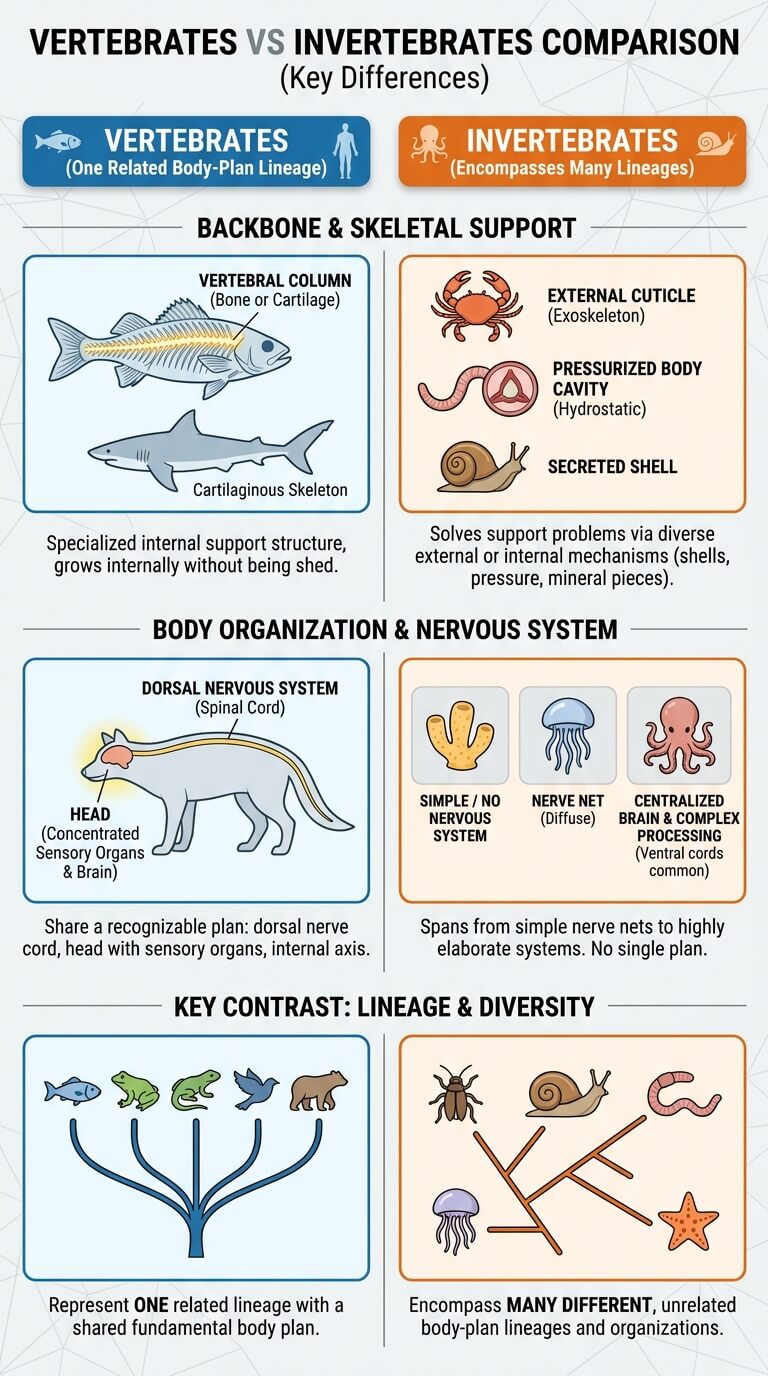
The vertebral column is a specialized internal support structure, not merely any hard material inside an animal. Vertebrates may have skeletons dominated by bone, cartilage, or mixtures of both. Sharks and rays are vertebrates even though their skeletons are primarily cartilaginous.
Invertebrates solve the same engineering problems in other ways. A crab’s external cuticle supports its limbs, an earthworm’s pressurized body cavity resists compression, a snail carries a shell secreted by its mantle, and a sea star has small mineralized pieces within its body wall.
Body Organization and Nervous System
Vertebrates share a recognizable body plan that includes a dorsal nervous system, a head with concentrated sensory organs, and an internal axis. The details can be radically modified, but the underlying arrangement remains traceable through development and anatomy.
Invertebrate organization spans many plans. A sponge lacks true organs and a nervous system. A jellyfish uses a nerve net. An earthworm has paired ganglia and a ventral nerve cord. An octopus has a large centralized brain plus extensive neural processing in its arms. One label therefore covers both very simple and highly elaborate systems.
Size, Movement, Habitats, Reproduction, and Diversity
Vertebrates include some of the largest animals, partly because internal support can grow without being shed. Yet size alone is not diagnostic. Giant squid are invertebrates, while many frogs, fishes, and lizards are smaller than common insects.
Both groups occupy marine, freshwater, terrestrial, underground, aerial, and parasitic settings. Both reproduce sexually in many cases, but invertebrates display an especially broad range of larval forms and asexual methods. The largest contrast is not that one group is capable and the other is limited. It is that vertebrates represent one related body-plan lineage, while invertebrates encompass many.
What Makes an Animal a Vertebrate?
Vertebral Column and Cranium
The vertebral column develops along the main body axis and surrounds or supports the spinal cord. The cranium encloses the brain and anchors sensory structures associated with the head. These features are linked to the evolutionary history of vertebrates, not added independently whenever an animal becomes large or active.
All vertebrates are chordates. Chordates share a notochord, a dorsal hollow nerve cord, pharyngeal structures, an endostyle or thyroid connection, and a muscular tail extending beyond the anus at some stage of development. The OpenStax description of chordate characteristics also explains why tunicates and lancelets are chordates without being vertebrates.
Internal Skeleton and Muscle Attachment
A vertebrate endoskeleton lies within living tissues and provides leverage for muscles. A muscle crossing a joint shortens and pulls one skeletal element relative to another. This arrangement can power a bird’s wing stroke, a fish’s tail beat, a frog’s jump, or a mammal’s bite.
Because the skeleton grows internally, a vertebrate does not need to shed its entire supporting structure to become larger. Bones and cartilage can be remodeled throughout life. The skeleton also stores minerals, protects organs, and changes in proportion as the animal develops.
The Vertebrate Nervous and Sensory Systems
Vertebrates have a centralized nervous system organized around the brain and spinal cord. Nerves connect that center with muscles, skin, internal organs, and sensory receptors. Vision, hearing, smell, balance, touch, electroreception, and other senses vary among lineages according to habitat and lifestyle.
This shared organization does not mean every vertebrate has the same mental abilities or sensory priorities. A shark, owl, mole, and frog process different types of information. The vertebrate plan provides a common foundation that evolution has modified in many directions.
Major Vertebrate Lineages at a Glance
Fishes include jawless, cartilaginous, and bony lineages. Tetrapods arose within the lobe-finned vertebrate branch and include amphibians and amniotes. Amniotes include mammals and the reptile lineage, with birds nested among living reptiles in evolutionary classification.
Every one of these animals is a vertebrate, but no single surface trait identifies them all. Feathers occur in birds, hair in mammals, and moist glandular skin in many amphibians. The deeper shared features are anatomical and developmental.
What Counts as an Invertebrate?
Exoskeletons, Shells, Hydrostatic Skeletons, and Other Support Systems
Invertebrates use several solutions for support. Arthropods have an exoskeleton secreted by the epidermis. Many mollusks make shells, although slugs and octopuses have reduced or lost the familiar external shell. Annelids and many other soft-bodied animals use fluid pressure working against muscles.
Biologists commonly distinguish hydrostatic skeletons, exoskeletons, and endoskeletons. These categories describe how support works, not whether an animal is advanced. The OpenStax comparison of skeletal systems shows how each design can support organs and transmit muscular force.
Major Body Plans Across Invertebrates
Sponges have porous bodies adapted for moving water through internal channels. Cnidarians such as jellyfish and corals have tissues organized around a digestive cavity and specialized stinging cells. Flatworms, roundworms, and segmented worms differ in body cavities, organ arrangements, and movement.
Mollusks share a basic plan involving a mantle, visceral mass, and muscular foot, even though a clam, snail, and squid look very different. Arthropods combine segmentation, jointed appendages, and a molting exoskeleton. Echinoderms have an internal skeleton and a water vascular system, with adults often arranged around five-part symmetry.
Why Invertebrate Animals Are Extraordinarily Diverse
The many lineages called invertebrates have had long, separate evolutionary histories. Their body plans allow them to exploit tiny soil pores, open oceans, reef surfaces, animal hosts, forest canopies, deep-sea sediments, and nearly every other environment where animals can live.
Small body size also opens ecological opportunities unavailable to large animals. A parasitic wasp can develop inside another insect, a mite can live among feathers, and microscopic roundworms can occupy films of water in soil. Invertebrate diversity reflects many successful solutions rather than one shared design.
Skeletons and Body Support Compared
Endoskeletons in Vertebrates
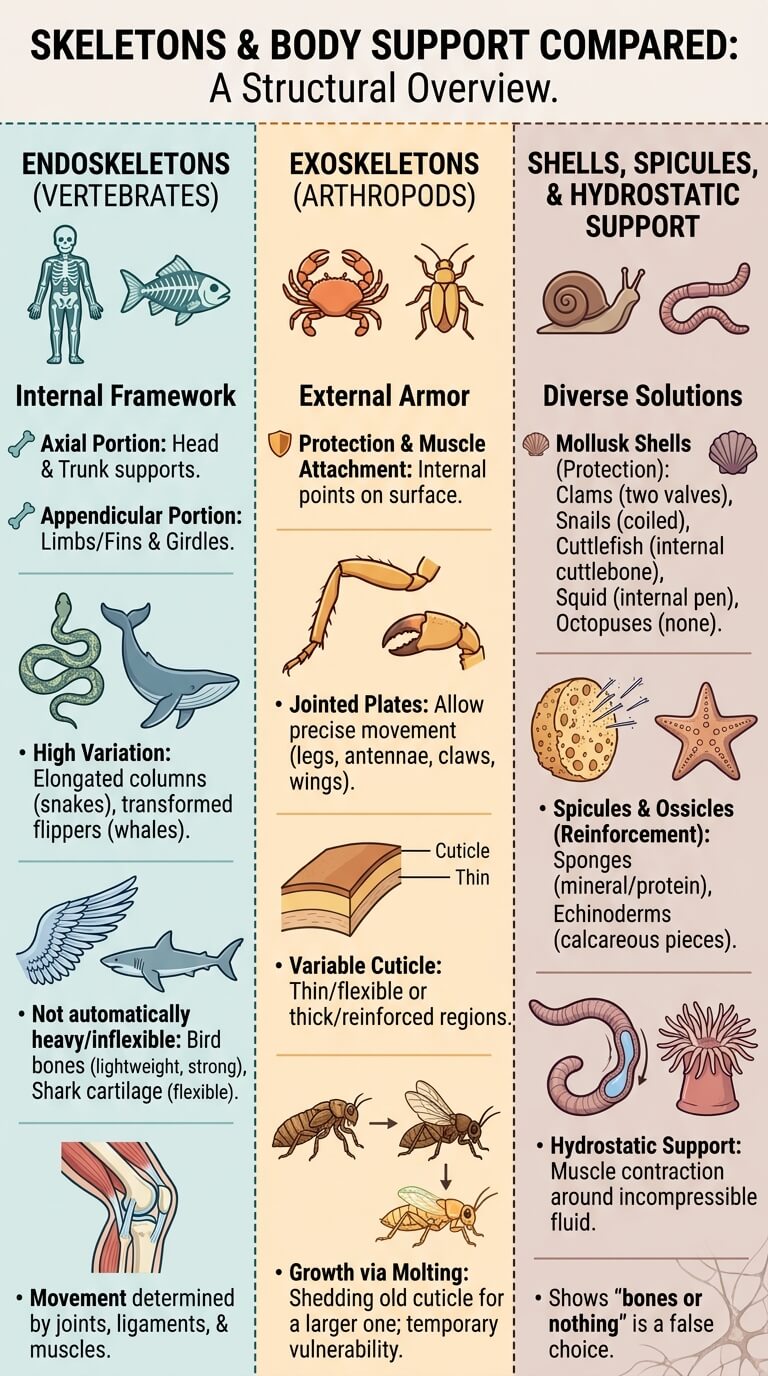
The vertebrate skeleton has an axial portion associated with the head and trunk and an appendicular portion associated with paired fins or limbs and their supporting girdles. Individual elements vary, fuse, shrink, or disappear in different lineages. Snakes have highly elongated vertebral columns, while whales have forelimbs transformed into flippers and greatly reduced external hind limbs.
An endoskeleton can support considerable mass, but it is not automatically heavy or inflexible. Bird bones combine strength with structural features suited to flight. Cartilage gives sharks flexible support. Joints, ligaments, and muscles determine how the framework moves.
Exoskeletons in Arthropods
An arthropod exoskeleton protects the surface and gives muscles internal attachment points. Jointed plates allow precise movement in legs, mouthparts, antennae, claws, and wings. The cuticle can be thin and flexible in one region and thick or reinforced in another.
A rigid exoskeleton cannot expand continuously. Arthropods grow by molting, shedding the old cuticle and forming a larger one. During part of this process, the animal may be softer and more vulnerable. Molting is a trade-off of external armor, not evidence that the design is inferior.
Shells, Spicules, and Hydrostatic Support
Mollusk shells are protective structures secreted by the mantle, but shell form varies from two valves in clams to a coiled shell in many snails. Cuttlefish retain an internal cuttlebone, squid have an internal pen, and most octopuses lack a rigid shell.
Sponges may be reinforced by mineral or protein spicules. Echinoderms have internal calcareous pieces called ossicles. Worms and sea anemones can move by contracting muscles around incompressible fluid. These examples show why “bones or nothing” is a false choice.
Movement and Nervous Systems Compared
Vertebrate Limbs, Fins, and Axial Movement
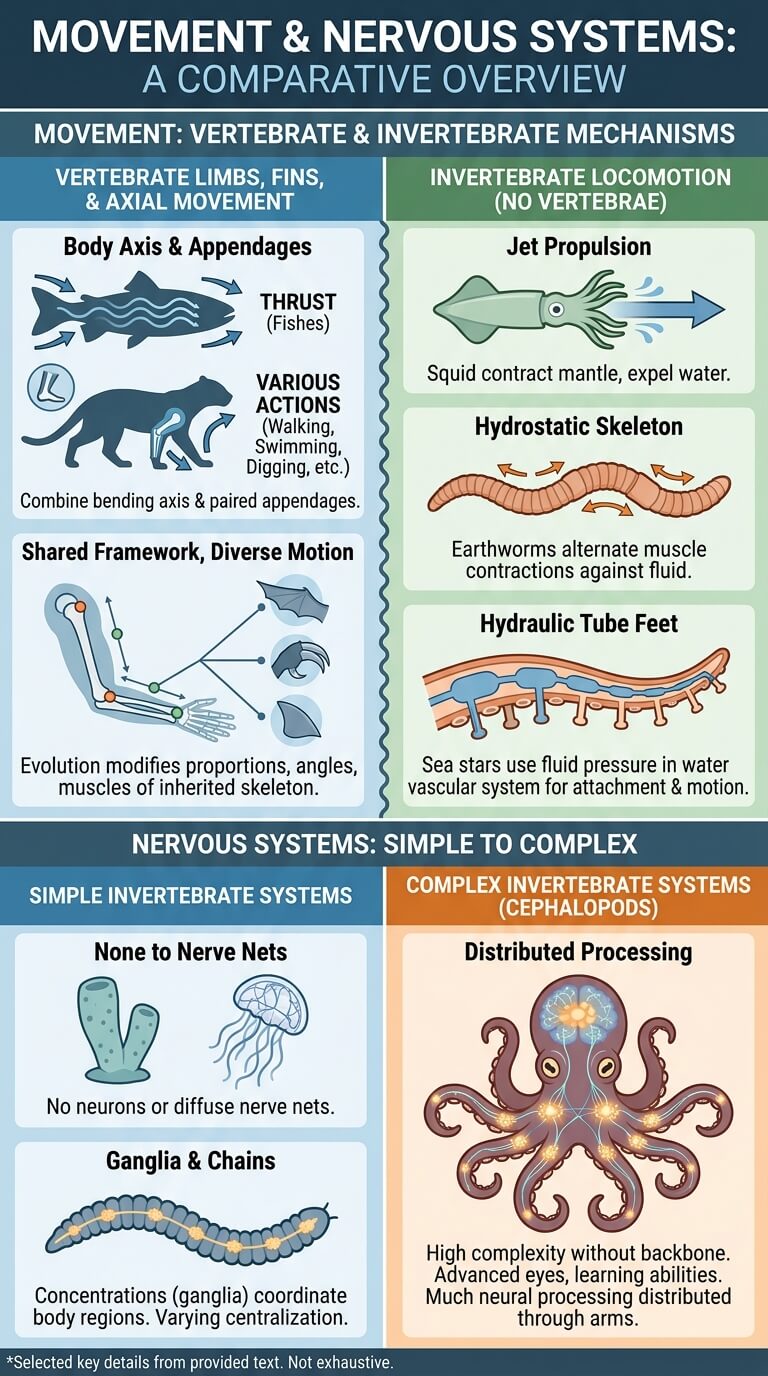
Many vertebrates move by bending the body axis, pushing with paired appendages, or combining both. Fishes generate thrust with waves passing along the trunk and tail. Tetrapods use limbs for walking, swimming, digging, climbing, gliding, or flying. Snakes use ribs, vertebrae, muscles, and contact with the ground to move without legs.
The same internal framework can therefore produce very different movements. Evolution modifies proportions, joint angles, muscle placement, and surface structures while retaining inherited skeletal relationships.
Invertebrate Locomotion From Jet Propulsion to Tube Feet
Invertebrates move in ways that do not require vertebrae. Squid contract the mantle to expel water through a funnel. Jellyfish pulse a bell. Snails glide with a muscular foot. Earthworms alternate circular and longitudinal muscle contractions against a hydrostatic skeleton.
Sea stars operate rows of tube feet connected to a water vascular system. Changes in fluid pressure extend and retract the feet for attachment, movement, and handling prey. The OpenStax account of echinoderm tube feet illustrates a hydraulic solution unlike vertebrate limbs.
Simple and Complex Invertebrate Nervous Systems
Some invertebrates have no neurons, while others have nerve nets or chains of ganglia. Ganglia are concentrations of nerve cells that coordinate particular body regions. Centralization has evolved to different degrees in separate lineages.
Cephalopods are a clear warning against equating a backbone with neural complexity. Octopuses, squid, and cuttlefish have advanced eyes, learning abilities, and highly developed nervous systems. Much of an octopus’s neural processing is distributed through its arms, a pattern described in the Smithsonian Ocean overview of cephalopods.
Habitats and Ecological Roles
Vertebrates Across Land, Freshwater, Air, and Oceans
Vertebrates occur from deep oceans to deserts and high mountains. Fishes dominate many aquatic settings, birds move through air and across continents, and mammals occupy land, water, and underground environments. Amphibians often depend on moisture, while reptiles include lineages adapted to dry land, freshwater, and the sea.
As predators, grazers, seed dispersers, scavengers, pollinators, and ecosystem engineers, vertebrates can strongly influence communities. Their roles depend on species and setting rather than on possession of a backbone alone.
Invertebrates in Nearly Every Habitat
Invertebrates inhabit seawater, fresh water, soil, leaf litter, caves, deserts, polar environments, and the bodies of other organisms. Many are too small or hidden to attract attention, yet they make up much of the animal activity in sediments, soils, plankton, and vegetation.
Some remain fixed to a surface as adults, while others fly, swim, burrow, crawl, or drift. Their distributions are shaped by moisture, temperature, oxygen, food, hosts, currents, and the physical demands of their support systems.
Pollination, Decomposition, Predation, Filtration, and Engineering
Bees, flies, beetles, butterflies, moths, and other insects pollinate plants. Earthworms and many small soil animals fragment and process organic material. Spiders, mantises, jellyfish, sea stars, and cephalopods act as predators. Bivalves, sponges, and many other aquatic animals filter particles from water.
Corals build habitat used by other organisms, termites alter soil and dead wood, and burrowing animals change sediment structure. Vertebrates also perform many of these roles, but invertebrates often operate at smaller scales and in greater numbers.
Reproduction and Development
Common Vertebrate Patterns and Exceptions
Most vertebrates reproduce sexually, but fertilization may occur inside or outside the body. Offspring may develop in eggs released into the environment, eggs retained by a parent, or within a reproductive tract supplied in different ways by the mother.
Parental care ranges from absent to prolonged. Many fishes release numerous eggs with little care, while some guard nests, brood young in the mouth, or provide other protection. Birds generally lay shelled eggs, mammals include egg-laying and live-bearing lineages, and reptiles and amphibians show their own combinations and exceptions.
Metamorphosis, Larvae, Budding, and Regeneration Among Invertebrates
Invertebrate development can include larvae that look and live differently from adults. Caterpillars become butterflies through complete metamorphosis. Many marine worms, mollusks, crustaceans, and echinoderms have planktonic larvae that later settle or transform.
Asexual reproduction also occurs in several lineages. Corals and hydras can bud, while some animals reproduce through fission or fragmentation under particular conditions. Regeneration is common in varying degrees, but regrowing a lost part is not automatically the same as producing a new individual.
Representative Examples
Mammals, Birds, Reptiles, Amphibians, and Fishes
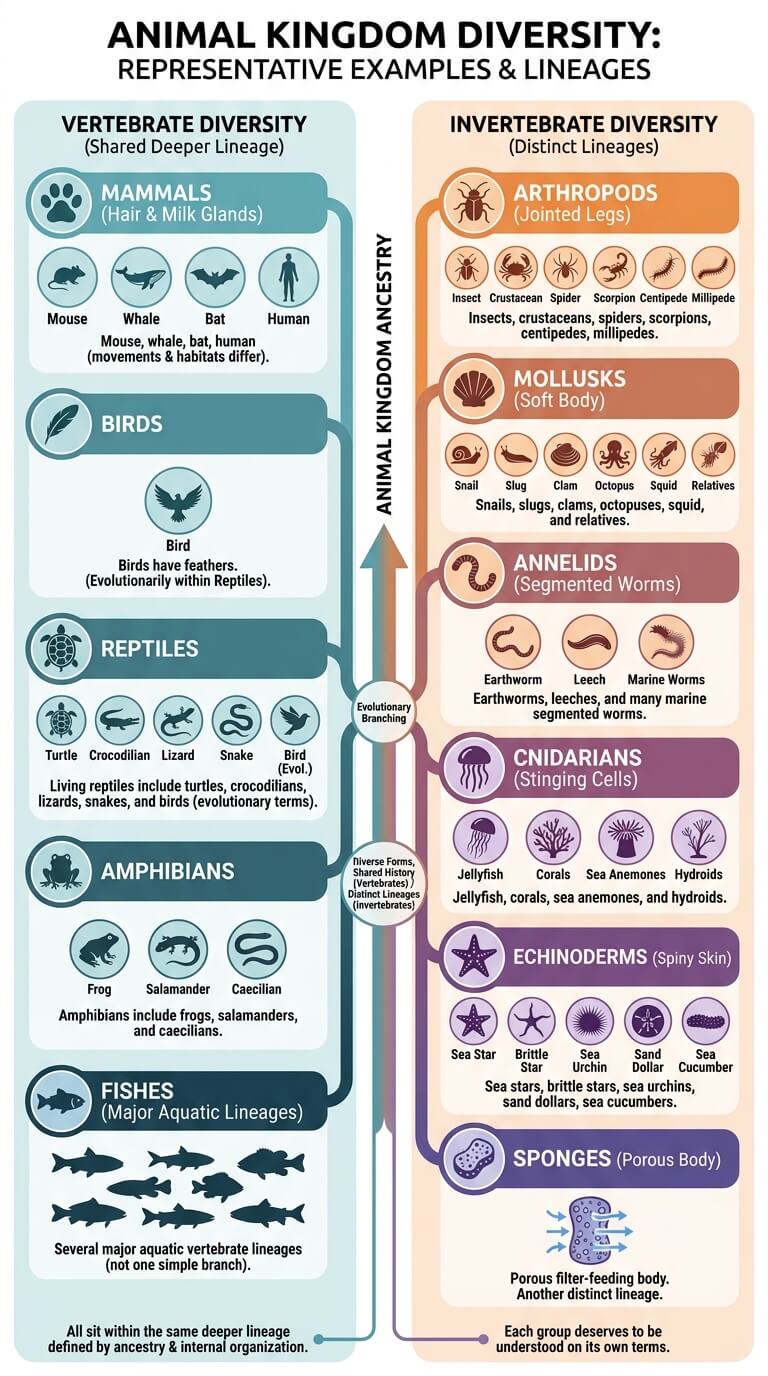
A mouse, whale, bat, and human are mammals with hair and milk-producing glands, although their movements and habitats differ. Birds have feathers. Living reptiles include turtles, crocodilians, lizards, snakes, and birds in evolutionary terms. Amphibians include frogs, salamanders, and caecilians. Fishes include several major aquatic vertebrate lineages rather than one simple modern branch.
These familiar groups are useful for recognizing vertebrate variety, but they all sit within the same deeper lineage defined by ancestry and internal organization.
Arthropods, Mollusks, Annelids, Cnidarians, Echinoderms, and Sponges
Arthropods include insects, crustaceans, spiders, scorpions, centipedes, and millipedes. Mollusks include snails, slugs, clams, octopuses, squid, and relatives. Annelids include earthworms, leeches, and many marine segmented worms.
Cnidarians include jellyfish, corals, sea anemones, and hydroids. Echinoderms include sea stars, brittle stars, sea urchins, sand dollars, and sea cucumbers. Sponges represent another distinct lineage with a porous filter-feeding body. Each group deserves to be understood on its own terms.
Common Confusions
Animals With Shells Are Not Automatically Vertebrates
A shell is a protective structure, not a vertebral column. Snails, clams, and nautiluses are mollusks and therefore invertebrates. Crabs and lobsters have hard exoskeletons but no backbone.
Turtles are different because their shell is integrated with a vertebrate skeleton, including modified ribs and vertebrae. Looking only at a hard exterior can therefore lead to the wrong conclusion.
Large Size Does Not Make an Animal a Vertebrate
Some invertebrates reach impressive sizes, especially in the ocean. Giant squid remain mollusks regardless of length. At the other extreme, tiny fishes and frogs are vertebrates because of their ancestry and anatomy.
Body size is affected by support, respiration, habitat, food, development, and evolutionary history. It is not a reliable sorting rule by itself.
Tunicates and Lancelets Complicate a Simple Backbone Story
Tunicates and lancelets share the defining developmental features of chordates but are not vertebrates. A tunicate larva has a notochord and dorsal nerve cord, although the adult may become a stationary filter feeder with a very different appearance. Lancelets retain a notochord throughout life but lack a cranium and true vertebral column.
These animals reveal that the vertebrate body plan arose within a broader chordate history. They also show why chordate and vertebrate are not interchangeable words.
Edge Cases and Exceptions
Cartilage Versus Bone
A vertebrate does not need a bony skeleton. Sharks, rays, and chimaeras have skeletons primarily made of cartilage. Lampreys also have cartilaginous supporting elements. What matters is their position within the vertebrate lineage and the organization of the cranium, nervous system, and axial support.
Likewise, an invertebrate can have hard mineralized material. Sea stars have an internal skeleton of ossicles, and many mollusks have calcium carbonate shells. Mineralization alone does not define either side.
Reduced or Flexible Skeletal Structures
Evolution can reduce structures that are no longer used in the same way. Whales retain a vertebral column while external hind limbs have been lost. Snakes have many vertebrae but no functional external legs in most species. Cartilaginous fishes maintain a flexible internal framework without replacing it with typical bone.
Hagfishes are an especially instructive case. Modern evidence places them with lampreys among jawless vertebrates, even though their vertebral elements are extremely reduced. The edge of a biological group is often clearer from ancestry and development than from one textbook feature.
Chordates That Are Not Vertebrates
All vertebrates are chordates, but not all chordates are vertebrates. Tunicates and lancelets sit outside Vertebrata. They share inherited chordate features, including a notochord during at least part of development, without possessing the full vertebrate combination of a cranium and developed vertebral column.
This distinction is valuable because it turns a yes-or-no backbone question into an evolutionary sequence. Chordate features appeared before the vertebrate skull and backbone became established in their familiar forms.
How These Groups Fit Into Animal Diversity
How the Familiar Vertebrate Groups Differ
Mammals, birds, reptiles, amphibians, and fishes can be compared by body covering, breathing, reproduction, development, habitat, and temperature regulation. Those differences explain variety within vertebrates, but they do not change the basic features that unite the lineage.
How Major Invertebrate Groups Differ From One Another
Arthropods, mollusks, annelids, cnidarians, echinoderms, and sponges differ in symmetry, segmentation, tissues, support, development, feeding, and nervous organization. Treating them as one opposing type hides these distinctions.
Where Vertebrates and Invertebrates Belong in the Animal Kingdom
Vertebrates are one branch within Chordata and one part of animal diversity. The remaining animal lineages are often described collectively as invertebrates for convenience. A modern family tree replaces the image of two equal boxes with many branching lineages, one of which contains vertebrates.
FAQ
Are Insects Vertebrates or Invertebrates?
Insects are invertebrates. They are arthropods with a chitin-containing exoskeleton, a body organized into head, thorax, and abdomen, and three pairs of legs in the adult stage. Their ventral nerve cord and external supporting system differ from the vertebrate backbone and spinal cord arrangement.
Can an Invertebrate Have a Hard Skeleton?
Yes. Arthropods have hard external skeletons, many mollusks make shells, echinoderms have internal mineralized ossicles, and sponges may contain spicules. The defining issue is not hardness. It is whether the animal belongs to the vertebrate lineage with a vertebral column and cranium.
Are Octopuses Less Complex Because They Lack Backbones?
No. Complexity cannot be ranked by one structure. Octopuses have sophisticated vision, flexible arms, learning abilities, and a highly developed nervous system arranged differently from a vertebrate brain and spinal cord. They are mollusks with an evolutionary history separate from vertebrates, not incomplete versions of them.
Are All Chordates Vertebrates?
No. Vertebrates are chordates, but tunicates and lancelets are invertebrate chordates. All share key chordate features at some life stage, including a notochord and dorsal hollow nerve cord. Vertebrates add the characteristic cranium and vertebral organization associated with their branch.
Final Thoughts
The core difference in a vertebrates vs invertebrates comparison is evolutionary and structural. Vertebrates belong to the chordate branch characterized by a cranium and vertebral column. Invertebrates include the many animal lineages outside that branch.
Backbones are only one solution to the challenges of support, protection, movement, and sensing the environment. Exoskeletons, shells, hydrostatic systems, tube feet, nerve nets, ganglia, and distributed brains show how varied the alternatives can be. Recognizing that variety prevents two common mistakes: assuming every hard-bodied animal is a vertebrate and treating animals without backbones as one simple or lesser group.

Ethan Walker is the founder and research editor of Animal Fact Central. He creates and reviews educational animal facts content using trusted wildlife, pet care, and science-based sources. His work focuses on making animal behavior, adaptations, habitats, and species facts clear, accurate, and engaging for everyday readers.
Read More Details About Ethan Walker: https://animalfactcentral.com/ethan-walker/