
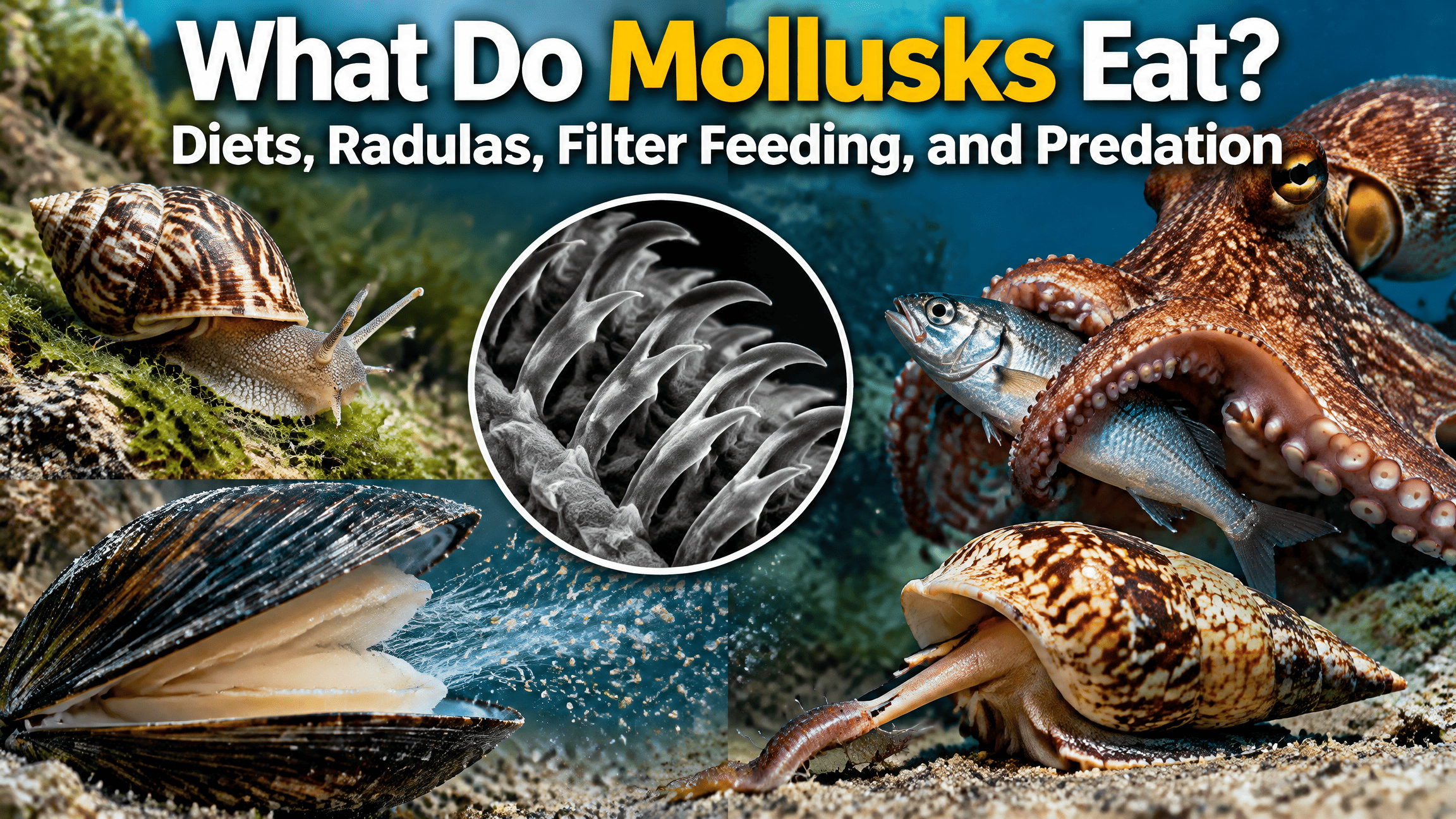
Mollusks do not share one diet. Depending on the species, a mollusk may graze algae and microbial films, collect organic particles from sediment, strain suspended food from water, scavenge dead material, bore into wood, or actively hunt other animals. The feeding tools also vary. Many mollusks use a radula, a flexible ribbon bearing rows of tiny teeth or denticles, while bivalves lack a radula and commonly rely on gills, cilia, mucus, and other structures to collect food from water or sediment.
That diversity makes the question what do mollusks eat? more interesting than a simple food list. Snails, slugs, clams, oysters, mussels, scallops, chitons, octopuses, squid, cuttlefish, nautiluses, and other mollusks occupy very different ecological roles. Understanding their diets means looking at both the food itself and the mechanism used to obtain it.
Quick Answer
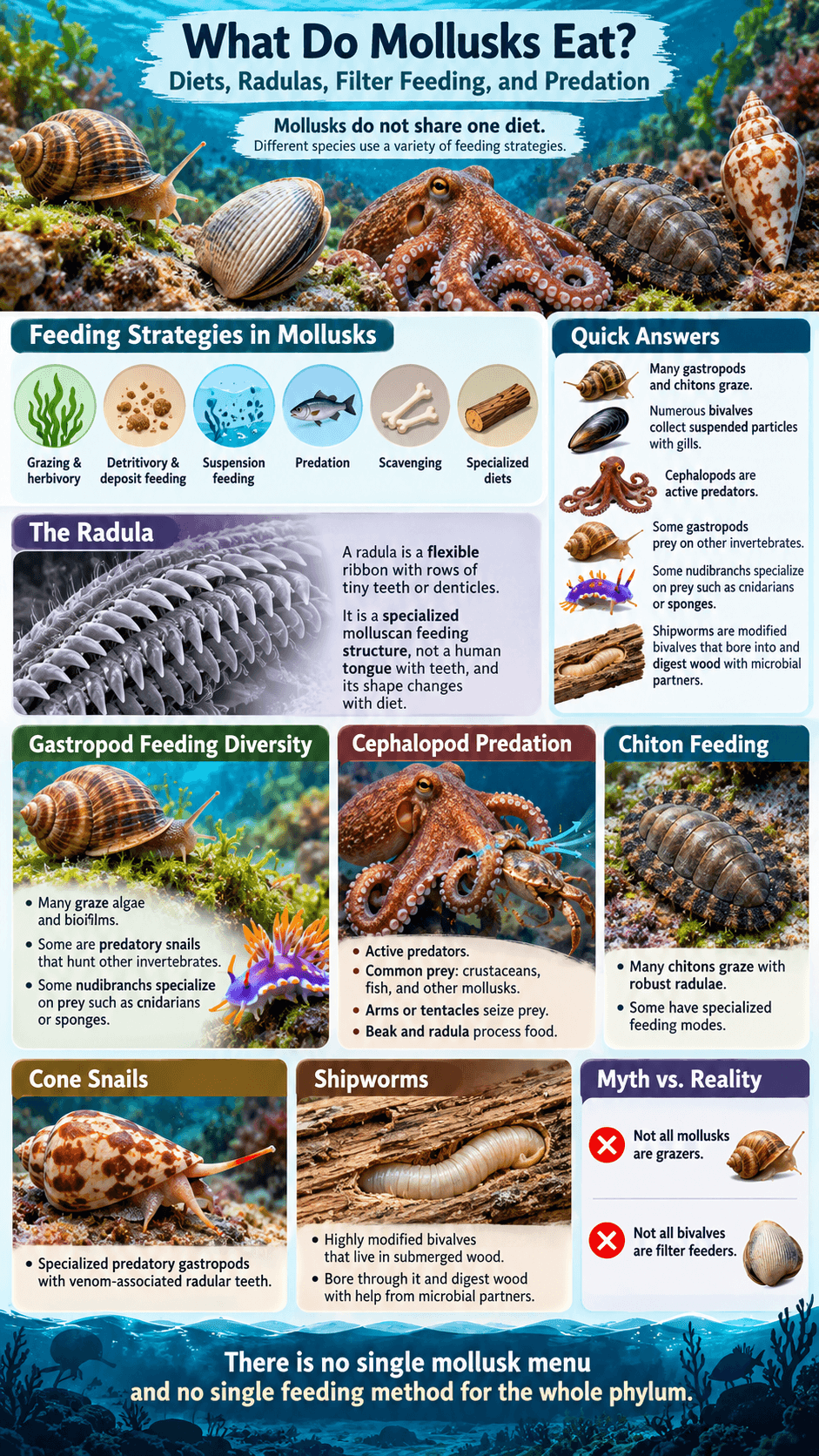
Mollusks eat an exceptionally wide range of foods. Many gastropods and chitons graze algae, biofilms, or other material from surfaces. Numerous bivalves collect suspended particles with their gills, although not every bivalve feeds the same way. Cephalopods are active predators that commonly take crustaceans, fish, and other animals. Some gastropods prey on other invertebrates, some nudibranchs specialize on particular prey such as cnidarians or sponges, and shipworms are highly modified bivalves that bore into and digest wood with help from microbial partners.
The Smithsonian’s overview of mollusk feeding emphasizes how strongly feeding structures can differ with diet. That is the central point to keep in mind: there is no single “mollusk menu” and no single feeding method that represents the entire phylum.
Mollusks Use Many Feeding Strategies
The phylum Mollusca includes animals that live on rocky shores, in seafloor sediments, on reefs, in open water, in freshwater, and on land. Food availability changes dramatically among those environments, so mollusks have evolved feeding strategies that match the resources around them. Even within one class, closely related species can use different foods or feeding behaviors.
Grazing and Herbivory
Grazing is one of the most familiar feeding strategies in mollusks. Many snails, limpets, and chitons move across rocks, plants, or other surfaces while scraping microscopic algae, films of microorganisms, or attached plant material. The feeding motion may leave visible scrape marks, but the exact material removed can include more than large, obvious algae. Biofilms can contain algae, bacteria, fungi, detritus, and other microscopic material.
Not every grazing mollusk eats the same thing or uses the same radular design. Research comparing intertidal gastropods shows that tooth form and feeding mechanics can differ among grazers, affecting how deeply or selectively they process a surface. In other words, “algae eater” can hide a large amount of mechanical and ecological diversity.
Detritivory and Deposit Feeding
Some mollusks obtain food from material deposited on or within sediment. Detritus is organic matter derived from dead organisms and waste, usually mixed with microbes and mineral particles. A deposit feeder processes this material and extracts edible components rather than simply eating “dirt.” The useful food may be microbial growth, fine organic particles, or other nutritious material associated with the sediment.
This strategy occurs in several molluscan lineages and can be especially important on soft seafloors or in habitats where food settles from the water above. Deposit feeding should not be treated as the opposite of filter feeding in every case, because some animals can switch or combine feeding modes depending on species, body design, and local conditions.
Suspension Feeding
Suspension feeders remove edible particles from water. Many bivalves do this by moving water across gills whose cilia and mucus help capture and transport suitable particles toward the mouth. The suspended material can include phytoplankton, microorganisms, detrital particles, and other small food items. Different bivalves sort and reject particles in different ways, so the process is more selective than simply passing water through a passive screen.
Suspension feeding is especially prominent among clams, mussels, oysters, and related bivalves, but it is not a definition of every bivalve lifestyle. Some bivalves collect food from sediment, scavenge, or prey on small animals. The broad pattern is useful, but the exceptions are biologically important.
Predation, Scavenging, and Specialized Diets
Predatory mollusks occur in several major groups. Cephalopods hunt mobile prey. Many marine gastropods attack other invertebrates, sometimes drilling shells or using highly specialized feeding structures. Some nudibranchs feed on sponges, bryozoans, cnidarians, or other animals, often with strong prey specialization. A few mollusks scavenge carrion or exploit food resources that most people would not associate with the group at all.
These strategies show why broad statements such as “mollusks are herbivores” or “mollusks are filter feeders” are misleading. The phylum contains grazers, particle feeders, scavengers, predators, and specialized feeders, and some species can use more than one food source during their lives.
How the Radula Works
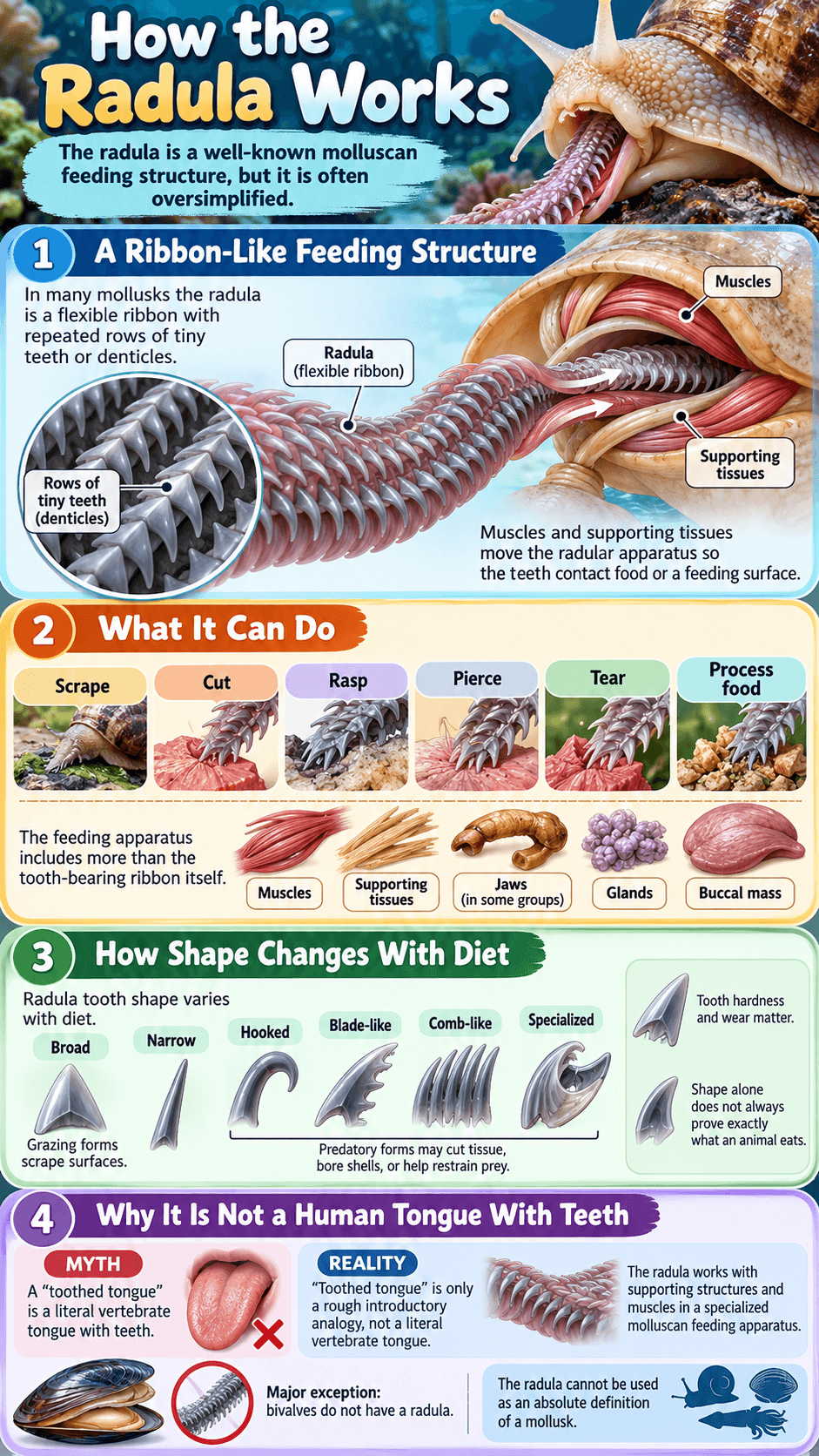
The radula is one of the best-known feeding structures in mollusks, but it is often oversimplified. It is not simply a miniature jaw, and describing it as a tongue with teeth can create the wrong mental picture if the analogy is taken literally.
A Ribbon-Like Feeding Structure With Microscopic Teeth or Denticles
In many mollusks, the radula is a flexible ribbon that carries repeated rows of tooth-like structures. Muscles and supporting tissues move the radular apparatus so the teeth can contact food or a feeding surface. Depending on the animal, the radula can scrape, cut, rasp, pierce, tear, or otherwise help process food.
Modern anatomical studies show that a gastropod feeding apparatus includes much more than the tooth-bearing ribbon itself. Muscles, cartilage-like supports, jaws in some groups, glands, and the surrounding buccal mass all contribute to feeding. A Journal of Molluscan Studies paper on radular structure illustrates how tooth shape, arrangement, and mechanical organization vary among gastropods rather than following one universal pattern.
How Radula Shape Changes With Diet
Radular teeth can be broad, narrow, hooked, blade-like, comb-like, or otherwise specialized. Grazing forms may be suited to scraping material from hard surfaces, while predatory forms may cut tissue, bore shells, or help restrain prey. Tooth hardness and wear also matter because repeated contact with rock, shell, or tough food places different demands on the feeding apparatus.
The relationship between radula and diet is strong enough that researchers often study tooth form for clues about feeding ecology. Still, shape alone does not always prove exactly what an animal eats. Direct observations, gut contents, stable isotope work, field behavior, and other evidence can be needed to confirm diet.
Why the Radula Is Not a Human Tongue With Teeth
Calling the radula a “toothed tongue” is a useful introductory analogy, but anatomically it is not a vertebrate tongue covered with miniature versions of human teeth. The radula is part of a specialized molluscan feeding apparatus, and the repeated denticles operate with supporting structures and muscles in ways that differ from chewing with jaws.
There is also a major exception: bivalves do not have a radula. That alone is enough to show why the radula cannot be used as an absolute definition of a mollusk. The larger body plan and evolutionary history matter more than possession of one feeding organ.
Gastropod Feeding Diversity
Gastropods include snails, slugs, limpets, whelks, conchs, nudibranchs, sea hares, and many other forms. Their diets are correspondingly broad. A terrestrial snail eating plant material and a predatory marine snail attacking another mollusk belong to the same class but operate in very different feeding niches.
Grazers and Biofilm Feeders
Many familiar gastropods graze surfaces. Limpets on rocky shores can scrape epilithic biofilms, which are thin communities growing on rock. Other snails consume algae, plant tissue, fungi, decaying vegetation, or mixtures of microscopic material. The exact diet often changes with habitat, species, life stage, and available food.
Grazing can influence the community around the animal. By removing films and algal growth, grazers can change which organisms dominate a surface and how quickly new growth appears. This makes feeding behavior ecologically important even when the individual food items are tiny.
Predatory Snails and Specialized Diets
Many marine snails are predators. Some drill or rasp through the shells of other mollusks, some feed on worms or other soft-bodied invertebrates, and some use a proboscis and highly modified radular teeth to capture prey. Predation is therefore not unusual within Gastropoda.
Specialization can be extreme. A feeding structure that works well for scraping algae would not necessarily be effective for piercing prey or cutting tissue, so the radula and associated anatomy can reflect very different mechanical demands. This is one reason gastropod radulas show such striking diversity.
Nudibranch Prey Specialization
Nudibranchs are shell-less marine gastropods, and many are selective predators rather than general grazers. Depending on the lineage, prey can include sponges, cnidarians, bryozoans, tunicates, eggs, or other animals. Some species are closely associated with a narrow prey type, while others have broader diets.
A particularly well-known example involves aeolid nudibranchs that feed on cnidarians such as anemones and related stinging animals. Some can retain undischarged stinging structures from their prey and later use them in defense. This remarkable ability is a feeding-defense connection, not evidence that every nudibranch eats cnidarians or stores stinging cells.
Bivalve Feeding
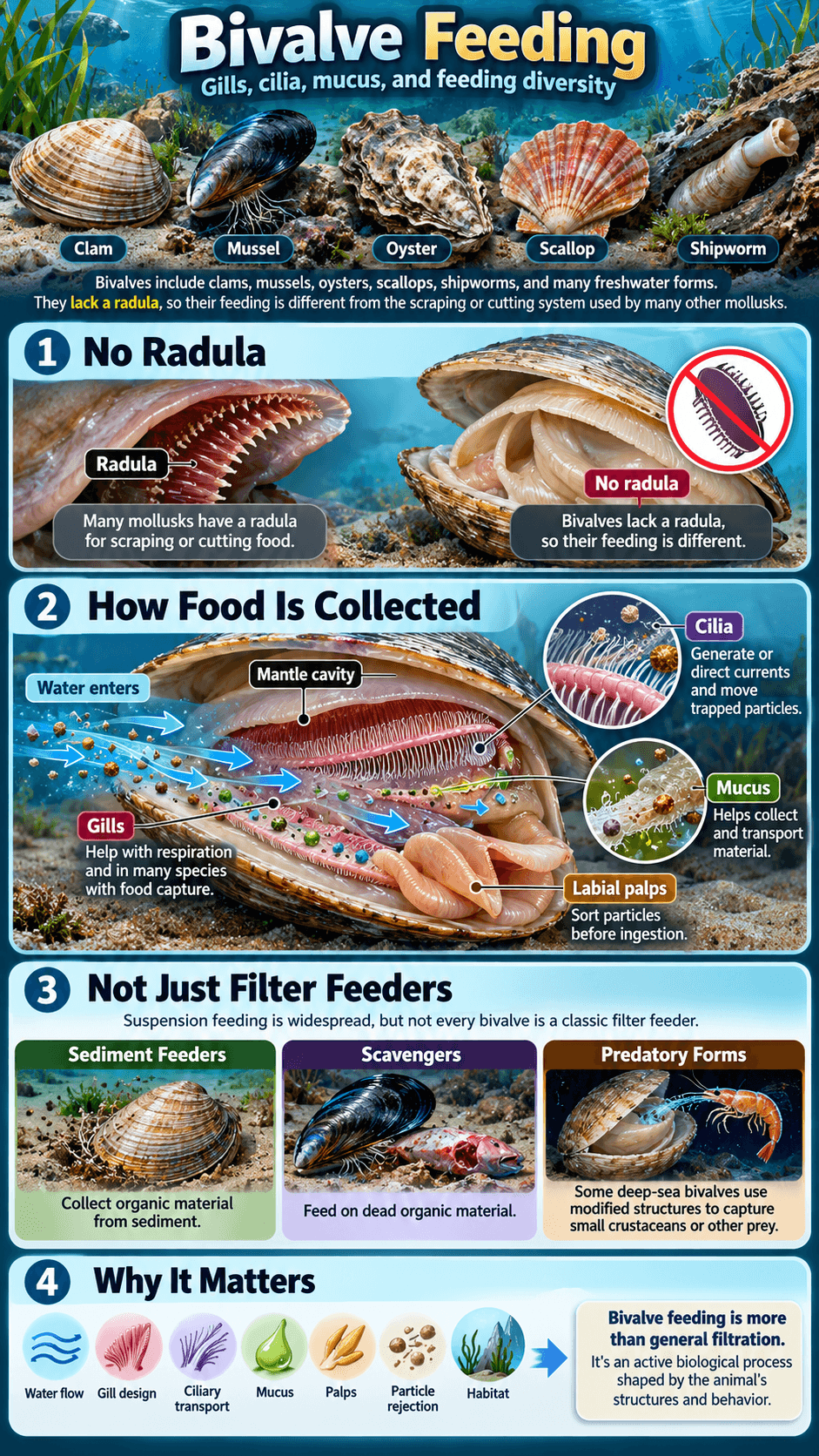
Bivalves include clams, mussels, oysters, scallops, shipworms, and many freshwater forms. They differ from most other mollusks in lacking a radula, so their feeding cannot be explained by the scraping or cutting system used by many gastropods and other mollusks.
Gills, Cilia, Mucus, and Suspension Feeding
In many bivalves, water enters the mantle cavity and passes across the gills. The gills serve respiratory functions and, in many species, also participate in food capture. Cilia generate or direct currents and move trapped particles, while mucus helps collect and transport material. Labial palps near the mouth can help sort particles before ingestion.
The Smithsonian’s bivalve feeding explanation describes how gills, cilia, and palps cooperate to collect particles and move accepted material toward the mouth. This is a living transport system, not simply a sieve hanging in flowing water.
Deposit-Feeding and Predatory Exceptions
Although suspension feeding is widespread, not every bivalve is a classic filter feeder. Some collect organic material from sediment. Others are scavengers or predators. Certain deep-sea bivalves, for example, use modified structures to capture small crustaceans or other prey. Those exceptions are important because they show how flexible a body plan can become over evolutionary time.
It is therefore safer to say that suspension feeding is common in bivalves than to say that bivalves are universally filter feeders. Generalizations are most useful when they leave room for documented exceptions.
Why Bivalve Feeding Is More Than General Filtration
A bivalve-focused explanation should emphasize the animal’s own anatomy and particle handling. Water flow, gill design, ciliary transport, mucus, palps, particle rejection, and habitat all affect what reaches the mouth. The broader physics of filtration applies to many unrelated aquatic animals and does not by itself explain how a clam or mussel selects food.
This distinction matters because two suspension feeders can live in the same water yet collect different particles, reject different material, or respond differently to changing food conditions. Feeding is an active biological process shaped by the animal’s structures and behavior.
Cephalopod Predation
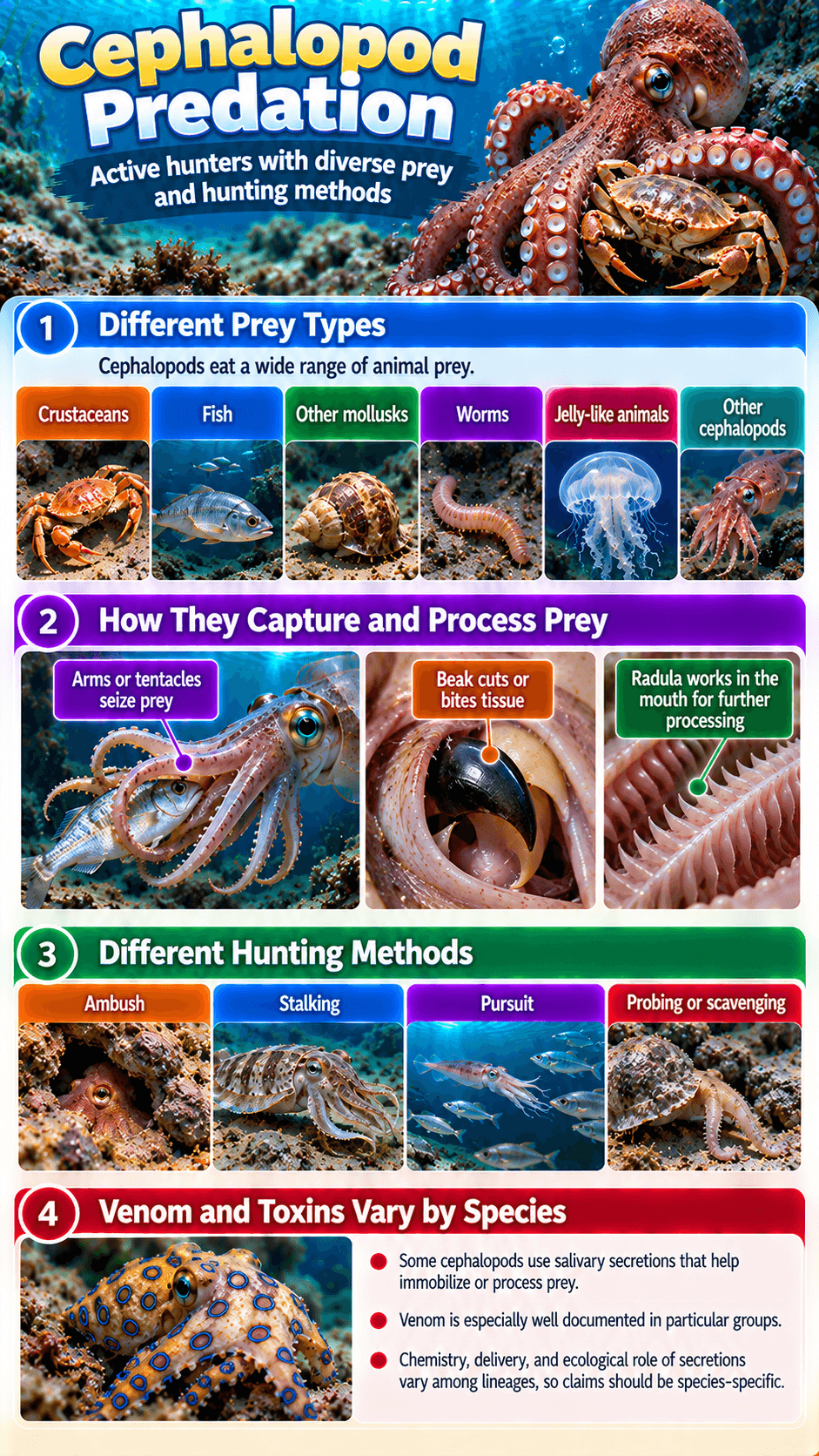
Cephalopods are the most consistently predatory major molluscan group. Octopuses, squid, cuttlefish, and nautiluses eat animal prey, but the exact prey and hunting method vary strongly among species and habitats.
Prey Types Across Species
Common cephalopod prey include crustaceans, fish, and other mollusks. Some species take worms, jelly-like animals, or other cephalopods. Size, habitat, hunting style, and life stage affect what is practical to capture. A bottom-dwelling octopus searching crevices for crabs faces a very different feeding problem from an open-water squid pursuing fish.
The Smithsonian Ocean overview of cephalopods describes their predatory role and the use of a beak and radula to process prey. It also makes clear that prey choice is broad rather than restricted to one food category.
Arms or Tentacles, Beak, and Radula
Cephalopods combine prey capture with powerful food processing. Arms, and in squid and cuttlefish the longer tentacles, can seize or manipulate prey. The beak cuts or bites tissue. The radula works inside the mouth region as part of further processing. These structures do not act independently, and their importance differs by species and hunting strategy.
The result is a feeding system suited to active predation. That does not mean every cephalopod hunts in the same way. Ambush, stalking, pursuit, probing, and scavenging can all occur in different ecological settings.
Venom and Toxins Only Where Species-Specific Evidence Supports It
Some cephalopods use salivary secretions that help immobilize or process prey, and venom is especially well documented in particular groups. However, it is inaccurate to describe every octopus, squid, cuttlefish, or nautilus as using venom in the same way. The chemistry, delivery, and ecological role of secretions vary among lineages.
For general readers, the safest rule is to keep venom claims species-specific. A famous example such as a blue-ringed octopus should not be used to represent the feeding biology of all cephalopods.
Chiton Feeding
Chitons are flattened marine mollusks protected dorsally by eight shell plates. Many live on hard substrates and are best known as grazers, but even this group contains more feeding diversity than a simple “algae eater” label suggests.
Grazing With Robust Radulae
Many chitons use a strong radula to graze biofilms and attached material from rock. Their radular teeth can be highly wear-resistant, which is useful when feeding repeatedly against abrasive mineral surfaces. The scraping action can remove microscopic growth that is not obvious to a person looking at the same rock.
Because the food occurs as a thin layer on a hard substrate, tooth material and tooth replacement are important parts of feeding performance. Chiton grazing is therefore a useful example of how diet, habitat, and mechanical design interact.
Specialized Predatory or Other Feeding Modes in Some Species
Not every chiton is a strict algal grazer. Specialized feeding modes, including predation in some lineages, have been documented. The details differ among species, so it is better to present grazing as a common pattern rather than a universal rule.
This exception also warns against identifying an animal’s diet only from its class. Broad classifications help organize diversity, but species-level ecology can surprise us.
Shipworms and Wood Feeding
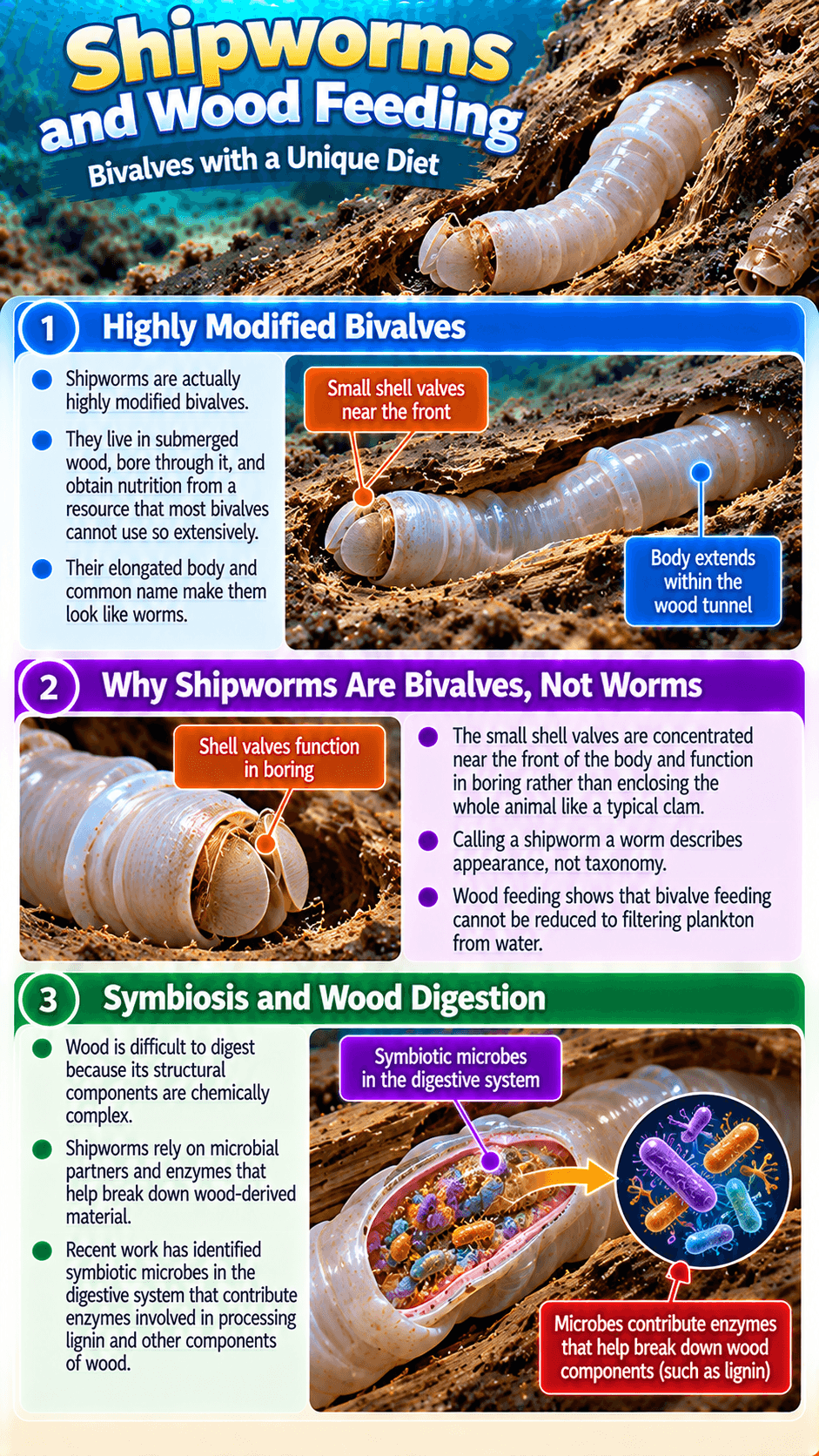
Shipworms are among the strangest mollusk feeders because their common name and elongated body make them look like worms. They are actually highly modified bivalves. They live in submerged wood, bore through it, and obtain nutrition from a resource that most bivalves cannot use so extensively.
Why Shipworms Are Bivalves, Not Worms
The small shell valves of a shipworm are concentrated near the front of the body and function in boring rather than enclosing the whole animal like a typical clam shell. As the animal tunnels through wood, the body extends within the protected passage. Calling a shipworm a worm describes appearance, not taxonomy.
Wood feeding is one of the clearest demonstrations that bivalve feeding cannot be reduced to filtering plankton from water. Shipworms evolved a very different use of the bivalve body plan.
Symbiosis and Wood Digestion at Appropriate Depth
Wood is difficult to digest because its structural components are chemically complex. Shipworms rely on microbial partners and enzymes that help break down wood-derived material. Recent work has identified symbiotic microbes in the digestive system that contribute enzymes involved in processing lignin and other components of wood.
A 2024 University of Massachusetts Amherst research summary on shipworms describes microbes in the typhlosole, a gut structure, producing enzymes associated with lignin digestion. This finding adds to earlier work showing that shipworm nutrition depends on a close partnership between the animal and its microbial community.
Cone Snails as Specialized Predatory Gastropods
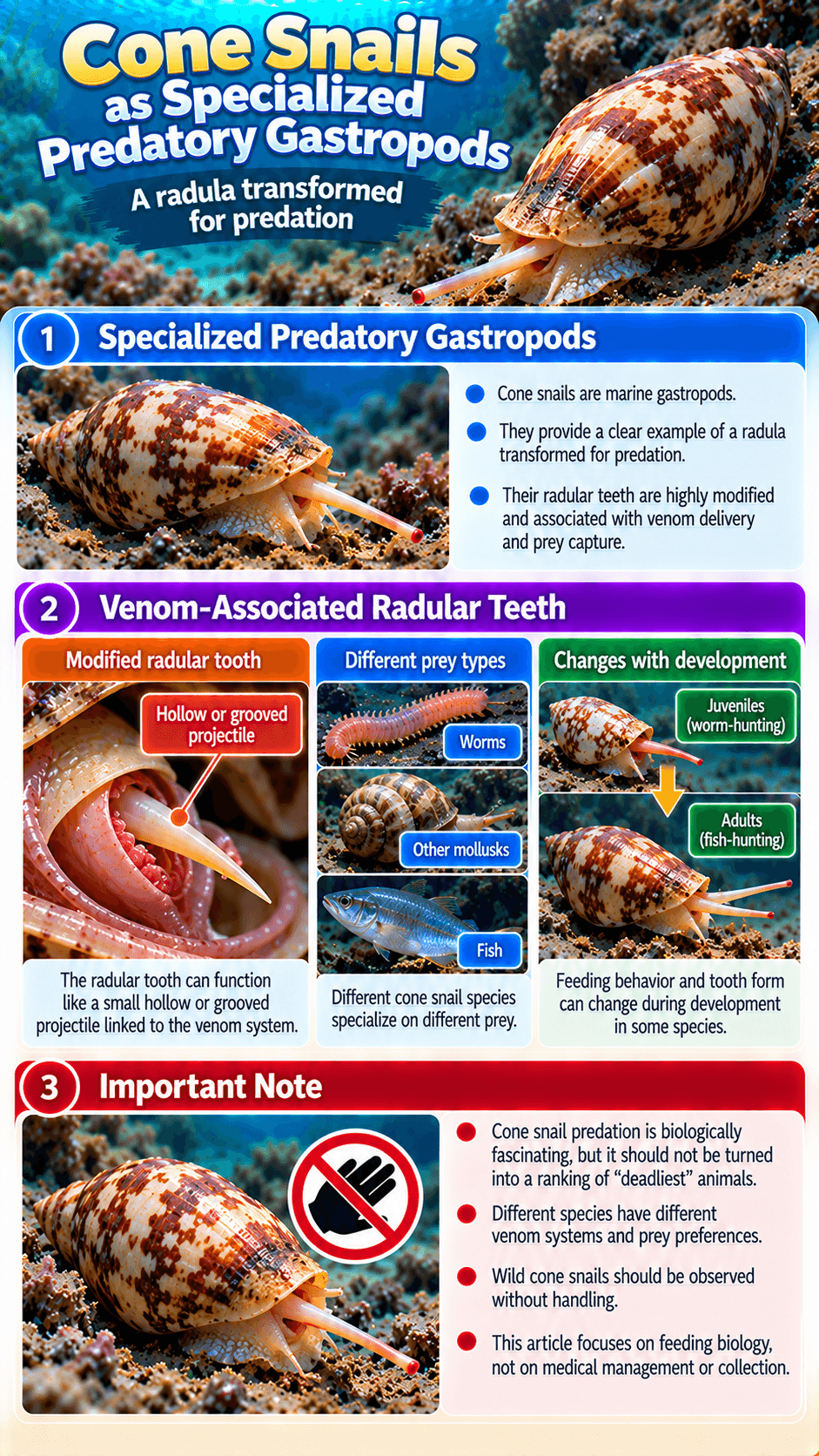
Cone snails are marine gastropods that provide one of the clearest examples of a radula transformed for predation. Rather than using repeated teeth mainly for scraping, they possess highly modified radular teeth associated with venom delivery and prey capture.
Venom-Associated Radular Teeth
Different cone snail species specialize on different prey, including worms, other mollusks, and fish. The radular tooth can function like a small hollow or grooved projectile linked to the venom system. Feeding behavior and tooth form can even change during development in some species.
A Nature Communications study of Conus magus documented a shift from worm-hunting juveniles to fish-hunting adults, accompanied by changes in radular tooth form, venom composition, and behavior. That study is a useful reminder that even within one species, feeding biology can change with life stage.
Why This Is Not a Human-Danger or Handling Guide
Cone snail predation is biologically fascinating, but it should not be turned into a ranking of “deadliest” animals. Venom evolved in ecological contexts that include prey capture and defense, and different cone snail species have different venom systems and prey preferences.
Wild cone snails should be observed without handling. This article focuses on feeding biology, not on medical management or collection. If a venomous marine animal is involved in an exposure or injury, appropriate emergency or medical guidance should come from qualified professionals rather than an animal-facts article.
Common Diet Myths
All Mollusks Are Grazers
Grazing is common in many snails and chitons, but it is only one feeding strategy. Cephalopods are predators, many marine snails hunt other animals, bivalves often suspension feed, shipworms process wood, and other mollusks use deposit feeding or scavenging. The diversity of diets is one of the defining ecological features of the phylum.
All Bivalves Are Filter Feeders
Many bivalves are suspension feeders, and familiar clams, oysters, and mussels make that pattern easy to remember. But some bivalves deposit feed, scavenge, or prey on small animals. Shipworms add an even more unusual case because they bore into wood and use symbiotic microbes in digestion. “Most familiar bivalves filter feed” is safer than “all bivalves filter feed.”
All Chitons Eat Only Algae
Chitons are often introduced as rock grazers, and many species do feed heavily on algae and biofilms. Yet specialized diets occur, including predatory behavior in some lineages. A class-level description should therefore capture the common pattern without erasing exceptions.
How Feeding Fits Into Mollusk Biology
Feeding is not an isolated process. The way a mollusk obtains food is connected to its anatomy, sensory systems, movement, defense, habitat, and ecological role. A radula works only as part of a larger feeding apparatus. A bivalve’s particle capture depends on water movement and gill function. A predator must detect, approach, restrain, and process prey.
Radula Anatomy
The radula connects feeding ecology with comparative anatomy. Its presence, absence, shape, supports, muscles, and replacement pattern all affect how it works. Bivalves demonstrate that a successful molluscan feeding system can evolve without a radula, while cone snails show how radically the structure can be modified in a predatory gastropod.
Sensory Systems Used in Feeding
Finding food requires information. Gastropods can use chemical and tactile cues while moving across surfaces. Cephalopods combine vision, touch, chemical sensing, and active movement during hunting. Bivalves can respond to waterborne particles and environmental conditions that influence feeding activity. The senses involved differ with lifestyle, but feeding begins long before food reaches the mouth.
Ecological Roles in Food Webs
Mollusk diets help determine their ecological effects. Grazers can shape algal growth on rocks. Suspension-feeding bivalves move particles from the water column into benthic food pathways. Predatory snails and cephalopods affect prey populations. Shipworms accelerate the breakdown of submerged wood. Mollusks are also prey for fish, birds, mammals, crustaceans, and other animals, so their feeding roles connect to larger food webs.
FAQ
Do all mollusks use a radula to eat?
No. Many mollusks use a radula, but bivalves are the major living exception. Clams, oysters, mussels, scallops, and other bivalves lack a radula and use different feeding mechanisms. In many species, gills and cilia are important for capturing and transporting suspended food particles.
What do bivalves eat if they have no radula?
Many bivalves eat phytoplankton, microorganisms, detrital particles, and other suspended material captured from water. Some collect food from sediment, while a smaller number use scavenging or predatory strategies. Shipworms are unusual bivalves that bore into wood and rely partly on symbiotic microbes to help process it.
Are any mollusks predators?
Yes. All living cephalopods are carnivorous, and predatory feeding also occurs in many gastropods and some bivalves and chitons. Predatory mollusks may use arms, tentacles, beaks, radulas, proboscises, venom systems, or other specialized structures depending on the lineage.
Final Thoughts
So, what do mollusks eat? Almost every broad food category available to an invertebrate is represented somewhere in the phylum. Some scrape algae and biofilms, some collect suspended or deposited particles, some consume decaying material or wood, and others actively hunt prey. The radula is central to feeding in many groups, but bivalves show that mollusks can thrive without it. The most accurate way to understand mollusk diet is to ask both what food is being eaten and how that particular animal is built to obtain it.

Ethan Walker is the founder and research editor of Animal Fact Central. He creates and reviews educational animal facts content using trusted wildlife, pet care, and science-based sources. His work focuses on making animal behavior, adaptations, habitats, and species facts clear, accurate, and engaging for everyday readers.
Read More Details About Ethan Walker: https://animalfactcentral.com/ethan-walker/