

Mollusk anatomy can look almost impossible to summarize because a garden snail, a clam, an octopus, a chiton, and a tusk shell do not seem built from the same plan. Yet they are all members of Mollusca. The most useful way to understand them is not to memorize one “standard mollusk,” but to recognize a set of body regions and organ systems that have been stretched, reduced, rotated, fused, or repurposed in different lineages.
Across the phylum, the mantle, visceral mass, muscular foot or its derivatives, and feeding structures provide a practical starting framework. Shells are common but not universal. A radula occurs in many mollusks but is absent in bivalves. Gills are widespread, yet some gastropods exchange gases through a vascularized mantle cavity adapted for air breathing. Most mollusks have an open circulatory arrangement, while cephalopods are a major exception. The result is not one anatomy repeated eight times, but a shared evolutionary foundation expressed in strikingly different forms.
Quick Answer
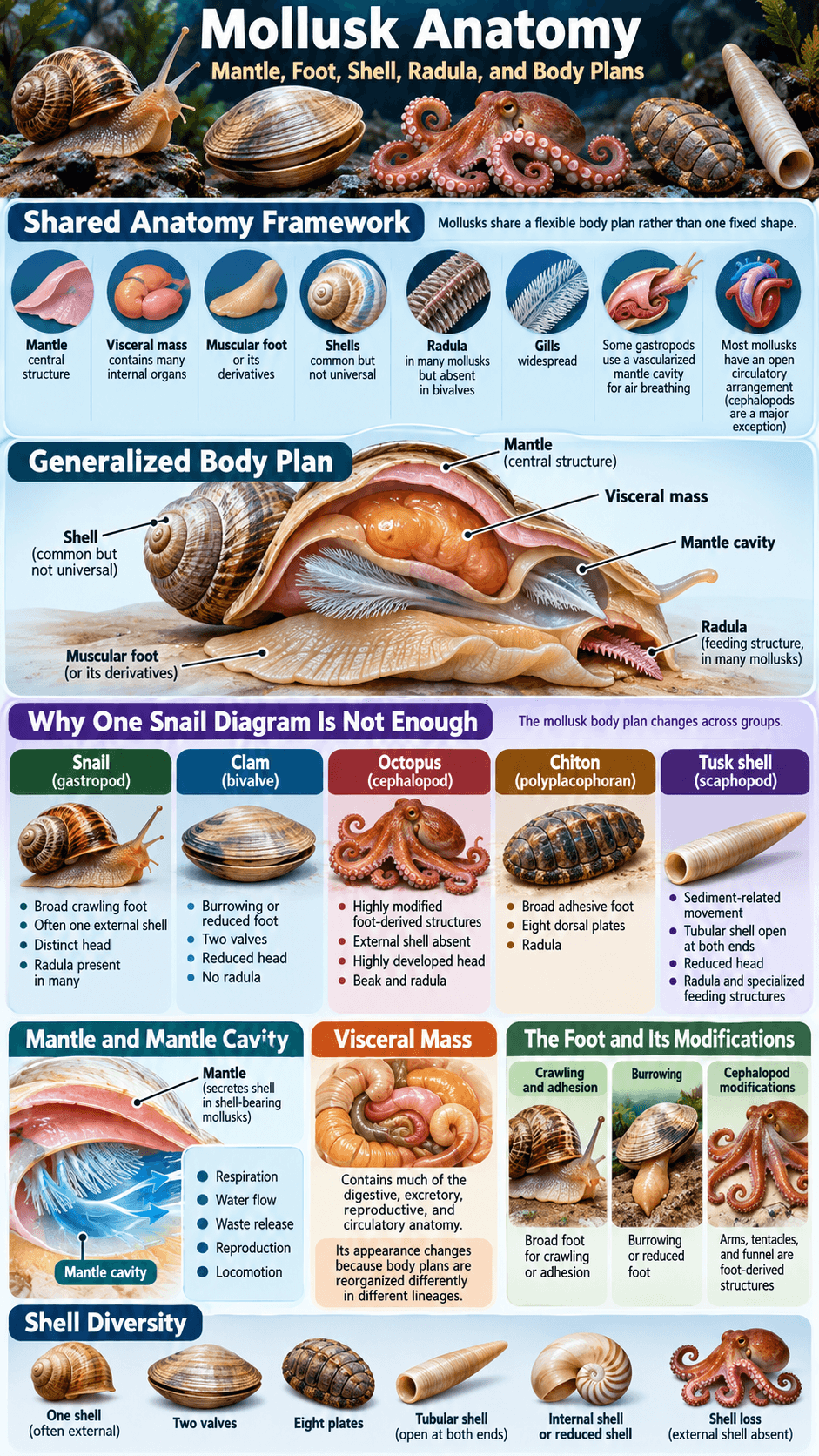
A generalized molluscan body plan includes a mantle, a visceral mass containing many internal organs, and a muscular foot that may be used for crawling, burrowing, attachment, or transformed into very different structures. Many mollusks also have a shell secreted by mantle tissue and a radula used in feeding. The general molluscan body plan described by Cambridge University Press emphasizes the relationship among the foot, mantle, shell, visceral region, and mantle cavity.
The important word is “generalized.” A clam has two shell valves and no radula. A chiton carries eight dorsal plates. An octopus lacks the large external shell that most people associate with mollusks. A terrestrial snail may use a vascularized mantle cavity for air breathing. These differences are not violations of the mollusk plan. They are examples of how flexible that plan has become.
The Molluscan Body Plan Is a Framework, Not One Fixed Shape
Why a Snail Diagram Cannot Represent Every Mollusk
Snails are often used in introductory diagrams because their major regions can be easy to point out. You can see a broad foot underneath the body, a head with sensory tentacles, a shell over much of the visceral mass, and a mantle lining the shell region. That makes a snail useful for learning vocabulary, but dangerous as a universal model.
In bivalves, the head is reduced and the body is compressed between two shell valves. In cephalopods, the head is strongly developed, the foot has been transformed into structures associated with the arms and funnel, and the shell may be internal, reduced, or largely lost. Chitons keep a broad ventral foot but carry multiple shell plates. Tusk shells live in sediment inside a tubular shell and have their own specialized arrangement. Anatomy makes more sense when these are compared side by side.
Comparing Snail, Clam, Octopus, Chiton, and Tusk-Shell Forms
| Example | Foot region | Shell condition | Head region | Feeding structure |
|---|---|---|---|---|
| Snail | Broad crawling foot in many species | Often one external shell, but highly variable across gastropods | Usually distinct | Radula present in many |
| Clam | Often adapted for burrowing or reduced | Two valves | Strongly reduced | No radula |
| Octopus | Foot-derived structures highly modified | Large external shell absent | Highly developed | Beak and radula |
| Chiton | Broad adhesive foot | Eight dorsal plates | Less prominent than in many gastropods | Radula |
| Tusk shell | Used in sediment-related movement | Tubular shell open at both ends | Reduced compared with many gastropods | Radula and specialized feeding structures |
This comparison shows why anatomy should be read as a pattern of transformation. The same broad regions can be enlarged in one lineage, reduced in another, or associated with new functions. That flexibility is one reason mollusks occupy such a wide variety of ecological roles.
Mantle and Mantle Cavity

Covering the Visceral Mass
The mantle is one of the central structures in mollusk anatomy. It is a sheet or fold of body tissue associated with the dorsal side of the animal and the visceral region. In shell-bearing mollusks, mantle tissues produce shell material. The Smithsonian’s cowrie anatomy overview, for example, identifies the mantle as the tissue involved in building, enlarging, and repairing the shell in those gastropods.
Calling the mantle simply a “shell-making organ,” however, misses much of its importance. The mantle helps define the space known as the mantle cavity, and both structures can participate in respiration, water movement, waste release, reproduction, and locomotor functions depending on the group. Its exact shape also varies dramatically. A clam’s mantle edge does not look like the mantle system of a squid, yet both reflect the same broad anatomical heritage.
Roles in Shell Secretion, Respiration, Water Flow, Excretion, Reproduction, and Locomotion
In many aquatic mollusks, the mantle cavity is where water passes over respiratory surfaces. Openings from excretory and reproductive systems may also empty into this space. In bivalves, mantle folds and siphons can help organize water flow through the body. In cephalopods, muscular mantle movements are involved in ventilation and in the water flow used for jet propulsion.
These functions overlap because anatomy is integrated. A structure rarely serves only one isolated purpose. Water entering a bivalve may contribute to both respiration and feeding. Mantle movement in a squid is linked with breathing as well as locomotion. The mantle is therefore best understood as part of a functional system rather than as a single-purpose tissue.
Visceral Mass and Internal Organ Arrangement
What the Visceral Mass Contains
The visceral mass is the body region containing much of the digestive, excretory, reproductive, and circulatory anatomy. In a generalized diagram it sits above the foot and beneath or within the mantle and shell region. The term is useful because it identifies where many major internal organs are concentrated without pretending that every mollusk packs those organs in the same shape.
A gastropod’s visceral organs may be strongly affected by developmental rearrangements, including torsion. A bivalve has a laterally compressed body between its valves. A cephalopod reorganizes the relationship of head, mantle, internal organs, and appendages so extensively that a simple snail-shaped template becomes misleading. The broad region remains recognizable in evolutionary terms even when the adult body looks very different.
How Body-Plan Reorganization Changes Its Appearance
When a body region changes position, the organs associated with it may move as well. This is why anatomy cannot be learned by asking where a structure “should” be in one universal diagram. Position depends on the lineage and its developmental history. What matters is the relationship among structures and their functions.
Gastropods demonstrate this especially clearly. Torsion changes the organization of the visceral and mantle regions during development, but torsion is not the same thing as shell coiling. Cephalopods demonstrate another kind of transformation, with a strong head, muscular mantle, specialized appendages, and sophisticated nervous and circulatory systems associated with active movement and predation.
The Molluscan Foot and Its Modifications
Crawling and Adhesion
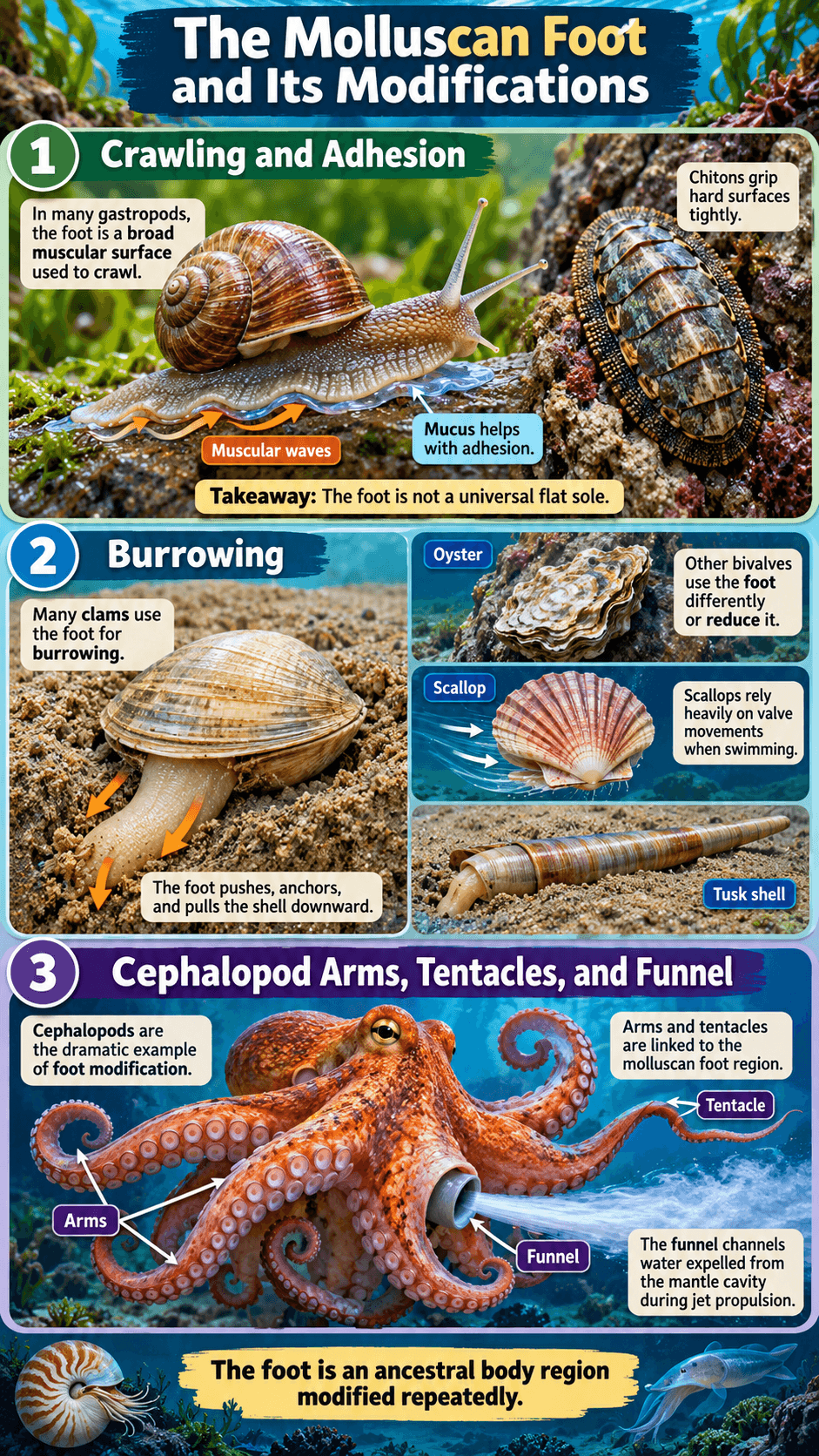
In many gastropods, the foot is a broad muscular surface used to crawl over rock, vegetation, sediment, or other surfaces. Muscular waves travel through the foot while mucus can help with adhesion and interaction with the substrate. Chitons also use a broad muscular foot, often gripping hard surfaces tightly while their dorsal plates remain exposed above.
The foot should not be pictured as a universal flat “sole” beneath every mollusk. It is an ancestral body region that has been modified repeatedly. Its form tells you a great deal about how a particular mollusk lives.
Burrowing
Many clams use the foot for burrowing. A muscular extension can push into sediment, expand or anchor, and help pull the shell downward. The exact sequence and mechanics vary among species. Other bivalves use the foot differently or reduce it. Oysters, for example, may become attached as adults, while scallops rely heavily on valve movements when swimming.
Tusk shells also use a foot in sediment, but their overall body arrangement and shell form are different from those of clams. These cases show why “has a muscular foot” is not enough to predict a mollusk’s lifestyle.
Cephalopod Arms, Tentacles, and Funnel
Cephalopods are the dramatic example of foot modification. Developmental and evolutionary evidence links their arm crown and funnel with the molluscan foot region. Research on cephalopod limb development describes the arms and tentacles as structures derived from the ventral embryonic foot while also emphasizing that the limbs themselves are distinctive cephalopod innovations.
This wording matters. It is too simple to say that an octopus “turned its foot into eight legs.” The evolutionary transformation involves developmental reorganization of a body region, not the direct reshaping of a modern snail foot. The funnel is also tied to this transformed anatomy and channels water expelled from the mantle cavity during jet propulsion.
Shell Anatomy Across Mollusks

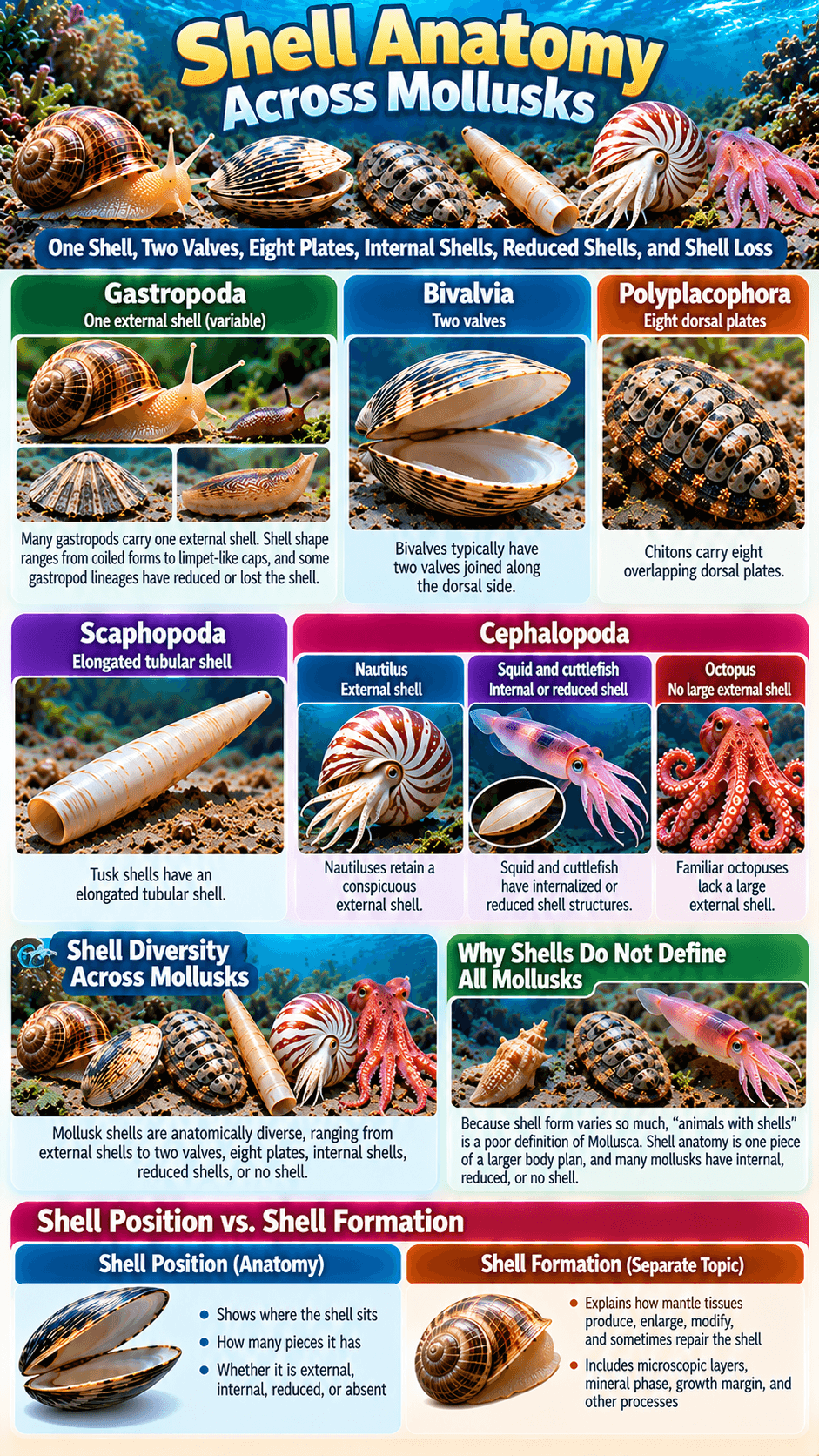
One Shell, Two Valves, Eight Plates, Internal Shells, Reduced Shells, and Shell Loss
Mollusk shells are anatomically diverse. Many gastropods carry one external shell, but shell shape ranges from coiled forms to limpet-like caps, and some gastropod lineages have reduced or lost the shell. Bivalves typically have two valves joined along the dorsal side. Chitons carry eight overlapping dorsal plates. Tusk shells have an elongated tubular shell. Nautiluses retain a conspicuous external shell, while squid and cuttlefish have internalized or reduced shell structures and familiar octopuses lack a large external shell.
Because shell form varies so much, “animals with shells” is a poor definition of Mollusca. Shell anatomy is one piece of a larger body plan. It also explains why a shell-only image can distort public understanding of the phylum by making shell-less or internally shelled mollusks seem exceptional in the wrong way.
Why Shell Position Is Anatomical but Shell Formation Is a Separate Topic
An anatomy overview needs to show where the shell sits, how many pieces it has, and whether it is external, internal, reduced, or absent. It does not need to explain every microscopic layer, mineral phase, growth margin, or repair process. Those belong to the biology of shell formation.
Keeping these questions separate is useful. Anatomy asks what structure is present and where it lies in relation to the rest of the body. Shell formation asks how mantle tissues produce, enlarge, modify, and sometimes repair the hard material.
Radula, Mouthparts, and Feeding Structures
Ribbon-Like Radula in Many Lineages
The radula is a flexible ribbon-like feeding structure bearing many tiny teeth or denticles. In different mollusks it can scrape surfaces, cut plant material, bore, rasp, or help process animal prey. Tooth shape varies with feeding mode, so there is no single “standard” radula that represents the entire phylum.
Calling the radula a “tongue with teeth” can be a useful first analogy, but it should remain an analogy. A radula has its own support and movement system and is not simply the molluscan version of a human tongue. Its importance comes from the remarkable range of feeding tasks that different radular designs can perform.
Bivalves as the Major Radula Exception
Bivalves are the clearest reminder that a radula is not required for an animal to be a mollusk. The Animal Diversity Web overview of Bivalvia identifies the class by the absence of a radula. Many bivalves instead use ciliated gills and associated mucus to capture suspended material, although feeding strategies are more diverse than the familiar filter-feeding pattern.
This exception is important because it prevents a common definition error. A radula is a characteristic structure in many molluscan lineages, not a feature present in every living mollusk.
Beak Plus Radula in Cephalopods
Cephalopods combine a radula with powerful jaw structures usually described as a beak. The beak can cut or break prey while the radula contributes to processing food. This is another example of a broadly shared molluscan structure operating within a very specialized feeding system.
The anatomy should not be generalized beyond the group. A clam does not have a cephalopod-style beak, and the jaws of a predatory snail are organized differently. Shared ancestry does not mean identical feeding equipment.
Respiration and the Mantle Cavity

Ctenidia and Other Aquatic Respiratory Surfaces
Many aquatic mollusks use ctenidia, the structures commonly called molluscan gills, within or associated with the mantle cavity. Water movement brings dissolved oxygen across thin exchange surfaces. The same structures may take on additional roles. In many bivalves, for example, the gills also participate in feeding by moving and sorting suspended particles.
Not every aquatic mollusk has the same gill arrangement, and not every lineage relies on ctenidia in the same way. Some use additional body surfaces for gas exchange. The correct generalization is that mantle-associated respiratory surfaces are widespread and highly varied.
Air-Breathing Mantle Cavities in Terrestrial Gastropods
Many terrestrial gastropods use a vascularized region of the mantle cavity for air breathing. It is often called a lung because of its function, but it is not a vertebrate lung built from the same anatomical plan. Some freshwater gastropods also combine aquatic and aerial respiratory structures. A study of apple snails in the Journal of Molluscan Studies describes a vascularized mantle-cavity “lung” alongside a ctenidium in these amphibious snails.
This is a useful example of anatomical flexibility. The mantle cavity can be modified into an air-breathing chamber without turning a snail into something anatomically equivalent to a mammal.
Why Not All Mollusks Have Gills
Statements such as “mollusks breathe with gills” are therefore too broad. Many aquatic forms do use gills, but air-breathing gastropods can rely on vascularized mantle surfaces, and some lineages use other body surfaces as well. Respiratory anatomy follows habitat, body size, activity level, and evolutionary history.
That diversity also means a diagram labeled “mollusk gill” should be read as an example, not as proof that the same structure appears unchanged across the phylum.
Circulation
Open Circulatory Systems in Most Mollusks
Most mollusks have an open circulatory system. The heart pumps hemolymph through vessels that lead into spaces where the fluid bathes tissues more directly before returning toward the heart. “Open” does not mean uncontrolled or primitive. Open circulatory systems can regulate flow effectively and support the lifestyles of a huge range of mollusks.
The organization varies among classes and species, so it is safer to describe the broad pattern than to force every group into one exact diagram. Heart structure, vessels, and respiratory connections differ with body plan and activity.
Largely Closed Circulation in Cephalopods
Cephalopods are the major molluscan exception. Their circulation is largely closed, keeping blood within a more extensive vessel system and supporting high rates of oxygen delivery associated with active locomotion. The Journal of Experimental Biology describes cephalopods as having a closed circulatory system and discusses the oxygen-delivery demands of their active lifestyles.
This difference is one reason cephalopods should never be used as the anatomical template for all mollusks. Their circulatory system, nervous system, locomotion, and sensory equipment are unusually specialized within the phylum.
Hemocyanin Without the All-Mollusks-Have-Blue-Blood Myth
Hemocyanin is an oxygen-transport protein containing copper and is widespread among mollusks. When oxygenated, it can give hemolymph a bluish appearance. That familiar fact is often simplified into “all mollusks have blue blood,” which is more confident than the anatomy supports.
Hemocyanin type, concentration, circulation, and visible color vary among lineages and physiological conditions. A more accurate takeaway is that hemocyanin is an important oxygen carrier in many mollusks and is especially prominent in discussions of cephalopod physiology.
Nervous and Sensory Anatomy
Nerve Organization Across Major Groups
Mollusk nervous systems range from relatively distributed arrangements of ganglia and nerve cords to the highly centralized brains of cephalopods. Gastropods commonly have several paired ganglia connected by nerves. Bivalves have a reduced head and a correspondingly different ganglionic organization. Cephalopods concentrate a large amount of nervous tissue around the esophagus and coordinate complex eyes, arms, skin, and locomotor systems.
It is tempting to arrange these systems on a ladder from “simple” to “advanced,” but that can hide what evolution actually does. Each nervous system is shaped by the animal’s way of life. A burrowing clam does not need the same sensory-motor architecture as a fast-moving squid, and the difference is not a score of biological worth.
Eyes, Tentacles, Statocysts, Siphons, and Other Structures at Overview Depth
Eyes vary enormously across Mollusca, from simple light-sensitive structures to the camera-type eyes of many cephalopods and the unusual mirror-based eyes of scallops. Gastropod tentacles can carry sensory organs involved in touch and chemical detection. Statocysts help many mollusks sense orientation and movement. Bivalve siphons manage water flow and can also carry sensory structures around their openings.
These examples belong in an anatomy overview because they show where sensory and nervous structures are located. Their detailed physiology is a separate question. Knowing that a statocyst contributes to balance is different from explaining every sensory cell and neural pathway inside it.
Common Anatomy Mistakes
One Flat Foot Under Every Mollusk
The generalized muscular foot is useful for understanding mollusk evolution, but adult anatomy varies too much to draw one flat foot beneath every species. Gastropods and chitons make the crawling-foot pattern easy to see. Bivalves often use a narrower foot for burrowing. Cephalopods transformed the same ancestral body region into much more elaborate structures.
So the best question is not “Where is the snail-like foot?” but “How has the foot region been modified in this lineage?” That keeps the comparison anatomically meaningful.
Three Hearts as a Mollusk-Wide Fact
The statement that “mollusks have three hearts” is false. The famous arrangement belongs to many cephalopods, where a systemic heart works with branchial hearts associated with the gills. Even within cephalopods, heart anatomy should be described at the appropriate group level rather than copied directly from an octopus fact page.
Most mollusks do not share that arrangement. Heart number and structure vary, so anatomy should follow the lineage being discussed.
Land-Snail Air Breathing as Vertebrate-Style Lungs
Calling a land snail’s air-breathing chamber a “lung” is common and functional, but the word can create the wrong mental image. The respiratory surface is derived from the mantle cavity and differs fundamentally from vertebrate lungs in structure and evolutionary origin.
That distinction matters because similar functions can evolve from different anatomical starting points. Both a snail and a mammal can breathe air, but they do not do so with homologous respiratory organs.
How Anatomy Shapes Shells, Movement, Senses, and Feeding
Shell Structure and the Mantle
The anatomical relationship between mantle and shell explains why shell position, shell number, and shell reduction are so informative when comparing mollusks. Once that relationship is clear, questions about mineral deposition, shell layers, growth lines, and repair can be understood as processes performed by living tissues rather than as properties of a dead external object.
Movement and Foot Modification
Movement follows anatomy closely. A broad foot favors crawling and adhesion, a wedge-shaped foot can help with burrowing, valve muscles can power scallop swimming, and a cephalopod’s muscular mantle and funnel support jet propulsion. Different movement strategies make sense when the underlying structures are compared first.
Senses and Feeding
Feeding and sensory biology also become easier to understand once anatomy is mapped. Radula form relates to diet. Bivalve gills can participate in particle handling as well as respiration. Cephalopod eyes, arms, suckers, beak, and nervous system work together during active predation. The structures are not isolated facts. They form coordinated systems.
FAQ
What is the mantle in a mollusk?
The mantle is a major body tissue associated with the visceral region. In shell-bearing mollusks it produces shell material, but its role is broader than shell secretion. It also helps form the mantle cavity, and depending on the group it may be involved in respiration, water flow, excretion, reproduction, and locomotor functions. Its shape varies greatly among gastropods, bivalves, cephalopods, and other mollusks.
Do all mollusks have gills?
No. Many aquatic mollusks use ctenidia or other gill-like respiratory surfaces, but some gastropods breathe air through vascularized mantle-cavity surfaces. Other mollusks may supplement gas exchange across different body surfaces. Respiratory anatomy depends on lineage, habitat, and lifestyle.
Do all mollusks have an open circulatory system?
No. An open circulatory arrangement is typical of most mollusks, but cephalopods are the major exception and have a largely closed circulatory system. That difference supports their active swimming and predatory lifestyles and is one of several anatomical features that make cephalopods highly specialized within Mollusca.
Final Thoughts
Mollusk anatomy is easiest to understand as variation on a flexible body-plan framework. The mantle and visceral mass remain central reference points, while the foot, shell, respiratory surfaces, feeding equipment, circulation, nervous system, and sense organs change dramatically across lineages. A snail helps introduce the vocabulary, but it cannot stand in for a clam, chiton, tusk shell, or octopus.
That comparative view also prevents the most common mistakes. Not every mollusk has an external shell, a radula, gills, one flat crawling foot, three hearts, or an open circulatory system. The shared pattern is evolutionary and structural, not a checklist in which every feature must appear unchanged. Once that is clear, the extraordinary variety of Mollusca becomes easier to read as anatomy rather than as a collection of exceptions.

Ethan Walker is the founder and research editor of Animal Fact Central. He creates and reviews educational animal facts content using trusted wildlife, pet care, and science-based sources. His work focuses on making animal behavior, adaptations, habitats, and species facts clear, accurate, and engaging for everyday readers.
Read More Details About Ethan Walker: https://animalfactcentral.com/ethan-walker/