
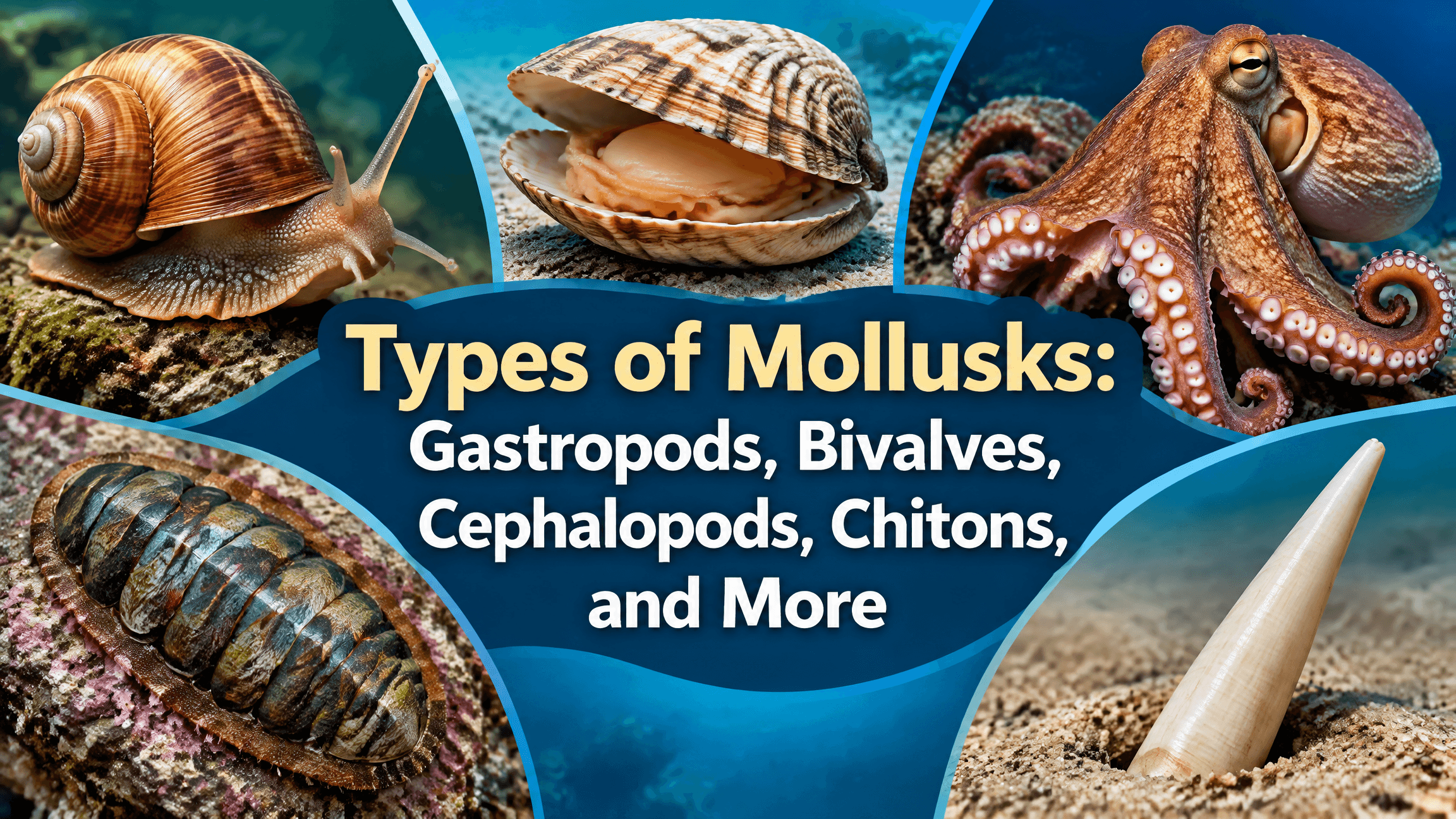
The major living types of mollusks are commonly organized into eight classes: Gastropoda, Bivalvia, Cephalopoda, Polyplacophora, Scaphopoda, Monoplacophora, Solenogastres, and Caudofoveata. Snails, clams, and octopuses are the best-known examples, but they represent only part of the range within the phylum Mollusca. Chitons carry eight shell plates, tusk shells live mostly within seafloor sediments, monoplacophorans are deep-sea animals with cap-like shells, and solenogasters and caudofoveates are small, worm-shaped mollusks without conventional shells.
That diversity is exactly why mollusks can be confusing. A slug does not resemble an oyster, and an octopus can seem even farther removed from either one. Yet these animals share evolutionary ancestry and variations on a molluscan body organization. Modern classification is continually refined as taxonomists add species and evaluate new evidence, so a current database such as MolluscaBase is more reliable than a fixed species count or an old textbook list.
Quick Answer
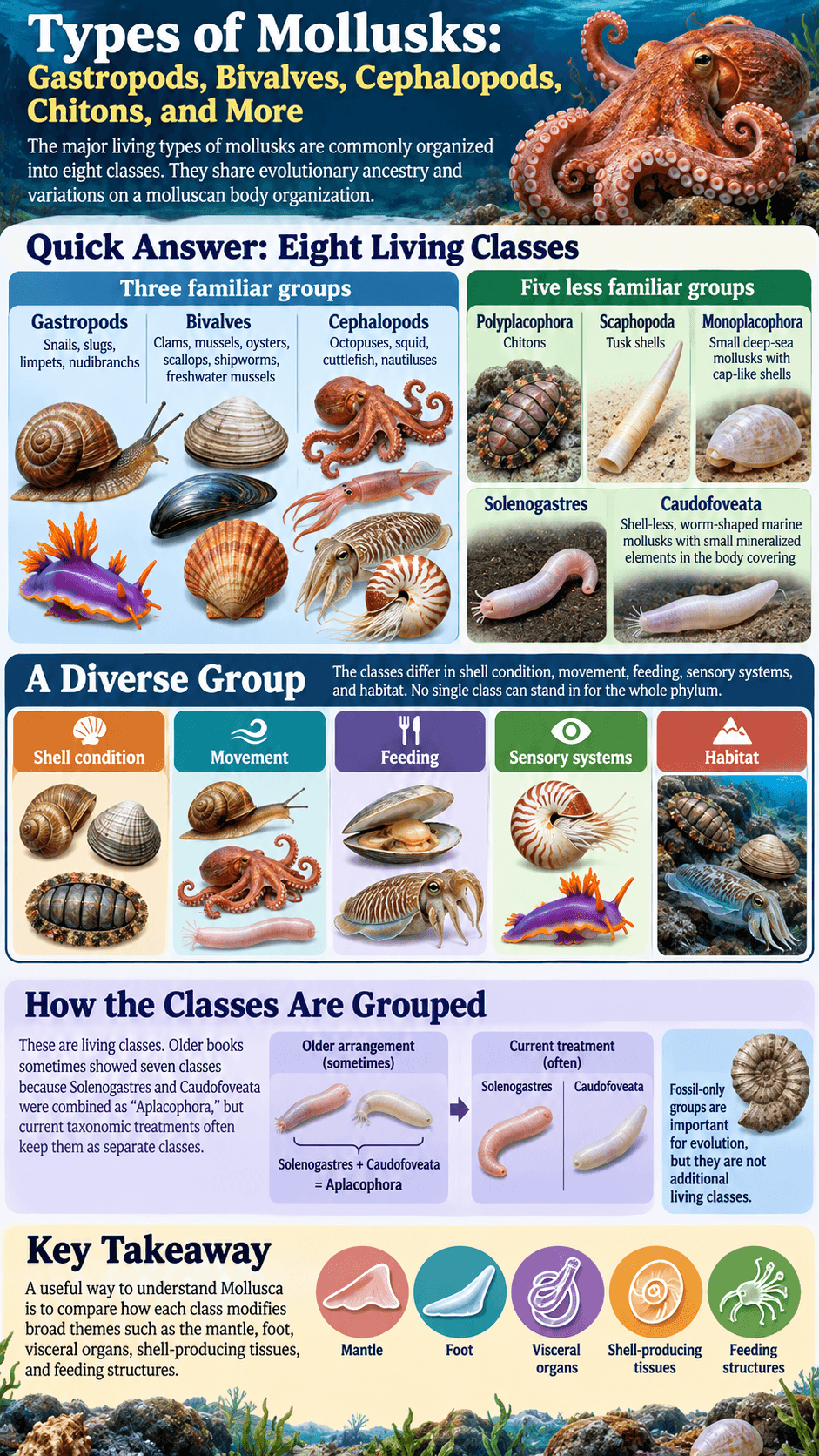
For general readers, the eight major living mollusk classes can be remembered as three familiar groups and five less familiar ones. Gastropods include snails, slugs, limpets, nudibranchs, and many other forms. Bivalves include clams, mussels, oysters, scallops, shipworms, and freshwater mussels. Cephalopods include octopuses, squid, cuttlefish, and nautiluses. Polyplacophora are the chitons, Scaphopoda are the tusk shells, Monoplacophora are small deep-sea mollusks with cap-like shells, and Solenogastres and Caudofoveata are shell-less, worm-shaped marine mollusks with small mineralized elements in their body covering.
These classes differ sharply in shell condition, movement, feeding, sensory systems, and habitat. No single class can stand in for the whole phylum. A useful way to understand Mollusca is to compare how each class modifies the same broad themes, including the mantle, foot, visceral organs, shell-producing tissues, and feeding structures.
How Mollusks Are Grouped
Living Classes vs Traditional Groupings
Older books sometimes present seven classes because Solenogastres and Caudofoveata were combined under the name Aplacophora. Current taxonomic treatments often keep them as separate classes. MolluscaBase’s published classification framework for Mollusca explicitly maintains Solenogastres and Caudofoveata as classes while noting the history of debate about their grouping. For a general reader, the practical point is simple: Aplacophora is a useful historical or convenient term in some contexts, but it should not automatically replace the two class names.
Other class names can appear in databases because Mollusca has a long fossil record. Fossil-only groups are important for understanding evolution, but they are not additional living mollusk classes. When the question is about types of mollusks alive today, the focus should remain on the eight extant class-level lineages listed above.
Why Current Taxonomy Can Change
Classification is not just a list of body shapes. Taxonomists compare anatomy, development, fossils, and molecular data to test how lineages are related. That process can change the arrangement of groups even when the familiar class names remain stable. A recent genomics resource summarizes the same eight molluscan classes while integrating modern taxonomic and genomic information across the phylum.
Deep relationships among classes have been especially difficult to resolve. For example, researchers have debated the placement of Monoplacophora and the relationships among the shell-less lineages, chitons, and the major shelled groups. Those questions matter to evolutionary biology, but they do not prevent readers from recognizing the eight living classes as useful class-level categories.
Gastropoda: Snails, Slugs, Limpets, and More
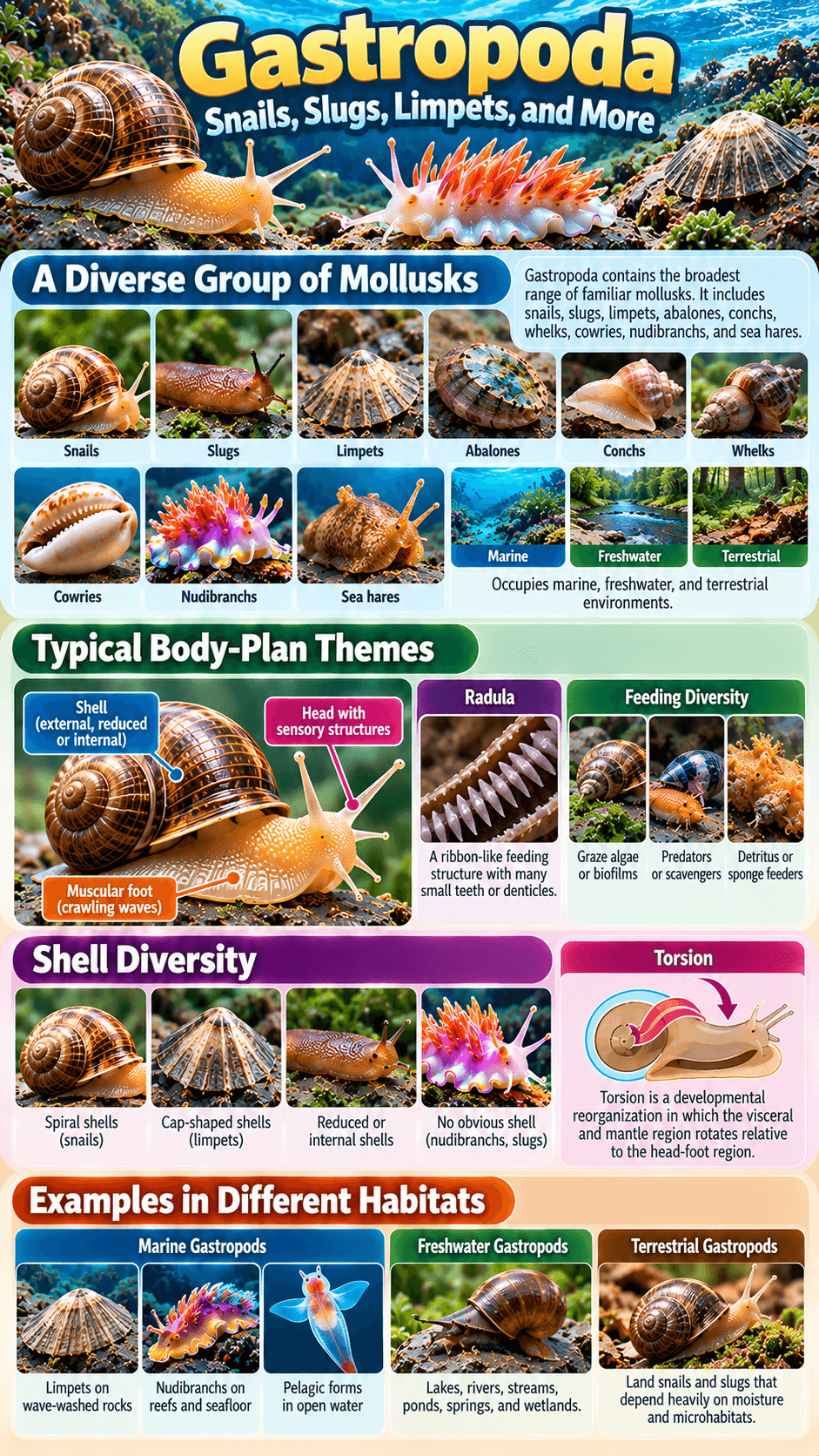
Gastropoda contains the broadest range of familiar mollusks. It includes land snails, freshwater snails, marine snails, slugs, limpets, abalones, conchs, whelks, cowries, nudibranchs, and sea hares. The class occupies marine, freshwater, and terrestrial environments, giving it a habitat range that no other living mollusk class matches in quite the same way.
Typical Body-Plan Themes
Many gastropods have a distinct head with sensory structures and a muscular foot that produces crawling waves. A radula, a ribbon-like feeding structure bearing many small teeth or denticles, is common. These similarities are useful, but Gastropoda is too diverse for one snail-shaped model to describe every member. Some species have prominent external shells, others have reduced or internal shells, and some lineages have lost the shell entirely.
Feeding varies just as much. Many species graze algae or biofilms, but others are predators, scavengers, detritus feeders, sponge feeders, or specialists on other invertebrates. Nudibranchs, cone snails, limpets, land snails, and pelagic sea butterflies can therefore share a class while living very different lives.
Shell Diversity and Torsion Without Equating Torsion With Coiling
A spiral snail shell is an easy symbol for Gastropoda, but it is not a class requirement. Limpet-like shells can be cap-shaped. Slugs and nudibranchs may have a reduced internal shell or no obvious shell. Shell reduction and loss have evolved repeatedly in gastropod history.
Gastropods are also known for torsion, a developmental reorganization in which the visceral and mantle region rotates relative to the head-foot region. Torsion is not the same process as making a coiled shell. Developmental research in the Journal of Molluscan Studies treats torsion and shell development as related but distinct aspects of gastropod body formation. Limpet-shaped gastropods provide an intuitive reminder that a gastropod can undergo torsional development without ending up with the classic high-spired snail form.
Marine, Freshwater, and Land Examples
Marine gastropods include limpets on wave-washed rocks, nudibranchs on reefs and other seafloor habitats, pelagic forms that live in open water, and countless shelled snails. Freshwater gastropods occupy lakes, rivers, streams, ponds, springs, and wetlands. Terrestrial gastropods include land snails and slugs that depend heavily on moisture and microhabitats that reduce water loss.
This range also explains why “snail” is not a habitat category. A snail may live in a forest, a desert microhabitat, a river, a tide pool, a deep-sea environment, or many other settings depending on its lineage.
Bivalvia: Clams, Mussels, Oysters, Scallops, and Relatives
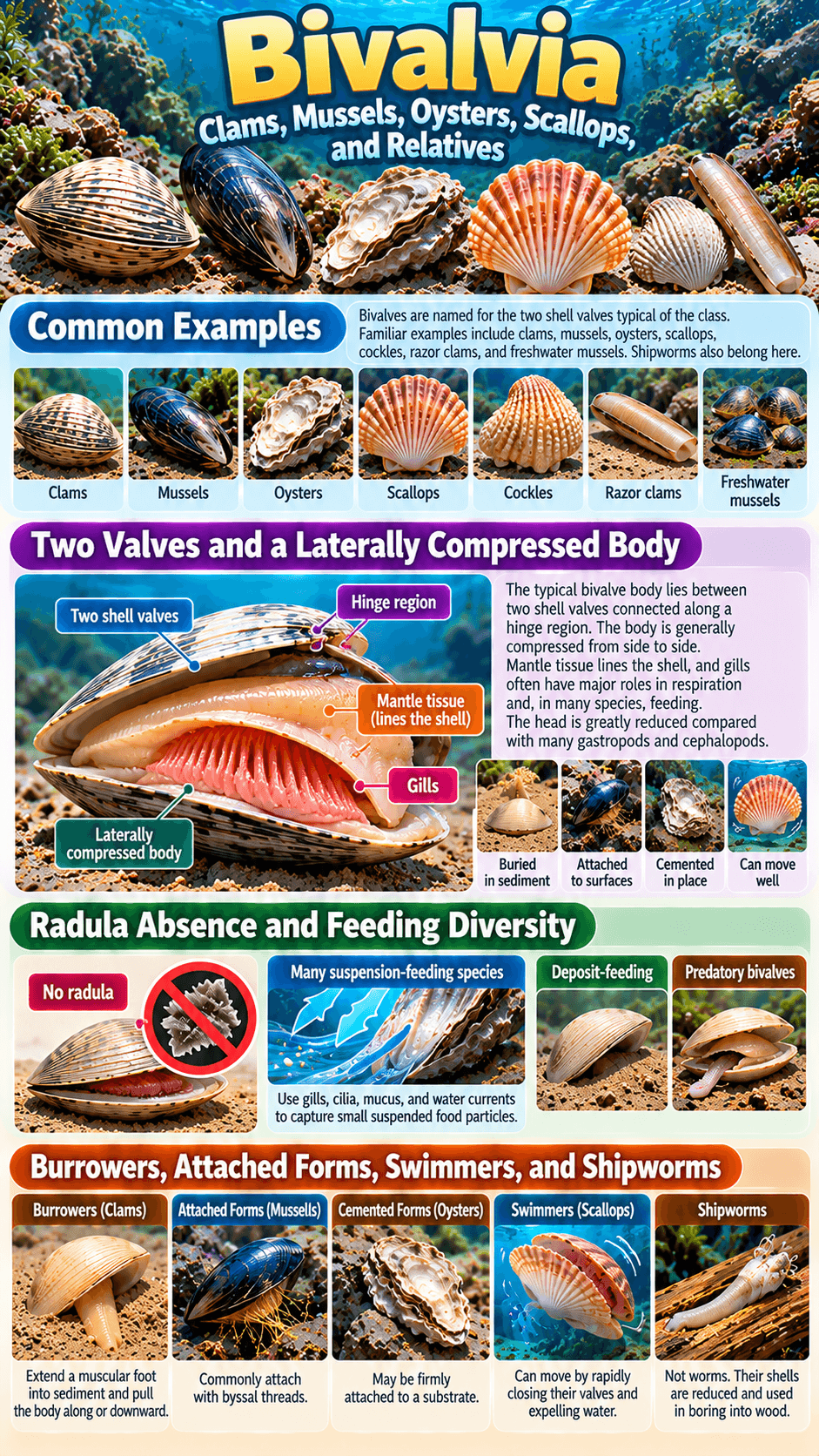
Bivalves are named for the two shell valves typical of the class. Familiar examples include clams, mussels, oysters, scallops, cockles, razor clams, and freshwater mussels. Shipworms also belong here, even though their long bodies and wood-boring lifestyle make them look unlike a conventional clam.
Two Valves and a Laterally Compressed Body
The typical bivalve body lies between two shell valves connected along a hinge region. The body is generally compressed from side to side. Mantle tissue lines the shell, and gills often have major roles in respiration and, in many species, feeding. The head is greatly reduced compared with the obvious head region of many gastropods and cephalopods.
The two-valve design does not mean every bivalve behaves alike. Some remain buried in sediment, some attach to hard surfaces, some become cemented in place, and some can move surprisingly well.
Radula Absence and Feeding Diversity
Bivalves are the major living mollusk class that lacks a radula. Many suspension-feeding species use gills, cilia, mucus, and water currents to capture small suspended food particles. That pattern is so common that bivalves are often described simply as filter feeders, but it is not universal. Deposit-feeding and predatory bivalves also exist.
The absence of a radula is useful for understanding why no single feeding structure can define all mollusks. It also shows how dramatically one class can reorganize the basic molluscan feeding system.
Burrowers, Attached Forms, Swimmers, and Shipworms
Many clams extend a muscular foot into sediment, anchor it, and pull the body along or downward. Mussels commonly attach with byssal threads. Adult oysters may be firmly attached to a substrate. Scallops can move through the water by rapidly closing their valves and expelling water.
Shipworms are one of the most misleadingly named bivalves. They are not worms. Their shells are reduced to small structures near the front of a long body and are used in boring into submerged wood. Their extreme form is a good example of why taxonomy cannot be based only on superficial appearance.
Cephalopoda: Octopuses, Squid, Cuttlefish, and Nautiluses
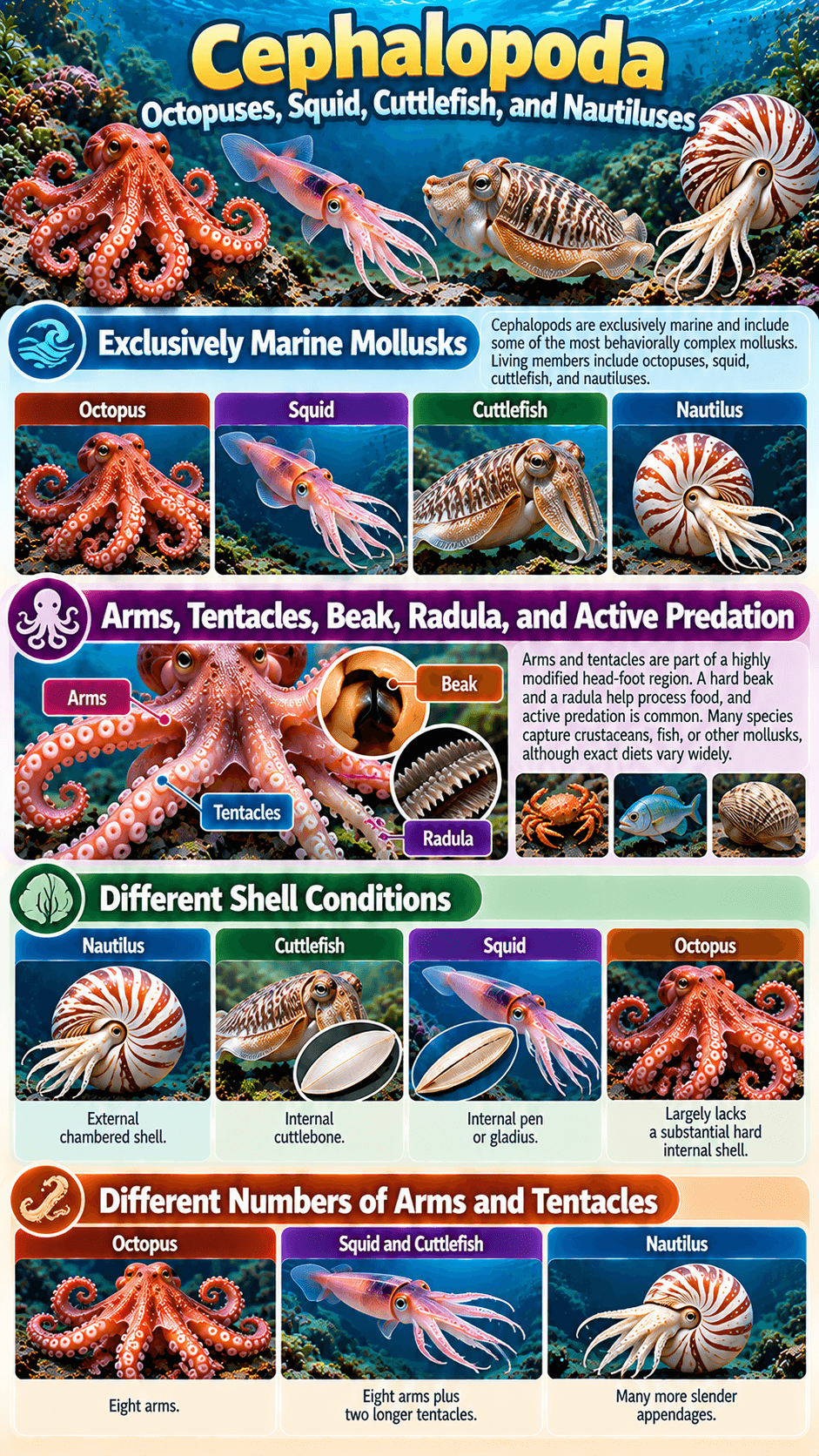
Cephalopods are exclusively marine and include some of the most behaviorally complex mollusks. Living members include octopuses, squid, cuttlefish, and nautiluses. They are active animals with a prominent head, large nervous systems, strong sensory abilities, and appendages around the mouth.
Arms, Tentacles, Beak, Radula, and Active Predation
Cephalopod arms and tentacles are part of a highly modified head-foot region. A hard beak and a radula help process food, and active predation is common. Many species capture crustaceans, fish, or other mollusks, although exact diets vary widely.
The class is often discussed through octopus intelligence or squid speed, but those themes can obscure its anatomical diversity. A nautilus, a cuttlefish, an octopus, and a pelagic squid all solve movement, buoyancy, feeding, and defense in different ways.
External, Internal, Reduced, and Lost Shell Conditions
Shell condition changes dramatically within Cephalopoda. Nautiluses retain an external chambered shell. Cuttlefish have an internal cuttlebone, many squid have an internal pen or gladius, and most familiar octopuses lack a substantial hard internal shell. The Smithsonian Ocean overview of living cephalopod diversity illustrates how these shell conditions differ across octopuses, squid, cuttlefish, and nautiluses.
This variation matters because the popular image of a mollusk as an animal enclosed by an external shell fails most obviously here. Cephalopods remain mollusks even when the ancestral shell has been internalized, reduced, or lost.
Why Not All Cephalopods Have Eight Arms
Octopuses have eight arms. Squid and cuttlefish generally have eight arms plus two longer specialized tentacles used in prey capture. Nautiluses have many more slender appendages and a very different arrangement. Saying that cephalopods are “eight-armed mollusks” therefore describes octopuses, not the whole class.
The terminology also matters. In common biological usage, the two elongated prey-capture appendages of squid and cuttlefish are distinguished as tentacles, while the shorter appendages are called arms. Nautilus appendages are structurally different again.
Polyplacophora: Chitons
Chitons are marine mollusks usually found crawling on or clinging to hard surfaces. Their most obvious feature is a row of eight dorsal shell plates surrounded by a muscular mantle margin called the girdle. The plates allow protection while still permitting some flexibility over uneven surfaces.
Eight Dorsal Shell Plates
The eight plates are shell structures, not body segments like those of an arthropod. Chitons do not become arthropod-like simply because the repeated plates look segmented. Their underlying organization is molluscan, including a broad foot and mantle tissues associated with the shell plates.
Smithsonian collection material for a West Indian chiton places the animal within Polyplacophora and provides a useful visual example of the class’s plated dorsal surface.
Adhesive Foot and Feeding Diversity
A broad muscular foot helps many chitons hold tightly to rocks, an important advantage in wave-exposed habitats. Many species graze algae and biofilms with a durable radula, but the class is not limited to one diet. Specialized predatory and other feeding strategies occur in some lineages.
Chitons therefore demonstrate two recurring lessons about Mollusca: a shell can be divided into multiple pieces, and a familiar feeding pattern can have important exceptions.
Scaphopoda: Tusk Shells
Scaphopods, commonly called tusk shells, are marine mollusks that usually live partly or completely within seafloor sediment. Their shell is elongated, curved or gently tapered, tubular, and open at both ends. Empty shells can resemble tiny tusks, which explains the common name.
Tubular Shells and Sediment Life
Living scaphopods are generally infaunal, meaning they live within sediment rather than on an exposed surface. The wider shell opening is oriented toward the deeper body end, while the narrower opening can remain closer to the sediment-water interface. Water exchange and waste movement are tied to this distinctive body position.
Because they spend much of their lives hidden, tusk shells are much less familiar to the public than beach-cast gastropod and bivalve shells. Their presence in Mollusca is another reminder that visible beach shells represent only part of the phylum.
Foot and Captacula at Overview Depth
The scaphopod foot is specialized for working through sediment. Slender feeding structures called captacula extend from the head region and help collect small food items. Depending on species, prey can include tiny organisms such as foraminiferans and other particles obtained from the sediment environment.
Captacula are distinctive to scaphopods, but they should not be mistaken for cephalopod arms or tentacles. Similar-looking structures in different classes can have different evolutionary origins and functions.
Monoplacophora
Living monoplacophorans are small marine mollusks best known from deep water. They have a single cap-like shell and a broad foot. Several internal structures occur in repeated series, a feature that made the discovery of living species especially interesting to zoologists studying molluscan evolution.
Deep-Sea Mollusks With Cap-Like Shells
The cap-like shell can make a monoplacophoran look superficially like a limpet. That resemblance does not make it a gastropod. Monoplacophora is its own class, and the repeated arrangement of organs such as certain gills, muscles, and excretory structures distinguishes its body organization.
Modern molecular studies have made the evolutionary placement of Monoplacophora an active research question. For a general class comparison, the safest conclusion is that monoplacophorans are a distinct living mollusk lineage, not a transitional species between today’s classes.
Why Living Fossil Language Is Misleading
Monoplacophorans are sometimes called “living fossils” because living representatives were discovered after similar shell forms were already known from fossils. The phrase can create the false impression that modern species are unchanged copies of ancient ancestors. They are not. Living monoplacophorans have continued evolving along their own lineages just as other living animals have.
It is more accurate to say that their discovery expanded scientists’ understanding of a lineage with a deep fossil history. That wording recognizes evolutionary continuity without implying that time somehow stopped for the group.
Solenogastres and Caudofoveata
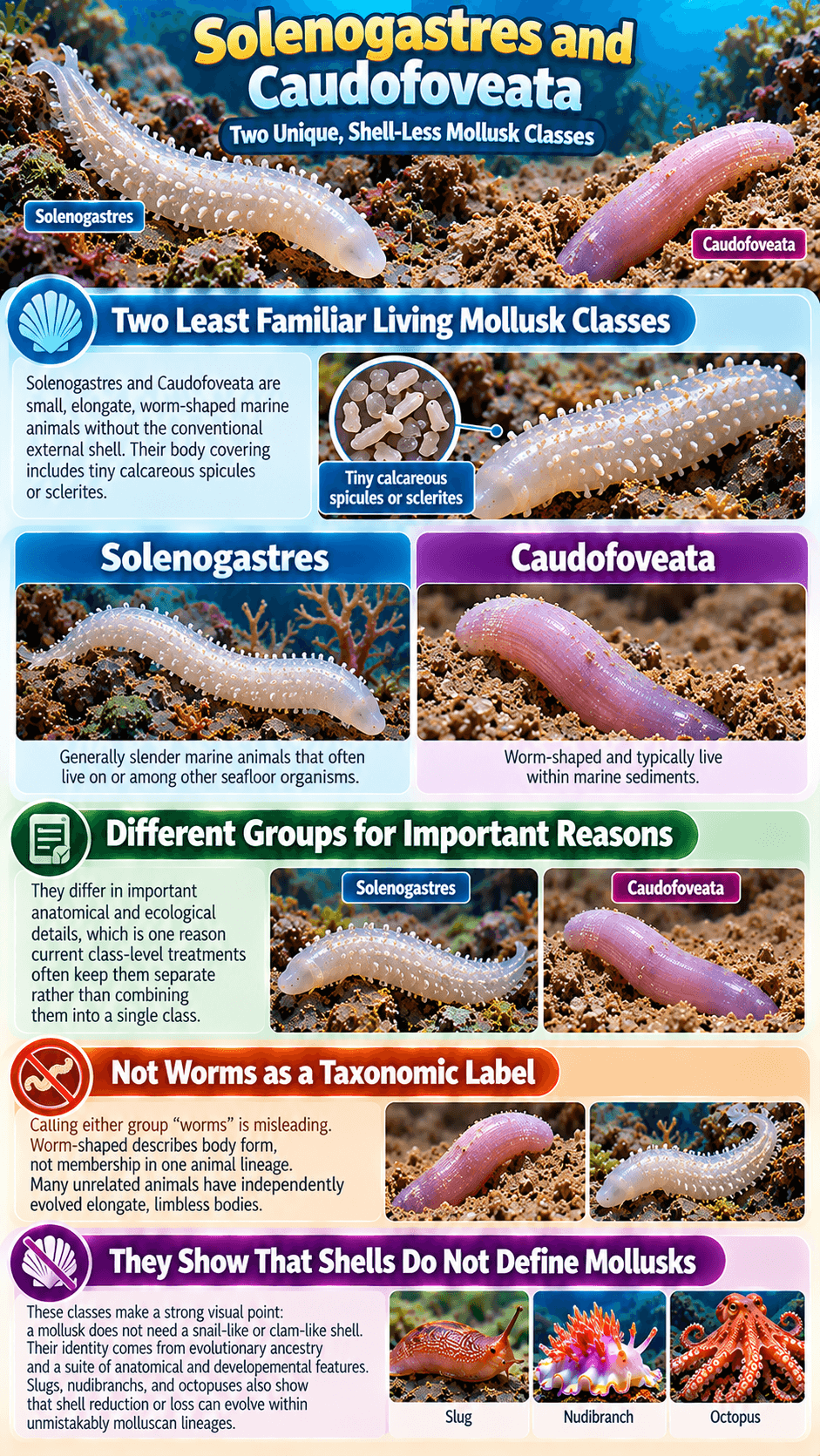
Solenogastres and Caudofoveata are the two least familiar living mollusk classes for many readers. Both contain small, elongate, worm-shaped marine animals without the conventional external shell seen in a snail or clam. Their body covering includes tiny calcareous spicules or sclerites, but their overall form is very different from the classic image of a shelled mollusk.
Worm-Shaped Shell-Less Mollusks With Spicules
Solenogasters are generally slender marine animals that often live on or among other seafloor organisms. Caudofoveates are also worm-shaped and typically live within marine sediments. They differ in important anatomical and ecological details, which is one reason current class-level treatments often keep them separate rather than collapsing them into a single class.
Calling either group “worms” as a taxonomic label is misleading. Worm-shaped describes body form, not membership in one animal lineage. Many unrelated animals have independently evolved elongate, limbless bodies.
How They Demonstrate That Shells Do Not Define Mollusks
These classes make a strong visual point: a mollusk does not need a snail-like or clam-like shell. Their identity comes from evolutionary ancestry and a suite of anatomical and developmental features, not from one obvious exterior trait.
That same principle applies elsewhere in the phylum. Slugs, nudibranchs, and octopuses also show that shell reduction or loss can evolve within unmistakably molluscan lineages.
Comparing the Major Living Classes
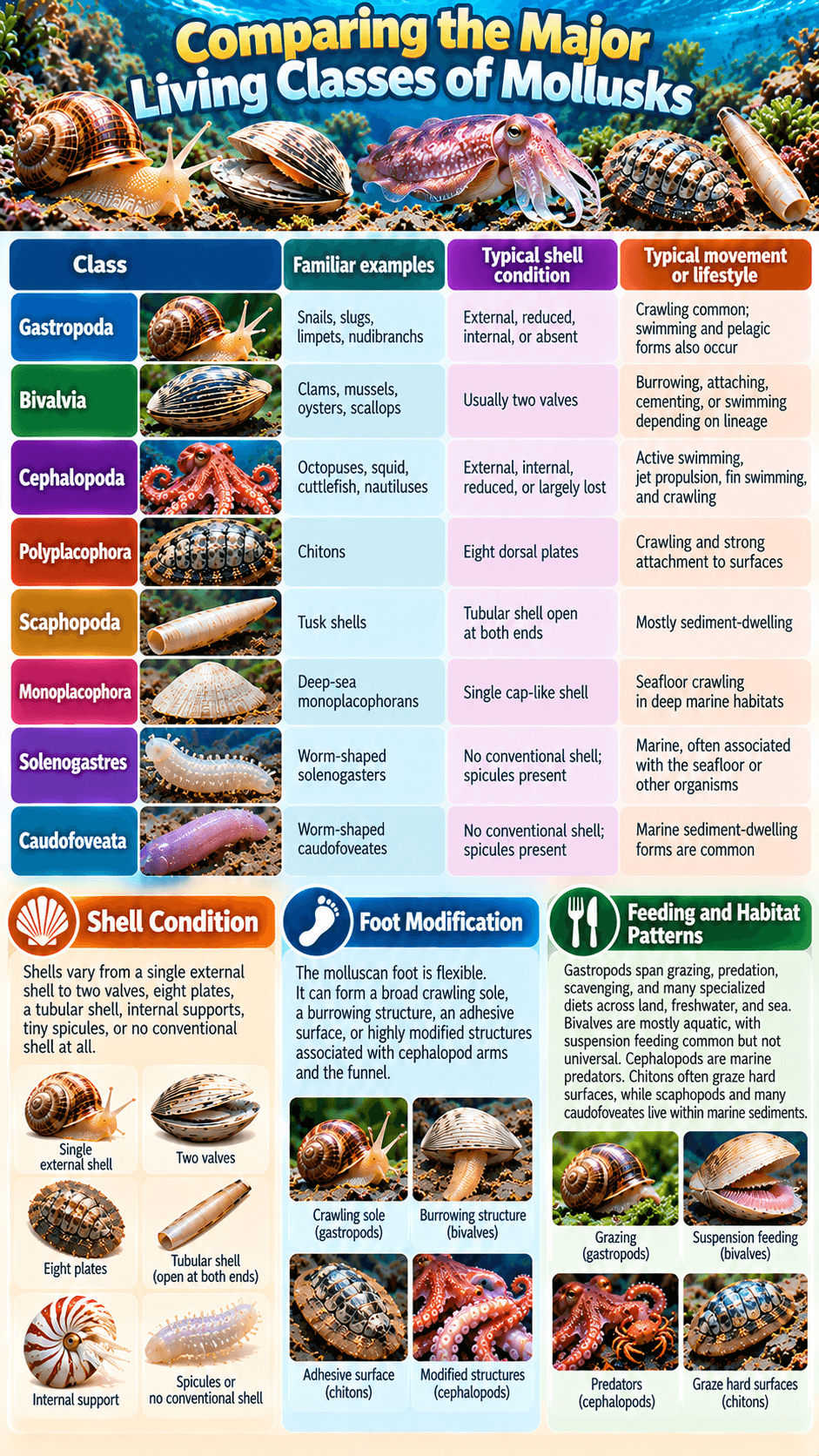
A side-by-side comparison makes the class differences easier to see without reducing any group to one feature.
| Class | Familiar examples | Typical shell condition | Typical movement or lifestyle |
|---|---|---|---|
| Gastropoda | Snails, slugs, limpets, nudibranchs | External, reduced, internal, or absent | Crawling common; swimming and pelagic forms also occur |
| Bivalvia | Clams, mussels, oysters, scallops | Usually two valves | Burrowing, attaching, cementing, or swimming depending on lineage |
| Cephalopoda | Octopuses, squid, cuttlefish, nautiluses | External, internal, reduced, or largely lost | Active swimming, jet propulsion, fin swimming, and crawling |
| Polyplacophora | Chitons | Eight dorsal plates | Crawling and strong attachment to surfaces |
| Scaphopoda | Tusk shells | Tubular shell open at both ends | Mostly sediment-dwelling |
| Monoplacophora | Deep-sea monoplacophorans | Single cap-like shell | Seafloor crawling in deep marine habitats |
| Solenogastres | Worm-shaped solenogasters | No conventional shell; spicules present | Marine, often associated with the seafloor or other organisms |
| Caudofoveata | Worm-shaped caudofoveates | No conventional shell; spicules present | Marine sediment-dwelling forms are common |
Shell Condition
Shells vary from a single external shell to two valves, eight plates, a tubular shell, internal supports, tiny spicules, or no conventional shell at all. This is why “animals with shells” cannot serve as a definition of Mollusca.
Foot Modification
The molluscan foot is equally flexible. It can form a broad crawling sole, a burrowing structure, an adhesive surface, or highly modified structures associated with cephalopod arms and the funnel. Some adult bivalves reduce its role dramatically. Looking at foot modification helps explain how closely related body-plan components can support very different ways of life.
Feeding and Habitat Patterns
Gastropods span grazing, predation, scavenging, and many specialized diets across land, freshwater, and sea. Bivalves are mostly aquatic, with suspension feeding common but not universal. Cephalopods are marine predators. Chitons are marine and often graze hard surfaces, while scaphopods and many caudofoveates live within marine sediments.
The pattern is diversity rather than a single molluscan lifestyle. Habitat and diet can help distinguish classes, but neither is sufficient by itself because many lineages contain exceptions.
Common Classification Mistakes
Treating Aplacophora as an Unquestioned Single Current Class
Aplacophora remains useful in historical writing and in discussions of relationships among shell-less, worm-shaped mollusks. However, a current general classification should recognize Solenogastres and Caudofoveata separately rather than presenting Aplacophora as the only accepted class name for both without explanation.
Calling Shipworms Worms
Shipworms are highly modified bivalves. Their long bodies and wood-boring lifestyle make the common name understandable, but their anatomy and ancestry place them among clams and other bivalves. Common names often describe appearance rather than true relationships.
Calling Chiton Plates Arthropod Segments
A chiton’s eight dorsal plates are shell plates. They are not the same structures as arthropod body segments or the jointed external skeleton of insects and crustaceans. Repeated hard structures can evolve in different animal groups without making those structures equivalent.
How Class Differences Shape Mollusk Biology
Shared Mollusk Traits
Understanding the classes makes the shared molluscan framework easier to recognize. The mantle, visceral organs, muscular foot ancestry, and shell-forming capacity are expressed differently from one class to another. Some traits are widespread without being universal, especially shells and radulas.
Comparative Anatomy
Class names become especially useful when comparing anatomy. A bivalve’s two valves, a chiton’s eight plates, a gastropod’s often prominent foot, and a cephalopod’s modified head-foot region are not random collections of features. They are different evolutionary outcomes built within the same phylum.
Gastropods, Bivalves, and Cephalopods Deserve Their Own Deeper Look
The three most familiar classes are internally diverse enough that broad labels quickly reach their limits. “Gastropod” includes both a garden slug and a pelagic sea butterfly. “Bivalve” includes a cemented oyster and a swimming scallop. “Cephalopod” includes a shell-bearing nautilus and a shell-less octopus. Knowing the class is the starting point, not the end of understanding an animal.
FAQ
How many major living classes of mollusks are recognized?
A common current treatment recognizes eight major living classes: Gastropoda, Bivalvia, Cephalopoda, Polyplacophora, Scaphopoda, Monoplacophora, Solenogastres, and Caudofoveata. Some older sources combine Solenogastres and Caudofoveata under Aplacophora, which is why readers may encounter a seven-class scheme. Fossil-only classes should not be added to a list of living mollusk classes.
Are slugs and snails in the same mollusk class?
Yes. Both slugs and snails are gastropods. The everyday distinction usually reflects shell condition rather than membership in different major classes. Many snails have conspicuous external shells, while animals called slugs typically have reduced, internal, or absent shells. Shell reduction has evolved more than once within Gastropoda, so “slug” does not refer to one single branch of the class.
Are octopuses and clams really both mollusks?
Yes. Octopuses belong to Cephalopoda and clams belong to Bivalvia, but both classes are within Mollusca. Their bodies look very different because the shared molluscan framework has been extensively modified in each lineage. Clams emphasize a two-valved shell and often a reduced head, while octopuses have a highly developed head-foot region, arms, complex sensory systems, and little or no substantial shell.
Final Thoughts
The types of mollusks extend far beyond snails, clams, and octopuses. Eight major living classes reveal an extraordinary range of forms, from plated chitons and tubular tusk shells to deep-sea monoplacophorans and shell-less solenogasters and caudofoveates. The most useful way to compare them is not to search for one universal outward feature, but to see how each class modifies a shared evolutionary framework. Once those class-level differences are clear, the seeming gap between a slug, an oyster, a nautilus, and a chiton becomes much easier to understand.

Ethan Walker is the founder and research editor of Animal Fact Central. He creates and reviews educational animal facts content using trusted wildlife, pet care, and science-based sources. His work focuses on making animal behavior, adaptations, habitats, and species facts clear, accurate, and engaging for everyday readers.
Read More Details About Ethan Walker: https://animalfactcentral.com/ethan-walker/