

Shell-bearing mollusks do not find an empty shell and move into it as they grow. They build their own shell. Specialized tissues in the mantle control the deposition of an organic framework and mineral components, especially calcium carbonate, so the shell can enlarge, thicken, and respond to some kinds of damage throughout the animal’s life.
This process is called biomineralization, meaning that a living organism controls the formation of a mineralized structure. The details vary widely among snails, clams, oysters, scallops, nautiluses, and other mollusks. Some lineages have external shells, others have internal or greatly reduced shells, and some have lost the large mineralized shell altogether.
Quick Answer
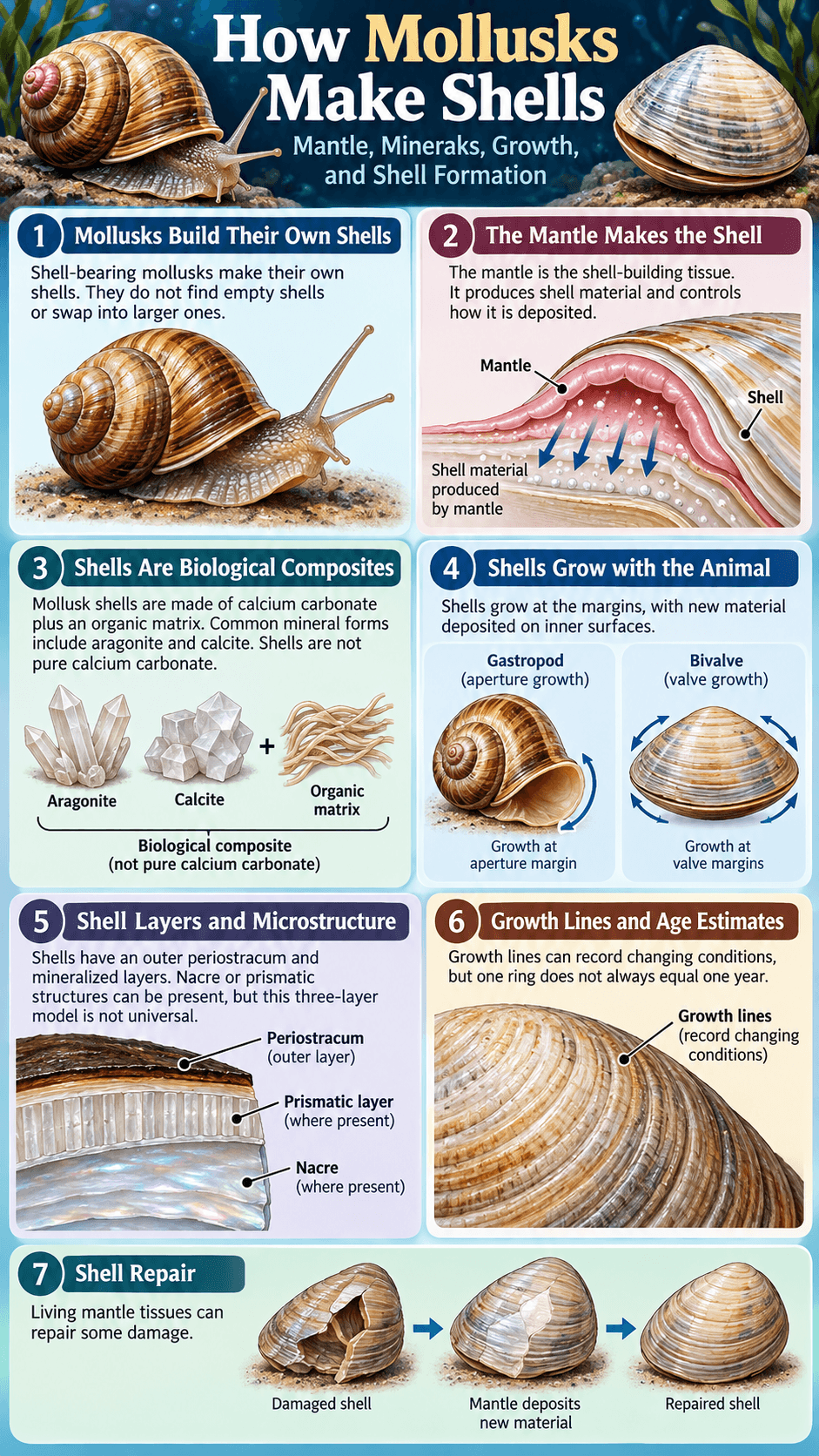
Mollusks make shells mainly through the mantle, a layer of living tissue associated with the animal’s body surface and mantle cavity. Mantle cells secrete organic molecules and help control the conditions in which calcium carbonate minerals are deposited. The resulting shell is a biological composite, not a simple block of mineral.
As the animal grows, new shell material is usually added at active growth margins, while deposition on inner surfaces can add thickness or specialized internal layers. The shell therefore grows with the mollusk. Its mineral form, microstructure, color, thickness, and layering depend on lineage, age, physiology, and environment.
The Mantle Is the Shell-Building Tissue
How Mantle Tissues Produce Shell Material
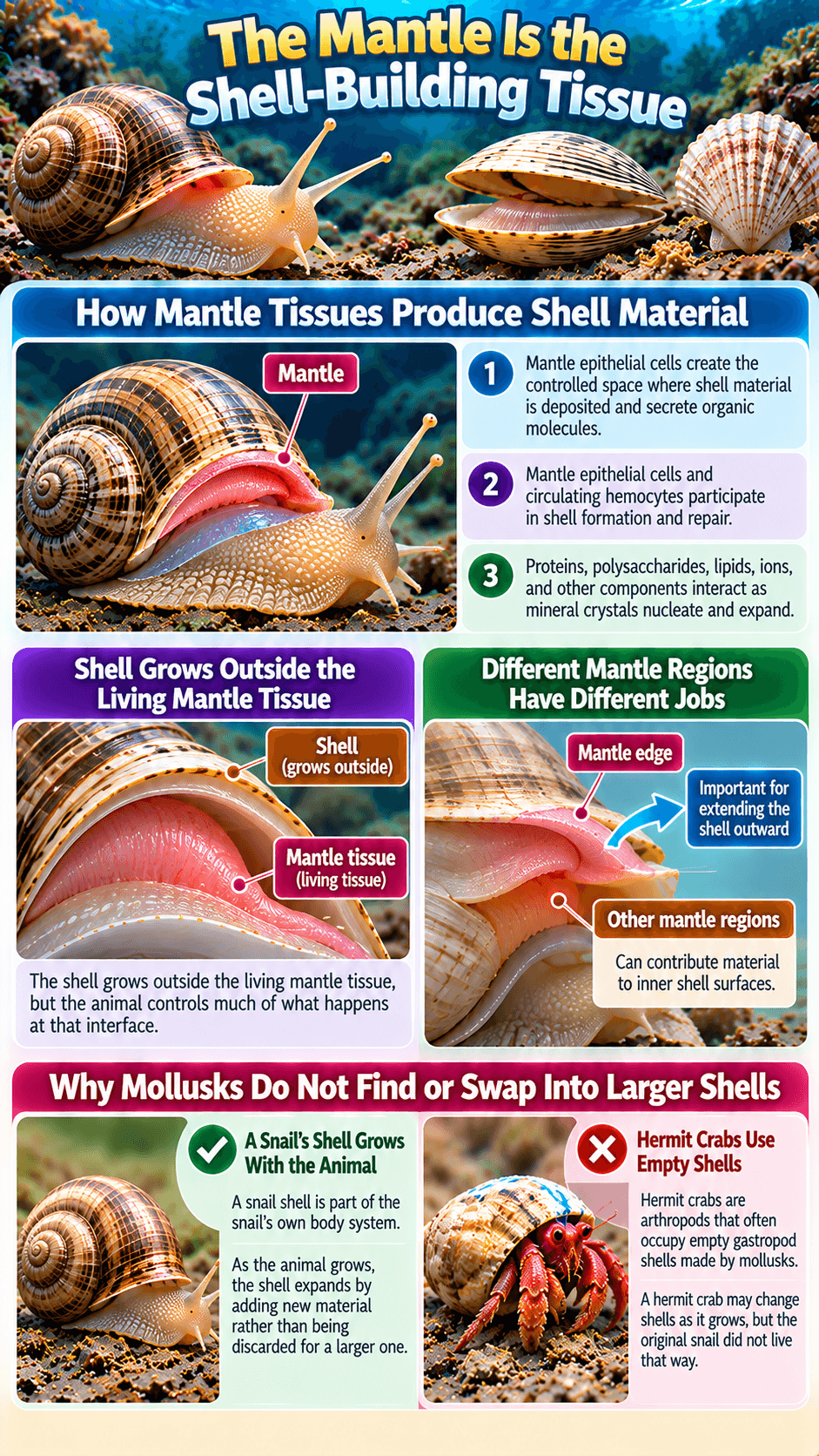
The mantle is central to mollusk shell formation. Its outer epithelial cells participate in creating the controlled space where shell material is deposited and secrete many of the organic molecules involved in mineralization. A modern review of molluscan shell biomineralization describes both mantle epithelial cells and circulating hemocytes as participants in shell formation and repair, while also noting that several details of the process remain active research questions.
The shell grows outside the living mantle tissue, but the animal controls much of what happens at that interface. Proteins, polysaccharides, lipids, ions, and other components interact as mineral crystals nucleate and expand. It is more accurate to picture shell formation as a regulated biological construction process than as calcium carbonate simply precipitating from seawater.
Different regions of the mantle can have different jobs. The mantle edge is especially important for extending the shell outward, while other mantle regions can contribute material to inner shell surfaces. This regional specialization helps explain how a shell can increase in both size and thickness without being replaced.
Why Mollusks Do Not Find or Swap Into Larger Shells
A snail shell is part of the snail’s own body system. A clam’s valves are likewise produced by the clam’s mantle. As the animal grows, the shell expands by adding new material rather than by being discarded for a larger one.
This is very different from a hermit crab. Hermit crabs are arthropods that often occupy empty gastropod shells made by mollusks. A hermit crab may change shells as it grows, but the original snail did not live that way. Confusing these two animals is one reason the myth of mollusks “changing shells” persists.
What Mollusk Shells Are Made Of
Calcium Carbonate Mineral Phases
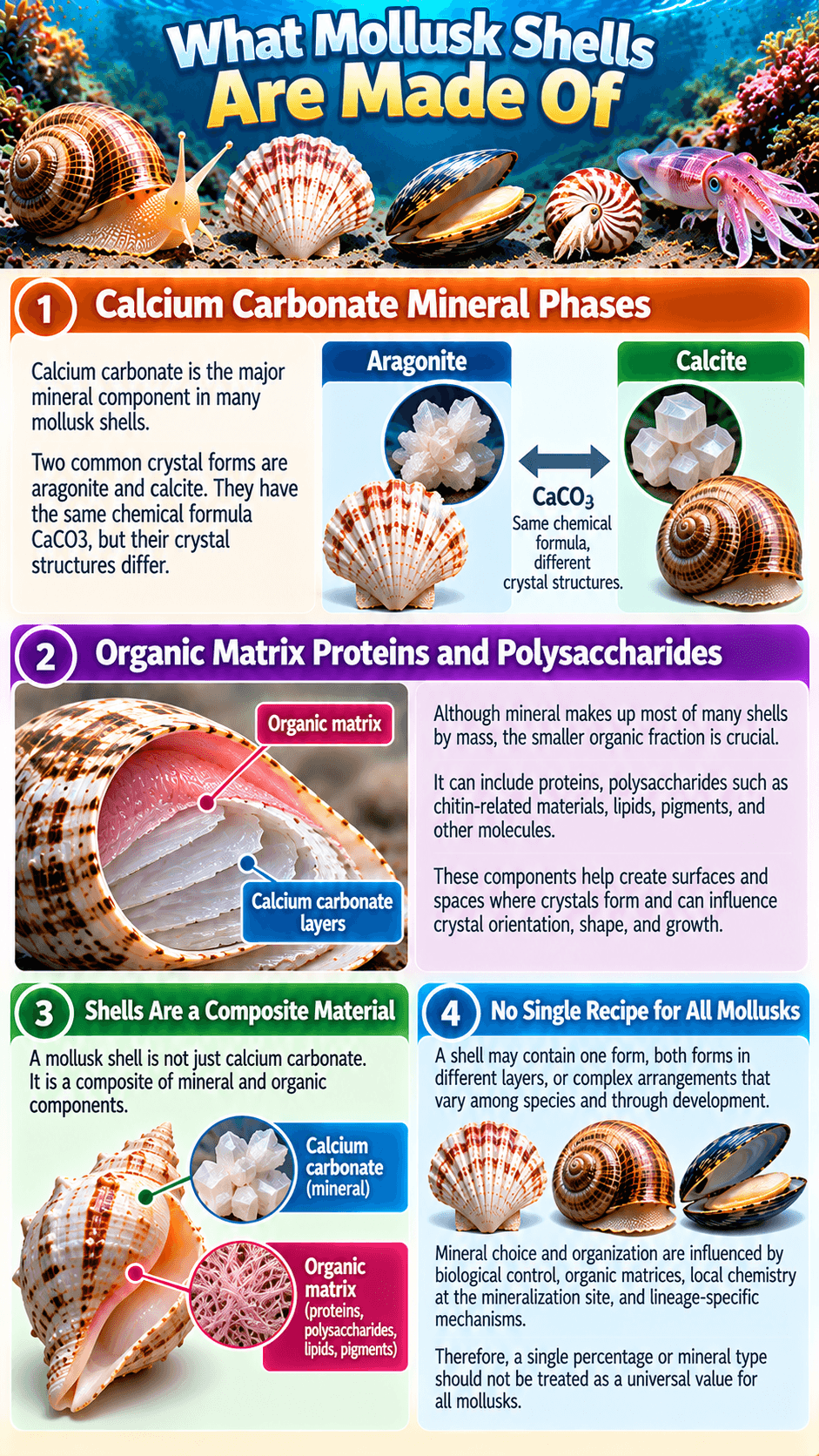
Calcium carbonate is the major mineral component in many mollusk shells. Two especially common crystal forms, or polymorphs, are aragonite and calcite. They have the same chemical formula, CaCO3, but their crystal structures differ. A shell may contain one form, both forms in different layers, or complex arrangements that vary among species and through development.
Researchers studying molluscan shell mineralization emphasize that shell structure cannot be reduced to one universal mineral recipe. Mineral choice and organization are influenced by biological control, organic matrices, local chemistry at the mineralization site, and lineage-specific mechanisms.
Some early larval stages can also use less ordered calcium carbonate forms before more stable crystalline structures develop. Because mineralogy can change with life stage and shell region, a statement such as “mollusk shells are made of aragonite” or “mollusk shells are made of calcite” is too broad.
Organic Matrix Proteins and Polysaccharides
Although mineral makes up most of many shells by mass, the smaller organic fraction is crucial. It can include proteins, polysaccharides such as chitin-related materials, lipids, pigments, and other molecules. These components help create surfaces and spaces where crystals form and can influence crystal orientation, shape, and growth.
Shell matrix proteins have received particular research attention because many are produced by mantle tissues and become associated with the mineralized shell. Their functions are not identical across mollusks. Different lineages can use different protein families or different versions of related proteins, which is one reason shell microstructures are so diverse.
Why Shells Are Not Pure Calcium Carbonate
Calling a shell “calcium carbonate” is useful shorthand, but it leaves out its composite nature. The organic framework may make up only a small fraction of the total mass, yet it contributes to how the mineral is arranged and how cracks behave. Pigments and trace elements can also contribute to shell appearance and chemistry.
The proportions are not identical in every species or every shell layer. For that reason, a single percentage should not be treated as a universal value for all mollusks. A safer description is that many mineralized mollusk shells are dominated by calcium carbonate integrated with a biologically produced organic matrix.
How Shells Grow With the Animal
Growth at Shell Margins
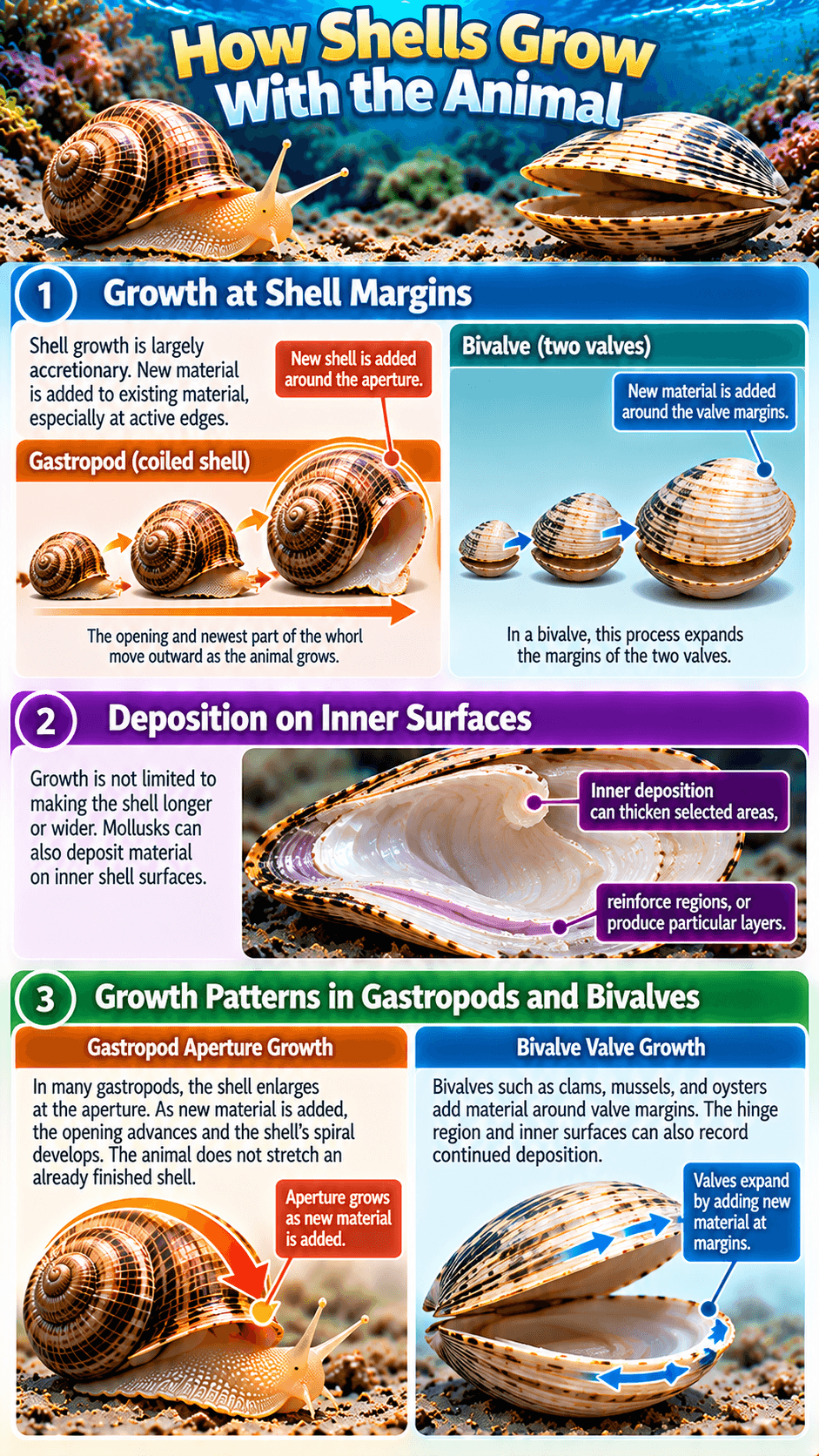
Shell growth is largely accretionary. New material is added to existing material, especially at active edges. In a bivalve, this process expands the margins of the two valves. In a coiled gastropod, new shell is added around the opening, or aperture, so the opening and the newest part of the whorl move outward as the animal grows.
This means the oldest shell material is generally not the newest outer edge. The pattern is recorded in the shell’s shape, layering, and growth increments. Because the shell remains attached to living mantle tissue during growth, its expansion has to stay coordinated with the animal’s soft body.
Deposition on Inner Surfaces
Growth is not limited to making the shell longer or wider. Mollusks can also deposit material on inner shell surfaces. This can thicken selected areas, reinforce regions subjected to mechanical stress, or produce particular microstructural layers.
Inner deposition helps explain why shell formation cannot be understood only by looking at the outer rim. The margin is a major growth front, but the mantle surface can continue modifying the shell from inside. The balance between edge extension and internal deposition differs among species, ages, and shell regions.
Gastropod Aperture Growth and Bivalve Valve Growth
In many gastropods, the shell enlarges at the aperture. As new material is added, the opening advances and the shell’s spiral or other geometry develops. The animal does not stretch an already finished shell. It expands the structure by adding a new edge to what was built before.
Bivalves such as clams, mussels, and oysters add material around valve margins. The hinge region and inner surfaces can also record continued deposition. Because the two valves must still meet and function together, their growth is coordinated with the ligament, muscles, mantle, and other soft tissues.
Shell Layers and Microstructure
Periostracum and Mineralized Layers
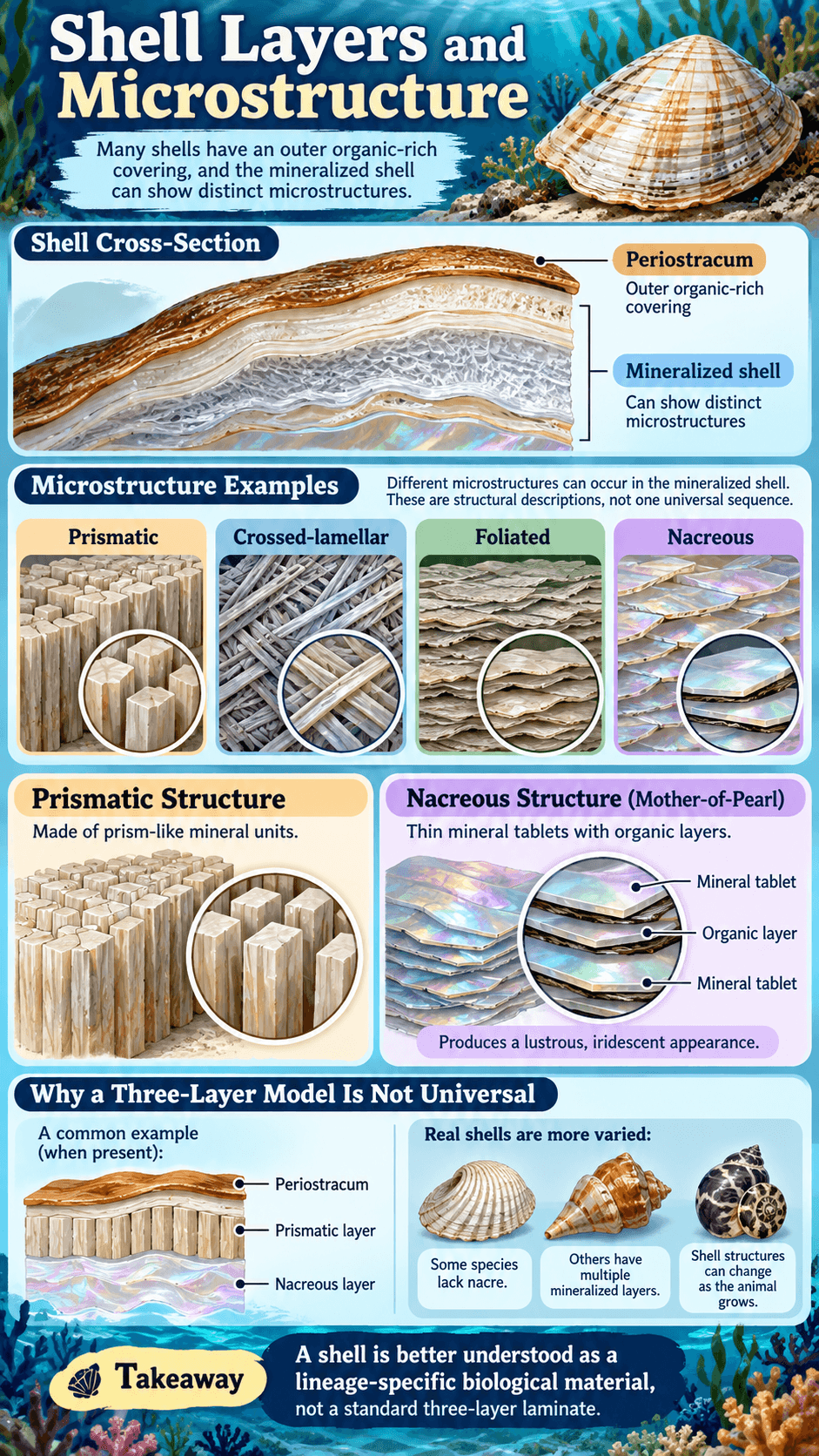
Many shells have an outer organic-rich covering called the periostracum. It can protect the underlying mineralized shell and plays roles during shell formation, but its thickness, persistence, and appearance vary greatly. In some species it is conspicuous, while in others it may be thin, worn, or difficult to notice.
Beneath or alongside that outer covering, the mineralized shell can be organized into distinct microstructures. Researchers use terms such as prismatic, crossed-lamellar, foliated, and nacreous to describe different arrangements of crystals and organic material. These are structural descriptions, not a single sequence shared by every mollusk.
Prismatic and Nacreous Structures Where Present
A prismatic layer consists of mineral units arranged in prism-like structures, but even “prismatic” shells vary in mineral type, crystal orientation, and organic composition. Nacre, commonly called mother-of-pearl, is another specialized microstructure in which thin mineral tablets are arranged with organic layers.
Nacre is famous because of its luster and mechanical properties, but it is not the default inner layer of every mollusk shell. Some lineages use other microstructures entirely. Even among nacre-bearing groups, the geometry of nacre differs. A comparison of nacre and prismatic structures across mollusks shows that the familiar nacre-prism pattern is not one universal shell blueprint.
Why a Three-Layer Model Is Not Universal
Diagrams often show a mollusk shell as three neat layers: periostracum, prismatic layer, and nacreous layer. That can be useful for explaining particular species, especially some well-studied bivalves, but it becomes misleading when presented as the plan for all mollusks.
Shell microstructure is much more varied. Some species lack nacre. Others have multiple mineralized layers with different structures, or structures that change as the animal grows. A shell is better understood as a lineage-specific biological material than as a standard three-layer laminate.
Growth Lines and Age Estimates
What Growth Lines Can Record
Shell growth does not always proceed at a constant rate. Temperature, food availability, tides, reproduction, stress, and other conditions can slow or interrupt deposition. These changes may leave visible or microscopic lines and increments in the shell.
A review of bivalve shell growth records notes that shell increments can form at daily, tidal, seasonal, or irregular intervals, and that stressful events can also leave growth anomalies. This is why shells can function as biological archives, but only when the timing of their increments has been validated for the species and population being studied.
Why One Ring Does Not Always Equal One Year
Some mollusks do form annual growth markers that researchers can use for age estimation. Others form several visible lines within a year, show irregular checks after stressful events, or lack clear annual bands. The reliability of ring counting therefore depends on the animal and the method.
Scientists may validate growth increments by following marked individuals, comparing shell chemistry with seasonal environmental cycles, examining internal rather than external lines, or using additional hard structures. Counting every visible ring as a year without species-specific validation can produce a false age.
Shell Repair
When Mantle Tissues Can Repair Damage
Living mollusks can repair some shell damage because the tissues that build shell remain active. When the shell is injured, mantle tissues can change their mineralization activity and deposit new material over or around the damaged area. The repair material may not perfectly reproduce the original shell architecture, especially early in the repair process.
Experiments on mussels, oysters, and scallops found coordinated changes in shell-building tissues after damage, with all three study species initiating and completing repair under experimental conditions. The bivalve biomineralization study also showed that different mantle regions have distinct molecular responses, reinforcing the idea that repair is an active biological process rather than simple mineral precipitation.
Why Severe Damage Does Not Always Regrow Completely
Repair ability has limits. A small break near a living mantle surface is not equivalent to crushing a large portion of the shell, tearing the mantle, damaging the hinge of a bivalve, or exposing soft tissues to prolonged injury. Species, age, health, damage location, water chemistry, infection risk, and the condition of the mantle can all affect the outcome.
For that reason, it is not accurate to say that a badly broken shell will always “grow back.” Shell repair should also not be treated as a do-it-yourself wildlife procedure. Injured wild animals are best left to appropriate wildlife or animal-care professionals when intervention is actually warranted and legally permitted.
External, Internal, Reduced, and Lost Shells

Slugs and Nudibranchs
Shell reduction and loss have evolved repeatedly within gastropods. Many slugs lack a large external shell, although some retain a small internal plate or other reduced shell material. Nudibranchs, a diverse group of marine gastropods, have lost the adult external shell in the lineages usually recognized as nudibranchs.
These animals are not mollusks that failed to complete shell growth. Their body plans reflect evolutionary changes in which the ancestral shell was reduced or lost, while other defenses and ways of supporting the body became more important.
Squid, Cuttlefish, and Octopuses
Cephalopods show another striking range of shell conditions. Nautiluses retain a large external chambered shell. Cuttlefish have an internal mineralized cuttlebone. Many squid have an internal support called a gladius or pen that is largely organic rather than a thick external mineralized shell. Most living octopuses lack a large shell, although small internal vestiges occur in some groups.
This diversity shows why “mollusk shell” does not describe one structure in one location. Evolution can move a shell inside the body, reduce its mineral content, simplify it, or eliminate most of it while the animal remains a mollusk.
Shell Loss as Evolutionary Change, Not Failure to Grow a Shell
Shells offer clear benefits, including mechanical protection and support, but they also have costs. Building mineralized tissue requires materials and energy, and a rigid shell can constrain movement or body shape. In some environments and lineages, other strategies can reduce the advantage of retaining a large external shell.
Shell reduction should therefore be understood as a change in the balance of body design, ecology, and defense across evolutionary time. It is not a defect and it does not make shell-less mollusks biologically incomplete.
Pearls and Nacre Without the Common Myths
Why Sand Is Not a Universal Pearl Trigger
The popular story says that a grain of sand enters an oyster, irritates it, and becomes a pearl. Real pearl formation is more varied. A pearl can develop when shell-producing tissues respond to an intrusive object, parasite, injury, or displaced tissue, depending on the mollusk and the circumstances.
The Florida Museum’s explanation of pearl formation notes that sand is not the only possible trigger and that tissue disturbance is central to the process. Cultured pearl production deliberately manipulates this biology, but that is a specialized practice rather than the normal explanation for how every natural pearl begins.
Why Not All Mollusks or Shell Layers Produce Nacre
Not every pearl is made of nacre, and not every mollusk produces nacre. Nacre occurs in particular groups and particular shell layers. Many shells use other microstructures, so “pearl equals mother-of-pearl” is not a universal rule.
This distinction also matters when discussing shell color and iridescence. A shiny inner surface may reflect a specific microstructure, while another shell can be strong and fully functional without a nacreous layer at all.
Shells Under Changing Environmental Chemistry
Why Acidification Responses Vary by Species and Life Stage
Marine mollusks build shells in seawater whose carbonate chemistry affects the availability and stability of calcium carbonate. As more carbon dioxide dissolves into seawater, pH and carbonate chemistry change. These changes can make calcification more energetically or chemically challenging for some shell-building organisms.
The response is not identical across mollusks. A review of mollusks and ocean acidification found strong variation among species, life stages, mineral forms, physiological capacities, and local environments. Larval stages can be especially sensitive in many studied species because early shell formation occurs during a period of rapid development and limited physiological buffering.
Why This Is More Complex Than Shells Simply Dissolving
It is misleading to say that future ocean chemistry will simply dissolve every mollusk shell. Some shells can experience greater dissolution or reduced calcification under certain conditions, but living animals also regulate the chemistry of mineralization sites, allocate energy to shell building, repair damage, and differ in tolerance.
Temperature, food supply, salinity, mineralogy, exposure time, local water chemistry, and genetics can change the result. The scientifically useful question is therefore not whether “acid melts shells,” but how a particular species and life stage changes shell production, maintenance, growth, and survival under a defined set of conditions.
Mollusk Shells vs Arthropod Exoskeletons
Mantle-Secreted Shell vs Arthropod Cuticle
A clam shell and a crab shell can both contain calcium carbonate, but they are not the same biological structure. A mollusk shell is produced by the mantle and grows by deposition at shell margins and surfaces. An arthropod exoskeleton is a cuticle produced by the epidermis and is periodically shed during molting so the animal can grow.
The two structures also differ in their evolutionary history, tissue relationships, and material organization. Calling a mollusk shell an “exoskeleton” can be acceptable in a broad functional sense because it is external support, but it should not imply that it is homologous to an arthropod cuticle.
Similar Minerals Do Not Make the Structures Homologous
Animals can independently use similar raw materials for different biological structures. Calcium carbonate appears in many animal skeletons and hard parts, but shared chemistry does not prove shared anatomical origin.
The same principle helps explain why a chiton’s shell plates are not arthropod body segments and why a snail shell does not make a snail related to a crab. The biological process that builds the structure matters as much as the material itself.
Common Shell Myths
Snails Change Into Bigger Shells
They do not. A snail builds and enlarges its own shell, mainly by adding material at the aperture and depositing material on internal surfaces. Empty snail shells may later be occupied by hermit crabs, which is a different behavior performed by a different animal group.
Every Shell Ring Shows One Year
Some validated growth lines are annual, but others may reflect tides, days, seasons, reproduction, stress, injury, or temporary growth interruptions. Age estimation requires a method that has been tested for the species and population.
Every Mollusk Shell Contains Mother-of-Pearl
Nacre is only one of many molluscan shell microstructures. Numerous mollusks build shells without a nacreous layer, and even nacre-bearing shells can contain other structures in different regions.
How Shell Biology Fits Into Mollusk Life
Shell Formation and Comparative Anatomy
The mantle links shell formation directly to mollusk anatomy. Understanding where the mantle lies and how it relates to the visceral mass and mantle cavity makes shell growth easier to visualize. Anatomy also explains why shell position differs so much among snails, bivalves, nautiluses, cuttlefish, squid, and shell-reduced gastropods.
Shells in Defense and Habitat
A shell can protect against predators, abrasion, wave action, and water loss, but its usefulness depends on habitat and lifestyle. Burrowing bivalves, rocky-shore limpets, terrestrial snails, and pelagic cephalopods face very different physical and biological pressures, so their shell designs and reliance on shells differ as well.
Environmental Change and Conservation
Shell-building biology also matters when scientists evaluate pollution, changing water chemistry, habitat alteration, and population decline. The important caution is to keep the scale appropriate. A laboratory result from one species or larval stage should not automatically be generalized to every mollusk in every habitat.
FAQ
Do mollusks grow their own shells?
Shell-bearing mollusks produce their own shells through living tissues, especially the mantle. New material is added as the animal grows, so a snail or clam does not normally leave its shell and move into a larger one. Some mollusk lineages have internal, reduced, or lost shells, but that reflects their evolutionary body plan rather than a failure to make a normal shell.
Can a damaged mollusk shell repair itself?
Some shell damage can be repaired if the animal survives and the relevant mantle tissues remain functional. Repair material may differ from the original shell in structure, especially at first. Severe breaks, damage to critical tissues, poor environmental conditions, or infection can limit repair, so it is not safe to assume that every damaged shell will fully regrow.
Do all mollusks have calcium carbonate shells?
No. Many shell-bearing mollusks build mineralized shells dominated by calcium carbonate, commonly using aragonite, calcite, or both. But many mollusks have reduced, internal, mostly organic, or absent adult shells. Even among mineralized shells, the proportion and arrangement of mineral and organic components vary among lineages and shell layers.
Final Thoughts
How mollusks make shells is a story of living tissue controlling mineral construction. The mantle creates and regulates the shell-building environment, organic molecules help organize mineral deposition, and calcium carbonate is assembled into structures that can expand, thicken, and sometimes repair damage. The result is not one universal shell plan but a remarkable range of biological materials shaped by lineage, function, growth, and environment.
That diversity is also the reason common shortcuts often fail. Not every shell has nacre, not every growth line marks a year, not every damaged shell repairs completely, and not every mollusk retains a large external shell. Understanding those exceptions makes shell formation more accurate and much more interesting than the simple idea of an animal “growing a hard covering.”

Ethan Walker is the founder and research editor of Animal Fact Central. He creates and reviews educational animal facts content using trusted wildlife, pet care, and science-based sources. His work focuses on making animal behavior, adaptations, habitats, and species facts clear, accurate, and engaging for everyday readers.
Read More Details About Ethan Walker: https://animalfactcentral.com/ethan-walker/