
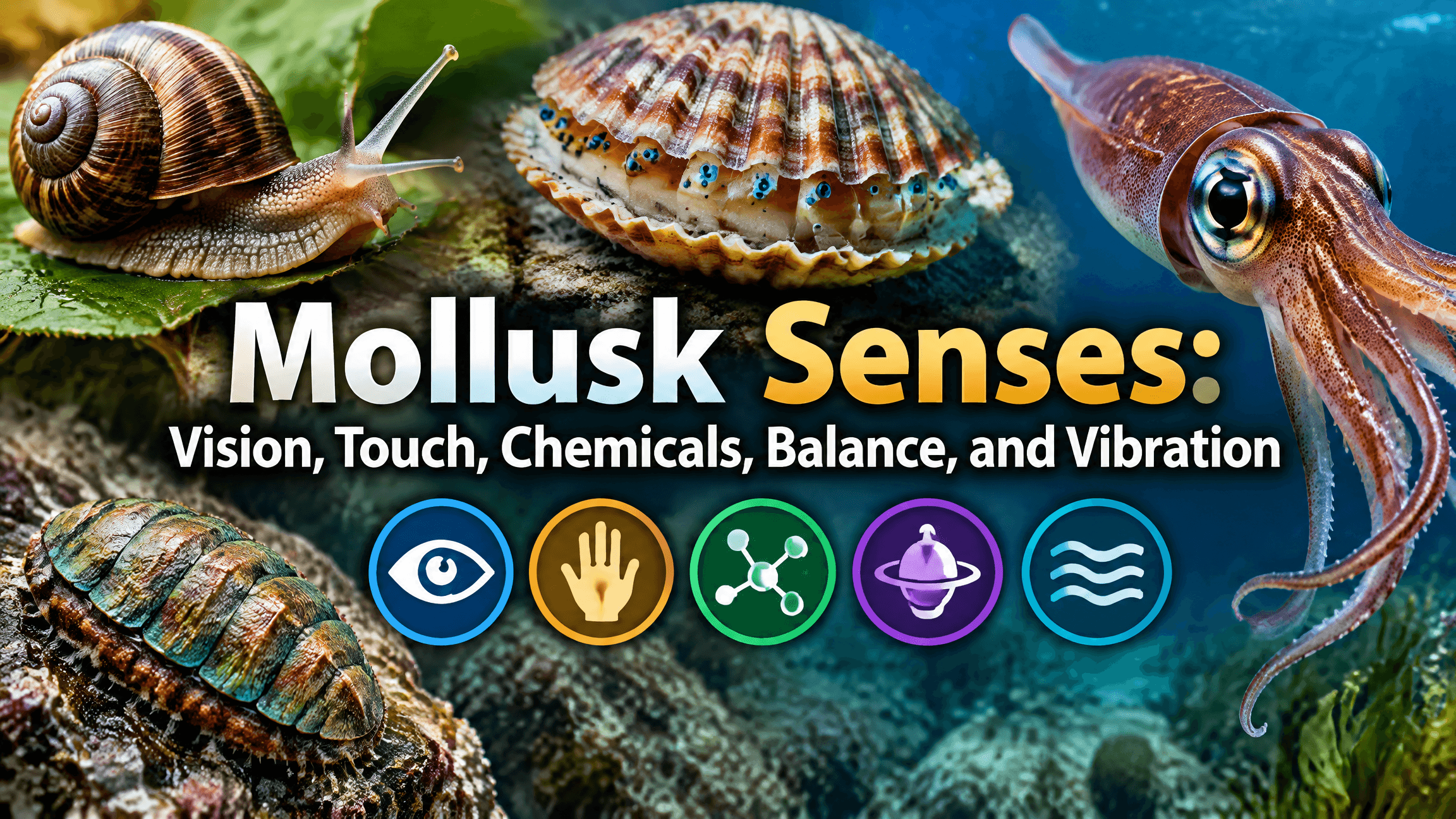
Mollusk senses are remarkably diverse because mollusks do not live, move, or feed in one standard way. A land snail exploring damp leaf litter, a scallop resting on the seafloor, a chiton gripping a wave-washed rock, and a squid hunting in open water face very different sensory problems. Their sensory systems reflect those differences.
Some mollusks detect little more than light direction, touch, chemicals, or motion near the body. Others form images, track movement, sense water-borne chemicals, monitor body orientation, or respond to vibrations and water flow. The important point is not that one mollusk has a “better” sensory system than another. Different structures are tuned to different ecological tasks.
Quick Answer

Mollusks can sense their surroundings through combinations of photoreception, vision, chemoreception, touch, mechanoreception, balance organs called statocysts, and other specialized sensory tissues. The exact combination varies widely among classes and species. Some gastropods use eyes and sensory tentacles, many bivalves have sensory structures along the mantle edge, some scallops form images with mirror-based eyes, selected chitons have shell-embedded visual structures, and many cephalopods have sophisticated camera-type eyes. Chemical, touch, flow, and orientation cues are equally important, especially in animals that do not depend heavily on image-forming vision.
There Is No Single Mollusk Sensory System
Sensory Diversity Across Major Classes
Mollusca includes animals with radically different body plans. Gastropods include snails, slugs, limpets, sea hares, and nudibranchs. Bivalves include clams, oysters, mussels, and scallops. Cephalopods include octopuses, squid, cuttlefish, and nautiluses. Chitons, tusk shells, monoplacophorans, solenogasters, and caudofoveates add still more variation.
Because these animals occupy different habitats and move in different ways, their sensory priorities differ. A crawling snail may rely strongly on chemical information and close-range touch. A buried bivalve may react to changes in water conditions, contact, pressure, or shadow rather than continuously forming detailed images. A fast-moving squid benefits from rapid visual processing because it must coordinate movement, prey capture, predator avoidance, and communication in open water.
Matching Sensory Systems to Ecological Tasks
It is tempting to rank sensory systems from “simple” to “advanced,” but that creates a misleading evolutionary ladder. A photoreceptor that only measures light intensity can be extremely useful if its main job is to warn an animal about a passing shadow. A chemical receptor can reveal food, predators, mates, or habitat conditions without producing any image at all.
Natural selection acts on usefulness in a particular setting, not on a universal scale of sensory complexity. That is why mollusks show so many different combinations of eyes, sensory epithelia, tentacles, statocysts, mantle-edge receptors, and other specialized structures.
Sensory investment also changes with how exposed an animal is. An animal that spends much of its life buried in sediment can gain more from detecting pressure, water chemistry, and nearby disturbance than from building a large image-forming eye. A mobile predator that must intercept moving prey may face the opposite problem. Even closely related species can emphasize different cues if one lives in bright shallow water and another occupies dimmer or more enclosed habitat.
This is why comparisons work best when they ask what information an animal needs and how that information reaches its nervous system. Light, dissolved chemicals, contact, acceleration, and water movement are different kinds of physical input. Mollusks convert those inputs into nerve signals through sensory cells arranged in structures suited to the animal’s body plan.
Vision and Light Detection

Simple Photoreceptors and Cup or Pit Eyes
Not every structure that detects light produces a detailed image. In many invertebrates, including mollusks, light-sensitive cells can provide information about brightness, direction, shadows, or day-night changes. Cup-shaped or pit-like arrangements can improve directional sensitivity by limiting the angles from which light reaches the receptors.
For an animal that needs to stay hidden under a rock or withdraw when a shadow passes overhead, that information may be enough. Image formation requires a more elaborate optical arrangement, but image formation is only one possible sensory solution.
Light detection can also help regulate ordinary daily behavior. A mollusk may change position as illumination changes, remain under cover during exposed periods, or adjust activity when a habitat becomes brighter or darker. These responses do not require the animal to identify objects. They require a receptor to distinguish meaningful changes in light and a nervous system capable of turning that change into behavior.
Mirror-Type Eyes in Scallops
Scallops provide one of the most unusual examples of mollusk vision. Some scallops have many small eyes along the mantle edge, and these eyes use a concave reflective structure to help form images. A detailed study of the scallop eye found that its mirror is built from carefully organized guanine crystals and works with two retinal layers. The authors reported up to about 200 eyes in the studied scallop visual system, but that number should not be generalized to every bivalve or every scallop species. The peer-reviewed study of the scallop’s image-forming mirror shows how different mollusk eyes can be from the lens-dominated systems people usually picture.
The presence of these eyes does not mean that all bivalves have hundreds of bright blue eyes. Bivalve sensory anatomy varies widely. Some species have conspicuous mantle eyes, while others depend on simpler photoreceptive or mechanosensory systems.
Camera-Type Eyes in Cephalopods
Many cephalopods have camera-type eyes with a pupil, lens, retina, and neural pathways that support rapid visual behavior. The overall optical layout looks superficially familiar to vertebrate eyes, but cephalopod eyes evolved independently and differ in important structural details.
A modern review of cephalopod visual processing describes how their eyes support object detection, motion analysis, polarization sensitivity, and other visually guided behaviors. It also emphasizes that cephalopod visual systems differ among species and habitats, so it is risky to treat an octopus, squid, cuttlefish, and nautilus as though they all process visual information identically. The review of cephalopod visual processing provides a useful overview of these differences.
Cephalopod Vision Without the Color-Vision Myths

Sophisticated Visual Processing
Cephalopods can use visual information for tasks such as locating prey, detecting predators, navigating, selecting camouflage patterns, and communicating with body displays. Many studied species are also sensitive to polarized light, a feature that can help reveal contrast or reflective structures underwater.
These abilities show why “good vision” is not the same thing as human-like color vision. A visual system can be highly capable while emphasizing brightness, contrast, motion, shape, polarization, or spatial structure rather than wavelength discrimination in the way humans do.
Why Conventional Color-Vision Claims Need Species-Specific Care
For many studied coleoid cephalopods, behavioral and physiological evidence points to limited conventional color discrimination. Most have been found to rely heavily on a single retinal photopigment, which is difficult to reconcile with ordinary multi-channel color vision. However, cephalopods are diverse, and a few deep-sea species have shown more complex photopigment arrangements.
That means two common statements are both too broad: “cephalopods see color just like humans” and “no cephalopod can ever distinguish color information.” The safer conclusion is that conventional retinal color vision appears limited in many well-studied coleoids, while unusual optical or neural mechanisms remain areas of active research.
Skin Photoreception as an Active Research Area
Cephalopod skin adds another layer of complexity. Research on cuttlefish and squid has found visual-pigment-related molecules and light sensitivity outside the eyes, including in skin tissues. These findings support the idea that some cephalopod tissues can detect light locally, but they do not prove that the skin forms images or “sees” color in the same way an eye does.
One study on cuttlefish found opsin expression in skin and proposed that distributed light sensing could contribute to local responses, while also noting that the detected opsins did not provide a simple explanation for color discrimination. The cuttlefish skin-photoreception research is a good example of why this topic should be presented as an evolving research question rather than a settled slogan.
Gastropod Sensory Structures
Tentacles, Eyes, and Chemical Sensing
Gastropods often combine vision, touch, and chemical sensing around the head and body. In many land snails and slugs, tentacles carry important sensory tissues, and the eyes may be positioned at or near the ends of one pair. Aquatic gastropods can use cephalic tentacles, rhinophores, lips, siphons, mantle structures, and other surfaces to sample their surroundings.
Chemical information is especially useful because odors and dissolved compounds can persist or spread even when visibility is poor. A gastropod can use chemical cues while searching for food, locating habitat, recognizing mates, or reacting to predators. A review of aquatic gastropod chemoreception describes how the relevant organs differ among species rather than following one universal plan. The review of gastropod chemoreception summarizes many of these structures and behaviors.
Why Mollusks Do Not All Smell With Tentacles
Calling a tentacle a “nose” can be a useful analogy for beginners, but it is biologically incomplete. Chemoreceptors may occur on tentacles, around the mouth, on the foot, in the mantle cavity, on siphons, or in other specialized epithelia. The distribution depends on the animal.
Even within gastropods, different lineages use different combinations of structures. A terrestrial slug exploring air and surfaces has different sensory demands from a marine snail tracking dissolved chemicals in moving water. The same broad sense, chemoreception, can therefore be supported by different organs and behaviors.
Bivalve Sensory Systems

Mantle-Edge Photoreception and Eyes in Some Groups
Bivalves are sometimes described as passive animals with little ability to sense their environment, but that is inaccurate. Sensory structures can occur along the mantle margins and around openings exposed to the water. Depending on the species, these may respond to light, touch, water movement, chemicals, or approaching objects.
Scallops are the dramatic visual example, but other bivalves can possess photoreceptive structures ranging from simple light-sensitive cells to more organized eyes. These systems can trigger shell closure, swimming, withdrawal, or other responses when conditions change.
The location of the receptors makes functional sense. Much of a bivalve’s soft body is enclosed between the valves, while the mantle margin, siphons, and nearby tissues are closer to incoming water and the outside environment. Placing sensory tissue at those boundaries allows the animal to sample conditions without needing a centralized head like a snail or squid.
Why Not All Bivalves Have Hundreds of Blue Eyes
The famous row of bright mantle eyes seen in some scallops should not be used as a template for Bivalvia as a whole. Oysters, mussels, clams, scallops, shipworms, and other bivalves differ in body form, mobility, and exposure to the environment.
Recent experimental work also supports chemical sensing in bivalves. Electrophysiological research on the Pacific oyster found responses from a structure identified as the osphradium when exposed to chemical stimuli. At the same time, scientists continue to debate whether structures called “osphradia” across different mollusk groups are truly equivalent in evolutionary origin and function. The Pacific oyster chemoreception study illustrates both the evidence and the need for careful wording.
Chiton Sensory Structures

Shell-Embedded Sensory Systems
Chitons carry eight dorsal shell plates, and their plates can contain networks of small sensory structures called aesthetes. These are not simply decorative pores. They connect the armored exterior with sensory tissues beneath and may participate in detecting environmental information.
The exact sensory role of aesthetes varies and is still being investigated. Importantly, not every chiton has the same visual system. Some lineages have evolved more specialized eyes or eyespots within the shell, while others retain less elaborate sensory arrangements.
Mineralized Lenses in Selected Lineages
In the West Indian fuzzy chiton Acanthopleura granulata, researchers showed that shell-embedded eyes contain lenses made from aragonite, a mineral form of calcium carbonate. These lenses can focus images onto retinal tissue. That finding is striking because the same broad biomineralized structure that provides armor also supports a visual function.
The discovery should not be inflated into “all chitons have rock eyes.” Image-forming shell eyes occur in selected lineages, and sensory systems vary among chiton groups. The study of aragonite lenses in chiton eyes demonstrates the specialized case without making it universal.
Chemoreception
Osphradia and Other Chemical-Sensing Structures
Chemoreception means detecting chemical cues in the environment. For aquatic mollusks, those cues may arrive dissolved in water. For terrestrial gastropods, chemical information can be sampled from air, mucus trails, food surfaces, soil, or vegetation.
The osphradium is often described in textbooks as a chemosensory structure associated with the mantle cavity, usually near respiratory structures. That description can be useful, but it should not be treated as a single identical organ present in every mollusk. Comparative researchers have questioned whether all structures historically called osphradia are truly homologous or function in the same way.
How Chemical Sensing Varies by Class
Gastropods may use tentacles, rhinophores, oral tissues, siphons, or mantle-associated organs. Bivalves can respond to dissolved chemicals and water conditions through mantle-cavity sensory tissues. Cephalopods use chemical sensing on arms, suckers, and other tissues alongside vision and touch. Other mollusk groups have their own combinations.
This diversity matters because “smell” is a human-centered word. In water, chemicals move in plumes shaped by currents and turbulence. A mollusk may respond to concentration changes, contact chemicals, or compounds carried through flowing water rather than detecting airborne odor in the mammalian sense.
Touch, Water Movement, and Vibration
Mechanoreception at the Body Surface
Mechanoreception is the detection of physical forces such as touch, pressure, stretch, vibration, or water movement. It is especially important for animals that crawl against surfaces, burrow into sediment, attach to rocks, or live with soft tissues exposed around a shell opening.
Sensory cells in the skin, mantle, tentacles, siphons, arms, suckers, or other tissues can respond when the animal is contacted or when nearby water shifts. A sudden mechanical cue may cause withdrawal, shell closure, a change in posture, escape movement, or closer investigation.
Detecting Flow, Substrate Disturbance, and Contact
Water is constantly moving around aquatic mollusks. Flow direction and disturbance can carry information about approaching animals, food particles, sediment movement, waves, or changing habitat conditions. A burrowing clam and a swimming squid encounter this information very differently, so they do not need identical sensors.
Substrate-borne vibration can also matter. An animal attached to rock or buried in sediment can receive mechanical information through the surface it touches. In practice, touch, flow sensing, and vibration sensing often overlap because they are different forms of mechanical stimulation rather than neatly separated categories.
The behavioral response depends on context. A small disturbance might produce a brief pause, a change in siphon position, or a local withdrawal. A stronger or rapidly approaching disturbance may trigger valve closure, deeper retraction, swimming, or escape. These responses should not be described as proof that the animal has identified a specific predator. The sensory system may only be detecting a pattern of mechanical change that has often been associated with danger.
Mechanosensation also works during normal movement. A crawling foot experiences contact and resistance from the substrate, arms and suckers encounter objects directly, and mantle tissues change shape during ventilation or swimming. Sensory feedback from these movements helps the nervous system adjust posture and force as the animal acts.
Statocysts and Balance

Orientation and Motion Sensing
Many mollusks have statocysts, small sensory organs involved in orientation and motion detection. A typical statocyst contains sensory cells and one or more dense bodies, often called statoliths or statoconia, whose movement relative to the receptor surface provides information about position or acceleration.
In cephalopods, statocysts are particularly important for balance and coordinated swimming. Research on cephalopod statocysts has compared their role to the vestibular function of vertebrate inner ears, while also emphasizing their distinct anatomy. Research on cephalopod statocysts describes their role in orientation and locomotor control, including how sensitivity can relate to body movement and swimming behavior.
Why Statocysts Are Not Simply Ears
Calling a statocyst an “ear” is convenient because both systems can detect mechanical movement, but the analogy can mislead. A statocyst is not a miniature vertebrate ear, and its primary role in many mollusks is orientation, acceleration, and body-position sensing.
Some mollusks can respond to vibrations or acoustic energy, and cephalopods in particular have been studied for sensitivity to low-frequency particle motion. Still, balance sensing, vibration detection, and hearing should not automatically be treated as the same biological function.
Common Sensory Myths
Bivalves Cannot Sense Their Environment
Bivalves may lack a prominent head, but they are not disconnected from their surroundings. Mantle-edge receptors, photoreceptors, mechanoreceptors, statocysts, and chemical-sensing structures can provide enough information for feeding, withdrawal, shell movement, burrowing, swimming, or other responses.
All Mollusks See in the Same Way
Mollusk eyes and light-sensitive structures range from simple photoreceptive systems to image-forming organs with very different optics. Scallops use reflective mirrors, many cephalopods use camera-type eyes, and some chitons use mineralized lenses embedded in the shell. These are not stages in one straight evolutionary sequence. They are different solutions to different sensory problems.
Octopus Color Perception Is Completely Settled
Many well-studied octopuses and other coleoids appear to have limited conventional retinal color vision, but cephalopod light detection includes polarization sensitivity, unusual pupil optics, and extraocular photoreception. Researchers continue to test how these systems interact. The safest summary is that conventional color-discrimination evidence is limited in many species, while alternative mechanisms remain an active field of study.
How Senses Work With Anatomy, Feeding, Habitat, and Defense
Sensory Anatomy
Sensory structures make more sense when viewed as part of the body plan. Tentacles place receptors where a gastropod can sample what lies ahead. Mantle-edge receptors let a bivalve monitor conditions around exposed tissue. Shell-embedded systems allow some chitons to gather information without giving up the protection of dorsal armor. Cephalopod eyes and statocysts support rapid movement in three-dimensional water space.
Finding Food and Avoiding Predators
Senses guide behavior. Chemical cues can lead an animal toward food or away from danger. Vision can reveal movement. Touch can trigger withdrawal. Water disturbance can warn that another animal is nearby. A sensory system is therefore not an isolated anatomical feature. It becomes useful through the behavior it helps control.
Habitat and Defense
Habitat sets the sensory background. Clear open water favors different information than muddy sediment, a rocky intertidal surface, a reef crevice, or damp forest litter. Defense also changes the value of particular cues. A slow animal protected by a shell may need a fast withdrawal response, while a mobile cephalopod can combine visual detection with camouflage, jetting, arm movement, or hiding.
FAQ
Do mollusks have eyes?
Many mollusks have eyes or light-sensitive structures, but not all have image-forming eyes. Some gastropods have eyes associated with tentacles, some scallops have many mantle eyes, many cephalopods have large camera-type eyes, and selected chitons have shell-embedded eyes. Other mollusks may rely mainly on simple photoreceptors rather than detailed vision.
How do mollusks sense chemicals?
Mollusks use chemoreceptor cells located on different body surfaces and organs. Depending on the group, these can include tentacles, rhinophores, oral tissues, siphons, mantle-associated sensory epithelia, suckers, or structures historically called osphradia. There is no single universal “nose” shared by all mollusks.
How do mollusks keep their balance?
Many mollusks use statocysts to detect orientation and movement. Inside a statocyst, dense particles or bodies shift relative to sensory cells as the animal changes position or accelerates. The nervous system can use that information to help coordinate posture and locomotion. The exact design and importance of statocysts vary among groups.
Final Thoughts
Mollusk senses cannot be reduced to one eye type, one chemical organ, or one universal body plan. Across the phylum, animals detect light, images, chemicals, touch, water movement, vibration, and body orientation in combinations shaped by how they live. A scallop’s reflective eyes, a chiton’s shell-based sensory structures, a gastropod’s chemical receptors, and a cephalopod’s camera-type eyes are best understood as different biological solutions rather than steps on a single ladder of complexity. Looking at those differences makes the diversity of Mollusca easier to understand and helps explain how each animal interacts with its particular environment.

Ethan Walker is the founder and research editor of Animal Fact Central. He creates and reviews educational animal facts content using trusted wildlife, pet care, and science-based sources. His work focuses on making animal behavior, adaptations, habitats, and species facts clear, accurate, and engaging for everyday readers.
Read More Details About Ethan Walker: https://animalfactcentral.com/ethan-walker/