
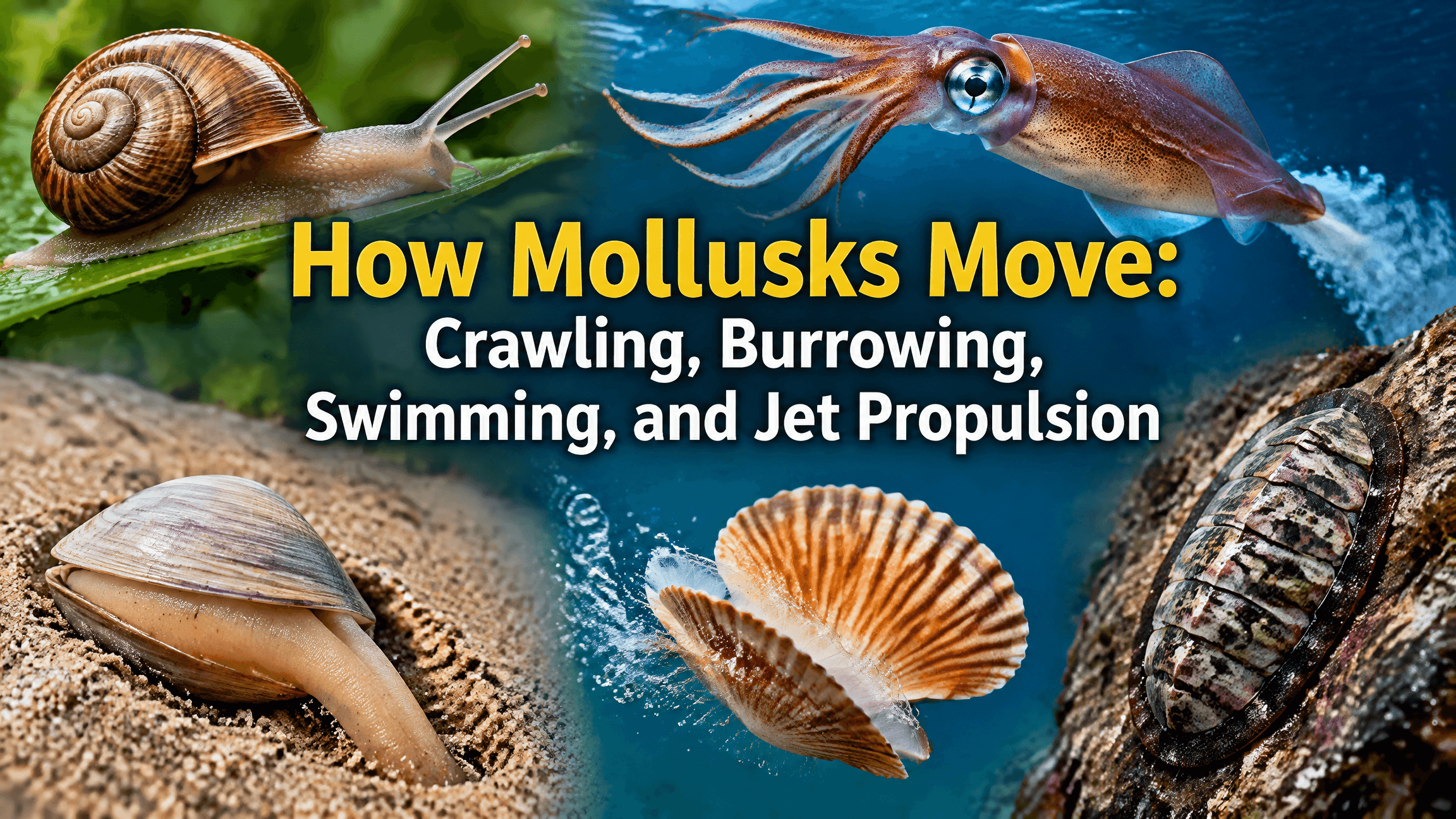
Mollusks move in far more ways than the familiar image of a snail gliding across a leaf suggests. Many gastropods crawl with muscular waves passing along a broad foot. Chitons creep over rock while maintaining strong attachment. Many clams dig into sediment with a specialized foot, scallops can swim by rapidly closing their valves, and cephalopods can combine jet propulsion with fins, arms, or other forms of swimming. Some mollusks also spend part of life drifting or swimming as larvae.
The shared starting point is the molluscan foot, but evolution has modified that structure so extensively that there is no single movement method that fits the entire phylum. Understanding how mollusks move therefore means comparing the mechanics of different groups rather than looking for one universal answer.
Quick Answer
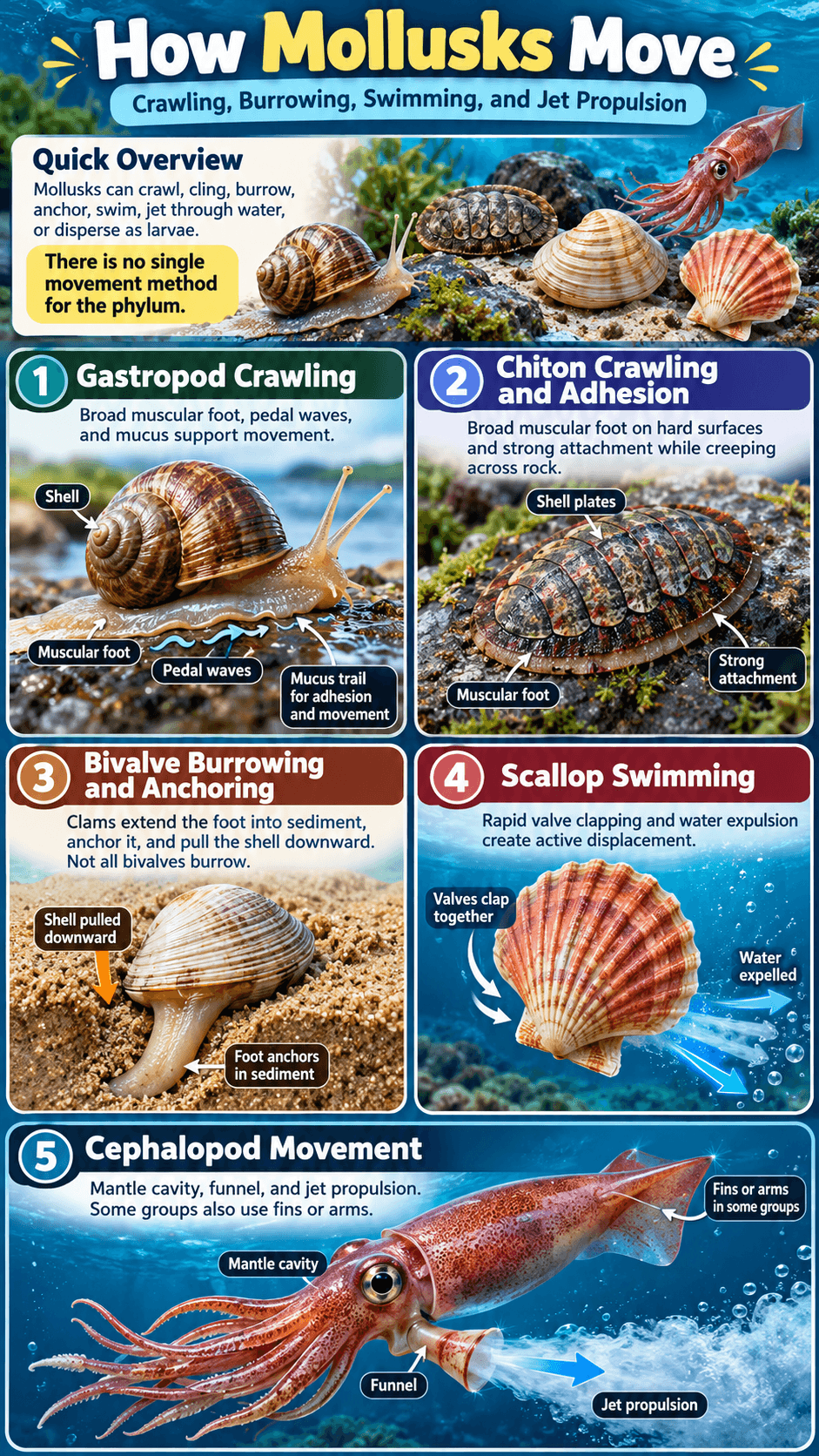
Mollusks can crawl, cling, burrow, anchor, swim, jet through water, or disperse as tiny larvae, depending on their body plan and habitat. Snails and slugs commonly use rhythmic muscle activity in the foot together with mucus. Many bivalves use the foot to enter sediment, while scallops can propel themselves by repeated valve movements. Cephalopods draw water into the mantle cavity and expel it through a funnel for thrust, but many also use fins or arms. Nautiluses combine jet propulsion with a chambered shell that helps control long-term buoyancy.
These differences matter because movement is tied to feeding, escape, attachment, habitat, and reproduction. A limpet holding position in surf, a clam disappearing into sand, and a squid accelerating away from danger are solving very different physical problems.
Why Mollusk Movement Is So Diverse
The Ancestral Foot as a Starting Framework
The muscular foot is one of the most recognizable parts of the molluscan body plan, but it should be treated as an evolutionary starting framework rather than as a single structure with one job. In many gastropods and chitons, the foot remains a broad surface used for crawling and attachment. In many bivalves it is shaped for probing or anchoring in sediment. In cephalopods, structures of the head-foot region became profoundly reorganized during evolution, while locomotion relies strongly on the mantle, funnel, fins, and arms.
This flexibility helps explain why closely related animals can occupy very different physical settings. A broad foot is useful for spreading forces against rock or soil. A narrow or wedge-like foot can enter sediment. A funnel that directs a pulse of water can generate rapid thrust. There is no contradiction in calling all of these animals mollusks because the shared body plan has been modified rather than copied unchanged.
How Evolution Modified the Foot Across Classes
Movement systems reflect both ancestry and the physical demands of a habitat. Chitons living on wave-washed surfaces benefit from a large contact area. Burrowing clams need a structure that can extend into sediment and act as an anchor. Squid living in open water benefit from a streamlined body, mantle-driven propulsion, and fins that help with steady maneuvering. Octopuses living near the seafloor can use their arms for walking or crawling as well as swimming.
As a result, statements such as “mollusks move with a foot” are only partly useful. The foot remains central to movement in many lineages, but locomotion in Mollusca also includes shell movement, mantle contractions, water jets, fin undulation, arm movement, and life-stage-specific swimming.
Gastropod Crawling
Pedal Waves Generate Motion
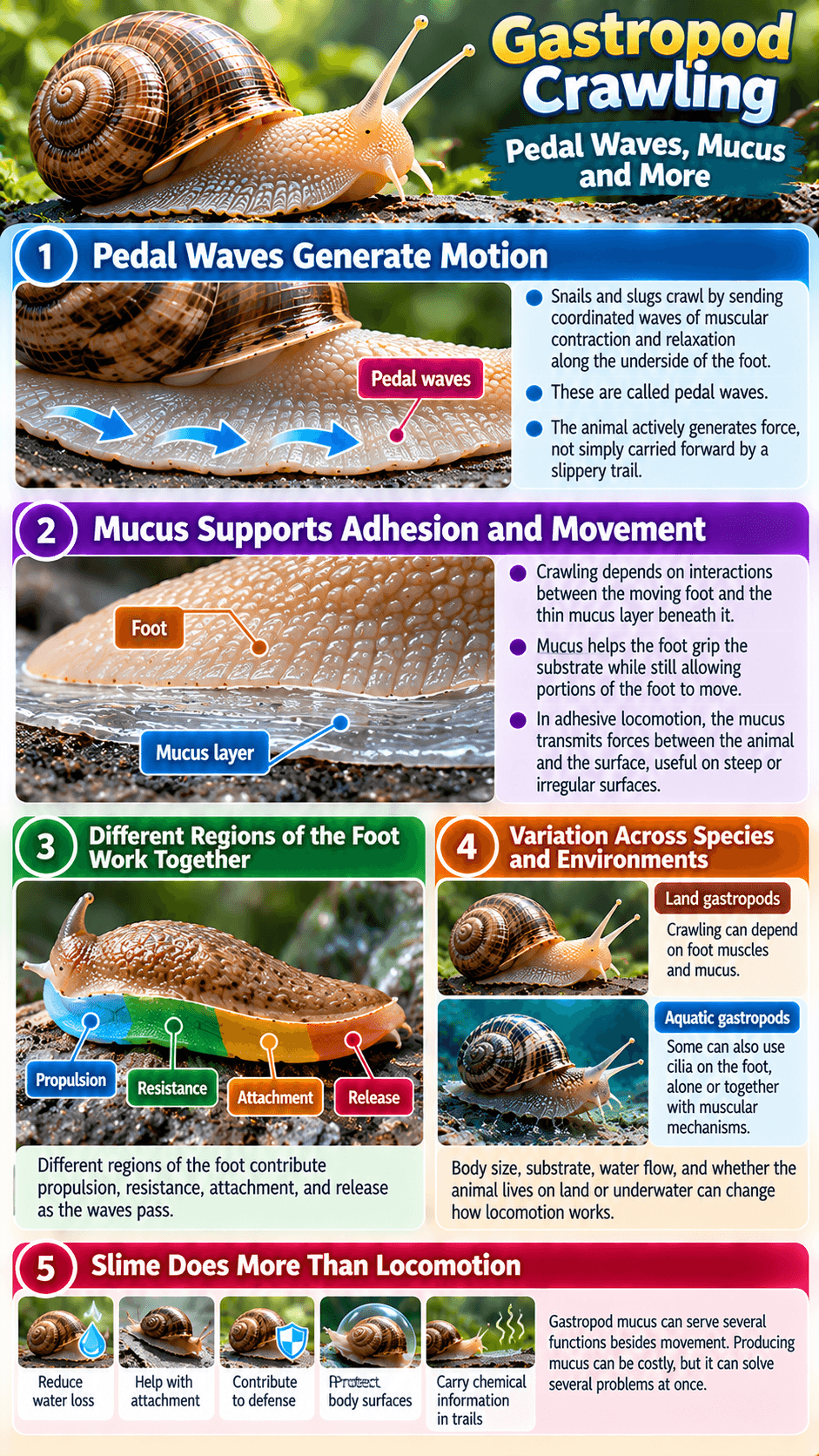
Many snails and slugs crawl by sending coordinated waves of muscular contraction and relaxation along the underside of the foot. These are called pedal waves. Their exact form varies among species, but the important point is that the animal is actively generating force. It is not simply being carried forward by a slippery trail.
Experimental work on terrestrial gastropods shows that crawling depends on interactions between the moving foot and the thin mucus layer beneath it. A detailed study of adhesive locomotion in terrestrial gastropods measured the forces produced beneath crawling snails and slugs and found a more complicated pattern than a simple slide. Different regions of the foot contribute propulsion, resistance, attachment, and release as the waves pass.
Some aquatic gastropods can also use cilia on the foot, alone or together with muscular mechanisms, so even “snail crawling” is not mechanically identical across every species. Body size, substrate, water flow, and whether the animal lives on land or underwater can change how locomotion works.
How Mucus Supports Adhesion and Movement
Mucus is essential to the familiar gliding movement of many land snails and slugs, but describing it as a lubricant alone misses much of its function. Gastropod pedal mucus can behave in ways that help the foot grip the substrate while still allowing portions of the foot to move. In adhesive locomotion, the mucus transmits forces between the animal and the surface.
This combination is especially useful on steep or irregular surfaces. A crawling gastropod must generate forward thrust without losing contact with the ground. Mucus can help maintain that contact, while muscular activity in the foot supplies the organized motion. The animal therefore does not passively “surf” on slime.
Why Slime Does More Than Locomotion
Gastropod mucus can serve several functions besides movement. Depending on the species and context, secretions may reduce water loss, help with attachment, contribute to defense, protect body surfaces, or carry chemical information in trails. The mucus associated with crawling should not be assumed to have exactly the same composition or purpose as every other secretion produced by a snail or slug.
That broader role also explains why a visible trail is not simply wasted material. Producing mucus can be costly, but it can solve several problems at once: mechanical contact, surface protection, moisture management, and sometimes communication.
Chiton Crawling and Adhesion
Broad Muscular Foot on Hard Surfaces
Chitons are flattened marine mollusks whose eight dorsal shell plates make them look very different from a snail. On the underside, however, they have a broad muscular foot that can support slow crawling over hard surfaces. Many species live on rocks where waves and water movement make secure attachment valuable.
The Animal Diversity Web overview of chitons describes a strong foot used to adhere to hard substrates, with muscular action and secretions contributing to attachment. The girdle around the plates can also help form a close seal against the surface in some circumstances.
A chiton can therefore alternate between holding position and moving. Its locomotion is not based on becoming permanently fixed. The same broad contact surface that helps it resist dislodgement can also support controlled crawling when the animal forages or changes location.
Attachment Without Calling the Animal Stationary
Strong attachment can look like immobility to a casual observer, especially in the intertidal zone where an animal may remain tightly pressed to rock during exposure or disturbance. Yet the ability to attach firmly and the ability to crawl are compatible. The animal can change how force is distributed across the foot as conditions change.
This distinction is useful beyond chitons. Mollusk movement is often about switching between motion and stability. For animals exposed to waves, currents, gravity, or predators, not moving can be an active behavioral state that depends on muscles and attachment rather than an absence of locomotor ability.
Bivalve Burrowing and Anchoring
Foot Extension, Anchoring, and Pulling
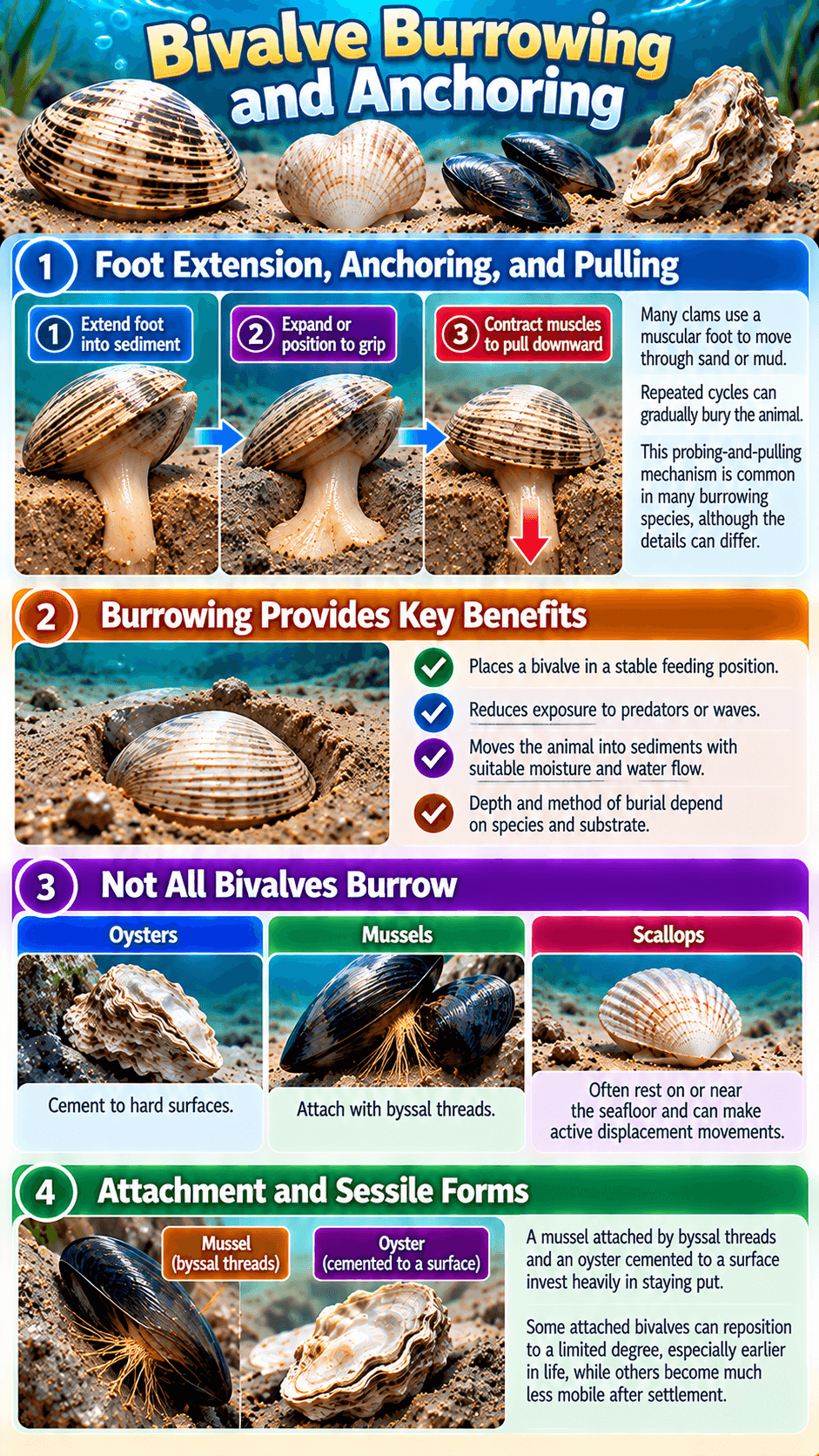
Many clams use a muscular foot to move through sand or mud. A common pattern is to extend the foot into the sediment, expand or position it so it can grip, then contract muscles to pull the shell downward. Repeated cycles can gradually bury the animal.
The Smithsonian’s overview of bivalve movement and defense describes this basic probing-and-pulling mechanism. It is a useful model for many burrowing species, although the details can differ greatly. Research on individual clams has even documented hydraulic contributions in which water movement helps loosen or remove sediment, showing that the foot is not the only possible part of a burrowing system.
Burrowing is more than transportation. It can place a bivalve in a stable feeding position, reduce exposure to predators or waves, and move the animal into sediments with suitable moisture and water flow. The depth and method of burial depend on species and substrate.
Why Not All Bivalves Burrow
Bivalves are often pictured as clams hidden in sand, but that image does not cover the entire class. Oysters may cement to hard surfaces. Many mussels attach with byssal threads, which are protein-rich fibers produced by the animal. Scallops often rest on or near the seafloor and can make active displacement movements. Other species occupy crevices, bore into material, or use highly specialized habits.
Even within a burrowing species, movement can change with age, season, sediment, disturbance, or life stage. A statement such as “bivalves move by digging with a foot” describes an important strategy, not a rule for every member of the group.
Byssal Attachment and Sessile Forms at Overview Depth
Attachment is another form of solving the movement problem. A mussel attached by byssal threads does not need to swim continuously to resist water movement. An oyster cemented to a surface invests even more heavily in staying put as an adult. These lifestyles shift the question from “How does the animal travel?” to “How does it maintain position where feeding and survival are possible?”
Some attached bivalves can reposition to a limited degree, especially earlier in life, while others become much less mobile after settlement. This is one reason adult appearance alone can give an incomplete picture of how a mollusk has moved during its full life cycle.
Scallop Swimming

Valve Clapping and Water Expulsion
Scallops are among the clearest examples of active swimming in bivalves. By rapidly closing their two valves with a powerful adductor muscle, they can force water out around the shell and produce a burst of movement. Repeated opening and closing can create jumping, flipping, rotational, or swimming motions depending on species and context.
Modern valvometry research on great scallops distinguishes large-amplitude displacement movements from ordinary smaller valve closures. A Journal of Molluscan Studies paper on scallop swimming behavior groups swimming, jumping, flipping, and rotation among the higher-amplitude movements that physically displace the animal.
This ability can help a scallop change position or respond to disturbance. It does not mean that every bivalve can swim, and it does not mean a scallop spends all its time moving through open water.
Why Scallop Swimming Is Not the Same as Cephalopod Jet Propulsion
Both scallops and cephalopods can move by accelerating water, but the mechanical systems are different. A scallop uses the motion of its paired shell valves and body openings to expel water during rapid closure. A cephalopod instead uses muscular mantle contractions to pressurize water in the mantle cavity and directs the outflow through a funnel.
Calling both of them simply “jet propulsion” can hide useful anatomical differences. The comparison is better understood at the level of physics: both generate thrust by pushing water one way so the body moves another way, but they do so with different structures and different patterns of control.
Cephalopod Locomotion
Mantle-Cavity Water and Funnel Thrust
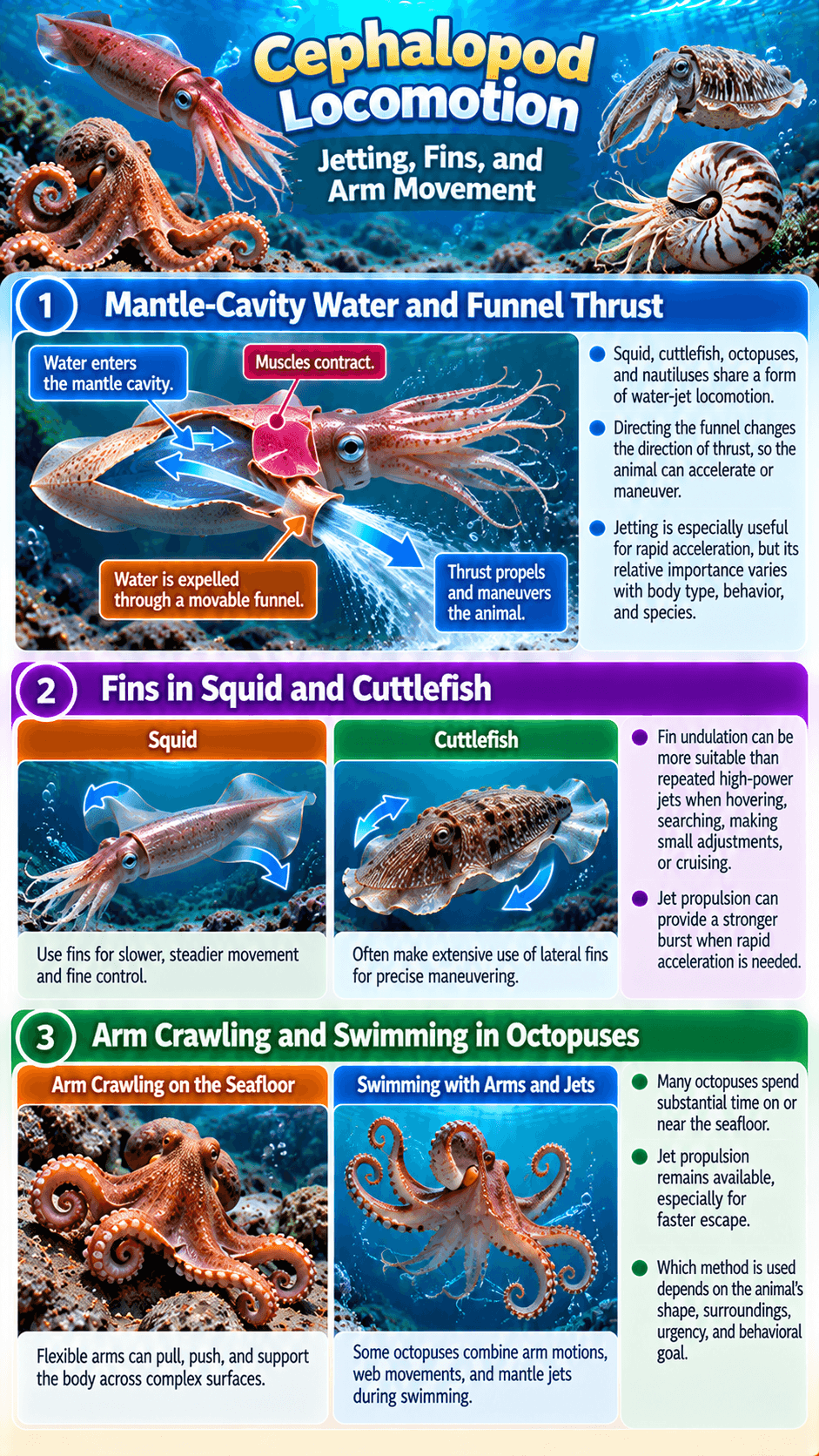
Squid, cuttlefish, octopuses, and nautiluses share a form of water-jet locomotion. Water enters the mantle cavity, muscles contract, and water is expelled through a movable funnel. Directing the funnel changes the direction of thrust, so the animal can accelerate or maneuver without using fins like a fish.
The Smithsonian Ocean summary of cephalopod propulsion and movement emphasizes that these animals use several movement methods rather than one. Jetting is especially useful for rapid acceleration, but its relative importance varies with body type, behavior, and species.
The mantle is therefore both a respiratory and locomotor structure in many cephalopods. The same cavity through which water moves over respiratory surfaces also becomes part of a muscular pump that can generate thrust.
Fins in Squid and Cuttlefish
Squid and cuttlefish commonly use fins for slower, steadier movement and fine control. Fin undulation can be more suitable than repeated high-power jets when an animal is hovering, searching, making small adjustments, or cruising at modest speed. Jet propulsion can then provide a stronger burst when rapid acceleration is needed.
The balance between fin use and jetting varies. Some squid are streamlined for sustained swimming, while cuttlefish often make extensive use of lateral fins for precise maneuvering. Deep-sea finned octopods can also use fins, showing again that “cephalopods move by jets” is too narrow a description.
Arm Crawling and Swimming in Octopuses
Many octopuses spend substantial time on or near the seafloor. Their flexible arms can pull, push, and support the body across complex surfaces, allowing crawling through reefs, rocks, and crevices where a single streamlined swimming strategy would be less useful. Jet propulsion remains available, especially for faster escape.
Some octopuses also combine arm motions, web movements, and mantle jets during swimming. The result is a locomotor toolkit rather than a single gait. Which method is used depends on the animal’s shape, surroundings, urgency, and behavioral goal.
Nautilus Movement and Buoyancy
Jet Propulsion in a Chambered-Shell Body Plan
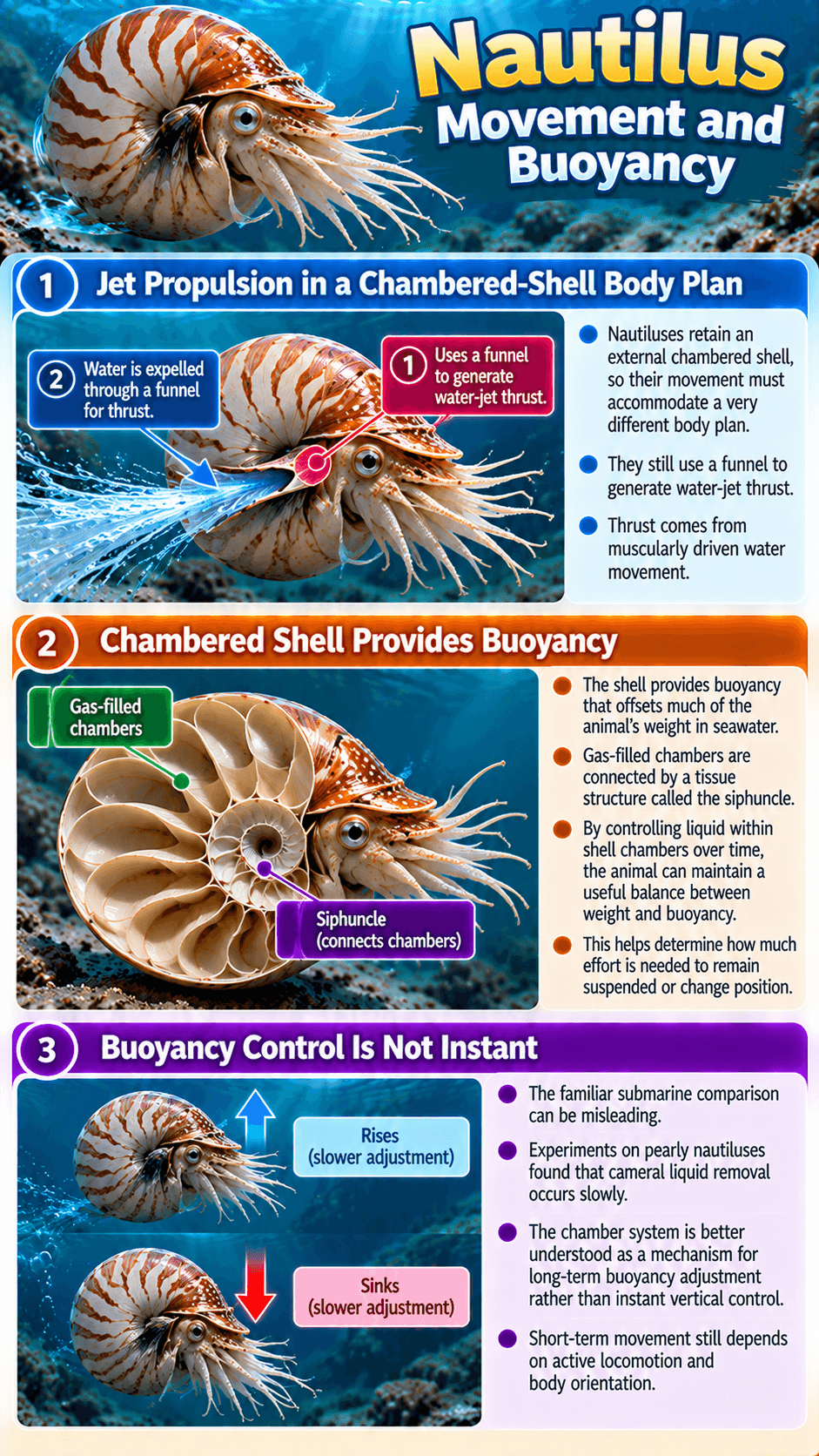
Nautiluses retain an external chambered shell, so their movement must accommodate a body plan very different from a streamlined squid. They still use a funnel to generate water-jet thrust, but the shell also provides buoyancy that offsets much of the animal’s weight in seawater.
Gas-filled chambers are connected by a tissue structure called the siphuncle. By controlling liquid within shell chambers over time, the animal can maintain a useful balance between weight and buoyancy. This does not make the shell a motor. Thrust still comes from muscularly driven water movement, while the shell influences how much effort is needed to remain suspended or change position.
Why Buoyancy Control Is Not Instant Submarine Ballast
The familiar submarine comparison can be misleading if it suggests that a nautilus rapidly floods and empties chambers every time it rises or sinks. Classic experiments on pearly nautiluses found that cameral liquid removal occurs slowly and concluded that the chamber system is better understood as a mechanism for long-term buoyancy adjustment rather than instant vertical control.
Short-term movement still depends on active locomotion and body orientation. The chambered shell helps set the animal’s overall buoyant condition, while jets provide directional thrust. Separating these functions gives a more accurate picture than imagining a rapid mechanical ballast tank.
Pelagic and Larval Movement
Swimming Gastropods and Drifting Larvae
Adult crawling is only one chapter in mollusk movement. Some gastropods are pelagic, meaning they live in the water column rather than mainly on the bottom. Their locomotion can involve modified foot structures or body parts used for swimming. Sea butterflies, for example, use wing-like lobes derived from the foot to move through the water.
Many marine mollusks also have microscopic or tiny larval stages that spend time in the plankton. These larvae may swim with cilia and can also be carried by currents. Their movement operates on a much smaller scale than adult locomotion, where viscosity and local water motion can be especially important.
Why Larval Dispersal Differs From Adult Locomotion
A larva carried kilometers by currents has not necessarily produced that displacement through its own swimming. Active swimming can influence vertical position, feeding, settlement, and local movement, while currents provide much of the large-scale transport. This distinction matters when discussing dispersal.
Adult and larval stages may therefore solve entirely different locomotor problems. An adult mussel may remain attached to rock, while its earlier larval stage traveled through the water column. A crawling snail may have descended from a free-swimming larva. Life history can transform what “movement” means for the same species.
Common Movement Myths
All Mollusks Move With One Flat Foot
A broad crawling foot works well as an introductory image, but it does not describe the entire phylum. Bivalve feet can be narrow and specialized for sediment. Cephalopod locomotion relies heavily on the mantle, funnel, fins, and arms. Scallops move by shell-valve action. Some adult bivalves attach or cement themselves in place.
The more accurate principle is that the molluscan foot is evolutionarily versatile. Its form, prominence, and locomotor role have changed dramatically among major lineages.
Snails Slide Passively on Slime
Snail and slug locomotion is active muscular behavior. Mucus matters because it helps transmit forces, maintain contact, lubricate movement, and support adhesion, but muscular or ciliary action supplies organized propulsion. A slime trail is part of the locomotor system, not a moving conveyor belt.
Cephalopods Move Only by Jet Propulsion
Jet propulsion is one of the signature cephalopod adaptations, yet it is only part of their movement repertoire. Squid and cuttlefish use fins, octopuses crawl with arms, and finned deep-sea octopods can swim using fins and web movements. Even within the same animal, the preferred method can change between routine movement and escape.
Movement Depends on Anatomy, Habitat, and Defense
The Foot and Mantle Set Mechanical Possibilities
Locomotion cannot be separated from anatomy. The shape and musculature of the foot determine whether it works well as a creeping surface, anchor, or digging tool. Mantle muscles and the funnel make cephalopod jetting possible. Shell shape and hinge mechanics influence what scallops can do. The same structures used for movement may also participate in breathing, feeding position, or attachment.
Substrate Changes the Movement Problem
A rock surface, loose mud, open water, and a coral crevice each impose different mechanical challenges. Crawlers need traction and adhesion. Burrowers must push against sediment. Swimmers must accelerate water without wasting too much energy. Attached animals need to resist currents while retaining access to food and oxygen.
This is why a movement strategy cannot be judged without its habitat. Slow crawling may be perfectly effective for an animal feeding on a surface. Rapid jetting may be valuable during escape but costly for routine travel. Staying attached can be more useful than swimming if food arrives with the current.
Escape, Burrowing, and Attachment Can Be Defensive
Locomotion also overlaps with defense. A clam can withdraw deeper into sediment, a scallop can make a burst of swimming after detecting a threat, a limpet or chiton can hold tightly to rock, and a cephalopod can accelerate away. These responses use movement or resistance to movement as part of survival.
Because these behaviors are easy to provoke, wildlife observation should remain noninvasive. Turning over, prying loose, chasing, or repeatedly touching intertidal animals can disrupt attachment and expose them to injury or drying. Watching natural movement is more informative than forcing a response.
FAQ
How do snails move without legs?
Snails use a muscular foot rather than jointed legs. In many species, coordinated pedal waves travel along the underside of the foot while mucus helps couple the foot to the surface. The exact mechanism varies among gastropods, and some aquatic species also use ciliary action. The key idea is that locomotion is actively generated by the animal rather than by passive sliding.
Can clams and scallops move?
Yes, but their methods differ. Many clams can burrow by extending and anchoring a muscular foot, then pulling the shell into sediment. Scallops can make rapid displacement movements by closing their valves and expelling water. Other bivalves may attach with byssal threads, cement to surfaces, bore into material, or move only modestly as adults.
How does jet propulsion work in cephalopods?
Water enters the mantle cavity, then muscular contraction forces it out through the funnel. The outgoing water creates thrust that moves the animal in the opposite direction. By changing funnel orientation and combining jetting with fins or arms, cephalopods can maneuver as well as accelerate. Jetting is important, but it is not the only form of cephalopod locomotion.
Final Thoughts
The best answer to how mollusks move is that their locomotion reflects extraordinary modification of a shared body plan. Gastropods can crawl through coordinated foot movements and mucus-mediated adhesion. Chitons combine attachment with crawling. Many bivalves burrow or anchor, while scallops can actively swim. Cephalopods use mantle-driven jets but also depend on fins and arms, and nautiluses add a chambered shell that supports long-term buoyancy.
Those differences make more sense when movement is viewed as a response to real physical problems: staying attached, crossing a surface, entering sediment, hovering in water, dispersing as a larva, or escaping danger. Mollusks did not evolve one universal locomotor solution. They evolved many ways to move, and sometimes many ways not to be moved.

Ethan Walker is the founder and research editor of Animal Fact Central. He creates and reviews educational animal facts content using trusted wildlife, pet care, and science-based sources. His work focuses on making animal behavior, adaptations, habitats, and species facts clear, accurate, and engaging for everyday readers.
Read More Details About Ethan Walker: https://animalfactcentral.com/ethan-walker/