Hoofed Mammal Herds: Social Behavior & Group Living

Hoofed Mammal Herds: Social Behavior, Group Living, and Cooperation

Hoofed mammals live in almost every kind of social arrangement, from large seasonal herds to small family groups and mostly solitary lives. Deer, bison, antelopes, giraffes, zebras, wild sheep, goats, camels, pigs, rhinos, and tapirs do not all organize themselves the same way. Even within one species, group size and composition can change with season, … Read more

How Hoofed Mammals Run and Escape Predators

How Hoofed Mammals Run and Escape Predators

Hoofed mammals escape predators with much more than raw speed. Long limbs, specialized hooves, elastic tendons, powerful muscles, sharp senses, group vigilance, rapid acceleration, sudden turns, camouflage, hiding behavior, and defensive body size can all affect whether an attack succeeds. Different species combine these tools in very different ways. A pronghorn or gazelle in open … Read more

How Ruminant Digestion Works: Stomachs & Cud

How Ruminant Digestion Works: Stomachs, Microbes, and Cud

Ruminant digestion works by combining a four-compartment stomach with microbial fermentation and repeated chewing. Instead of relying only on the animal’s own digestive enzymes, true ruminants such as deer, cattle, bison, sheep, goats, giraffes, and many antelopes depend on huge communities of microorganisms that break down tough plant material before it reaches the small intestine. … Read more

What Do Hoofed Mammals Eat? Grazers vs Browsers

What Do Hoofed Mammals Eat? Grazers, Browsers, and Other Feeding Strategies

Most hoofed mammals eat plants, but their diets are far more varied than the simple label “herbivore” suggests. Some focus heavily on grasses. Others browse leaves, shoots, twigs, bark, or fruit. Many switch between grass and browse as seasons change, and a few important groups, especially pigs and peccaries, can eat both plant and animal … Read more

Even-Toed Ungulates: Deer, Camels, Pigs & More

Even-Toed Ungulates Explained: Deer, Cattle, Giraffes, Camels, Pigs, Hippos, and More

Even-toed ungulates are mammals in the broader artiodactyl evolutionary radiation, a group that includes deer, cattle, bison, sheep, goats, many antelopes, giraffes, camels, llamas, pigs, peccaries, hippos, pronghorn, chevrotains, musk deer, and their relatives. The name “even-toed” comes from a characteristic foot plan in which the main axis usually runs between the third and fourth … Read more

Odd-Toed Ungulates: Horses, Rhinos & Tapirs

Odd-Toed Ungulates Explained: Horses, Rhinos, Tapirs, and Zebras

Odd-toed ungulates are mammals in the order Perissodactyla, a living lineage that includes horses, zebras, wild asses, rhinoceroses, and tapirs. The name means “odd-toed,” but the defining feature is more precise than simply counting toes: the main axis of the foot passes through the third digit, a pattern called mesaxonic. That shared foot plan links … Read more

Even-Toed vs Odd-Toed Ungulates: Differences

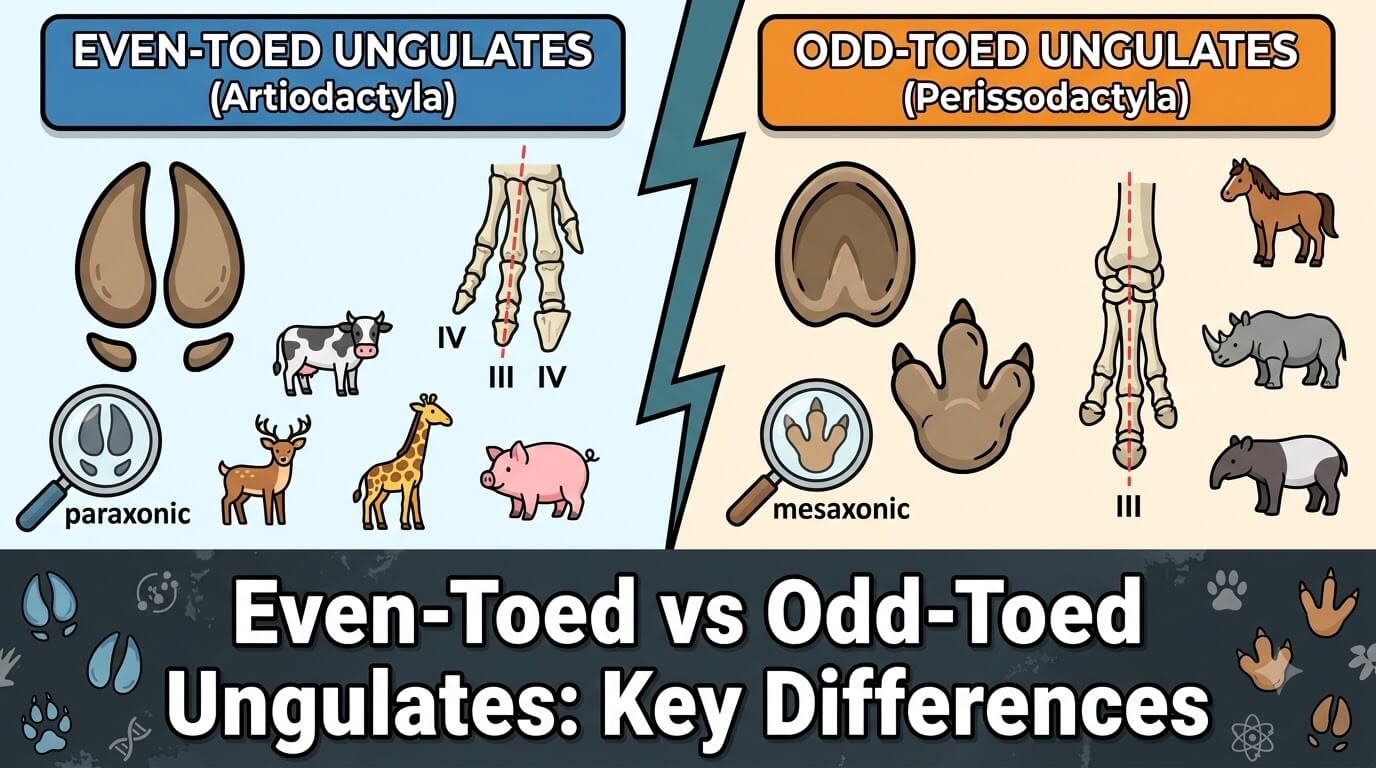
Even-Toed vs Odd-Toed Ungulates: Key Differences

The main difference between even-toed and odd-toed ungulates is not simply how many toes you can see. It is the structural axis of the foot. In terrestrial even-toed ungulates, the main weight-bearing axis typically runs between digits III and IV, a pattern called paraxonic. In odd-toed ungulates, or perissodactyls, the main axis runs through digit … Read more

What Is a Hoofed Mammal? Ungulates Explained

What Is a Hoofed Mammal? Ungulates Explained

A hoofed mammal is, in everyday biological language, a mammal whose feet are specialized for supporting body weight through one or more modified digits capped by hoof-like keratinized structures. These mammals are often called ungulates. Horses, zebras, rhinos, tapirs, deer, bison, giraffes, camels, pigs, hippos, and pronghorn are familiar examples. The simple definition is useful, … Read more

Hoofed Mammals: Types, Hooves, Diets & Habitats

Hoofed Mammals: Types, Hooves, Diets, Habitats, and Adaptations

Hoofed mammals include many of the world’s most familiar large land mammals, from horses, zebras, deer, and bison to giraffes, camels, rhinos, tapirs, pigs, hippos, and pronghorn. They are often called ungulates, a convenient biological term for mammals associated with hoof-like, weight-bearing feet. The label is useful, but it does not describe one simple modern … Read more