
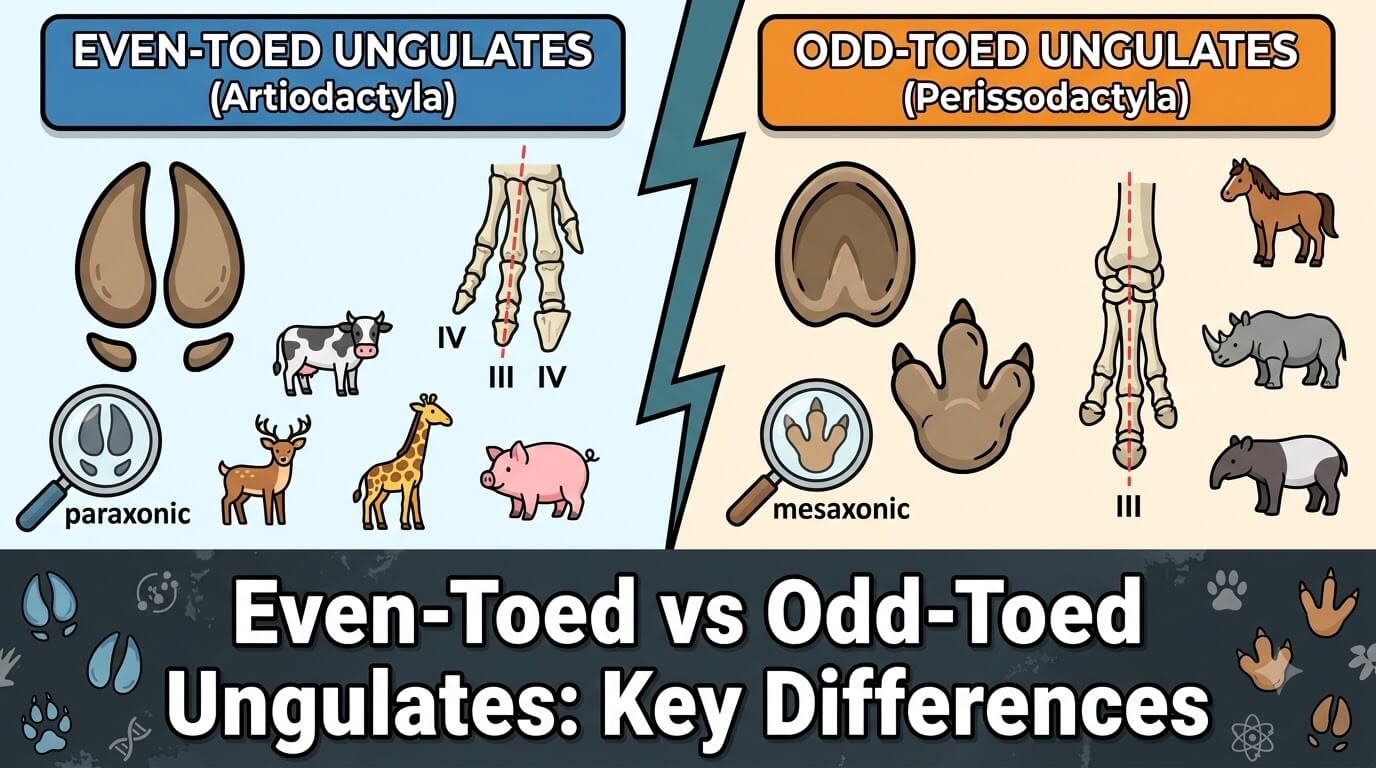
The main difference between even-toed and odd-toed ungulates is not simply how many toes you can see. It is the structural axis of the foot. In terrestrial even-toed ungulates, the main weight-bearing axis typically runs between digits III and IV, a pattern called paraxonic. In odd-toed ungulates, or perissodactyls, the main axis runs through digit III, a pattern called mesaxonic.
That anatomical distinction separates two major hoofed-mammal lineages. The odd-toed order Perissodactyla includes horses and zebras, rhinoceroses, and tapirs. The terrestrial even-toed radiation includes deer, bovids such as cattle, bison, sheep, goats, and many antelopes, as well as giraffes, camelids, pigs, peccaries, hippos, pronghorn, chevrotains, and musk deer.
The comparison becomes more useful once you move beyond the feet. Many even-toed groups are true ruminants, while perissodactyls are hindgut fermenters. Yet there are major exceptions on the even-toed side: pigs are not ruminants, camelids have a different multi-compartment foregut, and hippos do not fit a simple cow-like digestive model. Body form, habitat, and behavior also vary so much that neither lineage can be reduced to one lifestyle.
Quick Difference
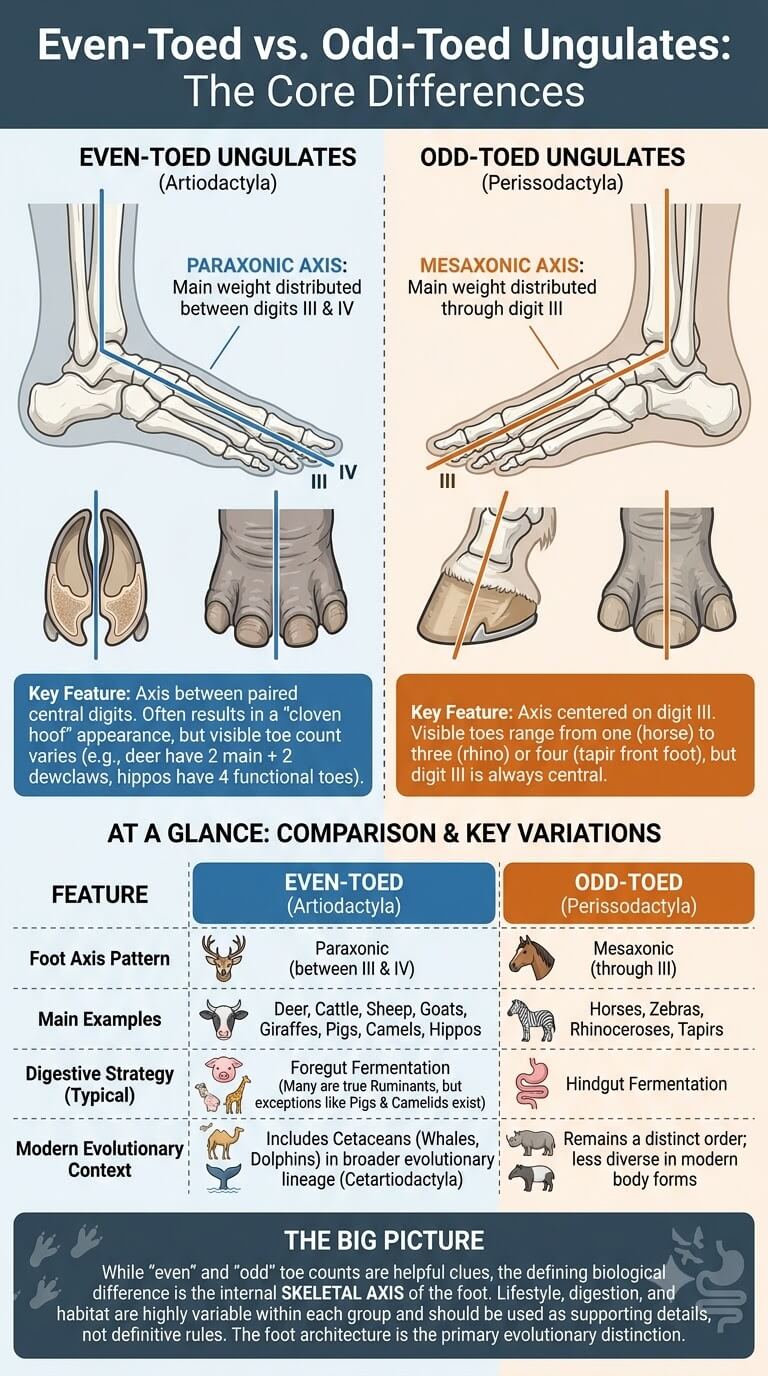
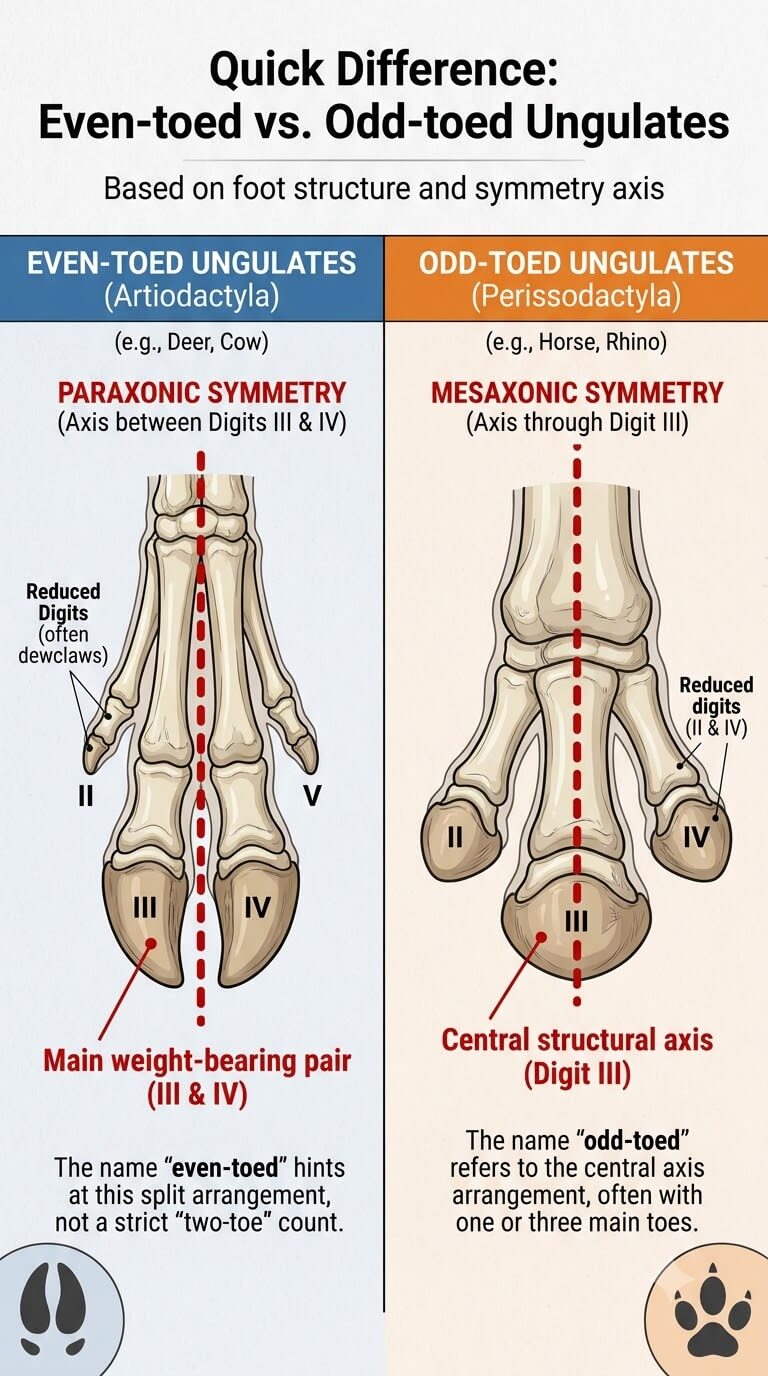
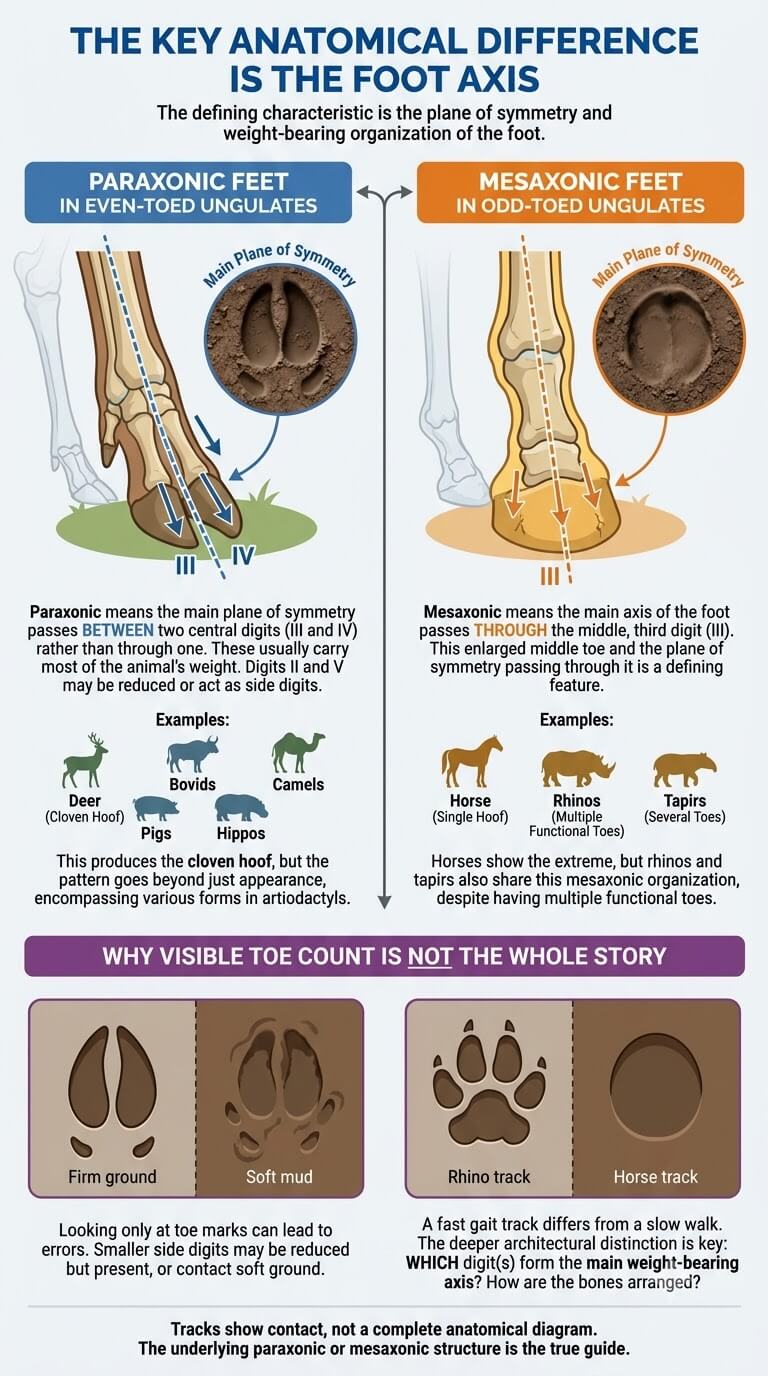
Even-toed ungulates are typically paraxonic: the line of symmetry of the terrestrial foot passes between the third and fourth digits, which are usually the main weight-bearing pair. Odd-toed ungulates are mesaxonic: the line of symmetry passes through the third digit, which is the central structural axis.
The Animal Diversity Web overview of Artiodactyla describes terrestrial artiodactyls as paraxonic, with digits III and IV remaining large and weight bearing even when other digits are reduced. By contrast, the perissodactyl foot is centered on digit III.
This is why the names “even-toed” and “odd-toed” are helpful but imperfect. They point toward the arrangement of the foot, not a universal rule that every animal must display exactly two toes or exactly one or three obvious toes in every footprint.
Even-Toed vs Odd-Toed Ungulates at a Glance
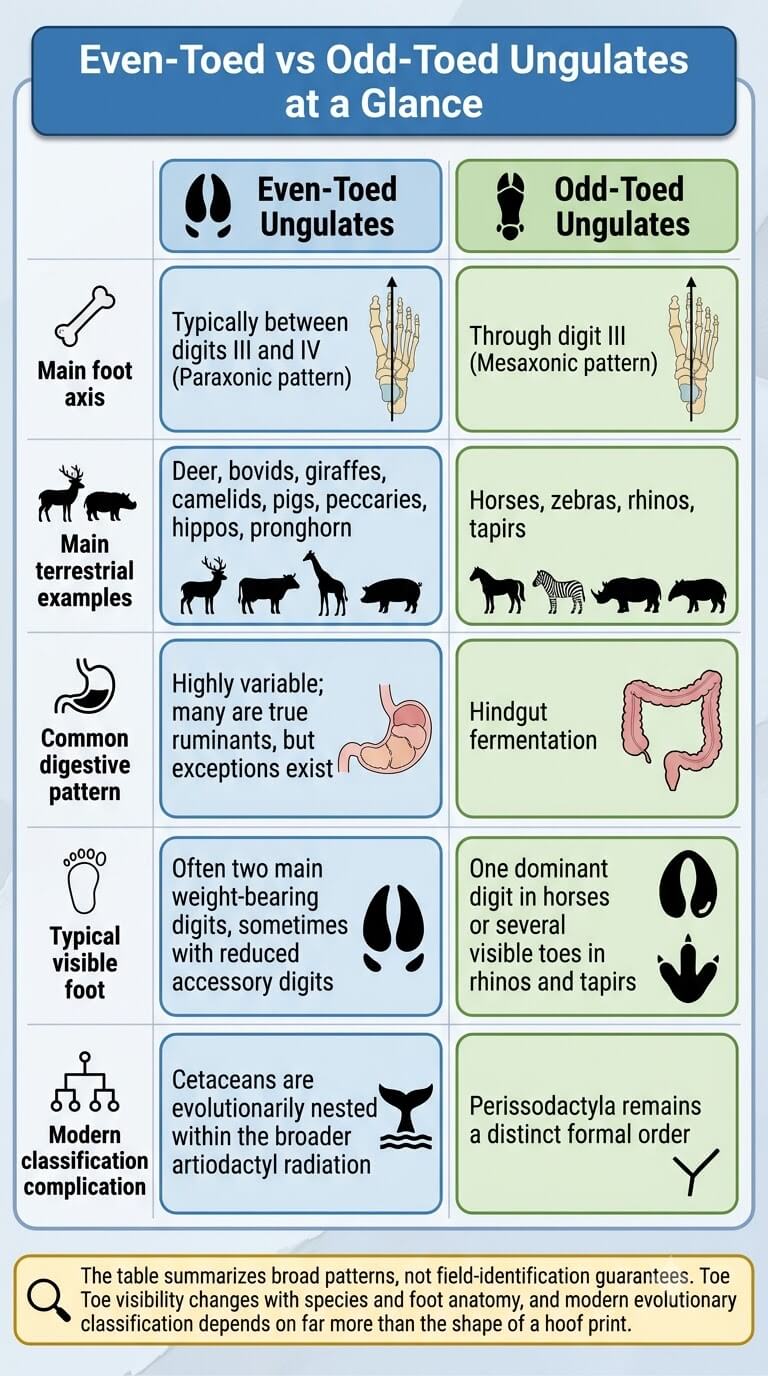
| Feature | Even-Toed Ungulates | Odd-Toed Ungulates |
|---|---|---|
| Main foot axis | Typically between digits III and IV | Through digit III |
| Technical foot pattern | Paraxonic | Mesaxonic |
| Main terrestrial examples | Deer, bovids, giraffes, camelids, pigs, peccaries, hippos, pronghorn | Horses, zebras, rhinos, tapirs |
| Common digestive pattern | Highly variable; many are true ruminants, but important exceptions exist | Hindgut fermentation |
| Typical visible foot | Often two main weight-bearing digits, sometimes with reduced accessory digits | One dominant digit in horses or several visible toes in rhinos and tapirs |
| Modern classification complication | Cetaceans are evolutionarily nested within the broader artiodactyl radiation | Perissodactyla remains a distinct formal order |
The table summarizes broad patterns, not field-identification guarantees. Toe visibility changes with species and foot anatomy, and modern evolutionary classification depends on far more than the shape of a hoof print.
The Key Anatomical Difference Is the Foot Axis
Paraxonic Feet in Even-Toed Ungulates
Paraxonic means the main plane of symmetry passes between two central digits rather than through one central digit. In terrestrial artiodactyls, those central digits are III and IV. They usually carry most of the animal’s weight, while digits II and V may be reduced, retained as smaller side digits, or expressed differently among groups.
This arrangement produces the familiar cloven hoof of deer and many bovids, but a cloven hoof is not the whole definition. Camelids, pigs, peccaries, and hippos all belong to the even-toed radiation, yet their feet are not simply scaled copies of a deer’s foot. The paraxonic pattern describes the underlying organization.
Mesaxonic Feet in Odd-Toed Ungulates
Mesaxonic means the main axis of the foot passes through the middle, third digit. The Animal Diversity Web account of Perissodactyla describes the enlarged middle toe and the plane of symmetry passing through it as a defining feature of the order.
Horses show the most familiar extreme, with one main functional digit enclosed by the hoof. Rhinos retain multiple functional toes, while tapirs retain several toes with a different forefoot and hindfoot arrangement. All are still perissodactyls because their feet share the same basic mesaxonic organization and they belong to the same evolutionary order.
Why Visible Toe Count Is Not the Whole Story
Looking only at the number of toe marks can lead to errors. Smaller side digits may be reduced but still present. Accessory digits may contact soft mud but not firm ground. A track made during a fast gait can differ from one made while an animal is walking slowly. Some footprints therefore reveal structures that are less obvious under other conditions.
The deeper distinction is architectural. Which digit or digits form the main weight-bearing axis? How are the metapodial bones arranged? Which toes are reduced? Those features are more informative than a rule such as “two toes equals artiodactyl.”
This distinction also matters when interpreting tracks. A crisp deer print on firm mud may show the two principal hoof halves clearly, while softer ground can capture marks from accessory digits. A rhino print can show several toes even though the animal belongs to the “odd-toed” order. Tracks are evidence of how the foot contacted a particular surface, not a complete anatomical diagram of every digit. That distinction also helps clarify what scientists and animal writers mean by a hoofed mammal or ungulate.
What Even-Toed Ungulate Feet Look Like
Digits III and IV as the Main Weight-Bearing Pair
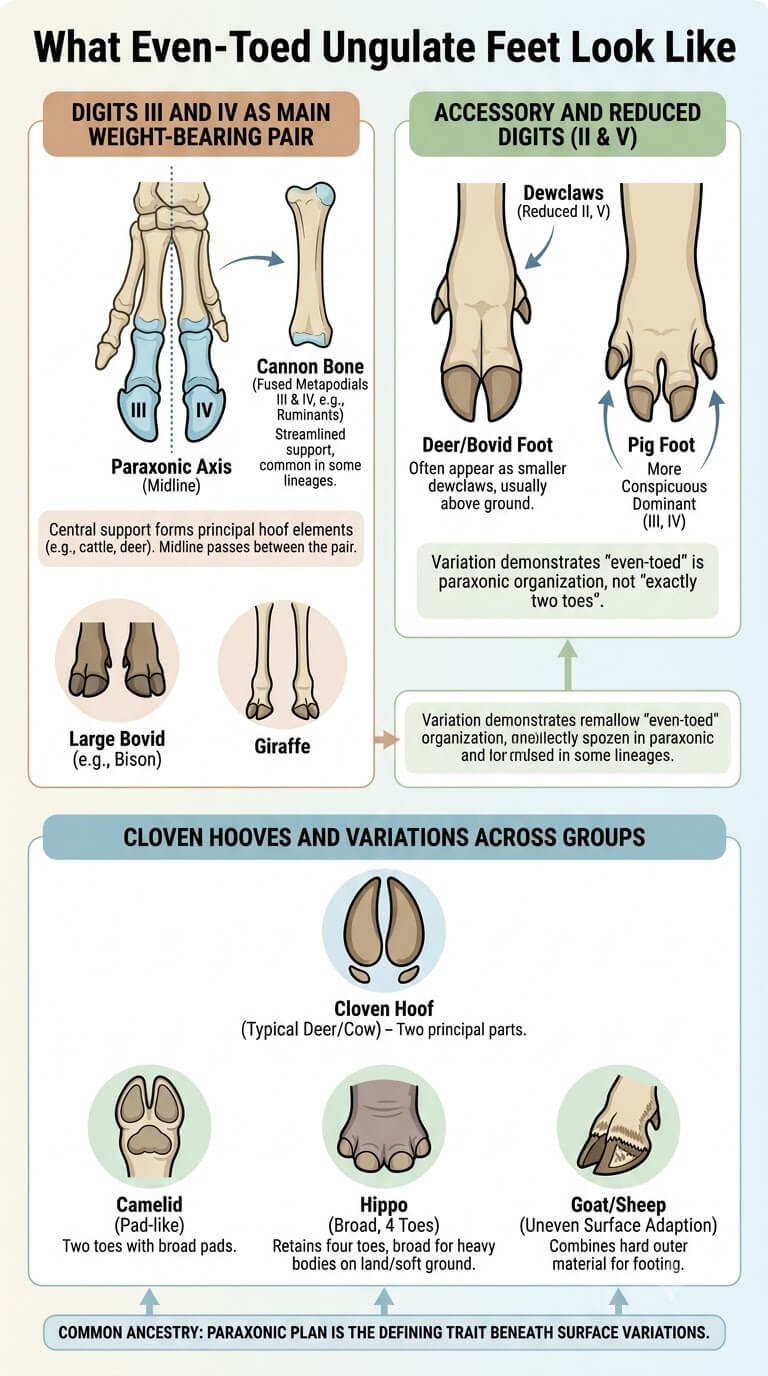
In many terrestrial even-toed mammals, digits III and IV form the central support of the foot. Their distal ends create the two principal hoof elements seen in deer, cattle, bison, sheep, goats, and many antelopes. The arrangement places the midline between the pair rather than through one enlarged central digit.
This paired support can take many forms. Large bovids carry substantial weight on two main digits. Smaller deer use the same broad pattern at a different scale. Giraffes also belong to this paraxonic radiation despite their dramatically elongated limbs and very different body proportions.
In several ruminant lineages, the long metapodial bones associated with digits III and IV are partly or extensively fused into a structure commonly called a cannon bone. That is a useful example of how the two central digits can remain functionally dominant even when the lower limb becomes streamlined. It is not universal across all even-toed mammals, so pigs, hippos, and camelids should not be forced into a deer-style model.
Accessory and Reduced Digits
Digits II and V are often reduced in even-toed ungulates. In deer and bovids they may appear externally as smaller dewclaws above or behind the main hoof. Whether those structures touch the ground depends on foot anatomy, substrate, body weight, and movement.
Pigs and hippos make the variation especially obvious because their side digits are more conspicuous than in many deer or antelopes. Their feet help demonstrate why “even-toed” cannot be translated into “exactly two toes.” The lineage is defined by the dominant paraxonic organization, not by one externally visible toe count.
Cloven Hooves and Variations Across Groups
A cloven hoof is divided into two principal weight-bearing parts. It is common among terrestrial artiodactyls, but even this familiar form varies. Deer feet are relatively compact. Goat and sheep feet combine hard outer hoof material with structures that can assist footing on uneven surfaces. Camelid feet end in two toes associated with broad pads rather than hard deer-like hoof halves.
Hippos retain four toes and have broad feet suited to carrying a heavy body on land and in soft substrates. Pigs also retain four toes, although the central pair normally bears most of the load. The common ancestry is visible in the paraxonic plan beneath those different surface forms.
What Odd-Toed Ungulate Feet Look Like
The Third Digit as the Main Axis
In perissodactyls, digit III is structurally central. This does not mean every species stands on only one toe. It means the middle digit defines the main axis of the foot. The other digits may be reduced or remain functional depending on the lineage.
This pattern helps explain why horses, rhinos, and tapirs belong together despite looking so different. Their shared ancestry is reflected in a suite of skeletal and anatomical traits, with mesaxonic foot organization being one of the clearest features for a general comparison.
Horses and the Highly Reduced Side Digits
Living horses, zebras, and wild asses belong to Equidae. Their foot represents the most extreme living version of perissodactyl digit reduction. The third digit is the main functional digit, while the ancestral side digits have been greatly reduced.
The result is a compact distal limb well suited to efficient travel in many equids. But it would be a mistake to assume that the single main hoof alone explains speed. Limb length, joints, tendons, muscles, gait mechanics, body size, and behavior all contribute to locomotion.
Digit reduction also involves trade-offs. Concentrating support can help create a light, elongated lower limb, but an animal still needs enough stability and contact with the ground for its habitat. The horse solution is therefore one specialized endpoint within Perissodactyla, not a standard that rhinos and tapirs somehow failed to reach.
Rhinos and Tapirs as More Complex Examples
Rhinos retain multiple functional toes, so they are an immediate counterexample to the idea that “odd-toed” means a single hoof. Their body mass and foot structure differ greatly from those of horses, yet digit III remains the central axis.
Tapirs also retain multiple toes and are adapted to a very different ecological setting from open-country equids. Their feet are useful on forest floors, soft ground, and around water. Again, the important shared feature is the mesaxonic plan, not identical outward appearance.
Major Groups on Each Side
Deer, Bovids, Giraffids, Camelids, Pigs, Peccaries, Hippos, Pronghorn, and Other Even-Toed Groups
The even-toed radiation contains a much wider range of living terrestrial body forms than many readers expect. Cervidae includes deer, elk, moose, and reindeer. Bovidae includes cattle, bison, sheep, goats, gazelles, and many animals commonly called antelopes. Giraffidae includes giraffes and okapi. Camelidae includes camels, llamas, alpacas, guanacos, and vicuñas.
Suidae contains pigs, while Tayassuidae contains peccaries. Hippopotamidae contains hippos. Antilocapridae contains pronghorn. Chevrotains and musk deer add still more variation. These groups differ in habitat, food, ornamentation, social behavior, and digestive anatomy, so the even-toed category should never be treated as a synonym for “cow-like ruminant.”
Horses and Zebras, Rhinos, and Tapirs as Perissodactyls
Perissodactyla is less diverse in living body plans but still contains three strongly contrasting families. Equidae includes horses, zebras, and wild asses. Rhinocerotidae contains rhinoceroses. Tapiridae contains tapirs.
Horses and zebras are not separate families, tapirs are not pig relatives, and rhinos are not close relatives of elephants. Those common misconceptions arise because body shape and lifestyle can be more visually obvious than ancestry.
Digestive Strategies Compared
True Ruminants Among Many Even-Toed Groups
Many familiar even-toed mammals are true ruminants, including deer and bovids. Their digestive system uses foregut fermentation, with microbes breaking down plant material before it reaches the acid-secreting stomach compartment. Food can be regurgitated and chewed again as cud.
Bovids illustrate this common pattern, but they should not be used as the digestive template for the entire even-toed radiation. The foot pattern and digestive pattern evolved within a lineage that contains important physiological exceptions.
This is a useful reminder that anatomical categories can overlap without being equivalent. “Paraxonic” describes the organization of the foot. “Ruminant” describes a digestive strategy and a particular branch of even-toed mammals. Many familiar animals happen to be both, which is why the terms are easy to blur, but one does not define the other.
Camelids, Pigs, and Hippos as Important Exceptions
Camelids ferment plant food in a multi-compartment foregut and chew cud-like material, but their stomach is not anatomically identical to that of true ruminants. The University of Minnesota College of Veterinary Medicine anatomy guide describes the three camelid stomach compartments and specifically notes major anatomical differences from true ruminants.
Pigs are not ruminants and can have omnivorous diets. Hippos are foregut fermenters, but they also should not be described as having a standard cow-like ruminant stomach. These examples show why foot classification and digestive classification answer different biological questions.
Hindgut Fermentation in Perissodactyls
Horses, tapirs, and rhinos are hindgut fermenters. Instead of carrying out their main microbial plant fermentation in a specialized chamber before the small intestine, they rely heavily on the cecum and colon farther along the digestive tract. The Open University’s overview of hindgut fermenters identifies odd-toed ungulates as examples of this strategy.
This difference is useful when comparing the lineages, but it should not be turned into a simple claim that one system is universally better. Foregut and hindgut fermentation involve different trade-offs involving food quality, retention time, intake, and microbial processing.
Body Form, Habitat, and Lifestyle Differences
Diversity Among Even-Toed Ungulates
Even-toed mammals occupy grasslands, forests, deserts, mountains, tundra, wetlands, and river systems. A giraffe browsing high foliage, a camel crossing arid terrain, a moose feeding in northern forests and wetlands, a mountain goat on steep rock, a pig rooting through mixed habitat, and a hippo using rivers all belong to the same broader radiation.
Their limbs and feet reflect those different lives. Open-country species may have elongated distal limbs suited to efficient travel. Mountain ungulates need secure footing and precise placement. Hippos use broad feet around soft substrates. Camelids spread weight through padded toes. No single artiodactyl body plan represents the whole group.
Diversity Among Perissodactyls
Perissodactyls are fewer in major living groups, but their ecology is still varied. Equids are often associated with open habitats and substantial daily movement. Tapirs are strongly linked with forested landscapes and frequently use water. Rhinos range from grazers in open habitats to browsers in shrub or forest environments, depending on species.
These differences also undermine the myth that all odd-toed ungulates are grazers. Hindgut fermentation is shared at a broad level, but feeding strategy and habitat are not identical.
Why No Single Lifestyle Defines Either Lineage
Anatomical classification does not dictate one behavior. Even-toed animals can be solitary or social, migratory or resident, browsers or grazers, small forest dwellers or enormous semi-aquatic mammals. Perissodactyls can be open-country runners, forest browsers, or massive defensive herbivores.
The most reliable comparison therefore starts with the foot axis, then treats digestion, diet, habitat, and behavior as important tendencies and contrasts rather than absolute rules.
That approach also prevents ecological stereotypes. An even-toed hippo and an even-toed pronghorn share ancestry but solve very different movement problems. A perissodactyl tapir and a perissodactyl zebra share a foot-axis pattern but live and feed in very different settings. Classification gives a framework for relationships; ecology explains what each lineage has done with that inherited body plan.
The Cetacean Classification Complication
Why Whales and Dolphins Matter to Modern Artiodactyl Classification
Modern evolutionary research showed that cetaceans are not simply a separate order sitting beside even-toed mammals with no close connection. They are deeply nested within the broader artiodactyl radiation. The Mammal Diversity Database explains that it unites Cetacea and Artiodactyla under Artiodactyla, while some other scientific sources use the name Cetartiodactyla for the combined clade.
This relationship matters because it changes how scientists describe the evolutionary tree. Hippos and cetaceans occupy closely related branches, but living hippos are not ancestors of living whales. Both groups descended from earlier common ancestors.
Why That Does Not Make a Modern Whale a Hoofed Animal Anatomically
A whale does not have a paraxonic, cloven-hoofed foot today. Its forelimbs are flippers, and its hind limbs have been drastically reduced during cetacean evolution. Calling a whale “even-toed” without explaining the evolutionary meaning would confuse ancestry with modern anatomy.
For a comparison of living terrestrial hoofed mammals, it is clearer to keep whales and dolphins as a short classification note. Their marine anatomy, behavior, communication, migration, and conservation are separate subjects.
Common Mistakes
Two Toes Always Means Even-Toed
Two prominent hoof elements are a strong clue in many deer and bovids, but the rule is not universal. Some even-toed mammals retain four visible toes, and accessory digits may or may not leave marks in tracks. Camelid feet also differ from the hard cloven-hoof pattern people often picture.
The paraxonic axis between digits III and IV is the deeper anatomical feature.
One or Three Visible Toes Always Means Odd-Toed
Perissodactyls do include a one-main-digit extreme in horses and multi-toed examples in rhinos and tapirs. Even so, a visible toe count is not enough by itself to establish classification, especially from an incomplete track.
Mesaxonic organization and evolutionary relationships are what unite the order.
All Even-Toed Ungulates Are Ruminants
They are not. Deer and bovids are true ruminants, but pigs are not. Camelids have a different foregut anatomy, and hippos use a distinctive foregut fermentation system. This is one of the most important exceptions to remember when comparing the two lineages.
It also shows why classification should not be inferred from diet alone. Two plant-eating mammals can process food in very different ways, and an even-toed mammal can be omnivorous.
Why the Comparison Matters Beyond Toe Count
Foot Architecture Helps Explain Movement
Paraxonic and mesaxonic feet organize weight differently. That organization interacts with limb length, joints, tendons, body mass, and substrate. A horse foot is well suited to a very different mechanical problem from a hippo foot or a mountain ungulate’s cloven foot.
Understanding the axis gives a foundation for studying traction, impact, stride mechanics, and terrain use without pretending the hoof works independently from the rest of the limb.
Digestive Anatomy Adds a Second Major Contrast
The broad contrast between many foregut-fermenting artiodactyls and hindgut-fermenting perissodactyls helps explain why feeding biology is often discussed alongside hoof classification. But digestive strategy is not part of the definition of paraxonic versus mesaxonic feet.
That separation is important. It prevents readers from assuming every artiodactyl chews cud or every perissodactyl eats exactly the same kind of vegetation.
Habitat Shows How Flexible Both Lineages Are
Both lineages have produced mammals suited to very different environments. Feet, digestion, body size, social behavior, and feeding height interact with habitat in combinations that vary from species to species.
The evolutionary labels organize ancestry. They do not erase ecological diversity.
This is why habitat should be used as supporting evidence rather than a classification shortcut. Open grassland does not make an animal a perissodactyl, and forest living does not make it an artiodactyl. Similar environments can produce similar-looking adaptations in mammals that are not especially close relatives, while close relatives can diverge into very different habitats.
FAQ
What is the main difference between even-toed and odd-toed ungulates?
The main difference is the structural axis of the foot. Terrestrial even-toed ungulates are typically paraxonic, with the main axis passing between digits III and IV. Odd-toed ungulates are mesaxonic, with the axis passing through digit III.
Visible toe number often reflects this arrangement, but it should not replace the anatomical definition because side digits and external foot forms vary.
Are horses odd-toed ungulates even though they have one main hoof?
Yes. Horses are perissodactyls, and their single main hoof is an extreme expression of the odd-toed pattern. The third digit became the dominant functional digit while the side digits were greatly reduced.
Zebras and wild asses share the same family, Equidae, and the same basic foot organization.
Are pigs even-toed ungulates?
Yes. Pigs belong to Suidae within the even-toed artiodactyl radiation. They typically bear most weight on the central third and fourth digits while retaining smaller outer digits.
Pigs are an important exception to the stereotype that every even-toed ungulate is a grazing ruminant. They are not true ruminants and can be omnivorous.
Are whales even-toed ungulates?
In evolutionary classification, cetaceans are nested within the broader artiodactyl radiation, and some systems combine the groups under Cetartiodactyla while the Mammal Diversity Database uses a united Artiodactyla. In modern anatomy, however, whales do not have even-toed hoofed feet.
The clearest phrasing is that whales are evolutionary members of this broader lineage, not modern terrestrial hoofed animals.
Final Thoughts
The difference between even-toed and odd-toed ungulates becomes much clearer when you stop treating the names as a toe-counting trick. Terrestrial even-toed mammals are organized around a paraxonic foot axis between digits III and IV. Odd-toed perissodactyls are organized around a mesaxonic axis through digit III. That structural distinction explains why a deer, pig, camel, and hippo can belong on one side while a horse, rhino, and tapir belong on the other despite enormous differences in appearance.
Digestion, habitat, and lifestyle add useful contrasts but also reveal important exceptions. Many even-toed mammals are ruminants, but pigs, camelids, and hippos complicate that pattern. Perissodactyls share hindgut fermentation, yet they range from grazing equids to browsing tapirs and rhinos. The best way to remember the comparison is simple: start with the foot axis and ancestry, then use toe number, digestion, and lifestyle as supporting clues rather than absolute rules.

Ethan Walker is the founder and research editor of Animal Fact Central. He creates and reviews educational animal facts content using trusted wildlife, pet care, and science-based sources. His work focuses on making animal behavior, adaptations, habitats, and species facts clear, accurate, and engaging for everyday readers.
Read More Details About Ethan Walker: https://animalfactcentral.com/ethan-walker/