
Insect conservation starts with a simple but easily distorted idea: some insect populations and communities are declining substantially, yet insects are far too diverse and poorly monitored for one global percentage to describe what is happening everywhere. A long-running butterfly survey, a light-trap record, a stream survey, and a biomass trap can each reveal real change, but they measure different things. Good conservation therefore depends on asking which insects changed, where, over what period, by which metric, and under which environmental pressures.
The evidence is serious enough to justify action. Habitat loss, intensive land use, pollution, artificial light at night, altered waterways, invasive species, and climate change can all affect insects, sometimes in combination. At the same time, trends differ among regions and taxa. Some monitored populations fall, some remain relatively stable, and some increase. That uneven picture is not a reason for complacency. It is a reason to match conservation decisions to strong, appropriately scaled evidence.
Quick Answer
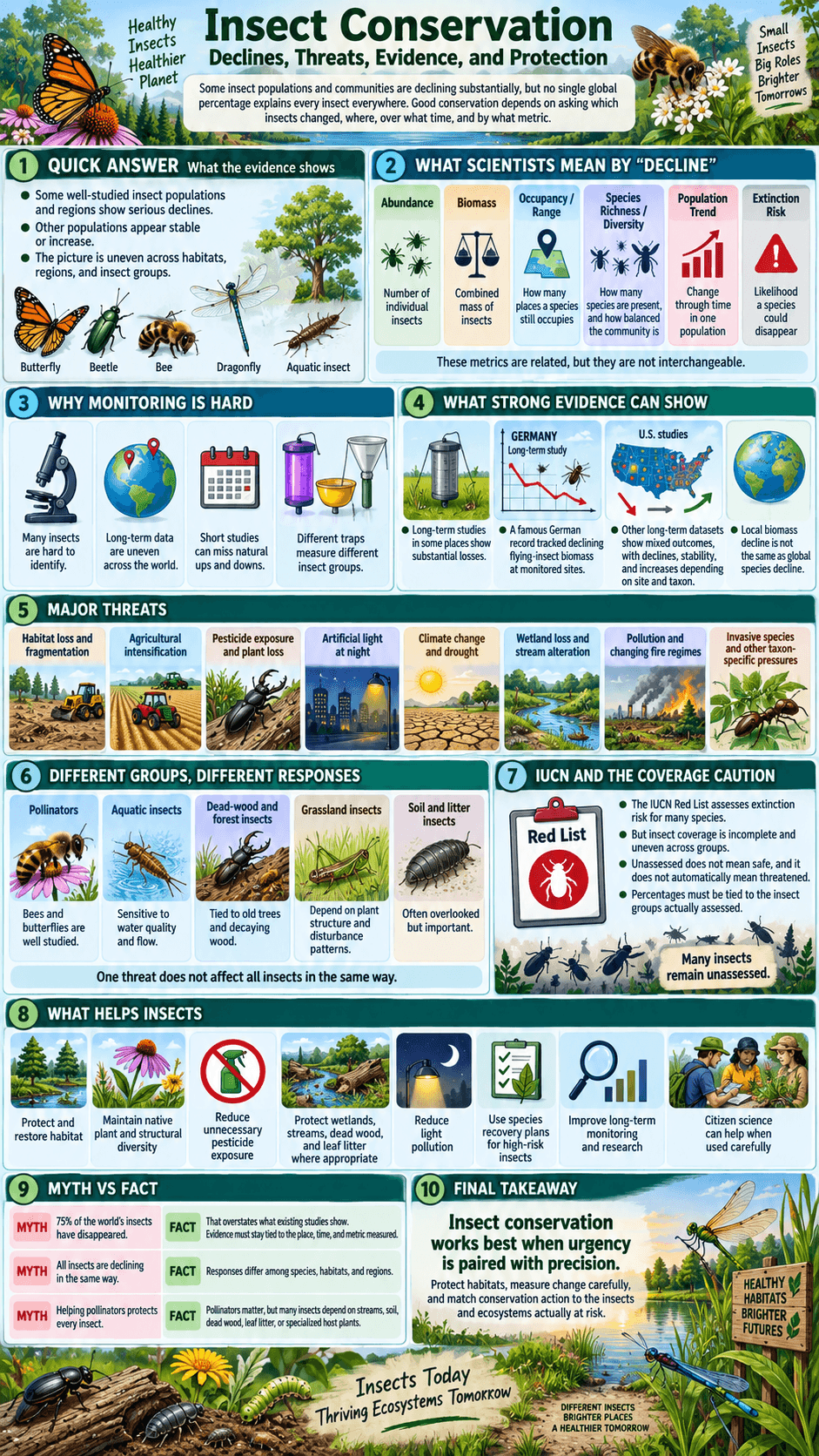
Some well-studied insect populations and regions show serious declines
Long-term studies have documented substantial losses in particular places and groups. One of the most discussed examples comes from protected areas in Germany, where standardized trapping revealed a major multidecade reduction in flying-insect biomass. Later analyses and debate have examined how weather and other factors may have influenced those observations, but recent work still supports a continuing decline in that monitored system and emphasizes the need for standardized research. A useful summary is the Nature analysis of the German biomass record. The important point is that this is evidence about flying-insect biomass at sampled German sites, not a census of every insect species on Earth.
Why the global picture remains uneven and uncertain
Insects include an enormous range of lineages, body sizes, habitats, and life histories. Monitoring is concentrated in certain countries and in relatively familiar groups, while many tropical regions and difficult-to-identify taxa have thin baseline data. A 2026 perspective on insect conservation in the Hindu Kush Himalaya highlights the basic problem: without repeatable inventories and standardized sampling, researchers may struggle to separate genuine ecological change from sampling bias. That limitation is especially important in high-diversity regions where baseline knowledge remains incomplete, as described in a recent Nature Reviews Biodiversity perspective on insect monitoring gaps.
What Scientists Mean by Insect Decline
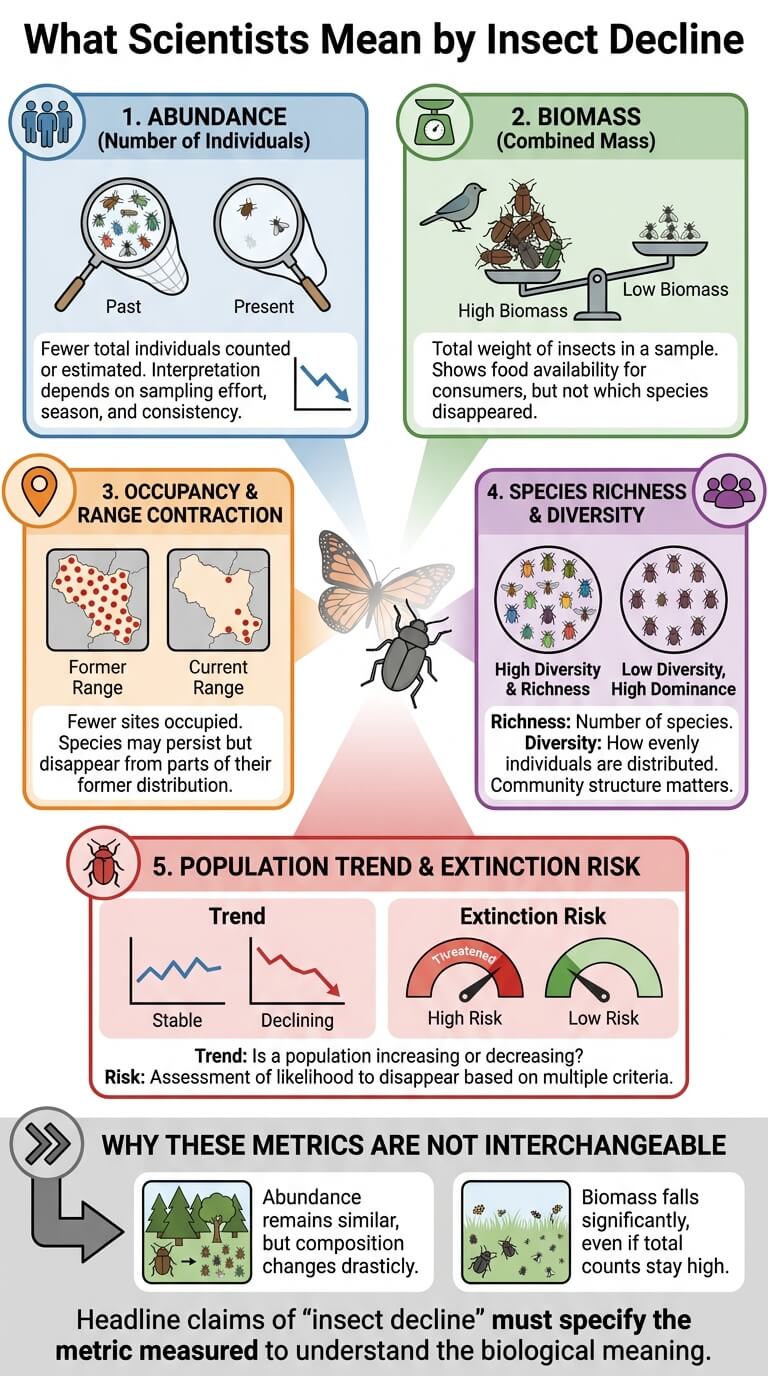
“Decline” can refer to several biological measurements. These measurements overlap, but they are not interchangeable. A study can find fewer individual insects without losing species, or lose species while total numbers are temporarily maintained by a few abundant survivors. Understanding the metric is the first step toward understanding the claim.
Abundance
Abundance is the number of individuals counted or estimated. If a monitoring program repeatedly samples the same meadow and captures fewer individuals of a target group over time, that can indicate an abundance decline. The interpretation still depends on sampling effort, season, weather, detectability, and whether the same methods were used consistently.
Biomass
Biomass measures the combined mass of organisms in a sample or area. A trap can therefore show lower insect biomass even if the number of species changes little. Biomass is ecologically useful because it can approximate how much insect material is available to consumers such as birds, bats, fish, and other arthropods. It does not tell researchers which species disappeared unless the catch is also identified.
Occupancy and range contraction
Occupancy describes how many surveyed sites a species occupies. A species may persist but disappear from part of its former distribution, producing a range contraction. Occupancy data can sometimes be estimated from repeated observations even when exact population sizes are unavailable, but changes in observer effort and detectability must be modeled carefully.
Species richness and diversity
Species richness is simply the number of species recorded in a community. Diversity measures can also account for how evenly individuals are distributed among those species. Two sites may contain the same number of species while differing greatly in community structure if one is dominated by a few very common insects.
Population trend and extinction risk
A population trend tracks whether a particular population is increasing, decreasing, or remaining broadly stable through time. Extinction risk is a different concept. It combines evidence such as population size, trend, geographic range, fragmentation, and other criteria to assess how likely a species is to disappear. A declining population is not automatically classified as threatened, and a threatened species cannot be assumed to have the same decline rate everywhere in its range.
Why these metrics cannot be substituted for one another
Imagine a community in which several formerly common insects become much rarer while a few adaptable species increase. Total abundance could remain similar even as composition changes. In another community, biomass could fall because large-bodied insects decline while counts of tiny insects remain high. These examples show why headlines about “insect decline” need a metric attached to them. The biological meaning changes depending on what was actually measured.
Why Insect Monitoring Is Difficult
Taxonomic gaps
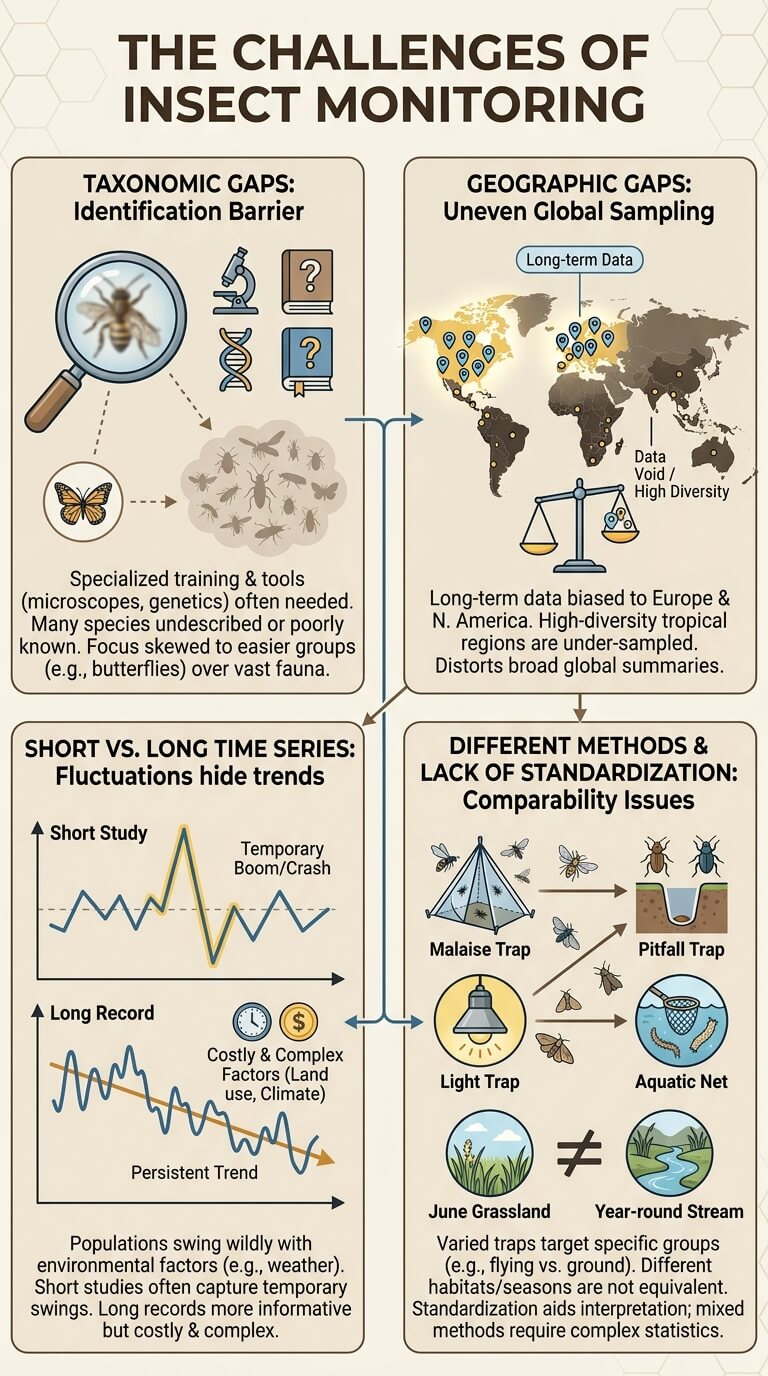
Many insects are difficult to identify without specialized training, microscopes, reference collections, or genetic tools. Some groups have many undescribed species, and even described species may be poorly represented in accessible identification resources. Monitoring programs often focus on butterflies, bees, dragonflies, or other groups that are easier to identify than much of the insect fauna.
Geographic gaps
Long-running datasets are much more common in parts of Europe and North America than in many tropical regions, even though tropical ecosystems contain exceptionally high insect diversity. That imbalance can distort broad summaries. A global synthesis cannot represent areas that were never sampled well in the first place.
Short versus long time series
Insect numbers can swing widely from year to year because of rainfall, temperature, host plants, predators, disease, disturbance, and life-cycle timing. A short study may capture a temporary boom or crash rather than a persistent trend. Longer records are usually more informative, but they are costly and can still be complicated by changes in land use, climate, sampling equipment, or personnel.
Different traps, sampling methods, habitats, and seasonal coverage
Malaise traps catch many flying insects. Pitfall traps sample ground-active arthropods. Light traps favor insects attracted to light. Aquatic sampling targets larvae or nymphs living in water. A study that samples June nights in a grassland is not equivalent to one that samples stream insects year-round. Standardization makes trends easier to interpret, while mixed methods require careful statistical treatment.
What the Strongest Evidence Shows
Regional long-term datasets and what they can support
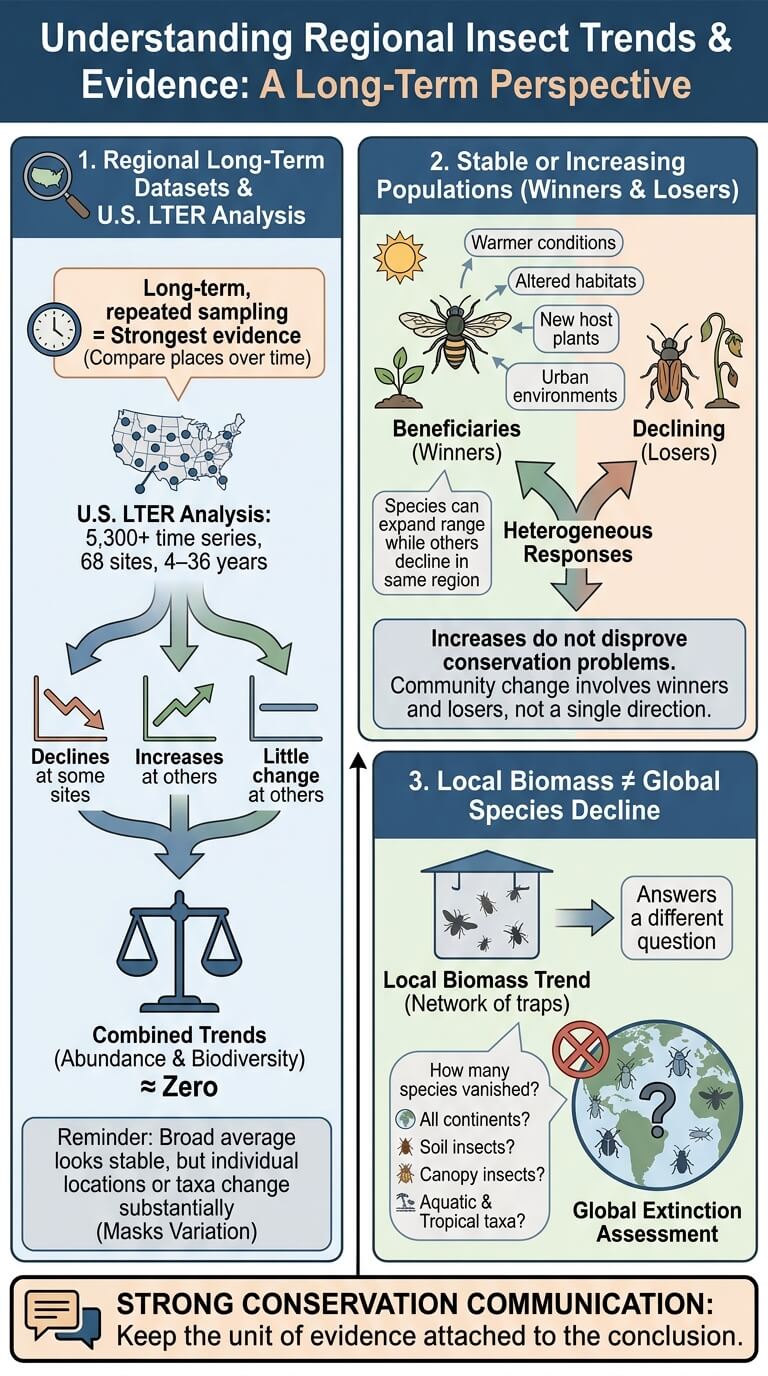
Long-term, repeated sampling provides some of the strongest evidence because it allows researchers to compare the same places through time. Yet results can differ. A large analysis of more than 5,300 arthropod time series from 68 U.S. Long Term Ecological Research settings, covering records of 4 to 36 years, found declines at some sites and increases or little change at others. The combined trends in abundance and biodiversity were generally not different from zero. The U.S. LTER analysis in Nature Ecology & Evolution is a useful reminder that a broad average can look stable even while individual locations or taxa change substantially.
Stable or increasing populations are part of the picture
Some insects benefit from warmer conditions, altered habitats, new host plants, irrigation, urban environments, or other changes. A species can expand its range while another declines in the same region. Increases do not disprove conservation problems. They show that insect responses are heterogeneous, and that community change can involve winners and losers rather than a single synchronized direction.
Why local biomass decline is not automatically global species decline
A biomass trend from a network of traps answers a different question from a global extinction assessment. It cannot by itself tell us how many species vanished, how all continents changed, or what happened to soil insects, canopy insects, aquatic insects, and tropical taxa that were not sampled. Strong conservation communication keeps the unit of evidence attached to the conclusion.
Major Threat Categories
Habitat loss and fragmentation
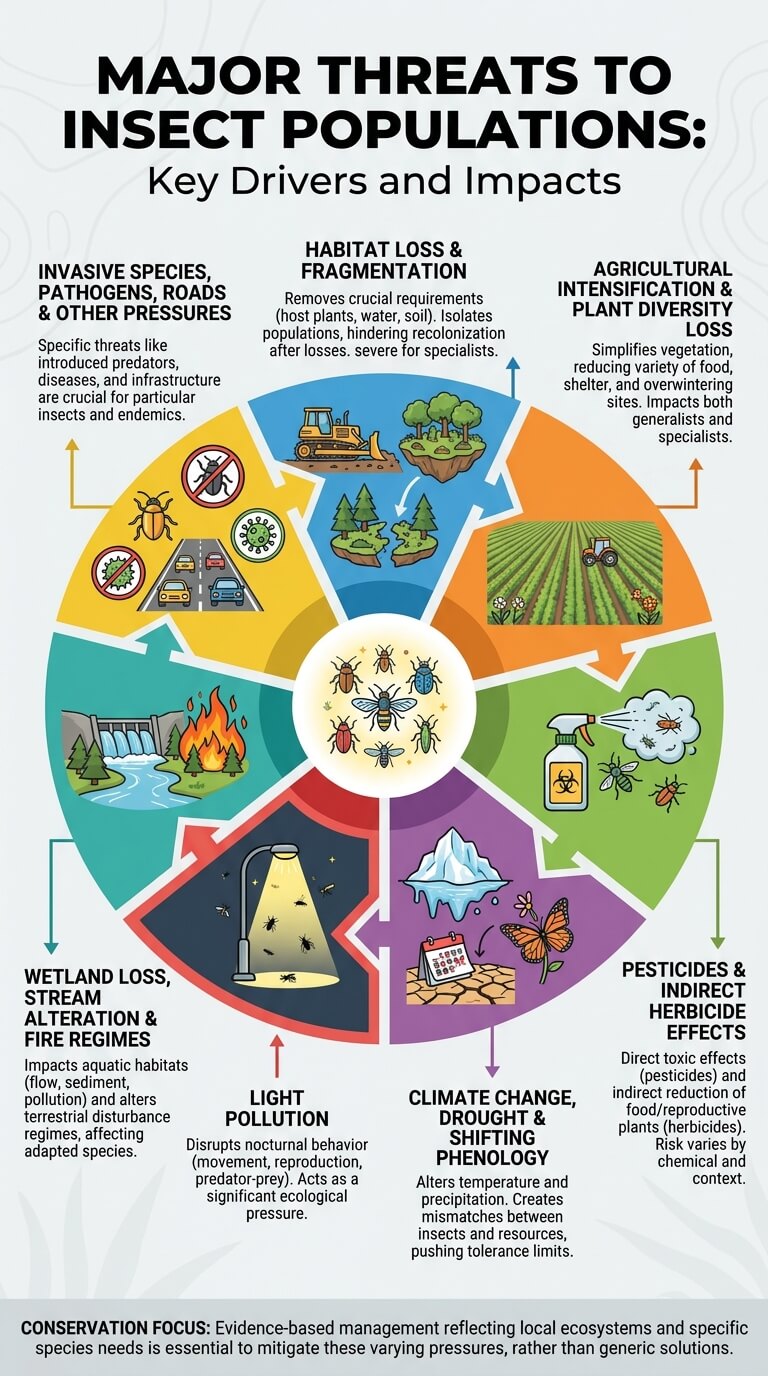
Insects often depend on specific combinations of host plants, nesting substrates, moisture, shade, dead wood, soil conditions, water chemistry, or seasonal resources. Converting or fragmenting habitat can remove those requirements or isolate populations so that recolonization becomes harder after local losses. The effect can be especially severe for insects with narrow ranges or specialized host relationships.
Agricultural intensification and loss of plant diversity
Large-scale simplification of vegetation can reduce the variety of flowers, host plants, shelter, litter, field margins, and overwintering sites available across the year. The consequences differ among insects. A crop-associated generalist may respond differently from a specialist that requires a particular native plant or undisturbed nesting substrate.
Pesticides and indirect herbicide effects where supported
Pesticides can affect target and non-target insects, but risk depends on the chemical, dose, route of exposure, timing, life stage, and species. Herbicides can also influence insects indirectly when they reduce plants used for food or reproduction. Conservation guidance should focus on reducing unnecessary exposure and using evidence-based land management rather than treating every chemical or every landscape as equivalent.
Light pollution
Artificial light at night can alter attraction, movement, feeding, reproduction, predator-prey interactions, and community composition in nocturnal insects. A broad meta-analysis found biological effects across taxa and response types, while also showing that outcomes vary with context. The meta-analysis of artificial light at night provides evidence for treating nighttime lighting as an ecological pressure rather than merely a human visibility issue.
Climate change, drought, and shifting phenology
Temperature and precipitation influence development, emergence, range limits, host plants, flowering, water availability, and seasonal timing. Climate change can therefore create mismatches between insects and resources, push populations beyond heat or drought tolerances, or open new areas for other species. These effects are not uniformly negative. Direction and severity depend on the species, location, and interaction with land use and other pressures.
Wetland loss, stream alteration, pollution, and changing fire regimes
Aquatic insects can be affected by altered stream flow, sediment, temperature, oxygen, contaminants, dams, channel modification, and wetland loss. On land, fire suppression or unusually frequent or intense fires can change vegetation structure and microhabitats. Some insect communities require periodic disturbance, while others are damaged by it. Conservation must therefore reflect the disturbance regime to which a local ecosystem and its species are adapted.
Invasive species, pathogens, roads, and other taxon-specific pressures
Invasive predators, competitors, pathogens, traffic, road construction, collection, and disease can matter greatly for particular insects without being universal explanations for decline. Island endemics may be especially vulnerable to introduced predators. A narrowly distributed butterfly can be affected by road development through its remaining habitat. These are cases where species-level ecology matters more than a generic list of threats.
Threats Differ Among Insect Groups
Pollinators are a relatively well-studied subset
Bees and butterflies receive substantial monitoring and conservation attention because of their ecological roles, visibility, and public interest. That evidence is valuable, but it cannot represent all insects. Global and regional pollinator assessments also emphasize that data quality varies among regions and groups. The IPBES assessment of pollinators and pollination is useful precisely because it separates what is well established from findings that remain incomplete.
Beetles, flies, aquatic insects, dragonflies, grassland insects, forest insects, and soil or litter insects
Different groups experience different bottlenecks. An aquatic mayfly may be limited by stream conditions during its immature stage. A dead-wood beetle may depend on old trees and decaying wood. A fly whose larvae develop in a narrow host may respond strongly to loss of that host. A grassland insect may require a particular vegetation height or disturbance pattern. Conservation becomes more reliable when these life histories shape the diagnosis.
Why one threat cannot be applied uniformly to all insects
The same environmental change can harm one insect and help another. Warming may allow a heat-tolerant species to expand northward while reducing habitat suitability for a cold-adapted mountain species. A disturbance that opens vegetation may benefit insects adapted to sunny early-successional habitat but reduce species that need cool, closed-canopy conditions. Grouping all insects into a single response category hides these differences.
Conservation Status and the IUCN Coverage Problem
What a Red List assessment means
The IUCN Red List evaluates extinction risk using formal criteria. Categories such as Vulnerable, Endangered, and Critically Endangered describe assessed risk, not simply whether a species has been seen less often recently. As of Red List version 2026-1, IUCN summary statistics report a best estimate of 16% threatened among the selected insect groups that are sufficiently assessed for that comparison, with substantial uncertainty around that estimate. The key word is selected. The IUCN Red List summary statistics do not support treating that figure as the threatened proportion of all insect species.
Why unassessed does not mean safe or threatened
If a species has not been assessed, its extinction risk is simply unresolved in that system. Lack of an assessment cannot be converted into Least Concern, and it cannot be converted into threatened status either. Some species are genuinely common and secure, some are poorly known, and others may be declining before enough evidence exists for a formal assessment.
Why IUCN has not comprehensively assessed all insect species
The number of insect species, limited taxonomic expertise, incomplete distribution data, and scarcity of long-term population records make comprehensive assessment difficult. Coverage is therefore uneven among insect groups. Statements about the percentage of insects at risk must specify which taxa were assessed and whether the sample is representative.
Conservation Approaches
Habitat protection and restoration
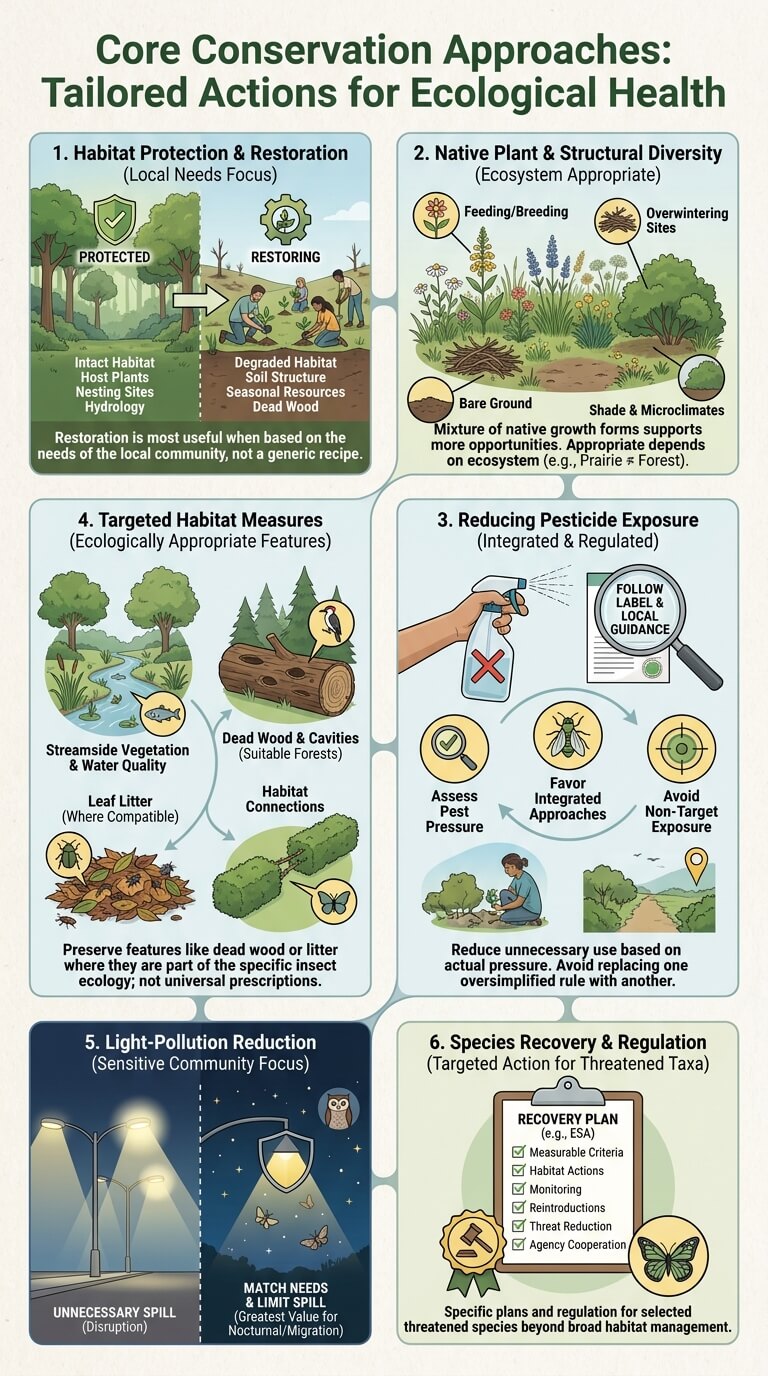
Protecting intact habitat and restoring degraded habitat can address many pressures at once by retaining host plants, nesting sites, microclimates, hydrology, dead wood, soil structure, and seasonal resources. Restoration is most useful when it is based on the needs of the local community rather than a single generic recipe.
Native plant and structural diversity in appropriate landscapes
In many terrestrial settings, a mixture of native plants with different growth forms and seasonal timing can support more feeding and breeding opportunities than a highly simplified plant community. Structural diversity can also provide shade, bare ground, litter, stems, cavities, and overwintering sites. What counts as appropriate depends on the ecosystem. Open prairie should not be managed like forest, and desert habitat should not be treated like a wet meadow.
Reducing unnecessary pesticide exposure without application instructions
Where pesticide exposure is a documented concern, conservation can include reducing unnecessary use, avoiding avoidable non-target exposure, and favoring integrated approaches that respond to actual pest pressure. Specific pesticide decisions should follow current labels, regulations, and qualified local guidance. Insect conservation is not improved by replacing one oversimplified rule with another.
Wetland, stream, dead wood, leaf litter, and connectivity measures where ecologically appropriate
Keeping streamside vegetation, maintaining water quality, retaining dead wood in suitable forest settings, leaving some leaf litter where compatible with local needs, and preserving habitat connections can protect life stages that are easy to overlook. These measures are not universal prescriptions. They work when the habitat feature is part of the ecology of the insects being conserved.
Light-pollution reduction
Reducing unnecessary nighttime illumination, limiting spill into natural habitat, and matching lighting to actual human needs can reduce ecological disruption without requiring darkness everywhere. The conservation value is greatest where sensitive nocturnal communities or migration corridors are exposed to artificial light.
Species recovery plans, protected areas, and regulation for selected threatened taxa
Some insects need targeted action beyond broad habitat management. In the United States, recovery planning for species listed under the Endangered Species Act can include measurable criteria, habitat actions, monitoring, reintroductions, threat reduction, and cooperation among agencies and landowners. The U.S. Fish and Wildlife Service recovery-plan program shows how species-specific conservation is organized for listed wildlife and plants, including imperiled insects.
Monitoring, Citizen Science, and Research Gaps
Standardized long-term monitoring
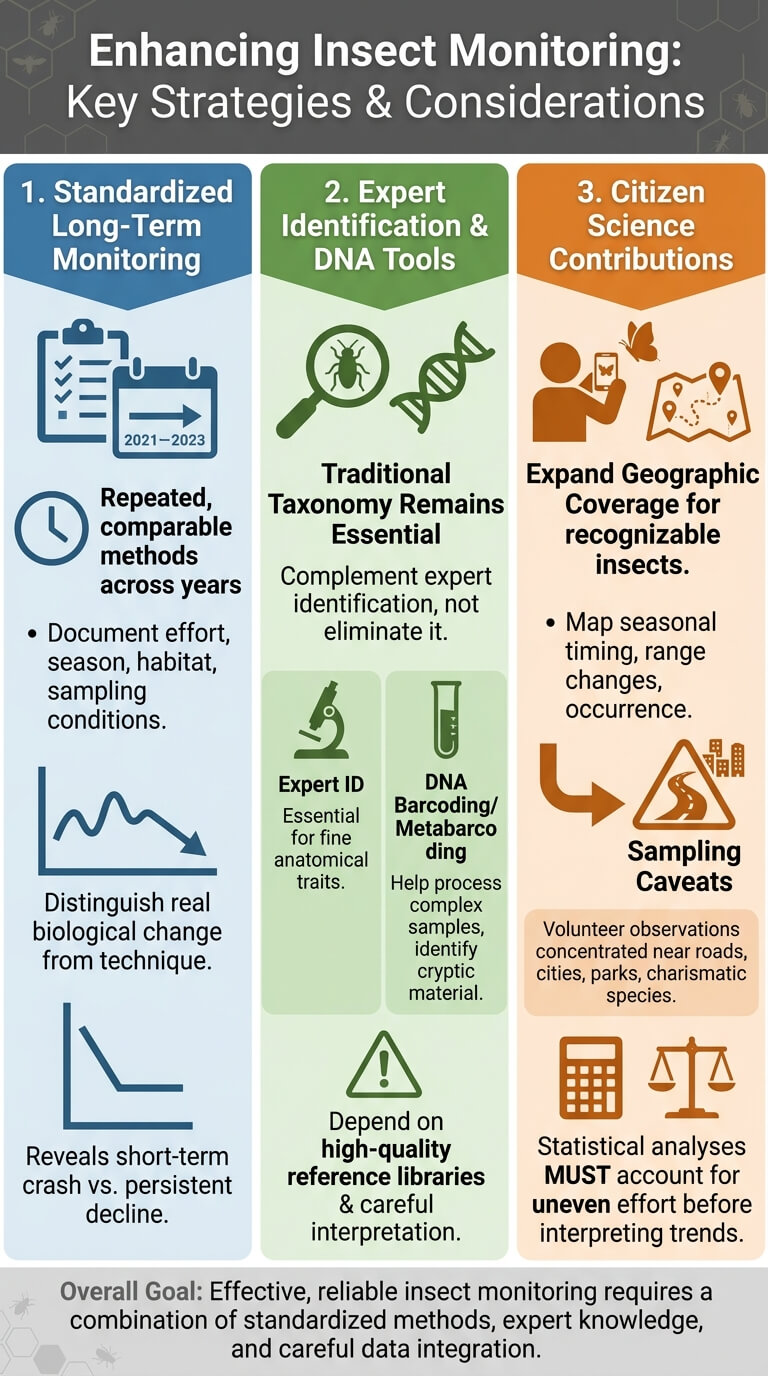
The strongest monitoring programs repeat comparable methods across years and document effort, season, habitat, and sampling conditions. Consistency allows researchers to distinguish real biological change from changes in technique. Long-term monitoring also helps reveal whether a short-term crash is followed by recovery or becomes a persistent decline.
Expert identification and DNA-based tools where appropriate
Traditional taxonomy remains essential, especially when species can only be separated by fine anatomical traits. DNA barcoding and metabarcoding can help process complex samples or identify cryptic material, but they depend on high-quality reference libraries and careful interpretation. These tools complement expert identification rather than eliminating the need for it.
Citizen science can add valuable observations, with sampling caveats
Photographs and repeated observations contributed by the public can greatly expand geographic coverage for recognizable insects. They can help map seasonal timing, range changes, and occurrence. However, volunteer observations are usually concentrated near roads, cities, parks, and charismatic species. Statistical analyses must account for uneven effort before those records are treated as population trends.
Common Conservation Misunderstandings
Did insects decline 75 percent worldwide?
No credible evidence supports turning a large regional biomass decline into a statement that roughly three-quarters of the world’s insects have disappeared. The widely repeated figure traces back to long-term flying-insect biomass measurements from protected areas in Germany. It was a striking result for those sites and that metric, but it was not a worldwide species census.
Are 40 percent of insect species going extinct?
That claim should not be presented as a current global fact for all insects. Extinction-risk coverage is incomplete, and the percentage threatened varies greatly among the insect groups that have been assessed. Reviews can identify concerning patterns, but they do not convert unassessed species into known threatened species.
Will insects disappear within a century?
There is no sound basis for saying that insects as a whole will vanish on a fixed century-scale deadline. Some species face severe extinction risk, many populations are declining, and major data gaps remain. Conservation urgency does not require a countdown claim that the evidence cannot support.
Does helping pollinators automatically protect all insects?
No. Flower-rich habitat can be extremely useful for many pollinators, but other insects depend on streams, dead wood, leaf litter, host-specific vegetation, caves, wetlands, soil, or specialized microhabitats. Broad insect conservation requires more than nectar plants because insect life histories are far more varied than pollination alone suggests.
Why Habitat and Ecological Roles Matter for Conservation
Habitat explains what is actually being lost
A statement such as “habitat loss threatens insects” becomes useful only when habitat is translated into biological requirements. For one species that may mean a host plant in sunny prairie. For another it may mean cold, oxygen-rich stream water. For another it may mean rotting wood of a particular size and decay stage. Conservation becomes more precise when the physical setting is connected to the insect’s life cycle.
Ecological roles explain why population changes can matter
Insects act as herbivores, predators, parasitoids, decomposers, pollinators, scavengers, and prey. A decline can therefore influence food webs, nutrient movement, plant reproduction, or population regulation. The strength of those effects depends on redundancy and on whether other organisms can perform similar functions, so ecological consequences should be measured rather than assumed.
Pollinator conservation is one important part of a larger picture
Pollinator research provides valuable examples of how habitat, pesticides, pathogens, climate, and resource availability can interact. But conserving insects also means paying attention to non-pollinating beetles, flies, aquatic insects, soil fauna, predators, parasitoids, and many poorly known lineages. Protecting insect diversity requires looking beyond the groups people notice most easily.
FAQ
Are insect populations declining everywhere?
No. Some well-studied populations and communities have declined substantially, while others appear stable or have increased. The pattern depends on taxon, location, habitat, time period, and metric. Broad averages can also hide opposing trends among species within the same community.
What is the difference between insect biomass and insect abundance?
Abundance refers to the number of individuals. Biomass refers to their combined mass. A community could contain many small insects but have lower biomass than a community with fewer large insects. That is why the two measurements can move differently over time.
What are the biggest threats to insects?
There is no single threat that dominates every insect group. Frequently documented pressures include habitat loss and fragmentation, intensive land use, some pesticide exposures, artificial light at night, climate change, altered freshwater systems, pollution, and invasive species. Which pressure matters most depends on the ecology of the insects and the place being studied.
Has the IUCN assessed every insect species?
No. IUCN coverage of insects is incomplete and uneven. Some groups have much better extinction-risk information than others. An unassessed species should not be assumed either safe or threatened without additional evidence.
Final Thoughts
Insect conservation is strongest when urgency is paired with precision. There is convincing evidence of serious declines in particular insect populations, communities, and regions, but there is no scientifically defensible single percentage that summarizes every insect on Earth. Abundance, biomass, occupancy, species richness, range change, and extinction risk answer different questions. Monitoring remains uneven, especially across many tropical regions and poorly known taxa. Protecting insects therefore means conserving the habitats and ecological processes they actually need, reducing well-supported pressures, improving long-term monitoring, and using species-specific recovery actions where risk is high. The most useful message is not that all insects are collapsing in the same way, but that many insect communities are changing and good conservation depends on measuring those changes accurately enough to respond.

Ethan Walker is the founder and research editor of Animal Fact Central. He creates and reviews educational animal facts content using trusted wildlife, pet care, and science-based sources. His work focuses on making animal behavior, adaptations, habitats, and species facts clear, accurate, and engaging for everyday readers.
Read More Details About Ethan Walker: https://animalfactcentral.com/ethan-walker/