

Odd-toed ungulates are mammals in the order Perissodactyla, a living lineage that includes horses, zebras, wild asses, rhinoceroses, and tapirs. The name means “odd-toed,” but the defining feature is more precise than simply counting toes: the main axis of the foot passes through the third digit, a pattern called mesaxonic.
That shared foot plan links animals that otherwise look remarkably different. A zebra is a long-legged open-country runner with one main hoof on each foot. A rhino is a massive herbivore with several functional toes. A tapir is a forest-associated browser with a flexible snout and multi-toed feet. Their body shapes, habitats, diets, and movement strategies differ, yet all belong to the same formal mammal order.
Perissodactyls also share an important digestive pattern. They are hindgut fermenters, using microbes mainly in the cecum and colon to process fibrous plant material. That separates them from true ruminants such as deer and cattle, which ferment food in a specialized foregut. Even within Perissodactyla, however, diet varies from grass-heavy feeding in many equids to browsing and fruit eating in tapirs and species-specific mixtures among rhinos.
Quick Answer
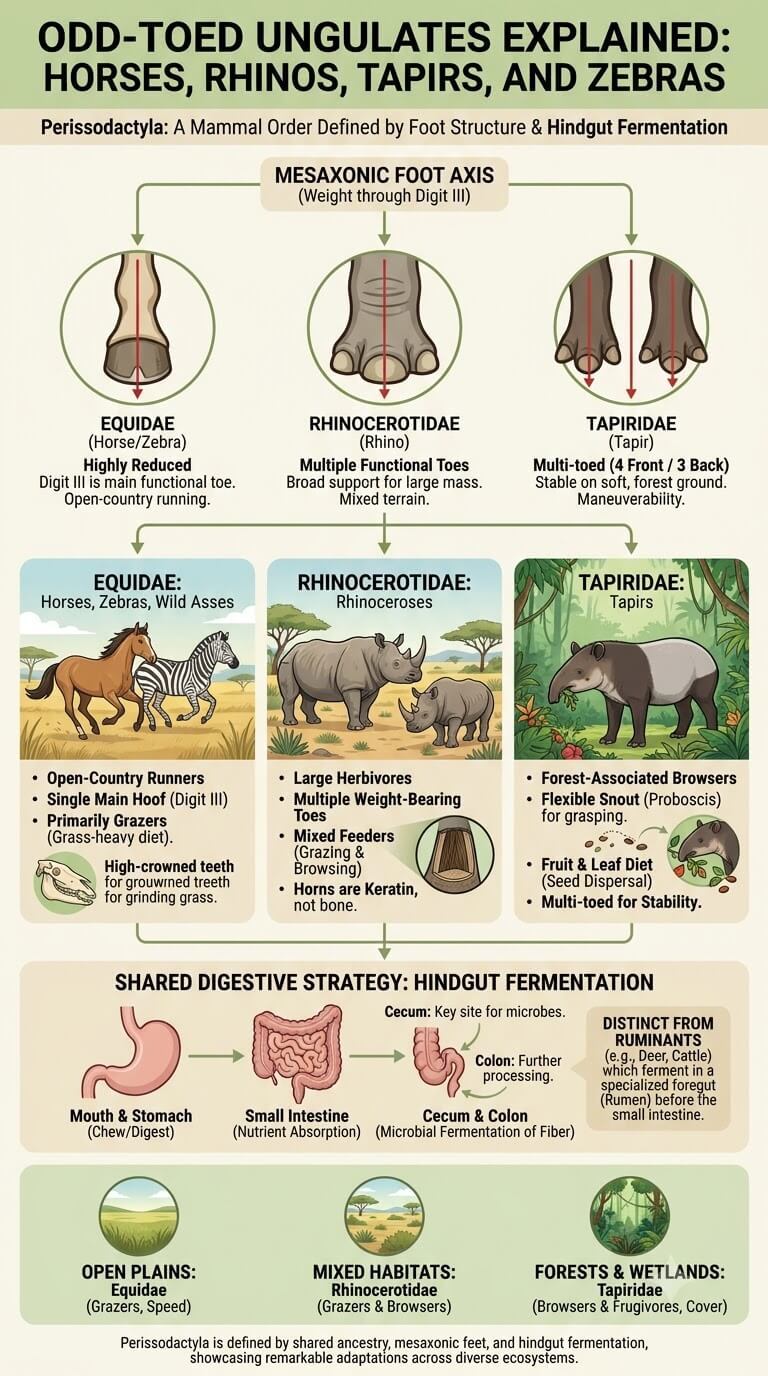
Perissodactyla is a formal order of hoofed mammals with a mesaxonic foot plan, meaning digit III forms the central axis of the foot. The current Mammal Diversity Database family hierarchy lists three living families in the order: Equidae, Rhinocerotidae, and Tapiridae.
Equidae contains horses, zebras, and wild asses. Rhinocerotidae contains the living rhinoceroses. Tapiridae contains tapirs. These groups share ancestry and broad anatomical traits, but they should not be treated as ecological copies of one another.
The phrase “odd-toed” is a useful shortcut, not a field-identification rule. Horses have one dominant functional digit, rhinos usually show several functional toes, and tapirs retain a more complex multi-toed arrangement. What unites them is the central role of digit III and their evolutionary relationship within Perissodactyla.
What Is Perissodactyla?
A Formal Mammal Order
Unlike the broad everyday term “ungulate,” Perissodactyla is a formal taxonomic order. Its living members occupy a distinct branch of placental mammal evolution. The Animal Diversity Web overview of Perissodactyla identifies horses, rhinos, and tapirs as the surviving major groups and describes the enlarged middle digit as central to the order’s foot structure.
Modern classification matters because older books may give totals or arrangements that no longer match current databases. Mammal taxonomy changes as genetic, fossil, morphological, and species-level evidence is reassessed, so family-level relationships are more useful here than an exact species count.
The Mesaxonic Foot Axis Through Digit III
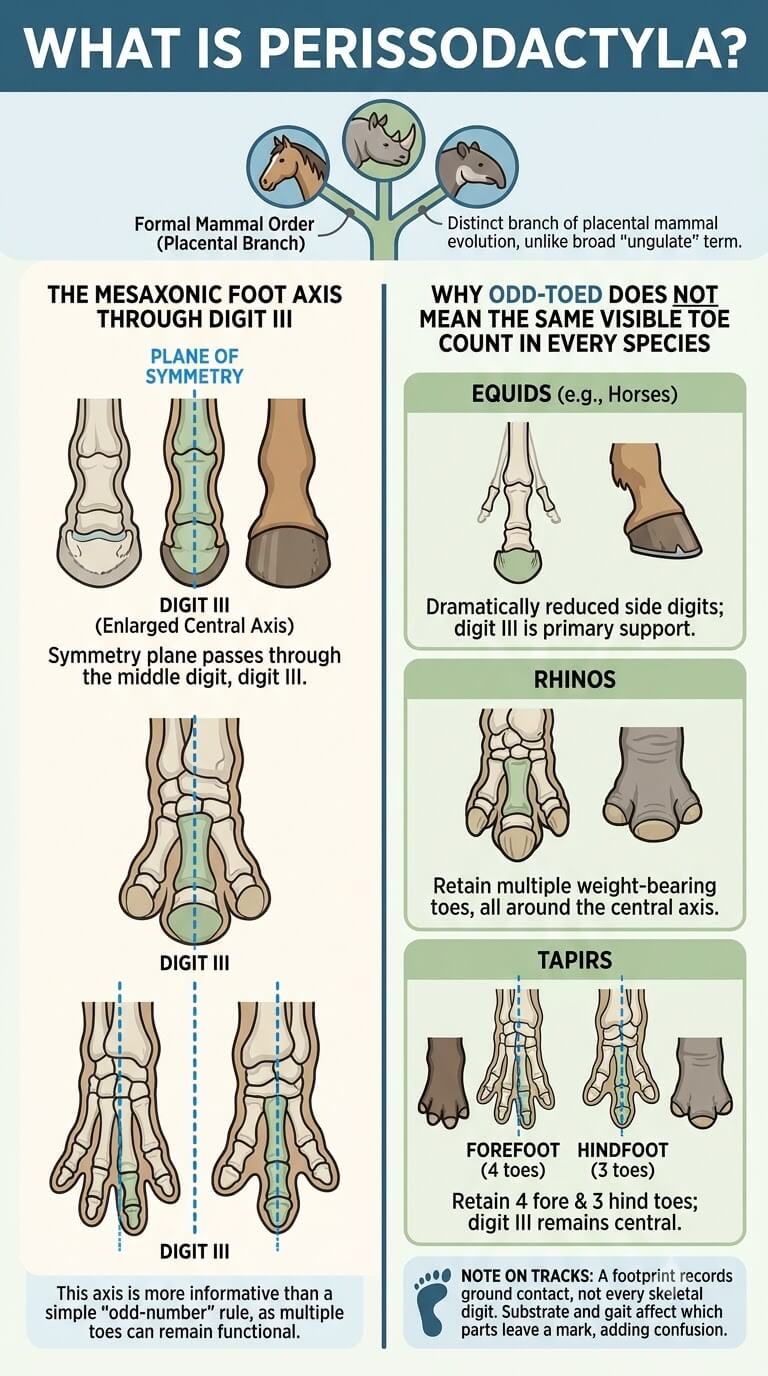
Mesaxonic means the plane of symmetry of the foot passes through digit III, the middle digit. In a horse, this is easy to visualize because digit III is the large functional digit enclosed by the hoof. In rhinos and tapirs, the same underlying axis exists even though more toes remain visible and functional.
This makes the foot axis more informative than a simple odd-number rule. The term “odd-toed” arose from the characteristic pattern, but it should not be interpreted to mean that every living perissodactyl must show exactly one or three toes in the same way. The mesaxonic foot pattern is most useful when contrasted with the paraxonic arrangement of even-toed ungulates.
Why Odd-Toed Does Not Mean the Same Visible Toe Count in Every Species
Digit reduction occurred differently within the lineages. Equids reduced their side digits dramatically, leaving digit III as the primary functional support. Rhinos retain multiple weight-bearing toes. Tapirs retain four toes on the forefeet and three on the hindfeet, with digit III remaining central.
Tracks can add confusion because substrate, gait, and pressure change which parts leave a mark. A footprint records ground contact, not every skeletal digit.
The Living Families of Perissodactyla
Equidae: Horses, Zebras, and Wild Asses
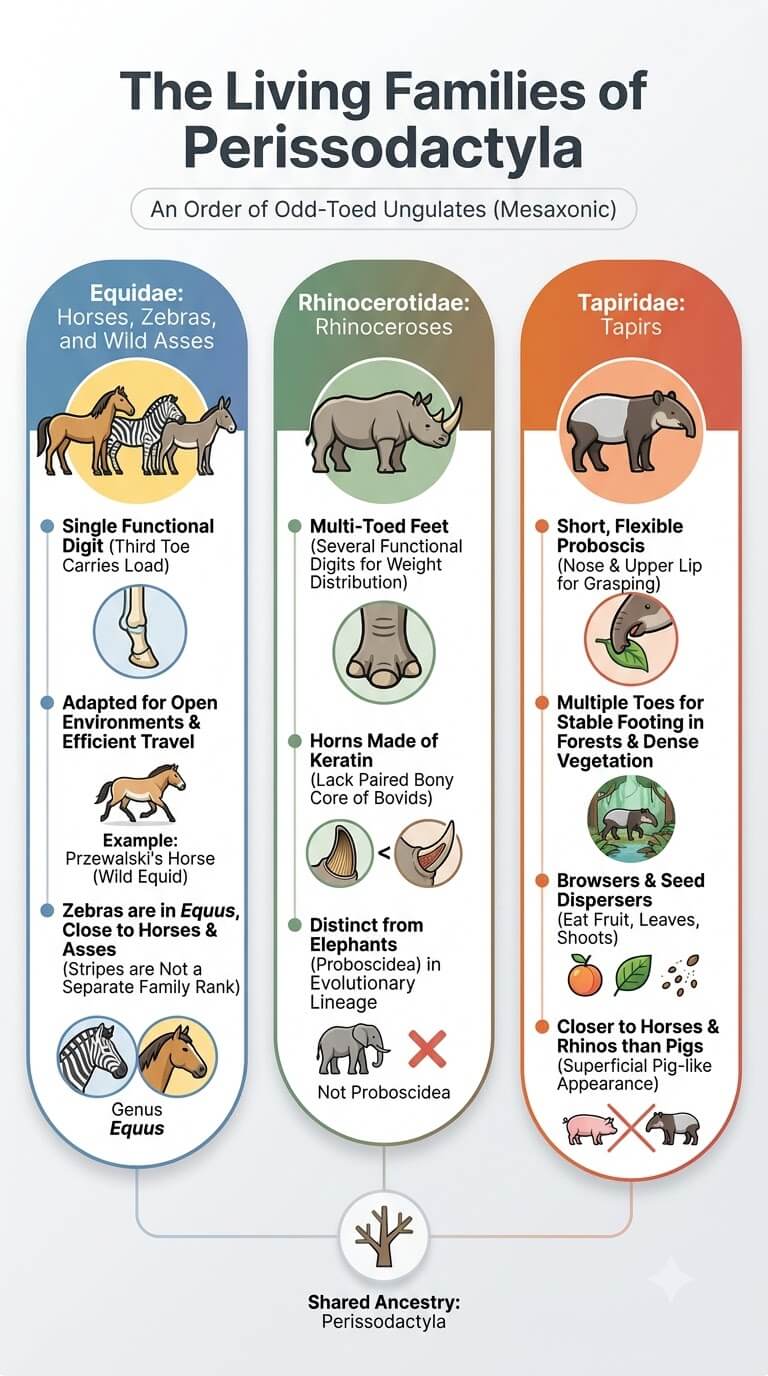
Equidae includes the living horses, zebras, and wild asses. They belong within the same family rather than forming separate horse and zebra families. Their most distinctive locomotor feature is the extreme reduction of the side digits, with the third digit carrying the main load.
Many wild equids occupy open or semi-open environments where efficient travel helps them reach forage and water and respond to danger. The Smithsonian’s Przewalski’s horse profile provides a familiar wild example in Perissodactyla and Equidae.
Zebras are also members of Equidae. Their stripes make them visually distinctive, but taxonomically they remain close relatives of horses and asses within the genus Equus. Treating “zebra” as a separate family would confuse a common-name category with a formal taxonomic rank.
Rhinocerotidae: Rhinoceroses
Rhinocerotidae contains the living rhinoceroses. Rhinos are large-bodied perissodactyls with several functional toes, showing immediately why the order cannot be defined by a single visible hoof. Their feet spread their weight differently from the highly reduced equid foot while retaining the same central mesaxonic organization.
Rhino horns also require careful terminology. They are not built like the true horns of bovids such as cattle, goats, or antelopes. The Smithsonian’s black rhino research overview notes that rhino horn is made of keratin. It lacks the paired bony-core arrangement characteristic of typical bovid horns.
Rhinos should not be grouped with elephants merely because both can be enormous herbivores with thick-looking skin and massive limbs. Rhinos are perissodactyls. Elephants belong to Proboscidea, a separate evolutionary lineage.
Tapiridae: Tapirs
Tapiridae contains tapirs, stocky forest mammals with a short flexible proboscis formed by the nose and upper lip. Their rounded bodies can make them look superficially pig-like, but tapirs are much closer to horses and rhinos than to pigs.
Tapirs retain more toes than horses and frequently use forested, humid, and water-associated environments. Their feet and compact body form suit a different movement problem from the long-distance running often associated with equids. A tapir navigating dense vegetation benefits from maneuverability and stable footing rather than a horse-like extreme in digit reduction.
Feeding also differs. Tapirs are mainly browsers and can eat fruit, leaves, shoots, and other plant material. Smithsonian field research on mountain tapirs in Ecuador describes a fruit-and-leaf diet and highlights their role in dispersing seeds in forest ecosystems.
How Their Feet and Limbs Differ
The Highly Reduced Equid Foot
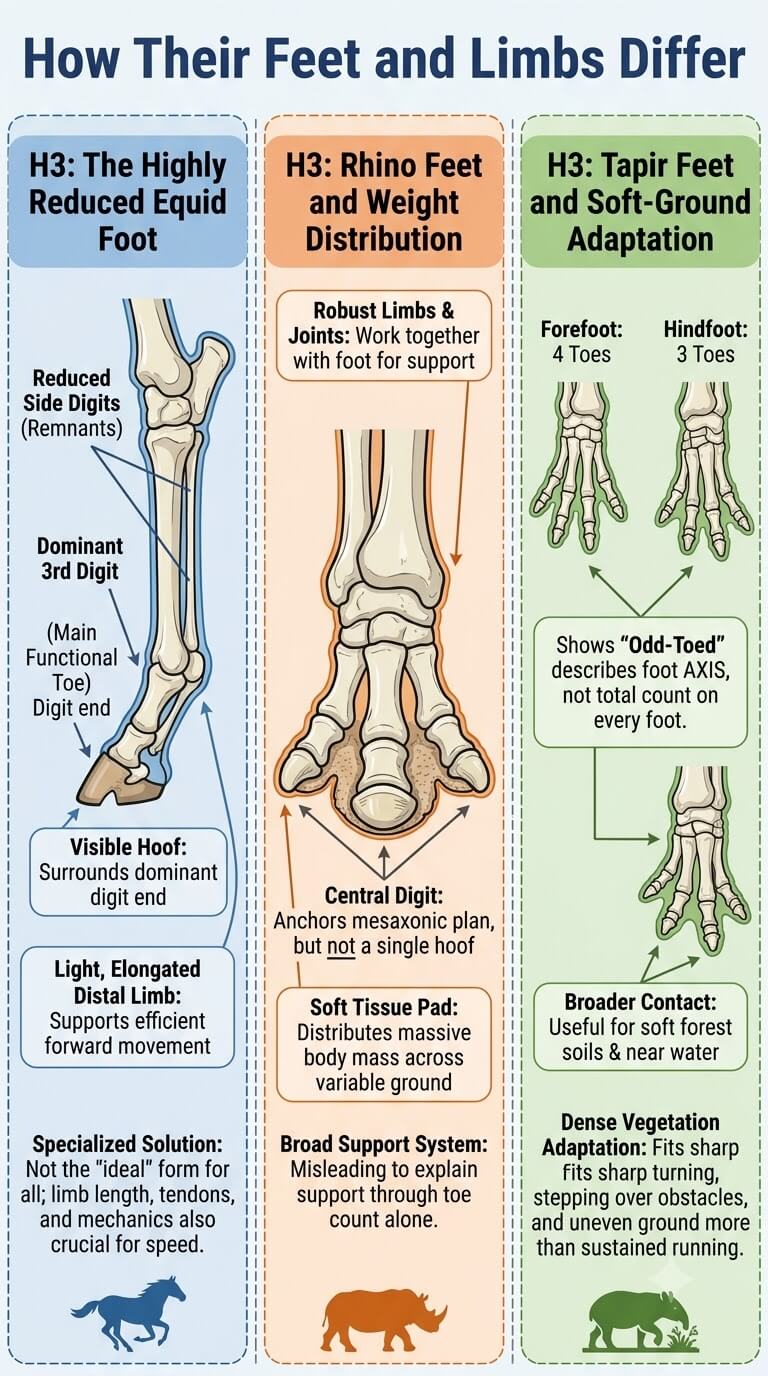
The living equid foot is one of the clearest examples of digit reduction among mammals. The third digit forms the main functional toe, while remnants of the side digits remain in reduced form higher in the limb. The visible hoof surrounds the end of that dominant digit.
This arrangement contributes to a light, elongated distal limb that supports efficient forward movement. The hoof alone does not make an equid fast: limb length, tendons, joints, muscles, stride mechanics, and body mass all contribute.
The equid foot is therefore a specialized solution, not the “ideal” form toward which every perissodactyl evolves. Rhinos and tapirs face different mechanical demands and retain different toe arrangements.
Rhino Feet and Weight Distribution
Rhinos carry far greater body mass than most equids, and their broad feet distribute loads through multiple toes and soft tissues. The central digit still anchors the mesaxonic plan, but the visible foot is nothing like a single horse hoof.
Broad support is especially important when a large animal moves across variable ground. The foot works together with robust limbs, joints, connective tissues, and body posture. It would be misleading to explain rhino support through toe count alone.
Tapir Feet and Soft-Ground Adaptation
Tapirs retain four toes on the forefeet and three on the hindfeet. This makes them particularly useful for showing why “odd-toed” describes the foot axis rather than the number of toes on every foot. Their broader contact with the ground can be useful in soft forest soils and near water.
Tapirs also tend to move through dense vegetation where sharp turning, stepping over obstacles, and negotiating uneven ground may matter more than sustained open-country running. Their foot design fits that broader ecological context.
Body Form and Movement
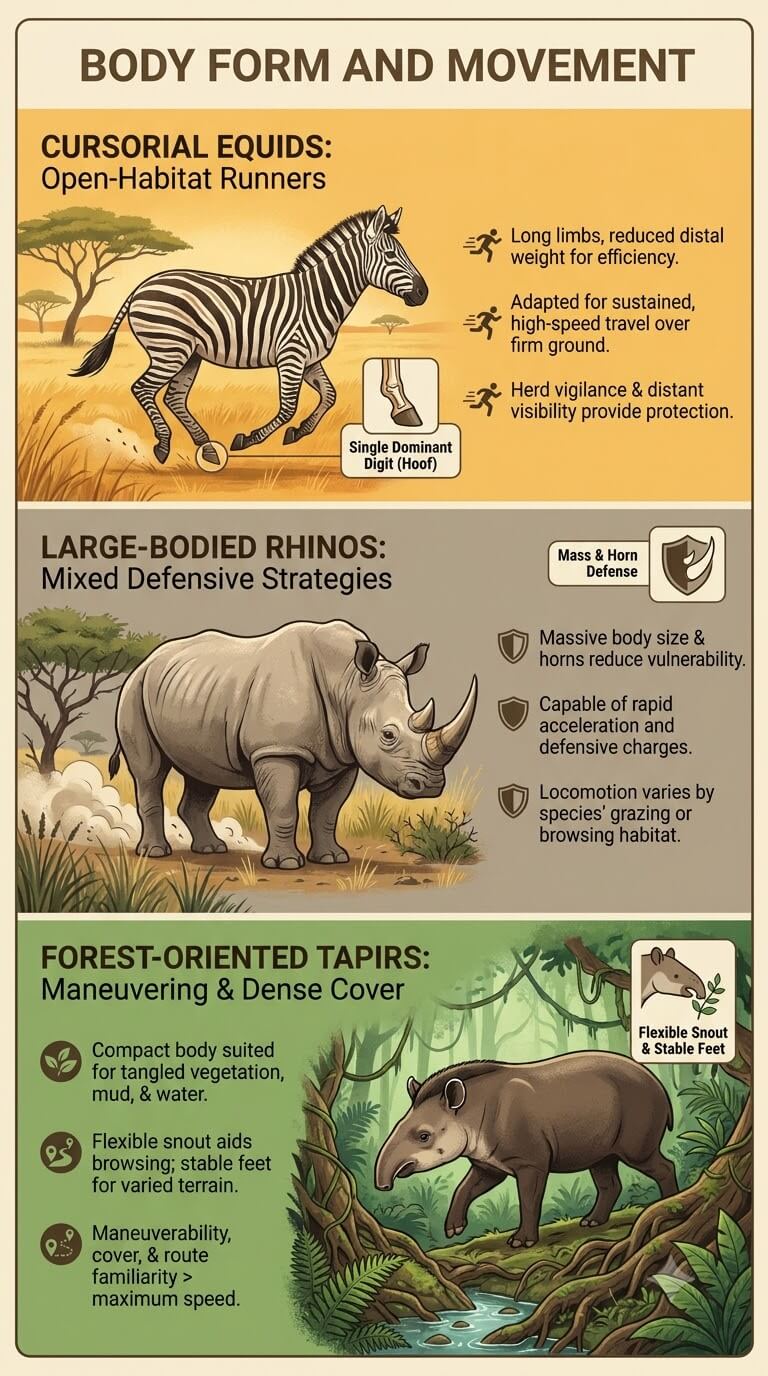
Cursorial Equids and Open-Habitat Movement
Cursorial describes animals adapted for running or sustained terrestrial movement. Many equids show classic cursorial features: long limbs, reduced distal weight, a single dominant digit, and body proportions suited to efficient travel.
Open habitats can reward the ability to see danger at a distance and move quickly across firm ground. Herd vigilance and coordinated movement may add another layer of protection. Still, not every equid lives in identical terrain, and movement is shaped by forage, water, social behavior, and local conditions as well as anatomy.
Large-Bodied Rhinos and Mixed Defensive Strategies
Rhinos solve predator and movement problems differently. Adult body size itself can reduce vulnerability to many predators, and horns, mass, acceleration, and defensive behavior can matter when threats occur. They are capable movers, but describing them as open-country “runners” in the same sense as equids misses their very different body design.
Rhino species also differ in habitat and feeding style. Some are associated more strongly with grasslands and grazing, while others browse shrubs, leaves, and woody vegetation. Their locomotion must therefore be understood in relation to species-specific habitat rather than one universal rhino lifestyle.
Forest-Oriented Tapirs and Maneuvering Through Dense Vegetation
Tapirs have more compact bodies than equids. In forests, that suits movement through tangled vegetation, streams, mud, and established paths. Their flexible snout aids browsing, while their feet provide stable contact on varied ground.
They can move quickly when necessary, but speed rankings reveal little about how well a tapir is adapted to its actual surroundings. Cover, water, route familiarity, and maneuverability can all matter more than maximum straight-line speed.
What Perissodactyls Eat
Grazing in Many Horses and Zebras
Many equids rely heavily on grasses. Grasses can be fibrous and abrasive, so equids combine high food intake with teeth and digestive anatomy suited to processing substantial amounts of plant material. Their feeding often involves moving through large foraging areas rather than selecting only a few high-quality leaves.
That does not mean every equid eats an identical diet. Seasonal plant growth, habitat, water, and local vegetation change what is available. “Grazer” is a useful ecological category, not a claim that an animal eats only grass every day of the year.
Browsing and Mixed Feeding in Rhinos
Rhino diets vary considerably by species. White rhinos are strongly associated with grazing, while black rhinos are well-known browsers. Asian rhinos also differ in the mixtures of grasses, leaves, shoots, and other plants they use.
This diversity is important because it prevents a common mistake: labeling all perissodactyls as grazers simply because horses and zebras are familiar examples. Body size, mouth shape, habitat, and vegetation all influence how a rhino obtains food.
Browsing and Frugivory in Tapirs
Tapirs are mainly browsers and often consume fruit along with leaves and other plant material. Their flexible proboscis helps grasp vegetation, and their forest movements can transport seeds away from parent plants.
Fruit availability changes seasonally, so tapirs may shift among plant resources. Their forest feeding strategy contrasts strongly with grass-heavy feeding in many equids.
How Perissodactyl Digestion Works
Hindgut Fermentation in Plain English
Perissodactyls are hindgut fermenters. They chew and swallow plant food, digest readily available nutrients through the earlier parts of the digestive tract, and then rely heavily on microbes farther along the gut to break down fibrous plant material.
The key difference from a true ruminant is where the major microbial fermentation occurs. A deer or cow ferments much of its plant food before the small intestine in a specialized foregut. A horse, rhino, or tapir carries out major fermentation after the small intestine, especially in the cecum and large intestine.
Cecum and Colon Fermentation at a High Level
The cecum is a large pouch connected near the junction of the small and large intestines. In perissodactyls it supports a dense microbial community that can break down cellulose and other plant fibers. The colon also contributes to fermentation and processing.
This arrangement allows perissodactyls to use fibrous vegetation without chewing cud. Microbial fermentation produces compounds the animal can absorb and use for energy. The exact efficiency, retention time, and diet differ among species, so the process should not be reduced to one universal digestive rate.
How This Differs From True Ruminant Digestion
True ruminants such as deer and bovids use a multi-compartment foregut that includes the rumen, reticulum, omasum, and abomasum. They can regurgitate partially processed food and chew it again as cud. Perissodactyls do not use that system.
Neither strategy is universally superior. Foregut and hindgut fermentation involve different trade-offs in intake, retention, and nutrient extraction. Perissodactyls show that large herbivores can thrive without true rumination.
Habitats and Geographic Diversity
Grasslands and Open Country
Many equids and some rhinos are strongly associated with grasslands, savannas, steppes, or other open environments. These habitats favor different combinations of grazing, vigilance, endurance, and access to widely scattered water and forage.
Open-country living does not define Perissodactyla as a whole. It is one ecological pathway within the order.
Forests and Tropical Habitats
Tapirs demonstrate the opposite pattern. They are strongly associated with forests, including tropical and montane environments, and often use rivers, swamps, or wet ground. Several rhino species also occupy forest or densely vegetated habitats.
Dense vegetation changes the value of body shape and movement. Maneuverability, browsing ability, concealment, and knowledge of paths can matter more than the high-speed locomotion associated with open plains.
Drylands, Shrublands, and Mixed Landscapes
Wild equids and rhinos can also occupy dry or seasonally dry regions where water and food availability shift across the year. Shrublands provide browsing resources for some rhinos, while equids may travel substantial distances between forage and water.
The broad habitat range of the order is another reason to avoid describing perissodactyls as a single ecological type. Their common ancestry is clearer in their anatomy and evolutionary history than in one shared environment.
Horns, Body Structures, and Common Identification Errors
Rhino Horns Are Not Bovid Horns
Rhino horns are keratin-based structures and do not have the paired bony cores characteristic of typical bovid horns. Bovids such as cattle, goats, sheep, and many antelopes belong to the even-toed lineage, not Perissodactyla.
Deer antlers are different again because they are bone structures that are typically shed and regrown on a cycle, with important variation by species and sex. Similar-looking head structures can therefore have very different anatomy.
Zebras and Horses Belong to the Same Family
Zebras are not a separate family of striped hoofed mammals. They belong to Equidae alongside horses and wild asses. Their stripes are an important species-level adaptation and identification feature, but they do not override the skeletal, genetic, and evolutionary evidence placing these animals together.
This is a useful example of the difference between common names and formal classification. “Horse,” “zebra,” and “ass” describe familiar forms within a closely related equid lineage.
Tapirs Are Not Pigs
Tapirs and pigs can look surprisingly similar at a glance, especially because both can have stocky bodies and mobile snouts. Their feet and ancestry tell a different story. Tapirs are perissodactyls, while pigs belong to the even-toed artiodactyl radiation.
Superficial resemblance often reflects similar ecological challenges rather than close ancestry. Classification works best when multiple lines of evidence are considered.
Evolutionary and Classification Context
What Unites Living Perissodactyls
Living perissodactyls are united by ancestry, mesaxonic foot organization, aspects of skull and tooth structure, and a broadly shared hindgut-fermenting digestive system. These traits are expressed differently in equids, rhinos, and tapirs because each lineage has followed a different ecological path.
Living forms still preserve striking variation in body size, limbs, habitat, and feeding behavior. Current taxonomy should be checked rather than relying on old species totals because boundaries and names can change.
Why Similar Herbivore Body Shapes Do Not Prove Close Relationship
Large plant-eating mammals often face comparable problems: supporting body weight, processing fibrous food, moving between resources, and avoiding predators. Similar pressures can produce superficially similar body forms in lineages that are not close relatives.
That is why rhinos are not grouped with elephants, and tapirs are not grouped with pigs. Evolutionary classification asks which traits were inherited from common ancestors and how multiple forms of evidence fit together, not which animals look most alike from a distance.
Conservation Context Without Oversimplifying the Order
Why Status Must Be Checked by Species
Perissodactyl conservation cannot be summarized with one label. Different equids, rhinos, and tapirs face different levels of risk in different regions, and assessments can change as new population data become available. A statement that “perissodactyls are endangered” would therefore be too broad.
When conservation status matters, the correct approach is to verify the exact species and the date of the assessment using an authoritative resource such as the IUCN Red List or an official wildlife agency. The same caution applies to population estimates.
Habitat Loss, Illegal Killing, and Small Populations
Threats also vary by species. Habitat conversion and fragmentation can isolate forest tapirs or reduce access to feeding areas. Several rhino populations have faced intense illegal killing associated with demand for horn. Wild equids may be affected by habitat change, barriers, competition with livestock, or very small population size in particular regions.
These pressures should not be generalized into one universal story. Conservation works at the species and population level, and reliable current data are more useful than dramatic claims about the order as a whole.
Common Myths and Mistakes
All Perissodactyls Have Exactly One or Three Obvious Toes
No. Horses provide the one-main-digit extreme, while rhinos and tapirs retain multiple functional toes. Tapirs are especially useful counterexamples because their forefeet and hindfeet do not display the same visible toe number.
The order is defined by the central role of digit III and shared ancestry, not by one simple toe-count formula.
All Odd-Toed Ungulates Are Grazers
No. Many horses and zebras rely heavily on grass, but tapirs are primarily browsers and fruit eaters. Rhino feeding varies by species, including strong grazing and browsing specialists.
Hindgut fermentation can support several plant-feeding strategies. Digestive anatomy does not force every perissodactyl into the same diet.
Rhinos Are Close Relatives of Elephants
They are not. Rhinos are members of Perissodactyla with horses and tapirs. Elephants belong to Proboscidea and a different placental mammal lineage.
The misconception comes from visible similarities such as large body size, thick limbs, and herbivory. Those similarities reflect comparable ecological and mechanical challenges rather than especially close ancestry.
Feet, Feeding, and Habitat Tell Different Parts of the Story
Foot Structure Helps Explain Locomotion
Equids, rhinos, and tapirs share a mesaxonic plan but distribute weight differently. Those differences shape stride, stability, traction, and the kinds of terrain each animal uses effectively. Foot anatomy provides a foundation for understanding movement without reducing locomotion to toe count.
Hindgut Fermentation Supports Different Feeding Styles
The shared digestive strategy links the order physiologically, yet feeding niches remain diverse. Grass-heavy equid diets, rhino grazing or browsing, and tapir browsing and fruit eating show how one broad digestive system can support different ecological roles.
Habitat Reveals the Order’s Flexibility
Open plains, shrublands, drylands, tropical forests, montane forests, and wet ground all support different perissodactyls. The order is therefore best understood as an evolutionary lineage with flexible ecological outcomes rather than one stereotyped type of hoofed animal.
FAQ
Which animals are odd-toed ungulates?
Living odd-toed ungulates belong to Perissodactyla and include horses, zebras, wild asses, rhinoceroses, and tapirs. These animals are organized into the living families Equidae, Rhinocerotidae, and Tapiridae.
They do not all show the same number of visible toes. Their shared mesaxonic foot organization and ancestry are more important than a simple toe count.
Are zebras horses taxonomically?
Zebras and horses are close relatives in the same family, Equidae, and both belong to the genus Equus under current classifications. It is clearer to say that zebras are equids closely related to horses rather than to treat “zebra” and “horse” as separate family-level categories.
Their coat patterns, behavior, habitat use, and species histories differ, but those differences occur within the same family.
Why are tapirs odd-toed ungulates?
Tapirs are perissodactyls because their evolutionary ancestry and foot anatomy place them in the mesaxonic lineage centered on digit III. Their multi-toed feet do not contradict the name “odd-toed” because the term refers to structural organization, not a requirement that every foot display the same odd number of visible toes.
They share Perissodactyla with equids and rhinos despite having a very different forest-oriented body form and feeding style.
Are rhinos related to horses?
Yes. Rhinos and horses belong to the same mammal order, Perissodactyla, although they are in different families and their lineages diverged deep in evolutionary time. Their shared order reflects inherited anatomical and evolutionary relationships, not close similarity in modern appearance.
Tapirs belong to that order as well, making horses, rhinos, and tapirs the three major living family-level branches of Perissodactyla.
Final Thoughts
Odd-toed ungulates are far more diverse than the name suggests. Perissodactyla unites the single-main-hoof design of horses and zebras, the broad multi-toed feet and massive bodies of rhinos, and the forest-adapted, multi-toed feet of tapirs. The common thread is a mesaxonic foot centered on digit III, shared ancestry, and a broad hindgut-fermenting digestive strategy.
The differences are just as informative as the similarities. Equids often emphasize efficient open-country movement and grazing. Rhinos combine large body size with species-specific grazing or browsing strategies. Tapirs show how the same order can produce a compact forest browser and fruit eater. Understanding Perissodactyla therefore means looking beyond the phrase “odd-toed” and seeing how foot structure, digestion, habitat, and evolutionary history fit together.

Ethan Walker is the founder and research editor of Animal Fact Central. He creates and reviews educational animal facts content using trusted wildlife, pet care, and science-based sources. His work focuses on making animal behavior, adaptations, habitats, and species facts clear, accurate, and engaging for everyday readers.
Read More Details About Ethan Walker: https://animalfactcentral.com/ethan-walker/