

Hooves are specialized structures at the ends of mammal digits that help support body weight, resist wear, grip the ground, and transfer forces between the limb and the surface below. They are made partly from tough keratinized tissue, but a hoof is not simply a giant toenail. Beneath and around the visible outer material are bones, joints, connective tissues, blood vessels, nerves, pads, and other living structures that work together every time the animal stands, walks, runs, turns, or climbs.
Hooves also come in very different forms. A horse carries most of its weight through one enlarged third digit. Deer and many bovids use two main weight-bearing digits that form a cloven hoof. Rhinos retain several functional toes. Tapirs retain multiple toes in a different arrangement, while camelids have two main toes supported by broad pads rather than hard deer-like hoof halves.
Those differences matter because hoof function is always tied to the rest of the limb and to the animal’s environment. A foot that works well for efficient travel on firm open ground faces a different mechanical problem from one used in mud, snow, loose sand, or steep rock. To understand how hooves work, it helps to look at anatomy, load transfer, traction, growth, wear, and digit evolution as parts of the same system.
Quick Answer

A hoof is a keratinized terminal structure associated with one or more digits. In hoofed mammals, the animal commonly bears much of its body weight near the ends of those digits, a posture often described as unguligrade. The visible hoof protects underlying tissues and forms part of the surface that contacts the ground.
In the horse, the anatomy is especially well documented. The University of Missouri guide to horse-foot anatomy describes the hoof wall, sole, frog, bars, third phalanx, lateral cartilages, digital cushion, tendons, and other structures that share the work of supporting and moving the animal. That horse model is useful for learning basic principles, but it should not be assumed to describe every wild ungulate.
Hooves grow because living epidermal tissues continually produce new keratinized material. At the same time, contact with the ground wears that material away. The balance between growth and wear depends on species, substrate, movement, body mass, and other conditions. In wild animals, natural wear can differ greatly between rocky slopes, open plains, wet forest floors, and soft sand.
What Is a Hoof Made Of?
External Keratinized Structures
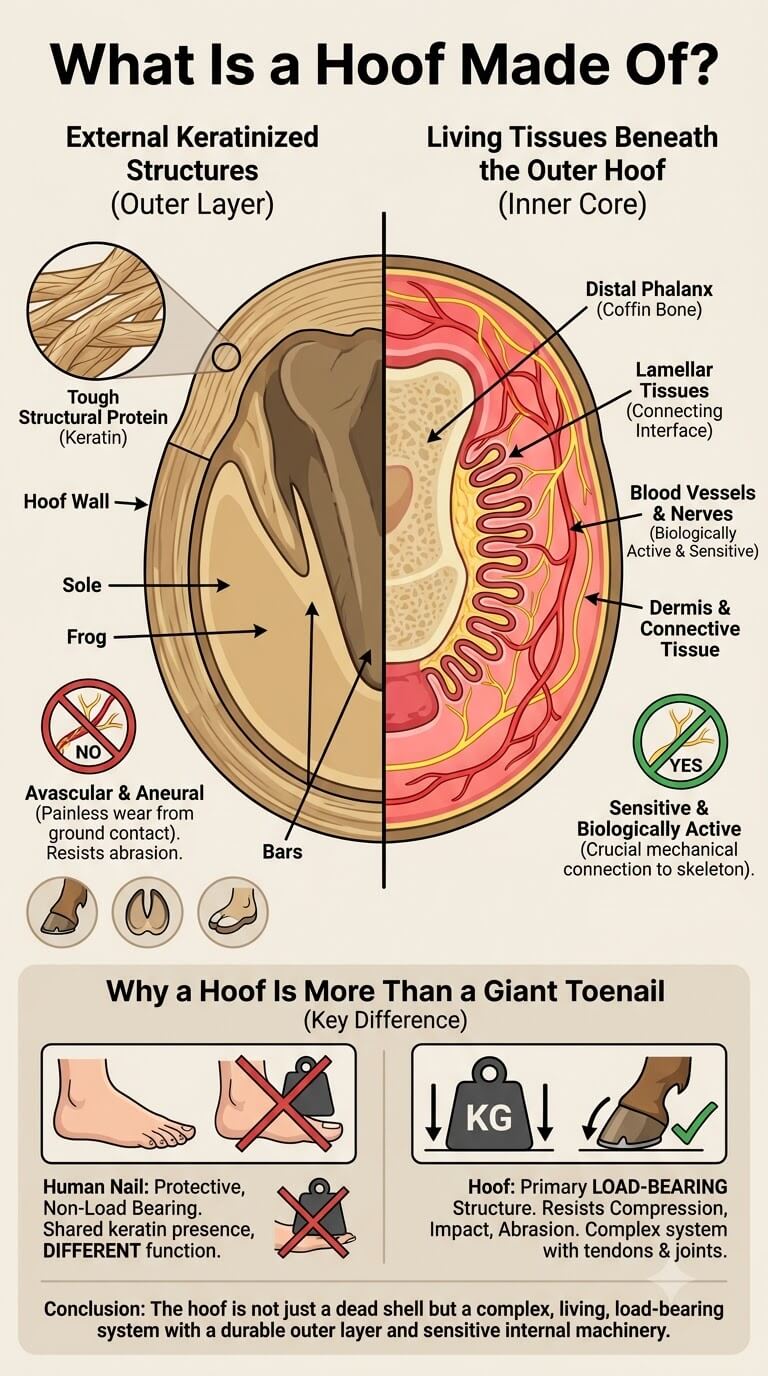
Keratin is a tough structural protein also found in hair, claws, and nails. In hooves, keratinized cells form durable outer structures that resist abrasion and help protect the living tissues beneath. Because the outermost horn is not itself richly supplied with blood vessels or nerves, it can tolerate repeated contact with the ground.
The exact external parts differ among species. A horse hoof includes a prominent wall, sole, frog, and bars. A cloven hoof has two principal hoof capsules associated with the main weight-bearing digits. Rhino and tapir feet spread load across several toes. Camelids place two toes on broad pads, creating a very different contact surface.
Living Tissues Beneath the Outer Hoof
The hard outer structure is only one layer of the system. Living tissues beneath it include dermis, connective tissue, blood vessels, nerves, and specialized interfaces that connect the hoof capsule with the skeleton. In a horse, lamellar tissues help link the hoof wall to the distal phalanx, often called the coffin bone.
This living connection is why describing a hoof as a dead shell is misleading. The outer keratinized portion can be worn without pain under normal conditions, but deeper tissues are biologically active and sensitive. The hoof must remain mechanically connected to the bones and soft tissues that carry forces through the limb.
Why a Hoof Is More Than a Giant Toenail
A human nail sits on the end of a digit, but it does not normally support the body’s mass with every step. A hoof does. That load-bearing role changes the mechanical demands enormously.
Hooves must resist compression, bending, abrasion, and repeated impact while maintaining a stable connection to the skeleton. They also work with pads, tendons, joints, and ligaments that deform or change position under load. The useful comparison to a nail is the shared presence of keratin, not an identical function.
Hooves Are Built Around Digits

Phalanges and the End of the Limb
A digit is a finger or toe, and the bones inside it are called phalanges. Hooves form around the terminal region of these digits. In many hoofed mammals, evolutionary changes have reduced the number of major weight-bearing digits while lengthening the limbs and shifting the body higher above the ground.
That reduction is especially dramatic in horses. The third digit became the dominant functional digit, while the side digits were greatly reduced. Deer and many bovids retain two main functional digits. Rhinos and tapirs preserve more obvious multi-toed feet.
Joints, Tendons, and Ligaments
The hoof cannot move the animal by itself. Muscles higher in the limb generate force, tendons transmit much of that force toward the distal limb, joints allow controlled motion, and ligaments help stabilize the skeleton. When the foot lands, these structures help manage the forces created by body weight and movement.
Some tendons can store and return elastic energy during locomotion, especially in running mammals with long, specialized limbs. That does not mean every ungulate uses the same spring-like mechanics to the same degree. Limb proportions, speed, body mass, gait, and species all affect how much different tissues contribute.
Reduced Digits and Weight-Bearing Toes
The arrangement of digits is also central to hoofed-mammal classification. The Animal Diversity Web account of Perissodactyla describes odd-toed ungulates as mesaxonic, with the main foot axis passing through digit III. Horses, rhinos, and tapirs all share that basic pattern despite very different visible feet.
Terrestrial even-toed mammals are typically paraxonic, with the axis passing between digits III and IV. Deer, bovids, pigs, hippos, camelids, and other artiodactyl relatives can therefore share a common structural plan even when the number and shape of visible toes differ.
How Hoofed Mammals Carry Their Weight
Unguligrade Posture
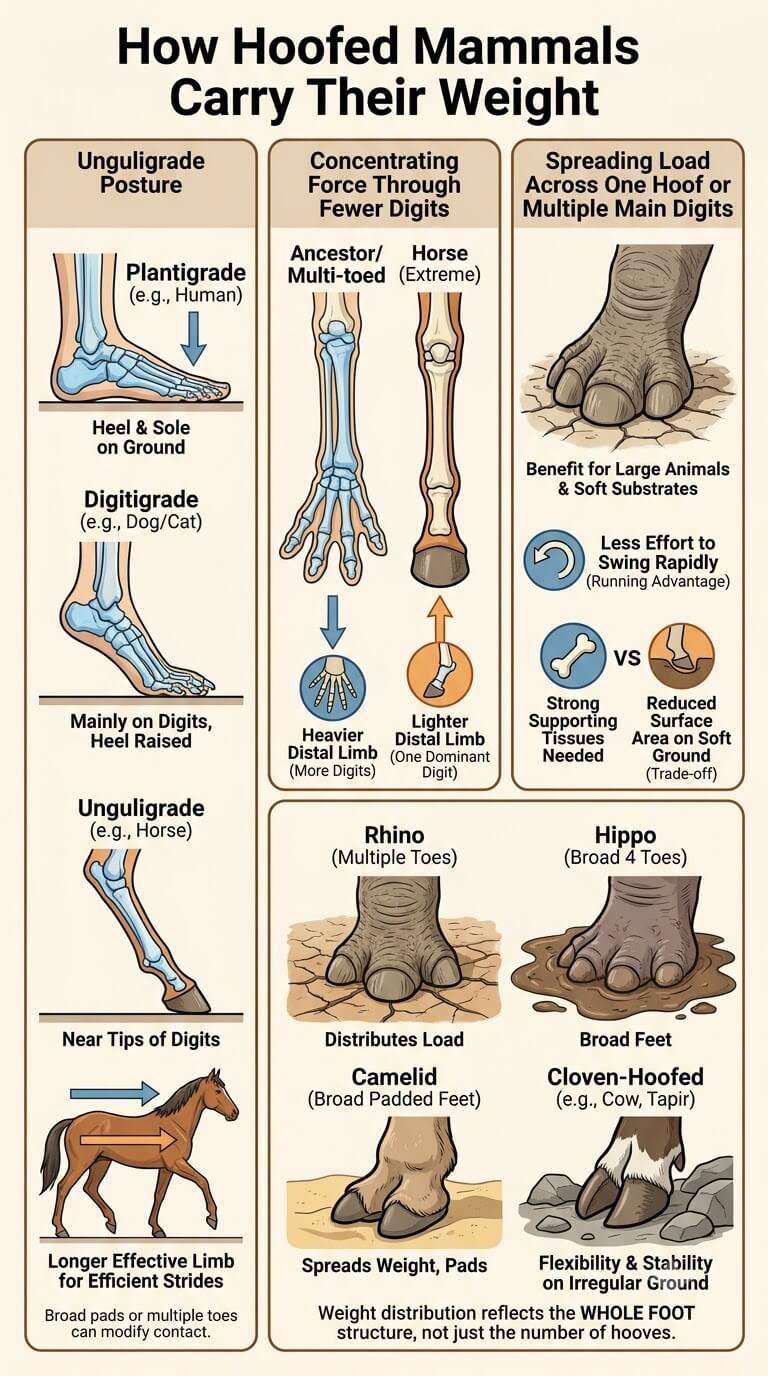
Many hoofed mammals are described as unguligrade because they support the body near the tips of their digits. This differs from plantigrade mammals such as humans, which place the heel and much of the sole on the ground, and from digitigrade mammals such as dogs and cats, which stand mainly on the digits with the heel raised.
Moving the functional support toward the end of the limb can make the limb effectively longer. In running specialists, a long distal limb can support a long stride and efficient forward movement. But unguligrade posture is not identical in every species, and broad pads or multiple functional toes can change how the foot actually contacts the ground.
Concentrating Force Through Fewer Digits
Reducing the number of main digits can lighten the far end of the limb. A lighter distal limb requires less effort to swing rapidly, which can be advantageous during repeated running. Horses show an extreme version of this pattern with one dominant digit.
There is a trade-off. Concentrating force onto fewer contact points increases the importance of strong supporting tissues and a well-organized limb. It can also reduce the surface area available on soft ground. Evolution therefore does not push every hoofed mammal toward a single-digit foot.
Spreading Load Across One Hoof or Multiple Main Digits
Large animals and species using soft substrates may benefit from broader support. Rhinos distribute load across multiple toes. Hippos have broad feet with four toes. Tapirs retain several toes, and camelids spread weight through broad padded feet.
Even within cloven-hoofed mammals, the two main digits can spread slightly or contact uneven surfaces independently. That flexibility can increase stability on irregular ground. The important point is that weight distribution reflects the whole foot, not simply whether the animal has one hoof or two visible halves.
Single Hooves and Cloven Hooves

Horse-Style Single-Hoof Mechanics
The horse foot is centered on one dominant third digit. The hoof wall surrounds the distal phalanx and related tissues, while the sole, frog, bars, digital cushion, and cartilages contribute to contact, support, and deformation under load.
The University of Missouri anatomy guide describes how weight passes through the phalanges and into the hoof structures, with flexible tissues changing shape as the foot bears weight. This is a useful model of how a hard outer capsule and softer internal structures can work together rather than acting as one rigid block.
The horse foot should still be treated as a specialized equid solution. A rhino or deer does not simply have a horse hoof divided or multiplied into several pieces.
Deer and Bovid Cloven-Hoof Mechanics
In deer and many bovids, digits III and IV form the main weight-bearing pair. The Animal Diversity Web overview of Artiodactyla describes this paraxonic arrangement and notes that side digits may be reduced while the central pair remains large.
Each principal digit ends in its own keratinized hoof structure, producing the familiar split or cloven appearance. Because the two sides can respond somewhat independently to the ground, a cloven foot can adapt to irregular surfaces differently from a single equid hoof.
Pig and Other Even-Toed Foot Variations
Pigs show why “cloven hoof” does not mean that only two digits exist. Their central third and fourth digits bear most of the weight, while smaller second and fifth digits remain visible. On soft ground or under greater load, those outer digits may contribute more to contact.
Hippos take the multi-toed pattern further with four functional-looking toes spread across a broad foot. Camelids show another route entirely, combining two principal toes with a broad pad. The underlying paraxonic ancestry remains, but surface anatomy changes with body size and habitat.
How Hooves Handle Impact
Limb Alignment and Force Transfer
When a hoof strikes the ground, force does not stop at the outer keratin. It passes through the foot into bones and joints and then upward through the limb. Limb alignment affects the direction of that force, while muscles and connective tissues control how the joints flex and extend.
This is why hoof biomechanics cannot be understood from a photograph of the hoof alone. The same hoof shape can behave differently depending on speed, body posture, gait, substrate, and the position of the joints at contact.
Joint Motion and Soft-Tissue Contribution
Flexible tissues can deform under load and then rebound as weight shifts away. In the horse, the frog, digital cushion, lateral cartilages, and surrounding tissues participate in changes in shape during stance. The exact amount of loading borne by each structure varies with conditions.
Tendons and ligaments farther up the limb also contribute to controlling motion and storing or dissipating energy. During fast locomotion, that whole-limb system helps prevent every impact from being absorbed by bone alone.
Why Hoof Shape Alone Does Not Explain the Whole System
It is tempting to label one hoof as “built for speed” and another as “built for climbing,” but such statements can become too simple. A mountain animal needs more than traction. It also needs suitable limb proportions, muscle strength, balance, joint control, sensory feedback, and behavior.
A 2016 biomechanical study of mountain-goat climbing found that hindlimb push-off and coordinated forelimb and shoulder movement contributed to ascent. The study is a useful reminder that the hoof is only one part of a climbing system.
Traction and Different Types of Terrain
Firm Ground and Open-Country Movement
Firm ground rewards a contact surface that can transmit force without excessive sinking or slipping. Equids moving across open terrain use compact hooves and long limbs as part of a locomotor system suited to efficient travel.
Traction still depends on surface texture, moisture, speed, foot placement, and the direction of force. A hoof that grips dry soil well may behave differently on smooth wet rock.
Soft Ground, Mud, and Wetland Surfaces
On soft ground, a broader contact area can reduce how deeply a foot sinks. Multi-toed or spreading feet may also distribute load across a larger surface. Tapirs, pigs, hippos, and some wetland-associated ungulates provide examples of feet that differ substantially from the compact equid form.
Soft substrates can also allow accessory digits to contact the ground when they would leave little or no mark on a hard surface. That is one reason track patterns can change with mud depth and soil consistency.
Rocky and Steep Terrain
Mountain ungulates often combine cloven hooves with compliant pads, strong limbs, careful foot placement, and powerful muscles. A 2025 study in npj Robotics examining mountain-goat-inspired feet reviewed how keratin-wrapped toes, softer pads, spreading digits, and terrain engagement can contribute to grip.
Those features should not be isolated from the rest of the animal. Mountain-goat climbing research also points to shoulder and neck musculature, hindlimb propulsion, and whole-body positioning. Secure climbing emerges from multiple interacting traits.
Mountain Goat and Bighorn Sheep Examples Without Single-Trait Explanations
Mountain goats and bighorn sheep both use steep terrain, yet they do not have identical bodies or movement strategies. Their feet, limb proportions, muscle distribution, and preferred terrain differ. Even closely related mountain ungulates can solve climbing problems in different ways.
This is why claims such as “soft hoof pads are the reason mountain goats can climb cliffs” are incomplete. Pads may help friction, but successful climbing also depends on where the foot is placed and how the body is moved over it.
Hoof Growth and Natural Wear
Continuous Keratin Production
Hoof horn is continually produced by living epidermal tissues. In horses, new wall material is generated near the coronary region and moves distally as the hoof grows. Comparable growth processes occur in other hoofed mammals, although anatomy and rate vary among species.
Growth is necessary because contact with the environment wears away keratin. Without replacement, the protective and weight-bearing surface would gradually be lost.
Wear From Substrate and Movement
Every step exposes the hoof to friction and abrasion. Rocky ground may wear keratin differently from soft soil, sand, wet forest litter, or snow. Animals that travel long distances also accumulate more ground contact than individuals that move less.
Natural wear is therefore part of hoof biology. It does not imply that every wild animal maintains a perfectly uniform hoof shape. Wear can be uneven, and injuries or abnormal conditions can occur in nature.
Why Growth and Wear Rates Vary
Species, age, season, nutrition, health, body size, activity, and substrate can influence growth or wear. Even within one species, individuals living on different ground can show different patterns.
This article is about wild-animal anatomy and biomechanics, not hoof management. Domestic horses and livestock may require professional hoof care because confinement, workload, surfaces, breeding, injury, and husbandry can alter the balance between growth and wear. Specific trimming, shoeing, or treatment belongs with qualified veterinary and hoof-care professionals.
Toe Reduction and the Evolution of Efficient Limbs
Why Fewer Main Digits Can Reduce Distal Limb Mass
One advantage of digit reduction is the potential to reduce mass at the far end of the limb. Moving a lighter distal segment back and forth can cost less energy than swinging a heavier one, especially during repeated fast locomotion.
Equids represent an extreme living example, but the same general principle appears in other cursorial mammals with elongated, streamlined lower limbs.
Trade-Offs Between Speed, Stability, and Surface Area
A narrow, lightweight foot is not ideal for every environment. Soft ground can reward more surface area, and irregular terrain can reward the ability to place different parts of the foot on different contact points.
Evolution therefore produces trade-offs rather than a ladder toward fewer toes. Rhinos, tapirs, pigs, hippos, deer, camels, and horses each retain foot structures suited to different combinations of body mass, substrate, movement, and ancestry.
Why Different Ungulates Retained Different Foot Designs
Hoofed mammals did not start from one identical foot and simply specialize in a straight line. Odd-toed and even-toed lineages have distinct evolutionary histories, and each family inherited its own anatomical starting point.
Natural selection modified those inherited structures as environments and lifestyles changed. The result is diversity: single dominant hooves, cloven hooves, multi-toed feet, padded feet, and many intermediate arrangements.
Hoof Diversity Across Familiar Mammals
Horse
The horse has one dominant functional digit per foot, a hard hoof capsule, a sole, frog, digital cushion, and a highly specialized distal limb. It is a useful model for studying hoof mechanics but should not be treated as the universal ungulate foot.
Deer or Bovid
Deer and many bovids have two principal weight-bearing digits that produce a cloven hoof. Smaller accessory digits may remain above and behind the main pair and can contribute to tracks under some conditions.
Goat or Mountain Ungulate
Many mountain bovids combine cloven hooves with compliant contact surfaces and precise limb control. Their ability on steep ground reflects both foot design and whole-body biomechanics.
Pig
Pigs retain four visible toes. The central pair bears most of the body weight, while the outer pair is smaller. Their feet show that an even-toed ungulate does not have to look like a deer or cow.
Rhino or Tapir
Rhinos and tapirs are odd-toed ungulates with multiple functional toes. Digit III remains central to the mesaxonic plan, but broader multi-toed support suits very different body sizes and environments from the equid single-hoof design.
Common Myths and Mistakes
Hooves Are Just Toenails
Hooves and nails both contain keratin, but a hoof is integrated into a weight-bearing digit and works with bones, joints, tendons, ligaments, pads, blood vessels, nerves, and living tissues. Calling it a toenail leaves out most of its mechanical function.
Every Hoofed Mammal Has the Same Growth Pattern
Hoof horn grows continually, but growth and wear vary among species and environments. Horse-specific growth rates or care schedules should not be generalized to deer, rhinos, tapirs, camels, or other wild ungulates.
Cloven Hooves Automatically Mean Ruminant
No. Many true ruminants have cloven hooves, but pigs are even-toed ungulates with a paraxonic foot and are not ruminants. Camelids also differ anatomically from true ruminants despite belonging to the even-toed radiation.
One Hoof Feature Alone Explains Mountain Climbing
No single pad, edge, dewclaw, or hoof shape explains climbing ability by itself. Mountain ungulates rely on coordinated feet, limbs, muscles, balance, body position, sensory control, and behavior.
How Foot Design Shapes Movement and Habitat Use
Foot Architecture Reflects Evolutionary History
Mesaxonic and paraxonic organization help explain why horse, rhino, deer, pig, and camel feet differ before habitat is even considered. Each lineage begins with an inherited structural framework.
Terrain Changes Which Features Matter Most
Firm plains reward different contact mechanics from mud or steep rock. Surface area, rigidity, flexibility, toe spread, pad compliance, and placement can all change how effectively a foot transmits force.
The Whole Limb Matters More Than the Hoof Alone
Hooves are the interface with the ground, but locomotion is a whole-body process. A successful step depends on muscle force, tendon tension, joint motion, balance, posture, and the nervous system coordinating them at the right moment.
That is the most important principle in hoof biomechanics: the hoof matters enormously, but it never works alone.
FAQ
Do animal hooves keep growing?
Yes. Living tissues continually produce new keratinized hoof material. At the same time, movement across the ground wears the outer material away. The balance between growth and wear varies by species, substrate, activity, health, and other conditions.
Wild animals do not all wear their hooves at the same rate, so horse or livestock care schedules should not be applied to wildlife.
What is inside a hoof?
Depending on the species, the hoof surrounds or connects with bones of the digit, joints, tendons, ligaments, blood vessels, nerves, dermal tissues, pads, and other soft structures. In horses, the distal phalanx, digital cushion, lateral cartilages, frog, and lamellar tissues are important parts of the foot.
The visible keratinized surface is therefore only the outside of a much more complex living structure.
Why do some hoofed mammals have one main hoof while others have two?
The difference reflects evolutionary history and digit organization. Horses are perissodactyls with a mesaxonic foot centered on digit III, which became the single dominant functional digit. Deer and many bovids are artiodactyls with a paraxonic foot centered between digits III and IV, leaving two principal weight-bearing digits.
Other ungulates retain more toes or use broad pads, showing that one-hoof and two-hoof designs are not the only possibilities.
How do hooves grip rocky or slippery ground?
Grip can come from several interacting features, including hard hoof edges, compliant pads, toe spreading, surface texture, and precise placement. The rest of the limb also matters because muscles and joints determine how force is applied to that contact point.
On steep terrain, successful movement depends on the combined mechanics of the hoof, limb, and body rather than one “non-slip” hoof feature.
Final Thoughts
Hooves work as specialized ground-contact structures built around mammal digits. Their keratinized outer surfaces resist wear, while bones, joints, tendons, ligaments, living dermal tissues, pads, and other structures carry and control force. Some hoofed mammals concentrate weight through one main digit, others use a paired cloven arrangement, and still others retain several toes or broad padded feet.
The most useful way to understand hoof anatomy is to think in systems. Growth must balance wear. Contact area must balance stability and efficiency. The foot must match the substrate, but it also has to work with the entire limb. A horse hoof, deer hoof, mountain-goat foot, pig foot, rhino foot, and tapir foot solve different mechanical problems, which is why hoof diversity tells us so much about how mammals move through the habitats they occupy.

Ethan Walker is the founder and research editor of Animal Fact Central. He creates and reviews educational animal facts content using trusted wildlife, pet care, and science-based sources. His work focuses on making animal behavior, adaptations, habitats, and species facts clear, accurate, and engaging for everyday readers.
Read More Details About Ethan Walker: https://animalfactcentral.com/ethan-walker/