
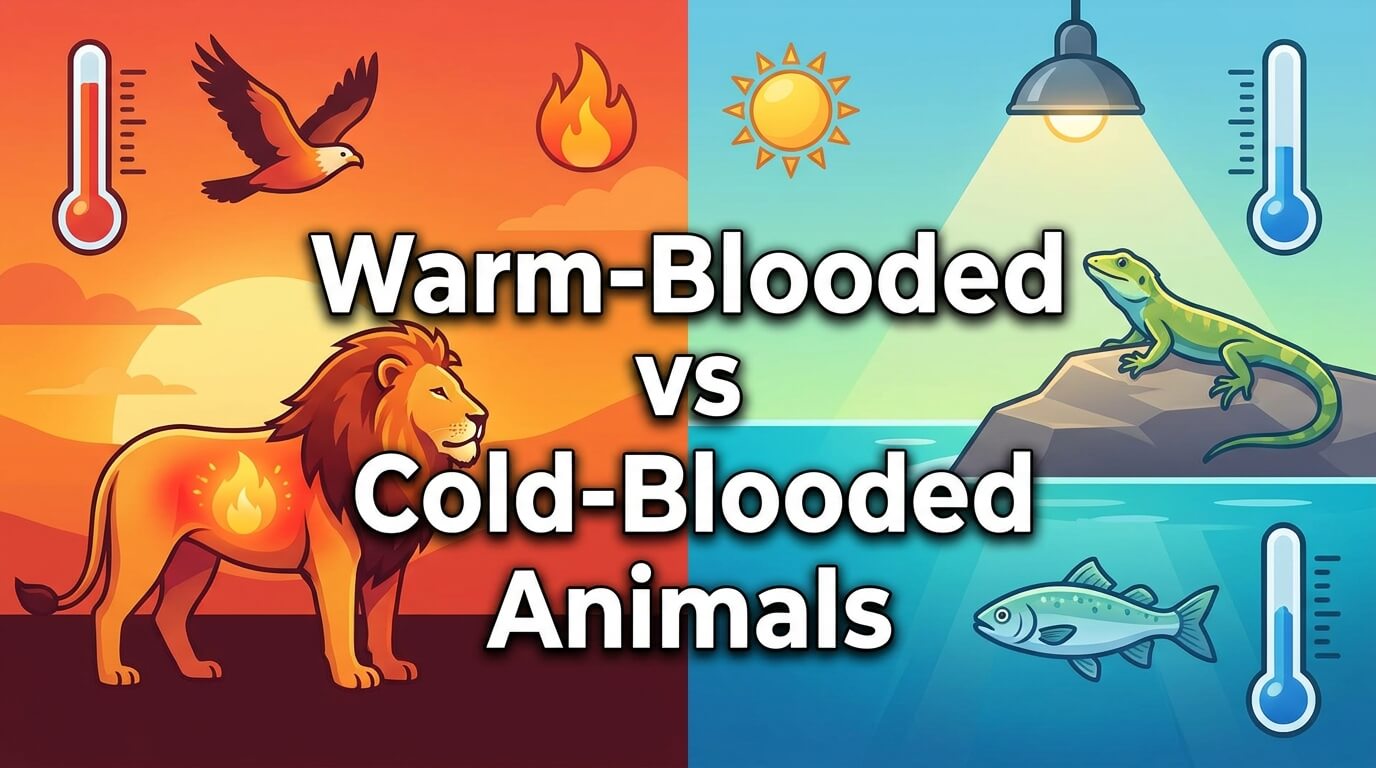
Warm-blooded animals produce and retain much of the heat needed to keep their bodies within a useful temperature range. Cold-blooded animals depend more heavily on heat moving between their bodies and the environment. Biologists usually call these strategies endothermy and ectothermy, because the familiar labels can be misleading.
An ectothermic lizard basking on a rock may be warmer than a person standing nearby, while an endothermic bat in torpor may allow its body temperature to fall sharply. The important difference is not whether the blood feels warm or cold. It is where most usable body heat comes from, how the animal controls heat gain and loss, and how much energy that control requires.
Quick Difference
Endotherms generate much of their heat internally
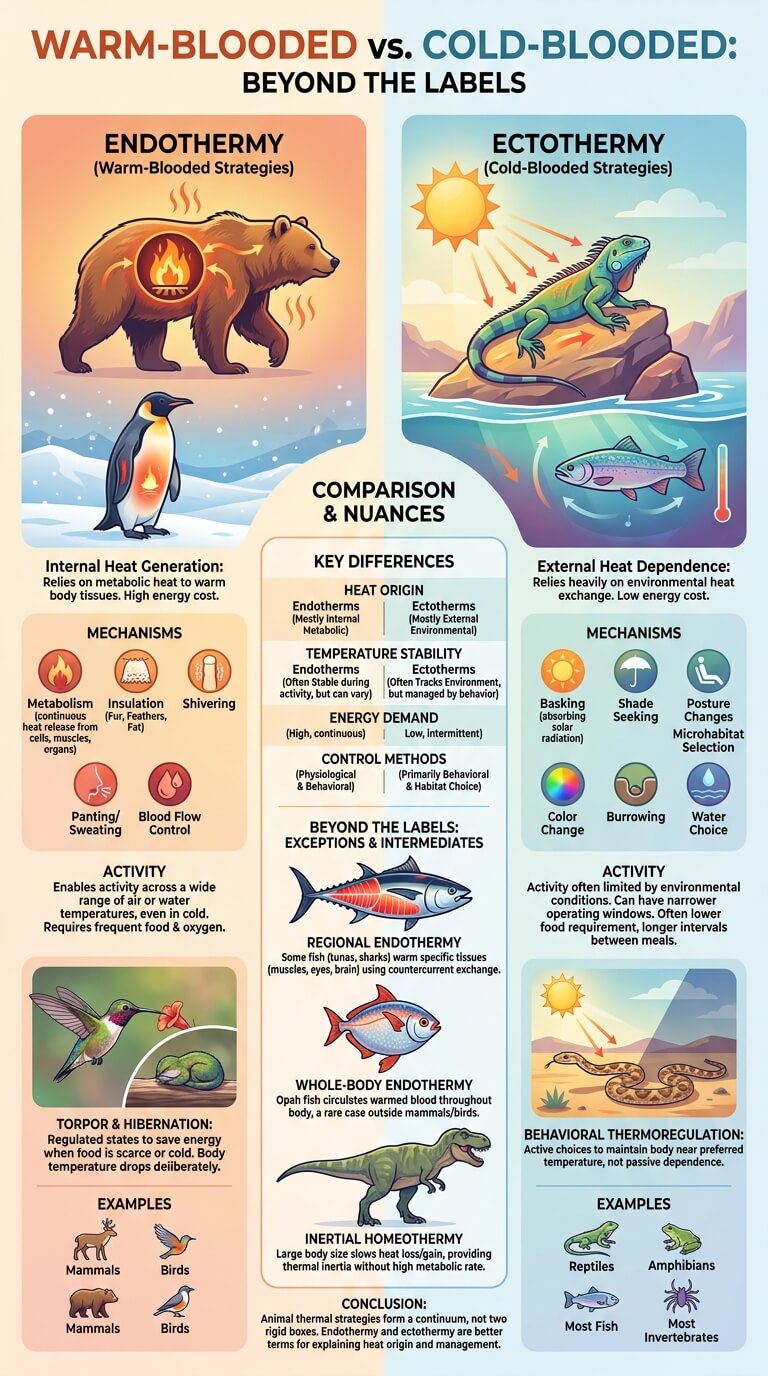
Endotherms use heat released by metabolism to warm the body. Mammals and birds are the best-known examples. Their cells continuously release heat as nutrients are processed, muscles work, and organs function. When the environment becomes cold, many endotherms can increase heat production, reduce heat loss, or both.
This strategy often allows activity across a wide range of air or water temperatures. It also has a substantial cost. Maintaining warm tissues requires food, oxygen, and a circulatory and respiratory system capable of supporting a high rate of energy use.
Ectotherms rely more heavily on external heat
Ectotherms produce metabolic heat, but it is usually not enough to dominate their body-temperature balance. Heat from sunlight, warm ground, air, or water often has a larger effect. Reptiles, amphibians, most fish, and most invertebrates use ectothermy.
Dependence on environmental heat does not mean passivity. An ectotherm may bask, retreat underground, enter water, change posture, select a warmer crevice, or shift its activity to a different time of day. These choices can keep its body much closer to a preferred temperature than the surrounding air alone would suggest.
Why warm-blooded and cold-blooded are imperfect labels
The everyday terms describe a rough pattern, not the actual temperature of the blood. A desert snake can become dangerously hot. A hibernating mammal can become cool. Some fish warm selected organs or muscles, and a few animals blur the categories in other ways.
The OpenStax explanation of animal thermoregulation distinguishes heat origin from temperature stability. That distinction matters because endotherm is not identical to homeotherm, and ectotherm is not identical to poikilotherm. A homeotherm keeps a relatively stable temperature, while a poikilotherm experiences wider variation. Either pattern can occur with more than one heat-management strategy.
Endotherms vs Ectotherms Comparison Table
Heat source and body-temperature stability
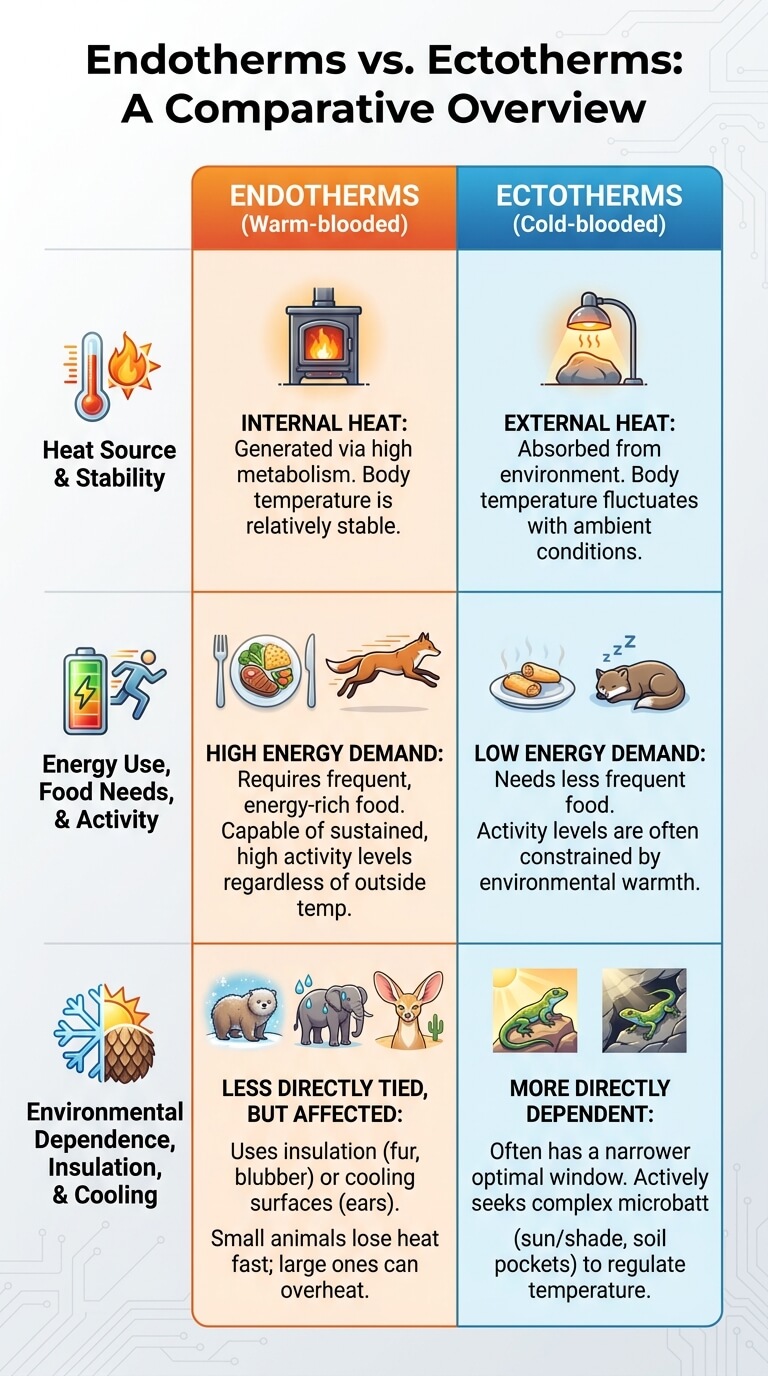
| Feature | Endotherms | Ectotherms |
|---|---|---|
| Main usable heat input | Heat generated by metabolism is a major contributor | Environmental heat exchange is usually the larger contributor |
| Typical temperature pattern | Often relatively stable during active periods | Often changes more with habitat, season, depth, or time of day |
| Control methods | Metabolism, insulation, circulation, evaporation, posture, shelter | Behavior, microhabitat choice, circulation, posture, color, physiological adjustment |
| Common examples | Mammals and birds | Reptiles, amphibians, most fish, most invertebrates |
Energy use, food needs, and activity
| Question | Typical endothermic pattern | Typical ectothermic pattern |
|---|---|---|
| Routine energy demand | Higher because heat production continues even at rest | Lower because less energy is spent on internal heat production |
| Food requirement | Often greater relative to body size | Often lower, allowing longer intervals between meals |
| Cold-weather activity | Can remain active if food and insulation are adequate | Often limited as muscles and nerves cool |
| Warm-weather challenge | Must shed both environmental and metabolic heat | Must avoid overheating while using external warmth |
Environmental dependence, insulation, and cooling
Endotherms are less directly tied to immediate environmental temperature, but they are not independent of weather. Small birds can lose heat rapidly. Large mammals can overheat during exercise. Marine mammals need insulation in cold water, while desert mammals may avoid daytime heat and use large ears or other surfaces to release warmth.
Ectotherms often operate within a narrower window of suitable body temperatures. Yet a complex habitat can provide many thermal choices. A rocky slope may contain sunlit surfaces, shaded cracks, cool soil, and warm sheltered pockets within a few yards.
How Animal Body Temperature Works
Heat production, heat gain, and heat loss
An animal’s body temperature reflects a heat budget. Heat enters through metabolism, solar radiation, conduction from a warmer surface, and convection from warmer air or water. Heat leaves through radiation, conduction to cooler surfaces, convection, and evaporation.
Body size, shape, covering, blood flow, wind, humidity, water temperature, and posture all influence the balance. A small animal has more surface area relative to its volume and usually exchanges heat quickly. A large animal changes temperature more slowly but may struggle to release excess heat.
Metabolism and cellular performance
Temperature affects the speed of many biochemical reactions. Muscles, nerves, digestion, and sensory systems work best within particular ranges, although those ranges differ among species. If tissues become too cold, reactions and movement may slow. If they become too hot, membranes, proteins, and coordinated cellular processes can fail.
Animals are adapted to different operating temperatures. A polar fish and a desert lizard do not share one universal optimum. Acclimatization, seasonal changes, and specialized molecules can shift performance, but every species still has limits.
Temperature regulation versus temperature conformity
Regulation means the animal actively keeps body temperature from following every environmental change. Conformity means body temperature tracks the surroundings more closely. These are ends of a continuum rather than two rigid boxes.
An ectothermic reptile may regulate tightly during the day by moving among sun and shade, then conform more closely to air temperature at night. An endothermic hummingbird may regulate while feeding but enter torpor after dark. The same animal can use different degrees of regulation at different times.
How Endotherms Regulate Temperature
Metabolic heat production
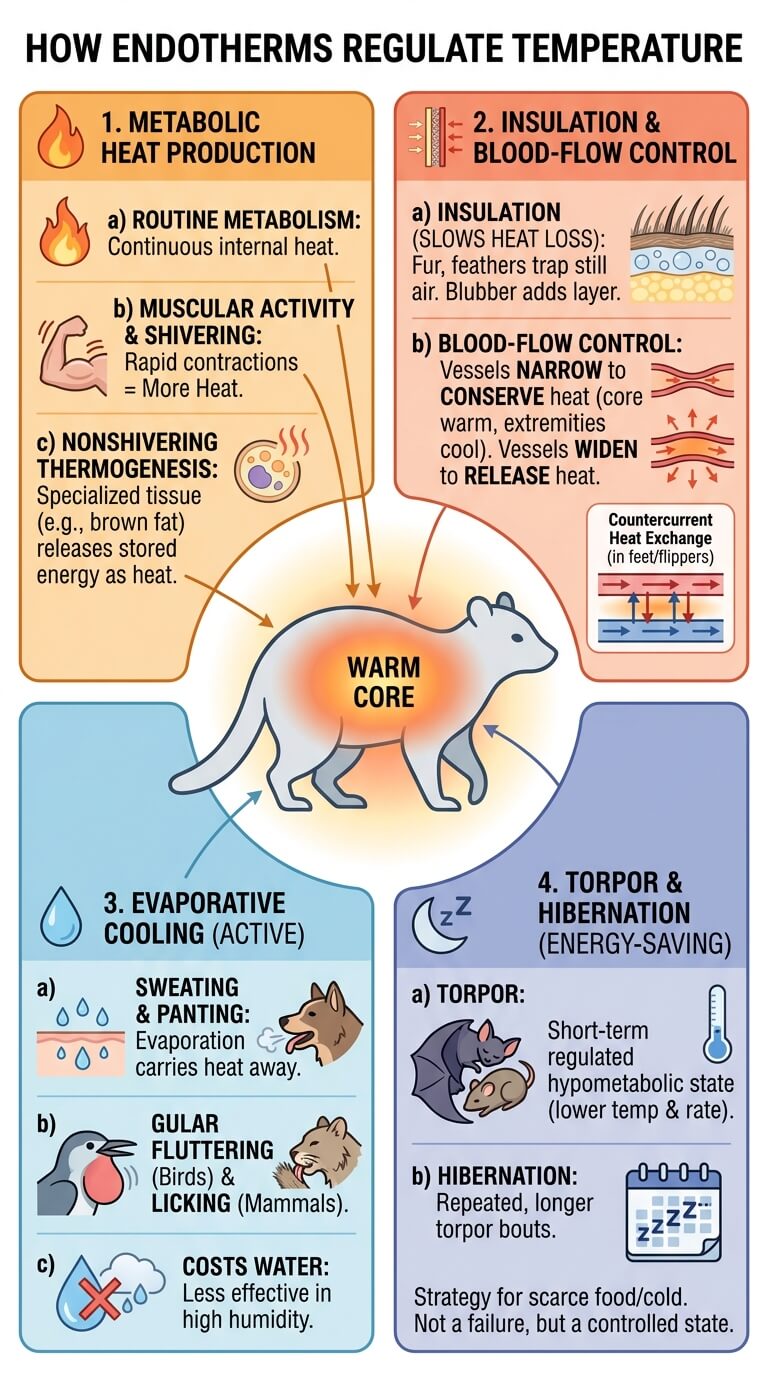
Routine metabolism produces heat continuously. Muscular activity adds more, and shivering converts rapid muscle contractions into heat when an animal is cold. Some mammals also use nonshivering thermogenesis, in which specialized tissues release stored chemical energy largely as heat rather than capturing all of it for other work.
Birds and mammals did not simply inherit one identical heating system from a recent warm-bodied ancestor. A review of mechanisms involved in vertebrate endothermy describes multiple cellular and muscular routes that contribute to heat production across lineages. The shared result is substantial internal heating, but the underlying details vary.
Fur, feathers, fat, and blood-flow control
Insulation slows heat transfer. Fur and feathers trap still air, while subcutaneous fat and blubber provide insulation in many terrestrial and aquatic species. Raising feathers or hair can increase the depth of the insulating layer, although this works best when the covering remains dry and the trapped air is not stripped away by wind.
Blood vessels near the skin can narrow to reduce warm blood flow to the surface or widen to release more heat. Countercurrent exchangers can transfer heat between outgoing and incoming blood. Penguins, seals, whales, and many birds use vascular arrangements that help keep the body core warm while allowing feet, flippers, or other exposed structures to run cooler.
Shivering, sweating, panting, and evaporative cooling
Shivering helps replace heat being lost to cold surroundings. Cooling requires the opposite approach. Sweating, panting, gular fluttering in some birds, and licking the body in certain mammals use evaporation to carry heat away.
Evaporation is powerful but costs water. It also becomes less effective in humid air because moisture leaves the body more slowly. Many animals therefore combine evaporative cooling with shade, reduced activity, altered blood flow, or movement to cooler ground or water.
Torpor and hibernation as energy-saving strategies
Endothermy can be expensive when food is scarce or nights are cold. Torpor lowers metabolic rate, activity, and usually body temperature for a controlled period. Daily torpor may last part of a day, while hibernation often contains repeated, longer torpor bouts separated by rewarming.
A scientific overview of the characteristics and control of torpor describes it as a regulated hypometabolic state rather than a simple failure to stay warm. Bats, hummingbirds, small rodents, and other endotherms use different forms of heterothermy to reduce the energy they would otherwise spend maintaining a high active temperature.
How Ectotherms Regulate Temperature
Basking and shade seeking
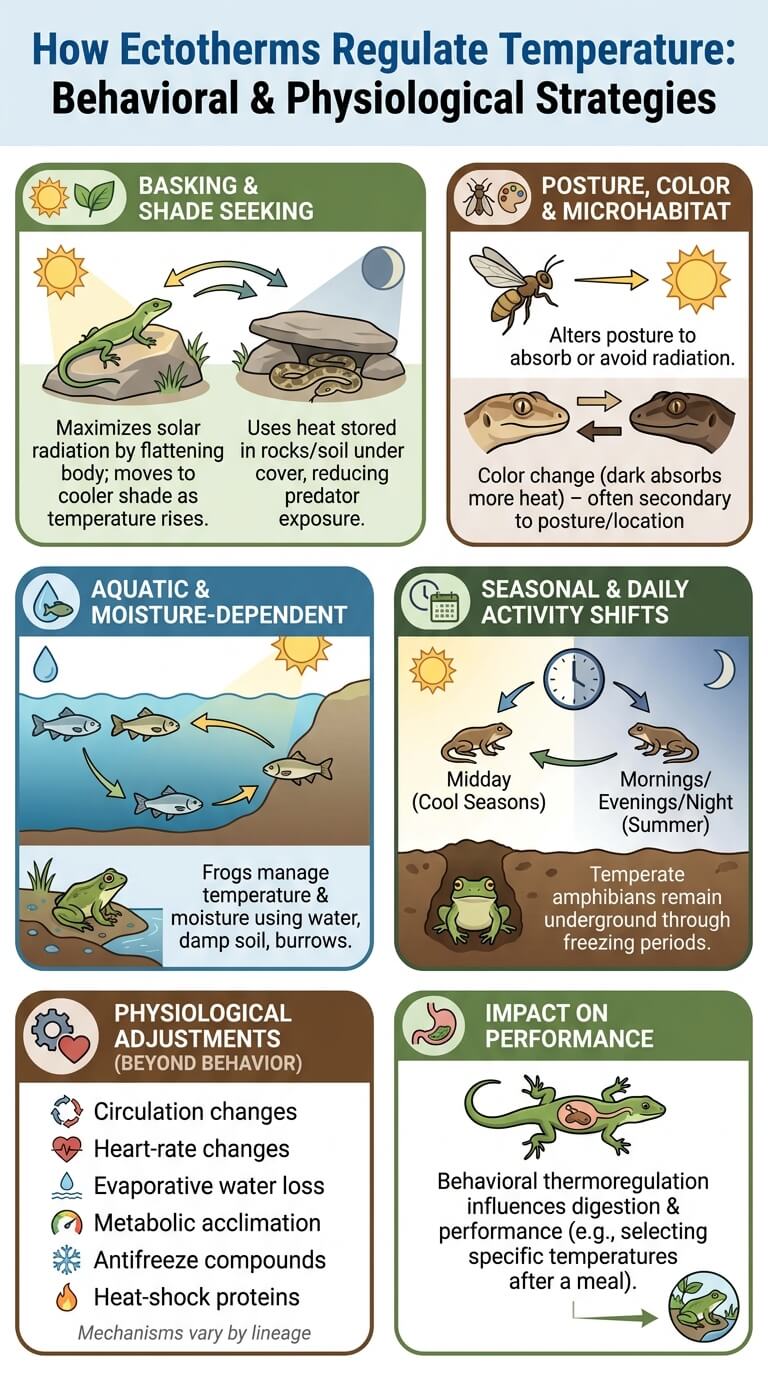
Basking exposes more of the body to solar radiation and warm surfaces. A lizard may flatten its body toward the sun in the morning, then move into shade as its temperature rises. Snakes can warm under cover by using heat stored in rocks or soil, which reduces exposure to predators.
Aquatic ectotherms also select temperatures. Fish may move between shallow and deep water, sunny and shaded areas, or layers separated by a thermocline. Frogs can use water, damp soil, vegetation, and burrows to manage both temperature and moisture.
Posture, color change, and microhabitat selection
Changing posture alters how much surface faces the sun, wind, ground, or water. Some insects orient their wings or bodies to absorb or avoid radiation. Darker surfaces often absorb more radiant energy than lighter ones, and some reptiles, amphibians, fish, and insects can modify skin color through pigment-cell responses.
Color change has many functions, including communication and camouflage, so it should not automatically be interpreted as thermoregulation. Even when temperature plays a role, posture and location may have a larger effect than color alone.
Seasonal and daily activity shifts
An ectotherm may be active at midday during cool seasons but switch to mornings, evenings, or nighttime during summer. Desert reptiles often avoid exposed surfaces during the hottest hours. Temperate amphibians may remain underground through freezing periods, while insects can time flight, feeding, or mating to warmer parts of the day.
These schedules are not mere inconvenience. They shape access to prey, mates, nesting sites, and safe cover. A thermal strategy can influence nearly every part of an animal’s ecology.
Physiological adjustments beyond behavior
Ectotherms also use circulation, heart-rate changes, evaporative water loss, metabolic acclimation, antifreeze compounds, heat-shock proteins, and other physiological tools. The exact mechanisms differ greatly among lineages.
Experiments on ectotherms show that behavioral thermoregulation can influence digestion and performance rather than simply making an animal feel warmer. Research on feeding and thermoregulatory behavior in lizards, for example, illustrates how animals can select temperatures that support changing physiological demands after a meal.
Energy Costs and Ecological Trade-Offs
Why many endotherms need more food
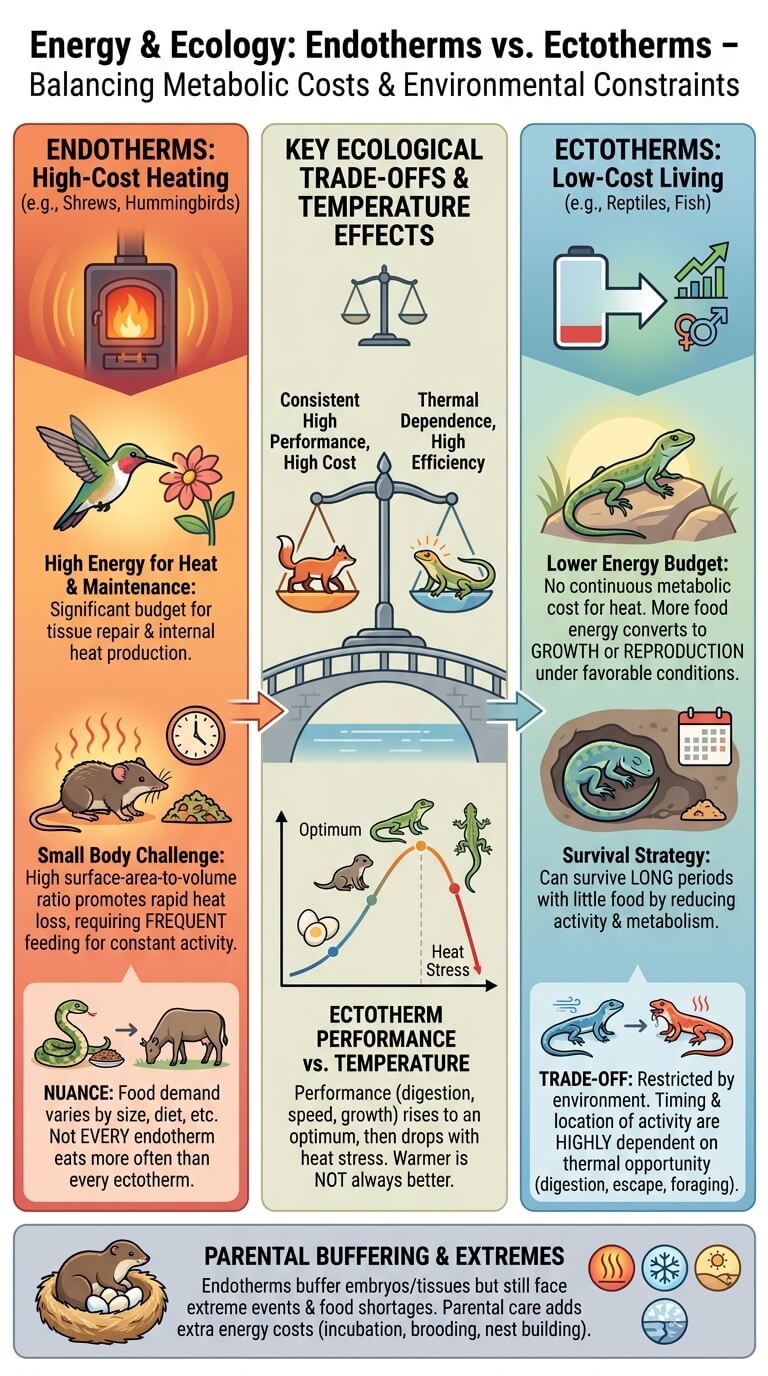
A large share of an endotherm’s energy budget may be spent maintaining tissues and producing heat, especially in small animals or cold environments. This helps explain why shrews, hummingbirds, and other small endotherms must feed frequently when active. Their high surface-area-to-volume ratio promotes rapid heat loss, while their warm tissues support high rates of movement and processing.
Food demand still varies with body size, diet, season, reproduction, activity, and weather. It is inaccurate to claim that every endotherm eats more often than every ectotherm. A large snake after a big meal and a grazing mammal follow very different feeding schedules.
How ectotherms survive on lower energy budgets
Because ectotherms generally do not pay the same continuous metabolic cost for heat, they can convert a larger share of food energy into growth or reproduction under favorable conditions. Many can also survive long periods with little food by reducing activity and metabolism.
The trade-off is that low environmental temperature can restrict digestion, escape speed, foraging, and reproduction. Ectothermy saves fuel, but it often makes the timing and location of activity more dependent on thermal opportunity.
Growth, reproduction, and activity under different temperatures
Temperature can alter how quickly ectothermic eggs develop, how fast juveniles grow, and when adults become active. Warmer is not automatically better. Performance often rises toward an optimum and then drops as heat stress increases.
Endotherms buffer their embryos and tissues from some environmental changes, but they still face heat waves, cold snaps, drought, and food shortages. Parents may spend extra energy incubating eggs, brooding young, building insulated nests, or moving between feeding and shelter sites.
Examples Across the Animal Kingdom
Mammals and birds are primarily endothermic
Most mammals and birds maintain relatively high body temperatures during normal activity through metabolic heat production. Hair, feathers, fat, behavior, circulation, and evaporation help manage that heat. These traits support sustained movement in cold air, nighttime activity, long migration, and life in polar or high-elevation habitats.
There is still wide variation. A tiny hummingbird can cool during torpor, a camel can allow body temperature to fluctuate to save water, and large marine mammals may have more difficulty losing heat than gaining it.
Reptiles, amphibians, most fish, and most invertebrates are primarily ectothermic
These groups rely strongly on the thermal landscape around them. Turtles bask, frogs move between moist retreats and feeding areas, butterflies warm flight muscles in sunlight, and many fish follow water layers that match their performance needs. Both vertebrates and invertebrates include varied temperature strategies, so backbone status alone does not predict physiology.
The grouping is broad and contains enormous diversity. A deep-sea invertebrate in stable cold water faces different challenges from a desert beetle crossing hot sand. Both are ectotherms, but their solutions are not interchangeable. The pattern is especially visible when mammals, birds, reptiles, amphibians, and fish are compared side by side.
Desert, polar, freshwater, and marine examples
Desert ectotherms may avoid midday heat, use burrows, and orient the body to reduce solar gain. Desert endotherms often combine shade, nocturnal activity, efficient kidneys, and controlled evaporation. In polar regions, endotherms depend heavily on insulation and food, while ectotherms may use cold-adapted enzymes, antifreeze compounds, seasonal dormancy, or supercooling.
Freshwater animals can move among depths, shorelines, vegetation, and flowing water. Marine animals face the high heat-conducting capacity of water, which draws warmth from the body much faster than still air at the same temperature. This is why blubber, dense fur, countercurrent exchange, and regional warming can be especially valuable in the ocean.
Exceptions and Intermediate Strategies
Regional endothermy in some fishes and sharks
Tunas, billfishes, and lamnid sharks such as great whites can retain heat in selected muscles, eyes, brain tissue, or digestive organs. Countercurrent exchangers reduce heat loss as warm venous blood passes close to cooler arterial blood. This regional endothermy can improve performance in cold water without keeping every tissue at a mammal-like temperature.
Regional warming is not the same in every lineage. The location of heat production, arrangement of blood vessels, depth behavior, and temperature difference from the surrounding sea all vary. Calling these animals simply warm-blooded can hide important details.
Whole-body endothermy in the opah
The opah is an unusual fish that distributes warmed blood through much of its body. Its constantly moving pectoral fins generate heat, and specialized countercurrent exchangers in the gills reduce the loss that usually occurs as blood meets cold water.
NOAA Fisheries’ account of opah endothermy reports that tagged fish remained warmer than surrounding water during deep dives. The opah is still not thermally identical to a bird or mammal, but it demonstrates that whole-body warming evolved outside those familiar groups.
Inertial homeothermy in very large animals
Large bodies gain and lose heat slowly because they contain much volume relative to surface area. This thermal inertia can smooth short-term temperature swings. A large ectotherm may therefore keep a more stable core temperature than a small ectotherm even without a mammal-like metabolic rate.
The concept is often called inertial homeothermy or gigantothermy. Research discussing thermal inertia in large crocodilians and extinct animals emphasizes that stable temperature and high aerobic power are separate questions. Large size can slow heat exchange, but it does not automatically provide the sustained metabolic performance of a typical endotherm.
Heterothermy, daily torpor, and fluctuating temperatures
Heterothermy describes controlled variation in body temperature across time or body regions. A bat may be warm while hunting and cool during daytime torpor. A camel can allow its temperature to rise during the day and fall at night, reducing the amount of water needed for evaporative cooling. A tuna may keep swimming muscles warmer than other tissues.
These examples show why heat origin, temperature stability, and regional temperature must be described separately. One label cannot capture every pattern.
Why mesothermy can be difficult to define
Mesothermy is sometimes used for animals thought to occupy an intermediate position between classic ectothermy and endothermy. The term may refer to partial metabolic warming, limited control over temperature, or an intermediate energy budget, depending on the study.
Because definitions vary, it is safer to explain the measured trait. Does the animal warm its whole body or only selected tissues? How far above the environment does it remain? Is warming continuous, activity-dependent, or mainly a consequence of large size? Those questions are more informative than forcing every animal into a third universal category.
Common Myths and Mistakes
Cold-blooded animals are not always cold
A basking reptile may reach a body temperature similar to or higher than that of a nearby mammal. The label refers to dependence on environmental heat, not a permanently low temperature. Overheating can be as dangerous to an ectotherm as chilling.
Endotherms do not maintain one exact temperature at all times
Body temperature varies by species, body region, time of day, activity, reproductive state, illness, and environment. Birds and mammals regulate within ranges rather than holding every tissue at one unchanging number. Torpor, hibernation, heat storage, and controlled daily fluctuation expand that variation.
Basking does not mean helpless dependence on weather
Basking is an active decision that can be precisely timed. Many ectotherms assess thermal conditions while balancing food, predators, moisture, and social behavior. A lizard may leave a sunny perch before becoming too hot, even when more heat is available.
Temperature Strategy Shapes Animal Lives
How thermal strategy helps distinguish familiar vertebrate groups
Endothermy helps explain why mammals and birds often remain active in cool conditions, while ectothermy helps explain the strong daily rhythms of many reptiles, amphibians, and fish. It is a useful comparison trait, but it should not be the sole basis for identifying an animal group because specialized exceptions exist. Thermoregulation is one of many traits used to compare groups within animal kingdom classification.
How habitat and behavior shape thermal survival
Shade, burrows, water depth, wind exposure, nest structure, body orientation, social huddling, migration, and seasonal dormancy can all determine whether a thermal strategy succeeds. The same species may behave differently in a forest, desert, mountain, city, or coastline because each setting offers a different heat landscape.
Why evolution produced multiple heat-management strategies
There is no single best thermal system for every environment. Endothermy supports long activity periods and physiological independence from immediate weather, but it requires dependable energy. Ectothermy reduces food demand, but it often narrows the times and places where high performance is possible. Regional warming, torpor, thermal inertia, and flexible behavior combine benefits in different proportions. Animal evolution and common ancestry help explain why similar heat-management strategies can arise in separate lineages.
FAQ
Are cold-blooded animals always the same temperature as the air?
No. Sunlight, warm rocks, water, evaporation, posture, blood flow, and shelter can make an ectotherm warmer or cooler than the air. Aquatic animals respond mainly to water temperature, and burrowing animals may experience soil temperatures that differ greatly from surface air. Many ectotherms actively select conditions that keep their bodies near a preferred range.
Can ectotherms actively control body temperature?
Yes. Behavioral thermoregulation can be highly effective. Ectotherms bask, seek shade, alter posture, move among water depths, enter burrows, change activity times, and choose egg-laying or resting sites with suitable temperatures. They also use physiological adjustments, although environmental heat remains the dominant input for most species.
Why do many endotherms need to eat more often?
Producing internal heat requires energy even when the animal is resting. Small endotherms lose heat especially quickly because they have a large surface area relative to body volume. Frequent feeding can support both ordinary metabolism and heat production. The pattern is not universal, since body size, diet, season, activity, and torpor all change how often an animal eats.
Are any fish warm-blooded?
Some fish retain metabolic heat. Tunas, billfishes, and certain sharks warm selected tissues, a pattern called regional endothermy. The opah circulates warmed blood through much of its body and is widely described as the first known fish with whole-body endothermy. These fishes still differ from birds and mammals in the degree and control of warming.
Final Thoughts
The warm-blooded versus cold-blooded comparison is most accurate when translated into endothermy and ectothermy. Endotherms use metabolic heat as a major part of temperature control, gaining broad activity windows at a high energy cost. Ectotherms rely more on environmental heat, saving food energy while using behavior and habitat choice to reach useful temperatures. Torpor, regional endothermy, whole-body warming in opah, and thermal inertia show that animal temperature biology is a continuum of strategies rather than two perfectly sealed boxes.

Ethan Walker is the founder and research editor of Animal Fact Central. He creates and reviews educational animal facts content using trusted wildlife, pet care, and science-based sources. His work focuses on making animal behavior, adaptations, habitats, and species facts clear, accurate, and engaging for everyday readers.
Read More Details About Ethan Walker: https://animalfactcentral.com/ethan-walker/