
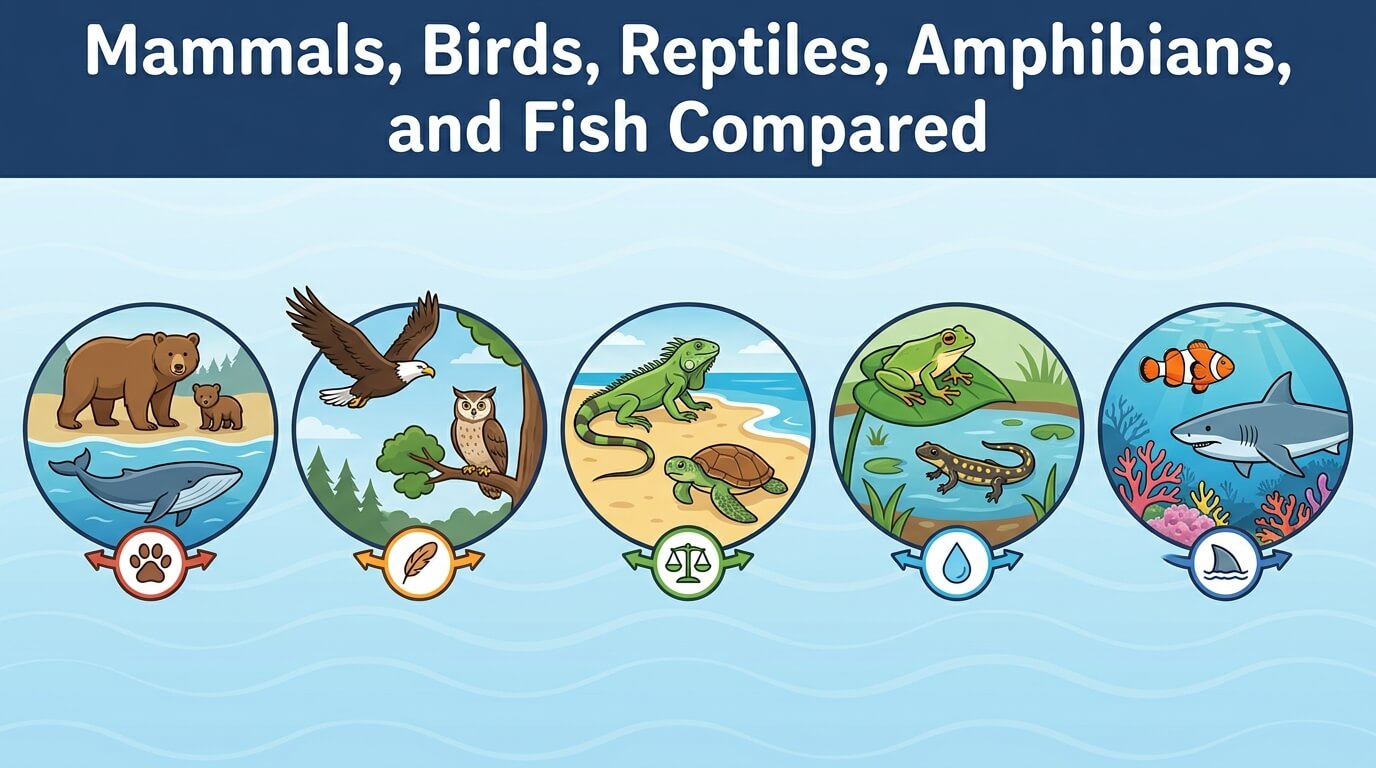
Mammals, birds, reptiles, amphibians, and fish are all vertebrates, but they solve the challenges of breathing, temperature control, reproduction, movement, and water balance in very different ways. Mammals have hair and produce milk. Birds have feathers and lay hard-shelled eggs. Nonavian reptiles have keratinized scales and amniotic development. Amphibians usually have permeable skin and life cycles tied closely to moisture. Fish live in water and usually rely mainly on gills and fins.
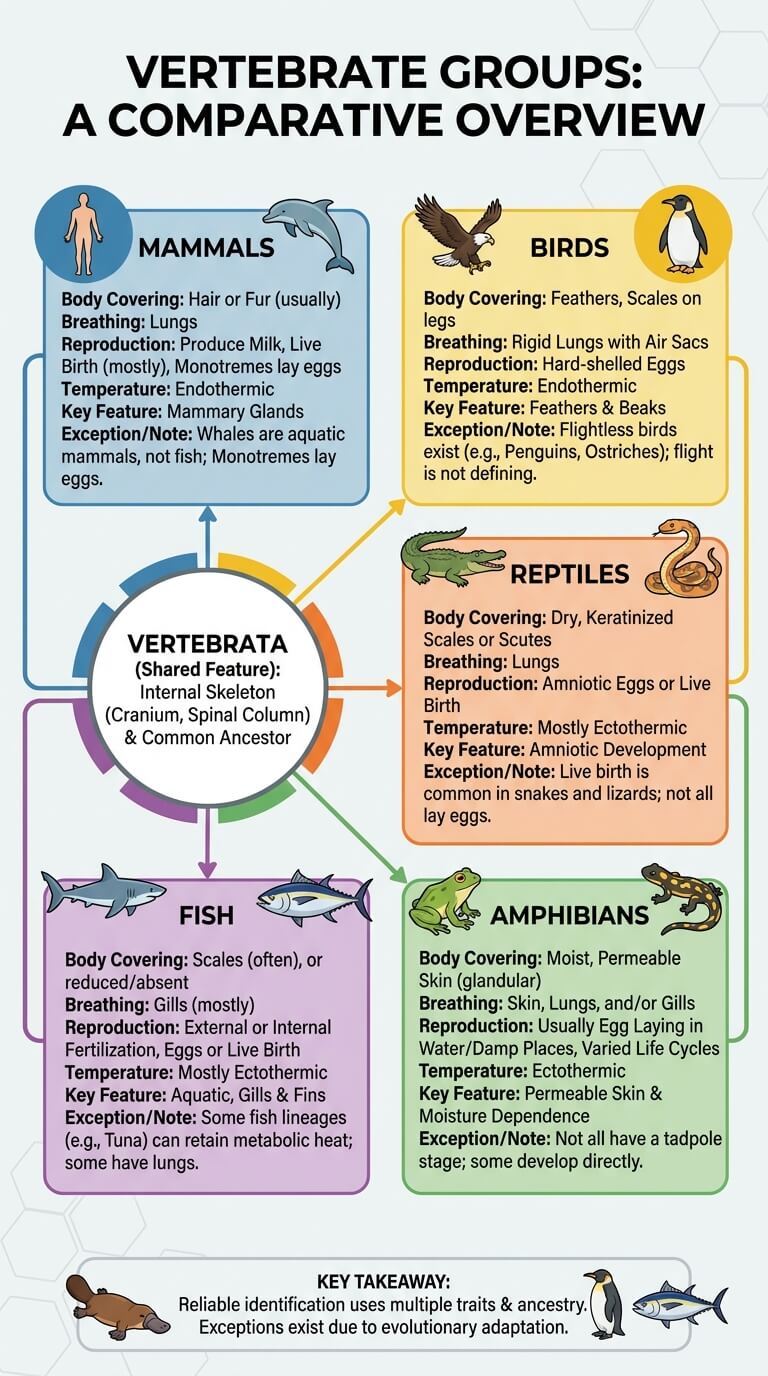
Those labels are useful but imperfect. Whales are aquatic mammals, some reptiles bear live young, monotremes lay eggs, some amphibians skip a free-swimming tadpole stage, and several fish lineages retain metabolic heat. Reliable identification uses several traits and ancestry together.
Quick Comparison
The fastest way to separate the five groups
Start with the body covering and the way the animal breathes. Hair or fur points to a mammal, even when the hair is sparse. Feathers identify a bird. Dry-looking keratinized scales usually point to a nonavian reptile. Moist, glandular, permeable skin is characteristic of living amphibians. An aquatic vertebrate with fins and gills is usually described as a fish. These five familiar groups occupy only part of the broader animal kingdom classification system.
Then check reproduction. Birds lay mineralized eggs. Reptiles and mammals are amniotes, although most mammals retain developing young internally. Amphibian eggs generally lack water-retaining amniotic membranes, so they are commonly laid in water or damp places. Fish may use external or internal fertilization and can lay eggs or bear live young.
Why no single trait works in every case
Body coverings can be reduced or modified. Dolphins appear smooth but have hair during development. Pangolin scales are specialized mammalian structures. A snake and an eel can both be legless, yet the snake uses lungs and belongs to the reptile lineage, while the eel is a ray-finned fish with gills.
Habitat is unreliable on its own. Penguins are aquatic birds, sea turtles are marine reptiles, whales are marine mammals, and air-breathing lungfish remain fish. Good identification combines anatomy, physiology, reproduction, and ancestry.
Five Vertebrate Groups Comparison Table
Body covering and support
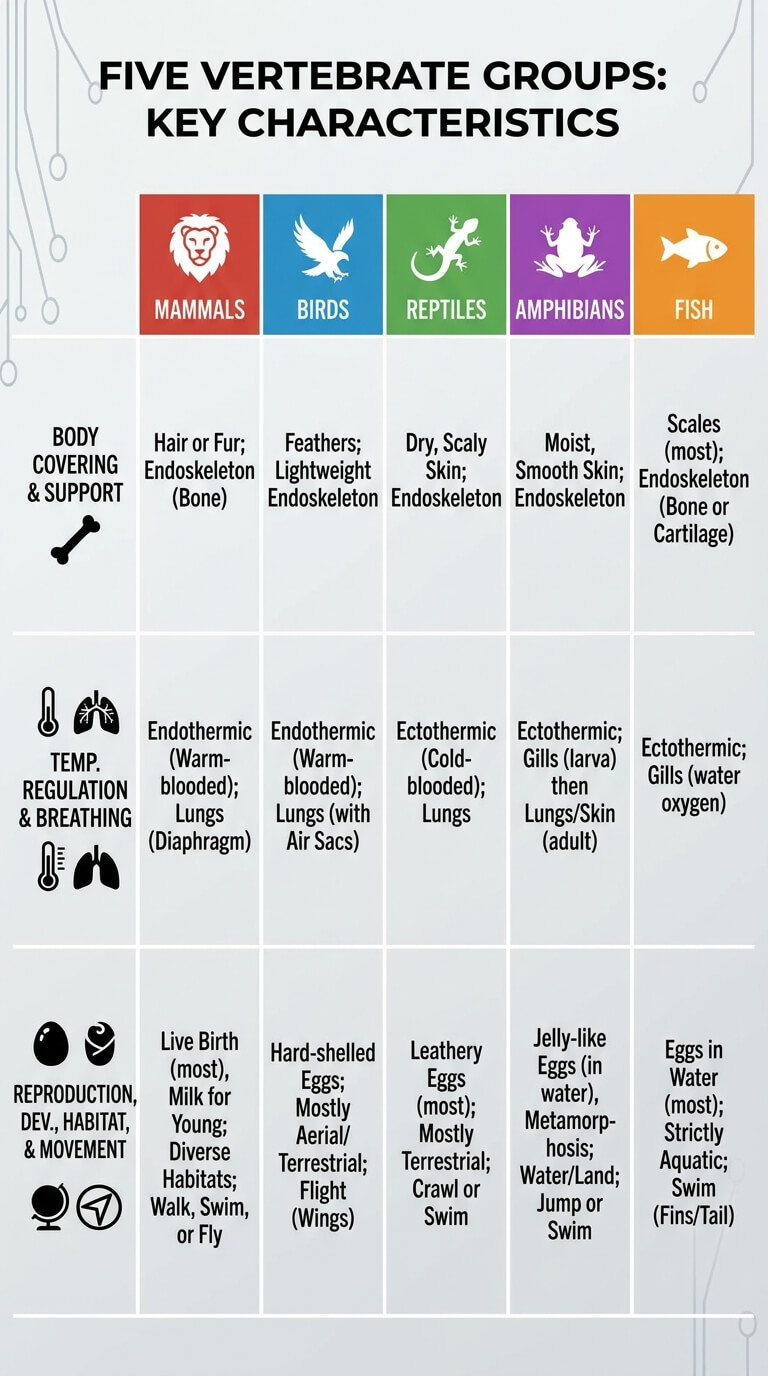
| Group | Typical outer covering | Main internal support | Useful identifying feature |
|---|---|---|---|
| Mammals | Hair or fur at some life stage | Bony endoskeleton | Mammary glands produce milk |
| Birds | Feathers, with scales on parts of the legs and feet | Bony endoskeleton with many flight-related modifications | Feathers are unique to living birds |
| Reptiles | Keratinized epidermal scales or scutes | Bony endoskeleton | Nonavian reptiles have dry, water-conserving skin and breathe with lungs |
| Amphibians | Usually moist, glandular, permeable skin | Bony endoskeleton, often lightly built | Skin commonly contributes to water uptake and gas exchange |
| Fish | Scales in many species, but reduced or absent in others | Cartilage or bone, depending on lineage | Aquatic body plan commonly using gills and fins |
Temperature regulation and breathing
| Group | Typical temperature strategy | Main breathing structures |
|---|---|---|
| Mammals | Endothermic, producing substantial metabolic heat | Lungs |
| Birds | Endothermic, usually maintaining a high and relatively stable body temperature | Rigid lungs ventilated with air sacs |
| Reptiles | Mostly ectothermic, relying strongly on environmental heat | Lungs |
| Amphibians | Ectothermic | Skin, lungs, mouth lining, or gills, depending on species and life stage |
| Fish | Mostly ectothermic, with specialized exceptions | Usually gills, sometimes supplemented by lungs or other air-breathing organs |
Reproduction, development, habitat, and movement
| Group | Reproductive pattern | Typical habitat range | Common movement structures |
|---|---|---|---|
| Mammals | Mostly live birth; monotremes lay eggs | Land, freshwater, ocean, underground, and air | Legs, flippers, wings, or flexible bodies |
| Birds | Internal fertilization and shelled eggs | Nearly every major terrestrial and aquatic environment | Wings and legs; many fly, swim, run, or climb |
| Reptiles | Internal fertilization; eggs or live birth | Mainly land and warm waters, with many freshwater and marine species | Legs, body undulation, flippers, or climbing structures |
| Amphibians | Egg laying is common; life cycles vary greatly | Freshwater and moist land habitats, with no fully marine living lineage | Legs, tails, body undulation, and swimming membranes |
| Fish | External or internal fertilization; eggs or live birth | Freshwater and marine environments | Fins and side-to-side body or tail movements |
What All Vertebrates Share
Vertebral column, cranium, and internal support
All five groups belong to Vertebrata, the vertebrate branch of the chordates. Their shared body plan includes a cranium around the brain and a vertebral system associated with the spinal cord, although the exact structures can be reduced or modified in some jawless vertebrates. The Animal Diversity Web overview of vertebrates also emphasizes the internal skeleton, paired sensory structures, and muscles acting against skeletal supports.
The internal skeleton may be mostly bone, as in mammals and birds, or primarily cartilage, as in sharks and rays. Cartilage does not make an animal an invertebrate. The defining issue is evolutionary membership in Vertebrata, not whether the skeleton feels hard or contains a particular amount of mineralized bone.
Shared evolutionary origin with diverse adaptations
Vertebrates inherited a basic chordate organization and diversified into aquatic, terrestrial, burrowing, and flying forms. The limbs of bats, whales, frogs, lizards, and birds differ in function, but their bones reflect shared ancestry. Ancient lobe-finned relatives are part of the history that led to tetrapod limbs.
This history also explains why the five familiar categories are not equivalent branches. Birds arose within the reptile lineage, and tetrapods arose within a lineage of bony vertebrates commonly included among fish. Classroom groupings remain useful for comparing living body plans, but evolutionary trees reveal nested relationships underneath them.
Mammals
Hair, milk production, and specialized jaws
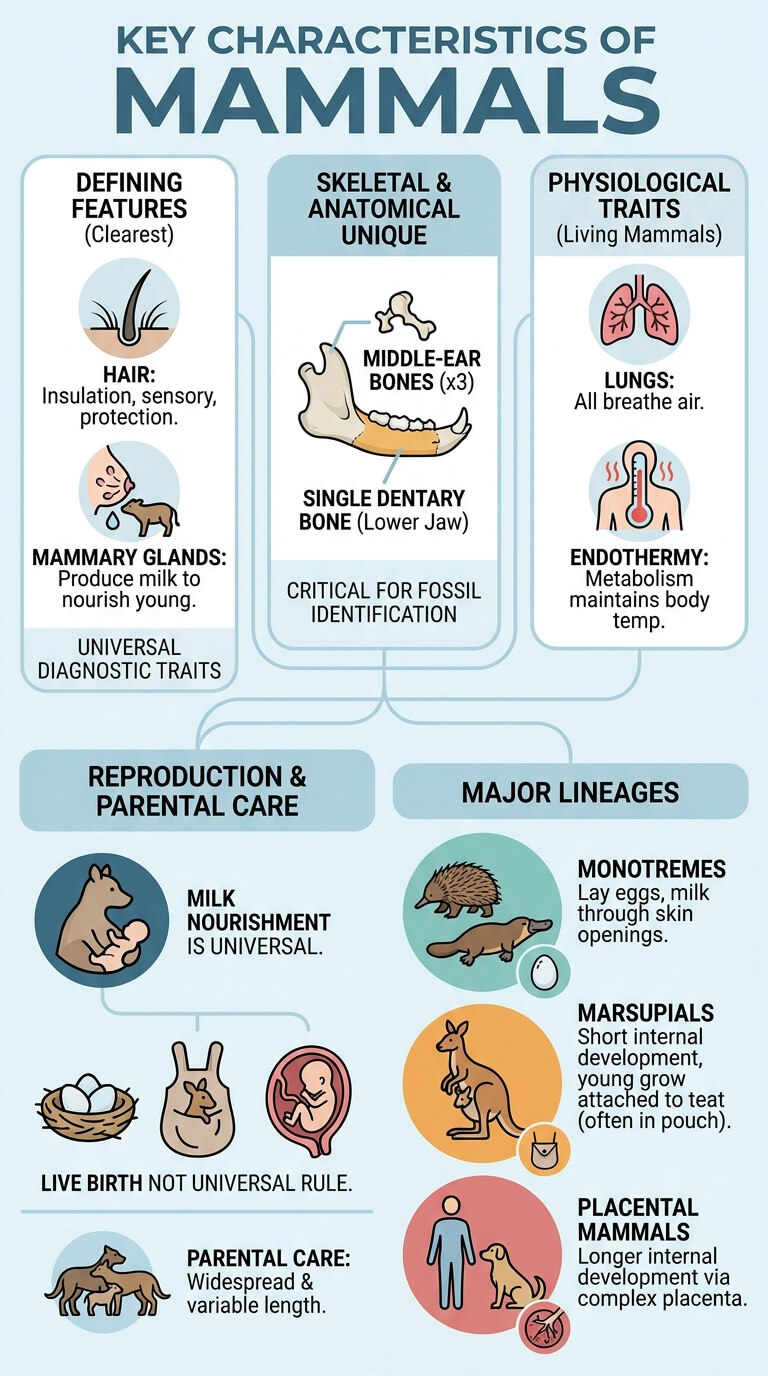
Hair and mammary glands are the clearest mammalian characteristics. Hair can insulate, protect skin, provide camouflage, form sensory whiskers, or become defensive spines. Mammary glands produce milk that nourishes young. Even marine mammals that look hairless retain mammalian skin and developmental traits.
Mammals also have a lower jaw formed mainly by one dentary bone and three middle-ear bones. These features help identify fossil mammals when hair is not preserved. The OpenStax account of mammalian characteristics explains how this jaw and ear anatomy differs from that of other vertebrates.
Lungs, endothermy, and reproduction
Every living mammal breathes air with lungs, including whales, seals, manatees, and otters. Mammals are endothermic, meaning their metabolism supplies much of the heat used to maintain body temperature. Insulation from hair or blubber can slow heat loss, while behavior and changes in blood flow help regulate temperature.
Most mammals give birth to live young, but that pattern is not universal. All nourish young with milk, which is a more dependable defining feature than live birth. Parental care is widespread and often prolonged, but its length and form vary from brief nursing periods to years of learning and social support.
Monotremes, marsupials, and placental mammals
Living mammals fall into three major lineages. Monotremes, represented by the platypus and echidnas, lay eggs and release milk through openings in the skin rather than nipples. Marsupials give birth after relatively short internal development, and the very immature young usually continue growing while attached to a teat, often in a pouch. Placental mammals generally support longer development inside the uterus through a complex placenta.
These reproductive differences show why “mammals give live birth” is only a rule of thumb. Milk production, hair, jaw structure, ear anatomy, and shared ancestry provide a stronger diagnosis.
Birds
Feathers, beaks, and lightweight skeletons
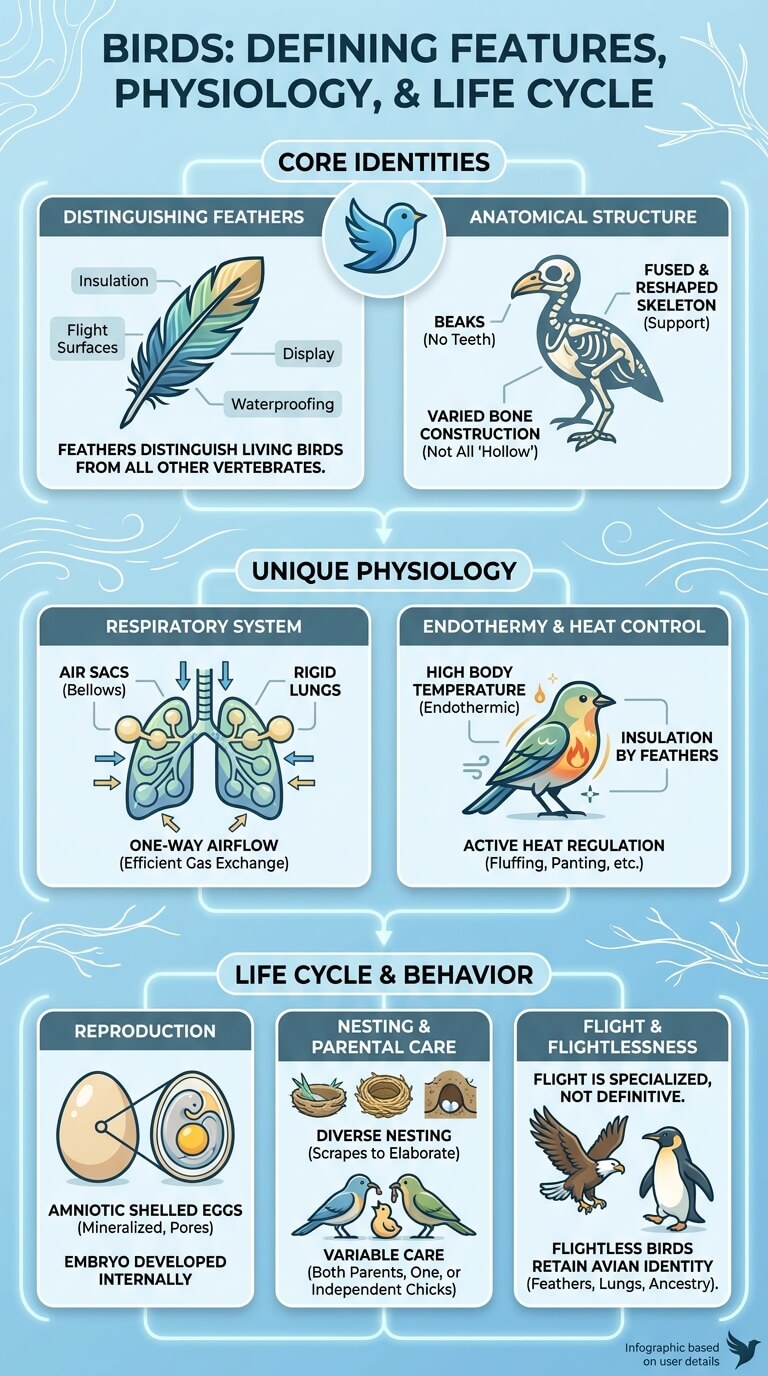
Feathers distinguish living birds from every other living vertebrate. They provide insulation, display surfaces, waterproofing support, camouflage, and the aerodynamic surfaces used in flight. A bird remains a bird even if it cannot fly. Ostriches, penguins, cassowaries, kiwis, and many island birds demonstrate that flight is a specialized ability, not the definition of the group. Modern evidence about anatomy, development, fossils, and genetics explains how animals are classified into these groups.
Modern birds have beaks and lack teeth. Their skeletons include extensive fusion and reshaping that can stiffen the body during flight or support powerful walking and swimming. Calling every bird bone “hollow” is misleading. Pneumatic spaces occur in many species, but bone construction varies with body size, diving behavior, and locomotion.
Lungs with air sacs and endothermy
Bird lungs do not expand and collapse like mammal lungs. Air sacs act as bellows that move air through relatively rigid lungs, supporting largely one-way airflow through the gas-exchange passages. The OpenStax explanation of bird respiration describes how a complete packet of air moves through the system over more than one breathing cycle.
Birds are endothermic and usually maintain high body temperatures. Feathers trap insulating air, while fluffing, shade seeking, bathing, panting, and posture changes help control heat exchange. Small birds lose heat quickly because of their high surface area relative to mass.
Eggs, nesting, flight, and flightlessness
All living bird species lay eggs. Their embryos develop inside amniotic membranes and receive nutrients from yolk. The mineralized shell limits water loss while allowing gas exchange through microscopic pores. Nesting behavior ranges from simple scrapes to elaborate woven structures, burrows, tree cavities, floating platforms, and carefully guarded ground sites.
Parental care varies. In some species both parents incubate and feed young. In others, one parent provides most care, or chicks become mobile soon after hatching. Flightless birds have not lost their identity as birds; they retain feathers, bird lungs, amniotic eggs, and avian ancestry.
Reptiles
Scales, amniotic development, and water conservation
For this practical comparison, reptiles means nonavian reptiles: turtles, crocodilians, lizards, snakes, and tuataras. Their skin has keratinized scales or scutes that reduce water loss and provide physical protection. These structures are not the same as fish scales, which develop differently and vary widely among fish lineages.
Reptiles are amniotes. Their embryos develop with membranes that manage protection, gas exchange, nutrients, and wastes. In egg-laying species, these systems function within a shelled egg. In live-bearing species, development remains inside the female. The OpenStax review of reptile reproduction describes egg laying, yolk-supported retention, and several forms of live birth.
Ectothermy and behavioral thermoregulation
Most reptiles are ectothermic. Their body temperature changes strongly with environmental conditions, but they do not simply match the surroundings passively. A lizard may bask to warm up, retreat into shade to prevent overheating, flatten its body toward the sun, alter activity times, or select a burrow with a more stable temperature.
Ectothermy lowers the continuous cost of producing heat, so reptiles may need less food than similar-sized endotherms. The trade-off is that muscle performance, digestion, and activity can be constrained by temperature.
Egg laying, live birth, and major reptile lineages
Many reptiles lay eggs, but live birth has evolved repeatedly, especially among lizards and snakes. Some retain yolk-rich eggs until the young emerge, while others exchange gases and nutrients through placenta-like tissues. Crocodilians and many other reptiles also provide more parental care than the stereotype of abandoned eggs suggests.
Turtles have shells integrated with the skeleton. Squamates include lizards and snakes. Crocodilians are more closely related to birds than to lizards. Tuataras resemble lizards externally but represent a separate surviving lineage. These relationships are another reason appearance alone can mislead.
Amphibians
Permeable skin and moisture dependence
Living amphibians include frogs and toads, salamanders and newts, and limbless caecilians. Their skin is usually moist, glandular, and permeable. Water and dissolved substances can move across it, and the skin often participates in gas exchange. This creates opportunities for breathing and water uptake, but it also makes many amphibians sensitive to drying and to environmental contaminants.
Moisture dependence does not mean every amphibian spends its entire life in a pond. Many live in forests, grasslands, deserts, caves, tree canopies, or underground burrows. They survive by using damp refuges, seasonal activity, protective secretions, water-storing behavior, or reproduction timed to rainfall.
Metamorphosis and varied life cycles
The familiar frog life cycle moves from aquatic egg to tadpole to adult, with major changes in limbs, tail, breathing, feeding, and digestion. Yet this is not the only pattern. Some frogs develop directly inside the egg and hatch as tiny froglets. Some salamanders complete a larval phase before hatching, while axolotls can reproduce while retaining larval features.
The OpenStax overview of amphibian diversity also notes that caecilians include egg-laying and live-bearing species. “Amphibians have tadpoles” is therefore a useful introduction to frogs, not a universal rule for the entire group.
Lungs, skin breathing, gills, and exceptions
Amphibian respiration can change during development. Tadpoles commonly use gills, while adult frogs usually use lungs, the lining of the mouth, and skin. Many salamanders lack lungs and depend heavily on skin and mouth tissues for gas exchange. Aquatic forms may retain external gills.
Gas exchange across skin requires moisture, but this does not mean every amphibian can simply breathe underwater. Oxygen availability, temperature, activity, species, and life stage determine whether the available respiratory surfaces can meet its needs.
Fish
Aquatic life, gills, fins, and body coverings
Fish are aquatic vertebrates that generally move with fins and breathe mainly through gills. Water enters the mouth or passes across the gill region, and oxygen diffuses into blood across thin respiratory surfaces. Some fish also gulp air, use lungs, or exchange gases through specialized parts of the gut, skin, or mouth.
Scales are common but not universal. Sharks have toothlike dermal denticles. Many bony fish have overlapping scales, while lampreys, hagfishes, and several familiar catfish have little or no typical scale covering. Fins also vary, from flexible rays to fleshy lobes with internal bones.
Jawless, cartilaginous, and bony fishes
Three broad divisions help compare fish. Jawless fishes include lampreys and hagfishes. Cartilaginous fishes include sharks, rays, and chimaeras. Bony fishes include the vast ray-finned radiation and the lobe-finned lineage, including coelacanths and lungfishes.
Reproduction is highly diverse. Many species release eggs and sperm into the water, but internal fertilization is common in sharks and rays and occurs in several bony fish groups. Depending on the species, embryos may develop in laid eggs, retained eggs, or through forms of live bearing.
Why fish is a practical grouping with evolutionary complexity
In everyday use, fish means aquatic, gill-bearing vertebrates without limbs ending in digits. Evolutionarily, however, tetrapods arose from within the broader lobe-finned vertebrate branch. If mammals, birds, reptiles, and amphibians are excluded, “fish” leaves out some descendants of the same ancestor and is not one complete clade.
Most fish are ectothermic, but there are important exceptions. Tunas, lamnid sharks, and billfishes can conserve metabolic heat in particular tissues or regions. A scientific review on the evolution of endothermy in fishes describes independently evolved heat-conserving systems and the energetic costs that accompany them. These animals do not erase the overall pattern, but they show why “cold-blooded” should not be treated as an absolute label.
Trait-by-Trait Differences
Feathers, hair, scales, and moist skin
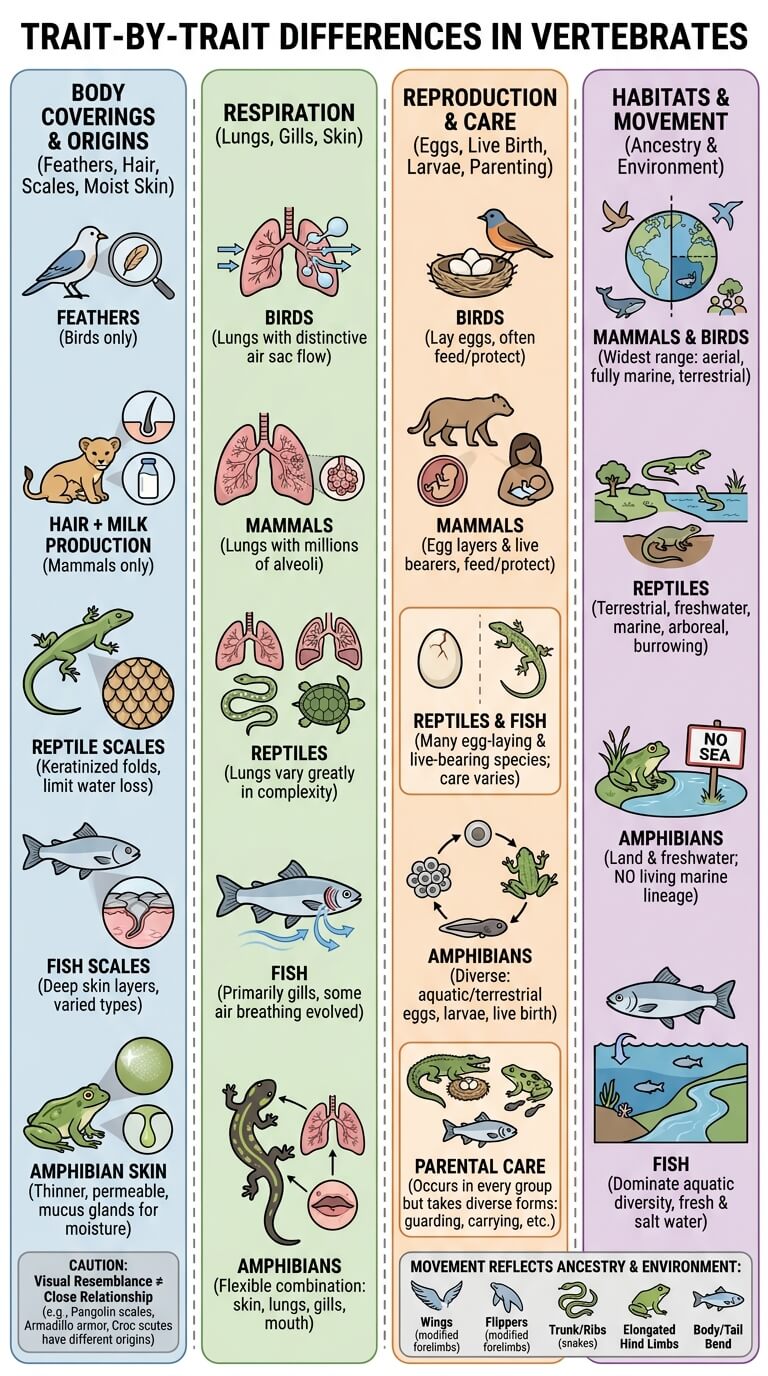
Feathers identify birds, and hair plus milk production identifies mammals. Reptile scales are keratinized folds of the epidermis that help limit water loss. Fish scales usually form within deeper skin layers and occur in several structural types. Amphibian skin is generally thinner and more permeable, with mucus glands that help maintain a moist surface.
Similar-looking coverings can therefore have different origins. Pangolin scales are modified mammalian structures. Armadillo armor contains bony plates covered by keratinized skin. Crocodilian scutes may include underlying bone. A visual resemblance does not automatically indicate close relationship.
Lungs, gills, and skin respiration
Mammals, birds, and nonavian reptiles breathe with lungs throughout postembryonic life. Bird lungs use air sacs to maintain a distinctive flow pattern. Mammal lungs ventilate millions of tiny air spaces called alveoli. Reptile lungs vary greatly, from relatively simple chambers to highly divided structures with efficient internal surfaces.
Fish primarily use gills, although air breathing has evolved many times. Amphibians combine respiratory surfaces more flexibly than the other familiar groups. Their skin, lungs, gills, and mouth lining can contribute in different proportions depending on the species and stage of life.
Eggs, live birth, parental care, and larval stages
Birds lay eggs, while mammals include both egg layers and live bearers. Reptiles and fish include many egg-laying and live-bearing species. Amphibian reproduction also spans external and internal fertilization, aquatic eggs, terrestrial eggs, direct development, larval stages, and live birth.
Parental care occurs in every group but takes different forms. Birds and mammals often feed or protect young. Crocodilians guard nests, some frogs carry eggs or larvae, and many fish guard, fan, mouthbrood, or internally carry offspring. Other species provide little care after spawning or egg laying.
Land, freshwater, marine, and aerial habitats
Mammals and birds occupy the widest visible range of lifestyles, including powered flight and fully marine living. Reptiles include terrestrial, freshwater, arboreal, burrowing, and marine forms. Amphibians occupy land and freshwater systems but have no living lineage adapted to permanent life in normal seawater. Fish dominate aquatic vertebrate diversity in both fresh and salt water.
Movement reflects both ancestry and environment. Birds use modified forelimbs as wings, whales use forelimbs as flippers, snakes use the trunk and ribs, frogs power jumps with elongated hind limbs, and fish generate thrust mainly by bending the body and tail or moving specialized fins.
Common Mistakes and Myths
Whales are mammals, not fish
Whales breathe air with lungs, produce milk, are endothermic, and descended from land mammals. Their flippers contain the same broad tetrapod bone pattern found in other mammalian forelimbs. Living in the ocean and having a streamlined body are adaptations to habitat, not evidence that whales are fish.
Not all reptiles lay eggs
Live birth has evolved many times among reptiles. Cold climates can favor retaining embryos because a pregnant female can move among warmer and cooler sites, giving developing young a more controlled thermal environment than a stationary nest would provide. The exact reproductive anatomy varies among lineages.
Not every amphibian has a tadpole stage
Tadpoles are characteristic larvae of frogs and toads, but direct-developing frogs hatch as miniature froglets. Salamander larvae differ from tadpoles, and some salamanders retain larval features into reproductive adulthood. Caecilian development includes additional egg-laying and live-bearing patterns.
Flight does not define birds
Feathers and ancestry define birds more reliably than flight. Bats are flying mammals, and extinct pterosaurs were flying reptiles outside the bird lineage. Penguins use modified wings underwater, while ostriches and emus use powerful legs for running. Each remains fully avian.
Edge Cases and Exceptions
Egg-laying mammals
Platypuses and echidnas demonstrate that milk production is more fundamental to mammal identity than live birth. Their eggs have flexible shells, and the hatchlings continue development while feeding on milk. They combine ancestral reproductive features with unmistakably mammalian hair, jaw, ear, and milk-producing anatomy.
Warm-bodied fish and regional endothermy
Most fish rely strongly on water temperature, but certain fast-swimming oceanic lineages retain heat generated by muscles. Countercurrent heat exchangers transfer warmth from outgoing blood to cooler incoming blood, allowing selected tissues to remain warmer than the surrounding sea. The degree and location of warming differ by lineage, so these fish should not be described as identical to birds or mammals in temperature control. Their differences in energy use are easier to understand through the contrast between warm-blooded and cold-blooded animals.
Legless reptiles and aquatic mammals
Snakes are tetrapods even though their ancestors lost the external limbs. Whales are also tetrapods despite having no external hind limbs and forelimbs reshaped into flippers. Evolutionary names often preserve ancestry rather than describing the animal’s present silhouette literally.
Why the Five Groups Fit Together Evolutionarily
Why vertebrates differ from invertebrates
The shared cranium, spinal organization, internal skeleton, and developmental pattern place these five groups within Vertebrata. Invertebrates include many other animal lineages with different support systems and body plans. The distinction is about ancestry and structural organization, not a claim that one side is simple and the other is advanced. The vertebrates vs invertebrates distinction provides the larger structural context for this comparison.
How endothermy and ectothermy shape animal lives
Birds and mammals generally spend more energy producing heat, which can support activity across a broad temperature range but requires a steady food supply. Reptiles, amphibians, and most fish depend more strongly on environmental heat, which reduces routine energy demands but can restrict activity. Behavior, insulation, circulation, body size, and habitat can modify both strategies.
How evolutionary ancestry explains shared traits
Nested ancestry explains the exceptions. Birds share reptilian ancestry. Mammals, reptiles, and birds are amniotes. Amphibians are tetrapods outside that branch, and tetrapods trace back to lobe-finned vertebrate ancestors. Modern categories describe living forms, while evolution explains their overlap. Animal evolution and common ancestors explain why birds sit within the reptile lineage and why tetrapods arose within the fish branch.
FAQ
Which vertebrate groups have amniotic eggs?
Mammals, birds, and reptiles are amniotes. Their embryos develop inside an amnion and other protective extraembryonic membranes. Birds and many reptiles package those membranes inside a shelled egg. Most mammals retain the embryo and membranes inside the reproductive tract, where placental tissues support development. Amphibians and fish are not amniotes.
Why are whales mammals instead of fish?
Whales breathe with lungs, nurse young with milk, are endothermic, and have mammalian skeletal and developmental traits. Their ancestors were land-dwelling mammals that returned to aquatic life. A streamlined body evolved because it works well in water, so external shape alone does not determine classification.
Do all reptiles lay eggs?
No. Many turtles, crocodilians, and lizards lay eggs, but live birth occurs in numerous snakes and lizards. Some species retain yolk-supported eggs inside the body until the young emerge, while others provide developing embryos with additional maternal exchange. Reptiles are identified by their ancestry and broader anatomical traits, not egg laying alone.
Why do many amphibians depend on moist environments?
Amphibian skin is usually permeable and often contributes to breathing and water uptake. Their eggs commonly lack the water-retaining amniotic membranes found in reptiles, birds, and mammals. Moist habitats help prevent dehydration and support reproduction, although many amphibians use behavior, burrows, seasonal dormancy, or direct development to live away from open water.
Final Thoughts
Mammals, birds, reptiles, amphibians, and fish can be compared most accurately by using several traits at once. Hair and milk point to mammals, feathers to birds, keratinized scales and amniotic development to nonavian reptiles, permeable skin and moisture-linked biology to amphibians, and an aquatic gill-and-fin body plan to fish. Exceptions do not make the categories useless. They reveal how evolution modifies inherited structures as vertebrates move into new habitats and adopt new ways of breathing, reproducing, and regulating body temperature.

Ethan Walker is the founder and research editor of Animal Fact Central. He creates and reviews educational animal facts content using trusted wildlife, pet care, and science-based sources. His work focuses on making animal behavior, adaptations, habitats, and species facts clear, accurate, and engaging for everyday readers.
Read More Details About Ethan Walker: https://animalfactcentral.com/ethan-walker/