
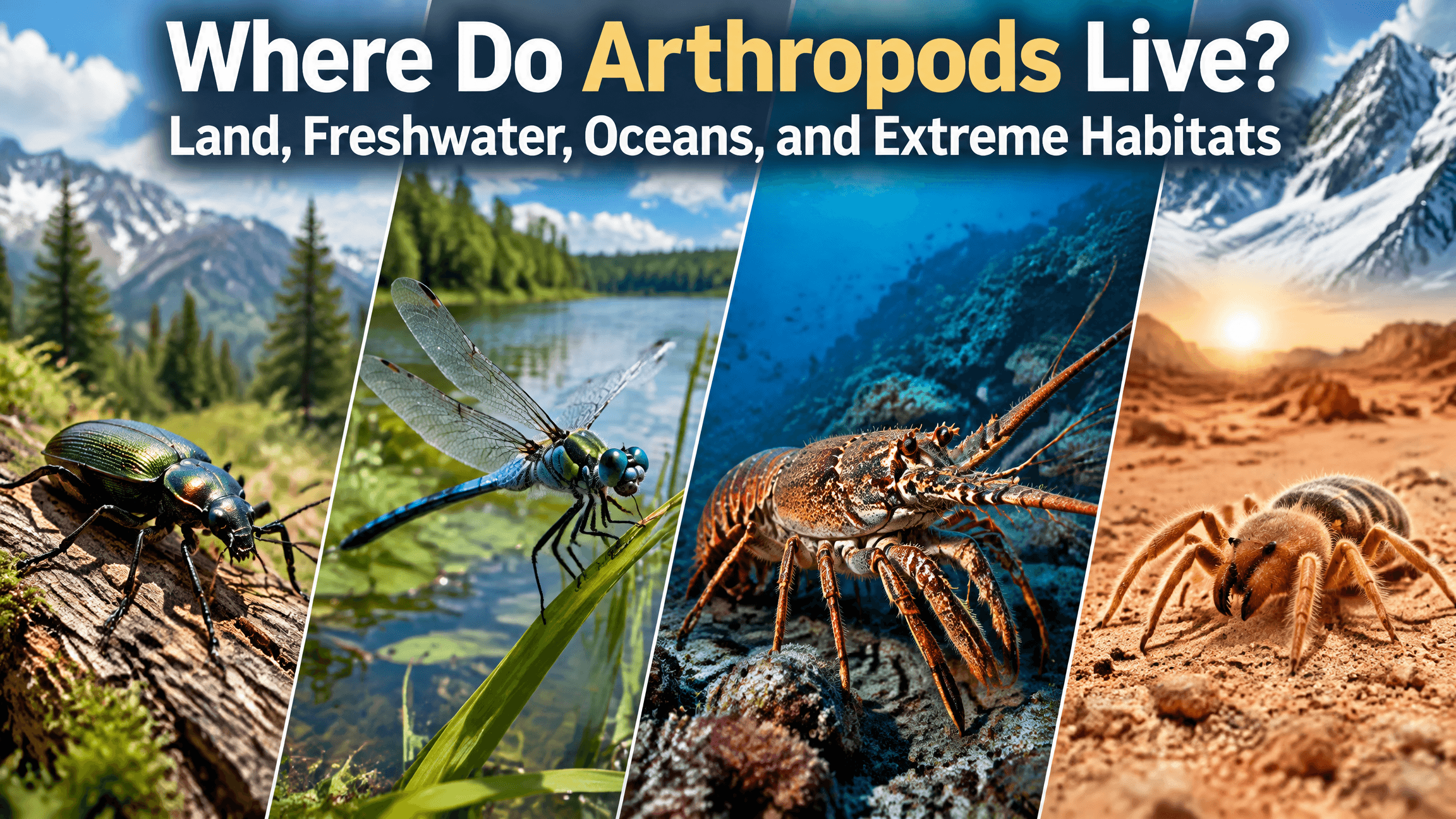
Arthropods live in marine, freshwater, and terrestrial environments, but they are not distributed evenly across every habitat. Crustaceans dominate many aquatic settings, insects are especially diverse on land and in freshwater, arachnids and myriapods are overwhelmingly terrestrial, and specialized lineages occupy caves, deserts, mountains, soils, plant surfaces, animal hosts, and urban environments.
The phrase “arthropods live everywhere” is convenient but too absolute. Habitat use depends on water balance, respiration, temperature, salinity, food, substrate, life stage, and evolutionary history. Some arthropods tolerate severe heat, cold, dryness, darkness, pressure, or low food availability, while others survive only within narrow environmental limits.
Understanding where arthropods live is therefore not just a map question. It is an adaptation question: which body plans and physiological systems can function under particular environmental conditions?
Quick Answer: Arthropods Occupy Marine, Freshwater, and Terrestrial Systems
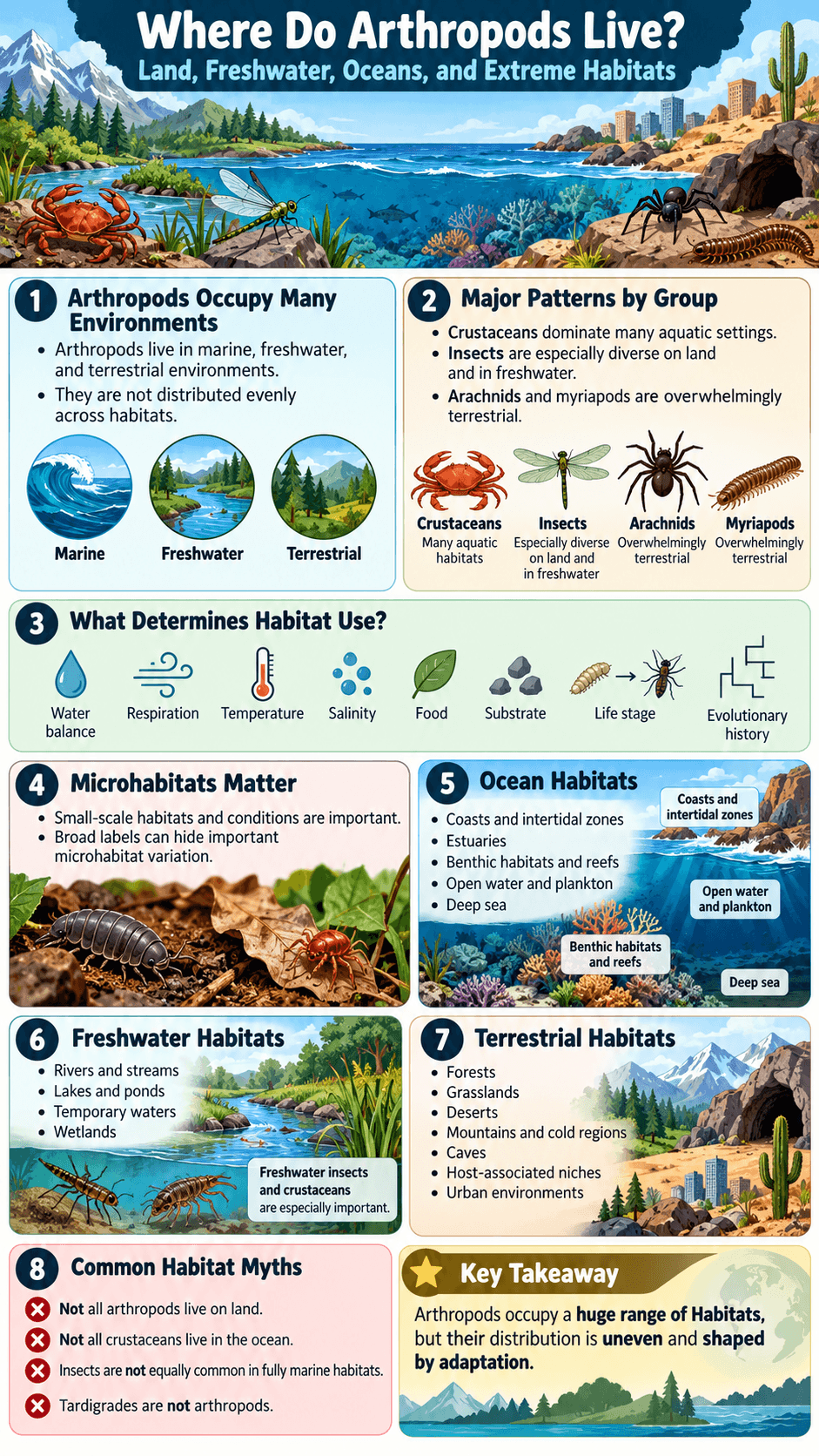
Living arthropods occur from ocean plankton and deep seafloors to rivers, lakes, wetlands, forests, deserts, soils, caves, mountains, and cities. The National Park Service summarizes modern arthropods as inhabiting marine, freshwater, and terrestrial environments. These habitat patterns reflect the broader diversity of arthropod adaptations.
Different groups show very different patterns. Crustaceans are extraordinarily diverse in marine waters but also include freshwater and fully terrestrial lineages. Insects dominate many terrestrial and freshwater communities but are relatively uncommon as fully marine animals. Arachnids are primarily terrestrial, while myriapods are strongly associated with land, especially soil, litter, bark, and other humid microhabitats.
Even within one lineage, habitat range can be surprisingly broad. Isopod crustaceans occur in the ocean, freshwater, groundwater, caves, and on land.
Why Habitat Patterns Differ Among Arthropod Groups
Water Balance
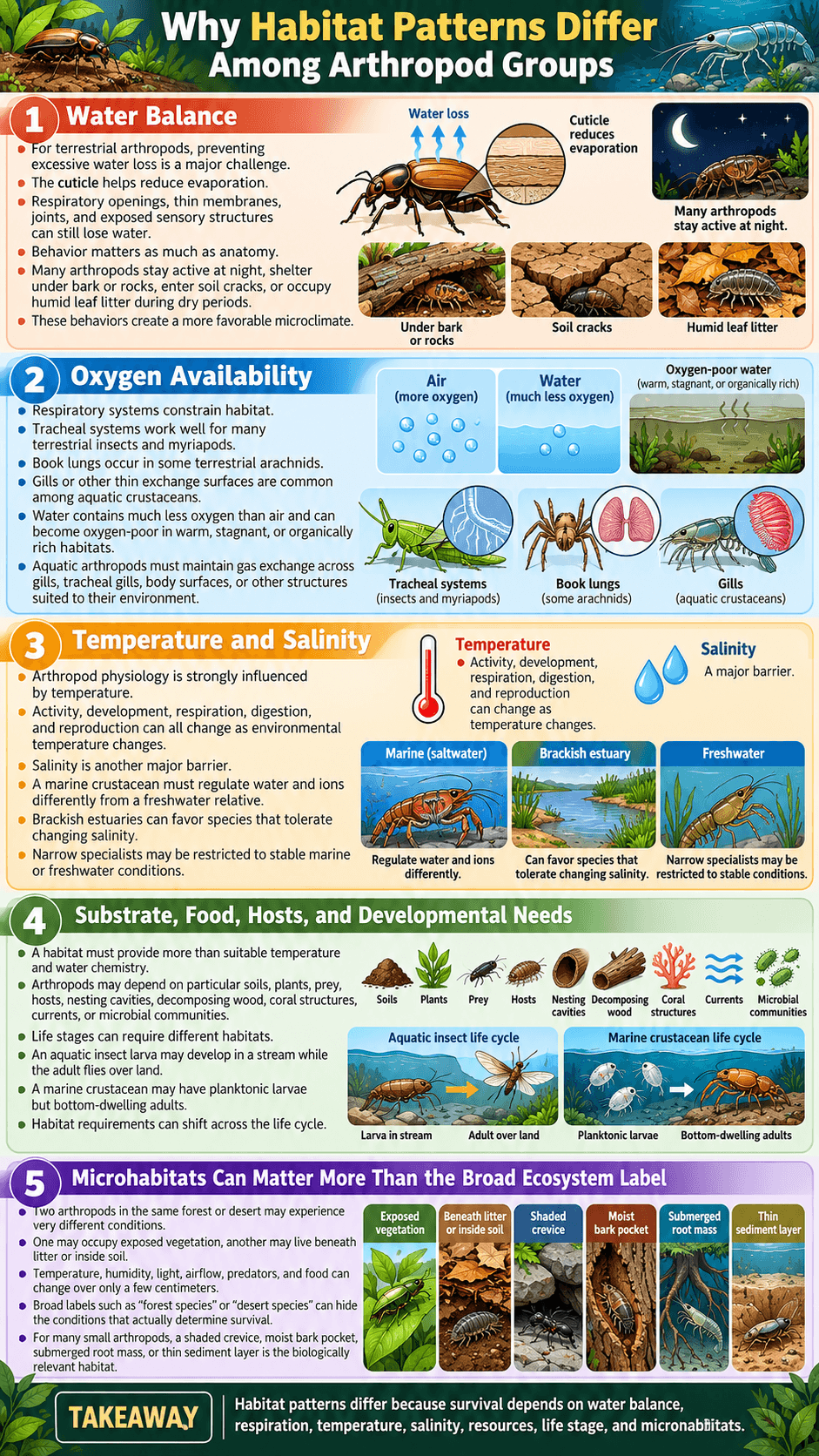
For terrestrial arthropods, preventing excessive water loss is a major challenge. The cuticle helps reduce evaporation, but respiratory openings, thin membranes, joints, and exposed sensory structures can still lose water.
Behavior matters as much as anatomy. Many arthropods remain active at night, shelter under bark or rocks, enter soil cracks, or occupy humid leaf litter during dry periods. These behaviors create a more favorable microclimate than the surrounding air.
Oxygen Availability
Respiratory systems constrain habitat. Tracheal systems work well for many terrestrial insects and myriapods, book lungs occur in some terrestrial arachnids, and gills or other thin exchange surfaces are common among aquatic crustaceans.
Water contains much less oxygen than air and can become oxygen-poor in warm, stagnant, or organically rich habitats. Aquatic arthropods must therefore maintain gas exchange across gills, tracheal gills, body surfaces, or other structures suited to their environment.
Temperature and Salinity
Arthropod physiology is strongly influenced by temperature because most species do not internally regulate body temperature the way birds and mammals do. Activity, development, respiration, digestion, and reproduction can all change as environmental temperature changes.
Salinity creates another major barrier. A marine crustacean must regulate water and ions differently from a freshwater relative. Brackish estuaries can favor species capable of tolerating changing salinity, while narrow specialists may be restricted to stable marine or freshwater conditions.
Substrate, Food, Hosts, and Developmental Needs
A habitat must provide more than suitable temperature and water chemistry. Arthropods may depend on particular soils, plants, prey, hosts, nesting cavities, decomposing wood, coral structures, currents, or microbial communities.
Life stages can require different habitats. An aquatic insect larva may develop in a stream while the adult flies over land. A marine crustacean may have planktonic larvae but bottom-dwelling adults. Habitat requirements therefore can shift across the life cycle.
Microhabitats Can Matter More Than the Broad Ecosystem Label
Two arthropods living in the same forest or desert may experience very different conditions if one occupies exposed vegetation and the other lives beneath litter or inside soil. Temperature, humidity, light, airflow, predators, and food can change over only a few centimeters.
This is why broad labels such as “forest species” or “desert species” can hide the environmental conditions that actually determine survival. For many small arthropods, a shaded crevice, moist bark pocket, submerged root mass, or thin sediment layer is the biologically relevant habitat.
Arthropods in the Ocean

Coasts and Intertidal Zones
Coastal environments support dense arthropod communities. Crabs, amphipods, isopods, barnacles, shrimp, and other crustaceans occupy rocky shores, mudflats, beaches, salt marsh edges, mangroves, kelp forests, and tide pools.
The intertidal zone is especially demanding because conditions change rapidly. An arthropod may be submerged at high tide and exposed to air, heat, drying, and changing salinity at low tide. Species living there combine behavior, body structure, and physiological tolerance to survive those transitions.
Estuaries and Brackish Water
Estuaries connect rivers with the sea and can change in salinity over tides, seasons, storms, and river flow. Arthropods living there may experience rapid shifts in water chemistry along with changing sediments and oxygen conditions.
Crabs, shrimp, amphipods, copepods, insect larvae near freshwater margins, and other arthropods can occupy different parts of these gradients. Species differ greatly in how much salinity change they tolerate, so an estuary is not one uniform habitat.
Benthic Habitats and Reefs
Many marine arthropods live on or within the seafloor. They crawl over sediment, burrow into mud or sand, hide in reefs, occupy crevices, live beneath stones, or associate with sponges, corals, algae, and other organisms.
Benthic crustaceans include large decapods as well as tiny amphipods, isopods, ostracods, copepods, and other forms. Habitat complexity creates small-scale niches that differ in light, flow, sediment, food, and predation risk.
Open Water and Plankton
Arthropods also occupy the open water column. Copepods and krill are among the most familiar crustacean zooplankton.
NOAA Fisheries describes copepods as tiny crustacean zooplankton that are abundant in coastal waters and oceans and connect phytoplankton production to larger animals. Some remain planktonic for most of life, while others have planktonic larval stages only.
Deep-Sea Environments
Deep-sea arthropods live under high pressure, low temperature, darkness, and often limited food. Crustaceans are represented from continental slopes to abyssal habitats and ocean trenches.
Deep-sea species may depend on sinking organic material, carrion, microbial production, hydrothermal systems, or predation. Adaptations differ widely, and not every deep-sea arthropod shares one extreme-environment strategy.
Crustaceans Are Major Marine Examples, but Not the Whole Story
Crustaceans are the most conspicuous living arthropod radiation in marine habitats, but chelicerates also have marine representatives such as horseshoe crabs and sea spiders. A small number of insects occupy marine or strongly coastal niches as well.
The key pattern is imbalance rather than absence: insects are enormously successful on land and in freshwater yet comparatively uncommon in fully marine environments.
Freshwater Arthropods

Rivers and Streams
Streams support aquatic insect larvae, crayfish, amphipods, isopods, copepods, mites, and other arthropods. Flow speed, oxygen, temperature, substrate, vegetation, and water chemistry shape which species can live in a particular reach.
The U.S. Environmental Protection Agency notes that river and stream benthic macroinvertebrates include aquatic insect larvae and crustaceans such as crayfish living among rocks, sediments, and vegetation on the bottom.
Lakes and Ponds
Lakes and ponds contain arthropods from open-water plankton to bottom-dwelling communities and shoreline insects. Copepods and other small crustaceans occupy the water column, while insect larvae may live on plants, sediments, or submerged debris.
Temporary ponds create a different challenge because they can dry completely. Some branchiopod crustaceans and insects survive such cycles through resistant eggs or life stages timed to seasonal water availability.
Temporary Waters
Vernal pools, rain-filled depressions, floodplain pools, and other temporary waters may exist for only part of the year. Arthropods that depend on them must complete development quickly, disperse before drying, or persist through drought in resistant stages.
These habitats can support specialized communities precisely because permanent-water predators or competitors may be absent. Their seasonal nature makes timing a major part of habitat adaptation.
Wetlands
Marshes, swamps, floodplains, bogs, and other wetlands combine aquatic and terrestrial conditions. Water level can fluctuate, oxygen can vary in sediments, and vegetation creates many surfaces for feeding and shelter.
Wetlands can support aquatic insects, spiders, mites, crustaceans, and numerous terrestrial arthropods along water margins.
Freshwater Insects and Crustaceans
Freshwater is especially important for many insect orders during immature life. Mayfly, stonefly, caddisfly, dragonfly, mosquito, and many beetle larvae or nymphs develop in water before emerging as terrestrial or aerial adults.
Crustaceans also have major freshwater radiations, including crayfish, amphipods, isopods, branchiopods, copepods, and ostracods. Freshwater habitats are therefore not simply insect water with a few marine crustaceans that moved inland. Different substrates and environments also favor different forms of arthropod locomotion.
Forests and Plant-Based Habitats
Canopies and Foliage
Leaves, branches, flowers, fruits, bark surfaces, and epiphytes create a vast three-dimensional habitat. Insects dominate many plant-associated niches, but spiders, mites, pseudoscorpions, and other arthropods are also abundant.
Plant surfaces provide food, prey, attachment sites, shade, humidity gradients, and mating locations. Arthropod communities can differ dramatically from the ground to the canopy.
Bark, Wood, and Dead Plant Material
Living and dead wood support beetles, termites, ants, mites, spiders, centipedes, millipedes, isopods, and other arthropods. Cracks in bark create shelter, while decaying logs retain moisture and support fungi and microbial communities.
Dead wood is not empty habitat. As decomposition progresses, its temperature, moisture, chemistry, and structural complexity change, creating niches for different species.
Leaf Litter and the Forest Floor
Leaf litter is one of the richest terrestrial arthropod habitats. It buffers temperature, retains moisture, and concentrates fungi, bacteria, decaying plant material, and small prey.
Mites, springtails, millipedes, centipedes, beetles, spiders, ants, isopods, and many insect larvae occupy this layer. The community links decomposition, predation, and soil processes.
Soil and Underground Habitats
Myriapods, Mites, Insects, and Other Soil Arthropods
Soil contains pore spaces, roots, organic matter, fungi, microbes, and small animals. Arthropods live at the surface, within litter, among root systems, and deeper in the soil profile.
Myriapods are especially associated with terrestrial ground habitats. Many millipedes consume decomposing material, while centipedes hunt small animals. Mites and springtails occupy extremely small spaces and can reach high densities in suitable soils.
Moisture and Microhabitat Constraints
Soil can protect arthropods from direct sunlight and temperature extremes, but moisture is critical. Fine-scale humidity differs between the surface, litter, pore spaces, roots, and deeper layers.
An animal that cannot tolerate dry air may survive only centimeters below a surface that appears too hot or dry. This illustrates why broad labels such as forest or desert can hide important microhabitats.
Grasslands, Deserts, and Dry Environments
Heat and Water-Balance Challenges
Dry habitats expose arthropods to high temperatures and water loss, especially at the ground surface during daylight. Desert insects, arachnids, and crustaceans must balance activity with dehydration risk.
Small body size can increase water-loss risk because surface area is large relative to volume, although cuticle properties and behavior can offset that disadvantage.
Behavioral and Structural Adaptations
Many dryland arthropods are nocturnal, crepuscular, or active only during favorable seasons. Burrowing, hiding beneath stones, and selecting shaded microhabitats reduce exposure to heat and dry air.
Waxy cuticular layers, controlled spiracles in many insects, efficient excretion, and water obtained from food can also contribute to survival. These features vary among lineages and should not be treated as one universal desert toolkit.
Mountains, Cold Regions, and Seasonal Extremes
Temperature Limits and Seasonal Strategies
Arthropods occur at high elevations, in Arctic and sub-Arctic regions, and in places with long winters. Survival strategies can include dormancy, diapause, freeze avoidance, freeze tolerance in selected species, supercooling, sheltered overwintering, and seasonal migration.
Cold tolerance is species-specific. An alpine insect adapted to freezing nights cannot be used as evidence that arthropods generally tolerate extreme cold.
Why Arthropods Should Not Be Described as Able to Survive Anywhere
Some arthropods are famous for tolerating extreme conditions, but the phylum also contains species with very narrow climatic requirements. Temperature, humidity, salinity, oxygen, food, and habitat structure can set sharp distribution limits.
Extreme tolerance is an adaptation of particular lineages, not a universal arthropod property.
Cave Arthropods

Darkness, Limited Food, and Specialized Microclimates
Caves can provide stable temperature and humidity but little or no sunlight and limited food production. Energy often enters through water, roots, guano, dead organisms, or animals that move between surface and underground habitats.
The National Park Service describes cave systems as supporting insects, spiders, crustaceans, centipedes, millipedes, mites, and other invertebrates, with some species spending their entire life cycle underground.
Reduced Eyes and Other Cave-Associated Traits
Long-term cave specialists may show reduced pigmentation, reduced eyes, elongated appendages, enhanced nonvisual sensing, or slower metabolism. These traits are associated with certain cave-adapted lineages, not every arthropod found in a cave.
NPS distinguishes temporary cave users, species that can live both inside and outside caves, and true cave specialists. A cave cricket near an entrance may therefore have very different adaptations from a blind crustacean restricted to groundwater.
Restricted-Range Cave Species Can Be Vulnerable
Cave species can have extremely small distributions. At Sequoia and Kings Canyon National Parks, the NPS notes that some cave invertebrates are endemic to a watershed or even a single cave.
Such narrow ranges can make populations vulnerable to groundwater change, pollution, disturbance, altered nutrient inputs, or physical damage to the cave environment. Sensitive locality information should therefore be handled carefully.
Arthropods Living on Plants or Animal Hosts
Plant-Associated Niches
Plants provide entire habitat networks. Arthropods can live on leaves, inside stems, beneath bark, within wood, in flowers, fruits, roots, galls, seeds, or plant litter.
Some feed directly on plants. Others prey on plant feeders, consume fungi, use plants as mating sites, or simply shelter within plant architecture.
Parasitic and Commensal Host-Associated Niches
Some arthropods spend part or all of life on animal hosts. Ticks, mites, lice, fleas, parasitic crustaceans, and other groups use host surfaces or tissues as habitat as well as food sources.
Other arthropods live with hosts without necessarily feeding directly on them. Host-associated living can involve shelter, transport, food access, or highly specialized ecological relationships.
Urban and Human-Modified Habitats
Buildings, Gardens, Farms, and Infrastructure Are Ecological Environments
Cities create warm surfaces, artificial light, gardens, drains, basements, walls, roofs, ponds, planted trees, stored materials, and fragmented patches of natural habitat. Arthropods exploit many of these features.
Urban environments can favor species able to tolerate disturbance and rapidly changing conditions, while specialists dependent on intact habitats may decline.
Urban Arthropods Are More Than Pests
Spiders, pollinating insects, decomposers, predators, soil arthropods, aquatic insects, and many other organisms live in cities without fitting a pest-control framing.
Urban ecology is therefore a real habitat topic, not simply a list of species people want removed from buildings or gardens.
Group-by-Habitat Comparison
Insects
Insects are extraordinarily diverse on land and in freshwater. They occupy soil, plants, forests, grasslands, deserts, caves, mountains, wetlands, rivers, lakes, cities, and host-associated niches.
Fully marine insects are comparatively uncommon. Coastal and intertidal insects exist, but insects have not radiated through the open ocean in the way crustaceans have.
Arachnids
Arachnids are primarily terrestrial. Spiders, scorpions, ticks, mites, harvestmen, and related groups occupy soils, vegetation, deserts, forests, caves, freshwater margins, and host-associated habitats.
Some mites are aquatic, but the major arachnid radiation remains land-based.
Crustaceans
Crustaceans dominate many marine habitats and are also important in freshwater. Their terrestrial representatives are easy to overlook.
The 2026 World List of Marine, Freshwater and Terrestrial Isopod Crustaceans states that isopods occur from the deepest oceans to montane terrestrial habitats, caves, and aquifers. Woodlice are familiar fully terrestrial isopods.
Myriapods
Centipedes, millipedes, pauropods, and symphylans are terrestrial and strongly associated with ground-level habitats. Soil, litter, rotting wood, bark, caves, and humid crevices are especially important.
Many myriapods lose water readily and therefore depend on sheltered microhabitats even when they live in regions that become seasonally dry.
Common Habitat Myths
All Arthropods Live on Land
No. Marine and freshwater arthropods are enormously diverse. Crustaceans are especially important in aquatic ecosystems.
All Crustaceans Live in the Ocean
No. Crayfish, branchiopods, copepods, amphipods, and isopods include freshwater forms, while woodlice and related isopods are terrestrial crustaceans.
Insects Are Equally Common in Fully Marine Habitats
No. Insects are extraordinarily successful on land and in freshwater but are relatively uncommon as fully marine animals. Coastal species do not change that broad distribution pattern.
Tardigrades Are Extreme-Environment Arthropods
No. Tardigrades are close evolutionary relatives of arthropods within Panarthropoda, but they belong to their own phylum, Tardigrada. Velvet worms likewise belong to Onychophora rather than Arthropoda.
Extreme-environment discussions often mention tardigrades, but using them as evidence of arthropod tolerance would be taxonomically incorrect.
How Habitat Connects to Nearby Animal Topics
Arthropod Habitats Versus Broad Ecosystem Guides
A broad guide to oceans, wetlands, deserts, caves, or freshwater asks which animals live in an ecosystem. An arthropod habitat article asks how arthropod lineages distribute themselves across those systems and which constraints shape that distribution. Habitat determines which resources and organisms are available, helping shape the ecosystem roles of arthropods.
The distinction keeps the focus on Arthropoda rather than trying to describe entire ecosystems.
Habitat and Respiratory Adaptations
Habitat strongly affects respiration. Gills suit aquatic exchange, while tracheal systems and book lungs internalize respiratory surfaces for life in air. Terrestrial crustaceans show intermediate solutions derived from aquatic ancestry.
Respiration is one reason habitat transitions are evolutionarily challenging.
Habitat and Conservation Vulnerability
A widespread generalist occupying many habitat types may respond differently to disturbance from a cave specialist, island endemic, headwater species, or arthropod tied to one host plant.
Habitat range is therefore central to conservation. The narrower the ecological requirements and geographic distribution, the fewer alternative places a species may have when conditions change. Narrow habitat requirements can increase arthropod conservation vulnerability when suitable environments are altered or lost.
FAQ
Do Arthropods Live in the Ocean?
Yes. Crustaceans such as copepods, krill, crabs, shrimp, amphipods, isopods, and barnacles are major marine arthropods. Horseshoe crabs and sea spiders are marine chelicerates, and a small number of insects occupy marine or strongly coastal habitats.
Are There Terrestrial Crustaceans?
Yes. Woodlice, pillbugs, and sowbugs are terrestrial isopod crustaceans. Other crustacean lineages also include semiterrestrial or land-adapted species.
Where Do Myriapods Usually Live?
Myriapods are terrestrial and are commonly associated with soil, leaf litter, rotting wood, bark, caves, and humid sheltered spaces. Many species are sensitive to drying conditions.
Can Arthropods Live in Extreme Environments?
Some can. Particular arthropods tolerate deserts, alpine cold, caves, deep seas, hypersaline settings, or other demanding habitats. Those abilities are species-specific adaptations rather than evidence that all arthropods can survive extreme conditions.
Final Thoughts
Arthropods occupy an enormous range of habitats, from ocean plankton and deep seafloors to rivers, forest canopies, soil, deserts, caves, mountains, host bodies, and cities. Their distribution is broad because different lineages have evolved different solutions to water balance, respiration, temperature, salinity, movement, feeding, and reproduction.
That diversity should not be reduced to the claim that arthropods live literally everywhere. Insects are especially successful on land and in freshwater but uncommon in the open ocean. Crustaceans dominate many aquatic systems yet also include terrestrial forms. Arachnids and myriapods are primarily terrestrial, often depending on particular microhabitats. Habitat is therefore one of the clearest ways to see how arthropod evolution has produced many specialized solutions rather than one universal way of life.

Ethan Walker is the founder and research editor of Animal Fact Central. He creates and reviews educational animal facts content using trusted wildlife, pet care, and science-based sources. His work focuses on making animal behavior, adaptations, habitats, and species facts clear, accurate, and engaging for everyday readers.
Read More Details About Ethan Walker: https://animalfactcentral.com/ethan-walker/