
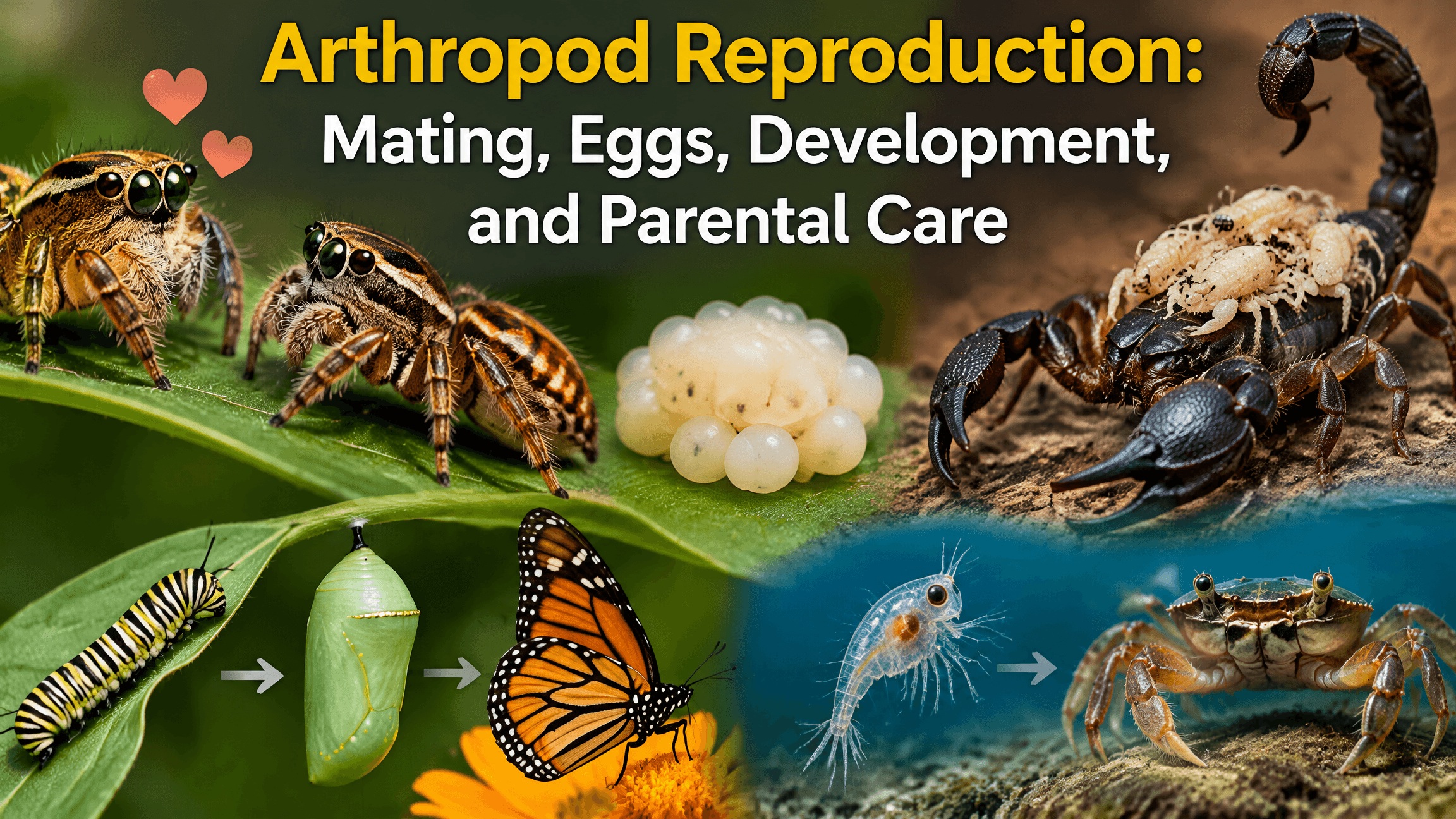
Arthropod reproduction is extraordinarily diverse. Most species reproduce sexually, but the details vary widely. Some transfer sperm directly, some use spermatophores, some brood eggs on or under the body, some give birth to live young, and some can reproduce without fertilization through parthenogenesis.
Development is just as varied. Some young hatch looking broadly like miniature versions of adults, while others pass through specialized larval stages that look and behave very differently. Insects may undergo gradual or dramatic developmental changes, crustaceans can pass through lineage-specific planktonic larvae, ticks move through larval and nymphal stages, and scorpions are born alive and ride on the mother’s back.
There is no single arthropod reproductive pattern. The most accurate way to understand the phylum is to compare recurring strategies while keeping important exceptions in view.
Quick Answer: Arthropod Reproduction Is Highly Diverse
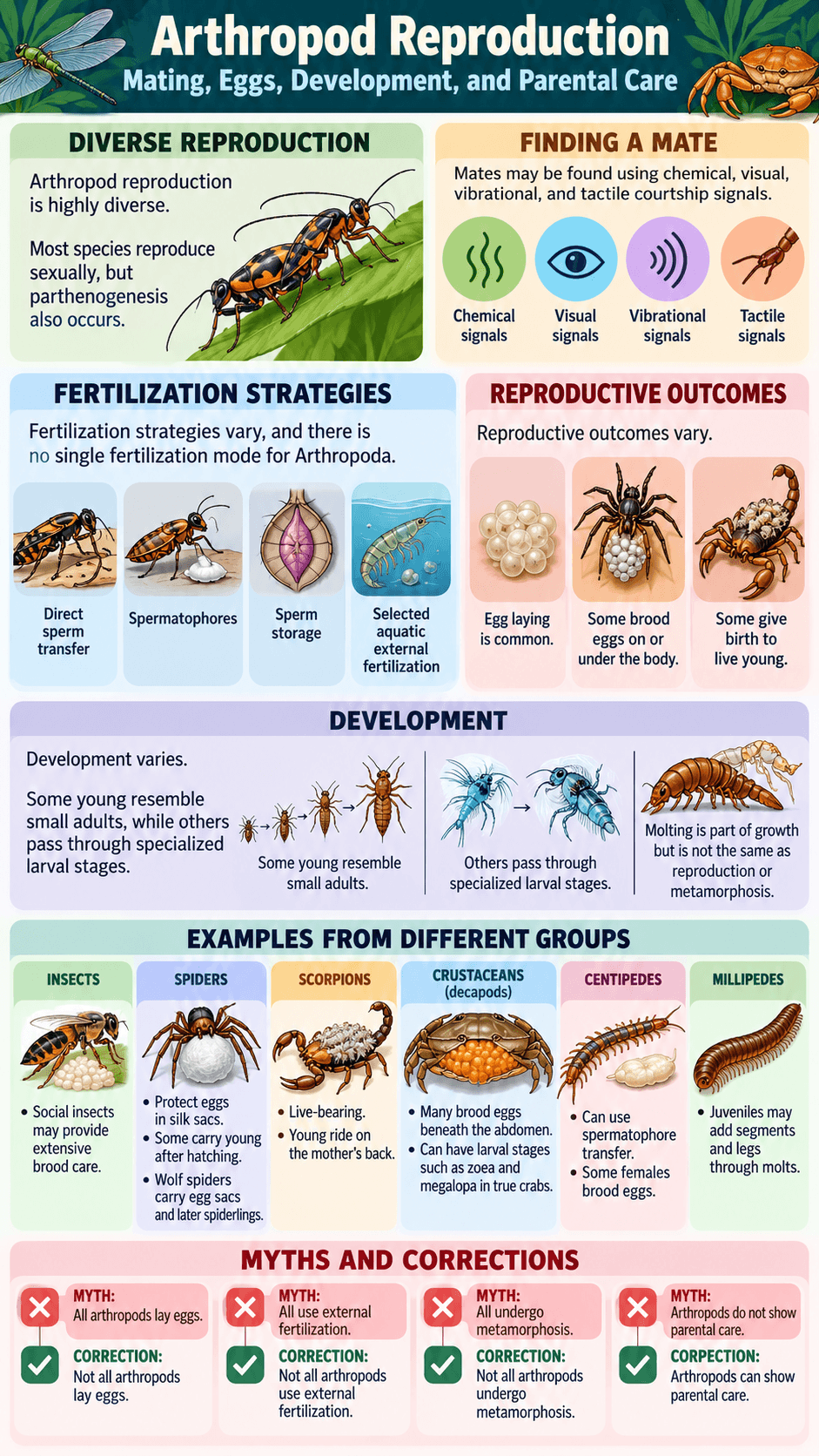
Arthropods reproduce through a wide range of mating, fertilization, egg-laying, brooding, live-bearing, and developmental strategies. Sexual reproduction is common, but parthenogenesis also occurs in multiple lineages. Fertilization may involve direct sperm transfer, spermatophores, or external release in selected aquatic groups. These reproductive strategies add another layer to the wider biological diversity of arthropods.
Many arthropods lay eggs, but not all do. Scorpions are a familiar exception because they give birth to live young. Some crustaceans retain eggs on appendages or under the abdomen. Many spiders protect eggs in silk sacs, and some continue guarding or carrying young after hatching.
Development also varies from relatively direct juvenile growth to complex larval transformations. Molting is involved in arthropod growth, but molting itself is not the same thing as reproduction or metamorphosis.
Finding and Choosing Mates
Chemical Signals Can Bring Mates Together
Many arthropods use chemical cues to locate potential mates or determine reproductive readiness. These cues may travel through air, water, soil, silk, or direct contact.
Pheromones are especially important in many insects, but chemical communication is also widespread among arachnids and crustaceans. The relevant signal may be released by one sex, deposited on a surface, or detected only at close range.
Visual, Vibrational, and Tactile Courtship
Vision matters in strongly visual species such as jumping spiders, dragonflies, and some crustaceans. Other arthropods rely more heavily on vibration, sound, substrate drumming, or touch.
Male spiders can vibrate webs or substrates during courtship. Some insects produce songs or wing vibrations. Crustaceans may use body movements, appendage displays, or chemical signals in combination.
The purpose is not simply attraction. Courtship can also help confirm species identity, reproductive condition, and whether close contact is safe.
Courtship Reduces Mistakes
For a predatory arthropod, approaching another individual can be risky. Courtship signals help distinguish a potential mate from prey or a competitor.
Species recognition is also important where closely related arthropods live together. Differences in timing, odor, movement, or vibration can reduce mating between incompatible species.
How Fertilization Happens

Direct Sperm Transfer
In many arthropods, sperm is transferred directly to the female reproductive tract during mating. The exact structures involved differ among groups.
In insects, specialized genital structures can transfer sperm during copulation. In spiders, males first place sperm onto a small silk web and load it into modified pedipalps, which are then used during mating.
Direct transfer does not mean fertilization occurs at the same instant as mating. Females of many arthropods can store sperm and use it later to fertilize eggs.
Spermatophores
A spermatophore is a packet or structure containing sperm. It can be transferred directly to the female or deposited on a surface and later picked up or positioned by the female.
Centipedes provide a clear example. The University of Michigan Animal Diversity Web overview of Chilopoda describes internal fertilization involving spermatophore transfer in centipedes.
Scorpions also use spermatophores. Courtship behavior helps position the female over the spermatophore so that sperm can be transferred.
Sperm Storage Can Separate Mating From Egg Fertilization
In many arthropods, females can retain viable sperm after mating. This allows fertilization to occur later when eggs mature or when environmental conditions become favorable.
Sperm storage can reduce the need to find a mate before every clutch. It can also allow a female to produce more than one batch of fertilized eggs from a previous mating.
The storage organs and duration vary widely, so sperm storage should not be described as one universal arthropod mechanism.
External Fertilization in Selected Aquatic Groups
Some aquatic arthropods release gametes in ways that allow fertilization outside the body, but external fertilization is not a general arthropod rule. Many aquatic crustaceans mate and transfer sperm directly.
The diversity reflects different ecological pressures. Water can make external gamete release possible in some lineages, while internal transfer protects sperm and increases control in others.
No Single Fertilization Mode Defines Arthropoda
Statements such as “arthropods use internal fertilization” or “aquatic arthropods use external fertilization” are both too broad. Internal fertilization is widespread, but exceptions occur, and even superficially similar groups can use very different mechanisms.
Eggs, Brooding, and Live-Bearing Exceptions
Egg Laying Is Common
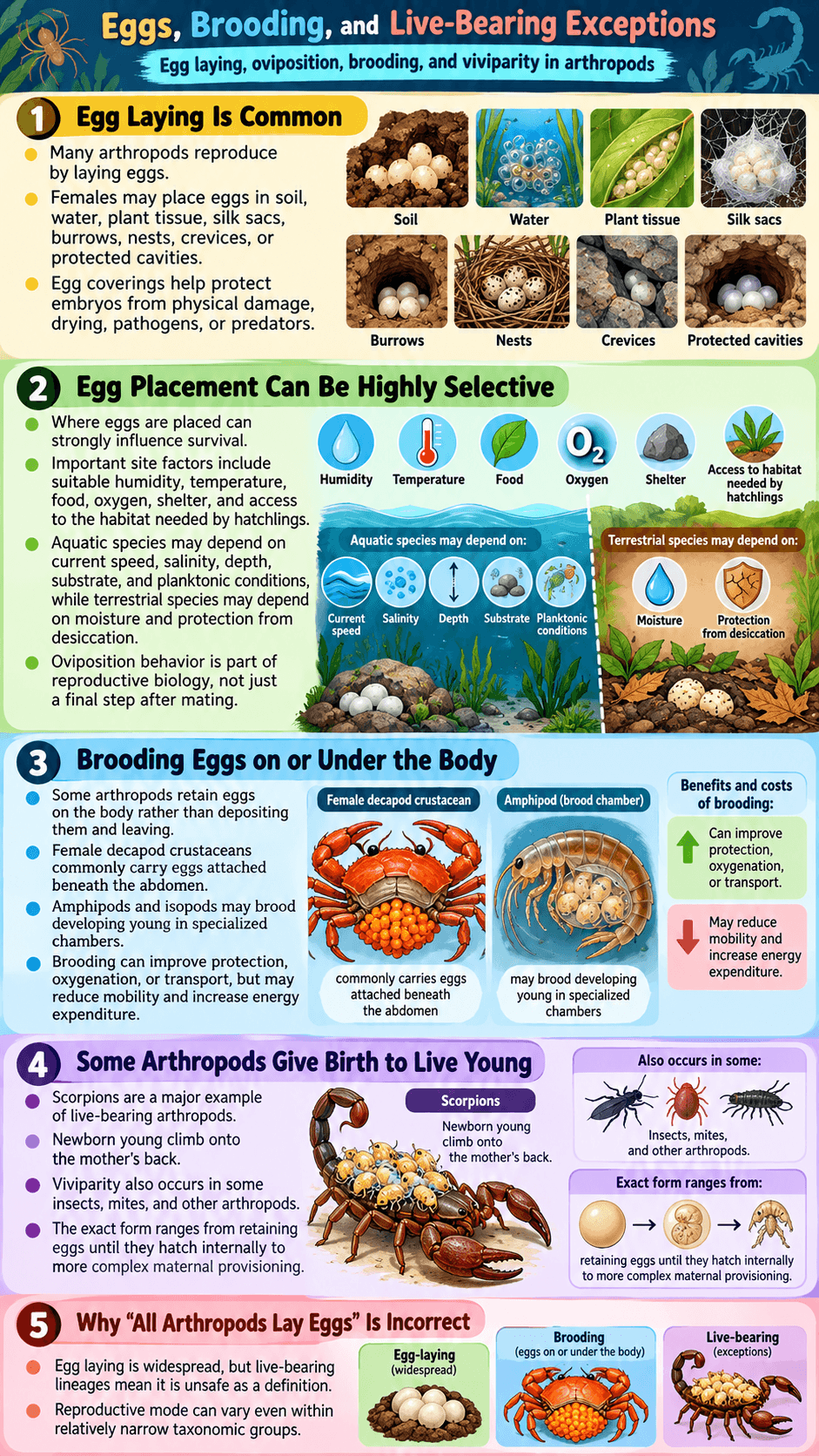
Many arthropods reproduce by laying eggs. Females may place them in soil, water, plant tissue, silk sacs, burrows, nests, crevices, or protected cavities.
Egg coverings help protect embryos from physical damage, drying, pathogens, or predators. The amount of protection varies enormously.
Egg Placement Can Be Highly Selective
Where eggs are placed can strongly influence survival. A female may choose a site with suitable humidity, temperature, food, oxygen, shelter, or access to the habitat needed by hatchlings.
For aquatic species, current speed, salinity, depth, substrate, and planktonic conditions can matter. For terrestrial species, moisture and protection from desiccation can be equally important.
This makes oviposition behavior part of reproductive biology rather than a simple final step after mating.
Brooding Eggs on or Under the Body
Some arthropods retain eggs on the body rather than depositing them and leaving. Female decapod crustaceans commonly carry eggs attached beneath the abdomen. Amphipods and isopods may brood developing young in specialized chambers.
Brooding keeps offspring close to the parent and can improve protection, oxygenation, or transport, although the costs to the parent can include reduced mobility and energy expenditure.
Some Arthropods Give Birth to Live Young
Scorpions are a major example of live-bearing arthropods. The Animal Diversity Web account of Scorpionidae describes scorpions as viviparous and notes that newborn young climb onto the mother’s back.
Viviparity also occurs in some insects, mites, and other arthropods. The exact form ranges from retaining eggs until they hatch internally to more complex maternal provisioning.
Why “All Arthropods Lay Eggs” Is Incorrect
Egg laying is widespread enough to be the first pattern many people learn, but live-bearing lineages make it unsafe as a definition. Reproductive mode can even vary within relatively narrow taxonomic groups.
Parthenogenesis and Alternative Reproductive Strategies
What Parthenogenesis Means
Parthenogenesis is development from an unfertilized egg. It occurs in several arthropod lineages, including some insects, crustaceans, mites, and other groups.
The genetic mechanism varies. In some species, parthenogenesis is a regular part of the life cycle. In others, it appears only under certain environmental conditions or in particular populations.
Parthenogenesis Does Not Mean Males Never Exist
Some arthropods alternate between sexual and parthenogenetic generations. Others have populations containing both sexual and parthenogenetic reproduction.
Aphids are a familiar example of seasonal switching between reproductive modes, but they should not be used as a universal model for arthropod parthenogenesis.
Reproductive Flexibility Can Match Changing Conditions
Alternative reproductive modes can help a lineage reproduce when mates are scarce or conditions favor rapid population growth. Sexual reproduction, however, reshuffles genetic variation and may remain important in other phases of the life cycle.
There is no single ecological explanation for every case of parthenogenesis.
Development After Fertilization

Some Young Resemble Small Adults
In relatively direct development, young emerge with the broad body organization of the adult, although they are smaller and sexually immature.
Spiderlings are a familiar example. Young spiders already have the basic spider body plan and grow through a series of molts.
Many centipedes and millipedes also hatch into juvenile forms that resemble the adult body plan, although segment and leg numbers can change in some lineages.
Other Arthropods Have Specialized Larvae
Larvae can be adapted to a different habitat, diet, or method of movement from the adult. A larva may be planktonic while the adult lives on the bottom, or aquatic while the adult lives on land.
This can reduce competition between life stages and allow dispersal into new habitats.
Embryo Development Can Be Fast or Prolonged
The time between fertilization and hatching or birth varies enormously among arthropods. Temperature, food supplied in the egg, maternal physiology, oxygen availability, and environmental seasonality can all affect developmental timing.
Some eggs hatch rapidly in warm conditions, while others enter delayed development or survive unfavorable seasons before hatching. In live-bearing species, embryos remain associated with the mother for a much longer period.
Developmental timing is therefore part of life-history strategy, not just a fixed countdown.
Growth Requires Molting
Because arthropods grow inside an external cuticle, juveniles and larvae generally pass through molts as they increase in size or change form.
Molting is the physical process of replacing the cuticle. Development describes the broader sequence of changing life stages. A molt can occur without a dramatic developmental transformation. Juvenile growth usually involves repeated arthropod molting, although molting and reproduction are separate biological processes.
Insect Development in Comparative Context
Insects Show Several Developmental Patterns
Insect development ranges from relatively gradual juvenile change to complete metamorphosis with distinct larval, pupal, and adult forms.
Grasshoppers and true bugs develop through nymphal stages that increasingly resemble adults. Beetles, flies, butterflies, moths, bees, and many other insects pass through larval and pupal stages before adulthood.
Insect Metamorphosis Is Not the Arthropod Standard
Because insects are so familiar, the larva-pupa-adult pattern is sometimes treated as if it represents arthropod development in general. It does not.
Spiders do not have a pupal stage. Ticks use larval, nymphal, and adult stages. Crustaceans may pass through aquatic larval forms with names such as nauplius, zoea, or megalopa depending on the lineage. Myriapods follow still other developmental pathways.
Arachnid Development
Spiderlings Have the Basic Spider Body Plan
Spider eggs develop inside silk sacs in many species. After hatching, spiderlings pass through juvenile stages and repeated molts before reaching sexual maturity.
The number of molts is not fixed across all spiders. It varies with species, sex, temperature, food availability, and other factors.
Wolf Spiders Carry Eggs and Young
Wolf spiders provide one of the clearest examples of arthropod maternal care. Females carry an egg sac attached to the spinnerets, and after hatching the spiderlings climb onto the mother’s abdomen.
The Animal Diversity Web account of a wolf spider describes females carrying spiderlings and protecting them until they disperse.
This is more than egg placement. It is active post-hatching care.
Ticks Have Larval, Nymphal, and Adult Stages
Ticks hatch as larvae, typically with three pairs of walking legs. After feeding and molting, they become nymphs with four pairs of walking legs, and later adults.
That sequence should not be confused with insect metamorphosis. Tick larvae and nymphs belong to a chelicerate developmental pathway with its own anatomy and ecology.
Scorpions Give Birth and Carry Young
Scorpion embryos develop inside the mother, and the young are born alive. Newborn scorpions climb onto the mother’s back, where they remain during their early postnatal period.
The Scorpionidae account notes that the young remain on the mother until after the first molt and before dispersing. This is a striking example of maternal care in an arthropod often stereotyped as solitary.
Crustacean Development
Nauplius Is an Important but Not Universal Larval Type
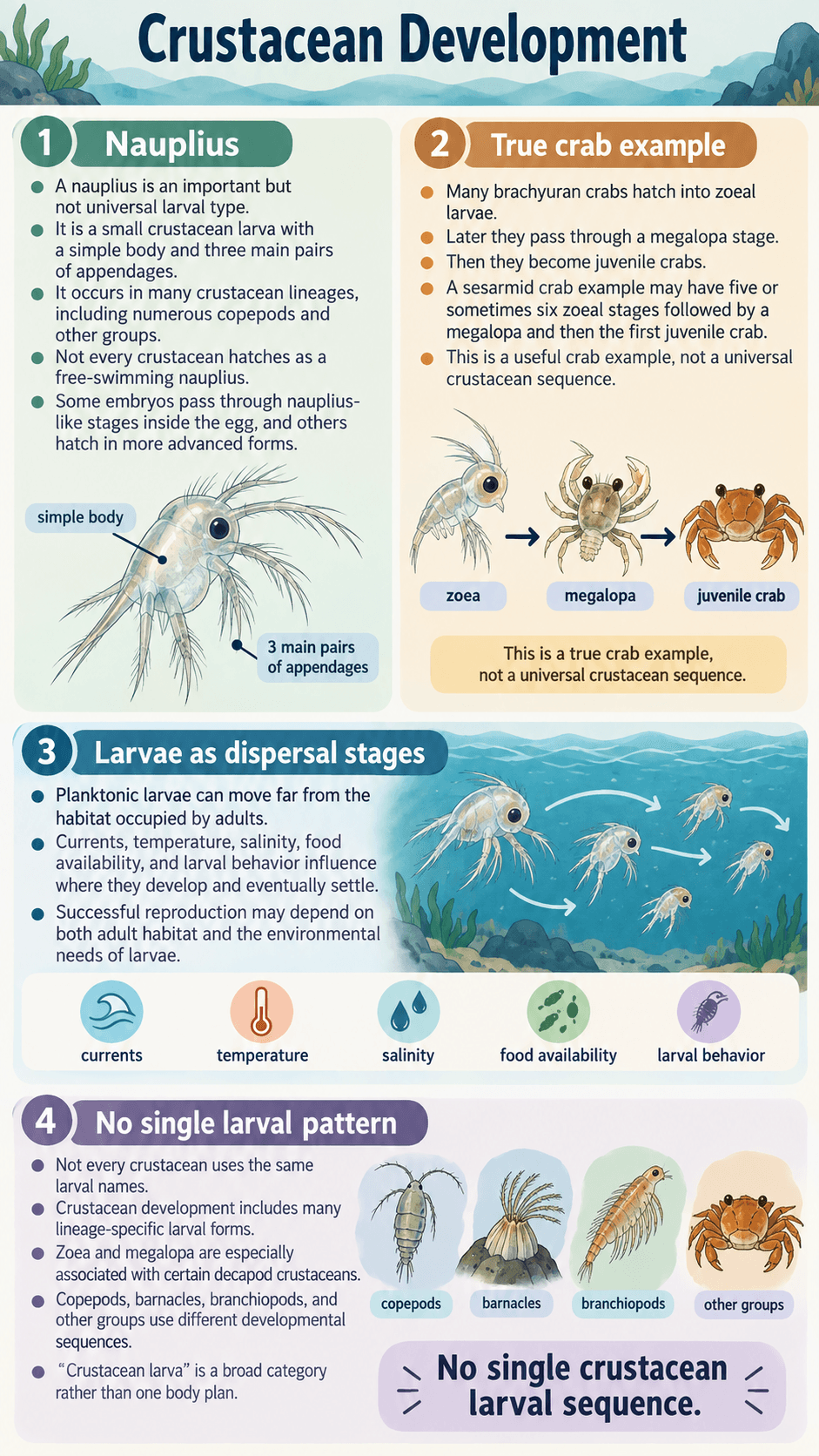
A nauplius is a small crustacean larva characterized by a simple body and three main pairs of appendages. It occurs in many crustacean lineages, including numerous copepods and other groups.
However, not every crustacean hatches as a free-swimming nauplius. Some embryos pass through nauplius-like stages inside the egg, and others hatch in more advanced forms.
Zoea and Megalopa Occur in Many True Crabs
Many brachyuran crabs hatch into zoeal larvae and later pass through a megalopa stage before becoming juvenile crabs.
A WoRMS-linked study of larval development in a sesarmid crab describes five or sometimes six zoeal stages followed by a megalopa and then the first juvenile crab.
This is a useful crab example, not a universal crustacean sequence.
Crustacean Larvae Can Be Major Dispersal Stages
Planktonic larvae can move far from the habitat occupied by adults. Currents, temperature, salinity, food availability, and larval behavior influence where they develop and eventually settle.
This creates a strong connection between reproduction and habitat. Successful reproduction may depend on both adult habitat and the environmental needs of larvae.
Not Every Crustacean Uses the Same Larval Names
Crustacean development includes many lineage-specific larval forms. Zoea and megalopa are especially associated with certain decapod crustaceans, while copepods, barnacles, branchiopods, and other groups use different developmental sequences.
The word crustacean larva therefore describes a broad category rather than one body plan.
Myriapod Development
Juvenile Segment and Leg Numbers Can Change
Some myriapods hatch with fewer trunk segments and legs than they will have as adults. Additional segments or leg-bearing units can appear across successive molts.
This pattern is common in many millipedes and occurs in some centipede lineages, but the developmental details are not identical across Myriapoda.
Other Myriapods Hatch With a More Complete Segment Pattern
Some centipedes hatch with the full adult number of leg-bearing segments already established. They still molt and grow, but they do not necessarily add new trunk segments in the same way as other myriapods.
This is why “myriapods add more legs after every molt” is too simple.
Parental Care in Arthropods
Spider Egg-Sac Guarding
Many female spiders protect eggs inside silk sacs. Some remain near the sac, carry it, move it, or defend it from disturbance.
Wolf spiders carry egg sacs and later transport newly hatched spiderlings. Other spiders guard egg sacs in webs, burrows, or retreats.
Scorpion Maternal Care
Scorpions carry live-born young on the back. The young remain there while their early cuticle develops and through the first molt.
This close association provides protection during a vulnerable developmental period.
Crustacean Egg Brooding
Many crustaceans protect embryos by carrying them. Female crabs and lobsters attach eggs beneath the abdomen, while amphipods and isopods can brood developing young in specialized chambers.
Brooding does not necessarily continue after hatching, but it is a substantial form of pre-hatching parental investment.
Selected Centipedes Guard Eggs
Parental care also occurs in myriapods. The Animal Diversity Web overview of centipedes notes that females of some species carefully brood their eggs.
In those species, guarding may reduce fungal attack, desiccation, or predation. The behavior is not universal across all centipedes.
Social Insects Take Brood Care Much Further
Ants, many bees, wasps, and termites can provide extensive cooperative care to eggs, larvae, or nymphs. Workers may feed, groom, move, defend, or regulate the environment around developing brood.
This highly organized social care is one extreme on a broad continuum of arthropod parental investment.
Common Reproduction Myths
All Arthropods Lay Eggs
No. Egg laying is common, but scorpions and several other arthropods give birth to live young.
All Arthropods Use External Fertilization
No. Internal sperm transfer is widespread. Spermatophores are used in groups such as scorpions and centipedes, while insects and spiders use their own forms of internal sperm transfer.
All Arthropods Undergo Metamorphosis
No. Dramatic metamorphosis is common in many insects and occurs in other forms in some crustaceans, but direct or relatively adult-like juvenile development also occurs widely.
Arthropods Show No Parental Care
No. Spiders can guard or carry eggs and young, scorpions carry newborns, crustaceans brood eggs, some centipedes guard clutches, and social insects may provide prolonged cooperative care.
How Reproduction Connects to Other Arthropod Biology
Development and Molting Are Connected but Different
Growing arthropods must molt, so reproduction and development naturally lead into molt cycles. However, ecdysis is the mechanism of cuticle replacement, not the reproductive process itself.
A juvenile can molt many times while remaining broadly similar in body form.
Development Depends on Habitat
Eggs and larvae can require environmental conditions different from those used by adults. Aquatic larvae may depend on salinity, oxygen, temperature, food, or currents, while terrestrial eggs may require humidity or shelter. Eggs, larvae, juveniles, and adults can have different habitat requirements, so one species may depend on several environments across its life cycle.
Reproductive success therefore depends on habitat at more than one life stage. Species with specialized breeding sites or vulnerable life stages can also face particular arthropod conservation challenges.
Parental Care Is One Strategy, Not a Requirement
Some arthropods produce many offspring with little or no post-laying care. Others invest heavily in smaller numbers of protected eggs or young.
Neither strategy is universally better. Each can be successful under different ecological conditions.
Comparing Reproductive Strategies Across Arthropods
| Example | Fertilization or sperm transfer | Development | Parental care example |
|---|---|---|---|
| Many insects | Internal sperm transfer | Nymphal or larval development depending on lineage | Ranges from none to extensive social brood care |
| Spiders | Male pedipalps transfer sperm | Spiderlings resemble small spiders and molt repeatedly | Egg-sac guarding or carrying; wolf spiders carry young |
| Scorpions | Spermatophore transfer | Live-born young | Young ride on mother’s back |
| Many decapod crustaceans | Internal or closely associated sperm transfer | Often larval; lineage-specific stages | Eggs commonly brooded beneath female abdomen |
| Centipedes | Spermatophore transfer in many groups | Juveniles broadly adult-like; segment patterns vary | Some females brood eggs |
| Millipedes | Internal sperm transfer | Juveniles may add segments and legs through molts | Care varies and is usually limited |
FAQ
Do Any Arthropods Give Live Birth?
Yes. Scorpions are a well-known example, and live-bearing reproduction also occurs in some insects, mites, and other arthropods.
Do All Arthropods Have Larvae?
No. Some arthropods hatch or are born as juveniles that already resemble small adults. Others have highly specialized larval stages. Developmental pathways vary greatly among lineages.
What Is a Spermatophore?
A spermatophore is a structure or packet containing sperm. It can be transferred directly or deposited and then picked up or positioned by the female. Scorpions and many centipedes use spermatophores.
Which Arthropods Care for Their Young?
Parental care occurs in multiple groups. Examples include spiders guarding egg sacs, wolf spiders carrying spiderlings, scorpions carrying newborns, crustaceans brooding eggs, some centipedes guarding clutches, and social insects caring for brood.
Final Thoughts
Arthropod reproduction cannot be summarized by one life cycle. Mating signals may be chemical, visual, vibrational, or tactile. Sperm may be transferred directly or through spermatophores. Eggs may be deposited, guarded, carried, or brooded, while some arthropods give birth to live young.
Development is equally varied. Spiderlings, tick larvae, crab zoeae, millipede juveniles, insect larvae, and newborn scorpions all represent different solutions to the problem of producing the next generation. Parental care ranges from none to prolonged guarding, carrying, brooding, or social care. That diversity is one more example of how the arthropod body plan supports many different ways of living and reproducing.

Ethan Walker is the founder and research editor of Animal Fact Central. He creates and reviews educational animal facts content using trusted wildlife, pet care, and science-based sources. His work focuses on making animal behavior, adaptations, habitats, and species facts clear, accurate, and engaging for everyday readers.
Read More Details About Ethan Walker: https://animalfactcentral.com/ethan-walker/