
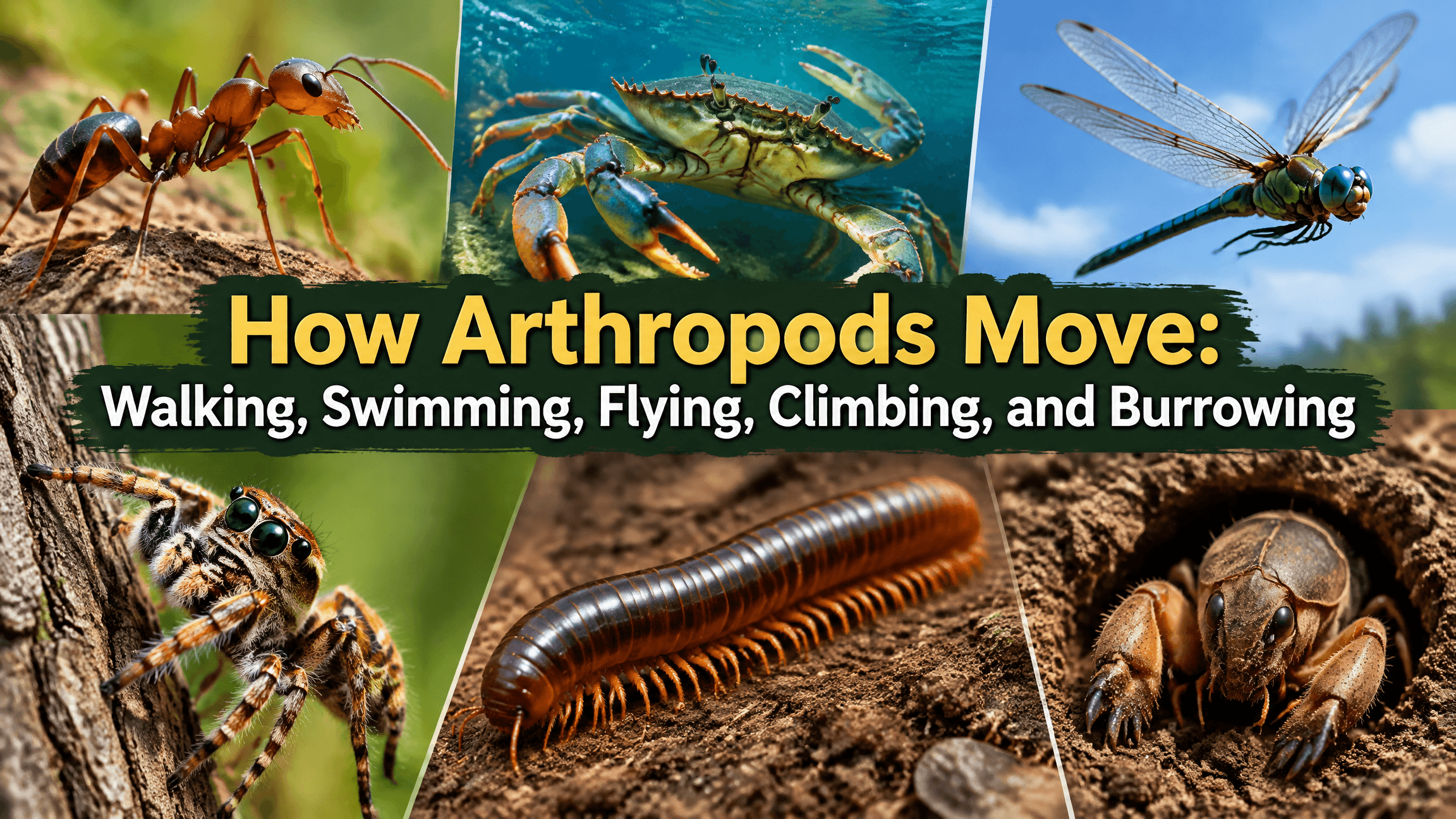
Arthropods move in an extraordinary variety of ways. They walk, run, jump, climb, burrow, row, swim, fly, drift, and sometimes use body waves or hydraulic pressure to help power particular movements. The shared foundation is a segmented body with jointed appendages, but different arthropod groups use that framework in very different ways.
An insect can coordinate six legs or beat wings through the air. A spider combines muscle action with internal fluid pressure at important leg joints. A crab may walk across the bottom and also use specialized appendages for swimming. A millipede coordinates many legs in traveling waves that push against the ground. These are not minor variations on one locomotor system. They are distinct solutions shaped by body plan, habitat, and evolutionary history.
Understanding arthropod movement therefore means looking at mechanics rather than simply counting legs. More legs do not automatically mean greater speed, wings do not make every insect a strong flier, and a crab is not limited to moving sideways. The most useful question is how anatomy and environment work together to create motion.
Quick Answer: How Do Arthropods Move?
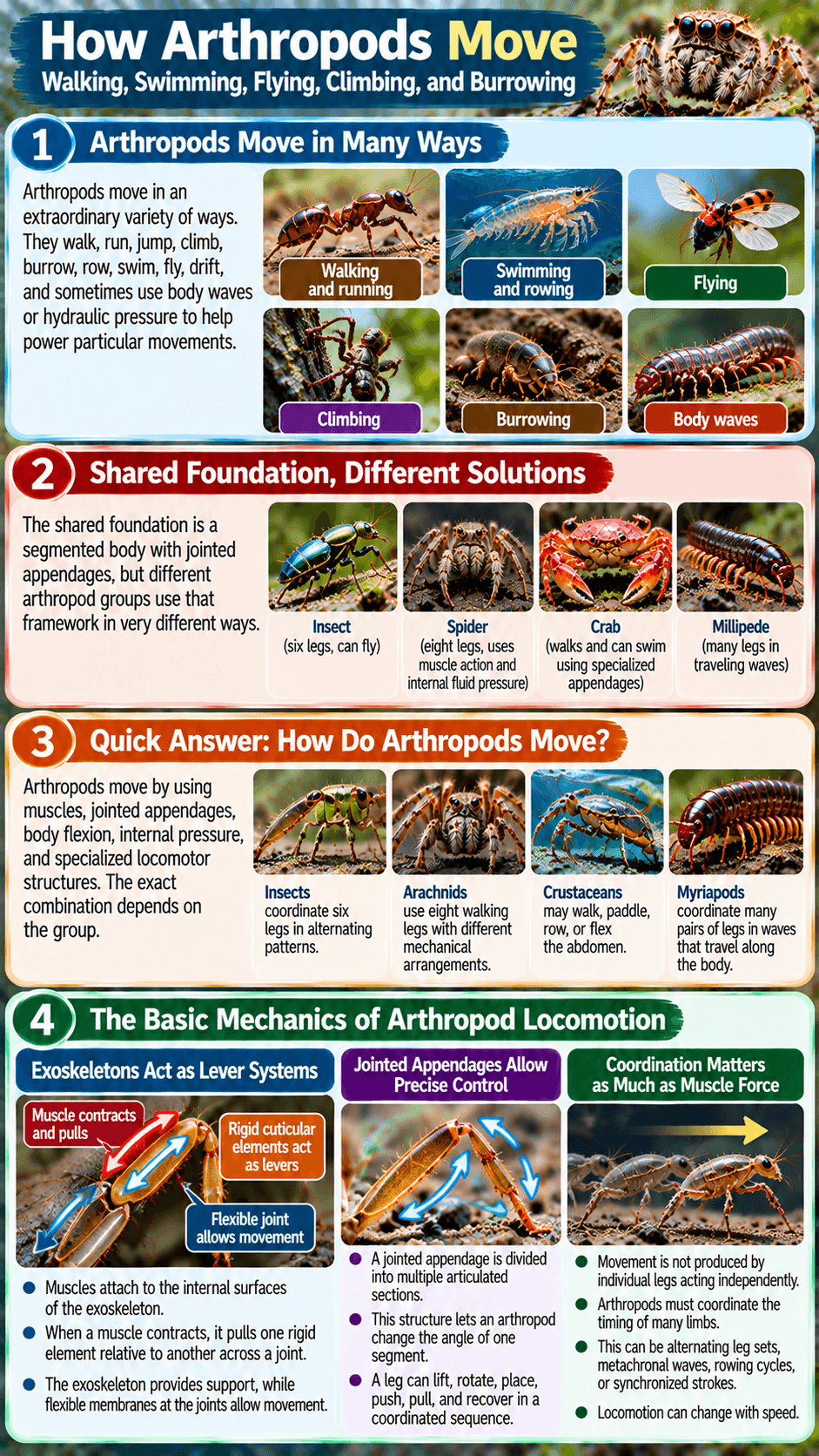
Arthropods move by using muscles, jointed appendages, body flexion, internal pressure, and specialized locomotor structures. The exact combination depends on the group. Walking insects commonly coordinate their six legs in alternating patterns. Arachnids use eight walking legs with different mechanical arrangements. Crustaceans may walk, paddle, row, or flex the abdomen. Myriapods coordinate many pairs of legs in waves that travel along the body. These movement systems are part of the broader diversity of arthropod body plans and adaptations.
Jointed appendages are especially important because they let an animal place force against the ground, water, vegetation, or another surface in controlled directions. Rigid cuticular sections act as levers, flexible joints permit movement, and muscles pull across those joints.
Some movements require additional mechanisms. Spider leg extension can depend partly on hydraulic pressure generated by hemolymph. Swimming crustaceans may use paddle-like limbs or rapid abdominal flexion. Insect flight uses wings attached to the thorax and a specialized flight-muscle system.
The Basic Mechanics of Arthropod Locomotion
Exoskeletons Act as Lever Systems
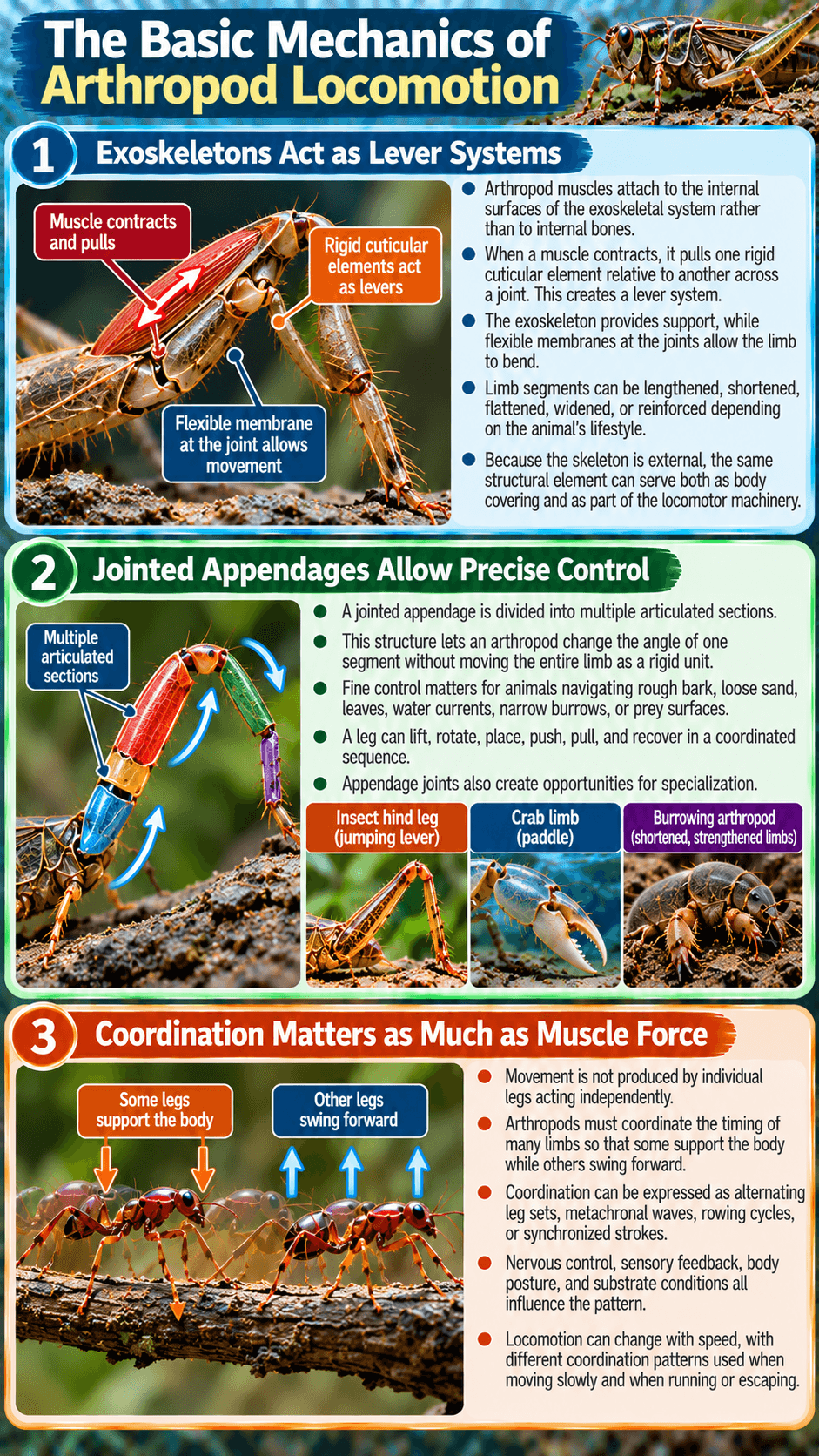
Arthropod muscles attach to the internal surfaces of the exoskeletal system rather than to internal bones. When a muscle contracts, it pulls one rigid cuticular element relative to another across a joint.
This creates a lever system. The exoskeleton provides support, while flexible membranes at the joints allow the limb to bend. Different limb segments can be lengthened, shortened, flattened, widened, or reinforced depending on whether the animal is adapted for jumping, digging, running, swimming, or grasping.
Because the skeleton is external, the same structural element can serve both as body covering and as part of the locomotor machinery.
Jointed Appendages Allow Precise Control
A jointed appendage is divided into multiple articulated sections. That structure lets an arthropod change the angle of one segment without moving the entire limb as a rigid unit.
Fine control matters for animals navigating rough bark, loose sand, leaves, water currents, narrow burrows, or prey surfaces. A leg can lift, rotate, place, push, pull, and recover in a coordinated sequence.
Appendage joints also create opportunities for specialization. An insect hind leg can become a jumping lever, a crab limb can become a paddle, and a burrowing arthropod can evolve shortened, strengthened limbs for pushing against soil.
Coordination Matters as Much as Muscle Force
Movement is not produced by individual legs acting independently. Arthropods must coordinate the timing of many limbs so that some support the body while others swing forward.
That coordination can be expressed as alternating leg sets, metachronal waves, rowing cycles, or synchronized strokes. Nervous control, sensory feedback, body posture, and substrate conditions all influence the pattern.
This is why locomotion can change with speed. An arthropod may use one coordination pattern while moving slowly and another when running or escaping.
How Insects Walk and Run
Six Legs Create Flexible Support Patterns
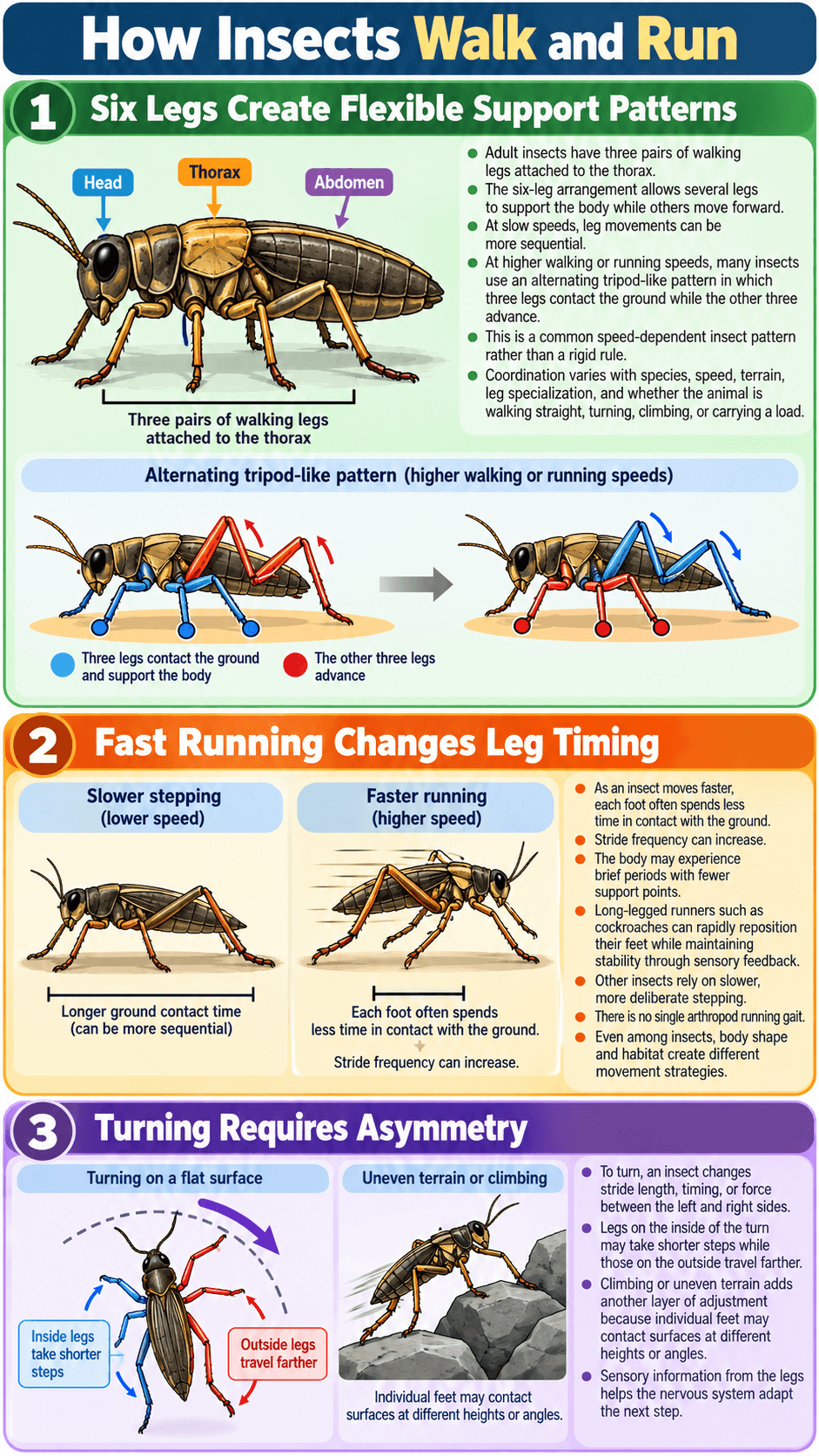
Adult insects have three pairs of walking legs attached to the thorax. The six-leg arrangement allows several legs to support the body while others move forward.
At slow speeds, leg movements can be more sequential. At higher walking or running speeds, many insects use an alternating tripod-like pattern in which three legs contact the ground while the other three advance. Comparative invertebrate locomotor research from UC Berkeley describes this as a common speed-dependent insect pattern rather than a rigid rule.
This coordination varies with species, speed, terrain, leg specialization, and whether the animal is walking straight, turning, climbing, or carrying a load.
Fast Running Changes Leg Timing
As an insect moves faster, each foot often spends less time in contact with the ground. Stride frequency can increase, and the body may experience brief periods with fewer support points.
Long-legged runners such as cockroaches can rapidly reposition their feet while maintaining stability through sensory feedback. Other insects rely on slower, more deliberate stepping.
There is no single arthropod running gait. Even among insects, body shape and habitat create different movement strategies.
Turning Requires Asymmetry
To turn, an insect changes stride length, timing, or force between the left and right sides. Legs on the inside of the turn may take shorter steps while those on the outside travel farther.
Climbing or uneven terrain adds another layer of adjustment because individual feet may contact surfaces at different heights or angles. Sensory information from the legs helps the nervous system adapt the next step.
Jumping and Powerful Leg Specialization
Enlarged Hind Legs Can Store and Release Energy
Grasshoppers, fleas, and many other jumping arthropods use specialized legs to generate rapid takeoff. Jumping can involve direct muscle force, elastic energy storage, or a combination of both.
In grasshoppers, the enlarged hind legs act as long levers. Energy can be stored in elastic structures and then released rapidly, producing acceleration greater than muscle contraction alone could provide over the same brief interval.
Jumping Is Not the Same Across All Arthropods
Springtails, jumping spiders, fleas, grasshoppers, and crustaceans can all make rapid jumps, but their mechanisms differ. A springtail may use a forked abdominal structure called a furcula. A jumping spider powers a leap with its legs and carefully controls body orientation.
Grouping all these movements under the word “jumping” is useful behaviorally, but it does not mean the anatomical mechanisms are homologous.
How Spiders Walk

Spider Legs Combine Muscles and Hydraulic Mechanics
Spider locomotion is often summarized by saying spiders use blood pressure instead of muscles to extend their legs. That is too simple. Muscles are essential to spider locomotion, but internal hemolymph pressure contributes importantly to extension at key joints.
Classic experimental work in The Biological Bulletin on spider leg extension showed that extension is closely associated with changes in internal fluid pressure within the legs. Modern descriptions treat spider walking as a coordinated interaction among flexor muscles, joint-specific extensor mechanisms, joint structure, and hydraulic pressure.
The result is a locomotor system that is neither purely muscular nor purely hydraulic.
Why Spider Legs Curl After Death
When a spider dies, active control of internal pressure stops. Flexor muscles and passive mechanical properties then tend to draw many leg joints inward, producing the familiar curled posture.
This observation helped inspire early research into hydraulic extension, but the curled posture should not be used to claim that spiders lack useful muscles for leg movement. Flexion is strongly muscular, and the mechanics differ among joints.
Eight Legs Provide Stability and Maneuverability
Spiders coordinate eight walking legs rather than the six found in insects. Different legs can take on different roles during acceleration, braking, turning, climbing, or prey handling.
The feet also interact with the substrate through claws, hairs, and in some lineages dense adhesive structures called scopulae. These features help spiders move across bark, rock, leaves, web silk, and in some cases smooth surfaces.
How Arthropods Climb
Claws Grip Rough Surfaces
Many arthropods have terminal claws that catch microscopic irregularities in bark, stone, leaves, or other rough surfaces. On a textured surface, mechanical interlocking can provide strong grip without any sticky secretion.
The effectiveness of a claw depends on its shape, the scale of the surface texture, body weight, leg angle, and how forces are distributed across multiple limbs.
Adhesive Pads Help on Smooth Surfaces
Some insects and spiders have specialized adhesive hairs or pads that improve attachment to relatively smooth surfaces. These structures can create close contact with the surface and use combinations of physical forces and secretions.
Different lineages have evolved adhesive systems independently, so a fly foot and a spider scopula should not be treated as the same anatomical structure.
Climbing Requires Constant Weight Redistribution
On a vertical surface, gravity pulls the animal away from stable horizontal support. Arthropods compensate by keeping enough attachment points engaged while other limbs reposition.
Body posture also matters. Holding the body close to the surface can reduce the torque that tends to peel the animal away.
How Insects Fly
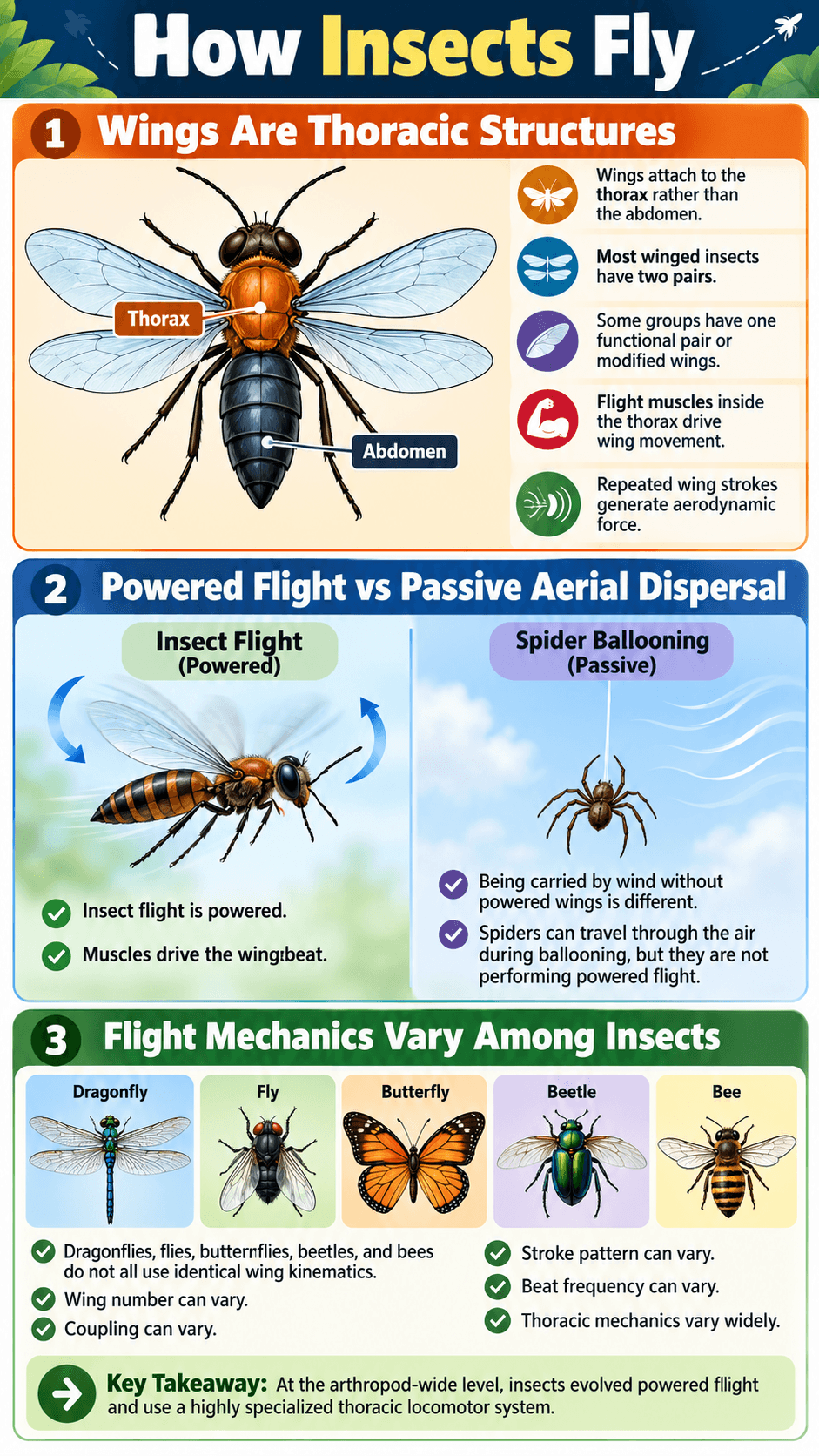
Wings Are Thoracic Structures
In living insects, wings attach to the thorax rather than the abdomen. Most winged insects have two pairs, although some groups have one functional pair or modified wings.
Flight muscles inside the thorax deform the thoracic structure or act more directly on wing bases depending on the insect lineage. This creates repeated wing strokes that generate aerodynamic force.
Powered Flight Is Different From Passive Aerial Dispersal
Insect flight is powered because muscles drive the wingbeat. That differs from an arthropod being carried by wind without powered wings.
This distinction is important when comparing insects with spiders. Spiders can travel through the air during ballooning, but they are not performing powered flight.
Flight Mechanics Vary Among Insects
Dragonflies, flies, butterflies, beetles, and bees do not all use identical wing kinematics. Wing number, coupling, stroke pattern, beat frequency, and thoracic mechanics vary widely.
A detailed explanation of insect wing mechanics belongs within insect biology rather than a broad arthropod locomotion comparison. At the arthropod-wide level, the important fact is that insects evolved powered flight and use a highly specialized thoracic locomotor system.
Spider Ballooning Is Not Powered Flight
What Ballooning Is
Some spiders disperse by releasing silk threads into moving air. Aerodynamic forces can lift or pull the spider away from its starting point and carry it through the atmosphere.
The spider can control parts of the launch process, such as posture and silk release, but the airborne movement is not powered by flapping wings.
Why the Distinction Matters
Calling ballooning flight without qualification can make it sound mechanically equivalent to insect flight. It is better described as aerial dispersal using silk and environmental forces.
Ballooning also varies with spider size, behavior, weather, electric conditions, and local airflow, so it should not be described as a single fixed process used by every spider.
How Crustaceans Walk
Walking Legs Work on the Bottom and on Land
Many crustaceans use thoracic appendages to walk across seafloors, stream beds, vegetation, rocks, or terrestrial surfaces. Decapod crustaceans such as crabs and lobsters use five pairs of thoracic walking appendages in the basic body plan, although some may be modified into claws.
Joint angles, limb orientation, substrate, and body shape influence the direction of movement. A crab’s broad body can favor lateral locomotion, but that does not mean every crab can move only sideways.
Crabs Are Not Restricted to Sideways Motion
Many true crabs are efficient lateral walkers because their leg joints and body form make sideways movement mechanically effective. However, crabs can also move forward, backward, diagonally, or turn depending on species and circumstances.
Other crustaceans, including lobsters, crayfish, amphipods, and isopods, show very different walking patterns.
How Crustaceans Swim
Swimming Appendages Can Act Like Paddles
Crustaceans may use specialized appendages to push against water. Shrimp, krill, copepods, amphipods, and other forms rely on different combinations of thoracic or abdominal limbs.
Repeated strokes create thrust, while recovery strokes are often arranged to reduce drag. In animals with many swimming appendages, the limbs may beat in coordinated waves rather than simultaneously.
Tail-Flip Escape Responses
Many shrimp, crayfish, and lobsters can rapidly flex the abdomen to accelerate backward through the water. This escape response uses powerful abdominal muscles and the broad tail fan to displace water.
The movement is mechanically different from steady swimming. It produces a short burst of acceleration useful for escaping a sudden threat.
Some Crabs Are Specialized Swimmers
Swimming crabs have flattened, paddle-like rear legs that generate thrust in water. This modification shows how a walking appendage can become specialized for a different locomotor role.
Other crabs lack these paddles and spend much more of their time walking along the substrate.
How Copepods and Small Crustaceans Move
Small Bodies Change the Physics
Tiny aquatic arthropods experience water differently from large animals. Viscous forces become especially important at small scales, and short appendage strokes can produce rapid changes in position.
Copepods use antennal and thoracic appendages for swimming, feeding currents, or escape movements depending on species and life stage.
Escape Jumps Can Be Extremely Rapid
Many copepods respond to disturbances with sudden jumps powered by rapid appendage strokes. These movements help them evade predators or reposition in the water.
Because performance varies enormously among species and experimental conditions, broad claims about the fastest copepod or strongest jump are not useful without a defined measurement method.
How Centipedes Move
Legs Move in Coordinated Waves
Centipedes have many walking legs distributed along the trunk. Those legs do not all step at once. Instead, timing differences create waves of limb movement that travel along the body.
The UC Berkeley comparative locomotion reference describes different metachronal wave directions and support patterns among centipede groups. Some fast-running forms reduce the number of legs contacting the ground at one time, while others use longer legs and different timing to avoid interference.
Body Flexion Can Contribute to Fast Movement
In some centipedes, the trunk bends laterally as the animal runs. Body undulation works together with leg motion, especially at higher speeds.
The exact wave direction and gait pattern can differ among centipede lineages, which is why a single centipede gait should not be applied to the entire class.
How Millipedes Move
Metachronal Waves Coordinate Many Legs
Millipedes typically move their numerous legs in metachronal waves. A metachronal gait means neighboring legs perform similar movements with a slight timing offset, creating a visible traveling wave along the body.
Research summarized by the University of Minnesota on millipede locomotion describes these traveling waves as a way to regulate thrust during walking, climbing, and burrowing.
This coordination allows many small legs to contribute force without all pushing and recovering at the same moment.
More Legs Do Not Automatically Mean More Speed
Millipedes have many more legs than insects, but most are not exceptionally fast runners. Their locomotor system is well suited to producing steady force and navigating litter, soil spaces, decaying wood, and other resistant substrates.
Speed depends on stride length, timing, limb length, body flexibility, substrate, and muscle performance, not simply the total number of legs.
Burrowing Through Soil, Sand, and Sediment
Burrowing Requires Force Against a Resistant Medium
Moving through soil or sediment is mechanically different from walking over a hard surface. The animal must push particles aside, compress material, exploit existing spaces, or loosen the substrate.
Short strong legs, narrow body shapes, reinforced head regions, or coordinated body waves can all improve burrowing performance.
Millipedes Use Many Legs to Generate Thrust
Millipede locomotion research shows that coordinated metachronal waves can generate substantial thrust. Many small contact points allow the animal to push against irregular substrate while moving the body forward.
This does not mean all millipedes are dedicated burrowers. Some are surface-active in litter or on vegetation, while others spend much more time within soil or decaying material.
Crustaceans and Insects Use Different Digging Tools
Burrowing crustaceans may use claws, walking legs, abdominal movements, or body rotation. Insects can modify forelegs into broad digging structures, as seen in mole crickets and some beetles.
Similar behavior can therefore emerge from very different anatomical modifications.
Movement Across Water Surfaces
Surface Tension Can Support Small Arthropods
Small body mass and water-repellent leg surfaces allow some insects and spiders to move across water without immediately breaking through the surface film.
Long legs distribute weight, while hydrophobic hairs help keep the limbs from wetting. The animal can then row, skate, jump, or use surface vibrations.
Surface Locomotion Is Not Swimming
A water strider moving across the surface is supported by surface tension rather than suspended within the water column. That is mechanically different from a shrimp swimming below the surface.
Both use appendages to generate thrust, but the physical environment and force balance are different.
Movement Changes With Habitat
Open Ground Favors Different Mechanics From Vegetation
An arthropod running across open ground benefits from rapid stride cycling and stability. An animal moving through vegetation may need greater joint range, grip, and careful placement.
Long legs can improve stride length but may interfere with neighboring limbs in a many-legged animal. Shorter limbs can provide better leverage in narrow spaces.
Water Changes Drag and Buoyancy
Aquatic arthropods move in a dense medium that both supports body weight and resists motion. Flattened paddles, streamlined bodies, coordinated rowing, and flexible abdominal movements can improve locomotion.
These mechanics differ from terrestrial running, where gravity and contact forces dominate and drag from the surrounding air is usually much smaller. Movement strategies also reflect where arthropods live, because water, soil, vegetation, air, and exposed surfaces create different mechanical challenges.
Burrows and Crevices Reward Compact Movement
In confined spaces, large sweeping limbs become a disadvantage. Burrowing arthropods often use shortened appendages, elongated bodies, strong pushing motions, or coordinated waves to move where turning room is limited.
Locomotion therefore cannot be separated from habitat. The same leg design that works well in open space may perform poorly underground or underwater.
Common Arthropod Movement Myths
Spiders Walk Only by Hydraulic Pressure
No. Hydraulic pressure contributes importantly to extension at particular spider leg joints, but locomotion also depends on muscles, joint geometry, sensory feedback, and coordinated leg movements.
Crabs Can Only Walk Sideways
No. Lateral movement is common and efficient in many crabs, but species can also move forward, backward, diagonally, or turn. Other crustaceans use entirely different walking patterns.
More Legs Mean a Faster Animal
No. Speed depends on stride length, limb timing, body mechanics, muscle power, substrate, and behavior. Millipedes can have many legs yet move relatively slowly while producing strong coordinated thrust.
Spider Ballooning Is Powered Flight
No. Ballooning is aerial dispersal using silk and environmental forces. The spider does not generate lift by flapping powered wings.
All Arthropods Use the Same Gait
No. Arthropods use many coordination patterns, and even one species can change gait with speed, terrain, or behavior.
Comparing Arthropod Locomotion
| Example | Main locomotor method | Key structures | Important caution |
|---|---|---|---|
| Walking insect | Alternating coordinated leg movements | Three pairs of thoracic legs | Tripod-like patterns are common but not universal |
| Flying insect | Powered wingbeats | Thoracic wings and flight muscles | Not every insect flies |
| Spider | Eight-legged walking with muscle and hydraulic contributions | Jointed legs, flexor muscles, hemolymph pressure | Not purely hydraulic |
| Swimming crustacean | Paddling, rowing, or abdominal propulsion | Specialized appendages, abdomen, tail fan | Mechanics vary greatly among lineages |
| Centipede | Coordinated leg waves plus body motion | Many trunk legs | Gait patterns differ among groups |
| Millipede | Metachronal traveling waves | Numerous short trunk legs | Many legs do not imply high speed |
FAQ
How Do Arthropods Walk With So Many Different Numbers of Legs?
They coordinate limb timing so that some legs support and push the body while others move forward. Insects can use alternating sets of three legs, spiders coordinate eight legs, and myriapods often use traveling waves across many pairs. The pattern depends on anatomy, speed, and substrate.
Do Spiders Really Use Hydraulic Pressure to Walk?
Hydraulic pressure is an important part of spider leg extension, especially at joints where muscular extension is limited, but spider locomotion is not purely hydraulic. Muscles flex joints, other joints have different mechanical arrangements, and the entire animal depends on coordinated nervous control and sensory feedback.
Why Do Millipede Legs Look Like Waves?
Neighboring legs move with slight timing offsets. This produces a metachronal wave that travels along the body. The wave allows many legs to generate continuous thrust while different feet alternate between pushing and recovery.
Can Arthropods Fly Without Wings?
They can become airborne without powered wings, but that is not true powered flight. Ballooning spiders use silk and air movement for aerial dispersal, while tiny arthropods may also be carried passively by wind. Powered flight in living arthropods is an insect specialization.
Final Thoughts
Arthropod movement is built on the shared advantages of segmentation and jointed appendages, but the mechanics vary dramatically among groups. Insects coordinate six legs and, in winged lineages, power flight from the thorax. Spiders combine muscular action with hydraulic contributions to leg extension. Crustaceans walk, paddle, row, or flex the abdomen. Centipedes and millipedes coordinate many legs in traveling waves.
Those differences show why locomotion is best understood as a match between anatomy and environment. A fast runner, climbing spider, swimming crab, burrowing millipede, and flying insect each use the arthropod body plan differently. Movement is not determined by leg count alone. It emerges from limb design, joint mechanics, muscle force, fluid pressure, coordination, and the physical world the animal must move through.

Ethan Walker is the founder and research editor of Animal Fact Central. He creates and reviews educational animal facts content using trusted wildlife, pet care, and science-based sources. His work focuses on making animal behavior, adaptations, habitats, and species facts clear, accurate, and engaging for everyday readers.
Read More Details About Ethan Walker: https://animalfactcentral.com/ethan-walker/