
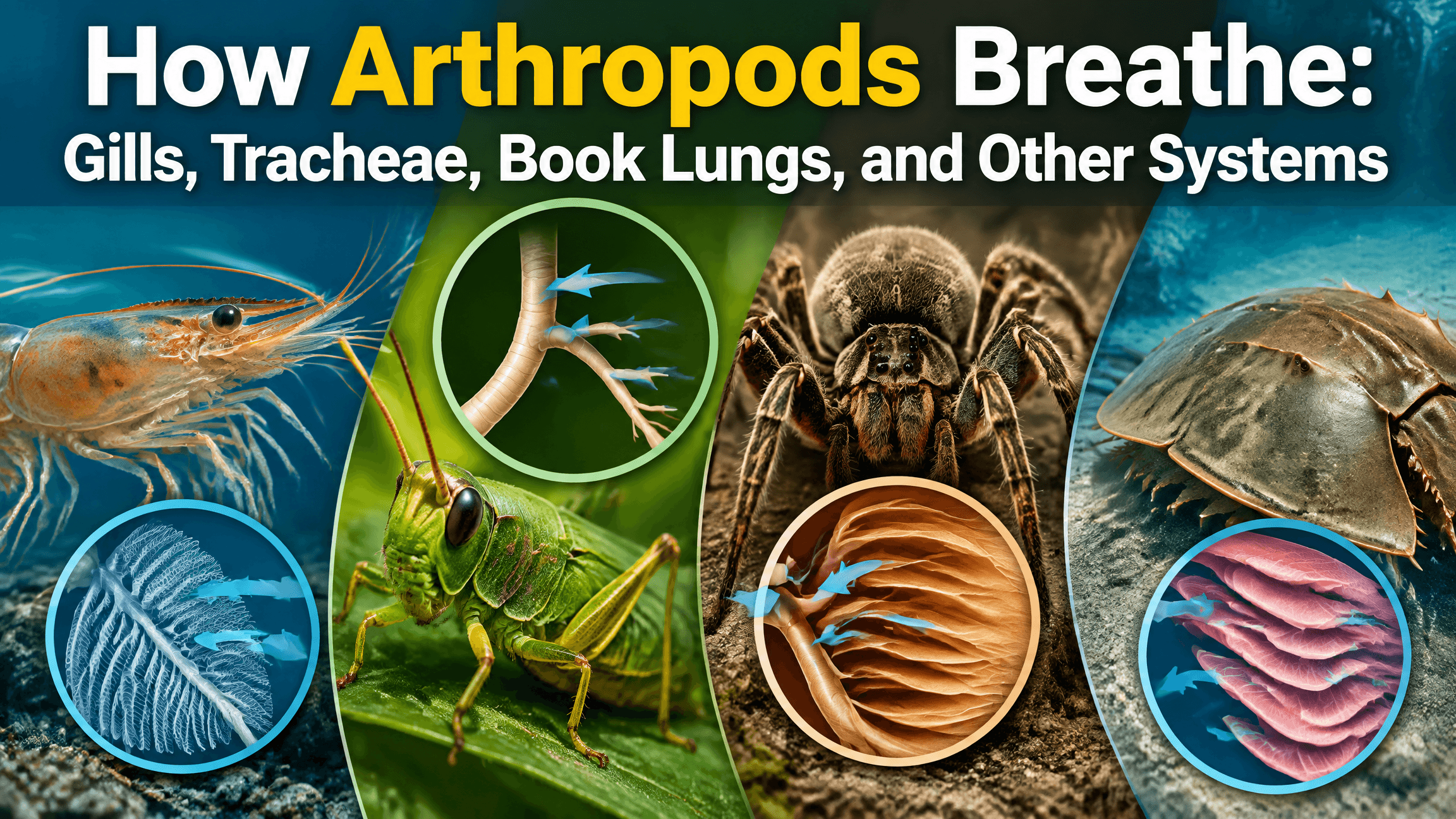
Arthropods do not all breathe the same way. Across the phylum, oxygen can enter the body through gills, tracheal tubes, book lungs, book gills, or relatively thin body surfaces. Which system an animal uses depends on its evolutionary lineage, habitat, body size, and way of life.
Terrestrial insects and myriapods commonly use tracheal systems that carry air through branching tubes. Many crustaceans exchange gases with water using gills or other thin respiratory surfaces. Arachnids are especially varied: some use book lungs, some use tracheae, and some combine both. Horseshoe crabs use book gills rather than book lungs.
This diversity is important because several common shortcuts are wrong. Not all arthropods breathe through spiracles, not all crustaceans rely on the same kind of gill, not all spiders depend only on book lungs, and oxygen is not always transported mainly by hemolymph. Arthropod respiration is best understood as a set of different solutions to the same problem: moving oxygen in and carbon dioxide out.
Quick Answer: How Do Arthropods Breathe?

Arthropods exchange gases through specialized respiratory surfaces or tubes. The Smithsonian overview of arthropod body functions notes that arthropod appendages can be specialized for respiration in the form of gills, tracheae, and book lungs. Different lineages emphasize different systems. These respiratory differences are part of the wider adaptive diversity found among arthropods.
In a tracheal system, air enters through external openings and passes through tubes that branch toward the tissues. In gill-based systems, oxygen dissolved in water crosses thin respiratory surfaces. Book lungs contain stacked internal lamellae where air contacts respiratory tissue, while book gills use stacked leaflike plates exposed to water.
Some small or specialized arthropods also exchange gases across body surfaces. The relative importance of hemolymph differs among groups. In many insects, tracheae deliver oxygen directly to tissues, whereas hemolymph plays a larger respiratory role in many crustaceans and chelicerates.
Why Arthropods Need Different Respiratory Systems

Air and Water Present Different Challenges
Oxygen is available in both air and water, but extracting it poses different physical challenges. Water is denser and more viscous than air, and dissolved oxygen is much less abundant than oxygen in air. Aquatic animals therefore need effective ways to move water across large, thin exchange surfaces.
On land, the problem changes. Air contains much more oxygen, but exposed respiratory surfaces can lose water rapidly. Terrestrial arthropods therefore benefit from respiratory systems that bring air inward while reducing the amount of delicate exchange surface directly exposed to the environment.
Body Size and Activity Matter
A tiny arthropod has a different respiratory problem from a large, active one. Small animals have a high surface-area-to-volume ratio and may be able to rely more heavily on diffusion across short distances. Larger or highly active arthropods need more organized systems for moving gases.
Activity also changes demand. Flight, rapid running, burrowing, swimming, and sustained feeding can raise oxygen requirements. Respiratory structures and ventilation behavior have evolved in ways that match the animal’s typical activity and environment. Oxygen demand also changes with activity, linking respiration with arthropod locomotion.
Evolutionary History Constrains the Options
Respiratory organs do not arise from scratch each time a lineage enters a new habitat. Evolution modifies structures inherited from ancestors. That is why closely related arthropods often share a general respiratory design even when the details differ.
Chelicerates, for example, include forms with book gills, book lungs, and tracheae. Crustaceans show great diversity in gill placement and structure. Hexapods and myriapods commonly use tracheal systems, but the anatomy of those systems is not identical across every lineage.
Tracheal Systems: Air Tubes That Reach the Tissues

What Tracheae and Tracheoles Are
A tracheal system is a branching network of air-filled tubes. Larger tubes called tracheae divide into progressively finer branches, and the smallest branches bring gases close to cells and tissues.
Because oxygen can diffuse from these tubes toward tissues, the circulatory system does not need to carry most of the oxygen in the same way vertebrate blood does. This is one of the major physiological differences between many insects and animals that depend heavily on blood-borne oxygen transport.
What Spiracles Do
Spiracles are external openings that connect the outside environment with a tracheal system. In many insects, valves can regulate these openings, helping balance gas exchange against water loss.
Spiracles are not universal arthropod structures. Aquatic crustaceans do not all have insect-like spiracles, and chelicerates can use book lungs, tracheae, or other respiratory organs. Even among myriapods, spiracle control and tracheal architecture can differ from the insect pattern.
Diffusion and Ventilation Work Together
At small scales, diffusion moves oxygen down concentration gradients. Larger or more active insects can supplement diffusion with body movements that ventilate larger tracheal tubes and air sacs.
Abdominal pumping, thoracic movements, or changes in internal pressure can move air through the system. The importance of active ventilation varies with species, size, activity, and temperature.
How Insects Breathe

Most Terrestrial Insects Use Tracheae and Spiracles
Most terrestrial insects exchange gases through tracheae connected to spiracles. Air passes inward through the tube network, and oxygen travels toward tissues without first having to be loaded onto a respiratory pigment in the hemolymph. Respiratory design is one reason arthropod habitats differ so strongly among aquatic and terrestrial lineages.
This direct-delivery system helps explain why insect hemolymph usually does not function like vertebrate blood for oxygen transport. Hemolymph still performs many essential jobs, including moving nutrients, hormones, immune components, and metabolic products.
Insect Hemolymph Usually Is Not the Main Oxygen Carrier
It is inaccurate to say insects have “no blood.” They have hemolymph. The difference is that, in most insects, oxygen delivery is handled primarily by the tracheal system rather than by hemolymph circulation.
This also makes the phrase “arthropod blood is blue” unreliable. Many insects do not use hemocyanin as their main respiratory transport system, and the appearance of hemolymph varies.
Aquatic Insect Larvae Use Several Strategies
Aquatic insect larvae do not all breathe the same way. Some use tracheal gills, which are thin body outgrowths supplied by the tracheal system. Others obtain air at the water surface through breathing tubes or specialized body structures. Some can use air stores or plastron-like systems associated with the body surface.
The oxygen still ultimately reaches the insect’s tracheal system, but the route from the environment differs. This is why “insects breathe through spiracles in air” is incomplete when aquatic life stages are considered.
Why Spiracle Control Helps on Land
Opening respiratory passages creates a tradeoff. Gas exchange requires contact with outside air, but open pathways can increase water loss. Many insects reduce that cost by controlling when and how widely spiracles open.
This does not eliminate water loss, and different insects use different patterns. Habitat, body size, activity, temperature, and humidity all affect the balance between oxygen demand and water conservation.
How Myriapods Breathe
Centipedes and Millipedes Commonly Use Tracheal Systems
Centipedes and millipedes generally rely on tracheal respiration. Openings along the body connect to internal air tubes that distribute gases to tissues.
The arrangement differs from insect anatomy because myriapods have elongated trunks with repeated body units. Their respiratory openings therefore occur along much more of the body rather than being organized around an insect-style thorax and abdomen.
Myriapod Spiracles Are Not Simply Insect Spiracles Repeated
Millipedes provide an important caution. The University of California, Riverside discussion of millipede anatomy notes that spiracles lead into tracheae but describes an absence of the same closing mechanism found in insect spiracles in the millipedes discussed there.
This matters for water balance. Open respiratory passages can contribute to moisture loss, which helps explain why many myriapods are strongly associated with humid soil, litter, rotting wood, or other protected microhabitats.
Tracheal Systems and Humid Microhabitats
Myriapods are terrestrial, but many are not well suited to dry exposed surfaces. Their respiratory system, cuticle, body size, and behavior interact with environmental humidity.
Hiding under logs, stones, bark, leaf litter, or within soil helps keep the surrounding air more humid. This reduces evaporative stress while still allowing gas exchange.
Book Lungs in Arachnids
What a Book Lung Is
A book lung is an internal respiratory chamber containing many thin, stacked lamellae. The arrangement resembles pages in a book, which gives the organ its name.
Air enters the chamber through an opening in the body wall, and gases diffuse across the thin surfaces. Hemolymph circulates on the opposite side of the exchange tissue, allowing oxygen to enter the circulatory system.
Scorpions Use Book Lungs
Scorpions are a clear example of terrestrial chelicerates that depend on book lungs. Their respiratory organs open on the underside of the body and contain stacked exchange surfaces.
Book lungs fit a terrestrial lifestyle because the respiratory lamellae are internal rather than exposed directly to drying air. They provide a large gas-exchange area while remaining sheltered inside the body.
Not All Spiders Rely on the Same Combination
Spiders vary. Some have two pairs of book lungs, while many have a combination of book lungs and tracheae, and some rely more strongly on tracheal systems.
The University of Michigan Animal Diversity Web overview of Chelicerata summarizes chelicerate respiration as involving book gills, book lungs, or tracheae. That range is why the statement “all spiders breathe with book lungs” is too broad.
Tracheae in Arachnids
Some Spiders Combine Book Lungs and Tracheae
In spiders that possess both systems, book lungs and tracheae can divide respiratory work. Tracheal tubes can bring air closer to tissues, while book lungs exchange gases with hemolymph.
The balance varies among spider lineages. Differences in body size, activity, habitat, and evolutionary history may influence how important each respiratory organ becomes.
Ticks and Mites Show Additional Variation
Ticks and mites are extremely diverse arachnids. Some use tracheal systems with external openings, while very small forms may rely more strongly on gas exchange across the body surface.
Because mites span an enormous range of body sizes and habitats, there is no single respiratory description that fits all of them. Statements about “arachnid breathing” therefore need more caution than statements about a specific lineage.
Book Gills in Horseshoe Crabs
How Book Gills Differ From Book Lungs
Book gills and book lungs share a stacked, lamellar appearance, but they operate in different environments. Book gills are exposed to water, while book lungs are internal air-breathing organs.
Horseshoe crabs use book gills on appendages beneath the posterior body. Water moving across the lamellae allows dissolved oxygen to diffuse inward.
Why Horseshoe Crabs Are a Useful Comparison
Horseshoe crabs are chelicerates, so comparing them with arachnids shows how related lineages can use structurally related respiratory solutions in aquatic and terrestrial settings.
The Smithsonian identifies horseshoe crabs within Chelicerata and describes arthropods as using multiple respiratory structures, including gills, tracheae, and book lungs. This helps place book gills within a broader chelicerate context rather than treating them as a crustacean feature.
Gills in Crustaceans

Most Familiar Aquatic Crustaceans Use Gills or Other Aquatic Exchange Surfaces
Many aquatic crustaceans exchange gases using gills. These are thin, well-supplied surfaces over which water passes, allowing oxygen to diffuse into hemolymph and carbon dioxide to move outward.
Gill form and position vary enormously. In some crustaceans, gills are associated with appendages. In decapods, gills often lie within branchial chambers under the carapace. Smaller crustaceans may rely more heavily on body surfaces or specialized regions.
Ventilating the Gills
Gas exchange works best when fresh water moves across respiratory surfaces. Crustaceans can generate water flow using appendages or other movements associated with the branchial chamber.
The specific mechanism depends on body plan. A crab ventilates its gills differently from a tiny copepod or a barnacle. “Crustaceans pump water over gills” is therefore a useful generalization only when paired with recognition of substantial diversity.
Not All Crustaceans Have the Same Gill Design
Crustaceans occupy marine, freshwater, terrestrial, intertidal, and semiterrestrial environments. Their respiratory structures reflect that diversity.
The Smithsonian notes generally that arthropod appendages can become respiratory structures such as gills, while crustacean morphology shows repeated modification of appendages and body surfaces. There is no single gill shape or number that defines Crustacea. The placement and structure of respiratory organs are closely connected with arthropod anatomy.
How Terrestrial Crustaceans Breathe
Woodlice Are Crustaceans That Live on Land
Woodlice, including pillbugs and sowbugs, are terrestrial isopod crustaceans. They do not become insects simply because they live on land.
Their respiratory surfaces are derived from abdominal appendages called pleopods. Different isopod lineages show varying degrees of specialization for gas exchange in air.
Why Moisture Still Matters
Terrestrial isopods remain strongly associated with humid microhabitats because their respiratory surfaces and water balance impose limits on life in dry air.
They are often found under logs, stones, leaf litter, bark, or other objects that help retain humidity. This is a good example of an aquatic ancestry being modified for terrestrial life without copying an insect tracheal system.
Body-Surface Respiration
Small Arthropods Can Rely More on Diffusion
Very small arthropods may exchange a meaningful amount of oxygen directly across thin body surfaces. Short diffusion distances make this more feasible than it would be for a large, active animal.
Body-surface respiration can supplement specialized organs or become especially important in tiny forms. The contribution varies with cuticle thickness, size, activity, water availability, and habitat.
Aquatic Larvae and Thin Respiratory Surfaces
Some aquatic arthropod larvae possess thin external structures that improve gas exchange. In insects, these may be tracheal gills connected internally to the tracheal system.
It is important not to treat all external aquatic respiratory structures as homologous gills. Similar exchange surfaces can arise in different anatomical ways.
Hemolymph and Oxygen Transport
What Hemolymph Is
Arthropods generally have an open circulatory system containing hemolymph. This fluid moves through vessels and body spaces and performs transport, immune, hydraulic, and homeostatic functions.
Calling hemolymph “blood” can be useful in casual explanation, but it can also create confusion because its role in oxygen transport differs greatly among arthropod groups.
Hemocyanin in Many Crustaceans and Chelicerates
Many crustaceans and chelicerates use hemocyanin, a copper-containing respiratory pigment, to transport oxygen in hemolymph. Oxygen binding can give oxygenated hemocyanin a bluish color.
That does not mean all arthropod hemolymph is blue. Pigment concentration, oxygenation, other dissolved compounds, and the absence of major respiratory pigments in many insects all affect appearance.
Why Most Insects Are Different
In most insects, the tracheal network delivers oxygen directly from the outside environment toward tissues. Hemolymph therefore is not the principal oxygen-delivery medium.
This is one reason insect respiration can support very high local oxygen demand despite an open circulatory system. Air tubes and tissue diffusion handle much of the job that vertebrate blood vessels perform.
Common Arthropod Breathing Myths
All Arthropods Breathe Through Holes in Their Bodies
No. Spiracles are important in many tracheal systems, but crustaceans can use gills, horseshoe crabs use book gills, arachnids may use book lungs, and small forms can rely partly on body-surface exchange.
All Crustaceans Breathe With Gills
No. Gills are common and important among aquatic crustaceans, but respiratory structures vary. Small crustaceans may use body surfaces extensively, and terrestrial isopods have modified pleopodal respiratory surfaces for life in air.
All Spiders Breathe With Book Lungs
No. Spider respiratory anatomy varies. Some spiders have two pairs of book lungs, many combine book lungs with tracheae, and others rely more strongly on tracheal systems.
Arthropod Hemolymph Is Always Blue
No. Hemocyanin can make oxygenated hemolymph appear bluish in many crustaceans and chelicerates, but it is not a universal arthropod respiratory pigment. Most insects rely primarily on tracheal oxygen delivery.
Insects Do Not Have Circulatory Fluid
They do. Insects have hemolymph and an open circulatory system. The key difference is that hemolymph usually does not carry most of the oxygen needed by the tissues.
How Respiratory Systems Match Different Habitats
Terrestrial Life Favors Internalized Exchange Surfaces
Moving onto land creates a water-conservation problem. Internal tracheae and book lungs allow respiratory exchange while keeping much of the delicate gas-exchange surface inside the body.
Spiracle control, sheltered behavior, cuticular properties, and humid microhabitats can further reduce water loss.
Aquatic Life Requires Moving Water Across Exchange Surfaces
In water, oxygen must diffuse from a medium with relatively low oxygen concentration. Thin gill lamellae and active water movement help maintain useful diffusion gradients.
Crustaceans, horseshoe crabs, and aquatic insect larvae solve this problem with different structures, illustrating that similar environmental challenges can produce multiple respiratory designs.
Amphibious and Terrestrial Transitions Create Intermediate Solutions
Arthropods that move between water and land, or descend from aquatic ancestors but live on land, often retain respiratory structures that reveal that history.
Terrestrial isopods are a good example. Their pleopodal respiratory surfaces are modified for aerial gas exchange, yet their moisture dependence distinguishes them from the tracheal systems of many insects.
Comparing Major Arthropod Respiratory Systems
| Group or example | Main respiratory structures | Medium | Important caution |
|---|---|---|---|
| Most terrestrial insects | Tracheae and spiracles | Air | Hemolymph usually is not the main oxygen carrier |
| Centipedes and millipedes | Tracheal systems | Air | Spiracle structure and water-loss control differ from insects |
| Many spiders | Book lungs, tracheae, or both | Air | There is no single spider respiratory formula |
| Scorpions | Book lungs | Air | Respiratory exchange occurs within internal chambers |
| Horseshoe crabs | Book gills | Water | Book gills are not book lungs |
| Many aquatic crustaceans | Gills or thin exchange surfaces | Water | Gill design varies widely |
| Terrestrial isopods | Modified pleopodal respiratory surfaces | Air | Humidity remains important |
This comparison shows why “arthropods breathe through spiracles” is far too narrow. Arthropoda includes respiratory systems built for both air and water, with multiple evolutionary solutions inside each environment.
FAQ
Do All Arthropods Have Lungs?
No. Some arachnids have book lungs, but insects and myriapods commonly use tracheal systems, many crustaceans use gills, horseshoe crabs use book gills, and small arthropods may rely partly on gas exchange across body surfaces.
Do Arthropods Breathe Oxygen?
Yes. Aerobic arthropods require oxygen for cellular respiration. Their respiratory systems differ in how oxygen is obtained from air or water and delivered to tissues.
What Is the Difference Between Book Lungs and Book Gills?
Both contain stacked lamellar surfaces, but book lungs are internal air-breathing organs while book gills operate in water. Book lungs occur in some terrestrial chelicerates, while horseshoe crabs use book gills.
Do Insects Breathe Through Their Mouths?
Generally no. Most terrestrial insects take in air through spiracles connected to the tracheal system. Oxygen then moves through branching tubes toward tissues rather than passing from the mouth into lungs.
Final Thoughts
Arthropod breathing is a collection of respiratory strategies rather than one universal system. Tracheae move air directly toward tissues in most terrestrial insects and many myriapods. Book lungs allow many arachnids to exchange gases in air. Book gills serve horseshoe crabs in water, while gills and other thin respiratory surfaces are widespread among aquatic crustaceans.
The circulatory system also plays different roles in different groups. Hemocyanin can carry oxygen in the hemolymph of many crustaceans and chelicerates, while most insects rely primarily on tracheal delivery. These differences make respiration one of the clearest examples of how the arthropod body plan has been modified for life in oceans, freshwater, soil, vegetation, deserts, and other environments.

Ethan Walker is the founder and research editor of Animal Fact Central. He creates and reviews educational animal facts content using trusted wildlife, pet care, and science-based sources. His work focuses on making animal behavior, adaptations, habitats, and species facts clear, accurate, and engaging for everyday readers.
Read More Details About Ethan Walker: https://animalfactcentral.com/ethan-walker/