
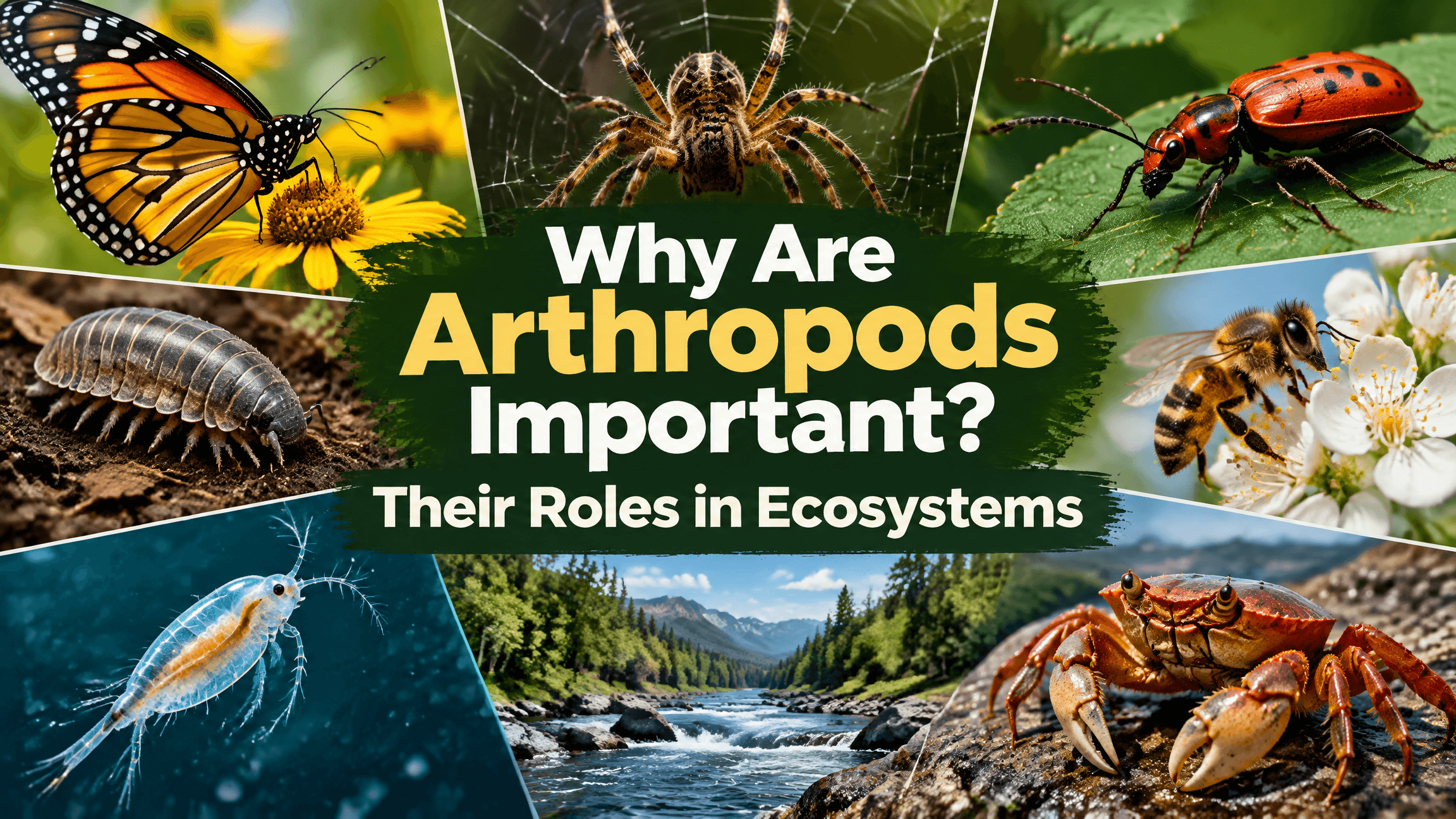
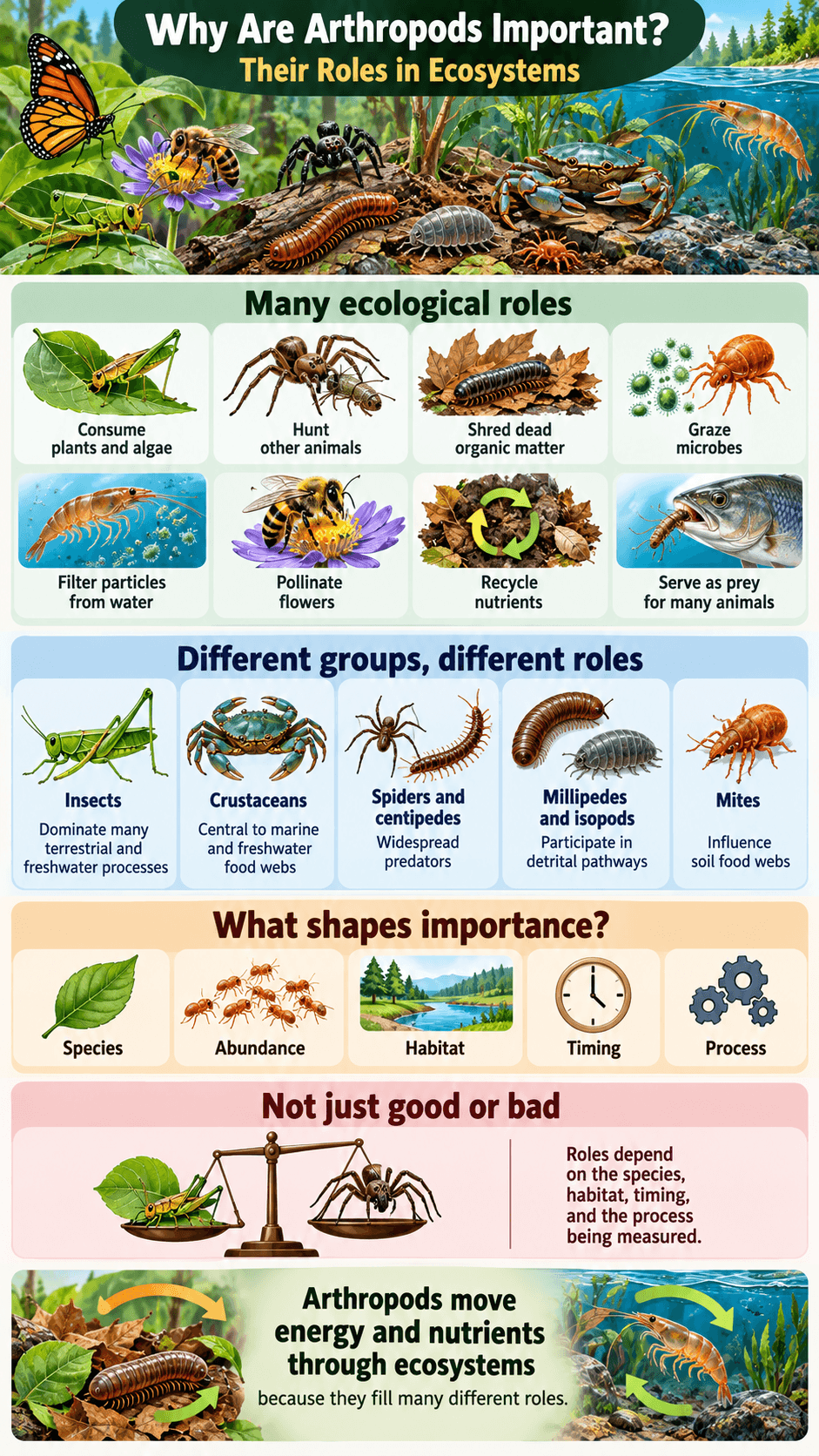
Arthropods matter because they perform many different ecological roles at once. They consume plants and algae, hunt other animals, shred dead organic matter, graze microbes, filter particles from water, pollinate flowers, recycle nutrients, and serve as prey for fish, birds, mammals, reptiles, amphibians, and other invertebrates.
No single role explains their importance. Insects dominate many terrestrial and freshwater processes, but crustaceans are central to marine and freshwater food webs, spiders and centipedes are widespread predators, millipedes and isopods participate in detrital pathways, mites influence soil food webs, and many small arthropods connect microscopic producers and decomposers to larger consumers.
It is also important not to turn ecological roles into simple “good bug” and “bad bug” labels. A herbivore can damage a crop while still functioning as prey or nutrient recycler. A predator can consume both species people value and species people dislike. Ecological importance depends on species, abundance, habitat, timing, and the process being measured.
Quick Answer: Arthropods Perform Many Different Ecological Roles
Arthropods help move energy and nutrients through ecosystems. They can act as consumers, predators, grazers, herbivores, detritivores, suspension feeders, parasites, parasitoids, pollinators, prey, and hosts for other organisms. These ecological connections are one part of the wider biological diversity of arthropods.
In soil and litter, many arthropods fragment dead organic material and interact with microbes. In freshwater, insect larvae and crustaceans feed, graze, shred, hunt, and become prey for fish and other animals. In the ocean, copepods, krill, crabs, shrimp, amphipods, isopods, and barnacles occupy multiple trophic levels.
The ecological importance of Arthropoda comes from this diversity of functions rather than from one universal service.
A Framework for Understanding Arthropod Importance
Ecological Process Versus Human-Centered Labels
Ecology asks what an organism does in a system, not whether people consider it useful or harmful. A tick is part of host-parasite relationships. A caterpillar transfers plant energy into animal food webs. A crab can be both predator and prey. A millipede can process litter without being a universal soil improver.
Human interests matter in agriculture, fisheries, medicine, and disease, but those interests are different from ecological function. Keeping the two ideas separate leads to more accurate descriptions.
Roles Depend on Species, Abundance, and Habitat
A small population of one predator may have little measurable effect, while a dense population of another species can strongly influence prey abundance. A detritivore may accelerate litter fragmentation in one forest but have a smaller effect where climate, litter quality, or microbes dominate decomposition. Ecological roles also vary with where arthropods live, because marine, freshwater, soil, and terrestrial communities function differently.
The same species can also play different roles at different life stages. An aquatic insect larva may graze algae or prey on other invertebrates, while the adult becomes aerial prey or a pollinator.
Ecological Importance Is About Connections
An arthropod may be important because it links two parts of a food web rather than because it dominates one process. A copepod can convert phytoplankton production into prey for fish. A leaf-litter arthropod can move dead plant material into the detrital food web. An emerging aquatic insect can transfer stream production into terrestrial predators.
This network perspective is often more informative than asking whether one species is “important” in isolation.
Arthropods as Food-Web Consumers and Prey
Predators
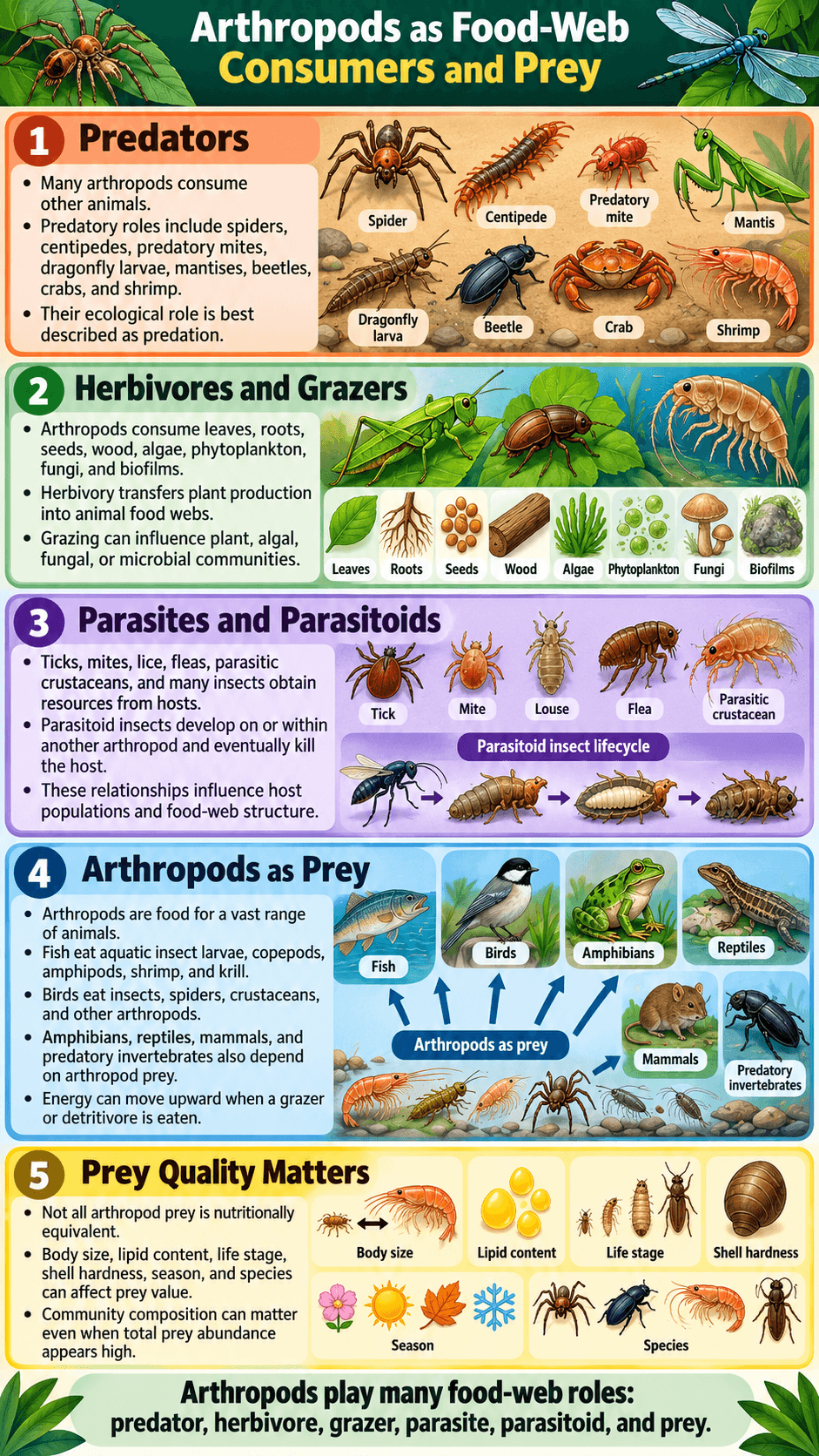
Many arthropods obtain energy by consuming other animals. Spiders, centipedes, predatory mites, dragonfly larvae, mantises, beetles, crabs, shrimp, and numerous other lineages occupy predatory roles.
The Smithsonian National Museum of Natural History describes spiders as predators and highlights how different hunting adaptations support prey capture. Their ecological role is best described as predation rather than as a universal pest-control service.
Herbivores and Grazers
Arthropods consume leaves, roots, seeds, wood, algae, phytoplankton, fungi, and biofilms. Herbivory transfers plant production into animal food webs, while grazing can influence plant, algal, fungal, or microbial communities.
In aquatic systems, crustacean grazers such as many copepods consume phytoplankton. On land, insects and mites feed on living plant tissue, sap, seeds, or fungi. These feeding relationships can affect growth, reproduction, and competition among producers.
Parasites and Parasitoids
Ticks, mites, lice, fleas, parasitic crustaceans, and many insects obtain resources from hosts. Parasitoid insects develop on or within another arthropod and eventually kill the host.
These relationships influence host populations and food-web structure, but their effects vary with host density, environment, and species identity. Parasite does not mean ecologically unimportant, and parasitoid does not automatically mean useful biological control in every setting.
Arthropods as Prey
Arthropods are food for a vast range of animals. Fish consume aquatic insect larvae, copepods, amphipods, shrimp, and krill. Birds eat insects, spiders, crustaceans, and other arthropods. Amphibians, reptiles, mammals, and predatory invertebrates also depend on arthropod prey.
This prey role often connects small primary consumers and detritivores to larger vertebrates. Energy captured by a grazer or detritivore can move upward when that arthropod is eaten.
Prey Quality Can Matter as Much as Prey Quantity
Not all arthropod prey is nutritionally equivalent. Body size, lipid content, life stage, shell hardness, season, and species can affect how valuable a prey item is to a predator.
In marine systems, changes from energy-rich copepods or krill to lower-quality prey can alter the condition or survival of fish and other consumers. This is one reason shifts in arthropod community composition can matter even when total prey abundance appears high.
Decomposition, Detritivory, and Nutrient Cycling
Millipedes and Litter Processing
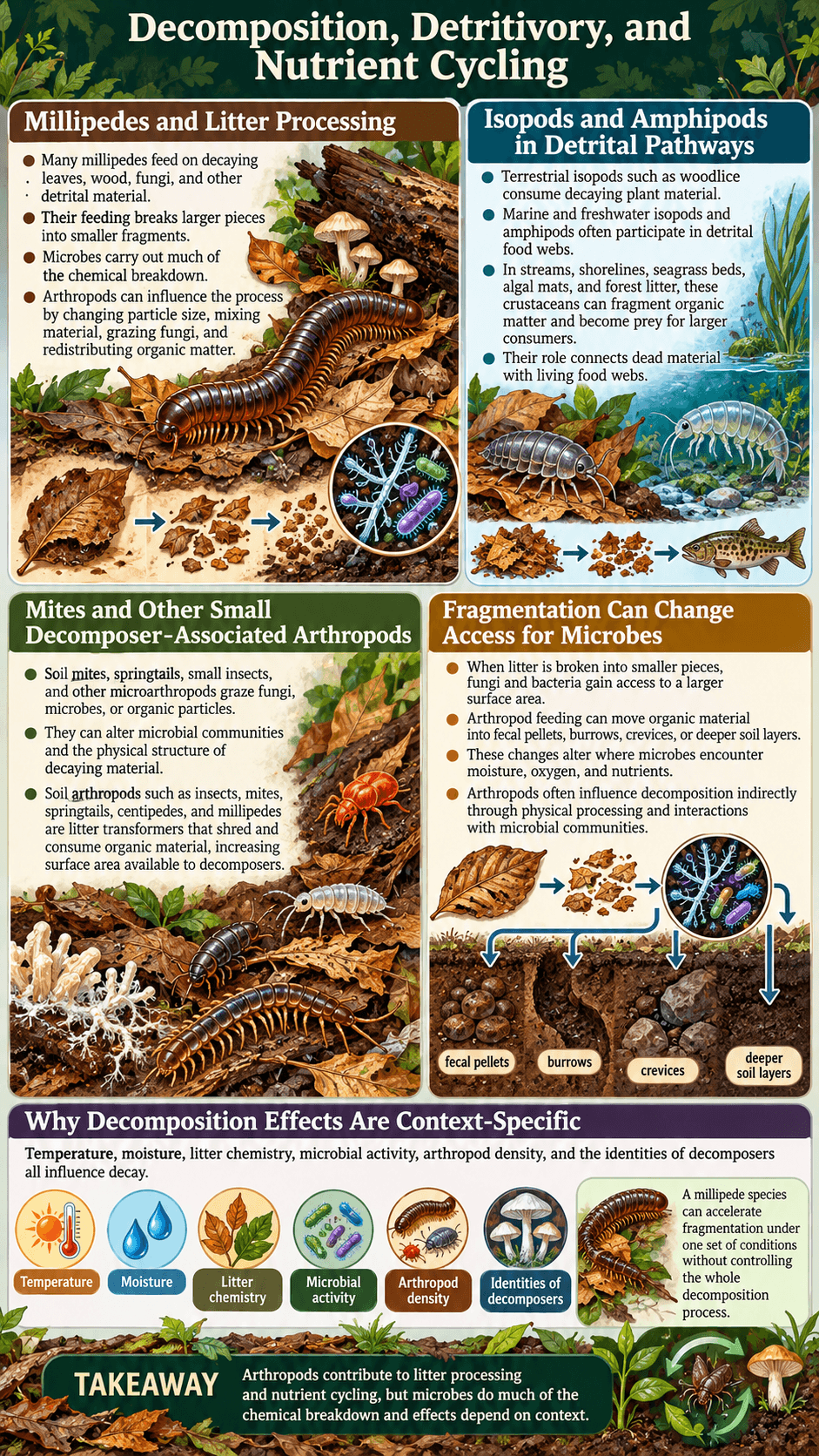
Many millipedes feed on decaying leaves, wood, fungi, and other detrital material. Their feeding breaks larger pieces into smaller fragments and produces fecal material with different physical properties.
This does not mean millipedes perform all decomposition themselves. Microbes carry out much of the chemical breakdown. Arthropods can influence the process by changing particle size, mixing material, grazing fungi, and redistributing organic matter.
Isopods and Amphipods in Detrital Pathways
Terrestrial isopods such as woodlice consume decaying plant material, while marine and freshwater isopods and amphipods often participate in detrital food webs.
In streams, shorelines, seagrass beds, algal mats, and forest litter, these crustaceans can fragment organic matter and become prey for larger consumers. Their role connects dead material with living food webs.
Mites and Other Small Decomposer-Associated Arthropods
Soil mites, springtails, small insects, and other microarthropods graze fungi, microbes, or organic particles. They can alter microbial communities and the physical structure of decaying material.
The USDA Natural Resources Conservation Service describes soil arthropods such as insects, mites, springtails, centipedes, and millipedes as litter transformers that shred and consume organic material, increasing surface area available to decomposers.
Fragmentation Can Change Access for Microbes
When litter is broken into smaller pieces, fungi and bacteria gain access to a larger surface area. Arthropod feeding can also move organic material into fecal pellets, burrows, crevices, or deeper soil layers.
These changes alter where microbes encounter moisture, oxygen, and nutrients. Arthropods therefore often influence decomposition indirectly through physical processing and interactions with microbial communities.
Why Decomposition Effects Are Context-Specific
Temperature, moisture, litter chemistry, microbial activity, arthropod density, and the identities of decomposers all influence decay. A millipede species can accelerate fragmentation under one set of conditions without controlling the whole decomposition process.
This is why statements such as “millipedes make soil fertile” are too broad. They may contribute to litter processing and nutrient cycling, but the magnitude and direction of effects depend on context.
Predatory Arthropods

Spiders
Spiders consume a wide range of prey, especially other arthropods. Web builders intercept mobile prey, while hunting spiders stalk, ambush, or actively pursue food.
Because prey choice varies by species and habitat, spiders should not be described as uniformly targeting animals humans classify as pests.
Centipedes
Centipedes are terrestrial predators that commonly consume insects, spiders, worms, and other small animals. In litter and soil communities, they occupy higher trophic positions than many detritivores and fungivores around them.
Their influence depends on prey availability, body size, habitat, and density.
Predatory Mites
Many mites feed on fungi or detritus, but others are predators. Predatory mites can consume nematodes, springtails, other mites, insect eggs, or small arthropods.
This diversity is why “mite” is not an ecological role. Mites occur at several trophic levels.
Crustacean Predators
Crabs, shrimp, amphipods, isopods, and other crustaceans include predators as well as scavengers, grazers, detritivores, and suspension feeders. A single species may switch among these roles depending on food availability.
Predatory crustaceans can influence benthic communities, but their ecological effects vary strongly across habitats.
Why Predator Does Not Automatically Mean Pest Controller
Predators consume available prey according to their biology, not human categories. A spider can eat a herbivorous insect, a pollinator, another predator, or another spider. A predatory mite may consume several kinds of small prey.
Demonstrating a useful pest-control effect requires evidence about prey choice, density, timing, and the crop or system involved.
Predator Does Not Automatically Mean Keystone Species
A keystone species has a disproportionately large ecological effect relative to its abundance. Being a predator alone does not meet that definition.
Some arthropod predators may have strong community effects in particular systems, but the term keystone should be reserved for cases supported by evidence rather than applied casually.
Arthropods in Pollination and Plant Interactions
Insect Pollination at Summary Depth
Bees, flies, butterflies, moths, beetles, wasps, and other insects move pollen among flowers while collecting nectar, pollen, or other resources. This supports reproduction in many wild and cultivated plants.
Pollination is one of the most familiar arthropod ecosystem services, but it represents only one part of Arthropoda-wide ecology.
Herbivory, Seed Interactions, and Other Plant Relationships
Arthropods also consume plants, move seeds, occupy galls, prune tissues through feeding, transport microbes, prey on plant feeders, and use plants as habitat.
Some interactions reduce plant growth, while others indirectly benefit plants or alter competition among species. The ecological result depends on the organisms involved.
Plant Feeding Also Supports Higher Trophic Levels
Herbivorous arthropods convert plant tissue into animal biomass that can then be eaten by spiders, birds, reptiles, amphibians, mammals, parasitoids, and predatory insects.
This means herbivory can both reduce plant tissue and support predators. The ecological role is not captured by a simple beneficial-versus-harmful label.
Why Pollination Should Not Dominate This Topic
If arthropod importance is explained mainly through pollination, marine crustaceans, soil communities, freshwater food webs, spiders, myriapods, and other major lineages disappear from the picture.
A cross-arthropod view must include both terrestrial plant relationships and aquatic food-web functions.
Arthropods in Marine Food Webs
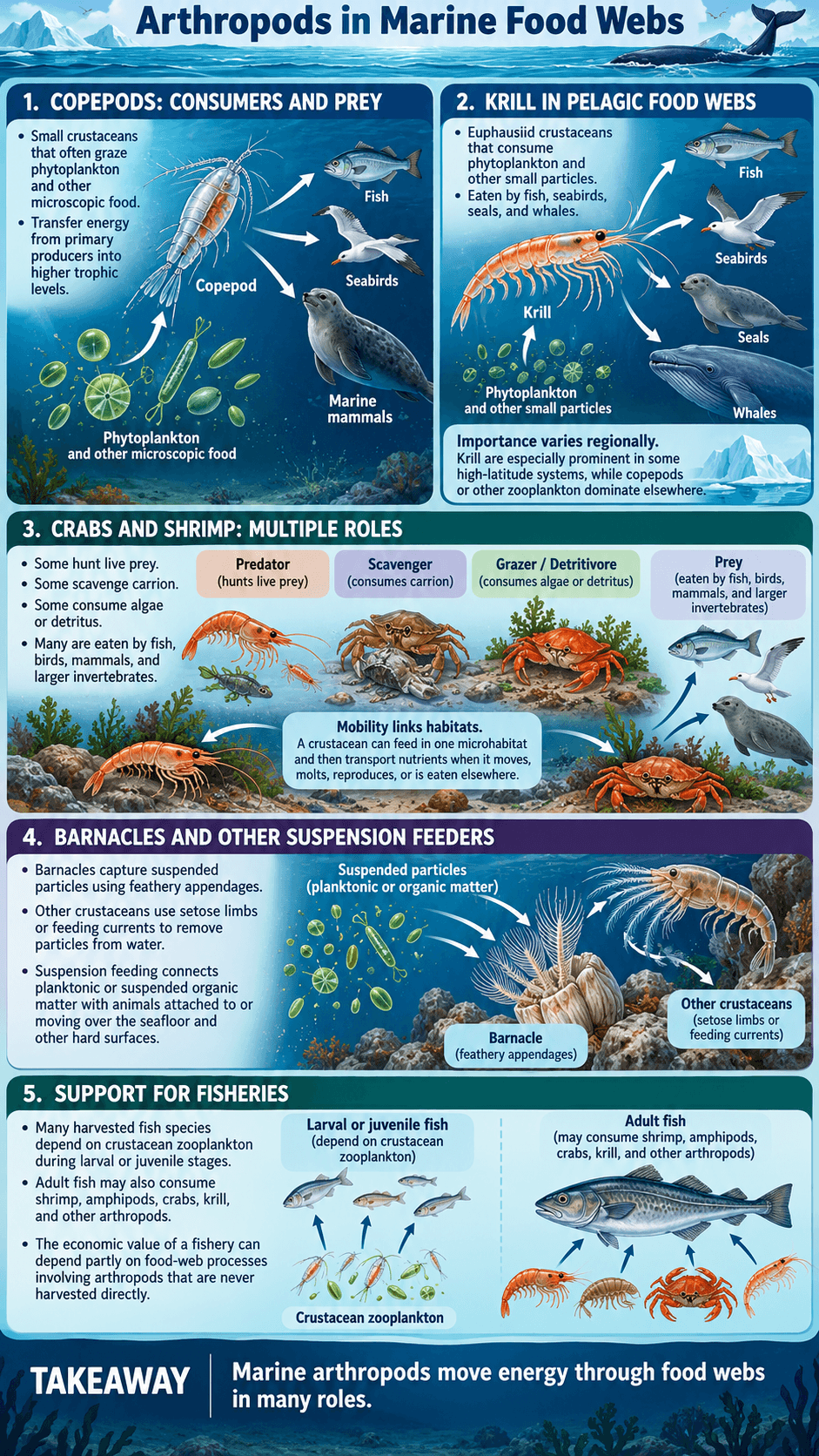
Copepods as Consumers and Prey
Copepods are small crustaceans that often graze phytoplankton and other microscopic food. They transfer energy from primary producers into higher trophic levels.
NOAA Fisheries explains that copepods connect phytoplankton with higher levels of marine food webs. Fish, seabirds, and marine mammals can depend heavily on copepods directly or indirectly.
Krill in Pelagic Food Webs
Krill are euphausiid crustaceans that consume phytoplankton and other small particles and are eaten by fish, seabirds, seals, and whales.
The importance of krill varies regionally. In some high-latitude systems they are especially prominent, while copepods or other zooplankton dominate elsewhere.
Crabs and Shrimp as Predators, Scavengers, Grazers, and Prey
Crabs and shrimp occupy several trophic roles. Some hunt live prey, some scavenge carrion, some consume algae or detritus, and many are eaten by fish, birds, mammals, and larger invertebrates.
Their mobility also links habitats. A crustacean can feed in one microhabitat and then transport nutrients when it moves, molts, reproduces, or is eaten elsewhere.
Barnacles and Other Suspension Feeders
Barnacles capture suspended particles using feathery appendages. Other crustaceans use setose limbs or feeding currents to remove particles from water.
Suspension feeding connects planktonic or suspended organic matter with animals attached to or moving over the seafloor and other hard surfaces.
Marine Arthropods Support Fisheries Indirectly
Many harvested fish species depend on crustacean zooplankton during larval or juvenile stages. Adult fish may also consume shrimp, amphipods, crabs, krill, and other arthropods.
The economic value of a fishery can therefore depend partly on food-web processes involving arthropods that are never harvested directly.
Arthropods in Freshwater Ecosystems
Grazing and Detrital Pathways
Freshwater insect larvae and crustaceans graze algae, scrape biofilms, shred leaves, consume fine particles, and feed on microbes. These processes move energy from primary producers and dead organic matter into animal biomass.
In forested streams, leaves entering the water can support detrital food webs involving microbes and shredding invertebrates.
Predation and Prey Roles
Dragonfly larvae, predatory beetles, aquatic bugs, crayfish, and other arthropods consume smaller animals. At the same time, arthropods are major prey for fish, salamanders, frogs, birds, and other predators.
Freshwater arthropods therefore function at multiple trophic levels rather than forming one ecological category.
Connections Between Aquatic and Terrestrial Food Webs
Many aquatic insects emerge into the air as adults. During that transition, biomass produced in streams or lakes becomes available to terrestrial predators such as birds, bats, spiders, and other insects.
Terrestrial material also enters water as leaves, insects, and other organic matter. Arthropods help move energy in both directions across the shoreline.
Seasonal Emergence Can Create Resource Pulses
When many aquatic insects emerge over a short period, terrestrial predators can receive a temporary surge of prey. The timing and magnitude vary with species, temperature, stream conditions, and season.
These cross-boundary pulses show why an arthropod’s ecological importance may extend beyond the habitat where it spent most of its juvenile life.
Soil and Litter Communities
Myriapods, Mites, Insects, and Other Arthropods
Soil and litter communities contain millipedes, centipedes, mites, springtails, insects, pseudoscorpions, isopods, and many other arthropods. These groups occupy different trophic roles.
Detritivores fragment dead material, fungivores graze microbial growth, predators consume small soil animals, and herbivores feed on roots or living plant tissues.
Soil Food Webs Are Layered
Microbes use organic compounds, fungivores and bacterivores consume microbes, predators feed on smaller soil animals, and detritivores process larger fragments. Arthropods participate at several of these levels.
Because soil habitats are physically complex, interactions occur across pore spaces, litter layers, roots, burrows, and decaying wood rather than in one uniform zone.
Physical Habitat Modification Requires Evidence
Animals that burrow or move through litter can alter pore spaces, mix material, or change where organic matter accumulates. These physical effects may influence microbes, roots, moisture, and other soil organisms.
However, the label ecosystem engineer should not be applied automatically. It is most useful when research shows that an organism creates or modifies habitat in ways that substantially affect other species.
Coastal Case Study: Horseshoe Crab Eggs as Food Resources
A Seasonal Resource in Specific Coastal Systems
Horseshoe crabs spawn on beaches, and their eggs can become an important seasonal food resource for migrating shorebirds and other animals.
NOAA Ocean Service notes that horseshoe crab eggs support migratory birds and other consumers, with Delaware Bay representing a particularly important regional example.
Why This Example Should Stay Region-Specific
The ecological importance of horseshoe crab eggs is not identical along every coastline or for every predator. Timing, spawning density, bird migration, beach conditions, and regional food availability all matter.
This makes horseshoe crab eggs a strong case study in seasonal resource pulses rather than a universal model for coastal ecosystems.
Arthropods and Humans Without a Good-Bug/Bad-Bug Framework
Ecosystem Services and Disservices
Arthropods can provide ecosystem services that people value, including pollination, decomposition support, food for harvested fish, and natural predation. They can also damage crops, transmit disease, foul infrastructure, or compete with people for resources.
The same species can participate in several of these processes at once. Ecological importance does not disappear because an organism causes economic or health problems.
Agriculture
Agricultural systems contain pollinators, herbivores, predators, parasitoids, decomposers, scavengers, and soil arthropods. Their interactions influence crop production in different directions.
A single species may be useful in one context and costly in another. This is another reason ecological roles should not be reduced to permanent good-or-bad labels.
Fisheries
Commercial and recreational fisheries depend on food webs that often include crustacean zooplankton, shrimp, crabs, amphipods, and aquatic insect larvae.
Changes in arthropod prey abundance or quality can affect fish growth and survival, especially during early life stages.
Disease Vectors and Biodiversity Context
Mosquitoes, ticks, fleas, and other arthropods can transmit pathogens. That relationship is important to human and animal health, but vector status does not summarize the full ecology of the species.
Those same arthropods remain part of food webs, host relationships, and nutrient pathways. Ecological description and public-health significance can both be true at the same time.
Common Ecology Myths
Ecosystems Would Universally Collapse Without Every Arthropod
No. Arthropods collectively participate in many major processes, but ecological systems differ in redundancy, species composition, and response to loss.
Removing one species can have a large, small, or context-dependent effect. Universal collapse claims require far more evidence than broad statements about arthropod importance.
All Spiders Control Pests
No. Spiders are predators, but their prey may include insects people call pests, neutral species, pollinators, other predators, or other spiders.
Predation is the ecological role. Pest control is a human-centered outcome that must be demonstrated in a specific context.
All Millipedes Improve Soil
No. Many millipedes participate in litter processing, but their effects depend on species, abundance, litter quality, moisture, microbes, and ecosystem conditions.
Every Arthropod Predator Is a Keystone Species
No. Keystone status requires evidence of a disproportionately large ecological effect. Predation alone does not establish that status.
How This Connects to Nearby Arthropod Topics
Feeding Strategies Versus Ecological Roles
A feeding article asks what an arthropod eats and how it captures or processes food. An ecology article asks what that feeding does within a community or food web.
A copepod grazing phytoplankton is a feeding behavior. Its role in transferring energy to fish and whales is an ecosystem function.
Habitat Distribution Versus Ecosystem Function
Habitat tells us where an arthropod lives. Ecological role tells us what it does there.
A woodlouse living in forest litter is a habitat statement. Its consumption and fragmentation of decaying plant material is an ecological process.
Ecological Importance Versus Conservation Status
An organism can play an important role without being threatened, and a threatened species can have a narrow or poorly understood ecosystem effect.
Conservation status and ecological function are related questions but should not be treated as synonyms.
FAQ
What Roles Do Arthropods Play in Food Webs?
Arthropods can be herbivores, grazers, detritivores, predators, parasites, suspension feeders, and prey. Because they occupy many trophic levels, they transfer energy among plants, microbes, detritus, other invertebrates, and vertebrate consumers.
Why Are Crustaceans Important in Aquatic Ecosystems?
Crustaceans include grazers such as copepods, suspension feeders such as barnacles, detritivores, scavengers, predators, and major prey species. They connect plankton, seafloor communities, fish, birds, mammals, and other consumers across marine and freshwater systems.
How Do Myriapods Affect Decomposition?
Many millipedes consume and fragment decaying plant material, while centipedes are predators within litter and soil food webs. Millipedes can influence decomposition indirectly by changing particle size and interactions with microbes, but the effect varies by habitat and species.
Are All Arthropods Beneficial to Humans?
No. Arthropods can provide services people value and also cause economic, agricultural, or health problems. Ecological importance is not the same as being beneficial to humans.
Final Thoughts
Arthropods are important because they participate in many ecological processes, not because every species performs the same service. They graze producers, consume prey, fragment detritus, interact with microbes, filter particles, pollinate plants, host parasites, and provide food for animals at higher trophic levels.
A broad Arthropoda perspective also changes which examples stand out. Copepods and krill can support marine food webs, spiders and centipedes occupy predatory roles, millipedes and isopods participate in detrital pathways, mites influence soil food webs, and horseshoe crab eggs can form seasonal food pulses in particular coastal regions. Their importance is real, but it is always most accurate when described through specific ecological processes, places, and species rather than universal good-or-bad labels.

Ethan Walker is the founder and research editor of Animal Fact Central. He creates and reviews educational animal facts content using trusted wildlife, pet care, and science-based sources. His work focuses on making animal behavior, adaptations, habitats, and species facts clear, accurate, and engaging for everyday readers.
Read More Details About Ethan Walker: https://animalfactcentral.com/ethan-walker/