
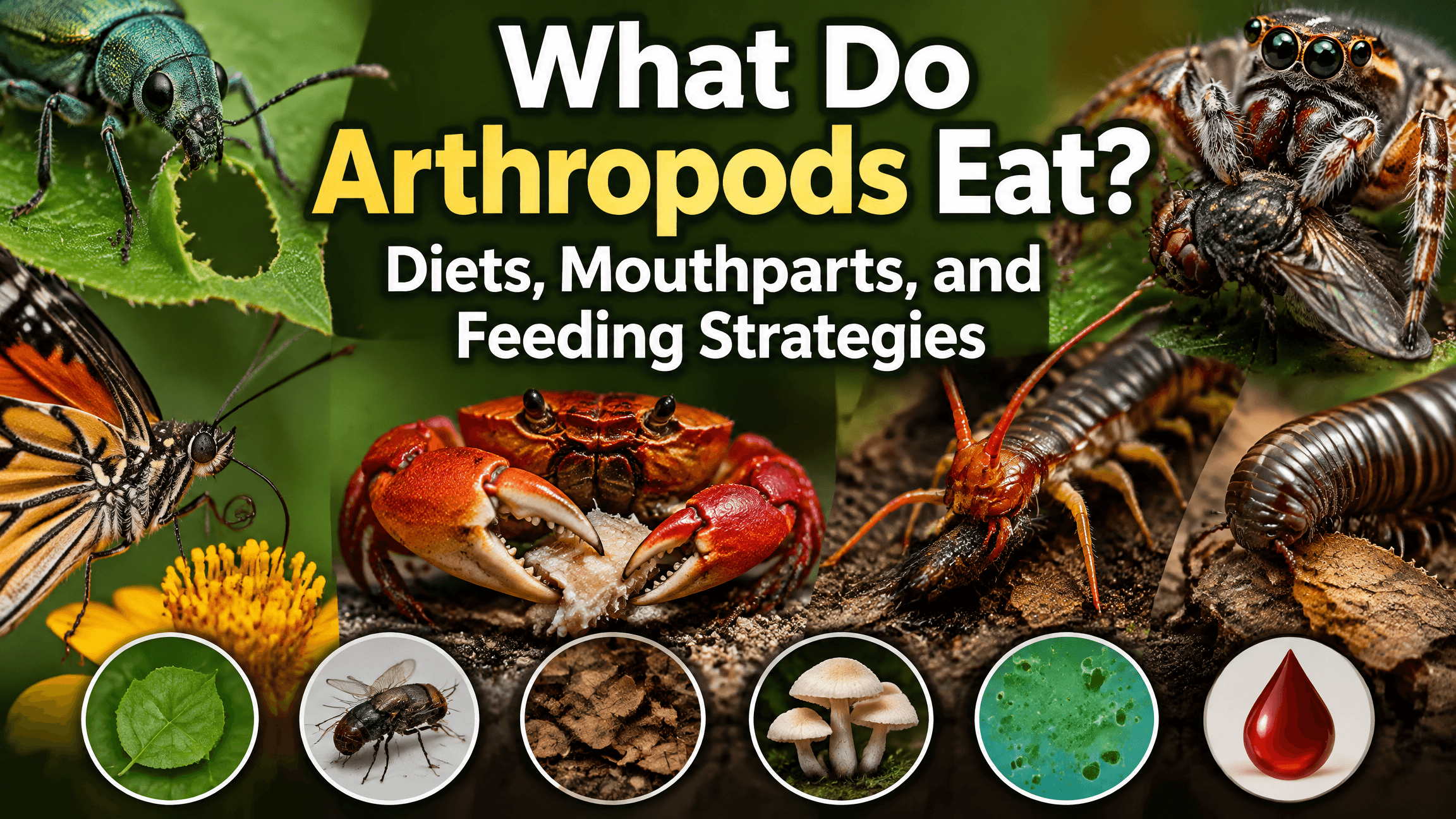
Arthropods eat almost every major kind of biological food available in their environments. Some are predators, some browse plants or algae, some feed on fungi, some consume dead organic matter, and others filter tiny particles from water. Many species are omnivores or change diet across life stages.
Their feeding diversity is possible because arthropod appendages have been modified into many kinds of mouthparts and food-handling structures. Insects use mandibles, maxillae, labial structures, piercing stylets, tubes, or sponging surfaces depending on the lineage. Chelicerates use chelicerae and other appendages rather than insect-style mandibles. Crustaceans can combine mandibles, maxillae, maxillipeds, claws, setose appendages, and feeding currents. Myriapods use still other arrangements.
There is no single arthropod diet and no single arthropod mouth. A spider, butterfly, crab, barnacle, centipede, and millipede may all belong to Arthropoda while processing food in completely different ways.
Quick Answer: What Do Arthropods Eat?
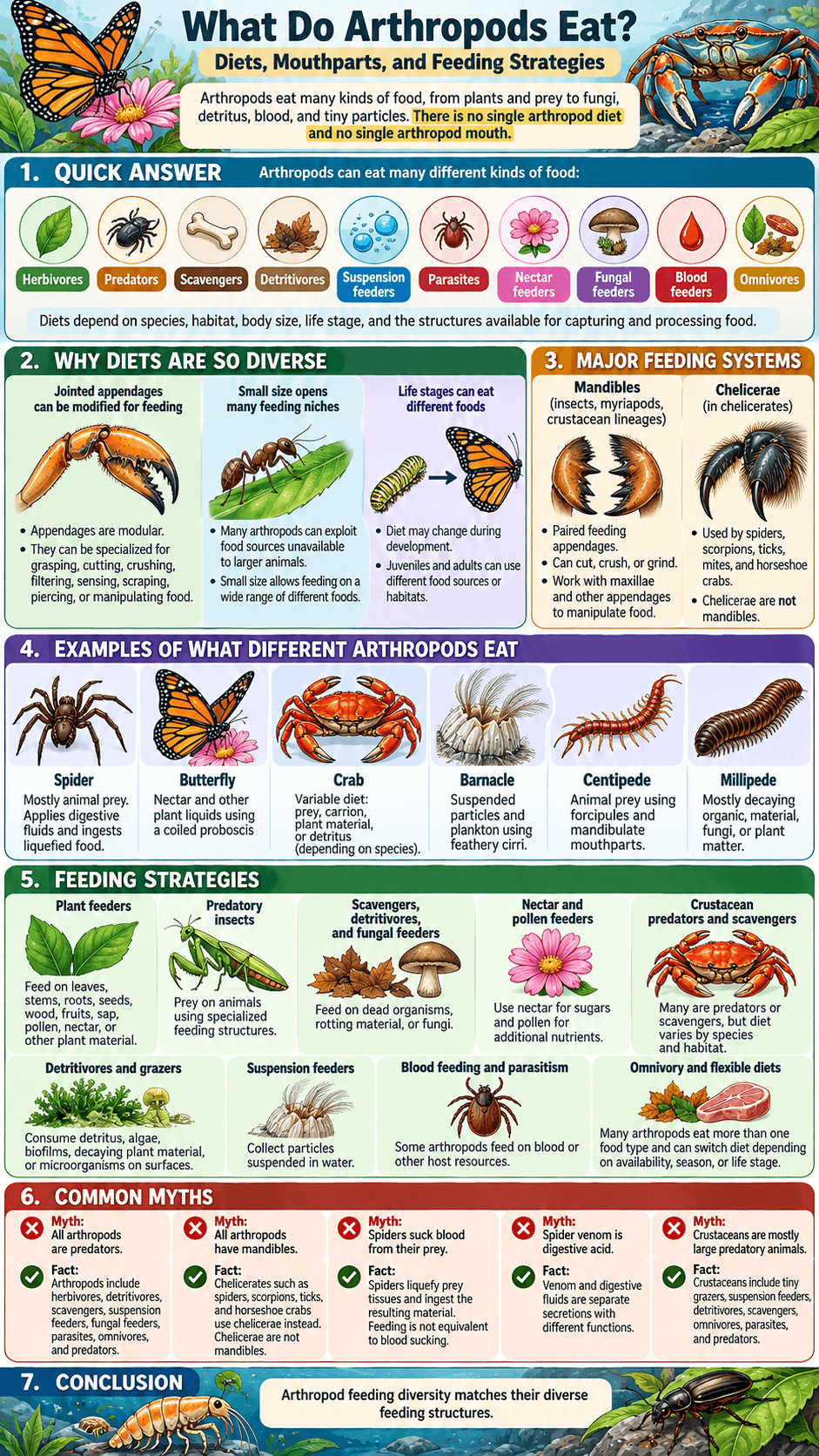
Arthropods can be herbivores, predators, scavengers, detritivores, suspension feeders, parasites, nectar feeders, fungal feeders, blood feeders, or omnivores. Their diets depend on species, habitat, body size, life stage, and the structures available for capturing and processing food. This feeding diversity reflects the wider range of body plans and lifestyles found among arthropods.
The Smithsonian comparative study of mandibulate arthropod jaws shows just how varied arthropod feeding appendages can be across crustaceans, myriapods, and hexapods. Even within mandibulate arthropods, the organs doing the biting, chewing, manipulating, or filtering are not identical.
Chelicerates follow a different plan. Their first major feeding appendages are chelicerae rather than mandibles. This distinction is one of the most important anatomical differences to keep in mind when comparing a spider with an insect or crustacean.
Why Arthropod Diets Are So Diverse
Jointed Appendages Can Be Modified for Feeding
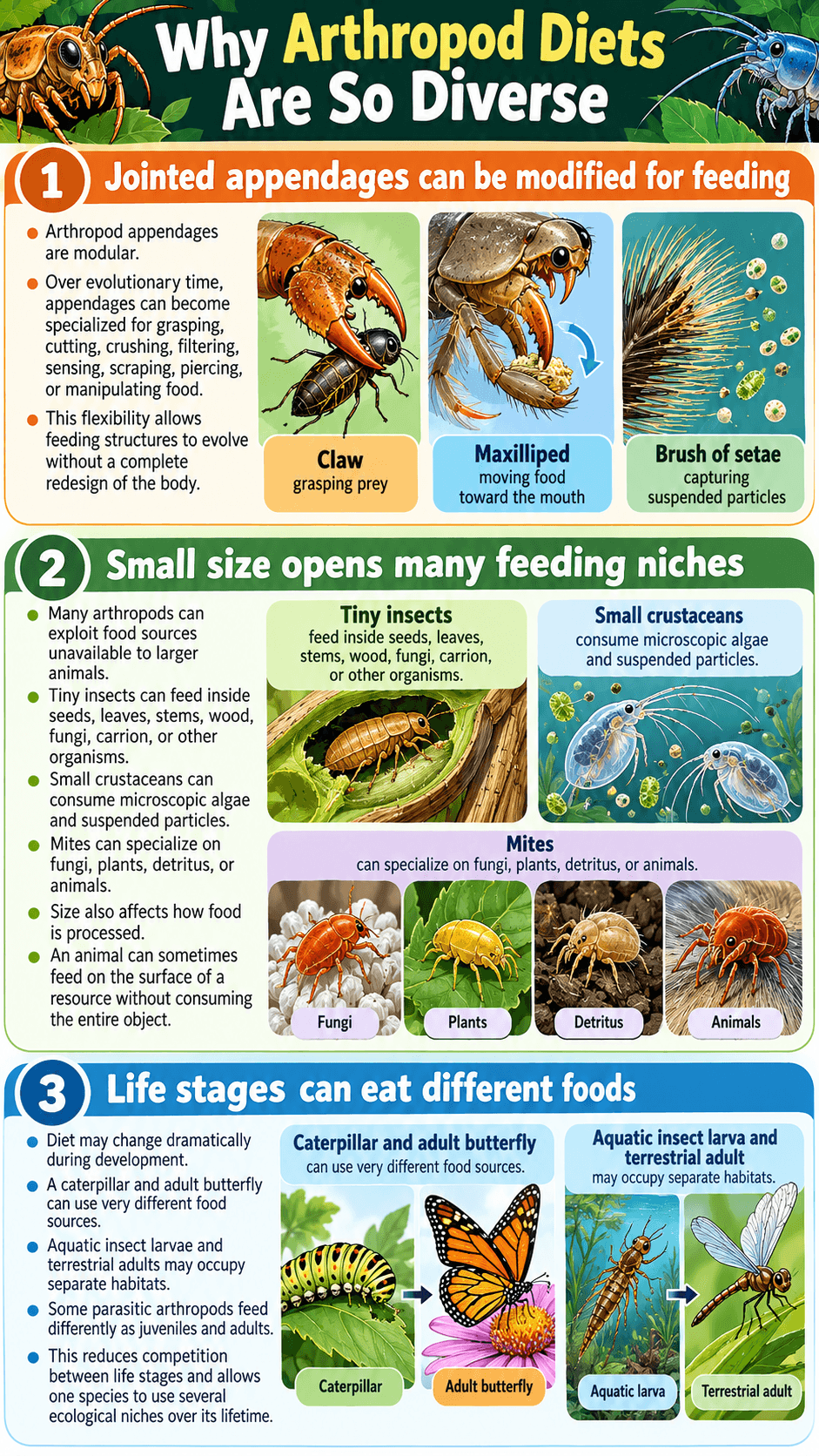
Arthropod appendages are modular. Over evolutionary time, an appendage that originally had one function can become specialized for grasping, cutting, crushing, filtering, sensing, scraping, piercing, or manipulating food. Many feeding differences originate in the specialization of appendages described in arthropod anatomy.
That flexibility allows feeding structures to evolve without requiring a complete redesign of the body. A claw can hold prey, a maxilliped can move food toward the mouth, and a brush of setae can capture suspended particles.
Small Size Opens Many Feeding Niches
Many arthropods can exploit food sources unavailable to larger animals. Tiny insects can feed inside seeds, leaves, stems, wood, fungi, carrion, or other organisms. Small crustaceans can consume microscopic algae and suspended particles. Mites can specialize on fungi, plants, detritus, or animals.
Size also affects how food is processed. An animal can sometimes feed on the surface of a resource without consuming the entire object.
Life Stages Can Eat Different Foods
Diet may change dramatically during development. A caterpillar and adult butterfly can use very different food sources. Aquatic insect larvae and terrestrial adults may occupy separate habitats. Some parasitic arthropods feed differently as juveniles and adults.
This reduces competition between life stages and allows one species to use several ecological niches over its lifetime.
Mandibles and the Mandibulate Feeding Plan
What Mandibles Are
Mandibles are paired feeding appendages found in mandibulate arthropods, including insects, myriapods, and crustacean lineages. Their shape varies enormously.
In a chewing insect, mandibles can cut, crush, or grind food. In crustaceans, mandibles may work with maxillae and other appendages to process food. In myriapods, mandibular structures also contribute to feeding but differ from the insect arrangement.
The important point is that “mandible” refers to a homologous appendage system within Mandibulata, not simply any hard structure near an arthropod mouth.
Maxillae and Other Food-Manipulating Appendages
Mandibles rarely work alone. Maxillae can help hold, sort, taste, or manipulate food. In insects, the labium and other mouthpart structures also contribute to feeding.
Crustaceans may add several pairs of specialized thoracic appendages called maxillipeds near the mouth. These can hold, sort, tear, or pass food inward.
Mouthparts Can Become Highly Modified
Evolution can transform a basic chewing arrangement into piercing, sucking, siphoning, lapping, or sponging systems. The resulting structures may look so different that their shared evolutionary origin is not obvious to a casual observer.
This is why mouthpart function is often more useful than a simple visual label. Two insects can use homologous structures in very different ways.
Chelicerae: A Different Feeding System
Chelicerates Do Not Have Mandibles
Spiders, scorpions, ticks, mites, horseshoe crabs, and other chelicerates use chelicerae rather than mandibles. The Smithsonian’s work on arachnid mouth appendages emphasizes that chelicerae are not mandibles and have a different positional and evolutionary history.
Functionally, chelicerae can grasp, pierce, tear, crush, or otherwise handle food depending on the lineage.
Spider Fangs Are Part of the Chelicerae
In spiders, the terminal portion of each chelicera forms a fang. Venom can be delivered through these fangs in most spider groups.
The fang is involved in prey capture, but feeding does not end with venom injection. Spiders are primarily liquid feeders and must chemically break down food before ingesting it.
Venom and Digestive Fluid Are Not the Same Thing
Venom helps subdue prey and can begin affecting tissues, but digestive fluids perform the main enzymatic breakdown associated with extra-oral digestion. Treating venom as if it were simply digestive acid is inaccurate.
The two secretions come from different biological systems and perform different functions, even though both may be involved during prey capture and feeding.
How Spiders Eat
Spiders Are Liquid Feeders
Spiders generally cannot swallow large solid chunks of prey. Instead, digestive enzymes are applied to prey tissues, liquefying digestible material outside the mouth.
The University of Minnesota Extension overview of spider biology explains that spiders liquefy food with digestive fluids and then suck in the digested material.
This process is called extra-oral digestion because substantial digestion occurs outside the digestive tract before ingestion.
Spiders Do Not Simply “Suck Blood”
Most spiders are predators of insects and other small animals, but their feeding should not be described as blood sucking. They ingest liquefied prey tissues and body fluids after extra-oral digestion.
Depending on the spider and prey, some solid particles may be filtered out while liquefied nutrients are pumped into the digestive system.
Different Spiders Capture Food Differently
Web-building spiders intercept prey with silk. Hunting spiders stalk, chase, ambush, or jump on prey. Some specialize on ants, other spiders, small vertebrates, or aquatic prey, while others have broader diets.
Capture strategy and feeding physiology are related but separate. Two spiders can use very different hunting behaviors while processing food through a similar liquid-feeding mechanism.
What Insects Eat
Plant Feeders
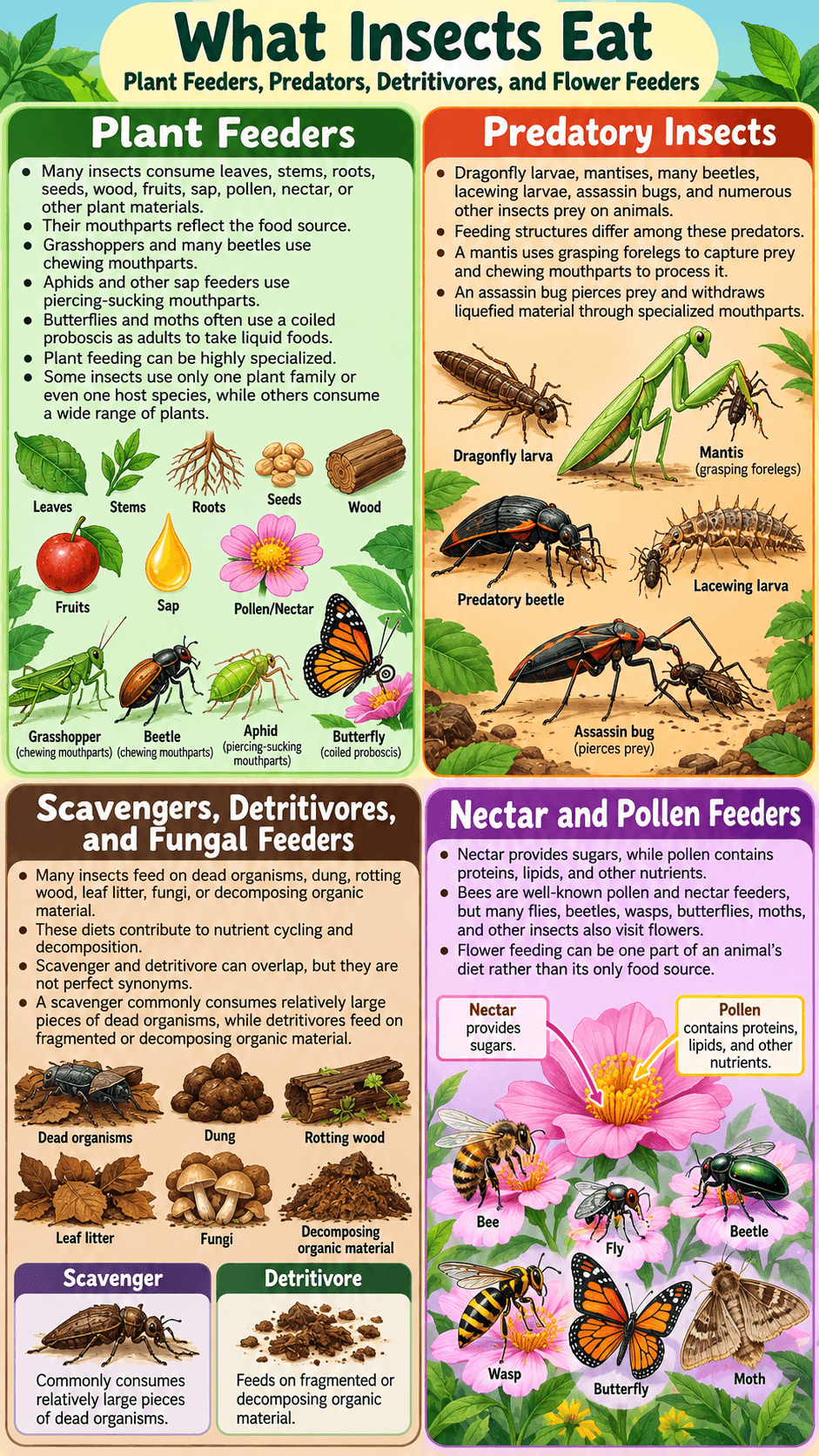
Many insects consume leaves, stems, roots, seeds, wood, fruits, sap, pollen, nectar, or other plant materials. Their mouthparts reflect the food source.
Grasshoppers and many beetles use chewing mouthparts. Aphids and other sap feeders use piercing-sucking mouthparts. Butterflies and moths often use a coiled proboscis as adults to take liquid foods.
Plant feeding can be highly specialized. Some insects use only one plant family or even one host species, while others consume a wide range of plants.
Predatory Insects
Dragonfly larvae, mantises, many beetles, lacewing larvae, assassin bugs, and numerous other insects prey on animals. Feeding structures differ among these predators.
A mantis uses grasping forelegs to capture prey and chewing mouthparts to process it. An assassin bug pierces prey and withdraws liquefied material through specialized mouthparts.
Scavengers, Detritivores, and Fungal Feeders
Many insects feed on dead organisms, dung, rotting wood, leaf litter, fungi, or decomposing organic material. These diets contribute to nutrient cycling and decomposition. Food availability is also closely tied to arthropod habitats, because different environments provide very different resources.
Scavenger and detritivore can overlap, but they are not perfect synonyms. A scavenger commonly consumes relatively large pieces of dead organisms, while detritivores feed on fragmented or decomposing organic material.
Nectar and Pollen Feeders
Nectar provides sugars, while pollen contains proteins, lipids, and other nutrients. Bees are well-known pollen and nectar feeders, but many flies, beetles, wasps, butterflies, moths, and other insects also visit flowers.
Flower feeding can be one part of an animal’s diet rather than its only food source.
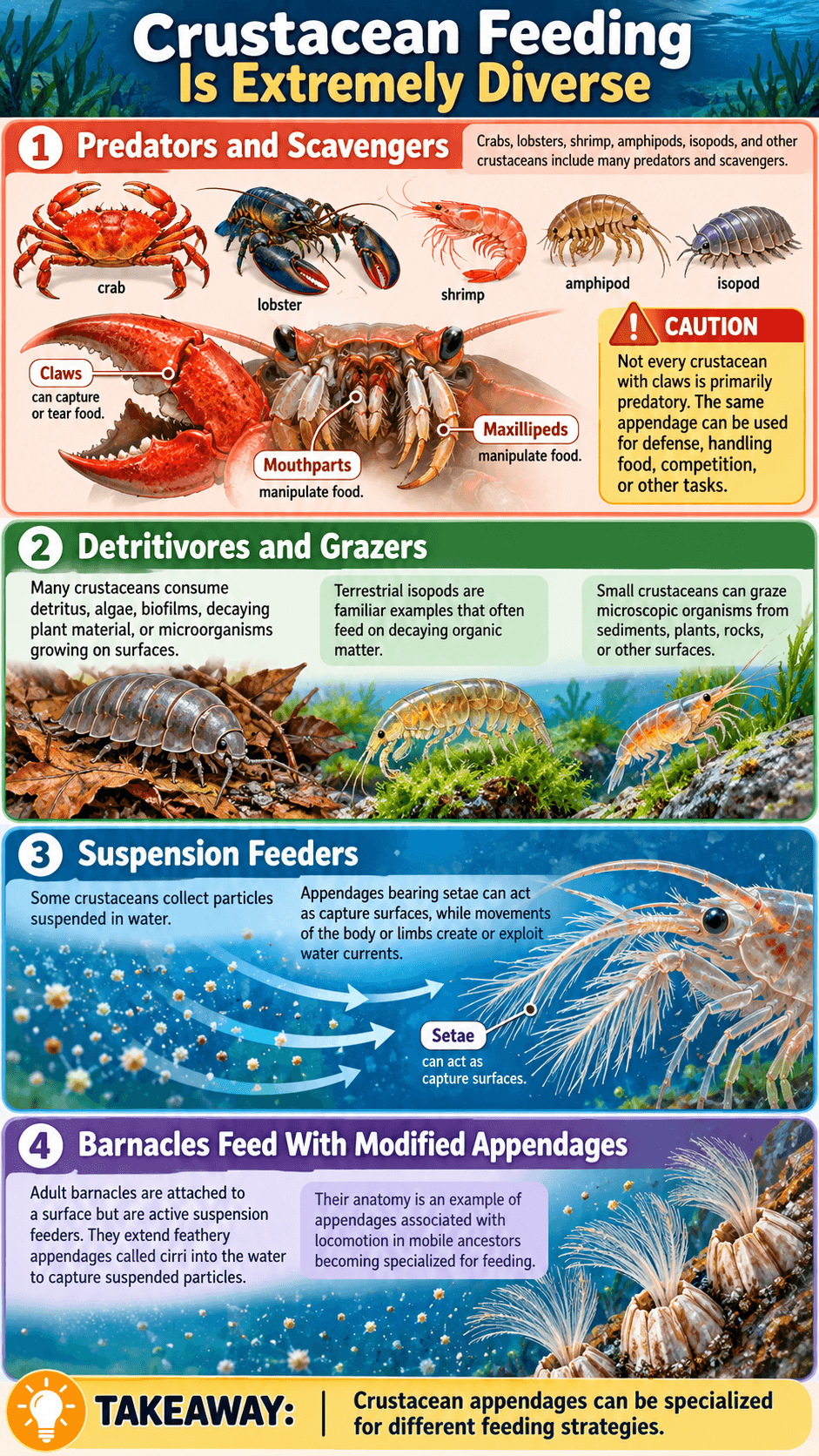
Crustacean Feeding Is Extremely Diverse
Predators and Scavengers
Crabs, lobsters, shrimp, amphipods, isopods, and other crustaceans include many predators and scavengers. Claws can capture or tear food, while mouthparts and maxillipeds manipulate it.
Not every crustacean with claws is primarily predatory. The same appendage can be used for defense, handling food, competition, or other tasks.
Detritivores and Grazers
Many crustaceans consume detritus, algae, biofilms, decaying plant material, or microorganisms growing on surfaces. Terrestrial isopods are familiar examples of crustaceans that often feed on decaying organic matter.
Small crustaceans can graze microscopic organisms from sediments, plants, rocks, or other surfaces.
Suspension Feeders
Some crustaceans collect particles suspended in water. Appendages bearing setae can act as capture surfaces, while movements of the body or limbs create or exploit water currents.
The Smithsonian’s catalog of crustacean functional morphology and feeding systems highlights the enormous diversity of crustacean appendages and includes feeding and digestive systems as a major area of comparison.
Barnacles Feed With Modified Appendages
Adult barnacles are attached to a surface, but they are active suspension feeders. They extend feathery appendages called cirri into the water to capture suspended particles.
Their anatomy is a striking example of how appendages associated with locomotion in mobile ancestors can become specialized for feeding.
What Centipedes Eat
Centipedes Are Predators
Centipedes primarily prey on other animals, especially small invertebrates. Depending on size and species, prey can include insects, spiders, worms, and other arthropods.
They locate prey using antennae and other sensory systems, then capture it with the anterior trunk appendages called forcipules.
Forcipules Deliver Venom
Forcipules are modified appendages located immediately behind the head. They grasp prey and deliver venom.
The Texas A&M guide to centipedes and millipedes distinguishes predatory centipedes from decomposer-oriented millipedes and describes centipedes as feeding on insects and spiders.
Forcipules are not true jaws, even though they are sometimes casually described as fangs. The actual mouthparts include mandibular structures.
What Millipedes Eat
Many Millipedes Consume Decaying Plant Material
Millipedes are commonly detritivores. They feed on decaying leaves, wood fragments, fungi, and other organic matter within litter and soil.
This makes them important participants in the breakdown of plant material, although the exact ecological impact depends on species and habitat. These diets become especially important when viewed through the ecosystem roles of arthropods in food webs and nutrient pathways.
Not Every Millipede Has the Same Diet
Some millipedes consume living plant tissue, fungi, algae, or other foods. A few lineages can be more opportunistic than the simple label dead-leaf eater suggests.
Diet also changes with availability. Decomposer communities often feed on mixtures of decaying organic material and microorganisms rather than one chemically pure food source.
Filtering and Suspension Feeding
Feeding From Water Without Chasing Prey
Suspension feeders obtain food particles carried in water. The food can include plankton, detritus, microorganisms, or other suspended material.
Feeding appendages may act like rakes, sieves, nets, or paddles. Hair-like setae increase the effective surface area for intercepting particles.
Filter Feeding Is One Form of Suspension Feeding
The terms are related but not always identical. Suspension feeding broadly means taking particles from the water column. Filter feeding specifically involves passing water or particles through a filtering structure.
Some crustaceans actively create currents, while others rely more heavily on ambient water movement.
Grazing, Scraping, and Browsing
Arthropods Can Feed on Surface Films
Algae, fungi, bacteria, and organic films grow on rocks, plants, wood, shells, and sediments. Small arthropods can scrape or browse these surfaces.
This feeding mode is common among many aquatic and terrestrial microarthropods and crustaceans.
Surface Feeding Can Be Highly Selective
An animal does not necessarily ingest everything on a surface. Sensory structures can help evaluate food before or during feeding, and mouthparts can selectively remove particles of particular sizes or textures.
This makes feeding a sensory process as well as a mechanical one.
Blood Feeding and Parasitism
Some Arthropods Feed on Blood
Mosquitoes, ticks, fleas, lice, some flies, and other arthropods can feed on vertebrate blood. Blood feeding has evolved in multiple lineages using different mouthpart systems.
It is therefore a feeding strategy rather than a single anatomical design shared by all blood-feeding arthropods.
Ticks Are Chelicerates, Not Insects
Ticks belong to Arachnida. Their mouthparts are built from chelicerate structures, not insect mandibles or a mosquito-style proboscis.
Grouping all blood-feeding arthropods under one mouthpart description would erase major anatomical differences.
Parasitism Includes More Than Blood Feeding
Parasitic arthropods may feed on skin, tissue fluids, blood, feathers, plant sap, other arthropods, or host-derived resources. Some remain on the host surface, while others spend part of the life cycle inside a host.
Parasitism therefore describes an ecological relationship, not one particular food.
Omnivory and Flexible Diets
Many Arthropods Eat More Than One Food Type
Some crabs, insects, isopods, and other arthropods switch between plant material, animal tissue, detritus, fungi, or carrion depending on availability.
Calling such species strict herbivores or carnivores can be misleading when field diets are flexible.
Season and Life Stage Can Change Diet
Food availability changes through seasons, tides, rainfall cycles, plant growth, and animal development. Arthropods may respond by shifting diet.
Juveniles can also have different mouthparts, habitats, or nutritional demands from adults.
Mouthpart Shape Reflects Feeding Mechanics
Cutting and Crushing
Robust mandibles can cut plant tissue, crush seeds, break prey, or process hard food. The shape of the cutting edge and muscle attachment influences the type of force produced.
Hard mouthparts do not reveal diet by themselves. Similar-looking jaws can be used on different foods.
Piercing and Sucking
Piercing mouthparts create an opening into plant or animal tissue, while fluid-feeding structures draw liquid inward. Mosquitoes, aphids, assassin bugs, and ticks use different anatomical solutions for this general feeding mode.
Shared function does not mean shared evolutionary origin.
Siphoning and Sponging
Some insects take liquid foods without piercing. Butterflies and moths commonly use a proboscis to draw liquids, while many flies use sponging or lapping structures.
These mouthparts are highly derived versions of ancestral insect appendages.
Filtering With Setae
Setae can form combs, baskets, or filtering surfaces. In water, these structures intercept particles and guide them toward the mouth.
Filtering structures are especially important in many crustaceans but have evolved in different forms across aquatic arthropods.
Food Handling Before It Reaches the Mouth
Claws and Legs Can Capture Food
Many arthropods use appendages farther from the mouth to seize food. Crabs use chelae, mantises use raptorial forelegs, and spiders use legs and silk during prey capture.
These structures are part of feeding behavior even though they are not technically mouthparts.
Food Can Be Sorted Mechanically
Crustacean setae, maxillipeds, and mouthparts can sort particles by size or texture before ingestion. Insects may manipulate food with palps and other appendages.
This reduces the amount of unsuitable material entering the digestive system.
What Happens After Food Is Ingested?

Mechanical Processing and Enzymes Work Together
Once food enters the digestive tract, arthropods continue processing it with enzymes, muscular movements, and specialized gut regions. The exact arrangement varies enormously. A liquid-feeding spider does not process food the same way as a chewing beetle or a crab that crushes food before swallowing.
In many mandibulate arthropods, mechanical breakdown before ingestion increases the surface area available to digestive enzymes. Fluid feeders often shift more of the breakdown process outside the mouth or into specialized pumping and filtering systems.
Gut Structure Reflects Diet
Digestive anatomy can be specialized for storage, enzymatic digestion, absorption, or handling difficult foods. Herbivores may depend heavily on microbial partners or prolonged processing of plant material, while predators often consume nutrient-rich animal tissues that are chemically different from leaves or wood.
Some arthropods use diverticula or branching gut regions to increase digestive or storage capacity. Others have compact digestive systems suited to small particles or liquids. These differences reinforce the central point that arthropod feeding includes both what enters the mouth and how the body processes it afterward.
Symbiotic Microbes Can Expand the Menu
Microorganisms associated with the gut can help some arthropods use foods that would otherwise be difficult to digest. This is especially relevant for diets rich in cellulose, wood, detritus, or chemically defended plant material.
The importance of microbial partners varies by species, and it should not be assumed that every plant-feeding or detritivorous arthropod relies on the same microbes or the same digestive pathway.
Common Arthropod Feeding Myths
All Arthropods Are Predators
No. Arthropods include herbivores, detritivores, scavengers, suspension feeders, fungal feeders, parasites, omnivores, and predators.
All Arthropods Have Mandibles
No. Mandibles characterize mandibulate arthropods. Chelicerates such as spiders, scorpions, ticks, and horseshoe crabs use chelicerae instead.
Spiders Suck Blood From Their Prey
No. Most spiders liquefy prey tissues through extra-oral digestion and ingest the resulting material. Blood may be part of a prey animal’s fluids, but spider feeding is not equivalent to specialized blood feeding.
Spider Venom Is Digestive Acid
No. Venom and digestive fluids are separate secretions with different primary functions. Venom helps immobilize or subdue prey, while digestive enzymes break down food for ingestion.
Crustaceans Are Mostly Large Predatory Animals
No. Crustaceans include tiny planktonic grazers, suspension feeders, detritivores, scavengers, omnivores, parasites, and predators as well as large crabs and lobsters.
Comparing Arthropod Feeding Strategies
| Example | Typical food | Main feeding structures | Important caution |
|---|---|---|---|
| Chewing insect | Plants, prey, fungi, carrion, or detritus depending on species | Mandibles plus associated mouthparts | Chewing insects are not all herbivores |
| Spider | Mostly animal prey | Chelicerae, fangs, sucking stomach, digestive fluids | Venom and digestion are different processes |
| Crab or lobster | Variable: prey, carrion, plant material, detritus | Chelae, mandibles, maxillae, maxillipeds | Diet varies by species and habitat |
| Barnacle | Suspended particles and plankton | Feathery cirri | Adult feeding appendages are highly modified |
| Centipede | Animal prey | Forcipules plus mandibulate mouthparts | Forcipules are modified trunk appendages, not true jaws |
| Millipede | Mostly decaying organic material, fungi, or plant matter | Mandibulate mouthparts | Not every species has the same diet |
FAQ
Do Arthropods Eat Plants or Animals?
Both. Some arthropods specialize on plants, others on animal prey, fungi, detritus, carrion, suspended particles, blood, or other resources. Many are omnivores.
Do All Arthropods Chew Their Food?
No. Some chew, while others pierce, suck, siphon, sponge, filter, scrape, or externally liquefy food before ingestion.
What Is the Difference Between Mandibles and Chelicerae?
Mandibles are feeding appendages of mandibulate arthropods such as insects, myriapods, and crustaceans. Chelicerae are the first major feeding appendages of chelicerates such as spiders, scorpions, ticks, mites, and horseshoe crabs. They are not the same appendage.
Do Spiders Digest Food Outside Their Bodies?
Substantial digestion occurs outside the mouth. Spiders apply digestive fluids to prey tissues, then ingest the liquefied material. Further digestion and absorption continue within the digestive system.
Final Thoughts
Arthropod diets range from living plants and prey to fungi, carrion, detritus, blood, plankton, algae, and microscopic particles. The diversity is matched by an equally varied set of feeding structures.
Mandibles, maxillae, chelicerae, fangs, maxillipeds, claws, stylets, proboscises, cirri, setae, and other appendages allow different arthropods to capture, manipulate, filter, pierce, crush, scrape, or liquefy food. Understanding those structures is more useful than trying to define one typical arthropod diet. The phylum succeeds partly because its modular body plan can be adapted to exploit almost every major food source in animal habitats.

Ethan Walker is the founder and research editor of Animal Fact Central. He creates and reviews educational animal facts content using trusted wildlife, pet care, and science-based sources. His work focuses on making animal behavior, adaptations, habitats, and species facts clear, accurate, and engaging for everyday readers.
Read More Details About Ethan Walker: https://animalfactcentral.com/ethan-walker/