
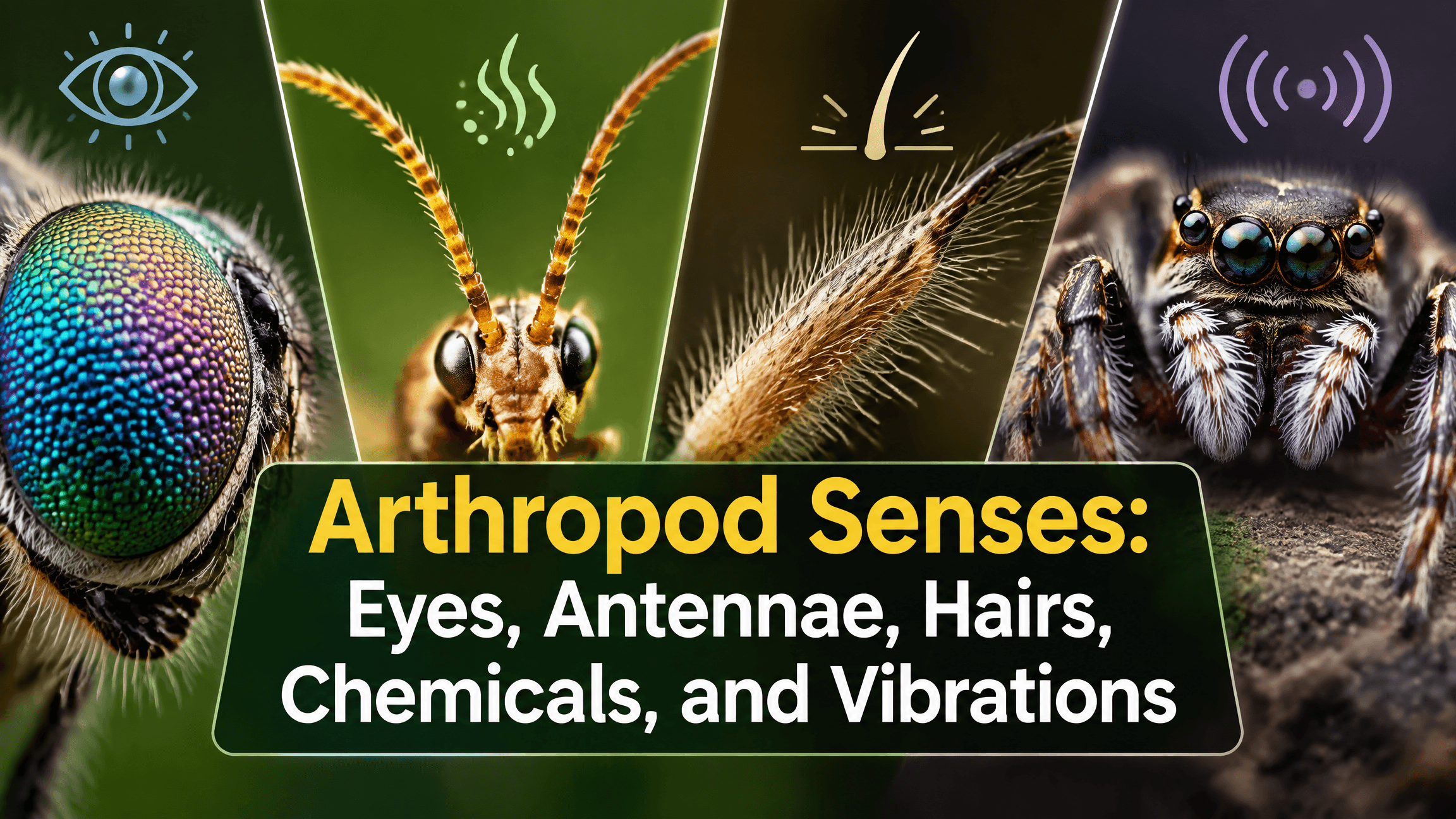
Arthropods sense the world through a remarkable variety of structures. Some rely heavily on vision, while others depend more on touch, vibration, chemicals, airflow, water movement, humidity, or body position. Their sensory systems are built into the same modular body plan that gives them jointed appendages and an external cuticle.
There is no single arthropod sensory toolkit. Insects often combine compound eyes, simple eyes, antennae, and many kinds of sensory hairs. Spiders lack antennae but can detect air movement, substrate vibration, touch, and cuticular strain through specialized receptors. Crustaceans may sample chemicals and water movement with antennules and can use statocysts to help sense orientation. Myriapods rely strongly on antennae, contact chemicals, and mechanical information in the dark, cluttered environments where many species live.
These systems are best understood as biological filters. A sensory organ does not record every possible detail of the environment. It is tuned to information that matters for finding food, avoiding threats, locating mates, choosing habitat, coordinating movement, and maintaining body orientation.
Quick Answer: How Do Arthropods Sense Their Environment?
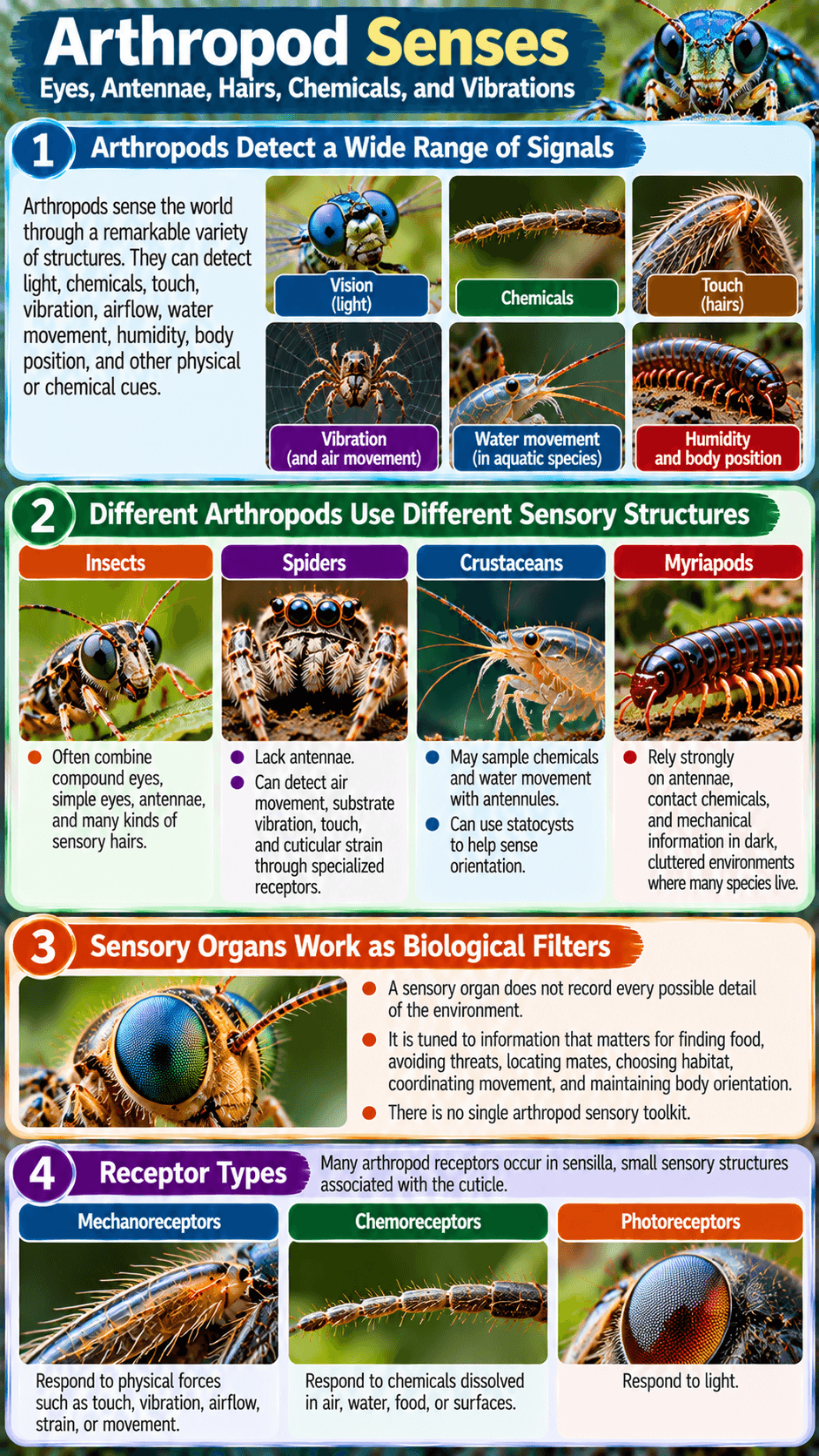
Arthropods detect light, chemicals, touch, vibration, airflow, water movement, body strain, gravity, and other physical or chemical cues through specialized receptor cells. Many of these receptors occur in sensilla, small sensory structures associated with the cuticle. This sensory diversity is another example of the broader adaptive range found among arthropods.
The North Carolina State University overview of insect senses groups insect receptors broadly into mechanoreceptors, chemoreceptors, and photoreceptors. That framework is useful across arthropod sensory biology even though the exact organs differ among lineages.
A mechanoreceptor responds to physical forces such as touch, vibration, airflow, strain, or movement. A chemoreceptor responds to chemicals dissolved in air, water, food, or surfaces. A photoreceptor responds to light. Other receptors can detect temperature, humidity, body position, or related environmental variables.
Why Arthropod Senses Are So Diverse
Different Habitats Contain Different Useful Signals
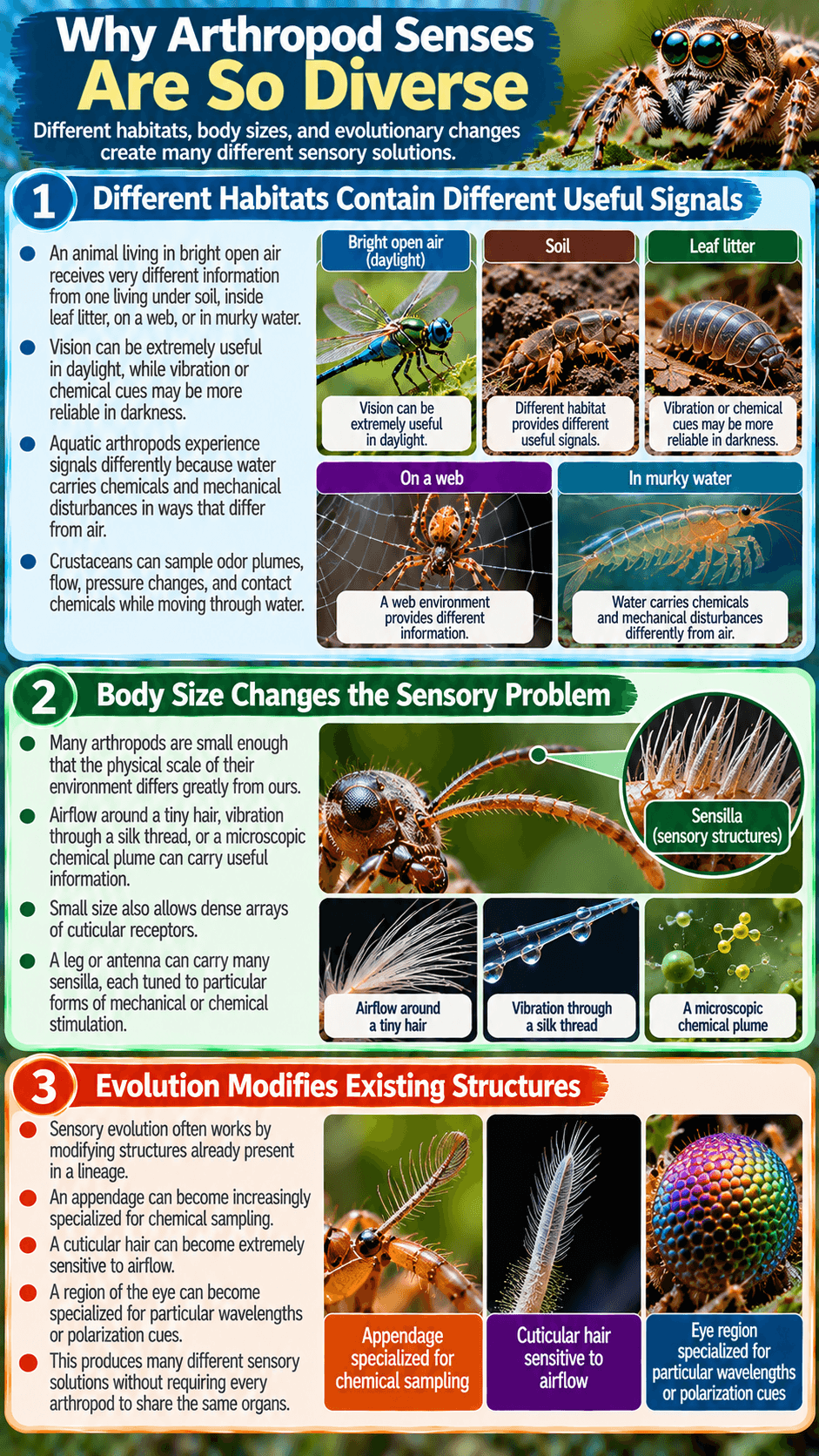
An animal living in bright open air receives very different information from one living under soil, inside leaf litter, on a web, or in murky water. Vision can be extremely useful in daylight, while vibration or chemical cues may be more reliable in darkness.
Aquatic arthropods also experience signals differently because water carries chemicals and mechanical disturbances in ways that differ from air. Crustaceans can sample odor plumes, flow, pressure changes, and contact chemicals while moving through water.
Body Size Changes the Sensory Problem
Many arthropods are small enough that the physical scale of their environment differs greatly from ours. Airflow around a tiny hair, vibration through a silk thread, or a microscopic chemical plume can carry useful information.
Small size also allows dense arrays of cuticular receptors. A leg or antenna can carry many sensilla, each tuned to particular forms of mechanical or chemical stimulation.
Evolution Modifies Existing Structures
Sensory evolution often works by modifying structures already present in a lineage. An appendage can become increasingly specialized for chemical sampling, a cuticular hair can become extremely sensitive to airflow, or a region of the eye can become specialized for particular wavelengths or polarization cues.
This produces many different sensory solutions without requiring every arthropod to share the same organs.
Compound Eyes
What a Compound Eye Is
A compound eye is made of many repeated optical units called ommatidia. Each ommatidium samples light from part of the visual field, and the nervous system combines signals across the eye to extract information about motion, direction, contrast, color, and spatial structure.
The common phrase that a compound eye creates hundreds of completely independent pictures is misleading. The visual system does not simply present the animal with a grid of tiny separate photographs. Neural processing integrates information across many photoreceptor inputs.
What Compound Eyes Are Good At
Compound eyes can be especially effective at detecting movement and rapid changes in light. Their performance varies greatly with eye size, number and arrangement of ommatidia, photoreceptor properties, habitat, and activity pattern.
NC State Extension notes that compound eyes in insects contain many small lenses and are effective at detecting movement. Some insects also discriminate colors, including wavelengths humans cannot see.
Compound Eyes Are Not Universal
Many insects and crustaceans have compound eyes, but not every arthropod does. Spiders have simple lens eyes rather than insect-like compound eyes. Some cave-dwelling or parasitic arthropods have reduced eyes or can be functionally blind.
Eye type therefore helps identify particular groups, but compound vision cannot be used as a definition of Arthropoda.
Simple Eyes and Ocelli
What Ocelli Detect
Ocelli are simple light-sensitive eyes found in many insects and other arthropods. They generally have much simpler optics than compound eyes and often contribute information about light intensity, horizon position, or rapid changes in illumination.
Their role varies among groups. In some flying insects, ocelli contribute to stabilization and orientation. In others, they may be reduced or absent.
Spider Eyes Are Also Simple Eyes
Spiders have multiple camera-type simple eyes rather than compound eyes. The number, arrangement, size, and optical performance differ substantially among spider families.
Jumping spiders are strongly visual and have enlarged principal eyes capable of detailed spatial vision. Many web-building spiders rely more heavily on vibration and mechanical cues even though they still possess eyes.
This contrast illustrates a recurring theme in arthropod senses: the presence of an organ does not tell us how important it is behaviorally.
Antennae and Antennules

Insect Antennae Are Multi-Purpose Sensory Organs
Adult insects have one pair of antennae. They often carry chemoreceptors used for odor detection, but their functions extend beyond smell.
The NC State Extension insect guide describes antennae as primarily involved in smell while also noting roles in sensing humidity, vibration, and air movement. Different insects have highly different antennal shapes because sensory demands vary.
A moth antenna, beetle antenna, mosquito antenna, and ant antenna can therefore look very different while following the same basic segmented appendage plan.
Crustacean Antennules Combine Chemical and Mechanical Sampling
Many crustaceans have two pairs of prominent anterior sensory appendages: antennules and antennae. Their first pair, the antennules, can be especially important for chemical and mechanical information.
A review of the crustacean antennule as a sensory organ describes sensilla that detect chemicals, vibration, touch, water flow, and the animal’s own movements. In some decapods, rhythmic antennule flicking actively samples the surrounding water.
This is an important difference from imagining smell as passive. By moving a sensory appendage through water, a crustacean changes how chemical and mechanical information reaches its receptors.
Chelicerates Do Not Have Antennae
Spiders, scorpions, ticks, mites, horseshoe crabs, and other chelicerates lack antennae. They gather sensory information through eyes, chelicerae, pedipalps, legs, cuticular hairs, slit organs, and other receptors instead.
Antennae are therefore important in insects, myriapods, and crustacean lineages, but they are not a universal arthropod trait.
Chemoreception: Smell and Taste Without a Human Nose
What Chemoreception Means
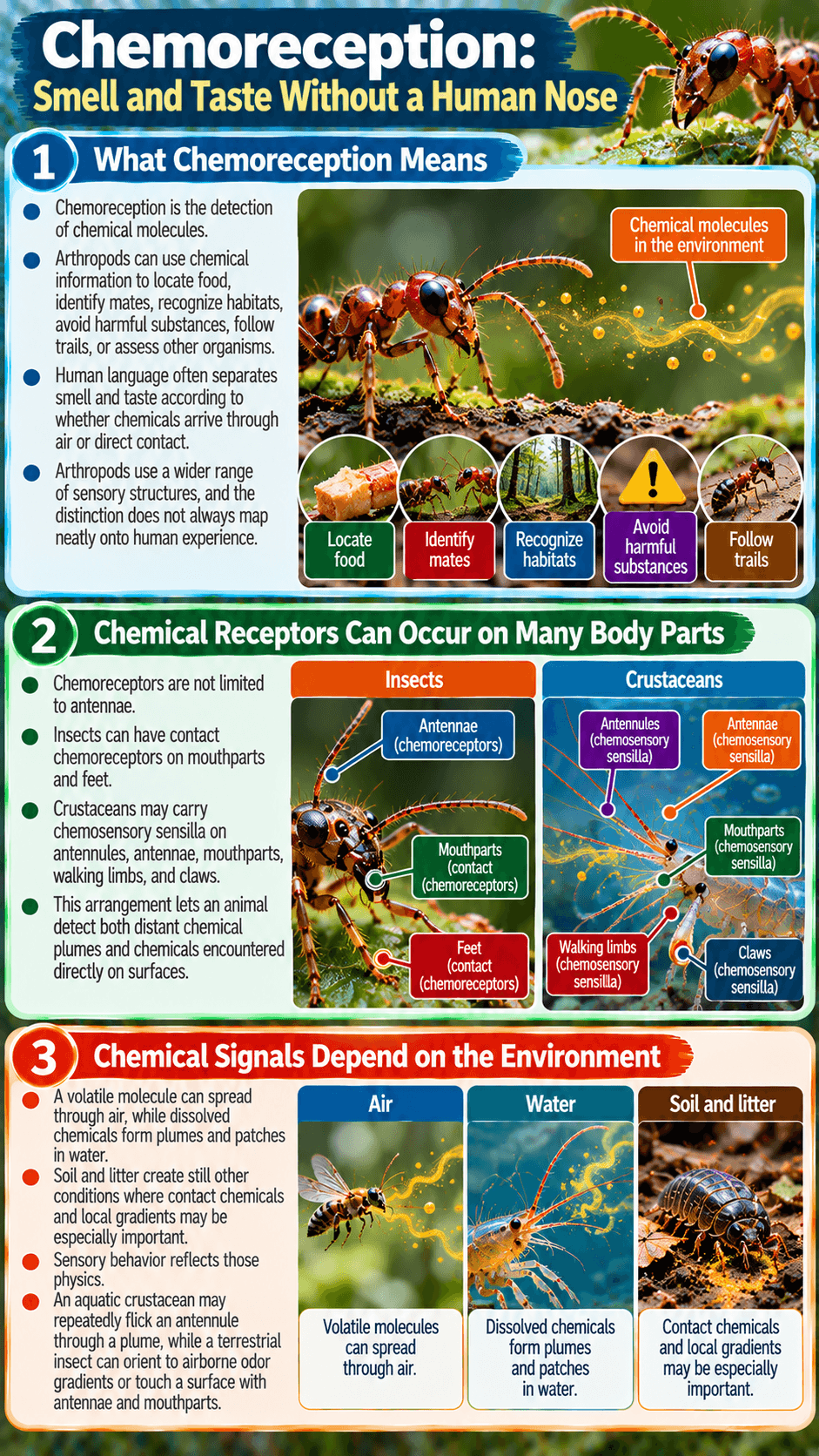
Chemoreception is the detection of chemical molecules. Arthropods can use chemical information to locate food, identify mates, recognize habitats, avoid harmful substances, follow trails, or assess other organisms.
Human language often separates smell and taste according to whether chemicals arrive through air or direct contact. Arthropods use a wider range of sensory structures, and the distinction does not always map neatly onto human experience.
Chemical Receptors Can Occur on Many Body Parts
Chemoreceptors are not limited to antennae. Insects can have contact chemoreceptors on mouthparts and feet. Crustaceans may carry chemosensory sensilla on antennules, antennae, mouthparts, walking limbs, and claws.
A comparative review of crustacean olfaction describes parallel sensory pathways involving chemosensory and combined chemo-mechanosensory sensilla on multiple appendages. That arrangement lets an animal detect both distant chemical plumes and chemicals encountered directly on surfaces.
Chemical Signals Depend on the Environment
A volatile molecule can spread through air, while dissolved chemicals form plumes and patches in water. Soil and litter create still other conditions where contact chemicals and local gradients may be especially important.
Sensory behavior reflects those physics. An aquatic crustacean may repeatedly flick an antennule through a plume, while a terrestrial insect can orient to airborne odor gradients or touch a surface with antennae and mouthparts.
Sensory Hairs and Mechanoreception
Tactile Hairs Detect Contact
Many arthropod hairs are sensory structures rather than simple body covering. When a tactile hair bends, mechanical force can be transmitted to receptor cells at its base.
This gives arthropods distributed touch sensitivity across legs, antennae, mouthparts, and body surfaces. Contact with vegetation, prey, predators, neighboring animals, or the substrate can be detected without a centralized skin sense like ours.
Trichobothria Detect Air or Fluid Movement
Trichobothria are very fine mechanosensory hairs that can respond to tiny movements of the surrounding air or water. They are especially well studied in spiders.
Research on spider sensory systems identifies trichobothria as sensitive detectors of airflow associated with biologically important events such as nearby movement. The receptors work because a slender hair moves in response to fluid motion and transfers that mechanical movement to sensory neurons. Sensory feedback also helps coordinate arthropod locomotion during walking, climbing, swimming, and other forms of movement.
Different Hairs Can Be Tuned to Different Stimuli
Hair length, stiffness, socket structure, position, and surrounding fluid all affect what a mechanosensory hair detects best. One sensillum may respond to direct touch, another to airflow, and another to water movement.
Calling every sensory hair a touch receptor therefore oversimplifies a highly diverse sensory system.
Spider Slit Sensilla and Cuticular Strain

What Slit Sensilla Detect
Spiders possess slit sensilla, narrow sensory structures embedded in the cuticle. They detect small deformations and strains produced when forces act on the exoskeleton.
A review of spider mechanosensitive receptors highlights tactile hairs, trichobothria, and slit sensilla as three major mechanoreceptor types used to study how mechanical stimuli are converted into neural signals.
Slit sensilla are particularly useful for sensing loads generated by movement, contact, body posture, or vibration transmitted through a surface.
Lyriform Organs Combine Multiple Slits
When several slit sensilla occur together in a grouped pattern, they can form a lyriform organ. These structures often occur near leg joints, where cuticular strain changes during movement and external loading.
The arrangement acts somewhat like a biological strain gauge. The comparison is useful mechanically, but the organ is part of a living sensory system with neural filtering and behavioral context.
Vibration Can Reach a Spider Through the Ground or Web
Mechanical signals can travel through silk, soil, leaves, bark, or other substrates. Spiders can use these vibrations to detect prey, potential mates, predators, or changes in the web.
Not every vibration means the same thing. Frequency, amplitude, timing, direction, and signal pattern all matter, and the importance of a signal depends on the spider’s ecology.
Vibration and Substrate-Borne Signals in Other Arthropods
Insects Can Detect Substrate Vibrations
Many insects use receptors in the legs or body to detect vibrations traveling through plants, soil, or other surfaces. These signals can help coordinate courtship, social behavior, predator avoidance, or prey detection.
Some insects that appear quiet to humans communicate extensively through vibrations that never become strong airborne sounds.
Myriapods Use Mechanical Information in Confined Habitats
Centipedes and millipedes frequently move through litter, soil spaces, bark, or other structurally complex habitats. Antennae and body mechanoreceptors help them navigate obstacles and detect contact with the environment.
The importance of vibration versus touch differs among species, but mechanical sensing is especially useful where vision is limited.
Hearing and Sound Detection
Arthropods Do Not Need Ears Like Ours
Sound is a mechanical disturbance, and arthropods can detect it with several kinds of structures. Some insects have tympanal organs with thin membranes that vibrate in response to airborne sound.
Others use antennal structures or fine hairs to detect particle motion or near-field air movement rather than pressure changes in exactly the same way a human ear does.
Tympanal Organs Evolved in Different Body Locations
Insect tympanal organs can occur on legs, thorax, abdomen, or other body regions depending on the lineage. This repeated evolution shows that hearing is a functional category rather than one fixed insect anatomical design.
The signals detected may include mate calls, predator sounds, or environmental cues.
Statocysts and Sensing Orientation
What a Statocyst Does
A statocyst is a balance or orientation organ found in some crustaceans. It contains sensory hairs and a movable mass or particles that shift with gravity and body movement.
As the statolith or particles press against different sensory hairs, the nervous system receives information about orientation. This helps the animal determine which way is up and how its body is positioned.
Crustacean Statocysts Can Use External Particles
In some decapod crustaceans, the statocyst is located near the base of an antennule and may contain mineral particles or grains. Historical zoological descriptions characterize these structures as balancing organs lined with sensory hairs.
The details differ among crustaceans, so a single shrimp example should not be treated as the universal statocyst design.
Vision Beyond Brightness and Motion
Color Vision Varies Widely
Many insects and crustaceans can discriminate wavelengths, but the range and number of photoreceptor classes differ among species. Some arthropods detect ultraviolet light, while others emphasize different spectral regions.
There is no universal arthropod color palette. An animal’s visual system reflects habitat, activity time, communication, feeding, and evolutionary history.
Some Arthropods Detect Polarized Light
Polarized light contains directional information in the orientation of light waves. Some insects and crustaceans can detect polarization patterns and use them for tasks such as orientation, water detection, contrast enhancement, or signaling.
A recent review of polarization vision in arthropods emphasizes that insects and crustaceans can use polarization information in multiple ecological contexts. This ability should not be generalized to every arthropod species.
Specialized Vision Does Not Mean Better Vision in Every Way
An arthropod may be excellent at detecting movement, polarized light, ultraviolet patterns, or rapid flicker while having lower spatial detail than humans. Sensory systems are optimized for particular tasks rather than arranged on one scale from poor to superior.
This is why phrases such as “compound eyes are better than human eyes” or “spiders have bad vision” are usually too broad to be scientifically useful.
Temperature and Humidity Sensing
Small Changes Can Matter to Water Balance
For small terrestrial arthropods, temperature and humidity can strongly affect dehydration risk and activity. Sensory receptors that detect moisture or temperature help animals choose safer microhabitats.
An insect may move toward humid shelter, a myriapod may remain beneath damp litter, and a tick may adjust its position according to local temperature and moisture conditions.
Hygroreception Can Be Integrated With Other Senses
Humidity receptors can occur near chemical and mechanical sensilla, especially on antennae. The nervous system then combines multiple forms of information rather than treating each sense as an isolated channel.
That integration is important because odor, airflow, temperature, and humidity often change together in natural environments.
Proprioception: Sensing the Arthropod’s Own Body
Movement Requires Internal Feedback
An arthropod needs information not only about the external environment but also about its own limbs and joints. Proprioceptors provide feedback about joint angle, muscle tension, cuticular strain, and movement.
Without that information, coordinating six, eight, or dozens of legs would be far more difficult.
Cuticular Receptors Can Monitor Strain
Campaniform sensilla in insects and slit sensilla in spiders are examples of receptors that respond to deformation of the exoskeleton. They provide information about load and mechanical stress.
This feedback can help adjust walking, gripping, takeoff, landing, or posture in real time.
How Sensory Information Guides Behavior
Finding Food
Predatory arthropods may combine vibration, airflow, vision, and chemical cues to locate prey. Herbivores can use plant odors, contact chemicals, color, shape, or texture. Chemical and mechanical information can also guide arthropod feeding strategies by helping animals locate and evaluate food.
Aquatic crustaceans may follow dissolved chemical plumes while simultaneously detecting water movement. The most useful sensory combination depends on the ecology of the species.
Avoiding Predators
Rapid visual motion, sudden airflow, substrate vibration, or direct touch can trigger escape. Some arthropods respond before a predator makes physical contact because mechanoreceptors detect the disturbance created by approach.
Others rely on camouflage until touch or movement crosses a behavioral threshold.
Finding Mates and Communicating
Arthropods can communicate through pheromones, visual displays, vibration, sound, touch, or combinations of these channels. A signal that works in bright open habitat may be ineffective under soil or at night.
Sensory systems and communication systems therefore evolve together. A signal is useful only if the intended receiver can detect it.
Common Arthropod Sensory Myths
All Arthropods Have Compound Eyes
No. Compound eyes are common in insects and crustaceans, but spiders have simple lens eyes and many arthropods have reduced or absent eyes.
All Arthropods Have Antennae
No. Chelicerates, including spiders and scorpions, do not have antennae. They use other appendages and cuticular receptors for sensing.
Compound Eyes Produce Hundreds of Separate Pictures
No. Each ommatidium samples part of the visual field, but the nervous system integrates information across the eye. The result is a processed visual representation, not a wall of independent photographs.
Spiders Sense Everything Through Their Webs
No. Web vibrations are important for many web-building spiders, but spiders also use tactile hairs, trichobothria, slit sensilla, chemical receptors, and eyes. Many spider species do not rely on capture webs at all.
Arthropods Have Poor Senses Because Their Brains Are Small
No. Sensory performance depends on receptor design, neural processing, and ecological function rather than brain size alone. Many arthropods detect mechanical, chemical, or visual information that humans cannot perceive directly.
Comparing Sensory Systems Across Arthropods
| Group or example | Prominent sensory structures | Important signals | Key caution |
|---|---|---|---|
| Many insects | Compound eyes, ocelli, antennae, sensory hairs | Light, chemicals, touch, vibration, airflow, humidity | Not every insect uses every sense equally |
| Spiders | Simple eyes, tactile hairs, trichobothria, slit sensilla, tarsal receptors | Vision, touch, airflow, vibration, strain, chemicals | No antennae and no compound eyes |
| Many crustaceans | Compound eyes, antennules, antennae, chemosensory sensilla, statocysts | Light, dissolved chemicals, water movement, touch, orientation | Sensory anatomy varies widely among lineages |
| Myriapods | Antennae, tactile and chemical sensilla, simple eyes in some groups | Touch, chemicals, humidity, vibration, light | Vision can be reduced in soil-dwelling species |
FAQ
Do Arthropods Have the Same Five Senses as Humans?
Not in a simple one-to-one way. Arthropods detect light, chemicals, mechanical forces, temperature, humidity, body position, and other cues, but their sensory organs and categories do not map neatly onto human sight, smell, taste, hearing, and touch.
What Do Arthropod Antennae Sense?
Depending on the group and receptor type, antennae can detect chemicals, touch, airflow, vibration, humidity, temperature, or other information. Crustacean antennules can also sample water movement and dissolved chemical plumes.
Can Spiders Hear?
Spiders can detect mechanical disturbances in air and substrates using sensory hairs and other mechanoreceptors. Whether a particular response should be called hearing depends on the signal and receptor system, but spiders can detect biologically useful vibrations and air movements without vertebrate-like ears.
Do Arthropods See Ultraviolet or Polarized Light?
Some do. Ultraviolet sensitivity occurs in many insects, while polarization sensitivity is documented in various insects and crustaceans. These abilities differ among species and should not be treated as universal arthropod traits.
Final Thoughts
Arthropod senses are diverse because arthropods live in very different sensory environments. Compound eyes and simple eyes detect light, antennae and antennules sample chemicals and mechanical signals, sensory hairs detect touch and fluid movement, slit sensilla measure strain, and statocysts can help aquatic crustaceans maintain orientation.
No single structure defines how arthropods perceive the world. A spider can depend heavily on vibration without antennae, a crustacean can actively flick an antennule through an odor plume, and an insect can combine vision, chemical cues, airflow, humidity, and touch. Their sensory systems reveal the same pattern seen throughout Arthropoda: a shared body framework repeatedly modified for different habitats, behaviors, and ecological challenges.

Ethan Walker is the founder and research editor of Animal Fact Central. He creates and reviews educational animal facts content using trusted wildlife, pet care, and science-based sources. His work focuses on making animal behavior, adaptations, habitats, and species facts clear, accurate, and engaging for everyday readers.
Read More Details About Ethan Walker: https://animalfactcentral.com/ethan-walker/