
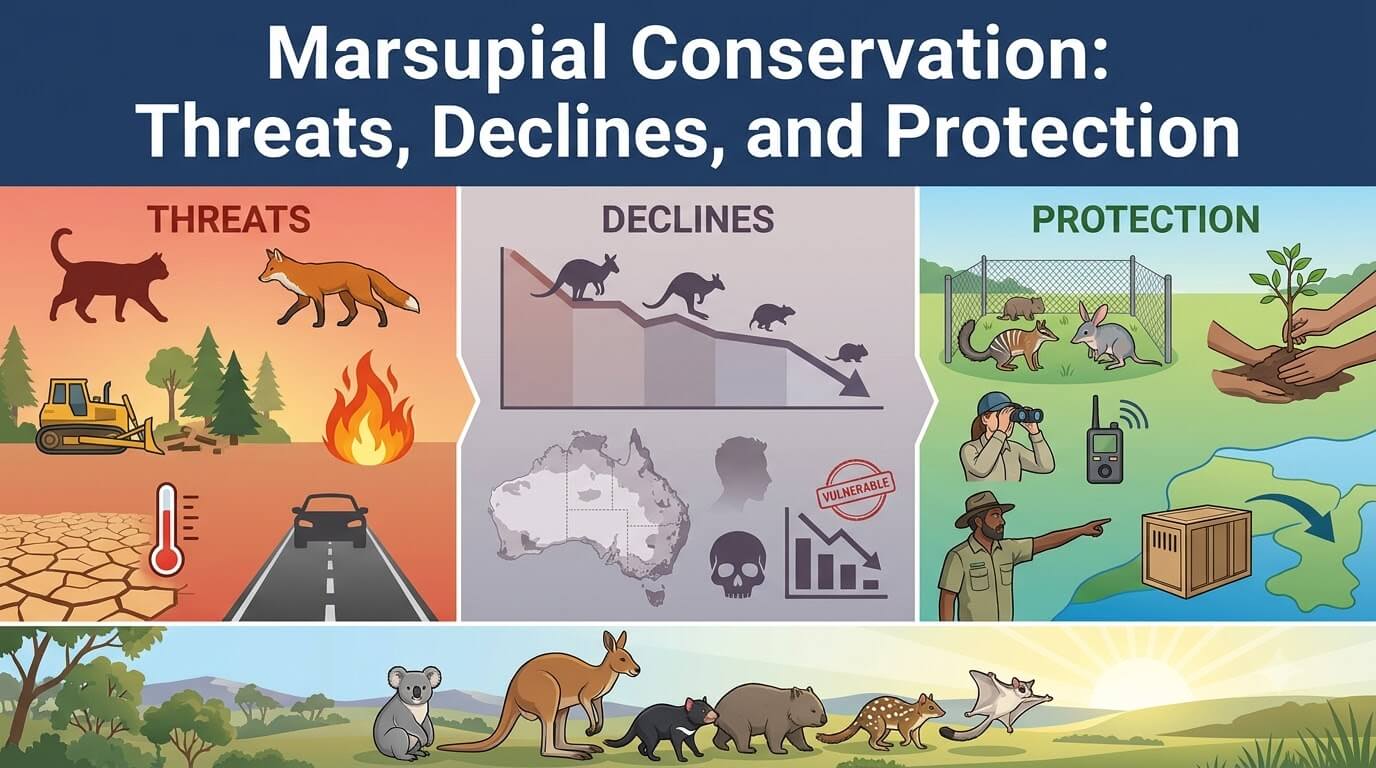
Marsupial conservation is not one crisis with one solution. Living marsupials range from widespread adaptable species to animals surviving only in small, managed populations. Their threats include habitat loss and fragmentation, introduced predators, altered fire regimes, climate change, disease, road mortality, invasive competitors, and the loss of shelter or food resources. The importance of each threat varies sharply by species and region.
Australia contains many of the world’s best-known marsupial conservation challenges, including the greater bilby, numbat, Gilbert’s potoroo, several quolls and bettongs, koala populations in eastern Australia, and the Tasmanian devil. Conservation also matters for marsupials in New Guinea and the Americas, where forest loss, hunting, roads, fire, and other pressures can affect local species. Effective protection therefore depends on species-specific evidence rather than the assumption that every marsupial faces the same problem.
Quick Answer
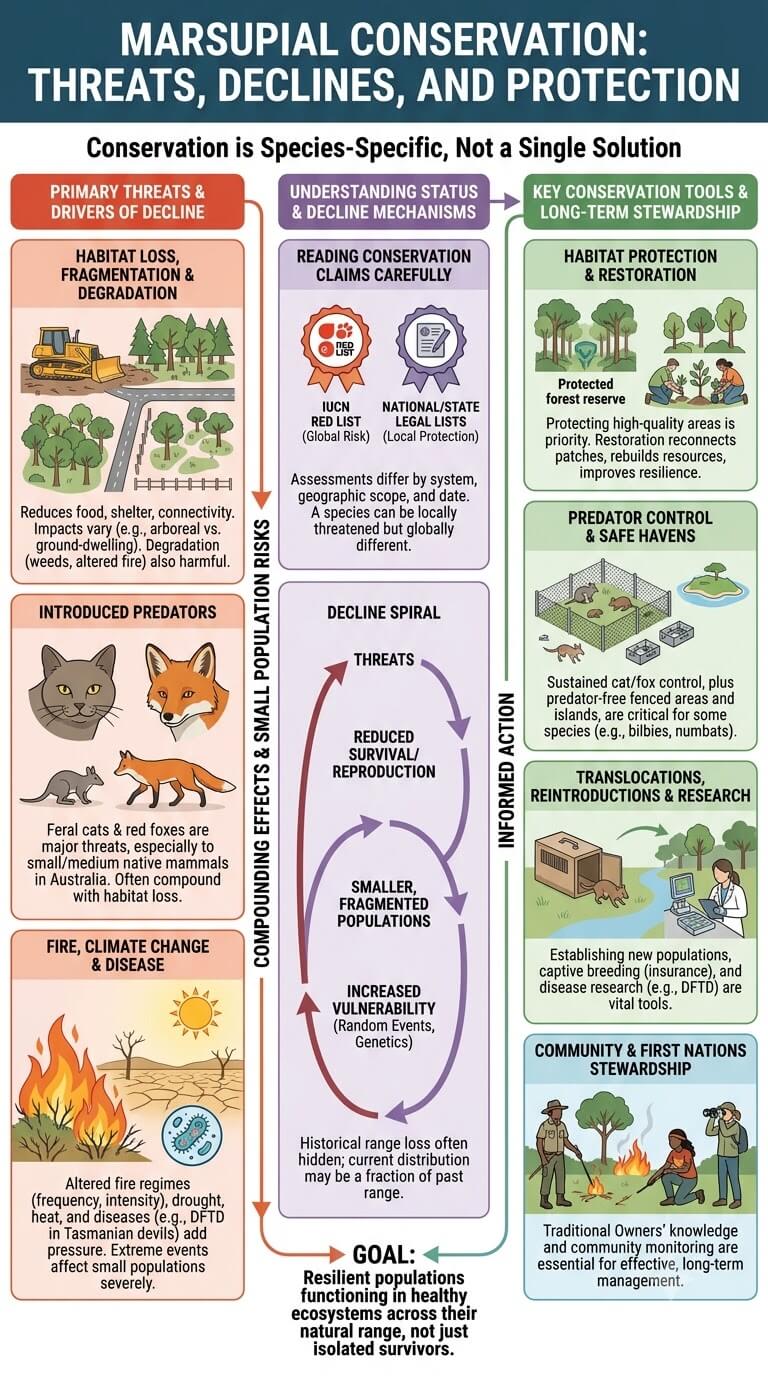
Marsupials decline when threats reduce survival, reproduction, habitat quality, or the ability of populations to stay connected. In Australia, introduced predators such as feral cats and red foxes have been especially damaging to many small and medium-sized native mammals. Habitat loss, degradation, inappropriate fire regimes, drought, disease, and road mortality add further pressure.
Conservation responses include protecting and restoring habitat, reducing introduced predators, creating predator-free islands and fenced areas, reintroducing locally extinct populations, managing fire, monitoring populations and disease, reducing roadkill, supporting genetic diversity, and working with Traditional Owners and local communities.
Conservation status must also be read carefully. The IUCN Red List categories describe extinction risk under a global assessment framework, while countries and states can use separate legal listing systems. A species or population may therefore have different labels at different geographic or legal scales.
Why Marsupial Conservation Is Species-Specific
One lineage, very different conservation situations
Marsupialia includes animals as different as kangaroos, tree-kangaroos, opossums, wombats, marsupial moles, gliders, bilbies, devils, and tiny insect-eating dasyurids. Their population sizes, ranges, reproductive rates, diets, predators, habitats, and sensitivity to disturbance are not interchangeable.
A widespread generalist can sometimes persist in fragmented or urban landscapes, while a habitat specialist may decline after losing a narrow food resource or shelter type. A small ground-dwelling marsupial may be highly vulnerable to introduced cats, while a large arboreal species may be more affected by tree loss, drought, heat, and roads.
This is why broad statements such as “marsupials are endangered” or “marsupials are doing well” are both misleading. Conservation needs to be assessed at the species, population, and place level.
Global status and legal status are not the same thing
The IUCN Red List is a global extinction-risk system. National governments, states, provinces, and territories may also maintain legal threatened-species lists. These systems can use different categories, boundaries, dates, and criteria.
For example, Australia’s federal Environment Protection and Biodiversity Conservation Act can list a species, subspecies, or particular population for national legal protection. A state may have another listing, and the IUCN may assess the species globally across its entire natural range.
A responsible conservation article should therefore name the assessment system when a status is important and should check the date of the source rather than treating a status label as permanent.
Habitat Loss, Fragmentation, and Degradation
Food and shelter disappear together
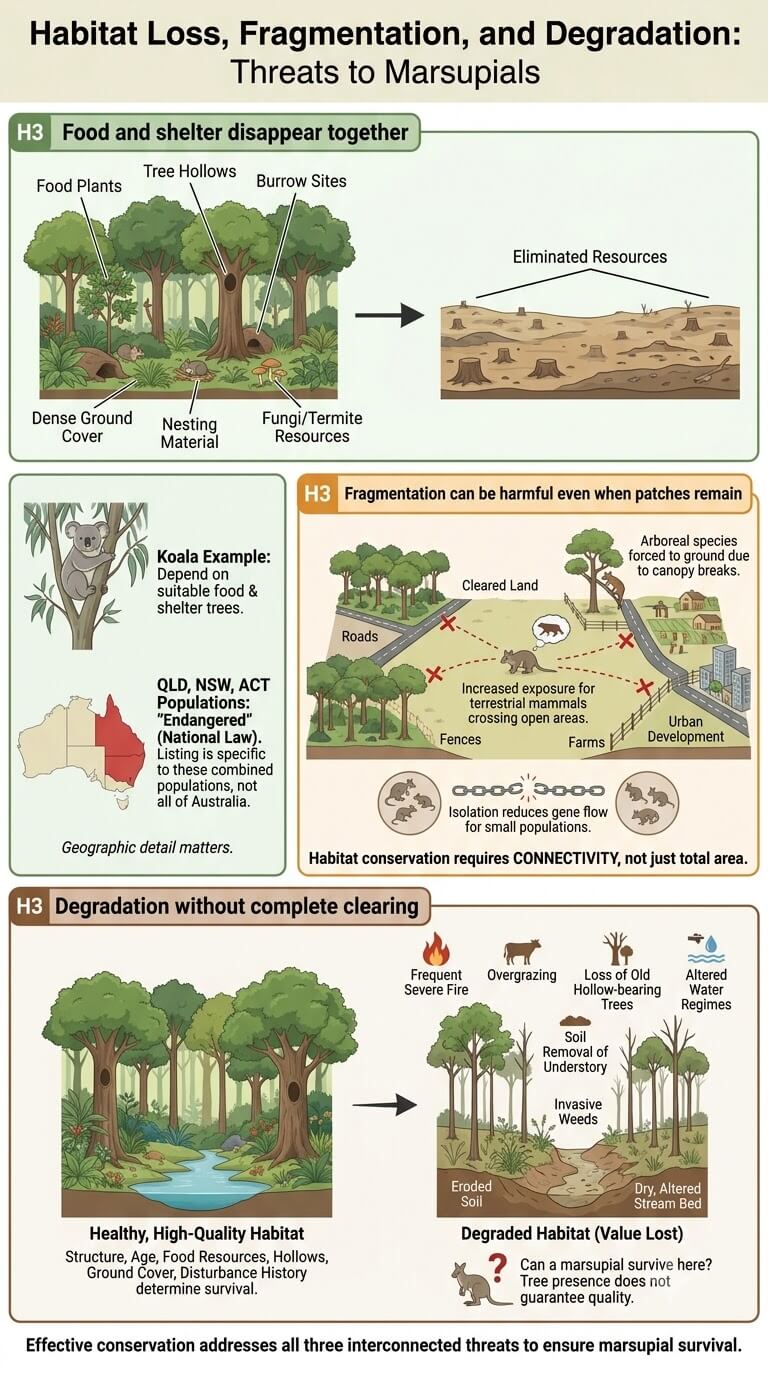
Habitat loss is more than the removal of vegetation. It can eliminate food plants, tree hollows, burrow sites, dense ground cover, nesting material, fungi, termite resources, or travel corridors. Different marsupials depend on different combinations.
Koalas are an obvious example because they depend on suitable food and shelter trees. The Australian Government notes that the combined koala populations of Queensland, New South Wales, and the Australian Capital Territory are listed as Endangered under national environmental law. The current national koala listing applies specifically to those combined populations rather than every koala in Australia.
That geographic detail matters. Victoria and South Australia contain koalas too, but the federal listing cited above is defined for Queensland, New South Wales, and the ACT.
Fragmentation can be harmful even when patches remain
A landscape can retain trees yet become difficult for wildlife to use if habitat patches are isolated by roads, cleared land, fences, farms, or urban development. Fragmentation can reduce movement between feeding sites and make it harder for young animals to disperse.
For arboreal marsupials, canopy breaks can force more movement on the ground. For small terrestrial mammals, crossing open areas can increase exposure to predators. For species with small remaining populations, isolation can also reduce gene flow.
Habitat conservation therefore includes connectivity, not only the number of hectares left on a map.
Degradation without complete clearing
Habitat can lose value without being completely destroyed. Frequent severe fire, overgrazing, invasive weeds, loss of old hollow-bearing trees, altered water regimes, soil compaction, or removal of dense understory can reduce shelter and food.
A forest is not automatically high-quality habitat simply because trees are present. Structure, age, food resources, hollows, ground cover, and disturbance history can determine whether a marsupial can survive there.
Introduced Predators
Feral cats
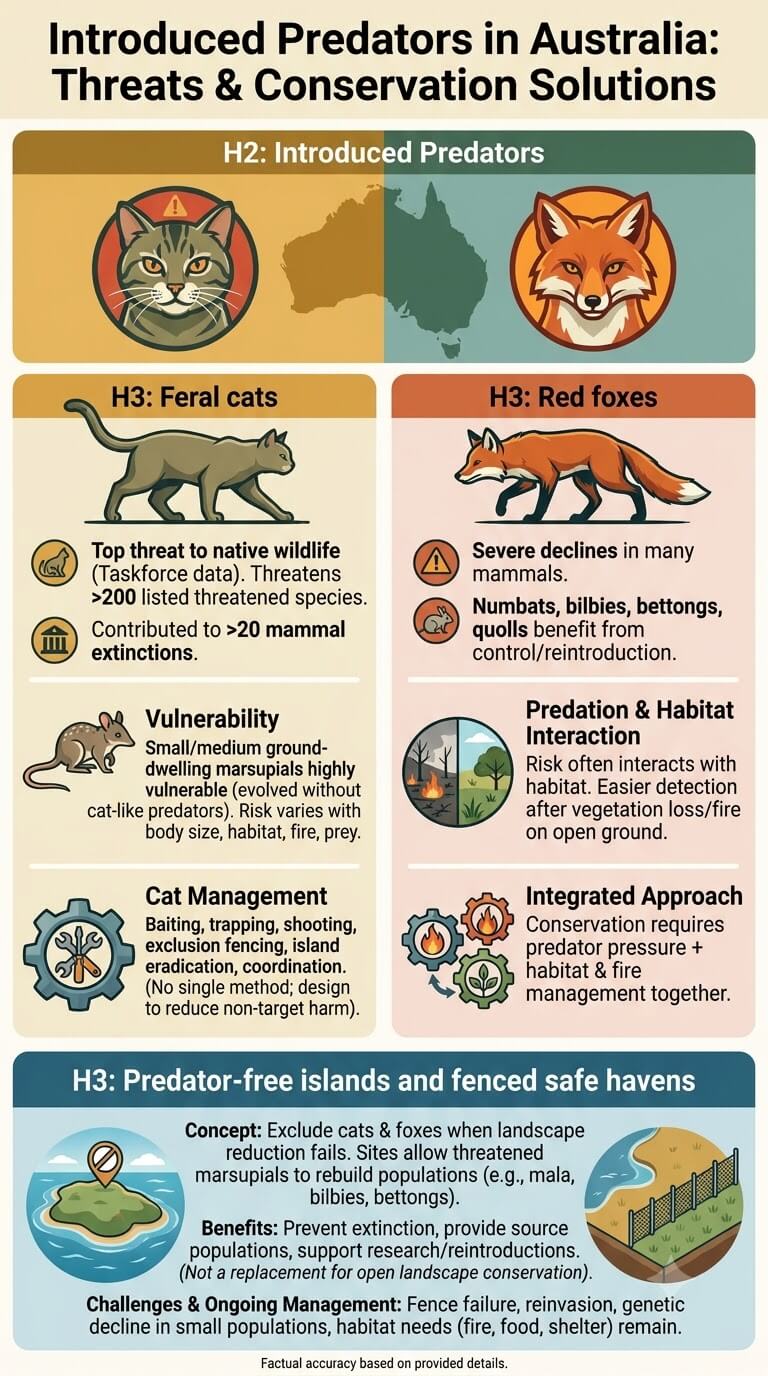
Feral cats are one of Australia’s most important threats to native wildlife. The Australian Government’s Feral Cat Taskforce states that feral cats threaten more than 200 nationally listed threatened species and have contributed to the extinction of more than 20 Australian mammal species.
Small and medium-sized ground-dwelling marsupials can be especially vulnerable because many evolved without a cat-like predator. Risk varies with body size, habitat cover, fire, prey availability, and whether populations are protected by predator control or exclusion.
Cat management can include baiting, trapping, shooting, exclusion fencing, island eradication, and landscape-scale coordination. No single method is appropriate everywhere, and control programs must be designed to reduce harm to non-target wildlife.
Red foxes
European red foxes have also caused severe declines in many Australian mammals. Species such as numbats, bilbies, bettongs, and some quolls have benefited from intensive fox control or reintroduction into areas where foxes are absent or heavily managed.
Predation risk often interacts with habitat. A small marsupial crossing open ground after vegetation loss or intense fire may be easier for a fox or cat to detect and capture.
This interaction means conservation cannot always solve predator pressure separately from habitat and fire management.
Predator-free islands and fenced safe havens
When introduced predators cannot be reduced enough across a whole landscape, conservation programs sometimes use islands or fenced mainland areas where cats and foxes are excluded. These sites can allow threatened marsupials to rebuild populations under lower predation pressure.
Australia has used this approach for species such as mala, bilbies, bettongs, and other small mammals. Safe havens are not a replacement for conserving open landscapes, but they can prevent extinction, provide source populations, and support research or future reintroductions.
They also require ongoing management. Fences can fail, predators can reinvade, genetic diversity can decline in small populations, and habitat inside the enclosure still needs suitable fire, food, and shelter conditions.
Fire, Drought, and Climate Change
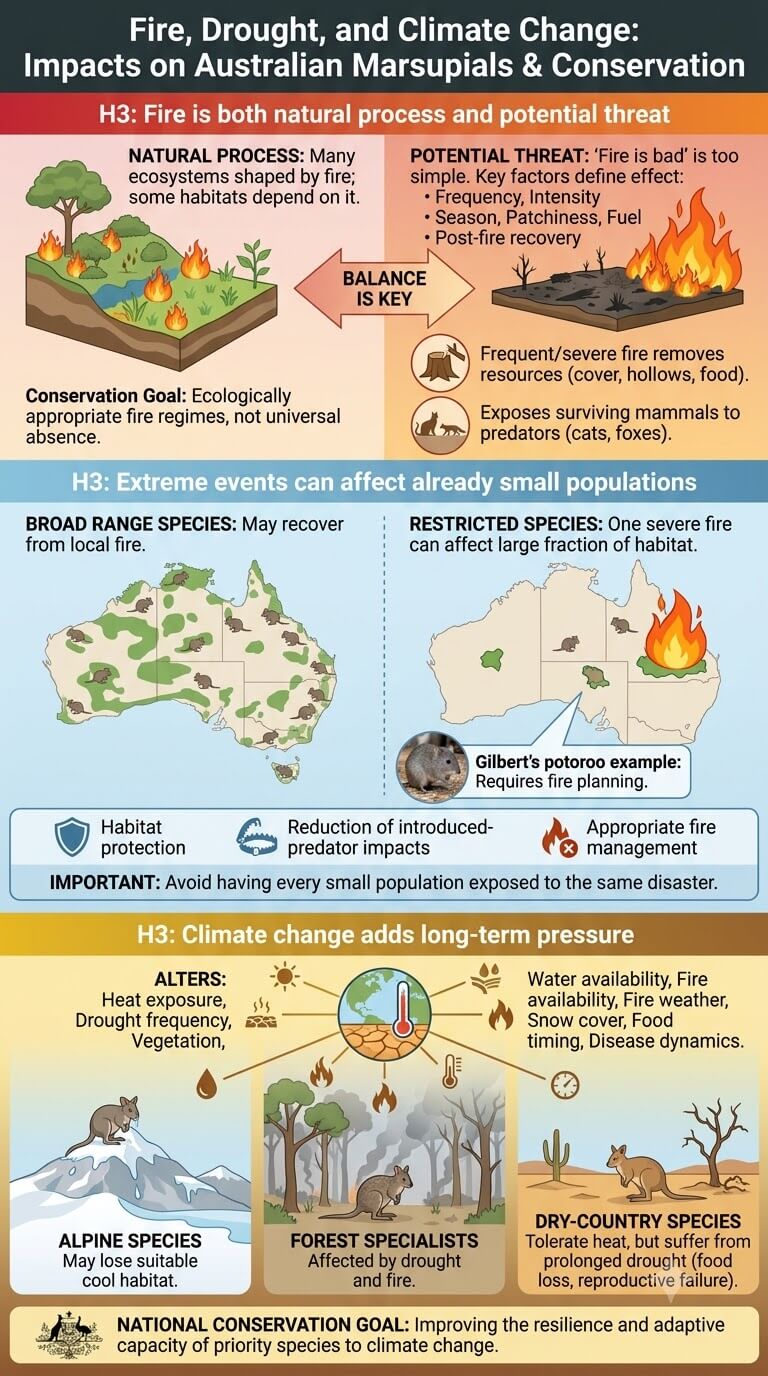
Fire is both natural process and potential threat
Fire has shaped many Australian ecosystems for long periods, and some marsupial habitats depend on particular fire patterns. The conservation problem is not simply “fire is bad.” Frequency, intensity, season, patchiness, fuel, and post-fire recovery determine the effect.
Frequent or severe fires can remove ground cover, tree hollows, food plants, or fungal resources before they recover. Fire can also expose surviving small mammals to cats and foxes.
Conversely, long fire exclusion can also change habitat structure in ecosystems that historically experienced fire. Conservation therefore aims for ecologically appropriate fire regimes, not a universal absence of burning.
Extreme events can affect already small populations
A species with a broad range may recover from a local fire more easily than a species confined to one or two sites. For a tiny population, one severe fire can affect a large fraction of the remaining habitat at once.
Gilbert’s potoroo provides a strong example of why fire planning matters for highly restricted species. Australian Government conservation information identifies appropriate fire management, habitat protection, and reduction of introduced-predator impacts among important actions for this marsupial.
The smaller the number of populations, the more important it becomes to avoid having every population exposed to the same disaster.
Climate change adds long-term pressure
Climate change can alter heat exposure, drought frequency, vegetation, water availability, fire weather, snow cover, food timing, and disease dynamics. The effect differs among marsupials.
Alpine species may lose suitable cool habitat. Forest specialists can be affected by drought and fire. Dry-country species may tolerate heat well yet still suffer when prolonged drought reduces food or causes repeated reproductive failure.
The Australian Government’s current Threatened Species Action Plan includes improving the resilience and adaptive capacity of priority species to climate change as a national conservation goal.
Disease and Wildlife Health
Devil Facial Tumour Disease
The Tasmanian devil is one of the clearest examples of a disease causing major wildlife decline. Devil Facial Tumour Disease is a transmissible cancer spread between devils, particularly through biting during social and mating interactions.
Tasmania’s official Save the Tasmanian Devil Program describes DFTD as the central threat driving its coordinated conservation response. The program combines monitoring, research, disease management, insurance populations, genetics, roadkill work, and other measures aimed at maintaining an ecologically functional wild devil population.
DFTD is Tasmanian-devil-specific. It should not be presented as a disease threatening marsupials generally.
Why disease can be especially dangerous in small populations
Disease risk increases when populations are already small, fragmented, genetically limited, or stressed by habitat loss and other pressures. A new pathogen can reduce survival or reproduction faster than a small population can replace losses.
At the same time, disease outcomes are complex. Exposure does not always mean population extinction, and wildlife populations can evolve changing resistance, tolerance, or behavior.
Conservation therefore relies on surveillance, diagnosis, long-term population monitoring, and careful movement of animals between sites.
Roads, Vehicles, and Human-Wildlife Conflict
Road mortality
Roads create both direct and indirect risks. Vehicles kill animals, while road corridors can fragment habitat and change movement. Species that travel long distances or move between feeding and shelter sites may cross roads repeatedly.
Tasmanian devils, koalas, wombats, kangaroos, wallabies, and opossums can all be killed on roads. The conservation significance depends on local population size and road density.
Mitigation can include wildlife crossings, fencing, speed reduction, warning systems, road design changes, and hotspot monitoring.
Conflict with people
Marsupials may enter farms, gardens, roofs, roadsides, or urban parks. Conflict can lead to illegal killing, trapping, poisoning, or poorly planned relocation.
Conservation is strongest when management reduces the cause of conflict, such as access to buildings or food waste, rather than relying on people to handle wildlife themselves.
Wild animals should not be captured, relocated, or treated without following local wildlife laws and professional guidance.
Why Some Marsupials Have Declined So Severely
Compounding threats
Species rarely face one threat in isolation. Habitat loss can reduce shelter while cats and foxes increase mortality. Fire can remove vegetation and make surviving animals easier to catch. Drought can reduce reproduction while roads continue killing dispersing individuals.
These combinations are called compounding threats because their combined effect can be greater than addressing each factor separately would suggest.
Recovery planning therefore tries to identify which threats are currently limiting a population rather than simply listing every possible danger.
Small populations face additional risks
Once a population becomes very small, random events matter more. A poor breeding season, disease outbreak, fire, flood, or skewed sex ratio can have a large proportional effect.
Small populations can also lose genetic variation. Conservation breeding and translocation programs may therefore consider pedigree, genetics, founder numbers, and connectivity in addition to simply increasing head counts.
Historical range loss can hide how much has changed
A species that is locally common within its remaining range may still have lost most of its historical distribution. Western quolls and numbats are examples of Australian marsupials whose current distribution represents only a fraction of former mainland range.
This is why conservation status cannot be inferred by visiting one successful reserve or seeing an animal frequently in one location.
Conservation Tools That Can Work
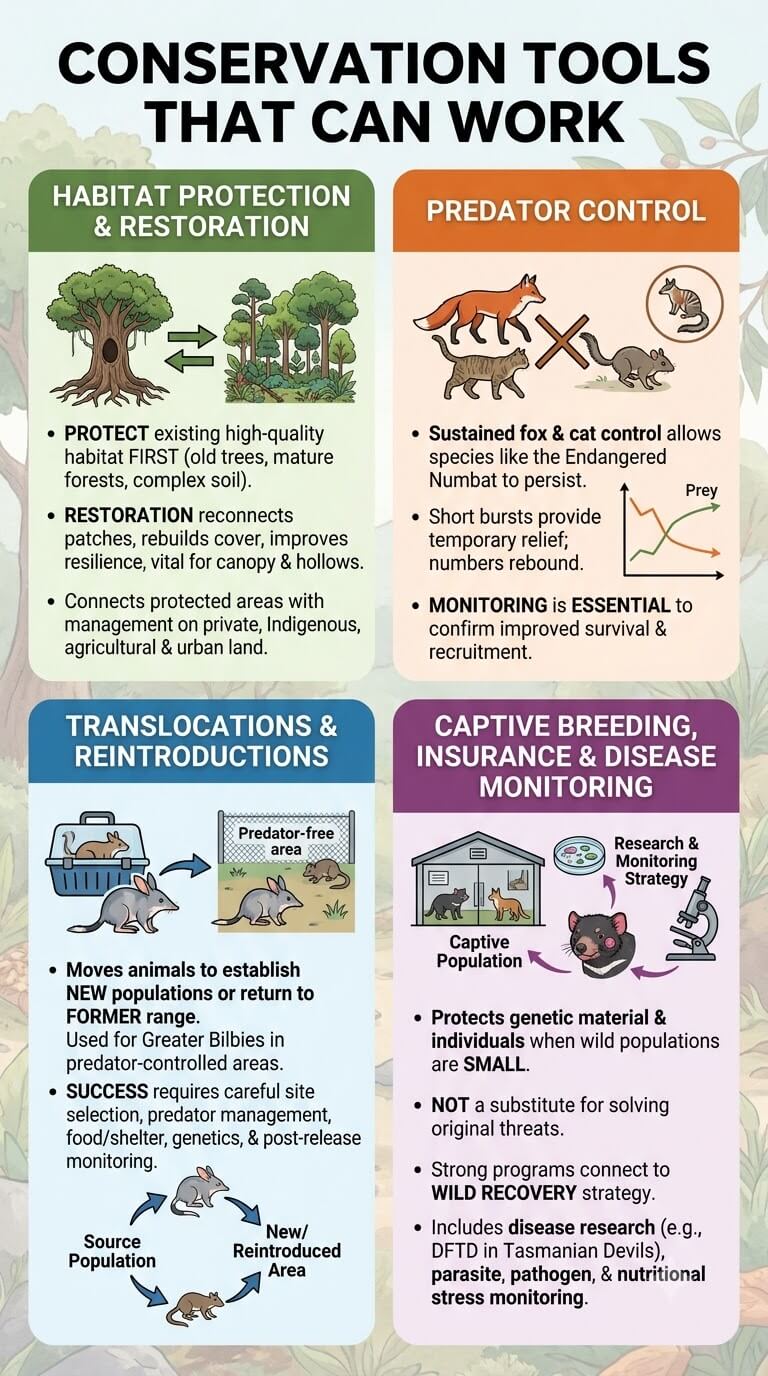
Habitat protection and restoration
Protecting remaining high-quality habitat is often the first priority because restoration cannot instantly replace old tree hollows, mature forests, complex soil communities, or long-established food resources.
Restoration can reconnect patches, rebuild ground cover, re-establish food plants, control weeds, and improve fire resilience. For arboreal marsupials, canopy connectivity and hollow-bearing trees can be especially important.
Landscape conservation is usually more durable when it combines protected areas with management on private, Indigenous, agricultural, and urban land.
Predator control
Fox and cat control has allowed several Australian marsupial populations to persist or expand. The numbat is a well-known example. Current Australian Government material lists the species as Endangered under the EPBC Act and notes that long-term fox control at key sites has supported numbat conservation.
Predator management works best when it is sustained. Short bursts of control may provide temporary relief, but predator numbers can rebound or animals can recolonize from surrounding areas.
Monitoring is essential so managers can test whether predator reduction actually improves survival and recruitment of the threatened species.
Translocations and reintroductions
Translocation moves animals for conservation purposes. Reintroduction returns a species to part of its former range. These tools can establish new populations, reduce the risk of one disaster affecting every animal, and restore ecological functions.
Greater bilbies have been translocated into managed areas in parts of southern Australia where introduced predators are excluded or intensively controlled. Current Australian Government programs also support threat management across important bilby habitat.
Moving animals is not automatically successful. Site selection, predator pressure, food, shelter, genetics, disease screening, post-release monitoring, and long-term funding all matter.
Captive breeding and insurance populations
Captive or intensively managed populations can protect genetic material and individuals when wild populations become dangerously small. They may also provide animals for release.
However, captive breeding is not a substitute for solving the reasons a species disappeared. If habitat remains unsuitable or predators remain uncontrolled, releasing more animals can simply recreate the original decline.
The strongest programs connect ex situ management with a realistic strategy for wild recovery.
Disease research and monitoring
For Tasmanian devils, conservation requires understanding DFTD transmission, tumor biology, genetics, population responses, and possible vaccination or other disease interventions.
For other species, health monitoring may focus on parasites, emerging pathogens, nutritional stress, or diseases whose effects become more severe in fragmented populations.
Wildlife health is therefore part of conservation biology, not a separate veterinary issue.
People, Traditional Owners, and Long-Term Stewardship
First Nations knowledge and land management
Aboriginal and Torres Strait Islander peoples have managed Australian landscapes for tens of thousands of years. Contemporary threatened-species programs increasingly include Indigenous ranger groups, Traditional Owners, cultural knowledge, and on-Country management.
Fire management is one area where long-term place-based knowledge can be particularly important, but partnerships can also include monitoring, predator control, habitat restoration, research, and decisions about culturally significant species.
Respectful conservation treats First Nations communities as partners and rights holders, not simply as sources of information for externally designed projects.
Community monitoring and citizen science
Public observations can help locate populations, document roadkill, monitor breeding, record disease signs, or detect changes in distribution. Citizen science is most useful when observations are collected through programs that can verify records and integrate them with professional monitoring.
Community involvement also increases the number of people who understand why habitat, predators, roads, and responsible pet ownership matter.
For threatened animals, location information may need to be protected if publishing exact sites could increase disturbance or illegal collection.
How to Read Conservation Claims Carefully
Check the species, place, date, and assessment system
A claim such as “the koala is endangered” needs context. Which populations? Under which law or Red List? On what date? A national legal listing may cover part of a species’ range, while a global assessment has a different scope.
The same applies to claims that a species has “recovered.” A population can increase at one reintroduction site while the species remains threatened overall.
Conservation information changes, so official databases and recent assessments should take priority over old headlines.
Population estimates are not exact head counts
Wildlife numbers are often estimated from surveys, detection models, telemetry, genetics, camera traps, tracks, or other indirect evidence. Confidence intervals and uncertainty can be large, especially for rare, nocturnal, fossorial, or wide-ranging marsupials.
A precise-looking number can therefore create false confidence if the method and date are missing.
Trends such as increasing, stable, or declining may sometimes be more informative than one headline population total.
Conservation success should be measured over time
A release event is not proof of recovery. A fenced population surviving for one year is not the same as a self-sustaining wild population. A predator-control program is useful only if it improves the condition of the species it is meant to protect.
Long-term monitoring asks whether animals survive, reproduce, disperse, retain genetic diversity, and maintain or expand suitable habitat.
Good conservation is therefore adaptive: managers test actions, measure results, and change strategy when evidence shows something is not working.
Common Conservation Myths
All marsupials are endangered
False. Conservation status varies widely. Some marsupials are widespread and adaptable, while others are threatened, highly localized, or dependent on intensive management.
Australia has protected marsupials simply because it is isolated
Too simple. Geographic isolation helped shape Australia’s evolutionary history, but modern marsupials face habitat change, introduced predators, disease, roads, fire, and climate pressures. Isolation alone does not protect present-day populations.
Removing one threat automatically recovers a species
Usually false. Reducing cats may not be enough if habitat is too fragmented. Restoring vegetation may not help if fox predation remains high. Captive breeding cannot solve a disease or habitat problem by itself.
Most successful programs combine several actions targeted at the threats currently limiting survival and reproduction.
Predator-free fencing is the final conservation solution
False. Fenced safe havens can be extremely valuable, especially for species that cannot currently persist with cats and foxes. But they need continuous management and represent only part of the species’ ecological and geographic future.
Long-term conservation ideally includes secure populations across multiple sites and, where feasible, restoration of functioning populations in larger landscapes.
Every wildfire has the same conservation effect
False. Fire effects depend on intensity, frequency, season, habitat type, patchiness, previous fire history, and species ecology. Some landscapes require fire, while repeated severe fire can be devastating.
FAQ
What are the biggest threats to marsupials?
There is no universal ranking. In Australia, introduced cats and foxes, habitat loss, altered fire regimes, climate pressures, roads, and disease are major threats for different species. In other regions, habitat conversion, hunting, forest loss, roads, and local disturbance may be more important. The dominant threat must be identified species by species.
How are endangered marsupials protected?
Protection can include legal listing, habitat conservation, predator control, fire management, road mitigation, disease monitoring, captive breeding, predator-free islands or fenced areas, translocation, reintroduction, genetic management, and partnerships with Traditional Owners and local communities.
Why are feral cats such a problem for Australian marsupials?
Feral cats are efficient predators of small and medium-sized native animals. Many Australian marsupials fall within vulnerable body-size ranges, and predation can become even more severe where fire or habitat loss removes cover. Cat impacts vary among species and landscapes, so management is targeted rather than identical everywhere.
Can marsupial populations recover?
Yes. Some populations have responded to predator control, reintroduction, protected habitat, and long-term management. Recovery is usually measured over many years and depends on whether the original causes of decline are reduced enough for animals to survive and reproduce without constant emergency intervention.
Final Thoughts
Marsupial conservation works best when it begins with the species, population, and place rather than a general story about marsupials. Habitat loss, fragmentation, cats, foxes, fire, climate change, disease, roads, and small-population effects can combine in different ways. Protection therefore ranges from maintaining connected forests and controlling predators to building safe havens, restoring former populations, managing fire, monitoring disease, and supporting Indigenous and community stewardship. Conservation status also needs careful interpretation because IUCN assessments, national laws, and state or regional lists do not always use the same geographic scope or category. The encouraging part is that management can work: predator control has supported species such as numbats, reintroductions have returned several marsupials to parts of former ranges, and coordinated disease research is helping Tasmanian devil conservation. The long-term goal is not simply to keep animals alive behind fences or in isolated reserves, but to maintain multiple resilient populations able to function in healthy ecosystems across as much of their natural range as practical.

Ethan Walker is the founder and research editor of Animal Fact Central. He creates and reviews educational animal facts content using trusted wildlife, pet care, and science-based sources. His work focuses on making animal behavior, adaptations, habitats, and species facts clear, accurate, and engaging for everyday readers.
Read More Details About Ethan Walker: https://animalfactcentral.com/ethan-walker/