
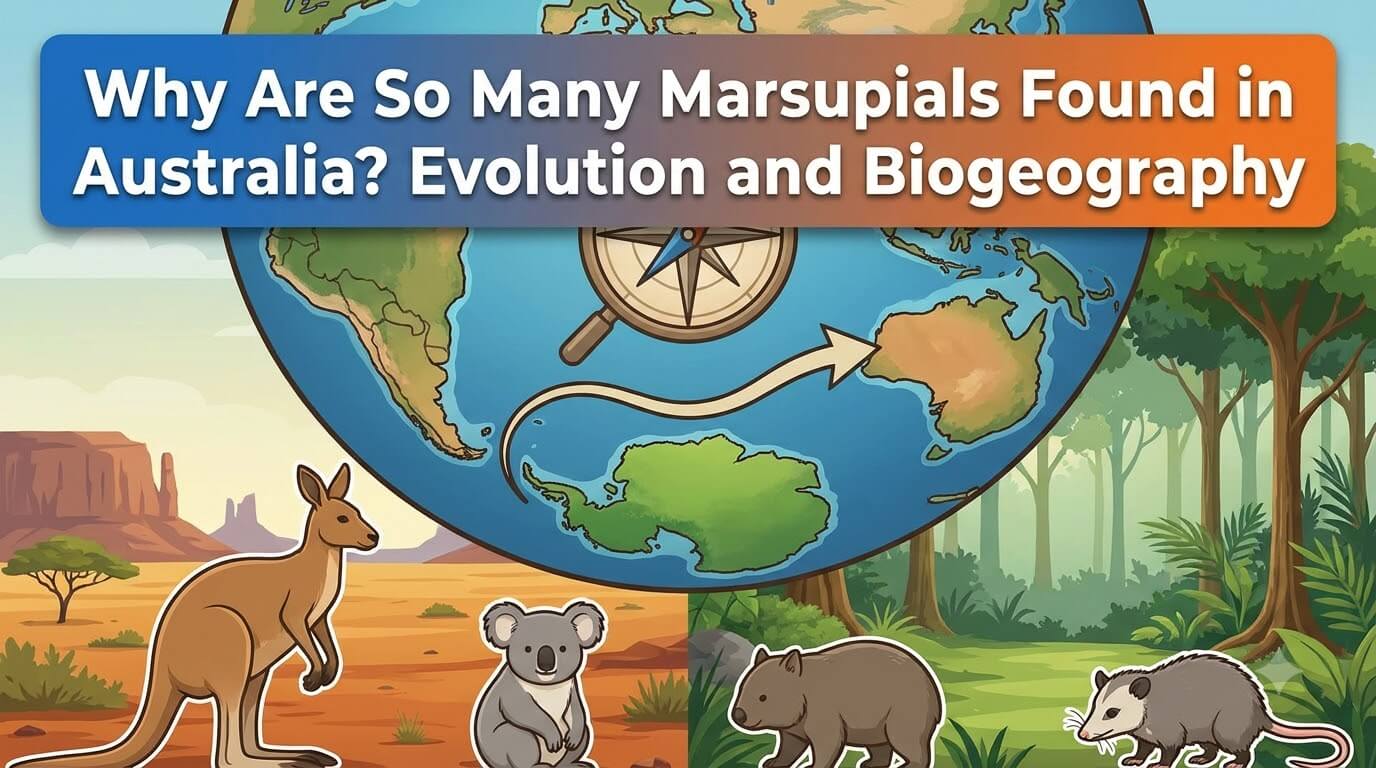
So many marsupials are found in Australia because the continent became a major center of marsupial diversification after ancestral marsupial lineages reached the southern landmasses and Australia became increasingly isolated. That history involved dispersal through regions that were once connected very differently from today, especially South America, Antarctica, and Australia, followed by tens of millions of years of evolution in changing Australian environments.
Australia is not where every marsupial lineage began, and marsupials are not exclusively Australian. Living opossums, shrew opossums, and monitos del monte remain in the Americas. Fossil relatives of marsupials also have a much broader history across the Northern Hemisphere. The Australian story makes sense only when fossil evidence, evolutionary relationships, continental movement, extinction, and modern distribution are considered together.
Quick Answer
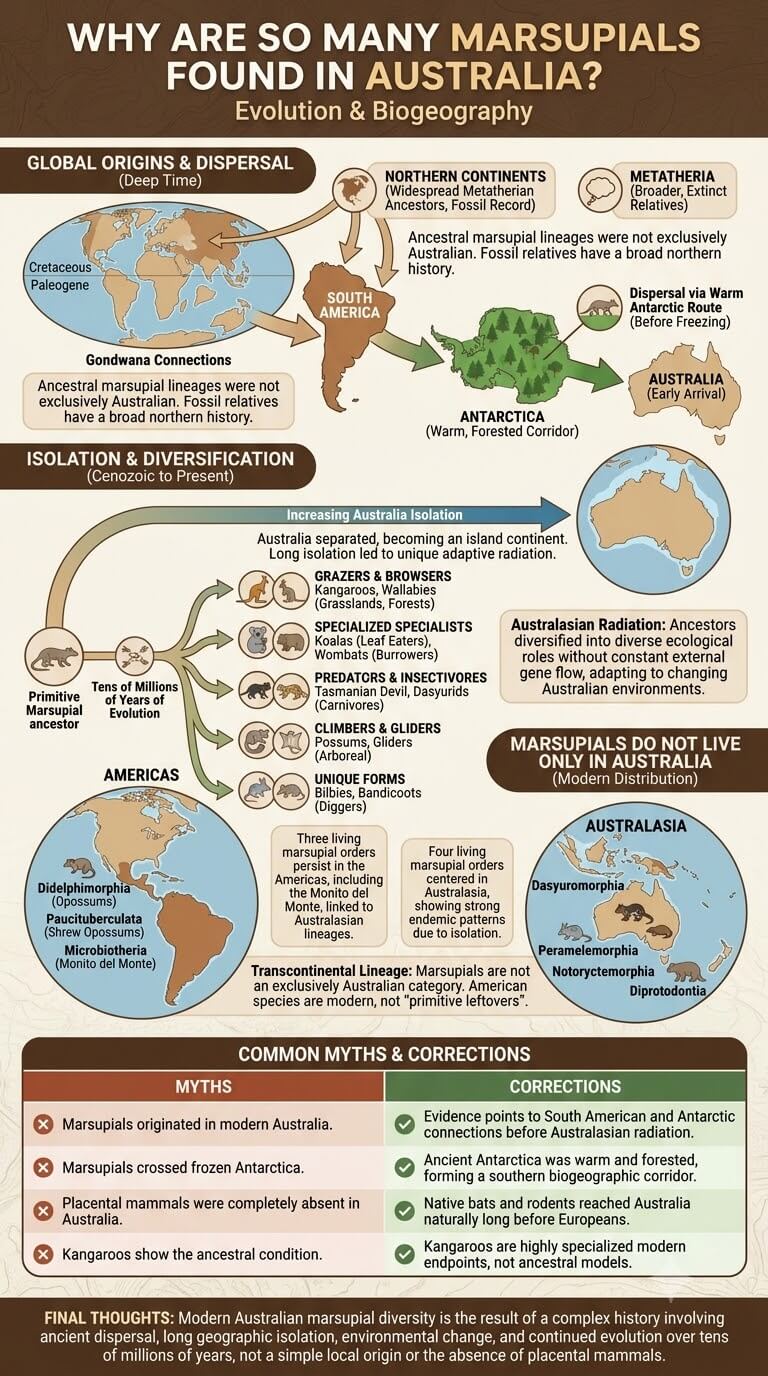
Living marsupials are especially diverse in Australia because ancestors of the Australasian marsupial radiation reached the region in deep time, after which Australia’s long geographic isolation gave those lineages extensive opportunities to diversify. Their descendants evolved into grazers, browsers, leaf specialists, predators, insect eaters, burrowers, climbers, gliders, and many other forms.
The route is usually reconstructed through southern continents that were once connected or much closer together. Ancestral australidelphian marsupials are thought to have moved from South America through Antarctica toward Australia when climates and geography were very different from today’s frozen Antarctic barrier. Evidence from Australia’s oldest known marsupial fossils supports a South America-Antarctica-Australia biogeographic connection, while also showing that the number and exact direction of ancient dispersal events remain subjects of research.
The modern pattern is therefore the result of history, not proof that marsupials originated in Australia or that placental mammals were biologically unable to live there.
Marsupials Do Not Live Only in Australia
Living marsupials in the Americas
Australia dominates popular images of marsupials because it contains kangaroos, wallabies, koalas, wombats, Tasmanian devils, bilbies, possums, gliders, and many other distinctive forms. Yet three living marsupial orders occur in the Americas: Didelphimorphia, Paucituberculata, and Microbiotheria.
Didelphimorphia includes American opossums. Paucituberculata includes shrew opossums of western South America. Microbiotheria includes the monito del monte lineage in southern South America. The current Mammal Diversity Database taxonomy table places these alongside the four living Australasian orders within Marsupialia.
The Virginia opossum also extends into North America, making marsupials part of the native mammal fauna of the United States. Their modern American distribution is a reminder that Marsupialia is a transcontinental lineage, not an Australian category.
Living marsupials across Australia, New Guinea, and nearby regions
The four living marsupial orders centered in Australasia are Dasyuromorphia, Peramelemorphia, Notoryctemorphia, and Diprotodontia. Together they include an enormous range of body plans and lifestyles.
Australia holds much of that diversity, but New Guinea and nearby islands are also important. Tree kangaroos, cuscuses, possums, bandicoots, dasyurids, and other marsupials occur across parts of the wider Australasian region. The distribution reflects both ancient continental history and later dispersal among land areas whose positions and connections changed through time.
Modern political boundaries are therefore poor guides to deep evolutionary history. “Australian marsupials” is useful as a geographic phrase, but it should not be mistaken for one formal evolutionary group.
Marsupials, Metatherians, and the Fossil Record
Living Marsupialia versus broader extinct metatherian relatives
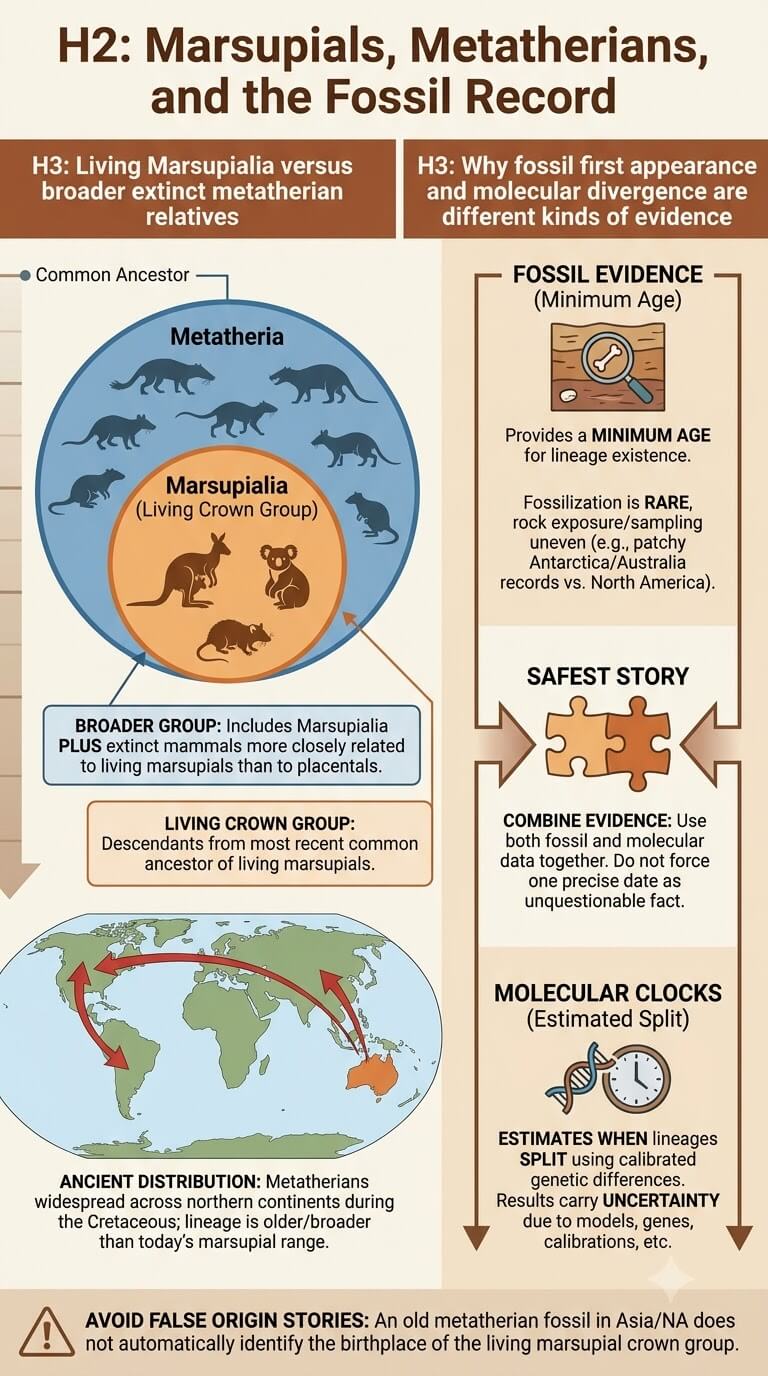
One of the most important distinctions in marsupial evolution is between Marsupialia and Metatheria. Marsupialia refers to the living marsupial crown group and its descendants from their most recent common ancestor. Metatheria is broader. It includes Marsupialia plus extinct mammals more closely related to living marsupials than to placental mammals.
This matters because many ancient fossils described casually as “marsupial relatives” are not necessarily members of living Marsupialia. A major review of early metatherian evolution shows that metatherians were widespread across northern continents during the Cretaceous and that the fossil record of the lineage is much older and geographically broader than today’s marsupial distribution.
Using Metatheria and Marsupialia interchangeably can create false origin stories. An old metatherian fossil in Asia or North America does not automatically identify the birthplace of the living marsupial crown group.
Why fossil first appearance and molecular divergence are different kinds of evidence
A fossil provides a minimum age for the existence of a lineage or anatomical form. Molecular clocks estimate when lineages may have split using genetic differences calibrated against fossils and other evidence. These tools answer related but different questions.
The first fossil found from a group is almost never the exact first individual of that lineage. Fossilization is rare, rocks of the right age are unevenly exposed, and sampling differs drastically among continents. Antarctica and Australia have much patchier early mammal records than many North American deposits.
Molecular estimates also carry uncertainty because results depend on models, genes, calibrations, and taxon sampling. The safest evolutionary story therefore combines fossil and molecular evidence instead of forcing one precise date to serve as unquestionable fact.
South America, Antarctica, and Australia in Deep Time
Ancient continental connections
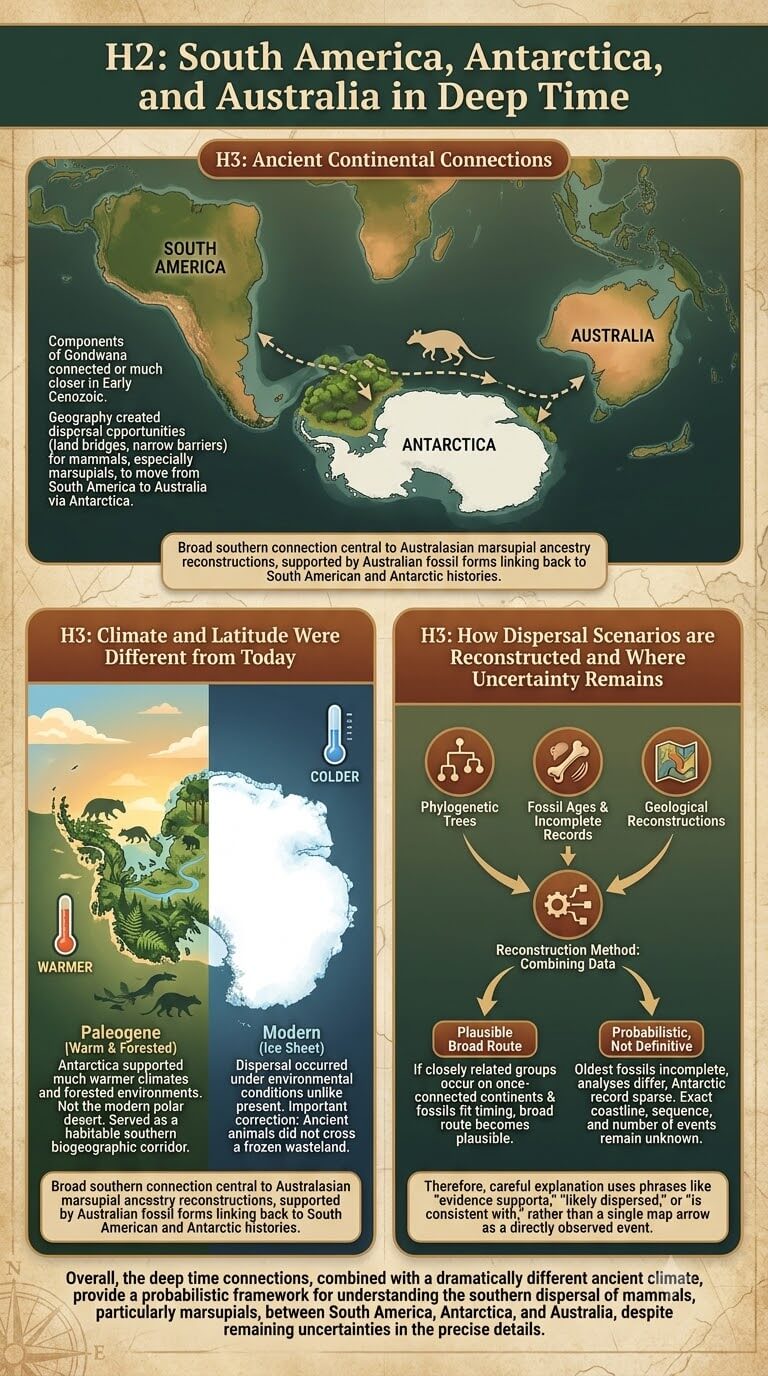
South America, Antarctica, and Australia were once components of Gondwana and remained connected or much closer together long after the supercontinent began breaking apart. That geography created dispersal opportunities that do not exist on a modern map.
By the early Cenozoic, mammals could potentially move through southern land connections or narrow barriers between South America and Antarctica and onward toward Australia. The exact timing, route, and number of dispersal events are debated, but the broad southern connection is central to most reconstructions of Australasian marsupial ancestry.
Australian fossil sites provide important support. Early Cenozoic marsupials from Australia include forms with relationships that point back toward South American and Antarctic histories, even though Australia’s earliest fossil record is incomplete.
Climate and latitude were different from today
The phrase “marsupials crossed Antarctica” can be misleading if it makes readers picture animals walking across the modern Antarctic ice sheet. Antarctica was not always the polar desert it is today.
During parts of the Paleogene, Antarctica supported much warmer climates and forested environments. Its position, ocean circulation, atmospheric greenhouse conditions, and connections to neighboring continents were different. Mammal dispersal across or through Antarctic regions therefore occurred under environmental conditions unlike those of the present.
The important correction is not that ancient animals crossed a frozen wasteland. It is that a continent now hostile to most terrestrial mammals once formed part of a much warmer southern biogeographic corridor.
How dispersal scenarios are reconstructed and where uncertainty remains
Scientists reconstruct ancient dispersal by combining phylogenetic trees, fossil ages, geological reconstructions, and the present and past ranges of lineages. If closely related groups occur on continents that were once connected, and fossils fit the timing, one or more dispersal routes can become more plausible.
Marsupials are a good example of why such reconstructions remain probabilistic. The oldest fossils are incomplete, different analyses can place extinct groups differently, and Antarctica’s mammal record is sparse. Researchers can often identify a likely broad route without knowing the exact coastline, population sequence, or number of separate crossing events.
A careful explanation therefore uses phrases such as “evidence supports,” “likely dispersed,” or “is consistent with,” rather than presenting a single map arrow as a directly observed event.
Arrival and Diversification in Australasia
Isolation and ecological opportunity
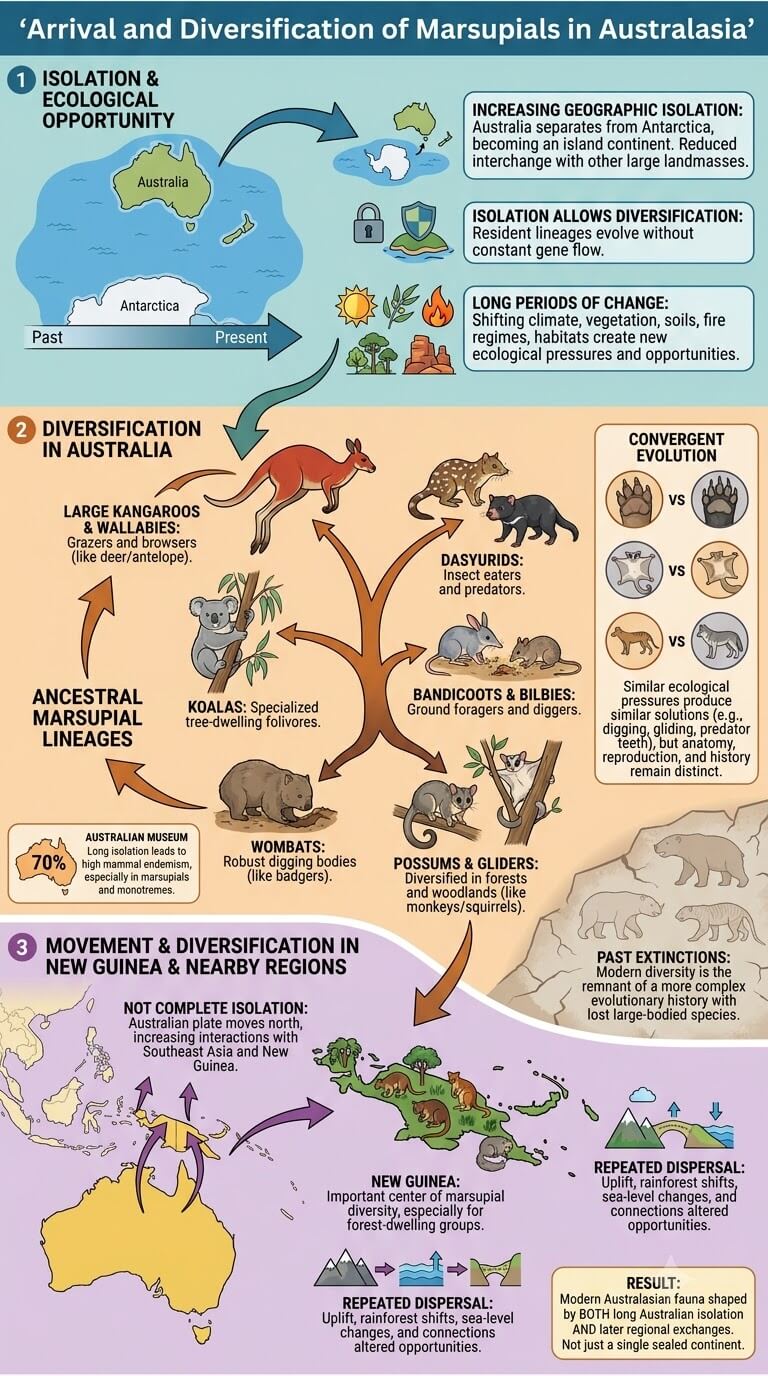
Once ancestral marsupial lineages were established in Australia, increasing geographic isolation changed the evolutionary setting. Australia separated progressively from Antarctica and became an island continent with fewer opportunities for regular interchange with other large landmasses.
Isolation does not automatically create diversity, but it can allow resident lineages to diversify without constant gene flow from the same source populations. Over long periods, changing climate, vegetation, soils, fire regimes, and habitats create different ecological opportunities and pressures.
The Australian Museum describes the continent’s high mammal endemism as a product of its long period of geographic isolation. Marsupials and monotremes show especially strong endemic patterns, although later-arriving placental mammals also became important parts of the fauna.
Diversification in Australia
Australian marsupials expanded into roles occupied by many different placental mammal groups elsewhere. Large kangaroos and wallabies became grazers and browsers. Koalas became specialized tree-dwelling folivores. Wombats evolved robust digging bodies. Dasyurids include insect eaters and predators. Bandicoots and bilbies became important ground foragers and diggers. Possums and gliders diversified in forests and woodlands.
This is not evidence that marsupials are ecological copies of placental mammals. Their anatomy, reproduction, physiology, and evolutionary histories are distinct. Similar ecological pressures can nevertheless produce convergent solutions, such as digging bodies, gliding membranes, predator-like teeth, or grazing adaptations.
Diversification also happened through extinction. The Australian marsupial fauna of the past contained lineages and large-bodied species that no longer survive. Modern diversity is only the remaining portion of a much more complex evolutionary history.
Movement and diversification in New Guinea and nearby regions
Australia did not evolve in complete isolation from every neighboring land area forever. As the Australian plate moved northward, interactions with the islands and geological systems of Southeast Asia and New Guinea increased.
New Guinea became an important center of marsupial diversity in its own right, especially for forest-dwelling groups. Uplift, rainforest expansion and contraction, sea-level change, and changing connections between land areas repeatedly altered dispersal opportunities.
The result is a modern Australasian fauna shaped by both long Australian isolation and later regional exchanges. A simple story of one sealed continent misses that second part.
Why Marsupials Persisted and Diversified in the Americas
Opossums and other American lineages
South America was not just a launch point for ancestors that eventually reached Australia. It remained a major arena of marsupial evolution. Opossums diversified widely, shrew opossums persisted in parts of the Andes, and the monito del monte lineage survived in southern temperate forests.
South America’s own history included long periods of isolation, later faunal exchange with North America, climate shifts, mountain building, rainforest change, and repeated extinctions. Marsupials responded to those changes in different ways.
The modern Virginia opossum’s presence in the United States is part of a much later northward expansion from tropical American ancestry, not evidence that today’s US marsupial fauna represents the ancient center of modern marsupial diversity.
Why South American persistence does not mean primitive leftovers
American marsupials should not be described as evolutionary leftovers waiting to be replaced. Living opossums, shrew opossums, and monitos del monte are modern species shaped by ongoing natural selection.
The same warning applies to Australian marsupials. A lineage can retain ancient anatomical features while also evolving highly specialized new traits. “Ancient lineage” and “primitive animal” are not equivalent concepts.
Survival into the present reflects a long sequence of environmental fit, population history, dispersal, extinction around them, and continued evolution.
Why the Old Competition Story Is Too Simple
Placental mammals are not simply superior competitors
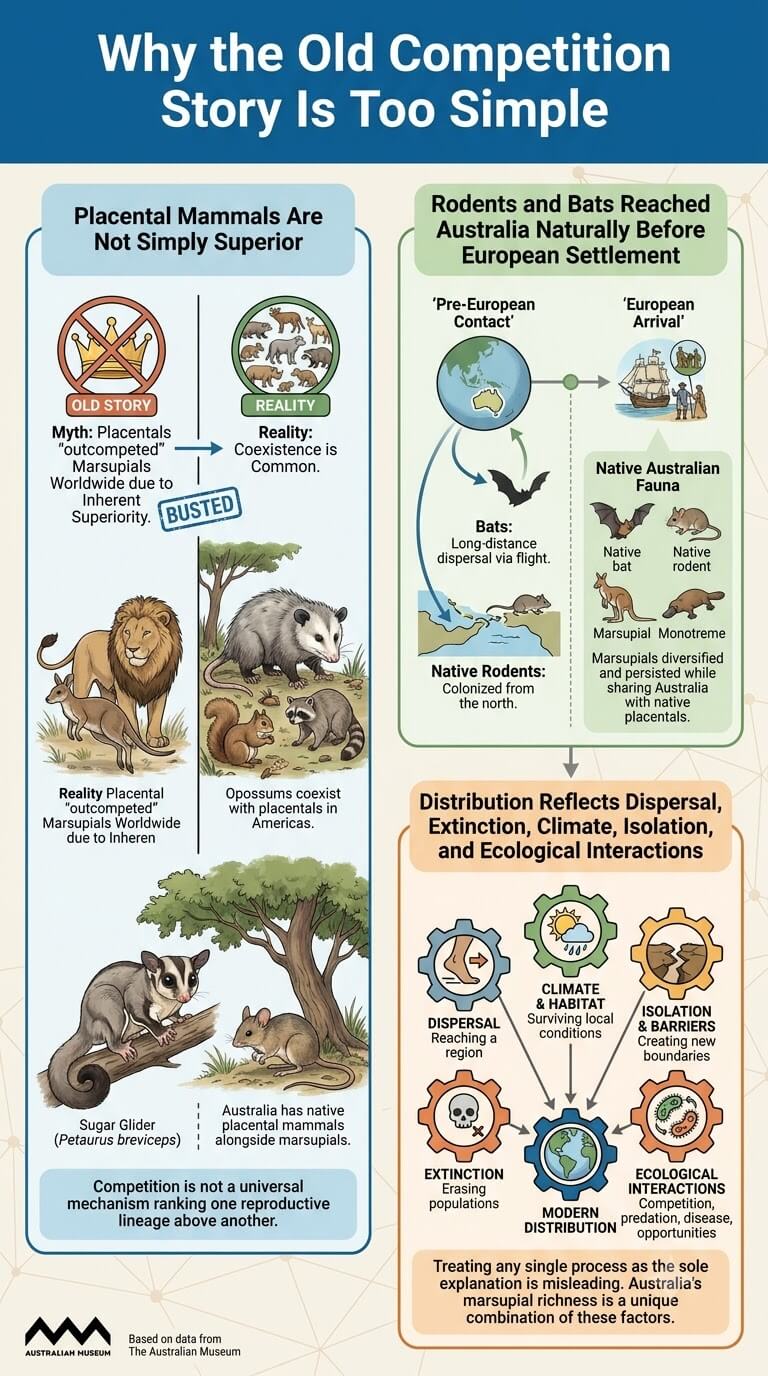
An older popular story says marsupials disappeared from much of the world because placental mammals were inherently superior and “outcompeted” them, while Australia protected marsupials by excluding placentals. That explanation is too simple.
Changes in mammal diversity unfolded across mass extinctions, continental separations, climatic shifts, habitat changes, dispersal barriers, and ecological interactions. Competition may matter in particular cases, but it is not a universal mechanism that ranks one reproductive lineage above another.
Modern marsupials and placental mammals also coexist successfully in several regions. Opossums live alongside diverse placental mammals in the Americas, and Australia has native placental mammals alongside marsupials.
Rodents and bats reached Australia naturally before European settlement
Australia was not free of placental mammals until Europeans arrived. Bats reached the region naturally because flight allows long-distance dispersal. Native rodents also colonized Australia from the north long before European settlement.
The Australian Museum’s overview of Australian mammals places native rodents and bats alongside marsupials and monotremes in the continent’s mammal fauna.
This matters because marsupials continued to diversify and persist while sharing Australia with native placental groups. The ecological history cannot be summarized as “marsupials succeeded only because no placentals were present.”
Distribution reflects dispersal, extinction, climate, isolation, and ecological interactions
Modern distribution is the endpoint of many processes acting at once. A lineage must first reach a region. Populations must survive local climate and habitat. New barriers can isolate them. Extinction can erase intermediate populations. Later immigrants can add competition, predation, disease, or new ecological opportunities.
When any one of these processes is treated as the sole explanation, the story becomes misleading. Australia’s marsupial richness reflects a particular combination of colonization history, isolation, diversification, environmental change, and survival.
How Modern Geography Can Mislead Taxonomy
American versus Australian is not a formal order split
It is convenient to describe American and Australasian marsupials, but those are geographic categories. The living orders do not divide cleanly into one formal American branch and one formal Australian branch.
Didelphimorphia and Paucituberculata are American. The four living orders Dasyuromorphia, Peramelemorphia, Notoryctemorphia, and Diprotodontia are centered in Australasia. Microbiotheria complicates a simple geographic split because its living representatives occur in South America while their evolutionary affinities connect them with the broader australidelphian radiation.
The South American monito del monte and australidelphian context
The monito del monte is one of the most useful animals for understanding marsupial biogeography. It lives in South America, yet phylogenetic studies place Microbiotheria in close relationship with Australasian marsupials.
A large molecular analysis of marsupial phylogeny and biogeography estimated deep divergences among australidelphian lineages and explored dispersal scenarios involving South America, Antarctica, and Australia. The precise timing depends on analytical assumptions, but the broader result reinforces a key lesson: modern continent labels do not map neatly onto evolutionary relationships.
The monito del monte should not be called an Australian animal because of that relationship. It is a South American marsupial whose ancestry helps reveal an ancient southern history.
Common Myths and Mistakes
Marsupials evolved in modern Australia as a settled fact
This is too strong. Australia became a major center of marsupial diversification, but the broader ancestry of marsupials and metatherians extends beyond the continent. Fossil and molecular evidence point to a complicated history involving northern metatherian relatives, South American crown-group history, and southern dispersal.
The exact geographic origin of crown Marsupialia remains sensitive to fossil interpretation and phylogenetic analysis. A good explanation distinguishes what is strongly supported from what remains debated.
Marsupials crossed modern frozen Antarctica
They did not encounter the Antarctica seen today. Ancient Antarctica experienced much warmer conditions and supported terrestrial ecosystems capable of sustaining mammals. Any dispersal through that region occurred under a different climate and continental arrangement.
Australia had no placental mammals before Europeans
False. Native bats and rodents reached Australia naturally long before European colonization. Fossil evidence also records much older placental mammals in Australia, although not all of those ancient lineages persisted.
The discovery of the early Cenozoic mammal Tingamarra, for example, helped challenge the idea that marsupials flourished in Australia only because placental mammals were completely absent. The broader fossil record remains incomplete, so interpretations continue to change as new material is found.
Kangaroos show the ancestral marsupial condition
Kangaroos are highly specialized modern marsupials, not models of what the ancestral marsupial necessarily looked like. Their hopping limbs, tail-assisted locomotion, grazing adaptations, and reproductive biology are products of their own evolutionary branch.
The same principle applies to koalas, wombats, devils, and opossums. Living species are endpoints of evolution, not unchanged snapshots of ancient ancestors.
How Ancient History Shaped Today’s Marsupial Fauna
Major living groups reflect deep geographic history
The seven living marsupial orders preserve traces of ancient geographic separation. Three occur in the Americas today, four are centered in Australasia, and Microbiotheria demonstrates that evolutionary relationships cross that simple geographic divide.
Understanding those orders helps make sense of the modern map. Classification records shared ancestry, while biogeography explains how those branches came to occupy different regions.
Current habitats are the latest chapter, not the origin story
Today’s kangaroo grasslands, koala forests, bilby deserts, New Guinea rainforests, and South American opossum habitats are only the most recent environments occupied by these lineages. Continents moved, climates cooled or warmed, mountain ranges rose, forests expanded and contracted, and species repeatedly shifted or lost ranges.
A current habitat map therefore cannot be read backward as a direct picture of where a lineage originated. Biogeography is historical precisely because distributions change.
FAQ
Did marsupials evolve in Australia?
Australia was a major center of marsupial diversification, but saying marsupials simply evolved there is too broad. The ancestry of living marsupials involves a much wider metatherian fossil history, and evidence supports important South American and Antarctic connections before the Australasian radiation became established.
How could marsupials move between South America and Australia?
South America, Antarctica, and Australia were once connected or positioned very differently from today. During warmer parts of the early Cenozoic, Antarctica supported terrestrial ecosystems rather than its modern ice-dominated environment. Ancestral marsupial lineages could therefore disperse through southern regions that no longer function as land routes for mammals.
Why are there still marsupials in the Americas?
South America remained an important center of marsupial evolution rather than simply losing every lineage after one dispersal toward Australia. Opossums, shrew opossums, and monitos del monte survived and diversified there, and opossums later expanded into Central and North America.
Did placental mammals replace marsupials everywhere else?
No single replacement story explains global mammal history. Metatherian and marsupial distributions changed through mass extinction, dispersal, climate, continental movement, habitat change, and ecological interactions. Competition can matter locally, but it does not justify treating placental mammals as universally superior or marsupials as evolutionarily destined to disappear.
Final Thoughts
Australia has so many marsupials because deep geographic history gave ancestral marsupial lineages access to the region and long isolation then provided the setting for extensive diversification. The story probably involved southern connections among South America, Antarctica, and Australia, but the fossil record is incomplete and the exact sequence of dispersal events is still reconstructed rather than directly known. Marsupials did not simply originate in modern Australia, cross today’s frozen Antarctica, or survive because placental mammals were entirely absent. Living American marsupials, the South American monito del monte, native Australian bats and rodents, and the broader metatherian fossil record all show why the simple versions fail. The modern Australian fauna is the result of dispersal, isolation, climate change, extinction, ecological opportunity, and continued evolution acting over tens of millions of years.

Ethan Walker is the founder and research editor of Animal Fact Central. He creates and reviews educational animal facts content using trusted wildlife, pet care, and science-based sources. His work focuses on making animal behavior, adaptations, habitats, and species facts clear, accurate, and engaging for everyday readers.
Read More Details About Ethan Walker: https://animalfactcentral.com/ethan-walker/