
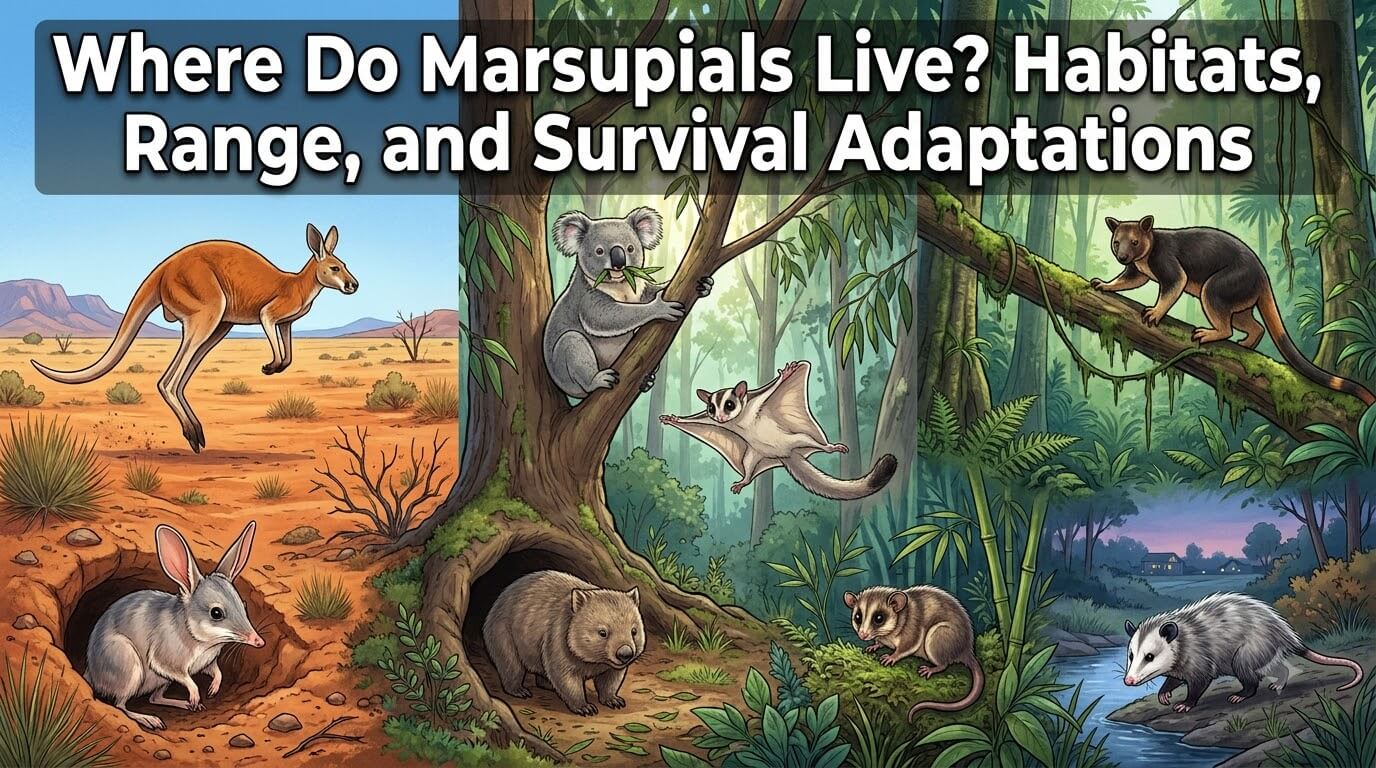
Marsupials live naturally in the Americas and Australasia, with their greatest modern diversity in Australia and nearby New Guinea. They occupy deserts, grasslands, shrublands, eucalyptus forests, tropical rainforests, temperate rainforests, alpine and subalpine environments, wetlands, river corridors, coastal scrub, farmland edges, suburbs, and underground sandy habitats. There is no single “marsupial habitat.”
Kangaroos may cross open semi-arid plains, koalas live in suitable eucalyptus forests and woodlands, tree-kangaroos occupy rainforests, wombats shelter in burrows, marsupial moles spend much of their lives beneath desert sand, monitos del monte live in cool South American forests, and Virginia opossums can use woodlands, wet areas, and human-modified landscapes across a broad North American range. Each survives through a different combination of anatomy, behavior, diet, shelter use, and physiology.
Quick Answer
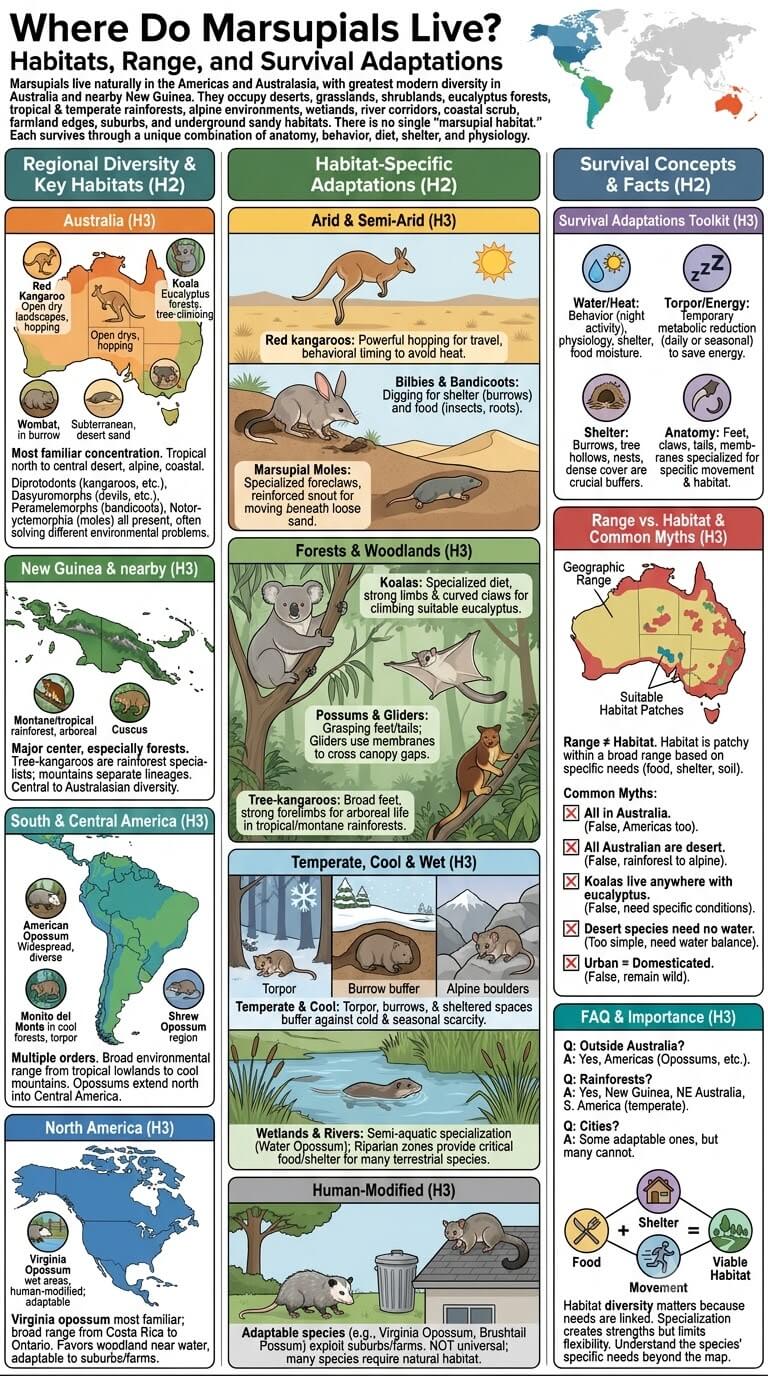
Living marsupials occur mainly across two broad regions: the Americas and Australasia. American marsupials include opossums, shrew opossums, and monitos del monte. Australasian marsupials include kangaroos, wallabies, koalas, wombats, possums, gliders, bandicoots, bilbies, quolls, Tasmanian devils, marsupial moles, tree-kangaroos, and many other groups.
The current Mammal Diversity Database taxonomy table recognizes seven living marsupial orders. Three have living representatives in the Americas, while four are centered in Australasia. Modern distributions reflect deep evolutionary history, but individual species still differ enormously in the habitats they can use.
Some species occupy broad environmental ranges. Others depend on a narrow combination of food plants, soil type, forest structure, moisture, shelter, or climate. That is why “where marsupials live” is both a geography question and a habitat question.
Where Marsupials Live Today
Australia
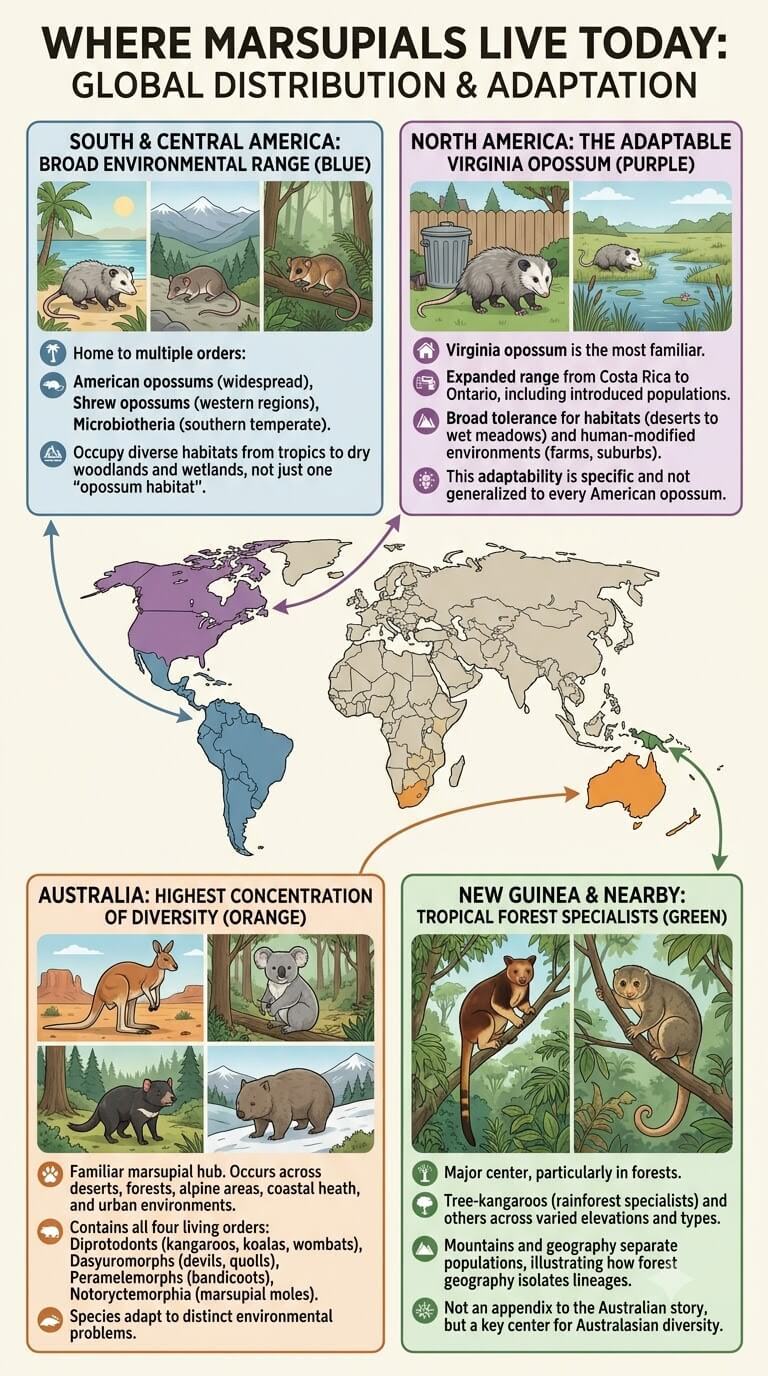
Australia contains the most familiar concentration of living marsupial diversity. Marsupials occur from tropical northern forests to central deserts, temperate southeastern woodlands, alpine areas, coastal heath, grasslands, islands, and urban environments.
Diprotodonts include kangaroos, wallabies, koalas, wombats, possums, and gliders. Dasyuromorphs include Tasmanian devils, quolls, dunnarts, antechinus, and the numbat lineage. Peramelemorphs include bandicoots and bilbies, while Notoryctemorphia contains marsupial moles.
The fact that all four orders occur in Australia does not mean they occupy the same landscape. A red kangaroo, mountain pygmy-possum, northern quoll, greater bilby, bare-nosed wombat, and marsupial mole solve completely different environmental problems.
New Guinea and nearby Australasian regions
New Guinea is another major center of marsupial diversity, particularly in forests. Tree-kangaroos, cuscuses, possums, bandicoots, and dasyurids occur across different elevations and forest types.
A 2026 Australian Museum study describes tree-kangaroos as rainforest specialists now confined to New Guinea and northeastern Queensland. Within New Guinea, different tree-kangaroo lineages occupy distinct regions and elevations, illustrating how mountains and forest geography can separate populations.
New Guinea should therefore not be treated as an appendix to the Australian marsupial story. Its tropical and montane forests support lineages and species that are central to understanding modern Australasian diversity.
South and Central America
South America is home to multiple living marsupial orders. American opossums are widespread and diverse, shrew opossums occur along parts of the western South American region, and Microbiotheria survives in the southern temperate forests.
Some American marsupials live in tropical lowlands, while others occupy cool mountains, dry woodland, wetlands, or temperate rainforest. The continent therefore contains a broad environmental range rather than one standard “opossum habitat.”
Central America also supports opossums, with several lineages extending northward from tropical South American ancestry.
North America
The Virginia opossum is the marsupial most familiar to readers in the United States. Its natural and expanded range extends far beyond the state that gives it its common name.
The Smithsonian’s Virginia opossum profile describes the species from Costa Rica and Mexico through much of the eastern United States and north into Ontario, with introduced populations on the Pacific coast. It occupies habitats ranging from deserts to wet meadows but often favors woodland and thickets near water.
This broad tolerance helps explain why the species can also appear around farms, suburbs, parks, and other human-modified environments. Its adaptability should not be generalized to every American opossum, many of which have narrower tropical or forest associations.
Arid and Semi-Arid Marsupial Habitats
Red kangaroos in open dry landscapes
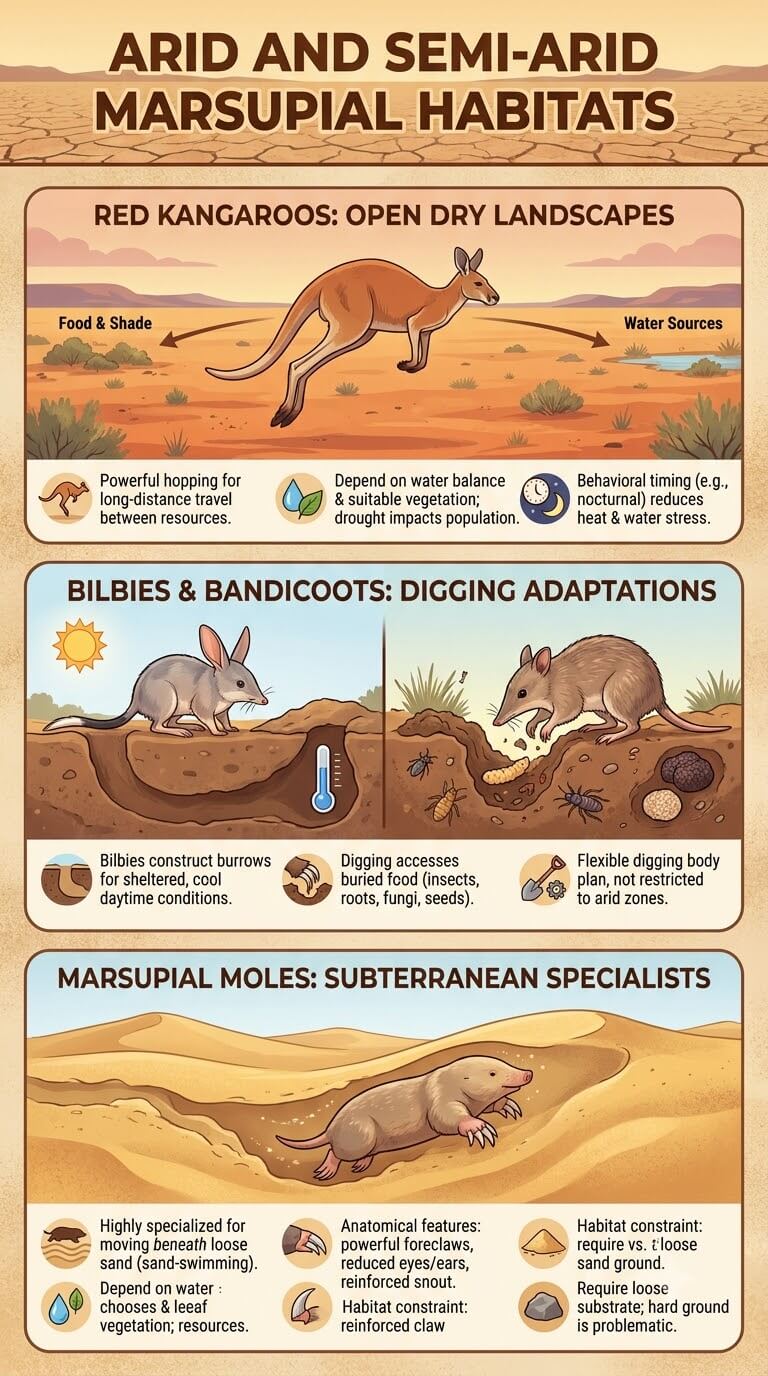
Red kangaroos are strongly associated with Australia’s dry interior. The Australian Museum’s red kangaroo profile places them across semi-arid and arid mainland regions and describes habitat including open plains, grassland, shrubland, desert, woodland, and open forest.
Open landscapes fit their locomotion. Powerful hopping allows large kangaroos to travel between food patches, shade, and water across broad areas. Their plant diet also provides some of the moisture they need, although drought can sharply reduce food availability and population condition.
Surviving in dry country is therefore not simply a matter of “needing no water.” Red kangaroos still depend on water balance, suitable vegetation, and environmental conditions. Behavioral timing, movement, and food selection help reduce exposure to heat and water stress.
Bilbies, bandicoots, and digging for shelter or food
Several Australian marsupials cope with dry environments by using the soil. Bilbies construct burrows that provide sheltered conditions during hot daytime periods, while their large ears and nocturnal activity are associated with life in open arid and semi-arid environments.
Bandicoots and bilbies also dig extensively while foraging. Soil excavation gives access to insects, larvae, fungi, seeds, roots, and other buried foods. Digging therefore serves both survival and feeding, depending on the species and context.
Not every bandicoot is an arid-zone animal. Peramelemorphs also occur in forests and wetter habitats. The adaptation is best understood as a flexible digging body plan used in different environments.
Marsupial moles beneath desert sand
Marsupial moles take subterranean adaptation much further. They are specialized for moving beneath loose sand, with powerful foreclaws, reduced external ears, compact eyes, a reinforced snout, and a cylindrical body.
Southern marsupial moles are associated with central Australian sandy deserts, dunes, sandplains, and vegetated sandy areas. Because the substrate itself is part of their locomotor system, hard-packed ground can present a very different problem from loose sand.
Life beneath the surface reduces exposure to daytime heat and creates access to subterranean invertebrates, but it also requires extreme anatomical specialization. Marsupial moles cannot be treated as ordinary desert quadrupeds that simply happen to dig.
Forests and Woodlands
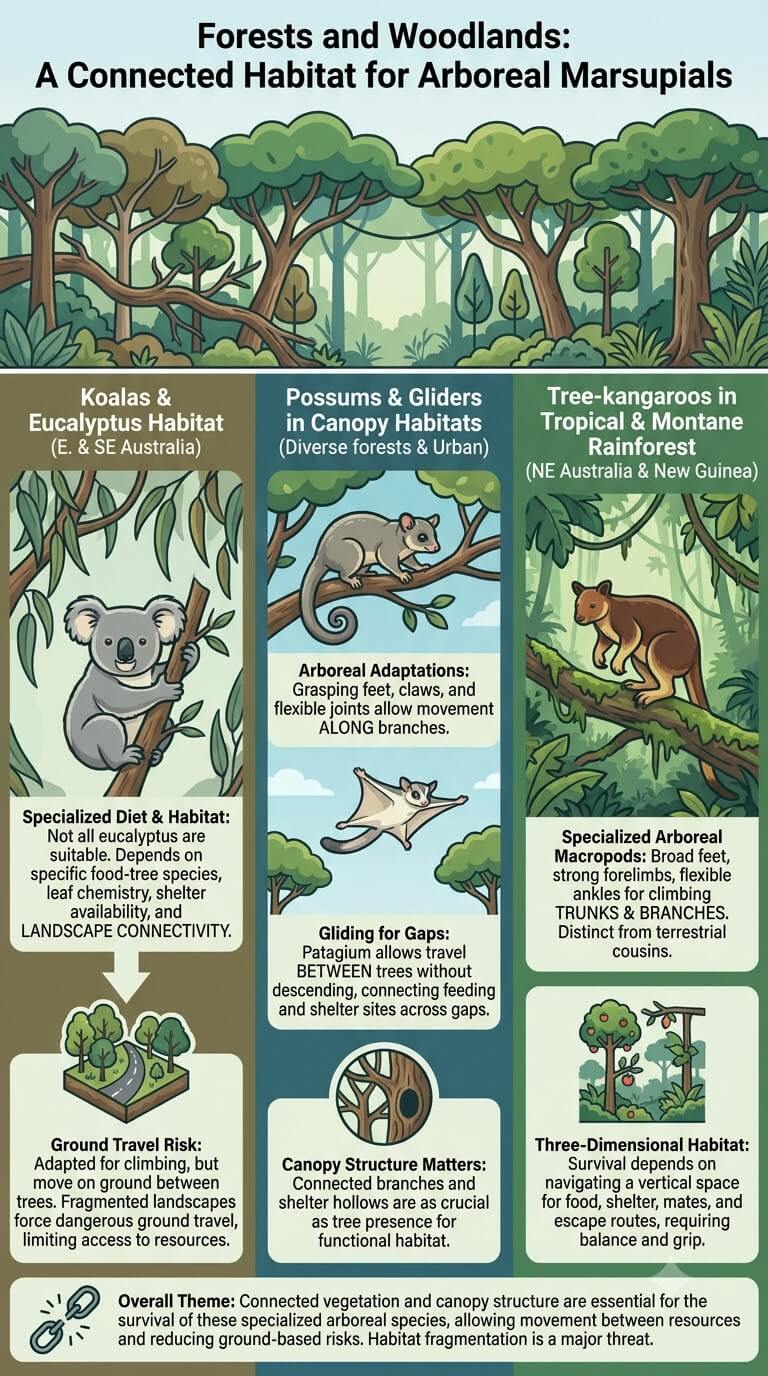
Koalas and suitable eucalyptus habitat
Koalas live in eucalyptus forests and woodlands within parts of eastern and southeastern Australia. The Australian Museum’s koala profile describes a patchy distribution from northern Queensland through New South Wales and Victoria into southeastern South Australia.
Koala habitat is not simply “any place with eucalyptus.” The animals depend on suitable food-tree species, local leaf chemistry, tree availability, shelter, and landscape connectivity. Their specialized diet makes the composition of a forest especially important.
Strong limbs, grasping hands, curved claws, and a body adapted to climbing help koalas spend much of their time in trees. They still travel on the ground when moving between trees or habitat patches, which means fragmented landscapes can force them into very different movement conditions from continuous forest.
Possums and gliders in canopy habitats
Many possums are arboreal. Grasping feet, claws, flexible joints, and in some species prehensile tails help them move along branches. Different species use eucalyptus forests, rainforests, woodlands, dense scrub, and urban tree cover.
Gliders add another solution to canopy gaps. Their patagium lets them travel between trees without descending completely to the ground. That can connect feeding sites and shelter trees across spaces that would be costly or dangerous to cross terrestrially.
Canopy structure therefore matters as much as the presence of trees. A forest with widely separated crowns, few hollows, or poor food resources can function differently from a mature habitat with connected branches and shelter sites.
Tree-kangaroos in tropical and montane rainforest
Tree-kangaroos are specialized arboreal macropods found in the rainforests of New Guinea and northeastern Australia. They contrast sharply with large terrestrial kangaroos despite belonging to the same broader family.
Broad feet, strong forelimbs, and more flexible ankles improve climbing on branches and trunks. In mountainous New Guinea, elevation and rugged topography can also separate populations, contributing to distinct regional lineages.
Forest life creates a three-dimensional habitat. Food, shelter, mates, and escape routes occur above the ground as well as across it, so survival depends on balance, grip, and access to connected vegetation.
Temperate and Cool Habitats
Monitos del monte in South American temperate forests
The monito del monte is a small South American marsupial found in cool temperate forest environments of Chile and Argentina. Animal Diversity Web describes Microbiotheria in Valdivian temperate rainforest, including forests dominated by southern beech with dense bamboo understory.
This habitat is very different from the dry Australian settings many people associate with marsupials. It can be cool, wet, and structurally complex, with dense vegetation providing climbing surfaces, shelter, and seasonal foods.
Monitos del monte can use torpor and seasonal fat storage, allowing them to reduce energy demands when temperatures fall and food becomes scarce. That physiological strategy shows how marsupial survival can involve changes in metabolism as well as body structure.
Wombats in southeastern forests, heath, and higher elevations
Bare-nosed wombats occupy temperate southeastern Australia in habitats including open forest, woodland, heath, coastal scrub, grassland, and some mountainous areas. They depend strongly on places where soil allows burrow construction and nearby vegetation provides grazing.
Burrows create a buffered shelter compared with exposed surface conditions. Wombats can retreat underground during warm periods and emerge to feed when temperatures are more favorable. In colder areas, they can also remain active in environments that experience winter snow.
The same species can therefore occupy quite different surface vegetation as long as the combination of soil, shelter, and food remains suitable.
High-elevation marsupials
Some marsupials live at high elevations in Australia and New Guinea. Mountain pygmy-possums are associated with alpine and subalpine boulder fields in southeastern Australia, while several tree-kangaroos occupy New Guinean montane forest.
High-elevation life creates cold temperatures, seasonal food shortages, snow or heavy rainfall, and short periods of high productivity. Small mammals may rely on sheltered rock spaces, nests, torpor, hibernation-like seasonal strategies, or stored body fat.
These adaptations should remain species-specific. Not every mountain marsupial hibernates, and not every temperate species uses torpor in the same way.
Wetlands, Rivers, and Moist Habitats
Water opossums and semi-aquatic specialization
Most marsupials are terrestrial or arboreal rather than aquatic, but the water opossum is a striking exception. It lives near freshwater streams and is strongly adapted to swimming and foraging around water.
Its lifestyle demonstrates that even within Didelphidae, habitat use can extend beyond the familiar woodland-ground combination of the Virginia opossum.
Semi-aquatic living requires different movement and sensory demands, especially when prey must be detected and handled in or near moving water.
Why riparian zones matter to many terrestrial marsupials
Even marsupials that do not swim may rely on river corridors, wet gullies, floodplains, and vegetation near water. These habitats can concentrate food, shade, shelter, and travel routes.
Virginia opossums often favor woodland and thickets near water. Other species use moist gullies or creek lines as cooler refuges in otherwise dry landscapes.
Water availability affects vegetation structure too, so a riparian strip can create a very different habitat from the surrounding country.
Human-Modified Habitats
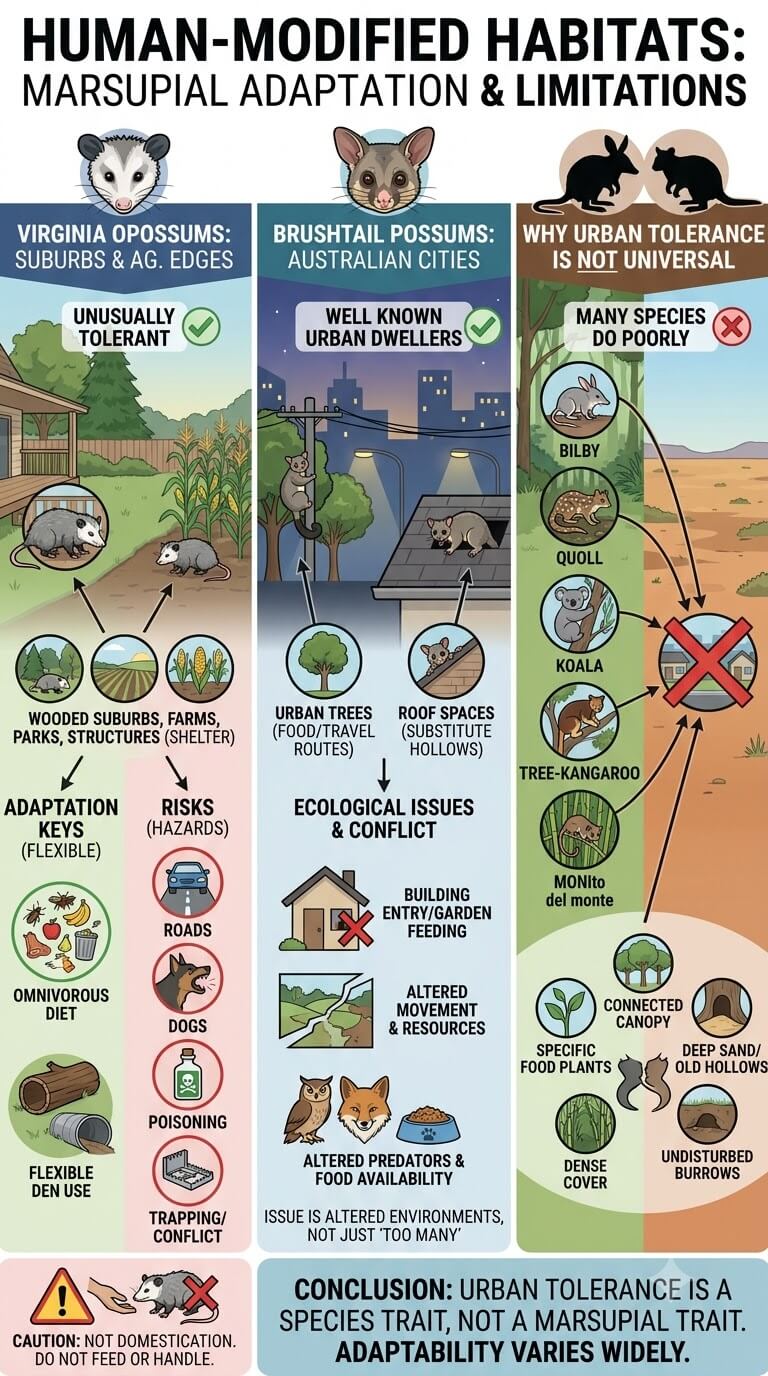
Virginia opossums in suburbs and agricultural edges
Virginia opossums are unusually tolerant of some human-modified environments. They can use wooded suburbs, farms, parks, drainage corridors, and structures that provide shelter.
Their omnivorous diet and flexible den use help them exploit resources across changing landscapes. That adaptability does not mean human environments are risk-free. Roads, dogs, poisoning, trapping, and conflict can all create hazards.
It also does not mean people should feed or handle wild opossums. Adaptation to living near humans is not domestication.
Brushtail possums in Australian cities
Common brushtail possums are another marsupial well known for living near people. Urban trees can provide food and travel routes, while roof spaces may substitute for natural hollows where hollows are scarce.
Urban success can create conflict when possums enter buildings or feed in gardens. The ecological issue is often not simply “too many possums,” but how built environments alter shelter, food availability, predators, and movement routes.
Why urban tolerance is not universal
Many marsupials do poorly when habitat becomes heavily modified. Species dependent on particular food plants, connected canopy, deep sand, old tree hollows, dense ground cover, or undisturbed burrows may be unable to substitute a suburb for natural habitat.
Urban tolerance is therefore a species trait, not a marsupial trait. A Virginia opossum and common brushtail possum can be adaptable without implying that a bilby, quoll, tree-kangaroo, koala population, or monito del monte will respond the same way.
Survival Adaptations Across Marsupial Habitats
Water conservation and heat avoidance
Dry-country marsupials often combine behavioral and physiological strategies. Activity may shift toward night or cooler periods, shelter reduces heat exposure, and food can provide part of the water budget.
Large kangaroos can also change posture and activity during heat. Small desert marsupials frequently rely on burrows, shade, or torpor. The exact balance differs strongly with body size and species.
It is more accurate to describe strategies for limiting water loss and heat load than to say desert marsupials do not need water.
Torpor and seasonal energy saving
Torpor lowers metabolic rate and body temperature for a period, reducing energy demand when conditions are difficult. Several small marsupials use daily torpor, while a smaller number use more prolonged seasonal patterns.
This can be especially valuable when nights are cold, insects or flowers are unavailable, or winter food is limited. Monitos del monte and some pygmy-possums provide notable examples of seasonal energy-saving strategies.
Torpor is not universal. Large kangaroos, wombats, devils, and koalas solve energy problems in other ways.
Burrows, hollows, nests, and dense cover
Shelter is often as important as food. Wombat burrows buffer the animal from surface weather. Bilby burrows provide daytime refuge. Tree hollows shelter many possums and gliders. Ringtail possums can build leafy nests, while small ground-dwelling marsupials may use logs, crevices, grass nests, or dense vegetation.
Shelter type is tied to habitat structure. Removing old hollow-bearing trees can affect an arboreal species even if plenty of young trees remain. Compacted soil can affect a burrower even if surface vegetation appears suitable.
Specialized feet, claws, tails, and membranes
Movement adaptations often reveal the habitat. Kangaroo hindlimbs suit open-ground travel. Koala hands grip trunks. Glider membranes connect canopy gaps. Wombat claws excavate soil. Marsupial mole forelimbs push through sand. Prehensile tails in some possums and opossums improve stability among branches.
These features do not tell the entire ecological story, but they show how anatomy is shaped by the physical environment an animal uses every day.
Range Is Not the Same as Habitat
A geographic range can contain many habitat types
A species range is the broad area across which the species occurs. Habitat is the kind of environment within that range that supplies suitable food, shelter, substrate, climate, and other requirements.
The Virginia opossum has a very large geographic range, but it does not use every square mile within that range equally. Red kangaroos extend across much of arid and semi-arid mainland Australia, yet they still favor particular open vegetation and respond to food conditions.
This difference is important when reading maps. A colored distribution polygon does not mean the animal lives everywhere inside it at equal density.
Why suitable habitat can be patchy inside a species range
Koalas provide a clear example. Their overall distribution covers a long portion of eastern and southeastern Australia, but suitable habitat depends on local tree species, food quality, landscape structure, and population history. Occupancy can therefore be patchy.
Mountain species can be even more restricted because suitable elevation, temperature, rock structure, or forest type occurs only in separated pockets.
A species may consequently have a broad-looking map but rely on narrow habitat bands inside that map.
Common Habitat Myths
All marsupials live in Australia
False. Living marsupials also occur naturally across South America, Central America, and North America. Opossums, shrew opossums, and monitos del monte represent living American branches.
All Australian marsupials live in the desert
False. Australia includes rainforest, eucalyptus forest, woodland, alpine habitat, grassland, heath, wetland margins, coastal scrub, tropical savanna, and desert. Marsupials occupy many of these environments.
Koalas can live anywhere eucalyptus grows
False. Koalas require suitable food-tree species and other habitat conditions. The presence of a eucalyptus tree alone does not prove that a landscape provides adequate koala habitat.
Desert marsupials survive without water
Too simple. Some can obtain much of their water from food and reduce water loss behaviorally or physiologically, but they still depend on water balance. Drought can reduce both food and available moisture.
Urban marsupials are domesticated
False. A wild opossum or brushtail possum using a suburb remains a wild animal. Tolerance of buildings, roads, gardens, or people does not make the species domesticated or safe to handle.
Why Habitat Diversity Matters to Marsupials
Food, shelter, and movement are linked
A habitat works only when multiple needs come together. A koala needs food trees and safe movement among them. A glider needs feeding resources plus trees positioned so canopy travel is possible. A wombat needs grazing areas plus soil suitable for burrows. A marsupial mole needs the right sandy substrate as well as prey.
This is why habitat cannot be reduced to a vegetation label. Structure, soil, moisture, temperature, food, shelter, and connectivity all matter.
Adaptations can create both strengths and limits
Specialization can make an animal highly effective in one environment while reducing flexibility elsewhere. A marsupial mole is extraordinary underground but poorly suited to prolonged surface travel. A koala is highly adapted to a tree-leaf diet but cannot simply switch to arbitrary vegetation when suitable food trees disappear.
Generalists such as Virginia opossums have broader options, yet even they still need shelter, food, and survivable climate. Every adaptation operates within limits.
FAQ
Are marsupials found outside Australia?
Yes. Living marsupials occur naturally in the Americas as well as Australasia. American opossums are the most widespread familiar example, while shrew opossums and monitos del monte occur in South America.
Do any marsupials live in rainforests?
Yes. New Guinea supports rainforest tree-kangaroos, cuscuses, possums, bandicoots, and other marsupials. Northeastern Australia also has rainforest marsupials. In South America, monitos del monte occupy cool temperate rainforest rather than tropical rainforest.
Which marsupials live in deserts?
Red kangaroos, bilbies, several small dasyurids, and marsupial moles are among marsupials associated with Australian arid or semi-arid environments. They do not all use the desert in the same way: kangaroos travel over the surface, bilbies use burrows, and marsupial moles spend much of their lives below sand.
Can marsupials live in cities?
Some can. Virginia opossums in North America and common brushtail possums in parts of Australia are well known in urban and suburban settings. Many other marsupials are much less tolerant of urbanization, especially species dependent on specialized food, shelter, or habitat structure.
Final Thoughts
Marsupials live across a remarkable range of environments in the Americas and Australasia. Australia holds deserts, grasslands, forests, alpine country, woodlands, heath, coastal scrub, and urban habitats used by different marsupial species. New Guinea adds major tropical and montane rainforest diversity, while South America supports opossums, shrew opossums, and the temperate-forest monito del monte. North America’s Virginia opossum shows how adaptable one marsupial can be across woodland, wet areas, and human-modified landscapes. The common thread is not one habitat but adaptation: hopping across open ground, gripping branches, gliding between trees, burrowing into soil, moving beneath sand, conserving water, using torpor, or exploiting flexible shelter. To understand where marsupials live, it is therefore necessary to look beyond the map and ask what each species needs from the environment inside its range.

Ethan Walker is the founder and research editor of Animal Fact Central. He creates and reviews educational animal facts content using trusted wildlife, pet care, and science-based sources. His work focuses on making animal behavior, adaptations, habitats, and species facts clear, accurate, and engaging for everyday readers.
Read More Details About Ethan Walker: https://animalfactcentral.com/ethan-walker/