
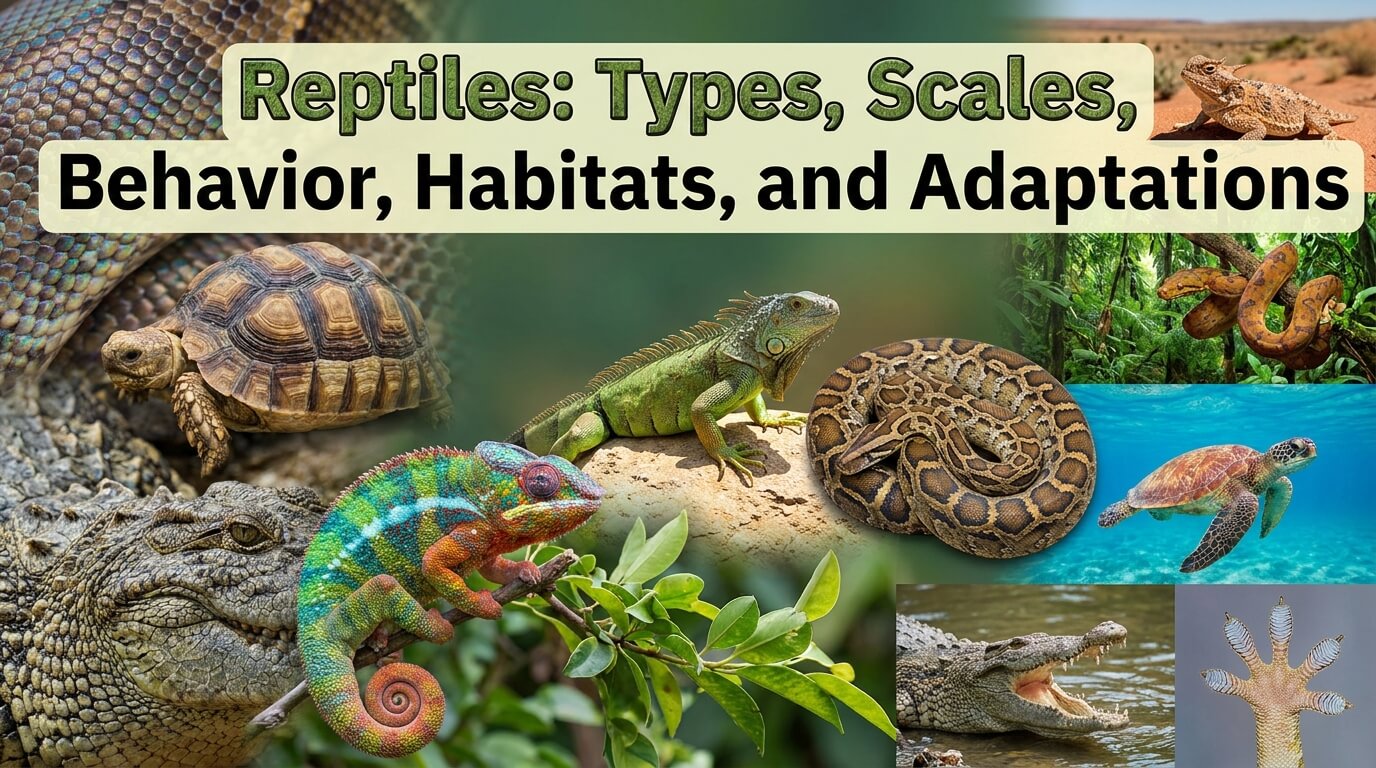
Reptiles are a remarkably varied group of vertebrates that includes snakes, the many animals commonly called lizards, turtles and tortoises, crocodilians, amphisbaenians, and tuatara. They share an evolutionary history and a set of broad biological themes, but there is no single simple rule that describes every reptile. Some have legs and some do not. Some live in deserts, others in forests, rivers, swamps, coastlines, or the open ocean. Many lay eggs, while some give birth to live young. Their diets range from leaves and algae to insects, fish, mammals, carrion, and other reptiles.
For practical everyday use, this guide focuses on living non-avian reptiles. That wording matters because modern evolutionary classification places birds within the broader reptilian family tree. In everyday education, birds and reptiles are usually discussed as separate living groups because their anatomy, ecology, and familiar forms are so different. Both ways of talking can be useful as long as the distinction is made clearly.
Understanding reptiles as a broad group helps replace several common stereotypes. A reptile is not simply a snake, a desert animal, or a dangerous “cold-blooded” predator. Reptiles include armored turtles, burrowing amphisbaenians, climbing geckos, marine iguanas that feed on algae, highly aquatic crocodilians, sea turtles that cross oceans, and tuatara representing an ancient but still evolving lineage found in New Zealand.
Quick Overview of Reptiles
What this guide means by living non-avian reptiles
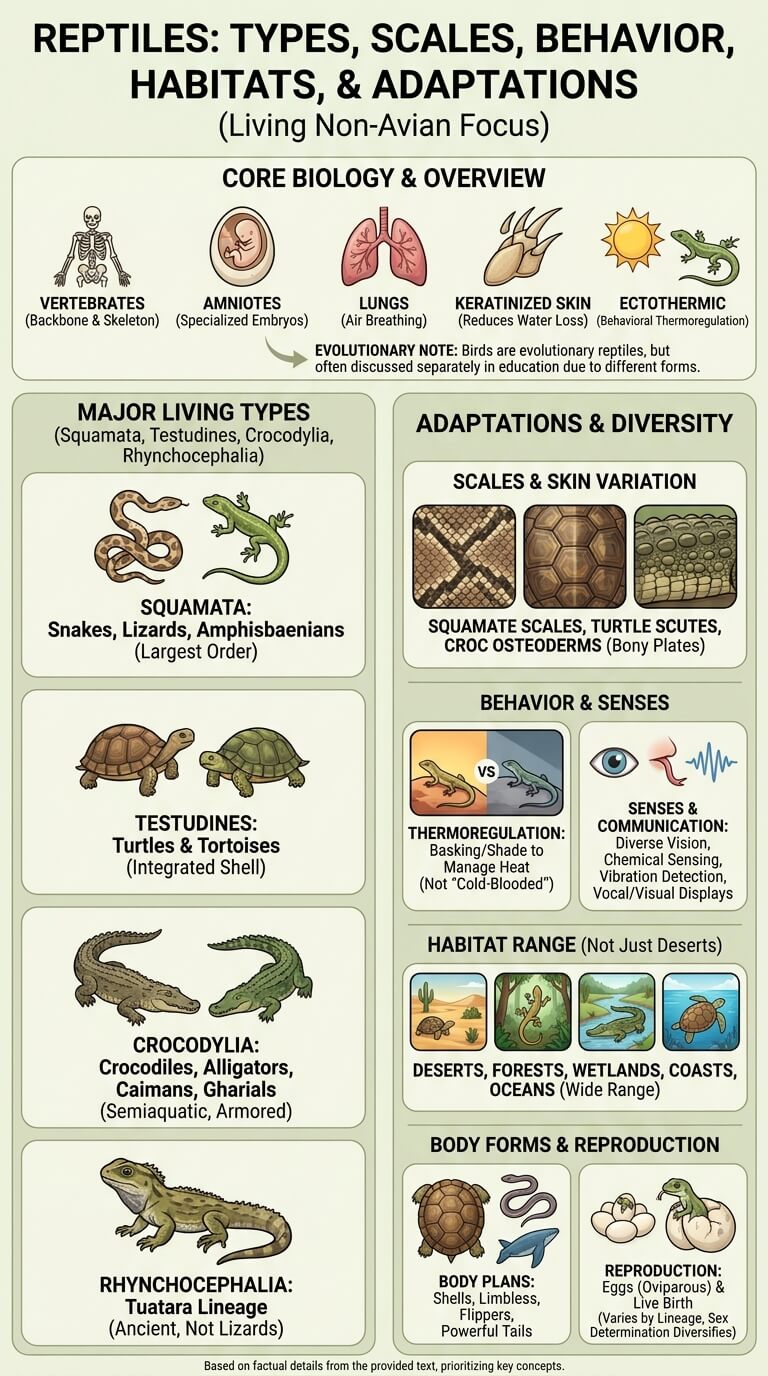
When people use the word reptile in a modern wildlife context, they usually mean living non-avian reptiles. The major living branches covered here are Squamata, Testudines, Crocodylia, and Rhynchocephalia. The Reptile Database tracks the taxonomy of living reptiles and includes turtles, snakes, lizards, crocodilians, tuatara, and amphisbaenians.
Why snakes are only one part of reptile diversity
Snakes are members of Squamata, the same broad reptile order that also contains the many lineages commonly called lizards and the specialized burrowing amphisbaenians. Snakes are therefore an important part of reptile diversity, but they are not a separate equivalent to all other reptiles combined.
What Makes Reptiles a Distinct Vertebrate Group?
Vertebrates, amniotes, lungs, keratinized skin, and ectothermy at a glance
Reptiles are vertebrates, meaning they have a backbone and an internal skeleton. They are also amniotes, members of a vertebrate lineage whose embryos develop with extraembryonic membranes including the amnion. Mammals and birds are amniotes too, so being an amniote does not by itself make an animal a reptile.
Living non-avian reptiles breathe with lungs and have keratinized outer body coverings that reduce water loss compared with the highly permeable skin typical of amphibians. Depending on the lineage, those coverings can include overlapping scales, scutes, specialized scale arrangements, and areas associated with bony armor. The Animal Diversity Web overview of Reptilia describes reptiles as amniotes with lungs and keratinized epidermal structures, while also noting the evolutionary inclusion of birds.
Most living non-avian reptiles are ectothermic. An ectotherm depends heavily on environmental heat rather than maintaining a high, stable body temperature mainly through internally generated metabolic heat. That does not mean its body is always cold, or that body temperature simply matches the air. Reptiles can move among sun, shade, water, burrows, rocks, and other microhabitats to regulate temperature behaviorally.
Why no single visible trait defines every reptile
Common shortcuts often fail because reptile diversity contains exceptions. “Reptiles have scales” is incomplete because reptile coverings vary greatly and other animals also have structures called scales. “Reptiles lay eggs” fails because live birth evolved repeatedly in squamates. “Reptiles have four legs” excludes snakes and other lineages with reduced or absent limbs. “Reptiles live on land” ignores sea turtles, sea snakes, and many freshwater species.
The most accurate way to understand the group is through ancestry combined with a suite of biological characteristics. Evolutionary relationships matter because animals can retain, modify, reduce, or lose visible traits over time. A snake without legs is still a squamate. A sea turtle adapted to life in salt water is still an air-breathing reptile. A tortoise is a terrestrial kind of turtle, not a separate order of vertebrate.
The Major Living Reptile Groups
Squamata: snakes, amphisbaenians, and the many lineages commonly called lizards
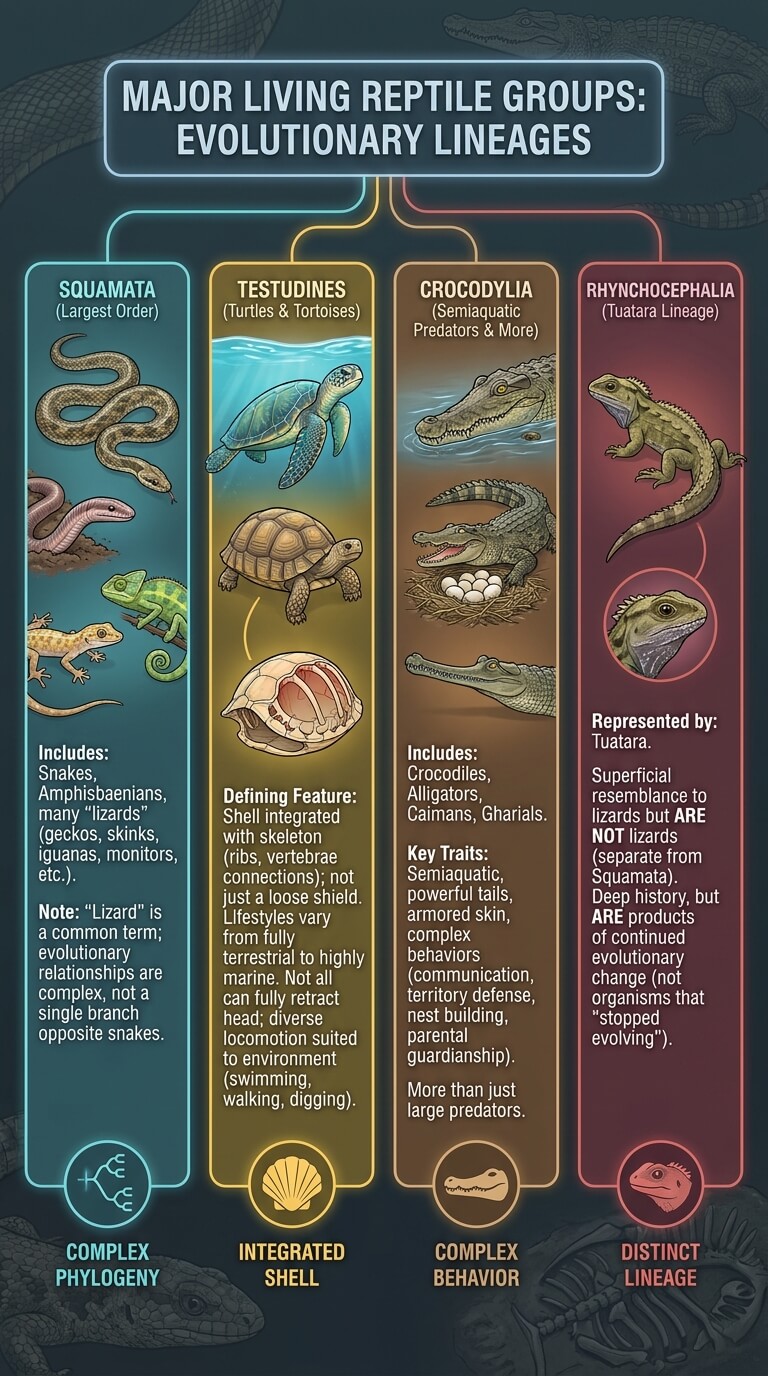
Squamata is the largest living reptile order. It includes snakes, amphisbaenians, and many lineages that people commonly call lizards, including geckos, skinks, iguanas, anoles, chameleons, monitors, and others. The word “lizard” is useful in everyday language, but modern evolutionary relationships are more complicated than a simple picture in which lizards form one clean branch opposite snakes.
Testudines: turtles and tortoises
Testudines includes turtles and tortoises. Their defining body feature is a shell that is integrated with the skeleton, including connections with ribs and vertebrae. It is not simply a loose shield sitting on top of the body. Many turtles have keratinous scutes over parts of the shell, while external shell coverings vary among groups.
Turtle lifestyles range from fully terrestrial tortoises to freshwater turtles and highly marine sea turtles. Not every turtle can pull its head and limbs completely into its shell, and not every turtle is slow in the context of its normal environment. Aquatic turtles are built for swimming, while terrestrial forms move in ways suited to walking, digging, or traveling across land.
Crocodylia: crocodiles, alligators, caimans, and gharials
Crocodylia includes crocodiles, alligators, caimans, and gharials. These are semiaquatic, air-breathing reptiles with powerful tails, well-developed sensory systems, armored skin, and complex behavior. They are often described only as large predators, but crocodilians also communicate, defend territories, build or use nests, guard young in many species, and respond to changing water and temperature conditions.
Rhynchocephalia: the tuatara lineage
Rhynchocephalia is represented today by tuatara. Tuatara can look superficially lizard-like, but they are not lizards and do not belong to Squamata. Their lineage has a deep evolutionary history, yet modern tuatara should not be described as organisms that “stopped evolving.” Like all living species, they are the products of continued evolutionary change.
Reptiles, Birds, and the Evolutionary Classification Complication
Everyday educational grouping versus modern phylogeny
Traditional school diagrams often list mammals, birds, reptiles, amphibians, and fish as separate major vertebrate groups. That remains a practical way to compare living animals by familiar body plans and biology. Modern phylogeny, however, classifies organisms by evolutionary relationships, and this creates an important complication: birds arose within the broader reptilian lineage.
It is therefore too absolute to say that birds are completely unrelated to reptiles or that birds are simply “not reptiles” in every scientific sense. A clearer explanation is that everyday educational usage usually separates birds from non-avian reptiles, while evolutionary classification places birds inside the broader reptilian tree.
Why crocodilians are closer living relatives of birds than of lizards or snakes
Crocodilians and birds are the two living branches of Archosauria. Their shared ancestry means a crocodilian is more closely related, in evolutionary terms, to a bird than it is to a lizard or snake. A Smithsonian discussion of reptile relationships summarizes this important pattern and describes birds and crocodilians as close relatives among living reptiles.
This does not mean crocodiles are birds, that birds evolved from modern crocodiles, or that living crocodilians are dinosaurs. Birds and crocodilians share extinct archosaur ancestors, and their lineages followed different evolutionary paths. Birds evolved within dinosaurs, while crocodilians belong to the crocodile-line branch of archosaurs.
Skin, Scales, Shells, and Body Forms
Scales, scutes, osteoderms, shells, and variation in external covering
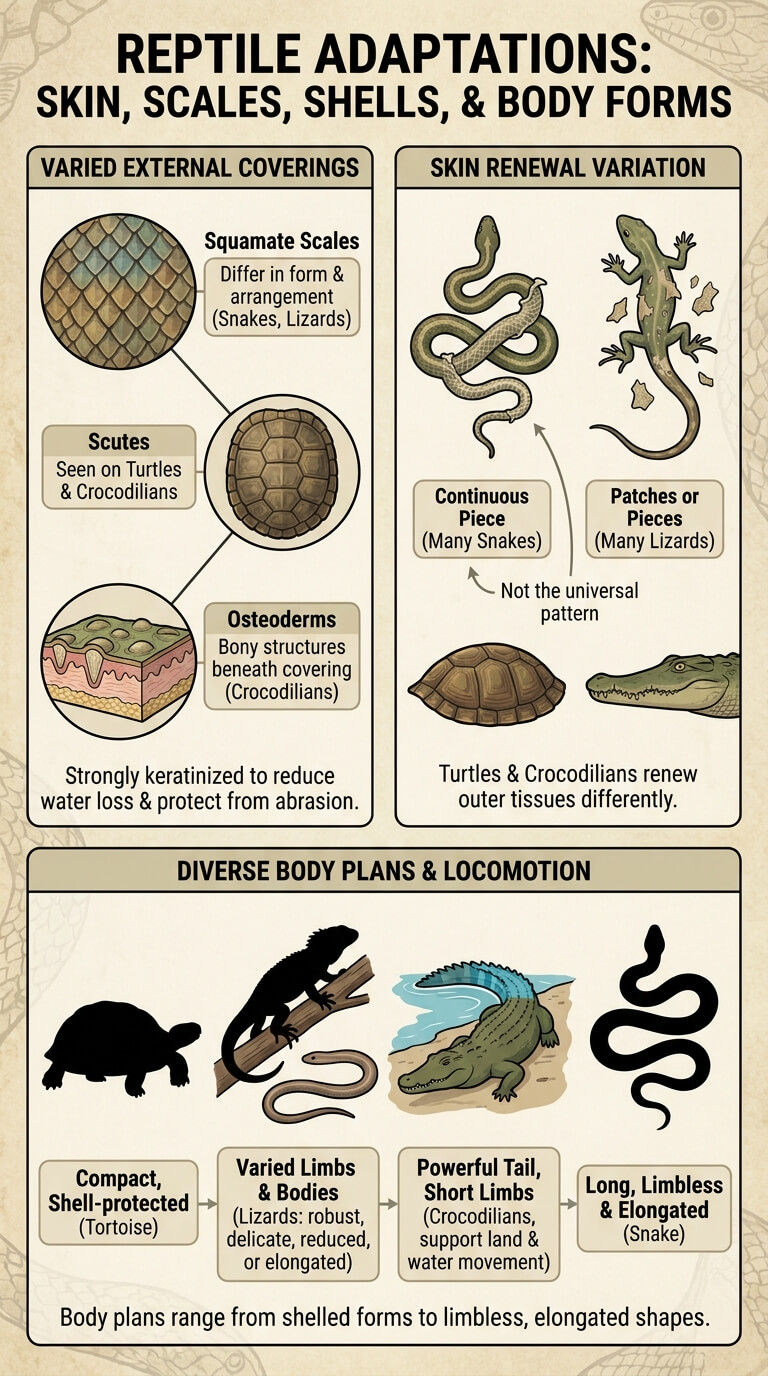
Reptile skin is strongly keratinized, which helps reduce water loss and protect the body from abrasion. Yet reptile skin is not identical across the group. Squamate scales differ in form and arrangement from the scutes seen on many turtles and crocodilians. Crocodilians also have osteoderms, bony structures within the skin, beneath parts of the outer covering.
Skin renewal also varies. Many snakes shed an outer epidermal layer in a relatively continuous piece, while many lizards shed in patches or pieces. Turtles and crocodilians renew outer tissues differently, so the familiar image of a snake leaving behind an intact skin should not be treated as the universal reptile pattern.
Limbed, limbless, armored, streamlined, and elongated body plans
Reptile body plans range from the compact, shell-protected form of a tortoise to the long limbless form of a snake. Lizards can have robust limbs, delicate climbing feet, reduced limbs, or highly elongated bodies. Crocodilians combine powerful tails with relatively short limbs that can support several styles of movement on land and in water.
How Reptiles Manage Body Temperature
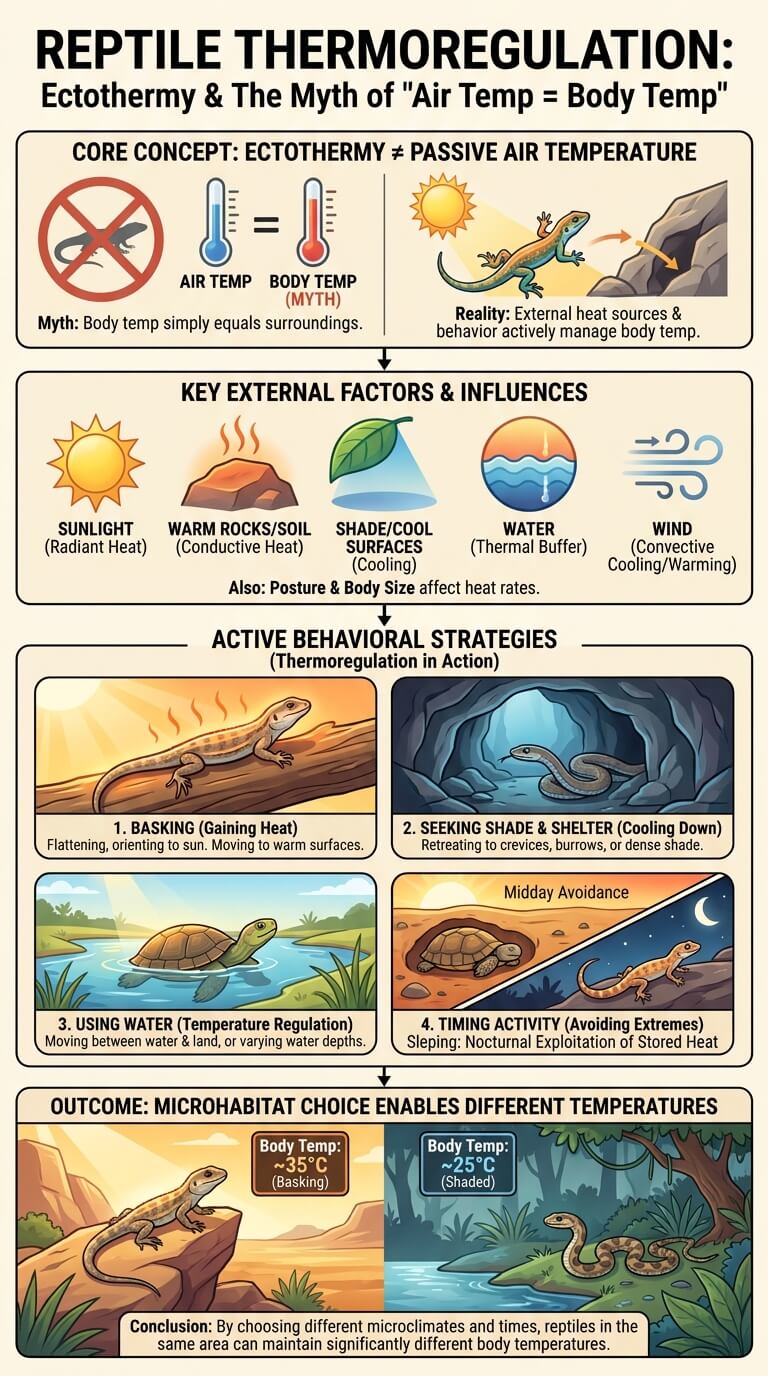
Ectothermy without the myth that body temperature simply equals air temperature
Ectothermy means that external heat has a major role in determining a reptile’s body temperature and activity. Reptiles do not simply become whatever temperature the surrounding air happens to be. Sunlight, warm rocks, cool soil, water, shade, wind, posture, and body size can all change the rate at which an animal gains or loses heat.
The National Park Service overview of reptile and amphibian life history notes that ectothermic animals can warm or cool themselves behaviorally, including by basking or seeking shade. This helps explain why two reptiles in the same landscape can maintain different body temperatures by choosing different microhabitats or activity times.
Basking, shade, burrows, water, and timing of activity
Basking is one visible form of thermoregulation, but it is not the only one. A lizard may move between sun and shade, flatten or reorient its body, or retreat into a crevice. A turtle may use sunlit logs or water with different temperatures. Desert reptiles may avoid the hottest part of the day, while nocturnal species can exploit heat stored in rocks and soil after sunset.
Reproduction and Life History
Eggs, live birth, sex determination, and parental care in overview
Reptile reproduction is more diverse than the common image of an animal burying eggs and leaving. Many reptiles are oviparous, meaning they lay eggs, but live birth has evolved repeatedly in squamates. Eggshell structure varies, and describing every reptile egg as “leathery” oversimplifies real differences in shell composition and mineralization.
Sex determination varies too. Many reptiles use genetic systems, while temperature-dependent sex determination occurs in several lineages, especially among many turtles and crocodilians. The relationship between incubation temperature and offspring sex is not identical across species, so a single formula such as “warm means female” is inaccurate as a general rule.
Why all reptiles do not follow one reproductive pattern
Parental behavior ranges widely. Many species provide little or no care after eggs are laid or young are born, while some crocodilians defend nests and assist hatchlings. Selected snakes attend eggs, and some lizards show forms of parental care as well. Minimal care should not be judged using human ideas of good or bad parenting. A reproductive strategy can succeed because it fits the species’ ecology and life history.
Diets, Feeding, and Movement
Carnivores, herbivores, omnivores, and specialized feeders
There is no single reptile diet. Many snakes are predators, but reptile feeding ecology also includes insectivory, herbivory, omnivory, fruit eating, algae grazing, scavenging, fish eating, and specialized feeding on mollusks or other prey. Green iguanas are primarily herbivorous, marine iguanas graze algae, many tortoises eat mostly plant material, and freshwater turtles vary greatly by species and age.
Walking, running, climbing, burrowing, swimming, gliding, and limbless locomotion
Reptiles move in many ways. Lizards can walk, sprint, climb, dig, swim, and in some lineages glide. Crocodilians swim mainly with powerful tail movements and can also move on land using low and more elevated postures. Turtles walk on land or swim with limb movements suited to their habitat. Some sea turtles have long flipper-like forelimbs specialized for efficient swimming.
Snakes use several forms of limbless locomotion, including lateral undulation, concertina movement, sidewinding, and rectilinear movement. These are important examples, but they are only one part of the broader reptile movement story.
Reptile Senses and Behavior
Vision, chemical sensing, hearing, touch, and specialized thermal sensing
Reptiles are sometimes described as having poor senses, but sensory abilities differ greatly with lifestyle. Many lizards use strong vision for detecting prey, rivals, or display signals. Squamates can rely heavily on chemical information, and tongue-flicking helps many species collect chemical particles for the vomeronasal system. Crocodilians combine vision, hearing, touch, and specialized sensory structures around the jaws and body.
Snakes do not have external ear openings, but describing them as simply deaf is misleading. They can detect vibrations and some airborne sound through their auditory system. Heat-sensitive facial organs occur only in particular snake lineages, not in every snake and certainly not in every reptile. Thermal sensing is a specialized sensory pathway rather than ordinary visual sight.
Daily activity, communication, defense, territoriality, and social variation
Reptile behavior includes far more than basking and feeding. Species may be active by day, at night, around dawn and dusk, or on schedules that shift with season and temperature. Communication can involve body posture, head movements, color displays, scent marks, touch, and sound. Crocodilians are especially notable for vocal communication, while many lizards use visual displays such as head bobs or dewlaps.
Where Reptiles Live
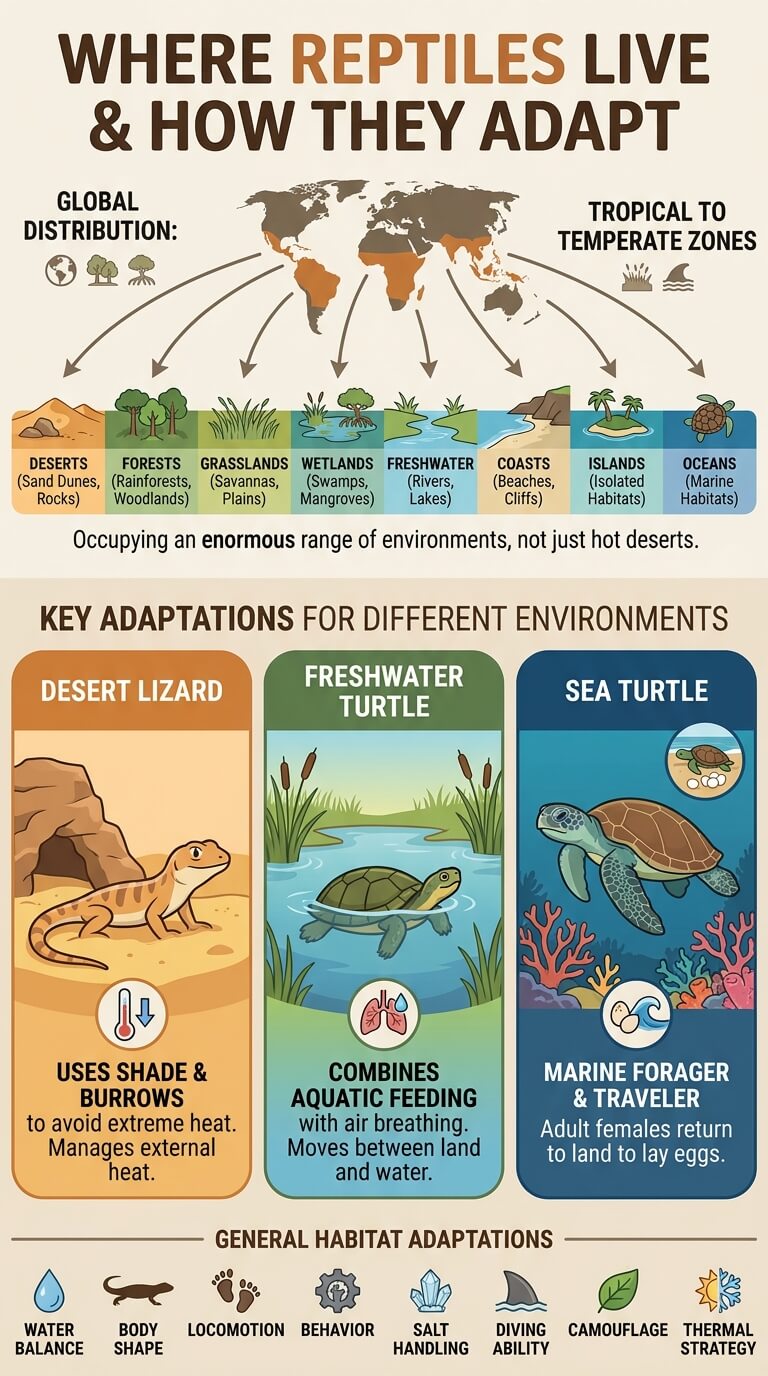
Deserts, forests, grasslands, wetlands, freshwater, coasts, islands, and oceans
Reptiles occupy an enormous range of environments. They occur in tropical rainforests, temperate woodlands, grasslands, savannas, deserts, rocky slopes, wetlands, rivers, lakes, mangroves, coastlines, islands, and marine habitats. Some spend most of their lives underground, while others live in trees or move between land and water.
The stereotype that reptiles belong only in hot deserts comes partly from their need to manage external heat, but reptiles also live in regions with cold winters and strong seasonal change. Their activity windows, shelter use, and seasonal dormancy can help them survive periods when surface conditions are unfavorable.
Adaptations that let different reptiles use very different environments
Habitat adaptations can involve water balance, body shape, locomotion, behavior, salt handling, diving ability, camouflage, or thermal strategy. A desert lizard may use shade and burrows to avoid extreme heat. A freshwater turtle can combine aquatic feeding with air breathing. Sea turtles are marine foragers and travelers, yet adult females must return to land to lay eggs.
Why Reptiles Matter in Ecosystems
Predators, prey, herbivores, scavengers, seed movers, and habitat modifiers
Reptiles occupy many positions in food webs. Some snakes prey on rodents, but others specialize on frogs, fish, eggs, insects, or other animals. Lizards can be insect eaters, predators, herbivores, or fruit consumers. Tortoises may move seeds after eating fruit or vegetation. Freshwater turtles can act as predators, scavengers, herbivores, or omnivores depending on species and life stage.
Reptiles are also prey. Eggs, hatchlings, juveniles, and adults can be eaten by birds, mammals, fish, other reptiles, and invertebrates. Large crocodilians may function as major predators in aquatic systems, while smaller reptiles can be important mid-level consumers. In some places, reptiles modify habitat in ways that affect other organisms. The ecological role depends on the species, life stage, and ecosystem rather than on the label “reptile” alone.
Reptile Conservation in Brief
Why conservation status and threats must be assessed species by species
It is inaccurate to describe reptiles as a whole as endangered. Extinction risk varies enormously among species and populations. Some reptiles remain widespread, while others have very small ranges or face serious declines. Habitat loss, road mortality, invasive species, collection and trade, persecution, fisheries interactions, pollution, and climate change can matter, but their importance differs across regions and lineages.
The IUCN Red List’s global assessment work evaluates extinction risk at the species level and notes that comprehensive reptile assessment has become an important part of tracking terrestrial vertebrate conservation. This species-by-species approach is essential because the pressures facing a sea turtle, an island lizard, a desert tortoise, and a crocodilian can be very different.
Common Reptile Myths and Misunderstandings
Myths about danger, venom, speed, senses, egg laying, shedding, and deserts
Several widespread reptile myths come from treating one familiar animal as representative of the whole group. Not all reptiles are dangerous, and not all venomous reptiles are snakes. Venom and poison are also different biological concepts: venom is delivered through a specialized mechanism such as a bite, while poison causes harm through contact, ingestion, or absorption depending on the substance and species.
Not all reptiles lay eggs. Not all reptiles shed their outer skin in one intact piece. Not all reptiles live in deserts, move slowly, have poor senses, or abandon their young. Turtles are not just aquatic reptiles, tortoises are turtles adapted to terrestrial life, and tuatara are not lizards. Crocodilians are not dinosaurs, although they and birds belong to the larger archosaur lineage.
Myths can also become safety problems. Head shape, pupil shape, color, and tail shape are not universal rules for identifying venomous snakes. Unknown wild reptiles should be observed from a safe distance rather than handled for closer inspection. Large crocodilians and venomous species require particular caution and respect for local wildlife guidance.
Why cold-blooded does not mean literally cold
“Cold-blooded” is a familiar phrase, but ectotherm is more precise. A basking reptile can become quite warm, and many species actively choose locations that help keep their body within a useful temperature range. The important difference is mainly where the heat comes from and how body temperature is regulated, not whether the animal’s blood feels cold.
This distinction also explains why temperature strongly influences when many reptiles can digest food, move efficiently, court, forage, or remain active. The details are species-specific, and there is no universal ideal body temperature for all reptiles.
Reptiles in the Bigger Picture of Vertebrate Life
Reptiles within vertebrate classification and the animal kingdom
Reptiles belong within Vertebrata, alongside other vertebrate lineages. Their identity is best understood through a combination of ancestry and biological traits rather than a checklist built around one visible feature. That broader perspective helps explain why turtles are reptiles despite their shells, why snakes remain squamates despite losing functional limbs, and why aquatic reptiles remain air breathers.
It also helps separate classification from lifestyle. Living in water does not make a turtle an amphibian. Flying does not place birds outside the reptilian evolutionary tree. A habitat, body shape, or movement style can evolve more than once in unrelated lineages.
Reptiles compared with amphibians and birds
Reptiles and amphibians are both primarily ectothermic, but they differ in important ways involving skin, water balance, development, and amniote ancestry. Amphibians generally have more permeable, glandular skin, while reptiles have more strongly keratinized outer coverings. Many amphibians have aquatic larval stages and metamorphosis, but these patterns are not universal, so comparisons need more nuance than “dry skin versus wet skin.”
Birds create a different kind of comparison. In everyday biology, birds are readily recognized by feathers and other distinctive features and are often taught separately from reptiles. In evolutionary classification, however, birds are nested within the reptilian lineage and share archosaur ancestry with crocodilians.
Snake diversity within the wider reptile story
Snakes deserve detailed study because their limbless movement, feeding systems, sensory biology, defensive strategies, and ecological roles are distinctive. Still, those features should not define reptiles as a whole. The best picture of reptile diversity keeps snakes in their proper evolutionary context within Squamata while giving equal conceptual space to turtles, crocodilians, tuatara, amphisbaenians, and the many lineages commonly called lizards.
Once reptiles are viewed this way, their diversity becomes easier to understand. Similar environmental problems can produce very different solutions: a tortoise carries a shell, a gecko may climb using microscopic toe structures, a crocodilian uses water and powerful tail propulsion, and a snake solves locomotion without limbs.
FAQ
Are reptiles vertebrates?
Yes. Reptiles are vertebrates, meaning they have a backbone and an internal skeleton. Living reptiles are also amniotes, a broader group that includes birds and mammals. Their body plans can look radically different, but snakes, turtles, lizards, crocodilians, amphisbaenians, and tuatara all belong within vertebrate evolutionary history.
Are birds reptiles in modern evolutionary classification?
In phylogenetic classification, birds are nested within the broader reptilian lineage. Birds and crocodilians are the two living archosaur branches and share a more recent common ancestor with each other than either does with lizards or snakes. In everyday educational use, birds and non-avian reptiles are still often discussed separately because they have very different living forms and many distinctive biological features.
What are the four major living groups of non-avian reptiles?
The four major living groups used here are Squamata, Testudines, Crocodylia, and Rhynchocephalia. Squamata includes snakes, amphisbaenians, and the many lineages commonly called lizards. Testudines includes turtles and tortoises. Crocodylia includes crocodiles, alligators, caimans, and gharials. Rhynchocephalia is represented today by tuatara.
Do all reptiles lay eggs?
No. Egg laying is widespread among reptiles, but live birth has evolved repeatedly, especially among squamates. Reproductive biology varies by lineage and species. Egg structure, incubation, sex determination, and parental behavior also differ enough that no single reproductive pattern can represent all reptiles.
Are all reptiles cold-blooded?
Living non-avian reptiles are generally described as ectothermic. This means environmental heat plays a major role in their thermal biology. It does not mean their blood is literally cold or that they passively match air temperature. Many reptiles regulate body temperature behaviorally by choosing sun, shade, water, shelter, posture, and activity times.
Final Thoughts
Reptiles are best understood as a diverse set of living vertebrate lineages, not as a collection of snakes and lizards with a few unusual exceptions. Their biology includes shells and scales, limbs and limbless bodies, herbivory and predation, deserts and oceans, quiet solitary periods and complex communication. The practical term “living non-avian reptiles” keeps the focus on Squamata, Testudines, Crocodylia, and Rhynchocephalia while still acknowledging the evolutionary fact that birds sit within the broader reptilian tree. Seeing that full range makes it easier to understand how reptile anatomy, behavior, habitats, and adaptations fit together without relying on oversimplified rules.

Ethan Walker is the founder and research editor of Animal Fact Central. He creates and reviews educational animal facts content using trusted wildlife, pet care, and science-based sources. His work focuses on making animal behavior, adaptations, habitats, and species facts clear, accurate, and engaging for everyday readers.
Read More Details About Ethan Walker: https://animalfactcentral.com/ethan-walker/