
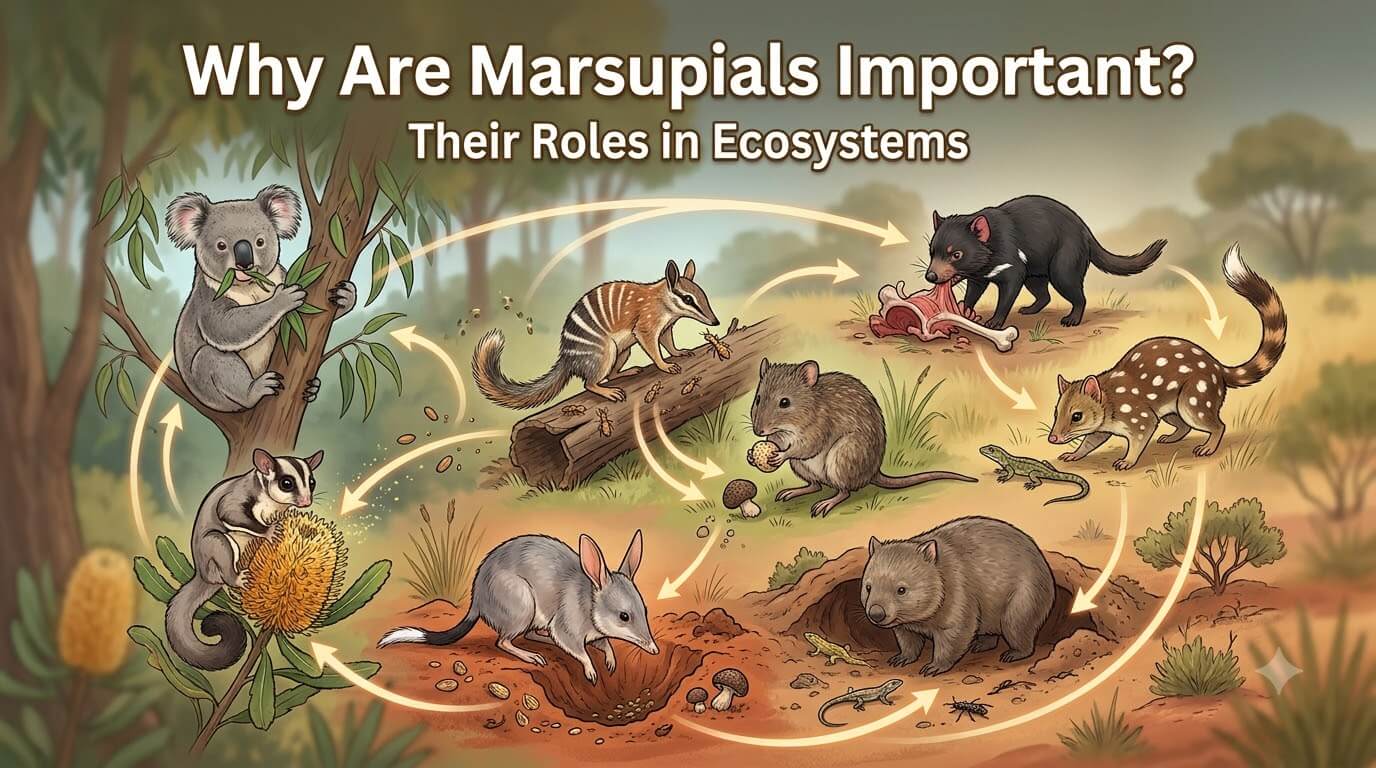
Marsupials matter in ecosystems because they perform many different jobs rather than one universal role. Some graze or browse vegetation. Some dig into soil while searching for food. Others move fungal spores, visit flowers, eat insects, hunt prey, scavenge carcasses, create burrows, or serve as prey themselves. These activities influence food webs, vegetation, soil structure, nutrient movement, shelter availability, and interactions among other species.
Those ecological effects are species-specific. A bilby digging thousands of small foraging pits can change soil conditions in ways a tree-dwelling possum does not. A Tasmanian devil affects carrion food webs differently from a koala. A long-footed potoroo moving fungal spores through forest soil has a different ecological function from a numbat feeding on termites. The most accurate way to understand why marsupials are important is to ask what each species does in its native ecosystem and what evidence shows about the consequences.
Quick Answer
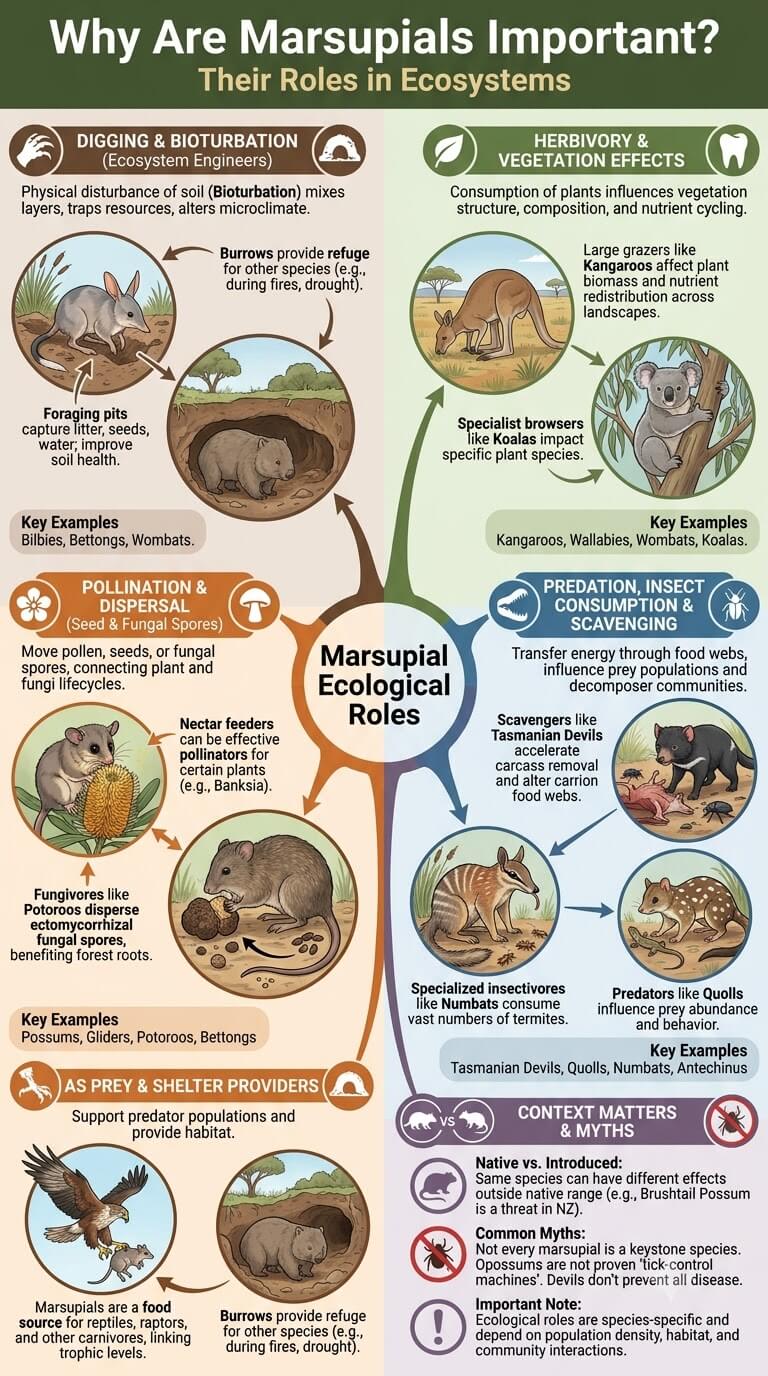
Marsupials contribute to ecosystems through herbivory, predation, insect consumption, scavenging, digging, burrow construction, seed movement, fungal-spore dispersal, pollination in some plant systems, and their role as prey. Some of these functions can reshape physical habitat, while others primarily move energy or nutrients through food webs.
One of the clearest examples comes from Australian digging mammals. Research on reintroduced greater bilbies and burrowing bettongs found that their foraging pits captured litter and seeds, altered soil resource distribution, and created fertile patches in arid landscapes. The study concluded that these digging marsupials affect ecosystem processes at both local and landscape scales.
However, not every marsupial is a keystone species, not every digger automatically qualifies as an ecosystem engineer, and not every ecological effect is beneficial in every location. Context matters, especially when a species is introduced outside its native range.
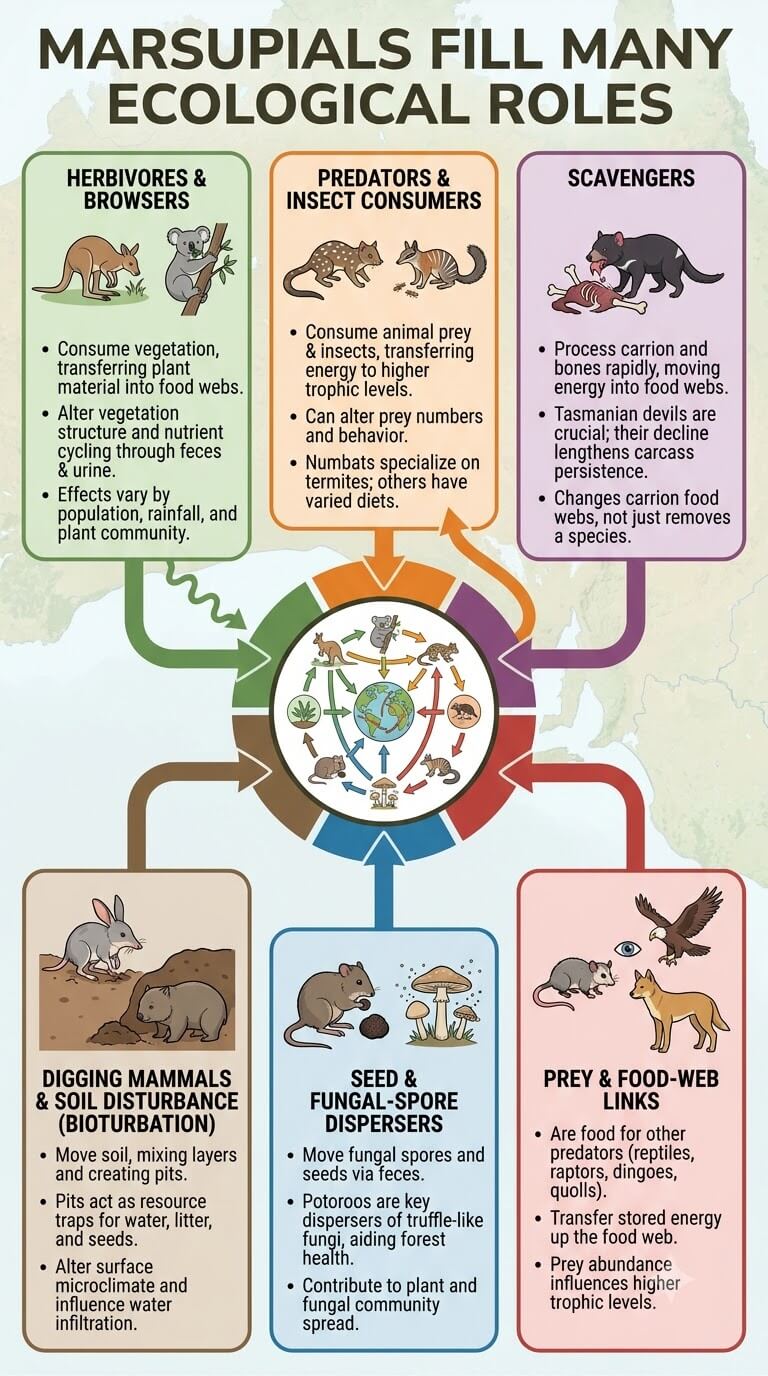
Marsupials Fill Many Ecological Roles
Herbivores and browsers
Kangaroos, wallabies, wombats, koalas, and many possums consume vegetation. Grazing and browsing transfer plant material into mammalian food webs and can change which plants are eaten most heavily, how vegetation is structured, and where nutrients are returned through feces and urine.
The effect of herbivory depends on population density, rainfall, plant productivity, fire history, and the plant community itself. Moderate grazing can create a different vegetation pattern from intense grazing during drought. A specialist leaf eater such as a koala also affects plants differently from a large grazer moving through open country.
Predators and insect consumers
Quolls, Tasmanian devils, dunnarts, antechinus, numbats, and other marsupials consume animal prey. Predators transfer energy from prey populations into higher trophic levels and can alter prey behavior as well as prey numbers.
Numbats illustrate a specialized insect-consumption role because their wild diet is overwhelmingly focused on termites. Small dasyurids often eat insects and other invertebrates, while larger quolls can take reptiles, birds, and mammals.
These roles should not be simplified into claims that one predator “controls” every prey population. Predator effects vary with prey abundance, alternative foods, habitat, season, and interactions with other predators.
Scavengers
Scavenging moves energy from carcasses into vertebrate food webs. Tasmanian devils are especially important because they can locate and consume carrion rapidly and can process tissues, bones, and other material that smaller scavengers may use less efficiently.
A decline in devils has provided researchers with a natural experiment. One study found that carcasses persisted about 2.6 times longer where devil numbers had declined, while other scavengers increased their use of carrion. The work showed that Tasmanian devil decline changes carrion food webs rather than simply removing one species from the system.
Seed and fungal-spore dispersers where documented
Animals can move plant seeds or fungal spores when they eat fruit or fungi and later deposit viable propagules elsewhere. Several marsupials participate in these processes, but the strength of the role differs among species and ecosystems.
Potoroos are especially important examples of fungal-spore dispersers. Long-footed potoroos consume large amounts of truffle-like ectomycorrhizal fungi, and recent research using DNA metabarcoding found that they disperse diverse fungal communities across their remaining range. The study describes their role in moving ectomycorrhizal fungal spores through forest habitats.
Digging mammals and soil disturbance
Bilbies, bettongs, bandicoots, potoroos, and wombats move soil while foraging or building burrows. That physical disturbance is called bioturbation. A digging animal can mix soil layers, create depressions that capture litter and seeds, alter surface temperatures, influence water infiltration, and create patches that differ from undisturbed ground.
The ecological consequences are not identical everywhere. In arid landscapes, pits can become resource traps for water, organic material, and seeds. In temperate grassy woodland, eastern bettong-like pits have been shown to alter surface microclimate strongly even when consistent nutrient changes were not detected.
Prey and food-web links
Marsupials are also food for other animals. Small possums, bandicoots, dunnarts, antechinus, and young macropods can be eaten by reptiles, raptors, owls, dingoes, quolls, and other predators depending on the ecosystem.
Being prey is an ecological role, not merely a source of mortality. Energy stored in one animal’s body becomes available to predators and scavengers. Changes in prey abundance can therefore influence species higher in the food web.
Large Herbivores and Vegetation Effects
Kangaroos as grazers and browsers
Large kangaroos can consume substantial amounts of grasses and other vegetation across open Australian landscapes. Their grazing changes plant biomass locally and redistributes nutrients through movement, digestion, and waste.
Effects vary with abundance and conditions. During productive periods, grazing may be spread across rapidly growing vegetation. During drought, the same population can place greater pressure on limited forage. Fences, artificial water points, livestock, fire, and predator abundance can further change where kangaroos feed.
This means kangaroo herbivory cannot be labeled automatically as helpful or harmful. It is one ecological process whose consequences depend on the plant community and the wider management context.
Wombats and terrestrial herbivory
Wombats feed on grasses, sedges, rushes, and other fibrous vegetation. Their role is more than herbivory because they also create large burrow systems, paths, soil mounds, and localized disturbed patches.
The combination of grazing and digging can produce a mosaic around burrow areas. Vegetation can differ along paths, near burrow entrances, and on excavated soil compared with surrounding ground.
Again, the outcome is not universally positive. Heavy local use can reduce vegetation around frequently used areas, while burrow-associated disturbance can also create new microsites and shelter opportunities.
Why herbivory can have both positive and negative ecosystem effects
Herbivores remove plant tissue, influence competition among plant species, and move nutrients. At moderate levels, this can increase spatial variation and create feeding opportunities for other organisms. At high density, herbivory can suppress regeneration or alter plant communities.
Whether an effect is desirable depends partly on what the ecosystem looked like historically and what other pressures are present. A native herbivore is not automatically harmless, and ecological importance is not the same thing as saying every effect is beneficial.
Digging, Bioturbation, and Soil Processes
Bilbies and bandicoots
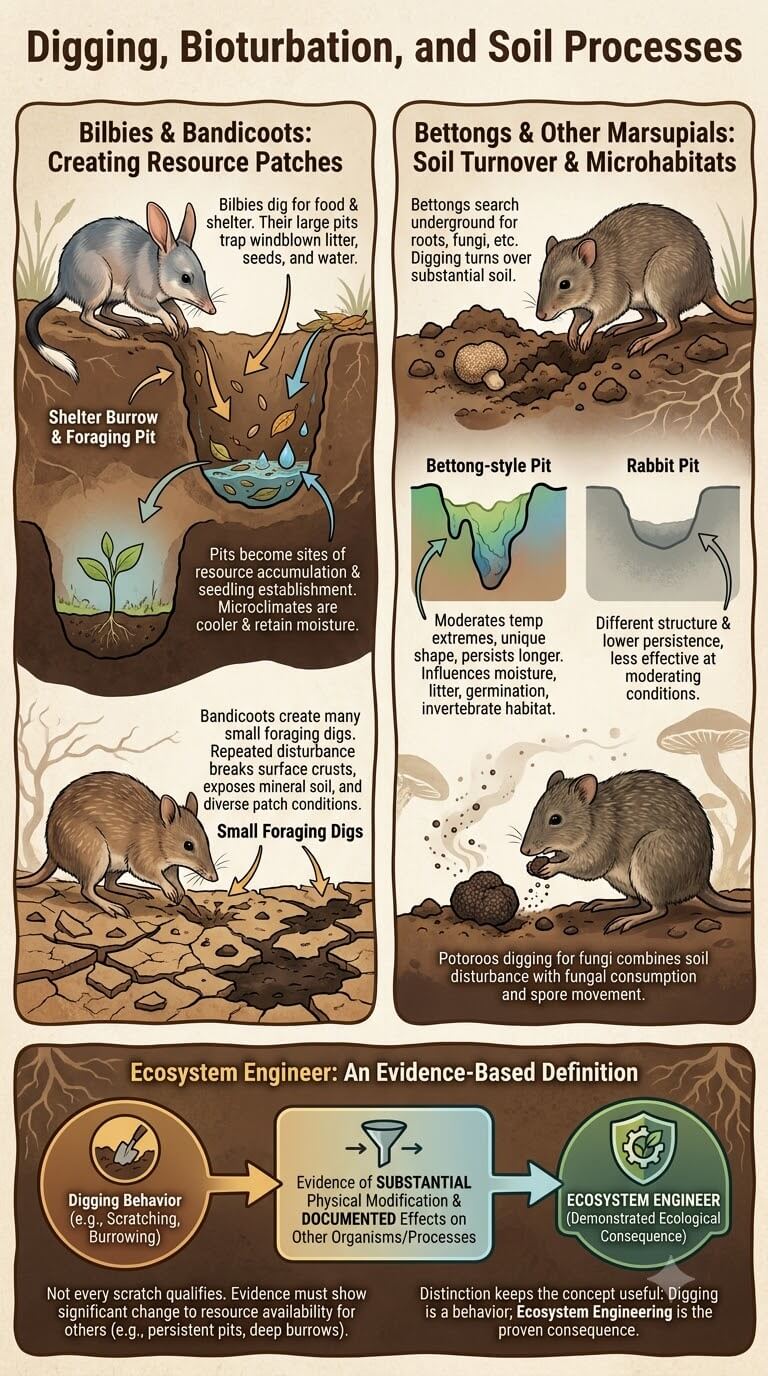
Greater bilbies dig while searching for underground foods and also excavate substantial shelter burrows. Their foraging pits can trap windblown litter, seeds, and water that might otherwise move across the soil surface.
Research in arid Australia found that pits associated with native digging animals became sites of resource accumulation and seedling establishment. Other experiments have shown that pit microclimates can be cooler and retain moisture longer than surrounding exposed soil.
Bandicoots create smaller foraging digs but can produce large numbers of them across a feeding area. Repeated disturbance breaks surface crusts, exposes mineral soil, and creates small patches with different physical conditions.
Bettongs and other digging marsupials
Bettongs search underground for roots, tubers, seeds, fungi, and other foods. Their digging can turn over substantial quantities of soil across a landscape.
In temperate grassy woodland, research comparing eastern bettong-style pits with rabbit pits found strong physical effects on the soil surface. Bettong pits moderated daily temperature extremes and differed in shape and persistence from rabbit disturbances. This matters because pit structure can influence moisture, litter capture, germination, and invertebrate microhabitat.
Potoroos add another layer because digging for fungi combines soil disturbance with fungal consumption and spore movement.
When ecosystem engineer is an evidence-based term
An ecosystem engineer is an organism that changes the physical environment in ways that alter resource availability for other organisms. A bilby that creates persistent pits or a wombat that constructs deep burrows can meet that definition where research documents those effects.
The term should not be applied automatically to every animal that scratches the ground. Evidence should show that the physical modification is substantial enough to change conditions for other organisms or ecosystem processes.
This distinction keeps the concept useful. Digging is a behavior. Ecosystem engineering describes the demonstrated ecological consequences of that behavior.
Pollination, Seed Dispersal, and Fungal-Spore Dispersal
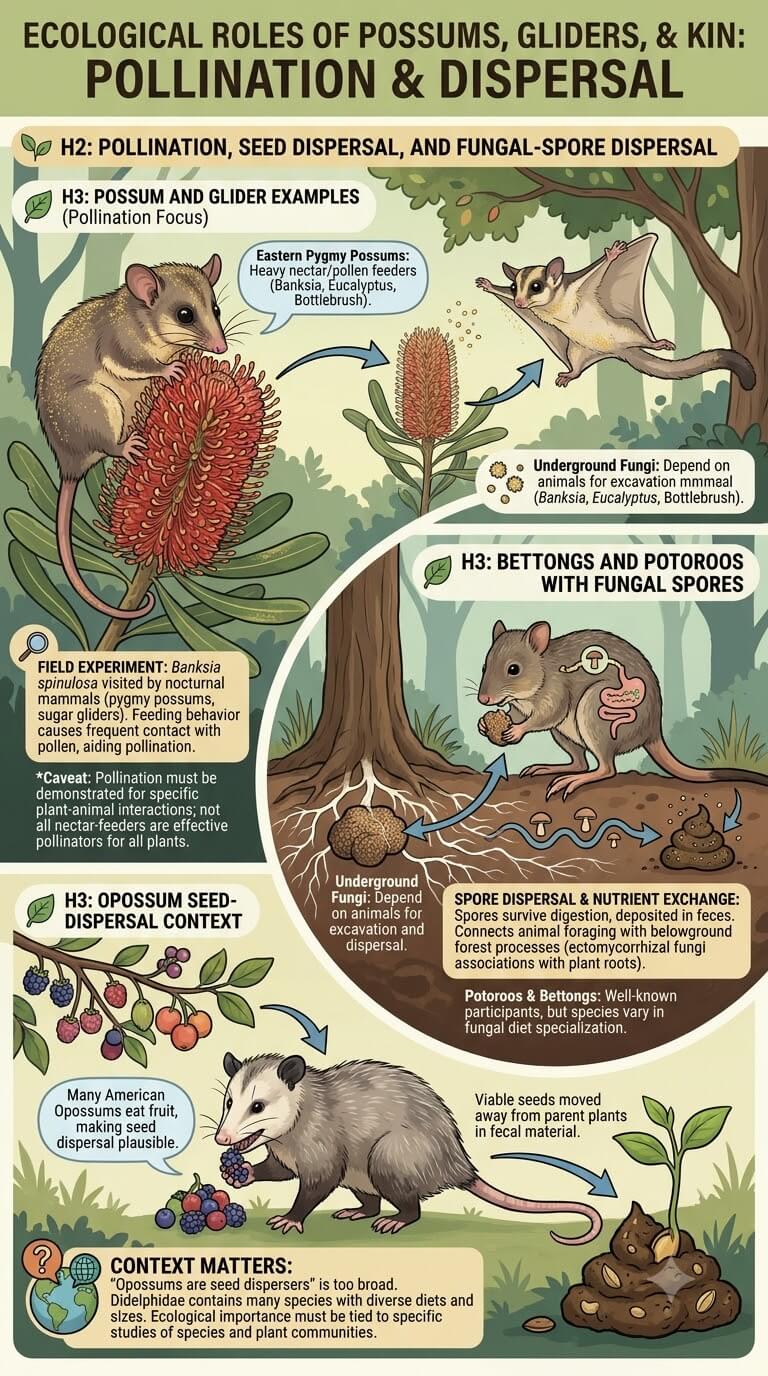
Possum and glider examples where documented
Small nectar-feeding marsupials can carry pollen between flowers. Eastern pygmy possums feed heavily on nectar and pollen from plants such as banksias, eucalypts, and bottlebrushes.
A field experiment on Banksia spinulosa recorded several nocturnal mammal visitors, including eastern pygmy possums and sugar gliders. The researchers concluded that mammals could be effective pollinators of Banksia flowers because their feeding behavior caused frequent contact with pollen and receptive floral structures.
That does not mean every nectar-feeding possum is a major pollinator of every plant it visits. Pollination must be demonstrated for particular plant-animal interactions.
Bettongs and potoroos with fungal spores
Many underground fungi produce fruiting bodies below the soil surface and depend heavily on animals to excavate and eat them. Spores can survive digestion and be deposited in feces at new locations.
Ectomycorrhizal fungi form associations with plant roots and play important roles in nutrient exchange. A mammal that spreads their spores can therefore connect animal foraging with belowground forest processes.
Potoroos and bettongs are well-known participants in this relationship, although different species consume different fungal communities and vary in how specialized their diets are.
Opossum seed-dispersal context
Many American opossums eat fruit, making seed dispersal plausible and documented in some species and plant communities. Seeds that remain viable after gut passage can be moved away from parent plants and deposited with fecal material.
However, “opossums are seed dispersers” is still too broad if used without context. Didelphidae contains many species with different diets, body sizes, ranges, and habitat use. Ecological importance should be tied to studies of the species and plants involved.
Predation, Insect Consumption, and Scavenging
Numbats as termite specialists
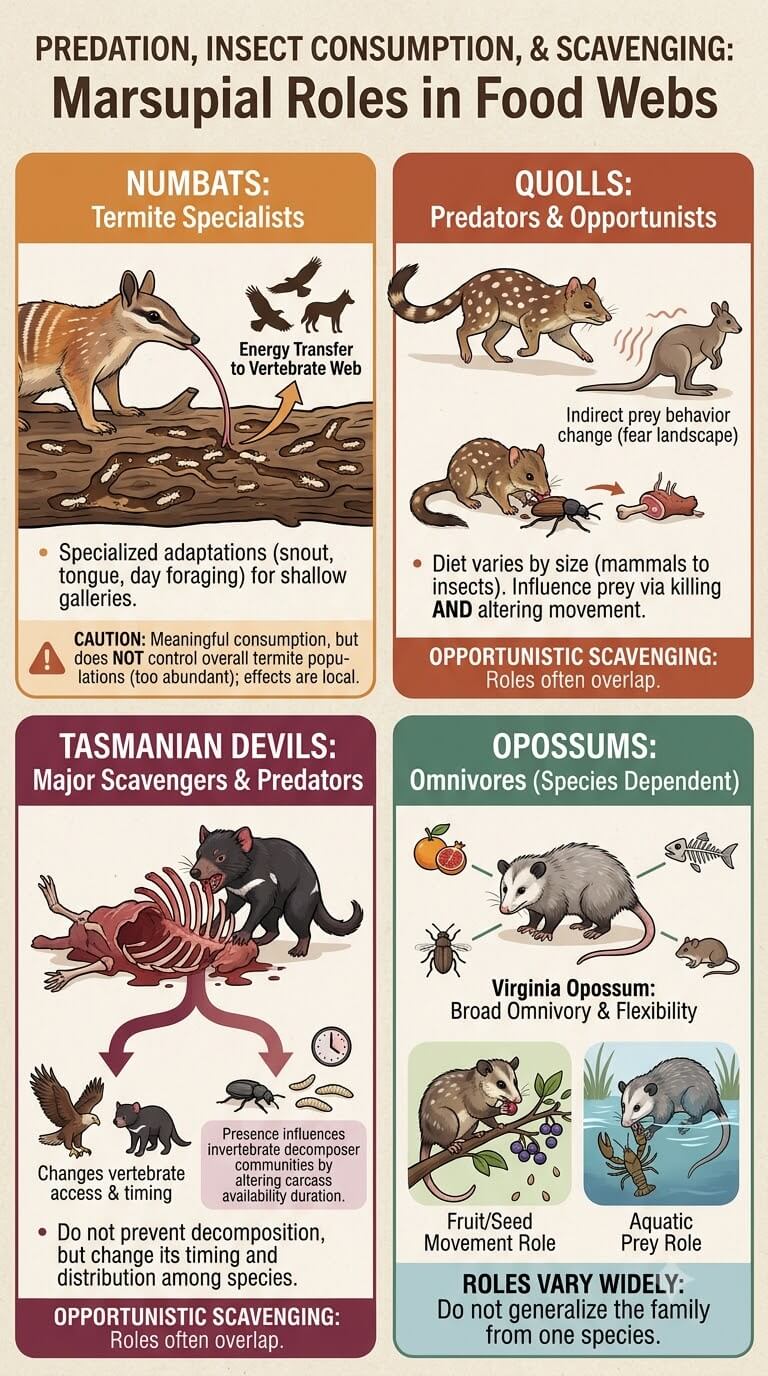
Numbats transfer energy from termite colonies into vertebrate food webs. Their narrow snout, long tongue, and daytime foraging allow them to exploit termites in shallow galleries and decaying wood.
Termite consumption is ecologically meaningful, but it should not be exaggerated into a claim that numbats control termite populations across their range. Termites are extraordinarily abundant social insects, and numbat effects depend on local density, habitat, and prey availability.
Quolls as predators
Quolls occupy predatory roles across several Australian ecosystems. Larger spotted-tailed quolls can take mammals, birds, reptiles, and other vertebrates, while smaller quolls rely more on insects and smaller prey.
Predators influence prey not only by killing animals but also by changing when and where prey move. Those indirect effects can be important, but they are difficult to generalize without local studies.
Quolls also scavenge opportunistically, showing that ecological roles often overlap rather than fitting one clean category.
Tasmanian devils as predators and scavengers
Tasmanian devils are both predators and major scavengers. Their carcass use can affect how quickly carrion disappears and which other animals gain access to it.
Recent work has extended this picture to invertebrates. Where devil densities were lower, more carcass material remained available to carrion beetles and blow fly larvae, showing how a vertebrate scavenger can influence decomposer communities indirectly.
This does not mean devils prevent decomposition. It means their presence changes the timing and distribution of access to carrion among vertebrates and invertebrates.
Opossums as omnivores and scavengers depending on species
The Virginia opossum uses a broad omnivorous diet and can consume carrion, insects, fruits, seeds, and small animals. That flexibility links it to several parts of a food web.
Other American opossums differ. A forest species feeding heavily on fruit may contribute more to seed movement, while a semi-aquatic species interacts with aquatic prey. The family should not be assigned one ecological role from the Virginia opossum alone.
Marsupials as Prey and Shelter Providers
Food-web roles as prey
Small and medium-sized marsupials support predators by serving as prey. Raptors, snakes, large lizards, dingoes, quolls, and other carnivores can depend partly on marsupial prey where ranges overlap.
Population declines in prey species can therefore affect predators even when the predator itself is not directly threatened by the same disturbance. Food-web importance runs both upward and downward through trophic levels.
This is another reason ecological role should not be equated only with visible activities such as digging or pollination.
Burrows and refuge effects where research supports them
Burrows can become habitat for animals other than the species that built them. A recent camera-trap study found that common wombat burrows in southeastern Australian forests were associated with increased activity of several small vertebrates, including mammals, birds, and reptiles.
The association remained or became stronger in severely burned areas after the 2019-20 Black Summer fires, supporting the idea that wombat burrows can act as ecological refuges after extreme disturbance.
The effect was not the same for every animal. Some species avoided burrows, showing why even well-supported engineering effects must be described as context-dependent rather than universally beneficial.
Native Versus Introduced Context Matters
The same species can have different effects outside its native range
An animal’s ecological role is shaped by the community in which it evolved and the community it enters. The common brushtail possum is native to Australia, where it interacts with Australian plants, predators, competitors, parasites, and other marsupials.
In New Zealand, the same species is introduced and can browse native vegetation, compete for plant foods, and prey on native animals. New Zealand’s Department of Conservation describes brushtail possums as a major environmental threat because of these impacts on native forests and wildlife.
This contrast shows why a species cannot be called ecologically “good” or “bad” without reference to place. A native ecological function in one community can become a disruptive interaction after introduction elsewhere.
Why ecological role is not the same as conservation value
A species can perform an important ecosystem function and still create local conflicts. Conversely, a rare species may deserve conservation even if researchers have not proven that it is a keystone engineer or indispensable pollinator.
Conservation value can include evolutionary uniqueness, cultural significance, ethical commitments to preventing extinction, and legal obligations, not only measurable ecosystem services.
Ecological roles are one reason species matter, not the only reason.
Common Myths and Overstatements
Every marsupial is a keystone species
False. A keystone species has a disproportionately large ecological effect relative to its abundance, and that status requires evidence within a particular ecosystem. Marsupials as a whole cannot be labeled keystone.
Every digging marsupial is automatically an ecosystem engineer
False. Digging can qualify as ecosystem engineering when it measurably changes physical habitat or resource availability for other organisms. The strength and persistence of those effects must be demonstrated.
Opossums are proven tick-control machines
This popular claim is overstated. A widely repeated laboratory-derived estimate suggested that opossums could consume very large numbers of ticks through grooming, but later field work examining wild Virginia opossum stomach contents found no ticks or tick parts in the sampled animals.
That does not prove an opossum never eats a tick. It means fixed claims that one opossum reliably removes thousands of ticks should not be used as an established ecosystem service.
Tasmanian devils prevent all carcass or disease problems
False. Devils can speed carrion removal and change scavenger interactions, but carcasses are also processed by insects, microbes, birds, and other mammals. Their presence does not sterilize carcasses or prevent all disease transmission.
The evidence supports an important scavenging role, not a universal sanitation service.
Ecosystems would collapse universally without marsupials
Too broad. Losing marsupials can remove important functions, and some effects may be difficult for other species to replace. But ecosystems vary, functional overlap exists, and ecological responses to species loss are often complex.
A stronger statement is that losing marsupial diversity can simplify food webs and remove specialized functions such as particular digging, fungal-spore dispersal, predation, or shelter creation.
How Diet, Habitat, and Behavior Shape Ecological Roles
Diet is the mechanism behind many ecosystem functions
What an animal eats determines many of its ecological connections. Grazing creates vegetation effects. Fruit eating can move seeds. Fungivory can move spores. Predation transfers energy from prey. Scavenging redistributes carrion resources.
Diet therefore explains much of what a marsupial does to and within an ecosystem.
Habitat determines where those functions operate
The same feeding behavior can have different consequences in rainforest, desert, woodland, grassland, or suburbia. A digging pit in arid soil may trap water and litter differently from one in temperate woodland. A fruit-eating opossum in tropical forest interacts with different plants from a Virginia opossum at a North American woodland edge.
Ecological function must therefore be understood in place, not as a species description detached from habitat.
Behavior changes the scale of ecological effects
Movement, home-range size, social behavior, den use, and activity timing influence how far ecological effects spread. A glider visiting flowers across several trees moves pollen differently from an animal feeding repeatedly at one plant. A potoroo moving fungi through a forest distributes spores differently from a sedentary consumer.
Conserving ecological functions therefore depends not only on keeping individual animals alive but also on maintaining the habitats and behaviors that allow those functions to occur.
FAQ
Which marsupials help move seeds or fungal spores?
Several fruit-eating opossums and possums can move seeds where viable seeds pass through the digestive tract. Potoroos and bettongs are especially well documented as consumers and dispersers of underground fungal spores. The importance of each species depends on the specific plants or fungi and ecosystem studied.
How can digging marsupials change soil?
Foraging pits and burrows can move soil, break surface crusts, capture litter and seeds, change temperature and moisture, influence infiltration, and create microsites for plants, microbes, or invertebrates. Bilbies and bettongs provide some of the strongest Australian examples, but effects vary among habitats.
Are marsupials important predators?
Some are. Quolls are active predators, Tasmanian devils both hunt and scavenge, and smaller dasyurids consume insects and small vertebrates. Numbats are specialized termite feeders. Predatory importance varies by species and ecosystem.
Is every marsupial beneficial in every ecosystem?
No. Ecological effects depend on place and community context. A species may perform normal native functions in one region yet have disruptive effects after introduction elsewhere. The Australian brushtail possum’s very different status in Australia and New Zealand is a clear example.
Final Thoughts
Marsupials are important because they participate in many ecosystem processes at once. Kangaroos and wombats affect vegetation, bilbies and bettongs modify soil, potoroos move fungal spores, small possums can pollinate flowers in documented plant systems, numbats consume termites, quolls hunt prey, Tasmanian devils reshape carrion food webs, and wombat burrows can provide refuge for other animals. Marsupials also serve as prey and connect lower and higher trophic levels. None of these roles should be exaggerated into the idea that every marsupial is a keystone species or that every ecological effect is beneficial everywhere. The scientifically useful question is more specific: what does this species do in this ecosystem, how large is the effect, and what evidence shows that other organisms or processes respond to it? That approach reveals why marsupial diversity matters without turning ecology into a collection of slogans.

Ethan Walker is the founder and research editor of Animal Fact Central. He creates and reviews educational animal facts content using trusted wildlife, pet care, and science-based sources. His work focuses on making animal behavior, adaptations, habitats, and species facts clear, accurate, and engaging for everyday readers.
Read More Details About Ethan Walker: https://animalfactcentral.com/ethan-walker/