

Marsupials are mammals best known for raising extremely undeveloped newborns while they remain attached to a teat, often inside a pouch. Kangaroos and koalas are the familiar examples, but the group also includes wombats, wallabies, bandicoots, bilbies, possums, opossums, gliders, quolls, and the Tasmanian devil. They range from tiny insect-eaters to large grazing kangaroos and occupy forests, deserts, grasslands, mountains, wetlands, and cities.
The pouch is only part of the story. Marsupials are defined more accurately by a reproductive pattern in which pregnancy is generally short, newborns arrive at a very early developmental stage, and milk supports much of the growth that occurs after birth. Not every species has a deep, visible pouch. Some have a shallow skin fold, a temporary pouch, or no permanent pouch at all. Understanding marsupials therefore means looking at birth, teat attachment, lactation, development, and evolutionary history together.
Quick Answer
A marsupial is a mammal whose young are born at a highly undeveloped stage and continue developing while attached to the mother’s teat. In many species, the teat is protected by a pouch, but the size, shape, direction, and permanence of that pouch vary widely. A kangaroo joey may spend months inside a deep pouch, while the young of a pouchless species remain attached beneath the mother’s belly and are protected by fur or skin folds.
Marsupials are native mainly to Australasia and the Americas. Australia and New Guinea contain the greatest variety of forms, from hopping herbivores to burrowing wombats and carnivorous dasyurids. The Americas are home to opossums, shrew opossums, and the monito del monte. The Virginia opossum is the marsupial most familiar to readers in the United States.
What Makes an Animal a Marsupial?
Marsupials Are Mammals
Marsupials share the defining features of mammals. They have hair, regulate their own body temperature, and produce milk from mammary glands. Their lower jaw is formed from a single bone on each side, and the middle ear contains the three small bones characteristic of mammals. A kangaroo may look dramatically different from an opossum, but both belong to the same larger mammalian lineage because of anatomy, reproduction, and evolutionary ancestry.
The Reproductive Traits That Define the Group
The clearest marsupial pattern is a shift in developmental investment. Pregnancy is usually brief compared with the long nursing period that follows. The newborn is tiny, hairless or nearly hairless, and far less developed than a typical newborn dog, horse, or human. Its forelimbs and mouth must work well enough to reach and attach to a teat, while many other body systems continue maturing afterward.
The Australian Museum’s marsupial overview explains that not all marsupials have a true pouch and that milk supplies much of the nutrition needed after the very early birth. That combination of early birth, firm teat attachment, and prolonged lactation is more useful for identifying the group than simply asking whether an animal has a pocket on its abdomen.
Marsupials Versus Eutherian Mammals and Monotremes
Mammals are often introduced as monotremes, marsupials, and placentals. That shortcut is convenient, but it can create the false idea that marsupials have no placenta. They do form placental tissues during pregnancy. The major difference is that pregnancy generally ends much earlier and a greater share of development takes place during lactation after birth.
A scientific review titled Marsupials: placental mammals with a difference emphasizes that marsupials do use a placenta, even though their reproductive schedule differs from that of eutherian mammals. Monotremes differ from both groups because they lay eggs. Eutherian mammals usually keep the developing young in the uterus for a larger portion of development, although newborn maturity still varies greatly among species.
Where Marsupials Live
Australia, New Guinea, and Nearby Islands
Australasia holds the greatest diversity of living marsupials. Australia is famous for kangaroos, wallabies, koalas, wombats, possums, gliders, bandicoots, bilbies, quolls, numbats, and Tasmanian devils. New Guinea and nearby islands add tree kangaroos, cuscuses, bandicoots, dasyurids, and other forms adapted to tropical forests and mountain habitats.
Opossums in the Americas
Opossums are the most widespread American marsupials. Most species live in Central or South America, where they occupy rainforests, dry forests, grasslands, wetlands, farms, and urban edges. They vary in size, diet, climbing ability, and use of the ground. The word opossum usually refers to American members of the family Didelphidae, while possum is commonly used for several Australasian marsupials.
The Smithsonian’s Virginia opossum profile describes a gestation of about 12 to 13 days, followed by development in the pouch and later nursing after the young become more mobile. This species has adapted well to many human-altered environments, but its familiar appearance should not be used as the model for every American marsupial.
Why Modern Distribution Reflects Deep Evolutionary History
The modern pattern is easier to remember than the full route: native marsupials survive mainly in Central and South America, Australia, New Guinea, nearby islands, and parts of North America. The Animal Diversity Web account of marsupial mammals also highlights how the group occupies habitats ranging from Australian deserts to South American rainforests. Geography shaped their opportunities, but it did not lock them into one body type or lifestyle.
How Marsupial Reproduction Works

Pregnancy and the Very Early Birth Stage
After fertilization, a marsupial embryo develops in the uterus and exchanges nutrients with the mother through placental tissues. The pregnancy is generally short relative to the nursing period. When birth occurs, the newborn may be only a tiny fraction of the mother’s size. It is not simply a miniature adult. Many organs, sensory systems, limbs, and other structures are still at an early stage.
The Newborn’s Journey to a Teat
In species such as kangaroos, the newborn moves from the birth opening across the mother’s fur toward the pouch. The mother may lick a pathway, but the joey makes the climb using its own forelimbs. Once it reaches a teat, it attaches firmly and begins receiving milk. The journey is short in absolute distance, yet enormous relative to the newborn’s body.
The route differs among marsupials. A pouchless species may have teats exposed on the abdomen or protected by a skin fold. In every case, reaching a teat quickly is critical. The newborn has little energy reserve and limited ability to regulate body temperature. Attachment places it close to a steady food supply and, where a pouch exists, a protected microenvironment.
Attachment, Milk, and Continued Development
Teat attachment is more than feeding. It anchors a newborn that cannot yet move independently and keeps the mouth aligned with the milk supply. Early in development, the mother controls milk flow more than an older joey does. As the young matures, its jaw, tongue, digestive system, immune defenses, skin, fur, eyes, ears, and limbs continue changing.
Lactation is unusually flexible in many marsupials. The composition of milk changes through different phases, providing a shifting mix of nutrients and biological signals. A mother may even nurse young at different developmental stages. A kangaroo can have an older joey drinking from one teat while a younger pouch young uses another, with the mammary glands producing milk suited to each stage.
How Lactation Changes as the Young Grows
Early milk supports a newborn with an immature digestive and immune system. Later milk becomes richer in components needed for rapid growth, fur development, movement, and life outside the pouch or nest. The transition is gradual. A young marsupial does not suddenly become independent when it first looks outside or steps onto the ground.
Do All Marsupials Have Pouches?
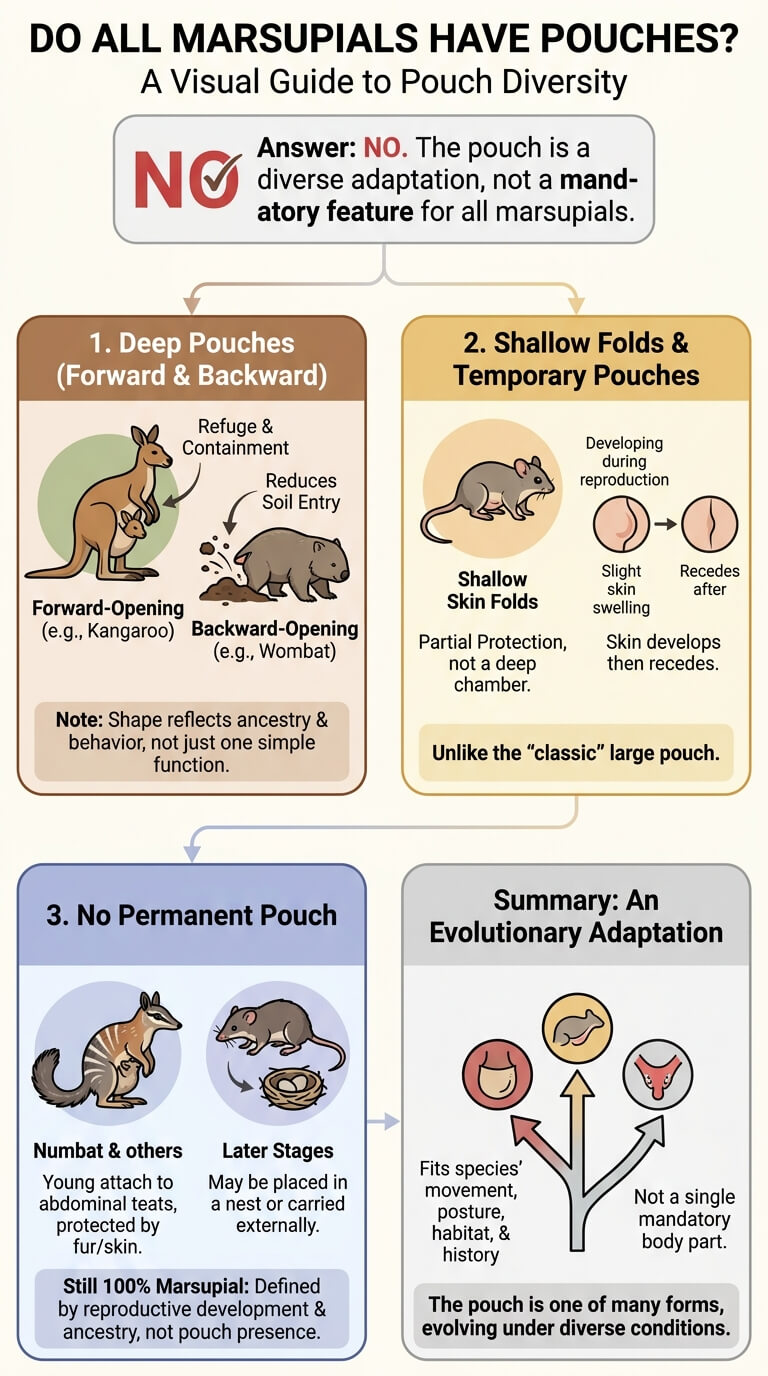
Deep Forward-Opening and Backward-Opening Pouches
The classic kangaroo pouch is deep and opens toward the mother’s head. Its shape helps contain a joey that will later lean out, climb in, and use the pouch as a refuge. Other marsupials have pouches that open toward the rear. Wombats and several burrowing species are often described this way, although pouch form differs among groups. A rear-facing opening can reduce the amount of loose soil entering during digging.
Pouch direction should not be turned into an absolute engineering story. Anatomy reflects ancestry as well as present behavior, and related species may share structures that evolved under older conditions. The safest explanation is that pouch shape can fit a species’ movement, posture, habitat, and evolutionary history, rather than assuming every feature has one simple purpose.
Shallow Skin Folds and Temporary Pouches
Some marsupials have only a shallow fold around the teats. It may offer partial protection without enclosing the young in a deep chamber. In other species, the surrounding skin becomes more developed during reproduction and then recedes. These arrangements still help stabilize or shield attached young, but they do not resemble the large pouch shown in most children’s illustrations.
Marsupials With No Permanent Pouch
The numbat is a well-known example of a marsupial without a permanent pouch. Its young attach to teats on the abdomen and are partly protected by the mother’s fur and surrounding skin. Some shrew-like and mouse-sized marsupials also lack a deep pouch. The young remain tightly attached during the earliest stage, then may be placed in a nest or carried in another way as they grow.
Pouchlessness does not make these animals less marsupial. Reproductive development, anatomy, and ancestry define the group. The pouch is an adaptation found in many forms, not a single mandatory body part with the same shape in every species.
From Tiny Newborn to Independent Juvenile
Development While Attached to the Teat
During the attached stage, the young changes from an almost embryonic-looking newborn into a furred juvenile with functional senses and stronger limbs. Eyes and ears open according to a species-specific timetable. The skeleton, muscles, nervous system, digestive tract, and immune defenses mature while milk remains the main food.
The pouch or protected teat area is therefore closer to an external nursery than a simple carrying bag. Temperature, moisture, microbes, grooming, milk, and the mother’s movement all shape the young animal’s environment. Researchers continue studying how pouch conditions and milk components influence development and disease protection.
Emerging From the Pouch or Nest
First emergence is usually a process, not a one-time departure. A joey may look out, withdraw, climb partly outside, and begin making short trips. It practices balance, locomotion, feeding, and responses to danger while the mother remains nearby. A young wombat may leave the pouch but continue following its mother. A young opossum can leave the pouch and later ride on the mother’s back.
Species without a permanent pouch may shift attached young to a nest, den, or sheltered site. Tasmanian devil mothers, for example, move from pouch care to den-based care as the surviving young grow. The Australian Museum’s Tasmanian devil account notes that females have four teats and later leave the young in a den after the pouch stage. This illustrates how teat number and shelter use can shape early survival.
Returning for Milk and Gradual Weaning
An older joey may be capable of eating vegetation, insects, fruit, or other solid food while still nursing. Milk remains a dependable source of energy and may continue during a long learning period. Returning to the pouch can also provide protection, warmth, and transport until the young grows too large.
Major Marsupial Groups and Examples
Kangaroos, Wallabies, and Rat-Kangaroos
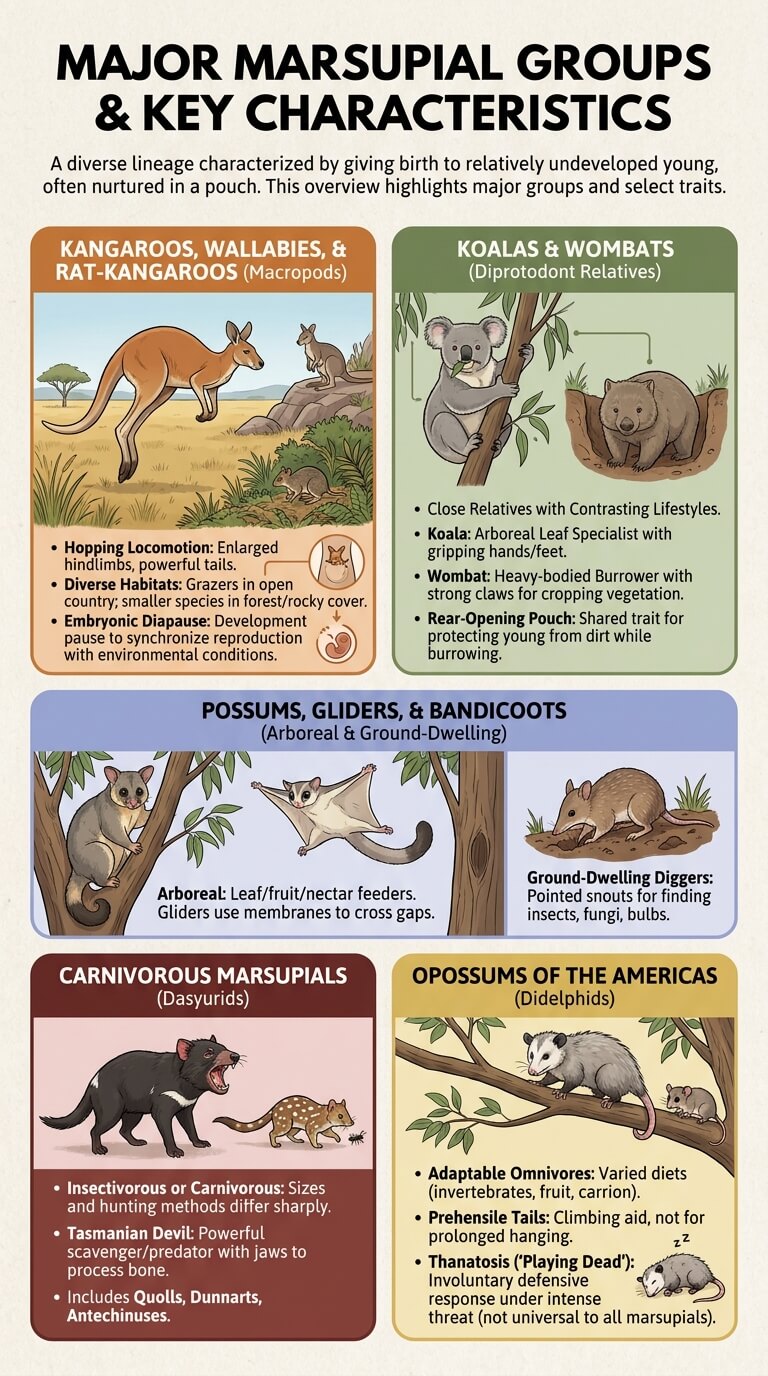
Kangaroos and wallabies belong to a radiation of hopping marsupials with enlarged hindlimbs, long feet, and powerful tails. The largest species graze across open country, while smaller wallabies and pademelons often use forest or rocky cover. Rat-kangaroos and bettongs are smaller relatives that may eat fungi, roots, seeds, insects, and other foods while moving through dense vegetation.
Reproduction can be closely linked to environmental conditions. The Australian Museum’s red kangaroo profile describes embryonic diapause, in which development of a new embryo can pause while an older joey occupies the pouch. This does not occur in every marsupial, but it shows how reproduction can be synchronized with maternal capacity and unpredictable rainfall.
Koalas and Wombats
Koalas and wombats are close relatives within the diprotodont marsupials, yet their lifestyles look very different. Koalas are tree-dwelling leaf specialists with gripping hands and feet. Wombats are heavy-bodied burrowers with strong claws and teeth adapted for cropping vegetation. Both produce highly undeveloped young that continue growing in a rear-opening pouch.
Possums, Gliders, and Bandicoots
Australasian possums include leaf-eaters, fruit-eaters, nectar-feeders, and omnivores. Several gliders have membranes between the limbs that let them cross gaps in the forest canopy. Bandicoots and bilbies are mostly ground-dwelling animals with pointed snouts and strong digging behavior. They search for insects, fungi, seeds, bulbs, and other foods, often turning over soil as they forage.
Carnivorous Marsupials and the Tasmanian Devil
Dasyurids include quolls, dunnarts, antechinuses, planigales, and the Tasmanian devil. Many are insectivorous or carnivorous, but their sizes and hunting methods differ sharply. Tiny species pursue insects and other small prey. Quolls take a wider range of animal foods. Tasmanian devils are powerful scavengers and predators whose jaws can process skin, muscle, and bone.
Opossums of North and South America
American opossums range from the large, adaptable Virginia opossum to small tropical species that spend much of their lives in trees. Many are omnivores, eating combinations of invertebrates, fruit, small vertebrates, eggs, carrion, and plant material. Some have prehensile tails that help with climbing, although the tail is not a permanent hanging hook and should not be portrayed as carrying an adult by itself for long periods.
Not every opossum has the same defensive behavior. The famous immobile response called thanatosis, or playing dead, is most associated with certain opossums and can be involuntary under intense threat. It is not a defining trait of marsupials and should not be generalized to kangaroos, koalas, or other members of the group.
Marsupial Adaptations Beyond the Pouch
Diet and Teeth
Marsupial diets include grasses, leaves, fruit, nectar, fungi, termites, insects, fish, small vertebrates, and carrion. Teeth reflect these differences. Kangaroos crop and grind vegetation. Koala cheek teeth shear fibrous leaves. Numbats have numerous small teeth suited to a termite-based diet. Tasmanian devils have robust jaws and teeth for animal tissue and bone.
Diet also influences movement, activity, territory size, and reproduction. A leaf specialist can remain near a predictable food supply but must process large amounts of low-energy material. A predator or scavenger may travel farther and face less predictable meals. There is no single marsupial feeding strategy.
Climbing, Digging, Gliding, and Hopping
Hopping is only one marsupial form of locomotion. Tree kangaroos climb with strong forelimbs and more flexible movement than their ground-dwelling relatives. Wombats dig with powerful shoulders and claws. Sugar gliders and several related species glide using a membrane stretched between the limbs. Opossums can climb with grasping feet, and the semi-aquatic water opossum swims and forages around streams.
Desert, Forest, Grassland, and Urban Habitats
Marsupials live in environments ranging from arid central Australia to New Guinea cloud forests and American wetlands. Desert species may reduce daytime activity, shelter underground, and time reproduction around rainfall. Forest species use hollows, dense vegetation, canopy pathways, or leaf nests. Grassland kangaroos depend on forage and water conditions that can change greatly between seasons.
Common Myths and Misunderstandings
Myth: Every Marsupial Has a Large Visible Pouch
Fact: Pouches range from deep chambers to shallow folds, temporary structures, and no permanent enclosure. Young still attach to teats and complete much of their development after birth. The pouch is common and important, but it is not identical across the group.
Myth: Marsupials Are Primitive or Inferior Mammals
Fact: Marsupials are not incomplete versions of eutherian mammals. They represent a successful mammalian lineage with a different reproductive schedule. Their young develop through a combination of pregnancy and prolonged lactation, and the adults have diversified into many diets, body forms, and habitats. Calling them primitive confuses difference with inferiority.
Myth: Possums and Opossums Are the Same Animal Everywhere
Fact: Opossum generally refers to American marsupials, especially members of Didelphidae. Possum commonly refers to several Australasian marsupials. The names overlap in casual speech, but the animals belong to different branches and can differ greatly in anatomy, behavior, and ecology.
Conservation and Human Pressures
Why Status Varies Widely Among Marsupial Species
Marsupials do not share one conservation status. Some, such as the Virginia opossum, are widespread and adaptable. Others have small ranges, specialized diets, isolated island populations, or severe declines. Status can also change as new surveys, taxonomic revisions, disease data, and population trends become available.
For that reason, broad statements such as “marsupials are endangered” are misleading. The correct approach is to check the exact species and assessment date in the IUCN Red List or an appropriate national wildlife authority. A common name can cover several species with very different levels of risk.
Reliable conservation writing should name the species, identify the authority making the assessment, and avoid carrying an old category forward without checking. Regional legal status and global IUCN status may also differ because they answer different questions.
Habitat Loss, Invasive Predators, Disease, and Road Mortality
Major pressures differ by place and species. Habitat clearing and fragmentation can remove food, shelter, nesting hollows, and safe movement routes. Introduced predators have had severe effects on many small and medium-sized Australian mammals. Disease is especially important for species such as the Tasmanian devil. Roads kill animals directly and divide habitat into smaller patches.
Climate-related shifts in heat, drought, fire, rainfall, and food availability can add further stress. The effect depends on whether a species can move, change diet, reproduce quickly, or find refuges. Conservation work therefore ranges from predator control and habitat restoration to disease research, road mitigation, captive breeding, and carefully managed reintroductions.
Why Species-Specific Status Must Be Checked Carefully
Taxonomy, survey results, disease data, and legal protections can change the picture for an individual marsupial. A newly recognized species may have a much smaller range than the broader name once suggested, while new fieldwork may find populations that were previously overlooked.
Global assessments and regional laws also answer different questions. A species can receive legal protection in one country or state while carrying a different global category. Accurate conservation information therefore needs the scientific name, location, assessment authority, and date.
Pouches and Development in the Broader Mammal Story
A Specialized Form of Carrying and Extended Development
A marsupial pouch can transport, shelter, warm, and protect young, but it is inseparable from teat attachment and lactation. It is not merely a pocket added to an otherwise typical mammal. The mother’s reproductive anatomy, milk production, pouch or skin folds, grooming, posture, and movement work together as one developmental system.
This combination of milk, shelter, transport, and gradual independence is a specialized form of animal parenting rather than simply a baby riding in a pouch.
Marsupial Development Within an Animal Life Cycle
The marsupial life cycle includes fertilization, pregnancy, birth, teat attachment, growth, emergence, weaning, juvenile learning, maturity, and reproduction. The boundaries between stages are gradual. A joey may eat solid food but still nurse, travel outside the pouch but return during danger, or look independent while remaining socially and nutritionally connected to its mother.
FAQ
Are Marsupials Mammals?
Yes. Marsupials have hair, produce milk, regulate body temperature, and share the skeletal and evolutionary features of mammals. They differ from monotremes because they give birth to live young, and they differ from eutherian mammals mainly in the timing and organization of pregnancy, birth, and lactation.
Why Are Marsupial Newborns So Small?
Marsupials give birth at an early developmental stage and shift much of growth to the nursing period. The newborn must reach and attach to a teat, but many organs and body systems continue maturing afterward. Small size is therefore part of a reproductive strategy built around prolonged lactation, not evidence that the young was born accidentally early.
Do All Marsupials Have Pouches?
No. Many have pouches, but these can be deep, shallow, forward-opening, rear-opening, seasonal, or little more than folds of skin. Some marsupials have no permanent pouch. Their young attach to exposed or partly protected teats and may later be kept in a nest or carried on the body.
What Is the Difference Between a Possum and an Opossum?
Opossums are American marsupials, including the Virginia opossum. Possums are several groups of Australasian marsupials. The words can sound similar and are sometimes used loosely, but the animals belong to different evolutionary branches and should not be treated as one species or one uniform group.
Final Thoughts
Marsupials are mammals whose reproductive strategy places much of early development after birth. Their tiny newborns attach to teats, grow through changing phases of milk, and often receive protection inside a pouch, although not every species has one. Kangaroos, koalas, wombats, gliders, bandicoots, quolls, devils, possums, and opossums show how one developmental pattern can support an extraordinary range of bodies and lifestyles. The most useful way to understand marsupials is not as “animals with pockets,” but as a diverse mammalian lineage built around early birth, prolonged lactation, and flexible care.

Ethan Walker is the founder and research editor of Animal Fact Central. He creates and reviews educational animal facts content using trusted wildlife, pet care, and science-based sources. His work focuses on making animal behavior, adaptations, habitats, and species facts clear, accurate, and engaging for everyday readers.
Read More Details About Ethan Walker: https://animalfactcentral.com/ethan-walker/