
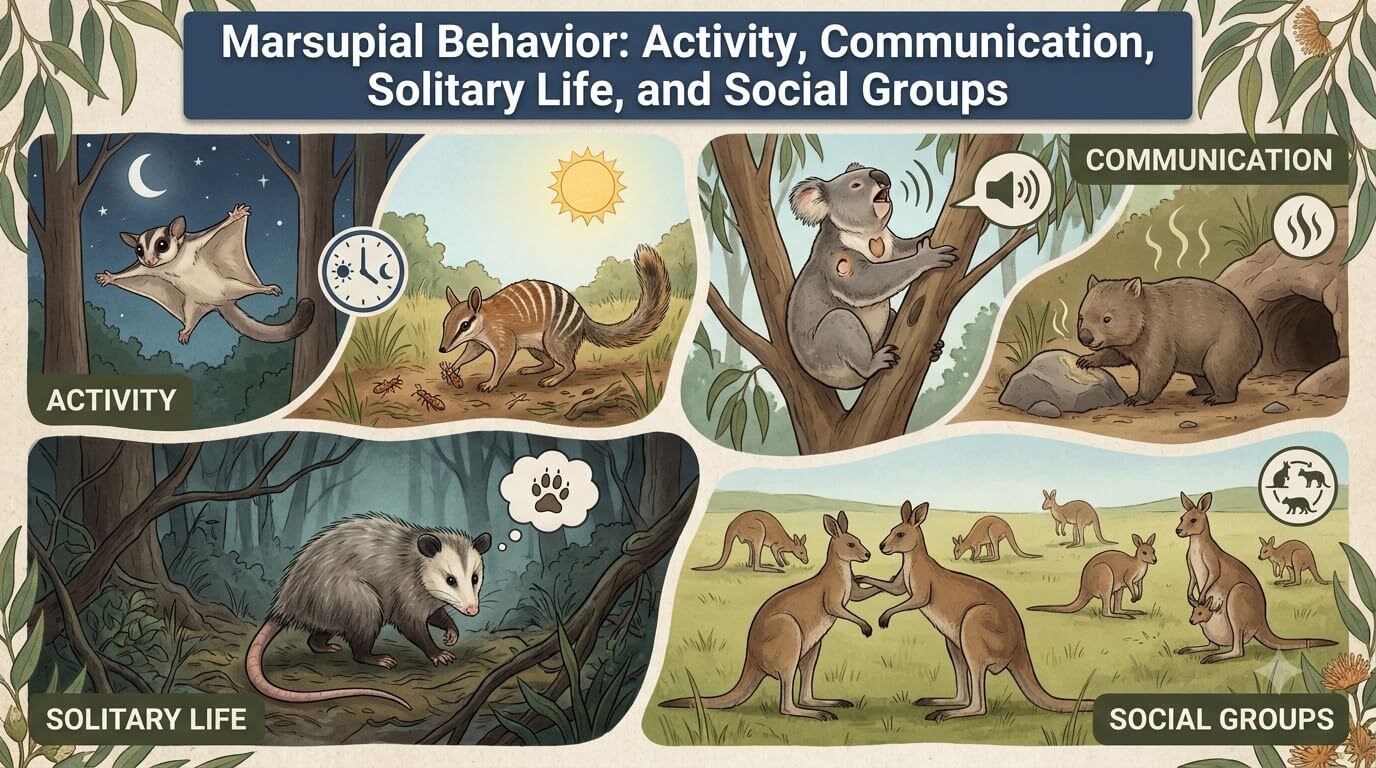
Marsupial behavior is far more varied than the stereotype of a solitary nocturnal animal. Eastern grey kangaroos can form social mobs. Sugar gliders may live in small clans and share nests. Koalas are mostly solitary but communicate during the breeding season and maintain overlapping home ranges. Tasmanian devils usually forage alone yet interact around carcasses, dens, and mates. Wombats often live alone while using scent to communicate with neighbors. Virginia opossums are primarily solitary and nocturnal.
These differences reflect habitat, diet, body size, predation risk, reproductive strategy, and ancestry. Some marsupials benefit from group vigilance or shared shelter. Others avoid one another except when mating, raising young, defending resources, or investigating scent marks. Activity patterns also vary: many species are nocturnal or crepuscular, but others can be active during daylight, shift schedules with weather, or change behavior seasonally.
Quick Answer
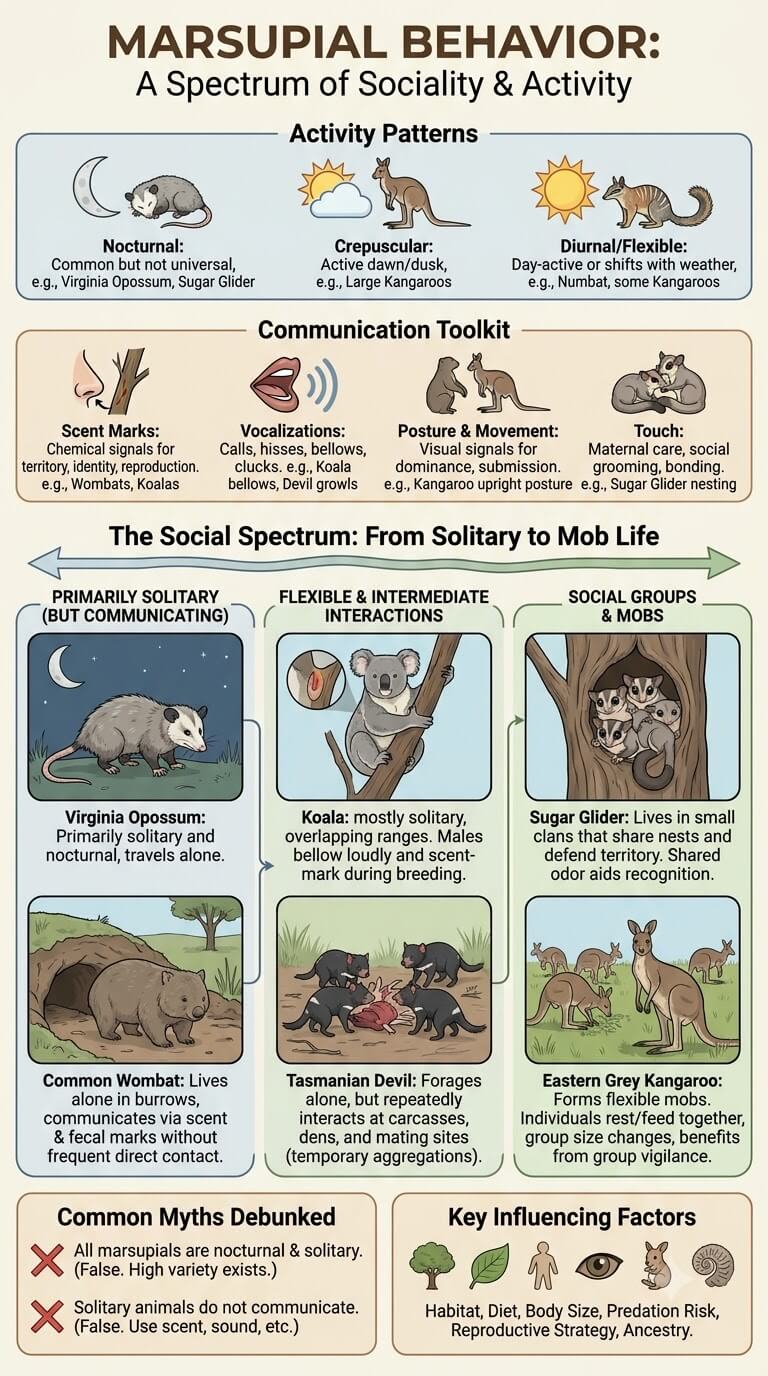
There is no single marsupial social system. Living marsupials include solitary, territorial, loosely social, family-group, and mob-forming species. Communication can involve scent marks, vocalizations, posture, touch, alarm signals, and direct physical interactions. Many species are most active at night, but nocturnality is not universal.
Eastern grey kangaroos are a useful social example. The Australian Museum’s eastern grey kangaroo profile describes them as living in mobs and gathering in large numbers at feeding areas, especially from late afternoon into the night. They use clucking sounds and guttural coughs in communication and alarm contexts.
At the other end of the social spectrum, a Virginia opossum usually travels and rests alone. Between those examples are marsupials that share nests, overlap home ranges, visit communal scent sites, form temporary feeding aggregations, or interact strongly only during breeding.
Activity Patterns: Night, Day, and Everything Between
Nocturnal behavior is common but not universal
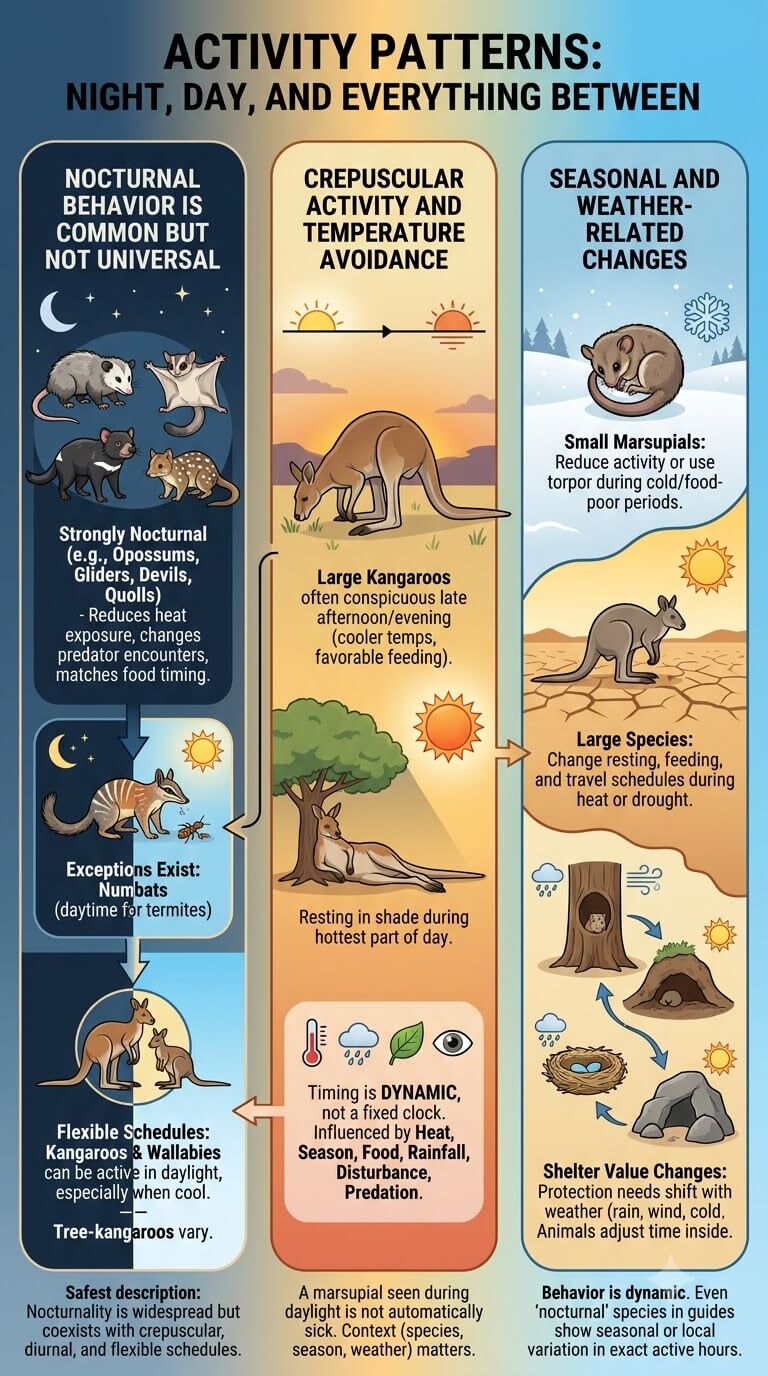
Many marsupials are active mainly at night. Virginia opossums, sugar gliders, Tasmanian devils, many quolls, numerous possums, and several small ground-dwelling marsupials are strongly nocturnal. Night activity can reduce heat exposure, change predator encounters, and match the timing of food resources.
Still, “marsupials are nocturnal” is too broad. Numbats are well known for daytime activity that tracks termite availability. Some kangaroos and wallabies feed from late afternoon through the night but can also be active during daylight, particularly in cool weather. Tree-kangaroo activity patterns vary among species and environments.
The safest description is that nocturnality is widespread across Marsupialia but coexists with crepuscular, diurnal, and flexible schedules.
Crepuscular activity and temperature avoidance
Crepuscular animals concentrate activity around dawn and dusk. Large kangaroos often become conspicuous in the late afternoon and evening, when temperatures are lower and feeding conditions are favorable. They may rest in shade during the hottest part of the day.
This timing is not simply a fixed internal clock. Heat, season, food condition, rainfall, disturbance, and predation can all shift when an animal moves or feeds.
A marsupial seen during daylight is therefore not automatically sick. Whether daytime activity is unusual depends on the species, season, weather, and behavior being observed.
Seasonal and weather-related changes
Small marsupials may reduce activity during cold or food-poor periods. Some use daily torpor or longer seasonal energy-saving strategies. Large species can change resting, feeding, and travel schedules during heat or drought.
Weather can also change the value of a shelter. A tree hollow, burrow, nest, rock crevice, or dense thicket provides different protection from rain, wind, cold, or heat. Animals may spend more or less time inside depending on conditions.
Behavior is therefore dynamic. A species described as “nocturnal” in a field guide may still have seasonal or local variation in the exact hours it is active.
Communication in Marsupials
Scent marks and chemical signals
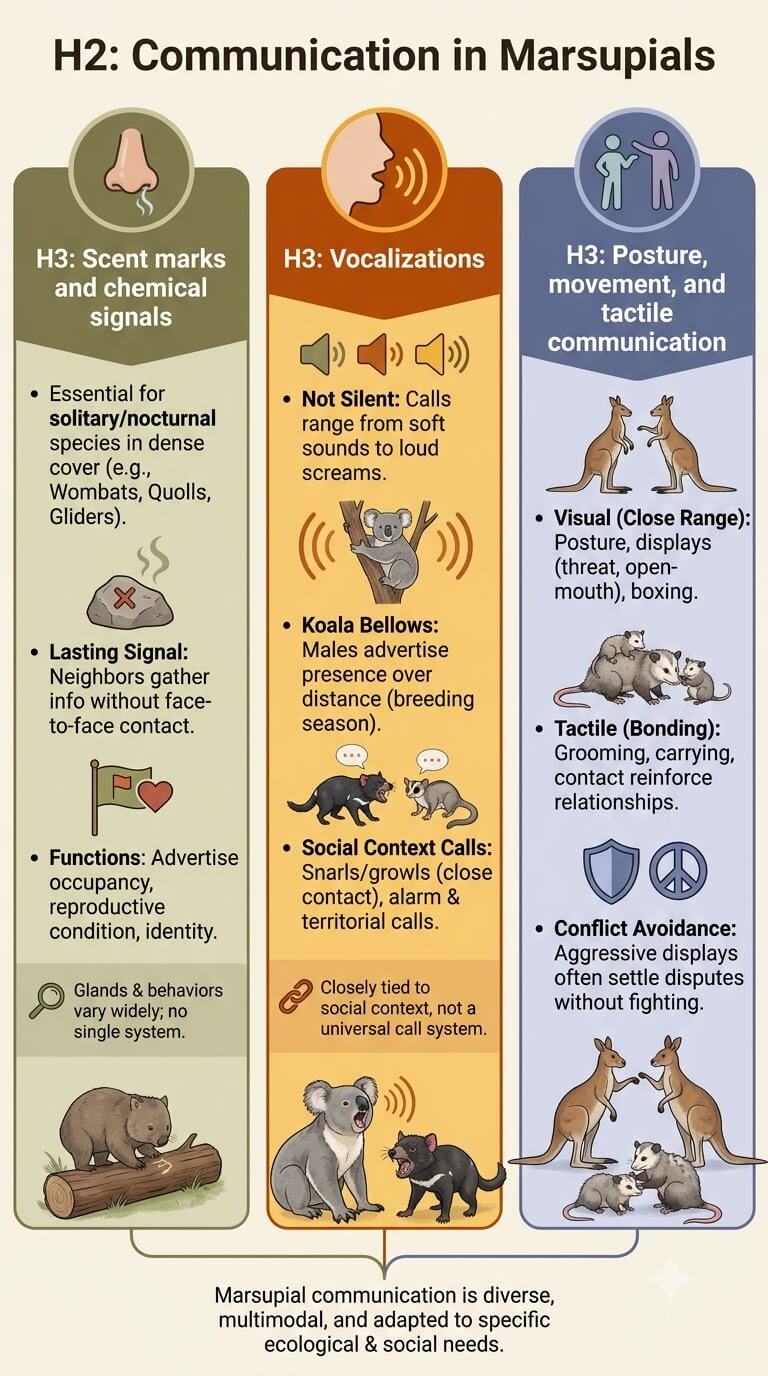
Scent is especially important for marsupials that move alone, occupy dense vegetation, or are active in darkness. A scent mark can remain after the animal has left, allowing neighbors to gather information without a face-to-face encounter.
Wombats, quolls, gliders, possums, koalas, and dasyurids all use chemical communication in different ways. Marks can help advertise occupancy, reproductive condition, group membership, or individual identity.
The exact glands and marking behaviors vary. It is therefore better to say that chemical communication is widespread than to assume every marsupial uses the same gland, scent, or territorial system.
Vocalizations
Marsupials are not silent. Calls range from soft contact sounds to loud mating bellows, hisses, coughs, growls, screams, barks, and alarm noises.
Koala males provide one of the most dramatic examples. The Australian Museum’s koala profile identifies koalas as solitary and notes the male’s prominent chest scent gland. During the breeding season, adult males also produce deep bellows that can advertise their presence over distance.
Tasmanian devils use growls, snarls, and other vocal displays during close social encounters. Eastern grey kangaroos use clucks and cough-like sounds. Sugar gliders can produce alarm and territorial calls. Vocal behavior is therefore closely tied to social context rather than one marsupial-wide call system.
Posture, movement, and tactile communication
Visual signals matter when animals are close enough to see one another. Body orientation, raised posture, threat displays, boxing or sparring, open-mouth displays, and retreat can communicate dominance, readiness to fight, or submission.
Touch is especially important between mothers and young, mates, and members of social groups. Grooming, carrying, nest sharing, and physical contact can reinforce relationships in species that tolerate close association.
Some apparently aggressive displays are ways of avoiding more costly contact. A cough, hiss, growl, chase, or posture may settle an encounter without prolonged fighting.
Solitary Does Not Mean Socially Inactive
What solitary usually means
In behavioral ecology, a solitary species is generally one in which adults do not routinely travel, feed, or rest as stable groups. It does not mean individuals never encounter one another.
Solitary animals still mate, raise young, investigate neighbors, defend resources, share landscape features, or respond to scent and calls. Their home ranges may overlap even when direct contact is limited.
This distinction prevents a common mistake: treating “solitary” as equivalent to “antisocial” or “no communication.” In many mammals, avoiding direct contact requires effective communication.
Home-range overlap without group living
Koalas illustrate this well. Adults are usually solitary, yet their home ranges can overlap. Males may move through areas used by several females, particularly during the breeding season.
Scent marking and vocalization help animals advertise presence and reproductive state without forming a permanent group. The social system therefore exists across space even though most individuals are not traveling together.
Similar patterns occur in quolls and other solitary carnivorous marsupials, where neighboring animals can recognize and respond to one another through scent, latrine sites, and occasional direct encounters.
Social Kangaroos and Mob Life
What a kangaroo mob is
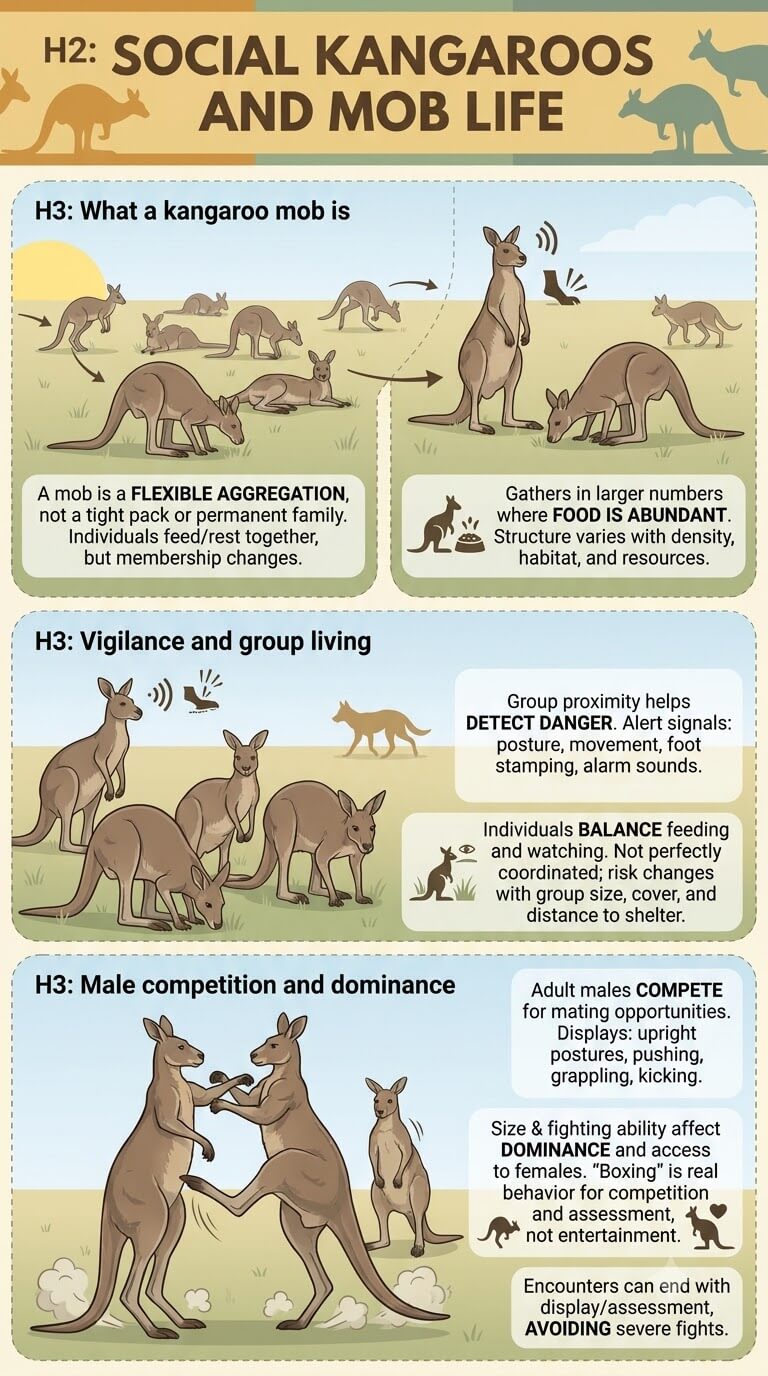
A mob is a social aggregation of kangaroos rather than a tightly coordinated pack. Individuals feed and rest in proximity, but membership can change as animals join or leave.
Eastern grey kangaroos commonly occur in groups and can gather in larger numbers where food is abundant. Social organization varies with population density, habitat, sex, reproductive condition, and local resources.
This flexible structure makes a mob different from a permanent family unit in which every member maintains the same relationship for life.
Vigilance and group living
Being near other kangaroos can provide additional opportunities to detect danger. When one animal becomes alert, others may respond to posture, movement, foot stamping, or alarm sounds.
Group vigilance does not mean every kangaroo watches equally or that mobs function as perfectly coordinated defense units. Individuals still balance feeding against watching, and risk changes with group size, habitat cover, age, and distance from shelter.
Male competition and dominance
Adult male kangaroos can compete strongly for mating opportunities. Displays may include upright postures, pushing, grappling, and kicking. Size and fighting ability can affect dominance and access to females.
Popular images of “boxing kangaroos” therefore have a real behavioral basis, but the behavior is not entertainment or a human-style boxing match. It is part of competition, assessment, and conflict between animals.
Not every male encounter becomes a severe fight. Display and assessment can allow one animal to retreat before injuries occur.
Small Social Marsupials and Shared Nests
Sugar glider clans
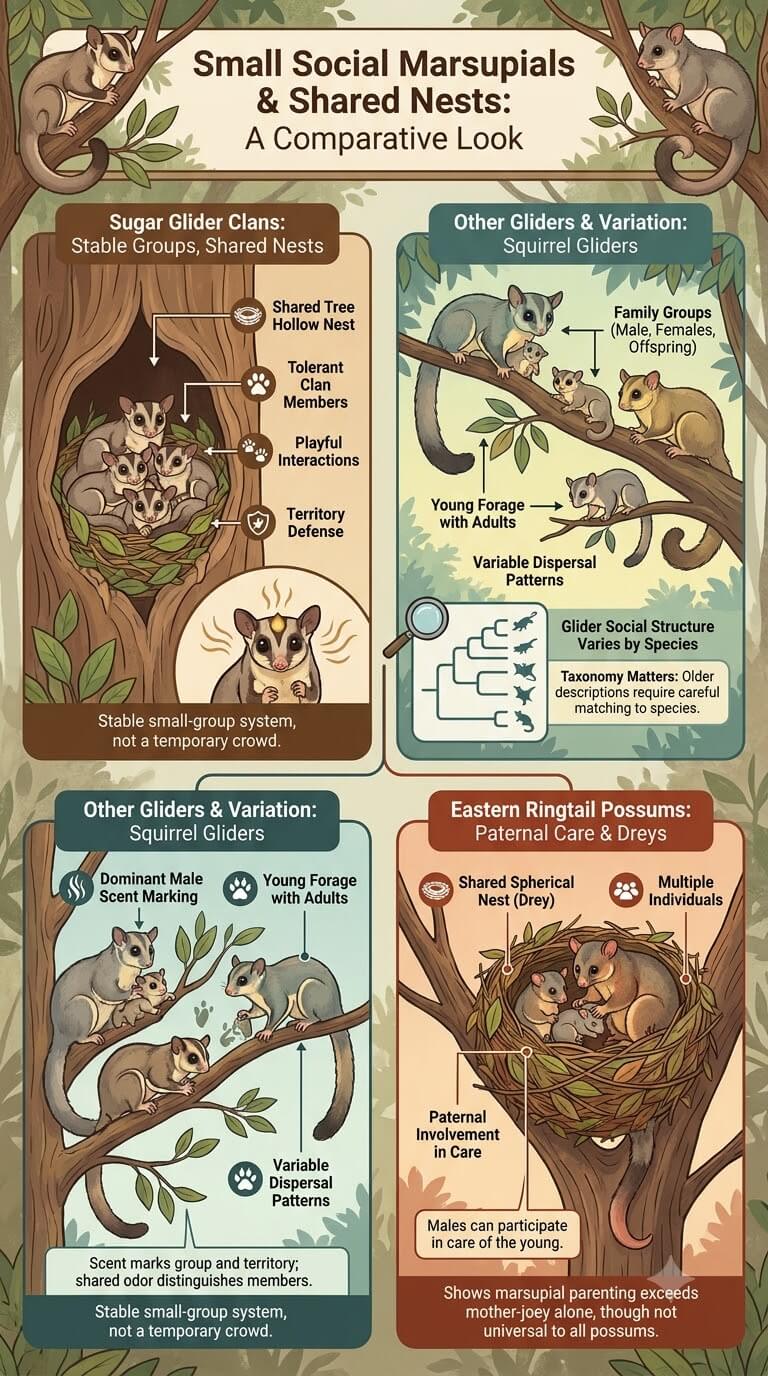
Sugar gliders show a very different kind of sociality from kangaroo mobs. The Australian Museum’s sugar glider profile describes groups of adults and young sharing nests in tree hollows. Clan members can be playful and tolerant toward one another while defending their area against outsiders.
Dominant males use scent glands to mark the group and territory. Shared odor can help distinguish familiar group members from unfamiliar gliders.
This is a stable small-group system centered on a nest and territory, not merely a temporary crowd at a feeding site.
Family groups in other gliders
Squirrel gliders can also live in family groups containing a mature male, one or more females, and offspring. Young may forage with adults after leaving the nest, and dispersal patterns can differ between males and females.
Glider social structure is therefore not identical across species. Even closely related animals can vary in group size, territoriality, nest sharing, and the age at which young leave.
Taxonomy also matters because what was once treated as one widespread sugar glider species has been revised into multiple species. Older behavioral descriptions should be matched carefully to the species and population studied.
Eastern ringtail possums and parental care
Eastern ringtail possums provide another social example. Several individuals may share a spherical nest, or drey, and males can participate in care of the young.
That level of paternal involvement should not be extended to all possums. Common names cover several marsupial families with different mating systems and parental behavior.
It does, however, show that marsupial parenting and social structure can include more than a mother carrying a joey alone.
Mostly Solitary Carnivorous Marsupials
Quolls and scent-mediated spacing
Quolls are generally solitary and territorial or range-based. Individuals use scent and communal latrine sites as part of communication, reducing the need for constant direct contact.
When quolls do meet, vocalizations can include hisses, chirps, coughs, or screams. Encounters may be related to territorial boundaries, mating, food, or parent-offspring interactions.
A solitary predator benefits from knowing where competitors are without having to fight them repeatedly. Chemical communication can therefore help organize space across a population.
Tasmanian devils: solitary foragers with repeated social contact
Tasmanian devils are often described as solitary, but that description needs context. They generally forage alone and do not travel as stable packs. Yet they repeatedly encounter other devils at carcasses, around dens, and during mating.
A field study using animal-borne video found that Tasmanian devil social interactions occurred while animals were traveling, at dens, and around carcasses. Many encounters involved growling, snorting, or brief chases without prolonged physical contact.
This makes devils a good example of a species that is solitary in daily movement but socially connected through repeated interactions.
Why food can temporarily bring solitary animals together
A carcass is a concentrated resource. Several devils may locate it independently, creating a temporary aggregation even though the animals do not form a permanent feeding group.
Competition at such sites can produce dominance displays, vocalization, chasing, and biting. The same individuals may separate again once feeding ends.
This distinction between aggregation and stable group living is useful across animal behavior. Animals can gather around a resource without becoming a social group in the stronger sense.
Wombats: Solitary Life with Neighborhood Communication
Common wombats and individual space
Common wombats are typically solitary. They use burrows for shelter and move through home ranges that can contain multiple burrow sites.
Direct encounters are not required for neighbors to influence one another. Wombats leave scent and fecal marks and can investigate the recent presence of other animals.
Territoriality and space use vary among wombat species and local populations, so one burrow system should not be treated as a universal wombat social model.
Southern hairy-nosed wombat warrens
Southern hairy-nosed wombats complicate the simple “wombats live alone underground” picture. Animal Diversity Web describes southern hairy-nosed wombat warrens that can be used by multiple animals, while individual wombats generally occupy separate burrows within the larger warren system.
This creates a neighborhood-like arrangement: several animals use the same broader underground complex without necessarily sharing the same resting chamber.
Much of their communication is chemical. Scent marking can provide information about territory or recent activity, reducing the need for frequent direct encounters.
Opossums and Flexible Solitary Behavior
Virginia opossums
The Virginia opossum is primarily nocturnal and solitary. The Smithsonian’s Virginia opossum profile describes it as active between dusk and dawn and generally living alone outside reproductive and maternal contexts.
Its solitary lifestyle fits a flexible forager that moves through woodlands, wet areas, farms, and suburbs searching for scattered food and shelter.
Young remain closely associated with the mother early in life, but adults do not form permanent social packs.
Why one opossum cannot represent all Didelphidae
American opossums occupy many ecological settings, from forest canopy to ground habitats and waterways. Activity, spacing, shelter, and interactions vary among species.
The Virginia opossum is therefore useful for US readers but should not become a behavioral template for every opossum in Central and South America.
The same caution applies across Marsupialia: familiar species help explain behavior, but broad conclusions require multiple lineages.
Breeding Changes Social Behavior
Temporary increases in movement and contact
Animals that spend much of the year alone may become far more socially active during breeding. Males can expand movement, search for females, investigate scent, call more frequently, or compete with rivals.
Females may alter space use around reproductive timing, shelter, food, and care of young. The result can be a seasonal change in the number and intensity of encounters.
This is why a species’ social behavior cannot always be summarized accurately from observations made in one month.
Koala bellows and scent during breeding
Adult male koalas become especially conspicuous during the breeding season because of their deep bellows and scent marking. These signals allow a mostly solitary animal to communicate across distance.
Calls can advertise presence and potentially influence the spacing and responses of other koalas. Scent marks provide information that persists after the male has moved away.
Communication therefore reduces the need for every reproductive interaction to begin with close physical contact.
Tasmanian devil contact networks during mating
Devil interactions also increase in importance during the mating period. Research on wild populations shows that contact networks become denser during the reproductive season and that biting behavior associated with social and mating interactions is important for transmission of devil facial tumor disease.
This disease context illustrates how behavior can influence population biology. A social system does not need stable groups for contact patterns to matter at the population level.
It is also a reminder not to label devils simply “antisocial.” Their interactions are biologically important even though adults usually forage alone.
Mothers, Young, and Learning
Maternal contact is the most universal social relationship
Across marsupials, the strongest predictable social relationship is between mother and dependent young. Newborns rely on the teat, milk, protection, warmth, and maternal behavior for survival.
As young grow, the form of contact changes. A kangaroo joey progresses from pouch dependence to excursions and young-at-foot. A koala joey can ride on the mother’s back. Small marsupials may remain in a nest while the mother forages.
The duration and intensity of care vary, but maternal dependence is central to marsupial development.
Young may learn routes, foods, and social cues
Juveniles can gain information while following or remaining near the mother. They encounter feeding sites, shelter, movement routes, predators, and other animals under maternal protection.
Some behaviors emerge largely through maturation and instinct, while others can be shaped by experience. The balance differs among species and behaviors.
It is safer to describe opportunities for learning than to assume every marsupial behavior is either completely innate or taught.
Common Behavior Myths
All marsupials are nocturnal
False. Nocturnality is common, but some marsupials are active by day, around dawn and dusk, or on flexible schedules. Numbats are a prominent daytime example, while kangaroos can shift activity with temperature and season.
All marsupials are solitary
False. Eastern grey kangaroos form mobs, sugar gliders live in clans, and some gliders and possums use family groups or shared nests. Other marsupials are largely solitary.
Solitary animals do not communicate
False. Solitary koalas, quolls, wombats, devils, and opossums still use sound, scent, posture, or direct contact. Communication can be especially valuable for avoiding unnecessary encounters.
A group of animals at food is always a social group
False. Several animals can gather temporarily around a concentrated resource such as a carcass or feeding patch without forming a stable social unit.
Kangaroo mobs may involve repeated social association, while several devils feeding at one carcass are better described as a temporary aggregation unless stronger long-term relationships are demonstrated.
Animal behavior can be interpreted from one dramatic photograph
Usually not. A still image removes the events before and after the moment. Courtship, aggression, stress, feeding, maternal care, and injury can look deceptively similar when human emotions are projected onto a photograph.
Behavioral interpretation is strongest when it comes from repeated observation, video, telemetry, experiments, or other evidence rather than one appealing image.
Why Behavior Changes Across Habitats and Species
Food distribution affects sociality
Food that occurs in large patches can allow animals to gather, while scattered or defendable food may favor more solitary foraging. Eastern grey kangaroos can congregate where grazing is abundant. Devils meet at carcasses because a carcass concentrates food in one place.
Small arboreal gliders may gain benefits from shared nests even while foraging over a broader territory.
Diet therefore influences not only what an animal eats but when and where it encounters others.
Shelter can create social opportunities
Tree hollows, warrens, nests, and dens are limited resources in many habitats. Sharing can reduce some costs, while competition can increase others.
Sugar gliders share nest hollows within clans. Southern hairy-nosed wombats can use the same broader warren while occupying separate burrows. Devils may encounter one another around dens.
The physical structure of shelter helps shape the social structure that can evolve around it.
Predation and risk influence vigilance
Animals balance feeding, resting, moving, and watching for danger. Group living can increase the number of eyes and ears available to detect threats, but it can also create competition and make a group conspicuous.
Solitary animals may rely more heavily on cover, burrows, climbing, rapid escape, or avoiding dangerous periods.
No single social strategy is universally safer. Its value depends on habitat, predators, food, body size, and the costs of competition.
FAQ
Are kangaroos social animals?
Many kangaroos are social to varying degrees. Eastern grey kangaroos commonly form mobs and can gather in larger numbers at good feeding areas. Group composition is flexible, and social relationships differ with sex, population density, habitat, and reproductive condition.
Are koalas solitary?
Adult koalas are generally solitary, but solitary does not mean isolated from all social information. Home ranges can overlap, and males use scent and loud breeding-season bellows to communicate with other koalas.
Do Tasmanian devils live in groups?
They generally forage alone rather than traveling in stable packs. However, devils interact repeatedly around carcasses, dens, territorial encounters, and mating. They are best described as solitary animals with important social interactions rather than animals with no social life.
Which marsupials live in social groups?
Eastern grey kangaroos form mobs, while sugar gliders and some other gliders live in small clans or family groups. Some possums share nests. Group size and stability vary by species, and many other marsupials remain primarily solitary.
Final Thoughts
Marsupial behavior ranges from solitary nocturnal foraging to mob life, family groups, shared nests, scent-based neighborhoods, temporary feeding aggregations, and intense seasonal mating interactions. Eastern grey kangaroos show flexible social grouping, sugar gliders show small-clan cooperation and territorial defense, koalas show how a solitary animal can communicate strongly through scent and sound, wombats demonstrate indirect neighborhood communication, Tasmanian devils combine solitary foraging with repeated social encounters, and Virginia opossums provide a familiar solitary nocturnal example. The most useful way to understand marsupial behavior is to separate several questions: when is the animal active, how does it communicate, how much space does it share, when does it tolerate others, and what causes those relationships to change? Once those questions are separated, Marsupialia looks less like one behavioral type and more like the diverse mammalian radiation it is.

Ethan Walker is the founder and research editor of Animal Fact Central. He creates and reviews educational animal facts content using trusted wildlife, pet care, and science-based sources. His work focuses on making animal behavior, adaptations, habitats, and species facts clear, accurate, and engaging for everyday readers.
Read More Details About Ethan Walker: https://animalfactcentral.com/ethan-walker/