
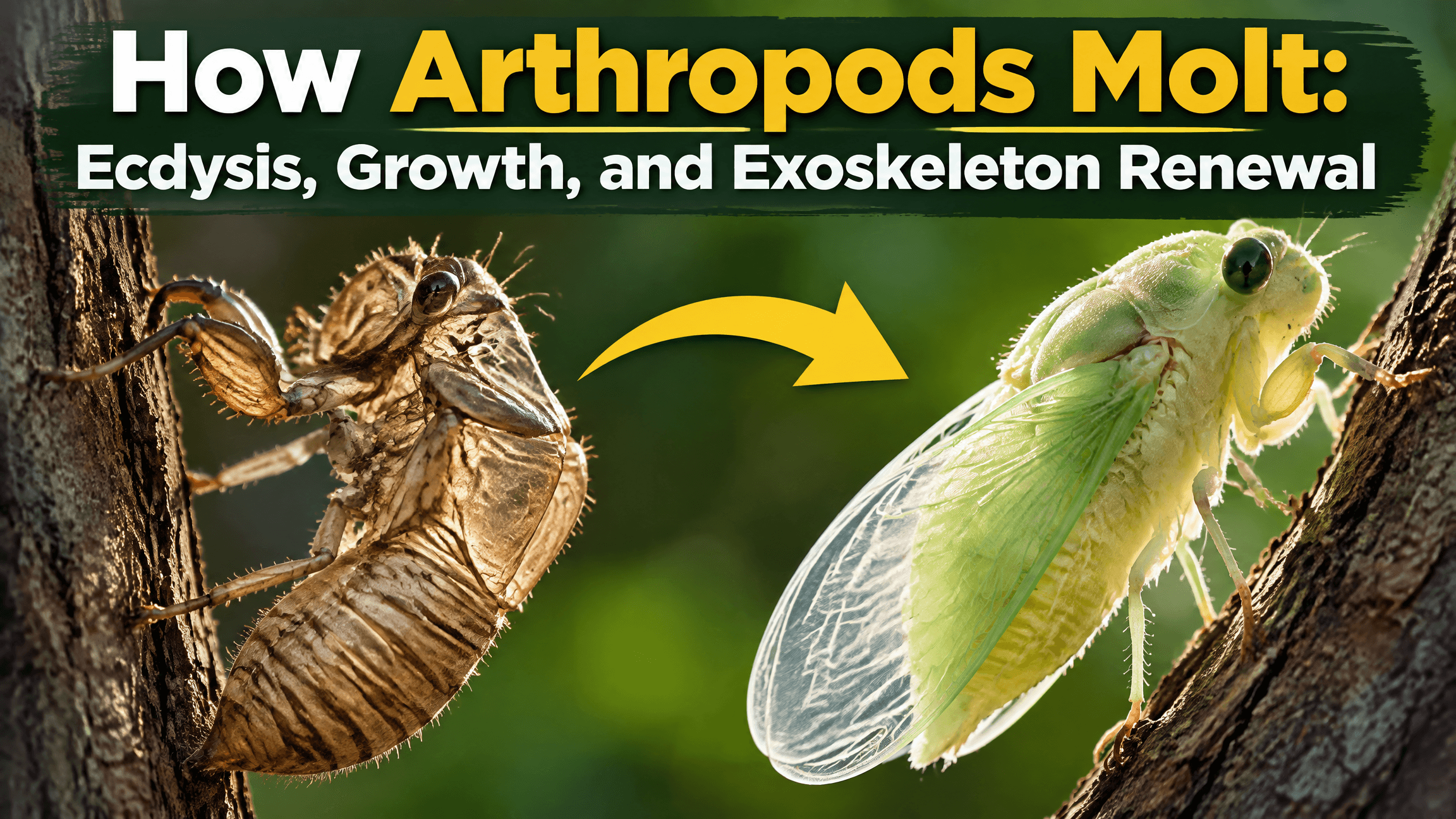
Arthropods grow in a way that is fundamentally different from animals with internal skeletons. Their body is supported and covered by an external cuticle, so growth requires periodic renewal of that covering. The broad process is called molting, while ecdysis refers specifically to the moment when the old outer covering is shed.
Molting is more than an animal simply “crawling out of its shell.” Before ecdysis, the living epidermis separates from the old cuticle, begins forming a new one, and may recycle parts of the old inner cuticle. After the old covering is shed, the new cuticle expands and then gains strength. The details differ among insects, spiders, crustaceans, myriapods, and other arthropods.
Molting also should not be confused with metamorphosis. Metamorphosis is a developmental change in body form. Molting is the replacement of the cuticle. A spider can molt repeatedly without undergoing butterfly-like metamorphosis, and many crustaceans continue molting after reaching sexual maturity.
Quick Answer: What Happens When an Arthropod Molts?

In a simplified molt cycle, the epidermis first separates from the old cuticle. This separation is called apolysis. A new cuticle begins to form underneath the old one, and portions of the old inner cuticle may be broken down and recycled. When the animal is ready, it sheds the remaining old covering during ecdysis. Molting is one part of the wider set of arthropod adaptations associated with an external skeleton.
The North Carolina State University description of insect molting lays out this sequence in detail: apolysis, formation of a new cuticle, digestion and recycling of old inner cuticle, ecdysis, expansion, and later hardening through sclerotization. That sequence is a useful model, but the exact chemistry, timing, and post-molt changes are not identical across Arthropoda.
For many arthropods, the period immediately after ecdysis allows the new body covering to expand before it reaches full mechanical strength. Expansion can involve air, water, or hemolymph pressure depending on the group. The new cuticle then becomes stronger through processes such as sclerotization, mineralization, or both. Growth through periodic molting is one of the shared arthropod traits that links otherwise very different lineages.
Why Arthropods Need to Molt
The Exoskeletal Growth Problem
An arthropod cuticle can support the body, protect tissues, reduce physical damage, and provide surfaces for muscle attachment. Once strongly hardened, however, it cannot simply stretch enough to accommodate unlimited growth.
This creates a structural problem. The animal’s tissues need to increase in size, but the old cuticle eventually limits further expansion. Molting solves that problem by replacing the old covering with a newly formed one that can expand before hardening.
The need to molt is therefore built into arthropod growth. It is not an optional behavior and it is not merely a way to clean the body surface.
Growth Happens Across a Cycle, Not Only at Ecdysis
Ecdysis can be visually dramatic, but it is only one event within a longer physiological cycle. Preparation begins before the old cuticle is shed, and post-molt changes continue afterward.
New cuticle must be synthesized, old material can be resorbed, body fluids are redistributed, and the new covering must gain strength. In crustaceans, mineral balance may also change substantially before and after ecdysis.
It is therefore more accurate to speak of a molt cycle than to treat the visible shedding event as the entire process.
Apolysis: Separation From the Old Cuticle

What Apolysis Means
Apolysis is the separation of the epidermis from the old cuticle. The epidermis is the living cell layer that produces the cuticle, so this separation creates space in which a new covering can begin to form.
The old cuticle is not simply abandoned intact. In many arthropods, parts of its inner layers are chemically broken down. Useful materials can then be recovered rather than wasted.
This is one reason the phrase “the animal sheds its skeleton and grows a new one afterward” is inaccurate. Much of the new cuticle is already forming before ecdysis occurs.
Building the New Cuticle Before Shedding
In insects, epidermal cells secrete new cuticular layers beneath the old cuticle during the pre-ecdysis period. North Carolina State University describes how new cuticle forms while molting fluid helps digest portions of the old endocuticle. Understanding the process is easier when considered alongside the arthropod cuticle and exoskeleton.
The old outer layers remain long enough to protect the animal while the replacement develops beneath them. By the time ecdysis begins, the animal is not emerging with no covering at all. It already has a new, initially softer cuticle.
Recycling Materials From the Old Cuticle
Breaking down portions of the old cuticle can allow structural materials to be reused. In insects, products from the old endocuticle can be absorbed and incorporated into the newly forming cuticle.
Crustaceans can also recover important mineral resources during the molt cycle. In heavily calcified forms, calcium handling becomes especially important because large amounts of mineral must eventually be redeposited into the new exoskeleton.
The exact recycling strategy differs among lineages, so the process should not be reduced to one universal chemical pathway.
Ecdysis: Shedding the Old Exoskeleton
How the Old Cuticle Splits
Ecdysis is the physical shedding of the old cuticle. The animal must create enough internal force to split the weakened outer covering along vulnerable regions or predetermined lines.
Insects may use muscular contractions together with air intake or changes in internal pressure. Aquatic crustaceans can use water uptake and body expansion. The mechanics vary with body shape and habitat.
The important point is that ecdysis is active. The animal does not passively wait for the old covering to fall away.
How the Animal Pulls Free
Once the old covering opens, the arthropod gradually withdraws its body and appendages. Long legs, antennae, wings, mouthparts, claws, or other structures can make this mechanically demanding.
The old shed cuticle is called an exuvia. Exuviae can preserve fine details of surface anatomy, including leg segments, mouthparts, or tracheal linings in insects.
An exuvia is not necessarily a perfect replica of the living animal. It can tear, collapse, deform, or remain incomplete during shedding.
Why Ecdysis Can Be a Vulnerable Period
Immediately before and after ecdysis, normal movement can be limited and the new cuticle has not yet reached its later strength. This can increase vulnerability to predators, injury, drying, or environmental stress.
That vulnerability varies greatly among species. Many arthropods molt in shelters, burrows, webs, crevices, or other protected places. Others complete ecdysis in more exposed settings.
It is misleading to say a freshly molted arthropod is completely unprotected. The new cuticle is already present, and protective behavior can reduce risk even before full hardening occurs.
Post-Molt Expansion and Hardening
Why the New Cuticle Starts Soft
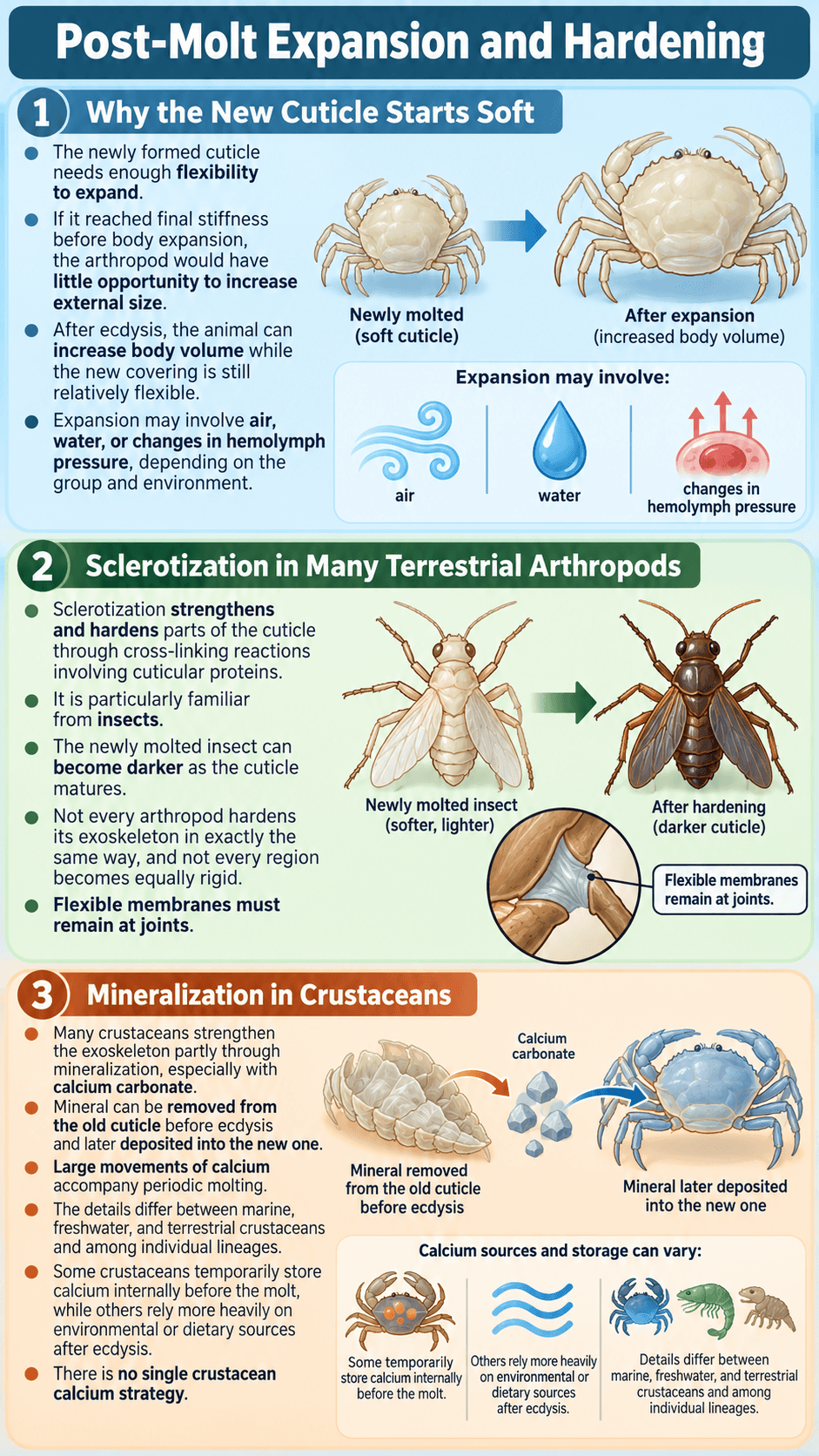
The newly formed cuticle needs enough flexibility to expand. If it reached final stiffness before body expansion, the arthropod would have little opportunity to increase external size.
After ecdysis, the animal can increase body volume while the new covering is still relatively flexible. Expansion may involve air, water, or changes in hemolymph pressure, depending on the group and environment.
Sclerotization in Many Terrestrial Arthropods
Sclerotization is a chemical process that strengthens and hardens parts of the cuticle through cross-linking reactions involving cuticular proteins. It is particularly familiar from insects, where the cuticle can darken as it hardens.
The University of California, Riverside overview of insect molting describes the new cuticle forming beneath the old one and the newly molted insect becoming darker as the cuticle matures.
Not every arthropod hardens its exoskeleton in exactly the same way, and not every region becomes equally rigid. Flexible membranes must remain at joints.
Mineralization in Crustaceans
Many crustaceans strengthen the exoskeleton partly through mineralization, especially with calcium carbonate. This adds another physiological challenge to the molt cycle because mineral can be removed from the old cuticle before ecdysis and later deposited into the new one.
Research on crustacean calcium balance notes that large movements of calcium accompany periodic molting. The details differ between marine, freshwater, and terrestrial crustaceans and among individual lineages.
Some crustaceans temporarily store calcium internally before the molt, while others rely more heavily on environmental or dietary sources after ecdysis. There is no single crustacean calcium strategy.
Molting and Metamorphosis Are Not the Same Thing
What Molting Means
Molting is the replacement of the cuticle. The process includes preparation before ecdysis and maturation of the new covering afterward.
An arthropod can molt while keeping essentially the same overall body form. A juvenile spider that becomes a larger juvenile spider after shedding has molted without undergoing a butterfly-style transformation.
What Metamorphosis Means
Metamorphosis is a developmental change in body organization between life stages. In insects with complete metamorphosis, larva, pupa, and adult can have dramatically different forms and ecological roles.
Molts occur within that developmental sequence, but the two concepts remain distinct. A molt may accompany a metamorphic transition, or it may simply allow growth between similar stages.
Why the Distinction Matters
If every molt is called metamorphosis, major differences among arthropod life cycles disappear. Spiders, centipedes, and many crustaceans grow through repeated molts without using the insect larva-pupa-adult pattern.
Even insects do not all metamorphose in the same way. Some develop gradually, while others undergo much more dramatic transformations.
How Insect Molting Works
Immature Insects Molt Between Growth Stages
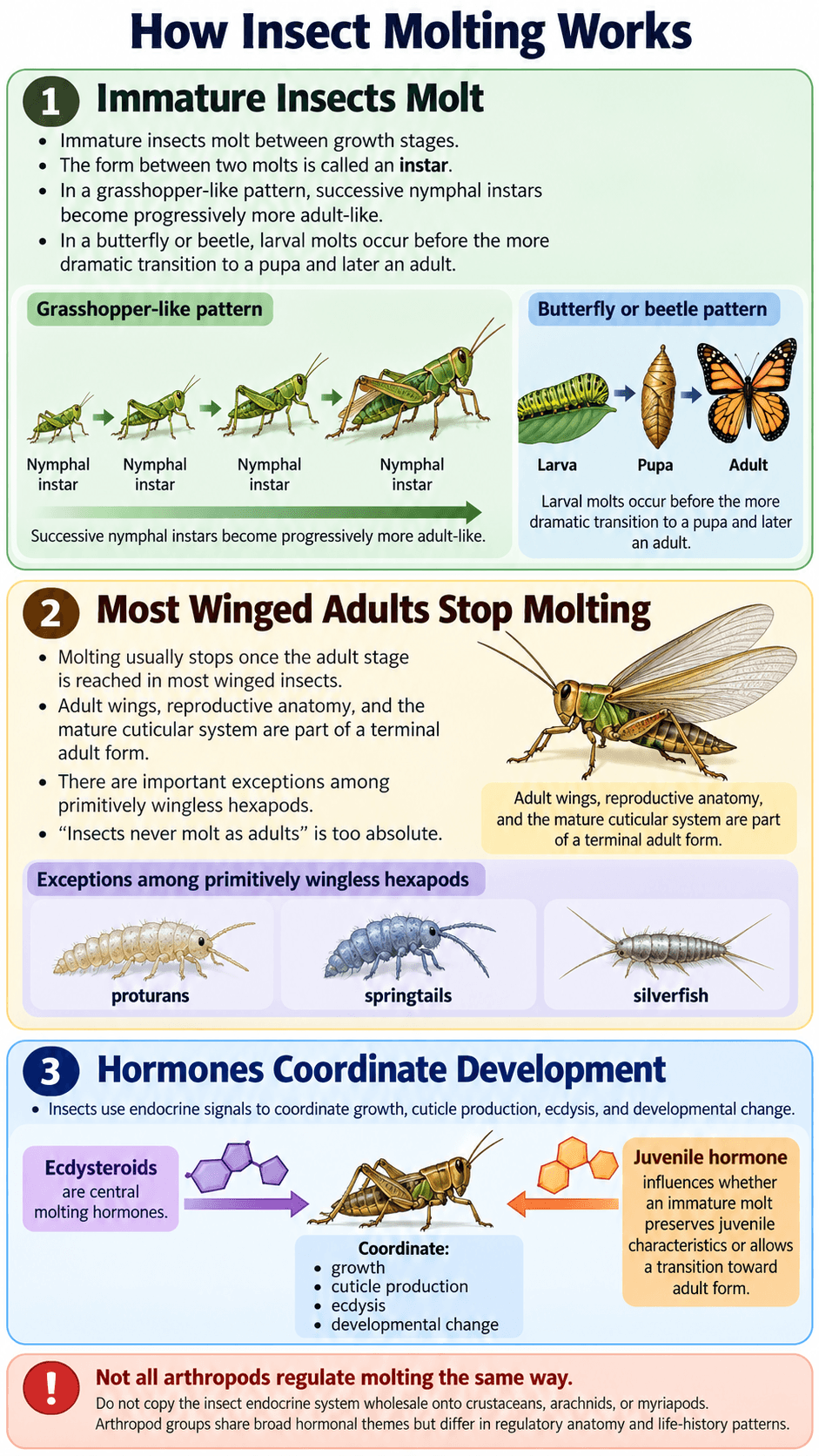
Immature insects molt as they increase in size and progress through developmental stages. The form between two molts is commonly called an instar.
In a grasshopper-like developmental pattern, successive nymphal instars become progressively more adult-like. In a butterfly or beetle, larval molts occur before the more dramatic transition to a pupa and later an adult.
Most Winged Adult Insects Stop Molting
In most winged insects, molting stops once the adult stage is reached. Adult wings, reproductive anatomy, and the mature cuticular system are part of a terminal adult form.
There are important exceptions among primitively wingless hexapods. The University of California, Riverside entomology text notes continued adult molting in groups such as proturans, springtails, and silverfish.
This is why “insects never molt as adults” is too absolute. It is broadly true for winged insects but not for every hexapod lineage.
Hormones Coordinate Insect Molting and Development
Insects use endocrine signals to coordinate growth, cuticle production, ecdysis, and developmental change. Ecdysteroids are central molting hormones, while juvenile hormone influences whether an immature molt preserves juvenile characteristics or allows a transition toward adult form.
The North Carolina State University guide to hormonal control explains how ecdysteroids trigger events associated with apolysis and how changes in hormonal context influence metamorphic outcomes.
The exact endocrine system of insects should not be copied wholesale onto crustaceans, arachnids, or myriapods. Arthropod groups share broad hormonal themes but differ in regulatory anatomy and life-history patterns.
How Spiders and Other Arachnids Molt
Spiderlings Grow Through Repeated Molts
Spiders emerge from early development as small juveniles and grow by shedding the cuticle repeatedly. Each molt allows an increase in body size and can be accompanied by changes in proportions, coloration, or maturity.
The number and timing of molts vary among species, sex, food availability, temperature, and other conditions. A single universal spider molt count would therefore be misleading.
Adult Molting Varies Across Arachnids
In many spiders, molting stops at sexual maturity, although developmental patterns differ across arachnids. Other chelicerates can follow different molt schedules.
The safest broad statement is that juvenile molting is essential to growth, while whether molting continues after maturity depends on the lineage.
Why a Shed Spider Skin Looks So Complete
Spider exuviae can look strikingly lifelike because the animal withdraws from a cuticular covering that includes the legs and external body surface. Even delicate-looking structures can remain visible after shedding.
That does not mean the shed skin contains the animal’s living tissues. It is the discarded outer cuticular structure. The spider remains covered by its newly formed cuticle after emerging.
How Crustaceans Molt

Intermolt, Premolt, Ecdysis, and Postmolt
Crustacean molt cycles are often described using phases such as intermolt, premolt, ecdysis, and postmolt. During premolt, the old cuticle begins to separate from the epidermis and parts of it can be broken down while the new cuticle forms underneath.
Ecdysis is the shedding event. Postmolt includes expansion and progressive strengthening of the new exoskeleton. Intermolt describes the period between active molt transitions.
A Weber State University zoology guide summarizes this sequence and notes that salts can be withdrawn from the old cuticle before ecdysis and later deposited into the new covering.
Water Uptake and Body Expansion
Aquatic crustaceans can take up water around the molt, increasing body volume while the new exoskeleton remains flexible. This creates room for later tissue growth within the enlarged external dimensions.
The balance between water uptake, tissue growth, mineral replacement, and hardening differs among species. A crab, copepod, barnacle, and terrestrial isopod should not be expected to use identical post-molt physiology.
Calcium Recycling and Re-Mineralization
Heavily mineralized crustaceans face a major calcium-management problem during each molt. Some calcium can be recovered before shedding, stored temporarily, and later moved into the new exoskeleton.
Research on crayfish has documented temporary calcium deposits called gastroliths in some species, but this should not be presented as a universal crustacean feature. Different groups use different strategies for conserving or acquiring minerals.
Many Crustaceans Continue Molting After Maturity
Unlike most winged insects, many crustaceans continue molting after sexual maturity. Adult crabs, lobsters, shrimp, and other crustaceans can keep growing through additional molt cycles, although molt frequency often decreases with age or size.
This difference is a major reason insect-based descriptions of “the final molt” do not work as a general model for Arthropoda.
How Myriapods Molt
Centipedes and Millipedes Grow Through Successive Molts
Centipedes and millipedes replace the cuticle as they grow. The overall principle is the same arthropod solution to an external skeletal covering, but developmental details differ among myriapod groups.
Some myriapods hatch with fewer trunk segments or legs than they will have later and add segments or leg-bearing units across molts. Others hatch with a body plan closer to the adult arrangement.
Why “More Legs After Every Molt” Is Too Simple
Not every centipede or millipede adds legs in the same way after every molt. Developmental patterns vary among lineages, and some eventually reach a stable number of segments while continuing other aspects of maturation.
Myriapod development is therefore better described as diverse rather than as one fixed staircase of increasing leg numbers.
What an Exuvia Can Tell You
Shed Cuticle Can Preserve Anatomy
An exuvia can retain recognizable details of legs, antennae, mouthparts, body segmentation, or other external features. For naturalists, a shed skin can sometimes provide evidence that an arthropod has recently molted nearby.
Insects may leave exuviae attached to stems, tree bark, soil surfaces, or other substrates. Spider molts may remain in webs or shelters. Crustacean exuviae may be found in aquatic habitats or enclosures.
An Exuvia Is Not Always a Perfect Copy
The old cuticle can split irregularly, become folded, lose appendage sections, or collapse after drying. Water currents, scavengers, weather, and handling can damage it further.
Therefore, an exuvia can be anatomically informative without being a flawless cast of the animal.
Some Arthropods Consume Shed Material
Some arthropods eat part or all of their exuviae, which can help recover nutrients or minerals. This behavior occurs in multiple groups, but it is not universal.
It is inaccurate to state that all arthropods eat their shed skins or that consuming an exuvia is required for successful hardening.
Common Myths About Arthropod Molting
Molting and Metamorphosis Are the Same
No. Molting replaces the cuticle. Metamorphosis changes developmental form. They can occur together during certain life-stage transitions, but they are different biological processes.
The Old Exoskeleton Simply Falls Off
No. The animal prepares extensively before ecdysis, separates from the old cuticle, forms new cuticle underneath it, and actively works free during the shedding event.
A Newly Molted Arthropod Has No Exoskeleton
No. A new cuticle has already been produced before ecdysis. It is generally softer and less mechanically mature immediately afterward, but the animal is not bare living tissue.
Every Arthropod Stops Molting as an Adult
No. Most winged adult insects stop molting, but many crustaceans continue after maturity, and patterns vary among other arthropods.
Every Arthropod Eats Its Exuvia
No. Some do, while others leave the shed covering behind. The behavior varies among species and circumstances.
Why Molting Patterns Differ Among Arthropods
Habitat Changes the Mechanical Problem
A terrestrial insect, marine crab, soil-dwelling millipede, and web-building spider face different physical environments during a molt. Air, water, humidity, gravity, shelter, substrate, and predator exposure can all affect how ecdysis and post-molt expansion are managed.
Aquatic crustaceans can use surrounding water during expansion, while terrestrial arthropods must balance expansion with water loss and structural support in air.
Exoskeleton Chemistry Changes the Post-Molt Challenge
A lightly sclerotized terrestrial cuticle does not require the same mineral management as a heavily calcified crab exoskeleton. Different lineages strengthen the new covering using different mixtures of cross-linking, pigmentation, proteins, chitin, minerals, and structural organization.
That is why “the exoskeleton hardens” is useful shorthand but not a complete physiological explanation.
Life History Determines Whether Molting Continues
Some arthropods have a terminal adult stage in which molting stops. Others continue molting through adult life. The pattern is tied to development, reproductive strategy, growth, and lineage-specific physiology.
No single statement about adult molting can accurately describe all of Arthropoda.
FAQ
What Is the Difference Between Molting and Ecdysis?
Molting is the broader process of replacing the old cuticle with a new one. It includes preparation before shedding and maturation afterward. Ecdysis is the specific event when the remaining old cuticle is physically shed.
What Is Apolysis?
Apolysis is the separation of the epidermis from the old cuticle before ecdysis. It creates space in which a new cuticle can begin forming. In many arthropods, parts of the old inner cuticle are also broken down and recycled during this period.
Why Are Arthropods Soft After Molting?
The new cuticle must remain flexible enough to allow body expansion. After ecdysis, it gradually gains strength through processes that can include sclerotization, mineralization, or both. The exact timing and chemistry differ among groups.
Do Adult Arthropods Still Molt?
It depends on the lineage. Most winged adult insects do not molt, while many crustaceans continue molting after sexual maturity. Other arthropod groups follow their own developmental patterns.
Final Thoughts
Arthropod molting is a coordinated cycle of exoskeleton renewal, not simply the moment an animal crawls out of an old shell. Apolysis separates the epidermis from the old cuticle, a new covering develops beneath it, reusable materials may be recovered, and ecdysis removes the remaining old cuticle. The new body covering then expands and gains strength.
The shared logic is consistent across Arthropoda, but the details are not. Insects emphasize sclerotization and often stop molting as winged adults. Many crustaceans manage large mineral shifts and continue molting after maturity. Spiders, myriapods, and other arthropods follow additional patterns of their own. Understanding those differences makes molting easier to see as a flexible growth system rather than one universal sequence copied across every arthropod.

Ethan Walker is the founder and research editor of Animal Fact Central. He creates and reviews educational animal facts content using trusted wildlife, pet care, and science-based sources. His work focuses on making animal behavior, adaptations, habitats, and species facts clear, accurate, and engaging for everyday readers.
Read More Details About Ethan Walker: https://animalfactcentral.com/ethan-walker/