
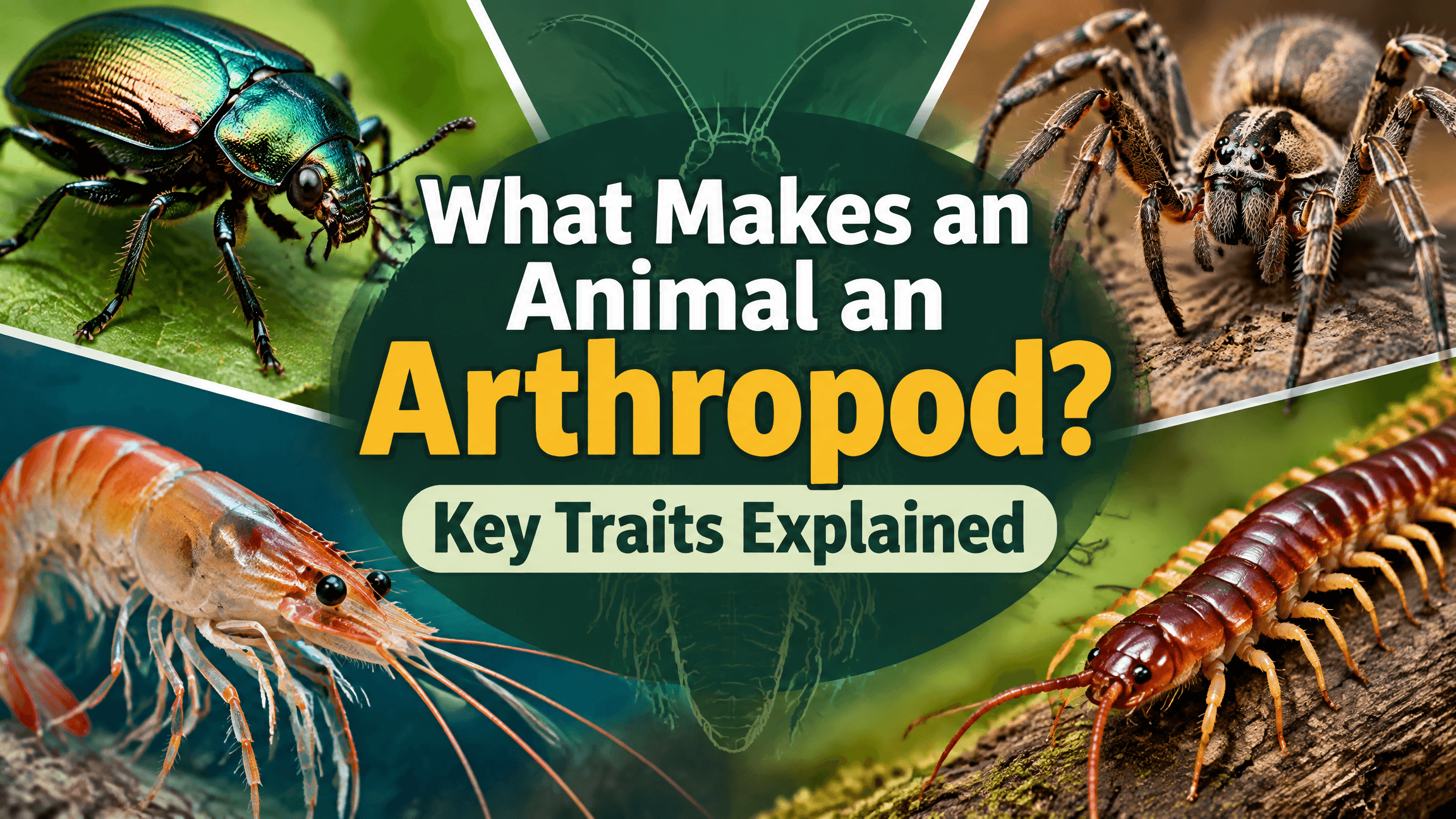
What makes an animal an arthropod is not one feature by itself. Arthropods share a body-plan framework that includes a segmented body, paired jointed appendages, an external cuticle that forms an exoskeletal system, and growth that involves molting. Their segments and appendages are often specialized into different functional regions and structures.
That combination matters because many non-arthropods share one superficial feature with arthropods. A snail has an external shell, but it is a mollusk. A velvet worm has a close evolutionary relationship to arthropods and molts its outer covering, but it belongs to a separate phylum. Meanwhile, a spider, shrimp, beetle, and centipede look very different from one another yet are all arthropods.
The most useful way to recognize Arthropoda is therefore to understand the complete structural pattern and the evolutionary relationships behind it. Features such as antennae, compound eyes, six legs, eight legs, or a hard shell can help identify particular groups, but none is a universal requirement for every arthropod.
Quick Answer: What Defines an Arthropod?
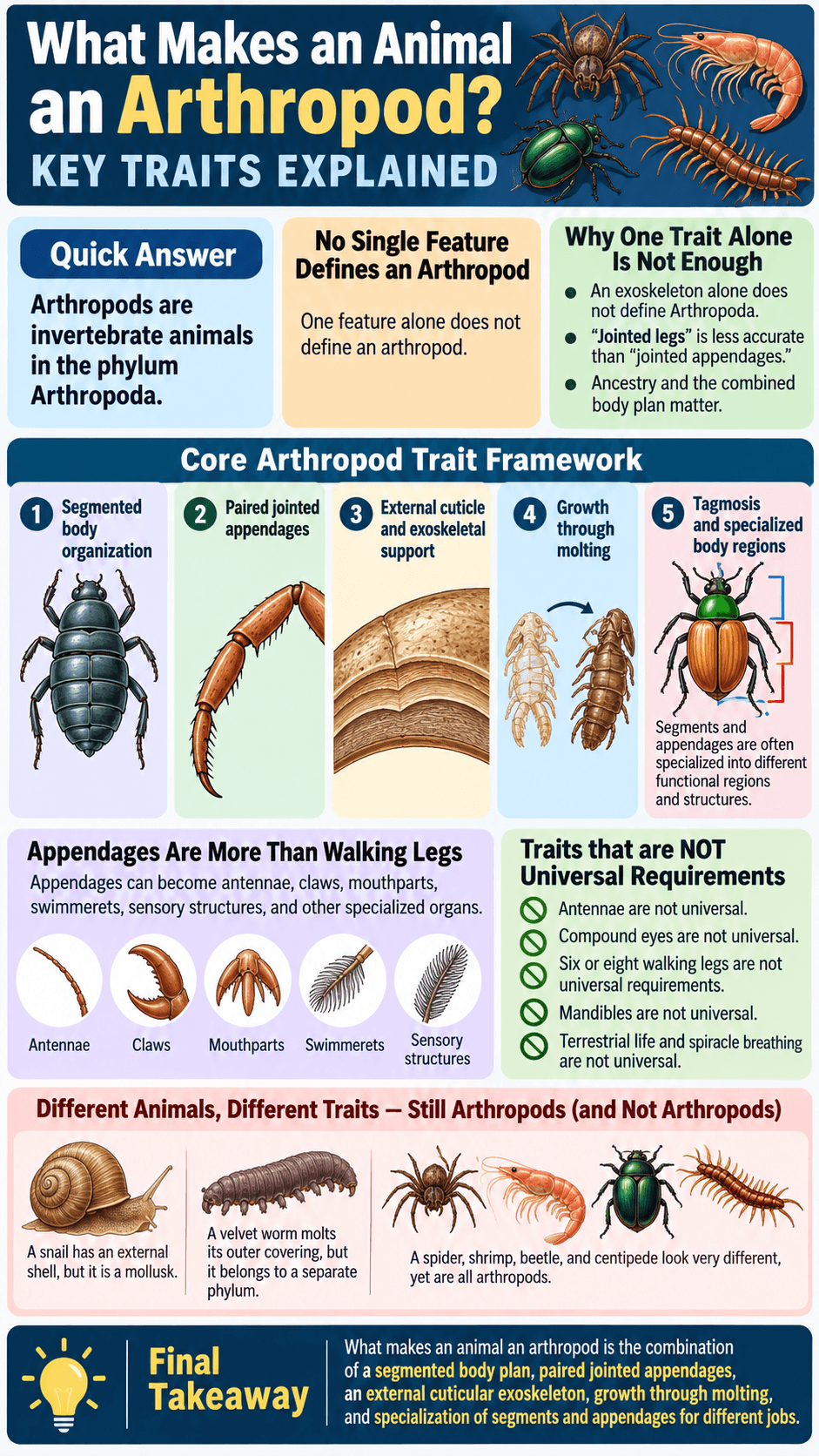
Arthropods are invertebrate animals in the phylum Arthropoda. The Smithsonian’s arthropod body-plan overview describes the group through an external skeleton containing chitin, bilateral body organization that is typically segmented, and appendages specialized for functions such as feeding, respiration, reproduction, and movement. Together, these features form the foundation for the wider diversity of arthropod body plans and adaptations.
In simple terms, the core pattern is a segmented animal whose paired appendages have joints and whose outer body covering functions as an exoskeletal system. That covering must be renewed as the animal grows. Over evolutionary time, body segments and appendages have been reorganized and specialized so extensively that the original pattern can be much easier to see in some arthropods than in others.
This explains why “jointed legs” is a useful introductory phrase but an incomplete definition. Arthropod appendages include far more than walking legs. They can become antennae, claws, mouthparts, swimmerets, sensory structures, and other specialized organs.
Why One Trait Alone Is Not Enough
Why an Exoskeleton Alone Does Not Define Arthropoda
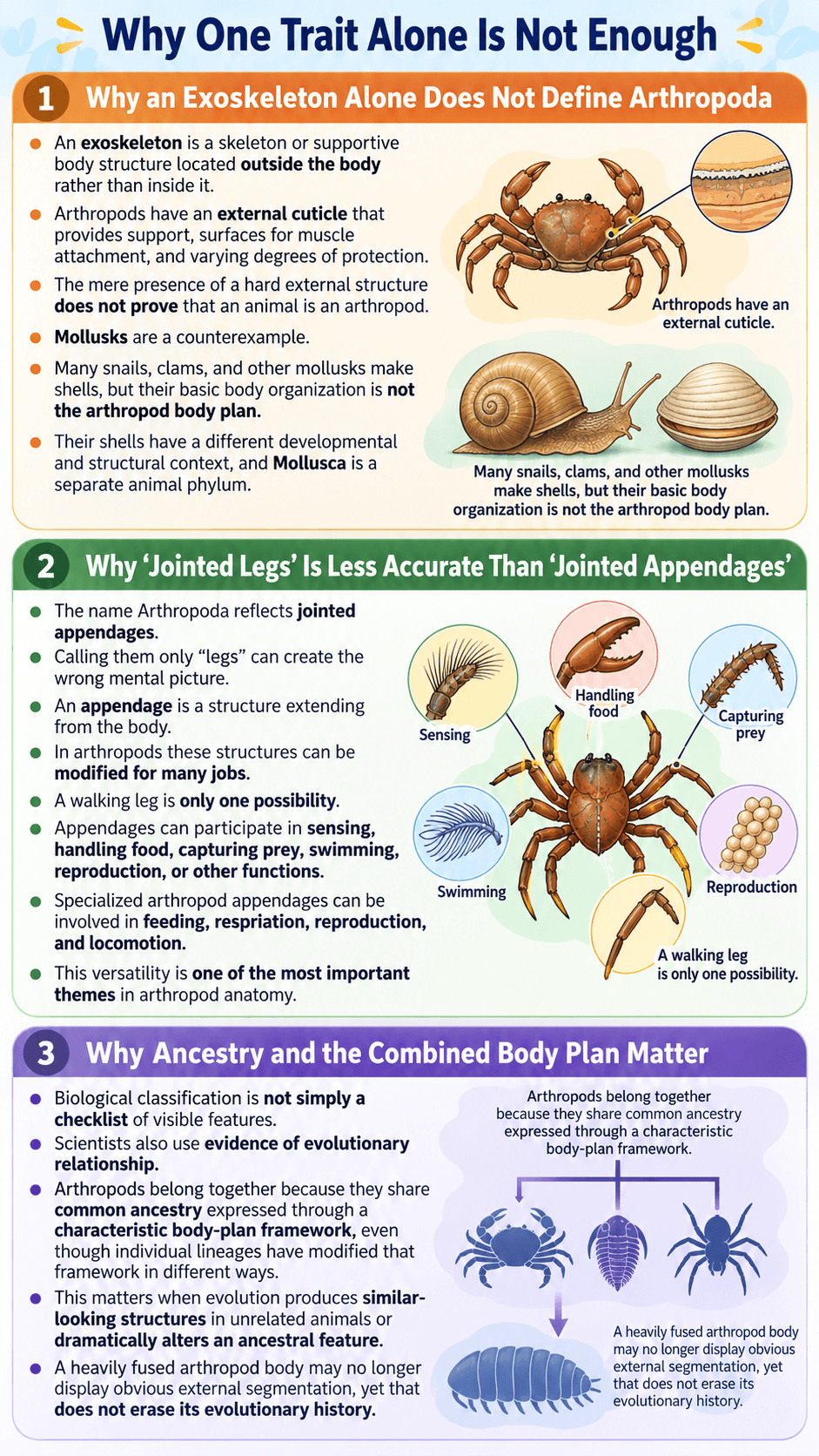
An exoskeleton is a skeleton or supportive body structure located outside the body rather than inside it. Arthropods have an external cuticle that provides support, surfaces for muscle attachment, and varying degrees of protection. However, the mere presence of a hard external structure does not prove that an animal is an arthropod.
Mollusks provide an obvious counterexample. Many snails, clams, and other mollusks make shells, but their basic body organization is not the arthropod body plan. Their shells have a different developmental and structural context, and Mollusca is a separate animal phylum.
Why “Jointed Legs” Is Less Accurate Than “Jointed Appendages”
The name Arthropoda reflects jointed appendages, but calling them only “legs” can create the wrong mental picture. An appendage is a structure extending from the body, and in arthropods these structures can be modified for many jobs.
A walking leg is only one possibility. Appendages can participate in sensing, handling food, capturing prey, swimming, reproduction, or other functions. The Smithsonian notes that specialized arthropod appendages can be involved in feeding, respiration, reproduction, and locomotion. This versatility is one of the most important themes in arthropod anatomy.
Why Ancestry and the Combined Body Plan Matter
Biological classification is not simply a checklist of visible features. Scientists also use evidence of evolutionary relationship. Arthropods belong together because they share common ancestry expressed through a characteristic body-plan framework, even though individual lineages have modified that framework in different ways.
This is especially important when evolution produces similar-looking structures in unrelated animals or dramatically alters an ancestral feature. A heavily fused arthropod body may no longer display obvious external segmentation, yet that does not erase its evolutionary history.
The Core Arthropod Trait Framework

Segmented Body Organization
Segmentation means that the body is organized from repeated units along its main axis. In arthropods, those units do not necessarily remain identical or even clearly visible. They can become specialized, fused, reduced, or incorporated into larger body regions.
A centipede makes segmentation easy to see because much of its trunk consists of a sequence of recognizable segments. A compact mite or tick can make the pattern much harder to recognize externally. Both situations fit arthropod organization because visible repetition is not the only evidence of segmentation.
Paired Jointed Appendages
Arthropod appendages are fundamentally associated with body segments and occur as paired structures in the underlying body plan. Joints allow neighboring parts of an appendage to move relative to one another. Flexible regions between more rigid sections make controlled movement possible.
The appendages themselves can be extensively modified. Some retain a locomotor role, while others become sensory or feeding structures. This is why a definition based only on the number of walking legs misses one of the most informative aspects of Arthropoda.
External Cuticle and Exoskeletal Support
The arthropod body surface is covered by a cuticle produced by the underlying epidermis. Smithsonian describes the external skeleton as containing chitin embedded in a protein matrix. The cuticle is not equally rigid everywhere. Joints require flexibility, and different lineages reinforce or mineralize particular regions to different degrees.
Calling the cuticle an exoskeleton emphasizes its mechanical role, but it should not be imagined as a lifeless suit of armor that exists independently of the animal. Living epidermal tissue produces it, muscles interact with the exoskeletal system, and sensory structures pass through or are integrated with the body covering.
Growth Through Molting
A mechanically supportive outer covering cannot simply enlarge without limit. Arthropods periodically replace the old cuticle through a molt cycle. Ecdysis is the actual shedding event, while the complete cycle includes preparation and formation of a new covering before the old one is discarded.
Molting is not the same as metamorphosis. A growing spider molts but does not pass through the caterpillar-pupa-butterfly sequence familiar from complete insect metamorphosis. Many crustaceans also continue molting according to patterns very different from those of winged adult insects.
Tagmosis and Specialized Body Regions
Tagmosis is the organization of body segments into specialized functional regions called tagmata. Instead of every segment remaining similar, groups of segments can become coordinated for particular jobs.
Insects provide the familiar head, thorax, and abdomen arrangement. Spiders organize the body differently. Myriapods have a head followed by an elongated trunk, while crustacean body regions vary substantially among lineages. Tagmosis is therefore a general principle, not a requirement for one fixed set of body sections.
Jointed Appendages Are More Than Legs

Antennae and Sensory Appendages
Insects, myriapods, and crustaceans use antennae or related antennal structures to gather information from their surroundings. These appendages can carry receptors sensitive to chemicals, touch, airflow, vibration, water movement, or other cues.
But antennae cannot define Arthropoda because chelicerates do not have them. The Smithsonian’s museum guide, for example, describes arachnids as having no antennae and four pairs of walking legs. Spiders and scorpions are still unquestionably arthropods.
Chelicerae, Mandibles, Maxillae, and Feeding Appendages
Feeding appendages differ among major lineages. Chelicerates possess chelicerae near the mouth. Mandibulate arthropods use other appendage arrangements that include mandibles and, in many groups, additional mouthpart structures.
These structures should not be treated as interchangeable simply because they all help with feeding. Their positions, evolutionary histories, and functions differ. A spider’s chelicerae are not merely an arachnid version of an insect mandible.
Walking Legs, Swimmerets, Claws, and Reproductive Structures
Locomotor appendages show striking specialization. A crab can walk with stout thoracic limbs, while many crustaceans use other appendages in swimming. Insects concentrate their walking legs on the thorax. Myriapods distribute locomotor appendages along much of the trunk.
Other appendages may become pincers, structures that manipulate food, organs involved in mating, or appendages that carry eggs. Looking across Arthropoda reveals a modular system in which related structural components can take on very different jobs.
Why Appendages Can Be Modified, Reduced, or Lost
Evolution does not require every ancestral structure to remain obvious. An appendage can become smaller, fuse with another structure, change function, or disappear externally in a lineage. Developmental and anatomical evidence can reveal relationships that are not apparent from a quick look at an adult animal.
This is another reason identification by leg count alone is unreliable at the phylum level. Leg number is highly useful within particular groups, but Arthropoda is defined at a deeper structural and evolutionary level.
Arthropod Body Regions Vary by Lineage

Insect Head, Thorax, and Abdomen
Adult insects typically have three major body regions: head, thorax, and abdomen. The head carries the primary mouthparts, eyes, and one pair of antennae. The thorax carries three pairs of walking legs and, in winged forms, the wings.
This familiar arrangement is useful for recognizing insects, but it should never be generalized to all arthropods. A spider, crab, or centipede is not expected to follow the insect pattern.
Arachnid Prosoma and Opisthosoma With Important Exceptions
Spiders illustrate a common arachnid organization in which the body is divided into a prosoma and an opisthosoma. The walking legs, chelicerae, and pedipalps attach to the prosoma.
Arachnids are diverse, however. Ticks and mites can show extensive fusion that makes external regional boundaries much less obvious. The underlying arthropod organization remains, even when an adult body looks compact and unsegmented.
Variable Crustacean Tagmata
Crustaceans should not be forced into one body-region formula. Familiar crabs, shrimp, barnacles, copepods, amphipods, isopods, and other crustaceans differ greatly in how segments and appendages are organized.
In many familiar decapods, head and thoracic regions are closely integrated, but that is not a universal template for every crustacean. Their diversity is a useful demonstration of how far tagmosis can reshape the shared arthropod framework.
Myriapod Head and Elongated Trunk
Centipedes, millipedes, pauropods, and symphylans belong to Myriapoda. Their general organization includes a head and a trunk containing many segments, although the arrangement of trunk segments and legs differs among the groups.
Centipedes do not have exactly 100 legs, and millipedes are not defined by having exactly 1,000. Those common names are descriptive rather than literal anatomical rules.
What the Arthropod Cuticle Really Is
Chitin, Proteins, Flexible Membranes, and Variable Mineralization
Chitin is an important structural polysaccharide in arthropod cuticle, but describing the exoskeleton as “made of chitin” is an oversimplification. Proteins and other components contribute to its properties, and different regions can be hardened to different degrees.
Crustaceans may add substantial mineral reinforcement, including calcium salts, to parts of the cuticle. Flexible membranes at joints are equally important because an animal enclosed in a uniformly rigid shell could not move its appendages normally.
Why Not Every Arthropod Has a Hard Shell
The word exoskeleton often brings a crab shell to mind, but arthropod cuticle ranges from thin and flexible to strongly hardened. Soft-bodied insect larvae are still arthropods. Delicate spiders are still arthropods. The mechanical properties of the cuticle are adjusted to the animal’s size, habitat, life stage, and way of moving.
The defining feature is the external cuticular skeletal system, not a requirement that the entire animal feel hard to the touch.
What Changes Immediately After a Molt
After ecdysis, the new cuticle is generally less mechanically resistant than it will be later. The animal can expand before the covering reaches its later strength and stiffness. The details of hardening differ among lineages and cuticle types.
This stage should not be described as though every arthropod becomes completely defenseless. Behavior, shelter, body size, remaining structural support, and the speed of post-molt changes vary widely among species.
Traits That Are Not Universal Arthropod Requirements
Antennae
Antennae are common in insects, crustaceans, and myriapods, but chelicerates lack them. Therefore, an animal does not need antennae to be an arthropod.
Compound Eyes
Compound eyes are prominent in many insects and crustaceans, but they are not universal. Spiders have simple lens eyes, and some arthropods living in dark environments have reduced visual systems. Eye type is useful for understanding particular lineages, not for defining the entire phylum.
Six or Eight Walking Legs
Six walking legs are characteristic of adult insects, while four pairs are characteristic of arachnids. Crustaceans and myriapods show other patterns. An arthropod-wide definition cannot use either six or eight as a required leg count.
Mandibles
Many arthropods possess mandibles, but chelicerates do not. Their feeding structures include chelicerae instead. Mandibles therefore help characterize a large branch of arthropods but not Arthropoda as a whole.
Terrestrial Life and Spiracle Breathing
Arthropods are not inherently land animals. Oceans and fresh waters contain enormous arthropod diversity. Many aquatic crustaceans exchange gases using gills or body surfaces, while terrestrial insects and myriapods commonly use tracheal systems with external openings.
Arachnids add still more variation, including book lungs, tracheae, or combinations. No single respiratory system defines the phylum.
Arthropods and Similar-Looking Non-Arthropods
Mollusk Shells Versus Arthropod Cuticle
A snail shell and a crab’s external covering can both provide protection, but similarity of function does not make the animals close members of the same phylum. Mollusks follow a different fundamental body plan and do not possess the arthropod combination of paired jointed appendages, segmentation, and arthropod cuticle.
This is a useful general lesson in classification: structures that solve a similar environmental problem can evolve in very different animal lineages.
Tardigrades and Velvet Worms Are Close Relatives but Separate Phyla
Tardigrades and velvet worms are often discussed near arthropods because they belong to closely related branches of molting animals. They should not be placed inside Arthropoda. Tardigrades belong to Tardigrada, and velvet worms belong to Onychophora.
The distinction matters because “close relative of arthropods” and “arthropod” are not equivalent statements. Classification depends on where a lineage sits on the evolutionary tree, not just on a few shared characteristics.
Why Invertebrate Is Broader Than Arthropoda
Every arthropod is an invertebrate in the ordinary zoological sense that it lacks a vertebral column. But not every invertebrate is an arthropod. Mollusks, annelids, cnidarians, echinoderms, flatworms, and many other animals also lack backbones.
It is therefore misleading to imagine a formal taxonomic ladder of Animalia, then “Invertebrata,” then Arthropoda. “Invertebrate” is a broad descriptive umbrella, while Arthropoda is a formal phylum.
How the Same Framework Produces Very Different Animals
An Insect Example
A beetle makes many arthropod traits easy to recognize. It has three main body regions, three pairs of jointed walking legs, one pair of antennae, and an external cuticle. Its mouthparts and legs are specialized appendages associated with particular body regions.
Those insect-specific details are not the definition of Arthropoda. They are one expression of the larger arthropod framework.
A Spider or Scorpion Example
A spider lacks antennae and does not have an insect’s head-thorax-abdomen organization. It has chelicerae, pedipalps, and four pairs of walking legs attached to the prosoma. A scorpion modifies the same broad chelicerate framework in a different way, including large grasping pedipalps and a segmented posterior body ending in a sting.
These animals show why antennae and six legs cannot be required arthropod traits.
A Crab or Shrimp Example
A crab or shrimp combines a strongly developed external covering with multiple specialized appendages. Depending on the structure, those appendages can help sense the environment, manipulate food, walk, swim, mate, or carry eggs.
Crustaceans also demonstrate that the arthropod body plan works extremely well in water. An external cuticle and jointed appendages are not adaptations restricted to life on land.
A Centipede or Millipede Example
Centipedes and millipedes make repeated trunk organization especially visible. Their many leg-bearing units show the segmented basis of the body, but the two groups organize those segments differently.
They also demonstrate that having many legs is compatible with the same arthropod framework that produces six-legged insects and eight-legged arachnids. The exact number of walking legs is a lineage-level characteristic, not a phylum-wide rule.
Common Mistakes About Arthropod Traits
All Arthropods Are Insects
Insects are arthropods, but Arthropoda also includes chelicerates, myriapods, and crustacean lineages. A spider, lobster, barnacle, tick, centipede, and butterfly can all be arthropods without all being insects.
Every Segment Carries a Walking Leg
Arthropod segments can bear appendages that have become feeding, sensory, respiratory, reproductive, or swimming structures. Some appendages are reduced or absent. Segments can also fuse into larger functional regions. The ancestral segmented pattern does not require a walking leg on every visible adult segment.
All Arthropods Have Antennae and Compound Eyes
Neither feature is universal. Chelicerates lack antennae, and compound eyes are absent from many arthropods. A definition that requires both would incorrectly exclude spiders, scorpions, and numerous other legitimate members of the phylum.
Every Exoskeleton Is Equally Hard
Arthropod cuticle can be flexible, lightly reinforced, heavily hardened, or mineralized depending on body region and lineage. Even a heavily armored arthropod needs flexible areas at joints. “External skeleton” describes a structural system, not one uniform material texture.
Three Questions That Clarify Arthropod Biology
Defining Traits and Major-Group Classification Answer Different Questions
Defining traits explain why an animal belongs to Arthropoda. Classification within Arthropoda asks how major lineages such as chelicerates, myriapods, and pancrustaceans relate to one another. The first question is about membership in the phylum; the second is about relationships and divisions within it.
Keeping those questions separate prevents a definition article from turning into a full classification tree.
Shared Traits and Comparative Anatomy Are Different Levels of Detail
The shared framework tells us that arthropods are segmented animals with paired jointed appendages and an external cuticular skeleton. Comparative anatomy asks how specific structures differ among a spider, insect, crab, centipede, and other forms.
Both perspectives matter, but a trait can be central to arthropod identity even when its visible expression differs greatly among living groups.
The Cuticle Is a Defining Structure, While Molting Is a Growth Process
The cuticle describes what covers and supports the animal. Molting describes how that covering is replaced during growth. They are tightly connected but not interchangeable concepts.
This distinction also prevents another common confusion: molting and metamorphosis are not synonyms. Molting occurs broadly across arthropods, while dramatic metamorphic changes characterize particular developmental patterns.
FAQ
Is an Exoskeleton Enough to Make an Animal an Arthropod?
No. An external protective or supportive structure by itself does not establish membership in Arthropoda. Arthropods are identified through a combined body-plan and evolutionary framework that includes segmentation, paired jointed appendages, an arthropod cuticle, molting, and characteristic patterns of segment and appendage specialization.
Do All Arthropods Have Jointed Legs?
Arthropods are characterized more accurately by jointed appendages. Walking legs are one kind of appendage, but other appendages may function as antennae, mouthparts, claws, swimming structures, or reproductive structures. Appendages can also be reduced or modified so extensively that “jointed legs” alone is too narrow a description.
Do All Arthropods Have Antennae?
No. Insects, myriapods, and crustaceans have antennal structures, but chelicerates such as spiders, scorpions, ticks, mites, and horseshoe crabs do not have antennae. Their sensory systems use other structures instead.
Are Animals With Shells Automatically Arthropods?
No. Many mollusks have shells but are not arthropods. Even among arthropods, the external cuticle does not have to resemble a thick shell. Classification depends on the complete body plan and evolutionary relationship, not simply whether an animal looks armored.
Final Thoughts
What makes an animal an arthropod is the combination of a segmented body plan, paired jointed appendages, an external cuticular exoskeleton, growth through molting, and evolutionary patterns that specialize segments and appendages for different jobs. No single familiar feature, whether a hard shell, antennae, compound eyes, or a particular number of legs, works as a universal shortcut.
That framework explains how a beetle, spider, shrimp, and centipede can look so different yet still belong to the same phylum. Their differences are not exceptions to the arthropod plan. They are examples of how flexible that plan can be when segments, appendages, and body regions are modified for different environments and ways of life.

Ethan Walker is the founder and research editor of Animal Fact Central. He creates and reviews educational animal facts content using trusted wildlife, pet care, and science-based sources. His work focuses on making animal behavior, adaptations, habitats, and species facts clear, accurate, and engaging for everyday readers.
Read More Details About Ethan Walker: https://animalfactcentral.com/ethan-walker/