Why Do Rodent Teeth Keep Growing?

Why Do Rodent Teeth Keep Growing? Incisors, Gnawing, and Tooth Wear

Rodent incisors keep growing because they are built for a life of heavy wear. These front teeth are used to cut, clip, scrape, open, and gnaw many kinds of material, so rodents continually produce new tooth tissue to replace what is lost at the biting edge. Growth by itself is only half of the system. … Read more

Major Rodent Groups Explained: A Clear Guide

Major Rodent Groups Explained: Mice, Squirrels, Beavers, Porcupines, and More

Rodents are not a single mouse-shaped kind of mammal. Rodentia includes familiar animals such as mice, rats, squirrels, chipmunks, prairie dogs, beavers, porcupines, guinea pigs, chinchillas, and capybaras, along with many less familiar lineages. What unites them is shared ancestry and a characteristic rodent dental pattern, not one body shape, habitat, diet, or lifestyle. There … Read more

Rodents vs Rabbits: Key Differences Explained

Rodents vs Rabbits: Key Differences Explained

Rabbits are not rodents. Rabbits and hares belong to the mammal order Lagomorpha, while mice, rats, squirrels, beavers, porcupines, guinea pigs, capybaras, and many other animals belong to Rodentia. The two orders are close evolutionary relatives, which helps explain why they share several features, including prominent gnawing incisors and a toothless gap behind those incisors. … Read more

Rodents: Types, Teeth, Behavior & Habitats

Rodents: Types, Teeth, Behavior, Habitats, and Adaptations

Rodents are mammals in the order Rodentia, a remarkably varied group that includes mice, rats, squirrels, chipmunks, marmots, prairie dogs, beavers, porcupines, guinea pigs, chinchillas, capybaras, and many less familiar animals. What unites them is not a shared lifestyle, body size, habitat, or relationship with people. Their defining pattern is anatomical and evolutionary, especially the … Read more

Why Are Primates Endangered? Threats and Conservation

Why Are Primates Endangered? Threats and Conservation

Many primate species are threatened with extinction, but the level of risk varies greatly among species and populations. Habitat loss and fragmentation are among the broadest pressures, especially where forests are cleared for agriculture, logging, roads, mining, settlements, or other development. Hunting, capture for wildlife trade, conflict with people, disease, and climate-related habitat change can … Read more

What Do Primates Eat? Diets and Feeding Strategies

What Do Primates Eat? Diets and Feeding Strategies

Primates eat an enormous variety of foods. Depending on the species, habitat, season, and life stage, the diet may include ripe fruit, unripe fruit, young leaves, mature leaves, flowers, nectar, seeds, nuts, plant gums, sap, insects, other invertebrates, eggs, and occasionally vertebrate prey. Some primates are strongly specialized, while others shift among foods as availability … Read more

Primate Social Behavior: Groups, Grooming, and Hierarchies

Primate Social Behavior: Groups, Hierarchies, Grooming, and Cooperation

Primate social behavior ranges from largely solitary spacing to pair-living, family groups, large mixed-sex troops, multilevel societies, and flexible communities that split into smaller parties and later reunite. There is no single “primate society.” Orangutans often spend substantial time apart, many gibbons live in small pair-based groups, gorillas commonly form cohesive groups, chimpanzees and bonobos … Read more

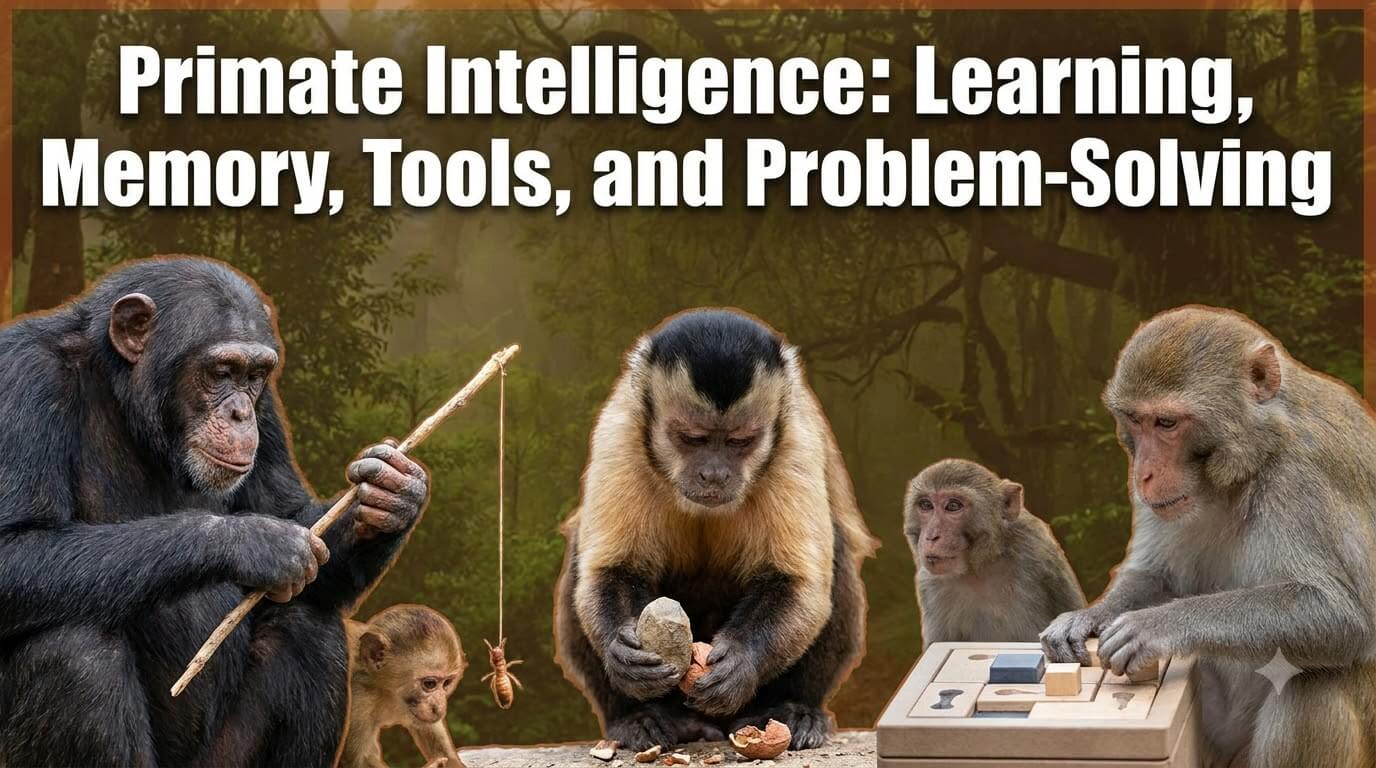
Primate Intelligence: Learning, Memory, and Tools

Primate Intelligence: Learning, Memory, Tools, and Problem-Solving

Primate intelligence is not one ability that can be measured with a single score. Researchers study specific cognitive skills such as learning, memory, attention, inhibitory control, spatial reasoning, social learning, problem-solving, tool use, planning, and self-recognition. Different primates show different strengths, and performance can change with age, motivation, experience, social setting, and the design of … Read more