

Primates eat an enormous variety of foods. Depending on the species, habitat, season, and life stage, the diet may include ripe fruit, unripe fruit, young leaves, mature leaves, flowers, nectar, seeds, nuts, plant gums, sap, insects, other invertebrates, eggs, and occasionally vertebrate prey. Some primates are strongly specialized, while others shift among foods as availability changes.
That diversity makes simple statements such as “monkeys eat bananas” or “primates mostly eat fruit” misleading. Fruit is important to many species, but some primates specialize heavily on leaves, plant exudates, insects, seeds, or mixed diets. Feeding also depends on anatomy: teeth break foods down, hands manipulate them, digestive systems extract nutrients, and memory helps animals find resources that can be scattered across large areas. Feeding anatomy also helps explain some differences between Old World and New World monkeys.
Quick Answer
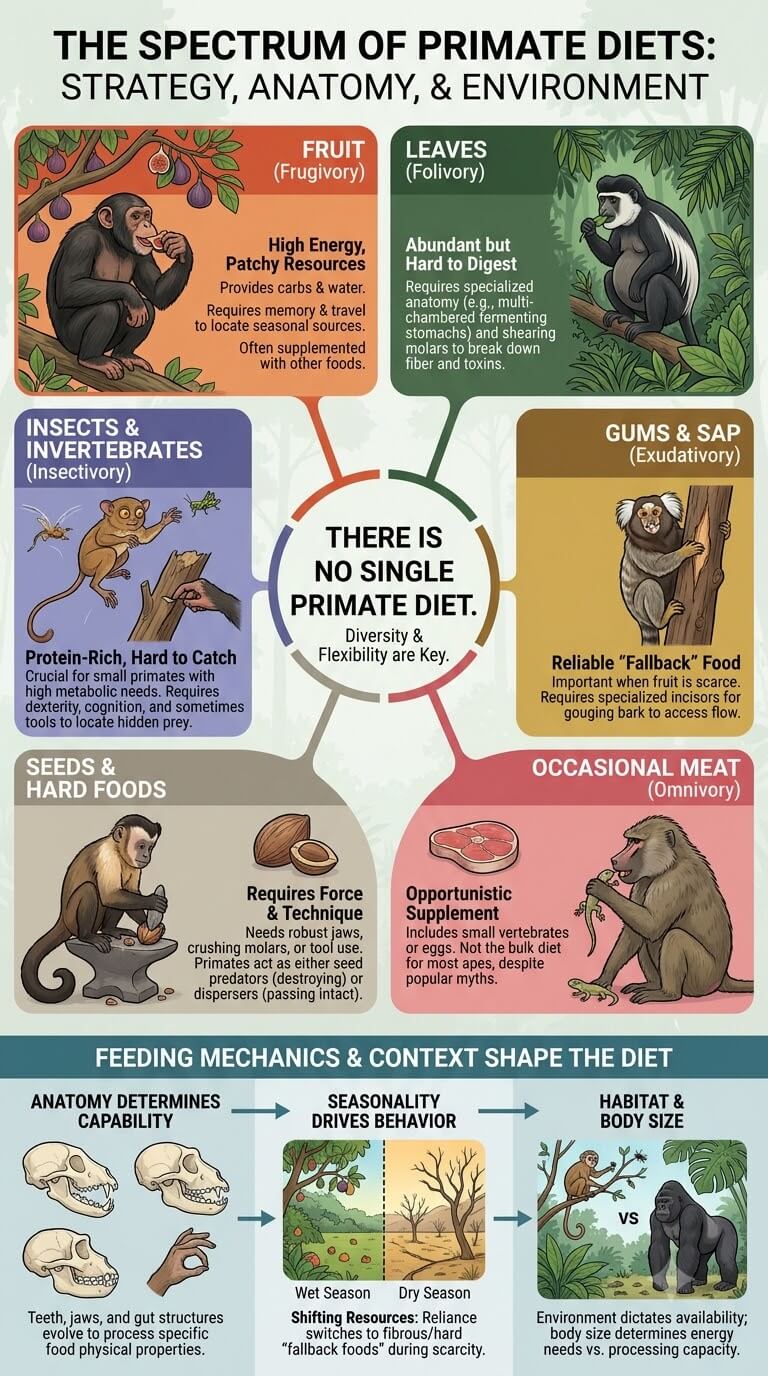
There is no single primate diet
Primates range from strongly fruit-oriented species to leaf specialists, insect hunters, gum feeders, seed predators, and flexible omnivores. Even labels such as frugivore and folivore describe emphasis rather than an exclusive menu. A frugivorous primate may eat leaves and insects, while a folivorous primate may eat fruit, flowers, or seeds when those foods are available.
Recent field research comparing sympatric lemurs reinforces this point. A study of diet and seasonality in rainforest lemurs found that a more fruit-oriented brown lemur still consumed other foods, while a more leaf-oriented sifaka also changed food selection through time. Broad dietary categories help summarize feeding ecology, but they are not strict ingredient lists.
Feeding strategy matters as much as food type
Two primates can eat the same general food but obtain it differently. One may swallow soft fruit quickly, another may peel or pound a hard outer layer, and another may search inside bark or wood for hidden invertebrates. The mechanics of obtaining food can be as important as the nutritional category.
Hands, teeth, jaw muscles, gut anatomy, body size, social competition, memory, and locomotion all shape how efficiently a primate feeds. A diet is therefore a combination of what is eaten, where it is found, how it is processed, and how the animal responds when preferred foods disappear.
Fruit in Primate Diets

Why fruit is valuable
Ripe fruits often provide readily digestible carbohydrates and water, making them attractive foods for many primates. Fruit can also be easy to process compared with fibrous mature leaves, although skins, husks, large seeds, toxins, or hard shells can make particular fruits difficult.
Fruit availability is rarely constant. Trees may produce crops only during certain weeks or seasons, forcing fruit-eating primates to travel among patchy resources and remember where productive trees are located.
Frugivores usually eat more than fruit
A species described as frugivorous may supplement fruit with leaves, insects, flowers, seeds, bark, pith, or other foods. These supplements can become especially important when preferred fruits are scarce.
The balance can also change among populations. A chimpanzee community in one forest may encounter a different set of seasonal fruits than another community, producing meaningful dietary differences without any change in species identity.
Fruit choice can be selective
Primates do not necessarily eat every fruit they encounter. Ripeness, sugar content, toughness, seed size, secondary plant compounds, odor, color, and competition can influence selection.
Some species prefer ripe sugary pulp, while others regularly eat unripe fruits or seeds. The same plant can be handled differently by different primates, which can determine whether the animal acts mainly as a seed disperser or seed predator.
Leaf Eating and Folivory

Young leaves versus mature leaves
Leaves are abundant in many forests, but their nutritional quality varies. Young leaves often contain more protein and less structural fiber than mature leaves, which can make them easier to digest. Mature leaves may contain more cellulose, lignin, and defensive compounds.
Leaf-eating primates therefore often select among leaf ages and plant species rather than simply consuming whatever foliage is most common.
Colobine monkeys and foregut fermentation
Old World colobine monkeys provide one of the clearest primate examples of digestive specialization for a leaf-rich diet. Their multi-chambered stomach supports microbial fermentation before food reaches the small intestine, helping break down fibrous plant material.
The silvered leaf monkey account from Animal Diversity Web describes a sacculated stomach containing fermenting bacteria along with bilophodont molars that help process plant foods. This does not mean colobines eat only leaves. Fruits, flowers, buds, and seeds can also be important depending on species and season.
Folivory is not an easy fallback lifestyle
Leaves may appear abundant, but choosing and digesting them presents difficult problems. Primates must distinguish nutritious leaves from fibrous or chemically defended ones, manage gut fermentation, and spend enough time processing large volumes of relatively low-energy food.
Leaf eaters can therefore show highly selective foraging rather than simply accepting any foliage. Folivory requires specialized anatomy and detailed ecological knowledge.
Insects and Other Invertebrates

Insects provide concentrated nutrients
Insects and other invertebrates can supply protein, fat, and micronutrients. Small-bodied primates may depend heavily on them, while larger fruit- or leaf-eating species may take insects opportunistically.
Common prey can include beetles, caterpillars, ants, termites, grasshoppers, spiders, and larvae, depending on species and habitat.
Searching can be more difficult than eating
Invertebrates often hide inside bark, dead wood, leaf rolls, bamboo, soil, or insect nests. Finding them may require listening, visual inspection, tearing vegetation apart, probing holes, or using tools.
This makes insect feeding an important connection between diet and cognition. The food itself may be small, but locating and extracting it can require persistent, coordinated behavior.
Body size affects insect dependence
Very small primates have high metabolic demands relative to body size and can benefit from energy-rich animal prey. Larger primates generally cannot meet all energy needs by catching tiny insects one at a time, although insects can still provide useful nutrients.
Dietary labels therefore interact with body size and foraging economics. A food item that is profitable for a small tarsier or tamarin may not support a large ape in the same way.
Gums, Sap, and Plant Exudates

Marmosets are specialized exudate feeders
Some marmosets rely heavily on gums and other plant exudates. They use specialized front teeth to gouge holes in bark and then return to feed on the material that flows from the wound.
Research on gum feeding in common marmosets notes that wild marmosets feed heavily on tree exudates and possess morphological adaptations linked to gouging behavior. They also eat insects and fruits, so gum feeding is a specialization within a broader diet rather than the only food consumed.
Why gum feeding requires special behavior
Plant gums are not distributed like fruit crops. A primate may need to create feeding sites, revisit them, defend access, or remember which trees produce useful exudates.
Gouging also places repeated force on the jaw and front teeth. Feeding anatomy therefore reflects not only what the animal swallows but how the food is obtained from the plant.
Exudates can become especially important when fruit is scarce
In some habitats, gum and sap can provide a relatively dependable resource during periods when ripe fruit is less available. This can reduce reliance on highly seasonal fruit crops.
The exact seasonal role differs by species and forest. It should not be assumed that every marmoset population relies on gums to the same degree.
Seeds, Nuts, and Hard Foods

Seeds can be food rather than cargo
When a primate swallows fruit pulp and later passes intact seeds, it may function as a seed disperser. When it cracks, chews, or destroys the seed to eat the internal tissue, it acts as a seed predator instead.
The same primate can potentially disperse some plant species and destroy the seeds of others. Ecosystem role depends on how each food is handled.
Hard foods require force and technique
Nuts, hard seeds, and encased foods can require strong jaws, robust teeth, pounding, biting, peeling, or tool use. Hard-object feeding can therefore select for different mechanical solutions than soft-fruit feeding.
Capuchins provide a dramatic behavioral example. Wild populations on Jicarón Island habitually use stones to open several encased food resources, as documented in research on stone-tool-aided extractive foraging in capuchins.
Teeth reflect recurring mechanical demands
Primate molars vary in cusp shape and shearing structure. Leaf and insect processing often benefits from longer shearing edges, while hard-object feeding places different stresses on teeth and jaws.
Dental form does not predict every meal. A species can have a broad dietary range, and seasonal shifts can expose the same teeth to foods with different mechanical properties.
Occasional Vertebrate Prey
Some primates eat small vertebrates
Although plant foods and invertebrates dominate many primate diets, vertebrate prey is documented in several lineages. Depending on the species, prey can include frogs, lizards, birds, eggs, rodents, or other mammals.
Chimpanzees are especially well known for occasional hunting of monkeys and other mammals. A field study of meat eating in wild chimpanzees found that access to meat varied with social and reproductive circumstances, illustrating that animal prey is embedded in social as well as nutritional contexts.
Meat should not be exaggerated in ape diets
Chimpanzee hunting attracts attention because it resembles a familiar human behavior, but meat is not the bulk of a typical chimpanzee diet. Plant foods, especially fruit where available, dominate much feeding time.
Using occasional hunting to label chimpanzees as primarily carnivorous would therefore misrepresent their ecology.
Omnivory can be uneven
An omnivorous primate may obtain most calories from plants while still regularly eating insects or occasionally taking vertebrate prey. The word omnivore means that both plant and animal foods occur in the diet, not that they contribute equal amounts.
This distinction is important when comparing capuchins, macaques, chimpanzees, and other flexible feeders.
Teeth, Jaws, and Digestive Adaptations
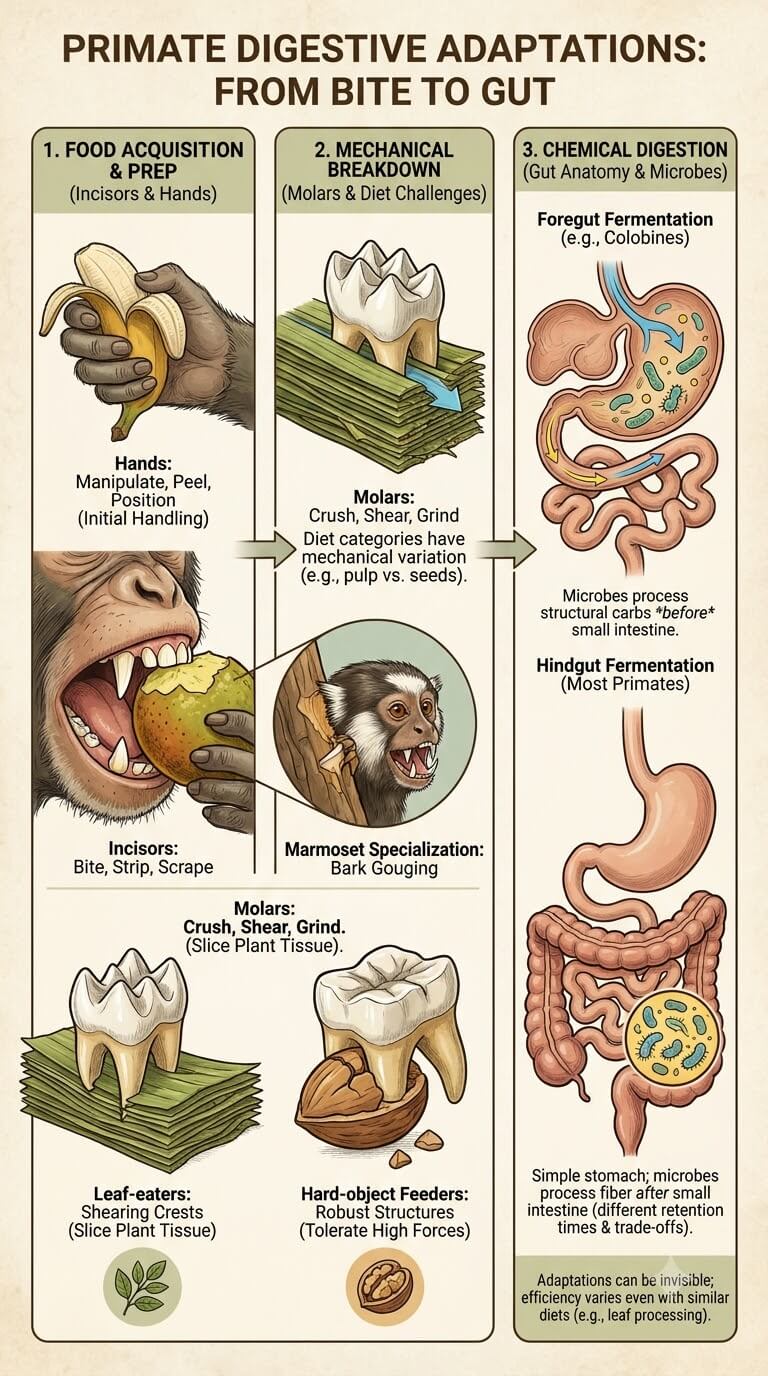
Incisors and food acquisition
Front teeth can bite into fruit, strip bark, scrape plant material, or help process food before it reaches the molars. In marmosets, lower front teeth are especially important for bark gouging.
Incisor size and shape reflect repeated feeding demands, but hands often perform much of the initial food handling in primates. A primate can rotate, peel, pull, or position food before biting.
Molars and food breakdown
Molars crush, shear, and grind foods. Leaf-eating species often benefit from strong shearing crests that slice plant tissue, while hard-object feeders need tooth structures able to tolerate high forces.
Fruit pulp can be mechanically easier than fibrous leaves, but seeds and hard rinds can change the challenge dramatically. Diet categories therefore contain substantial mechanical variation.
Gut anatomy affects what can be digested
Chewing is only the first step. Colobine foregut fermentation allows microbes to process structural carbohydrates. Other primates rely more heavily on simple stomachs and hindgut fermentation, with different retention times and digestive trade-offs.
A feeding adaptation can therefore be invisible from the outside. Two primates may both eat leaves, yet differ in how efficiently their digestive systems process fiber.
Seasonal Diet Shifts
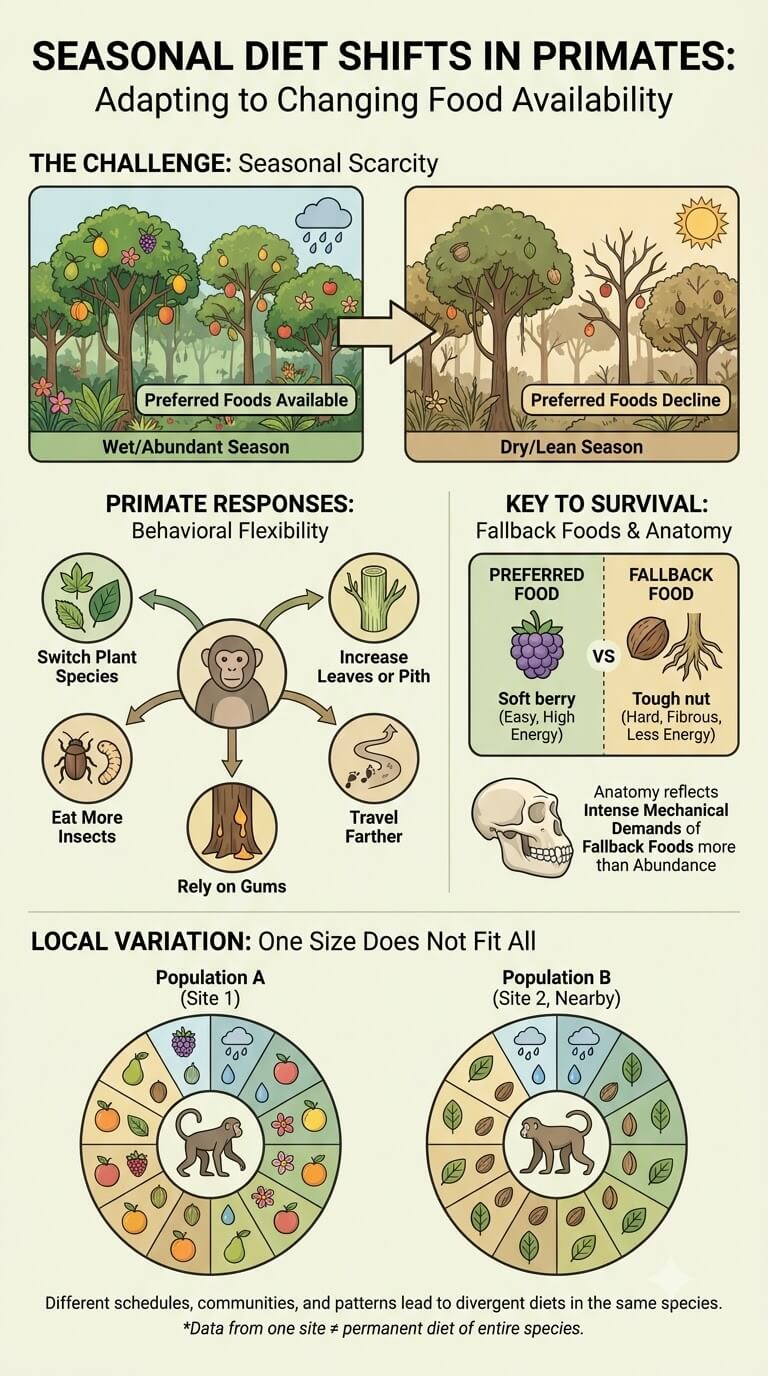
Preferred foods are not always available
Tropical forests can look permanently productive, but fruiting and flowering are often strongly seasonal. Drought, rainfall, temperature, and plant reproductive cycles change what is available. What a primate can eat is ultimately constrained by the foods available in its habitat.
Primates respond by switching plant species, increasing leaves or pith, eating more insects, relying on gums, or traveling farther to locate preferred foods.
Fallback foods can shape survival
A fallback food is used more heavily when preferred foods decline. It may be less energy-rich, more fibrous, harder to process, or more difficult to obtain.
The ability to exploit fallback foods can help a population survive lean seasons. Anatomy may even reflect these difficult periods more strongly than periods of abundance because hard or fibrous fallback foods can impose intense mechanical demands.
Seasonality can differ between nearby populations
Two populations of the same primate species can face different fruiting schedules, plant communities, rainfall patterns, and competitors. Their seasonal diets may therefore diverge even though their basic anatomy is similar.
This is another reason a single percentage from one field site should not be treated as the permanent diet of an entire species.
Food Processing and Extractive Foraging
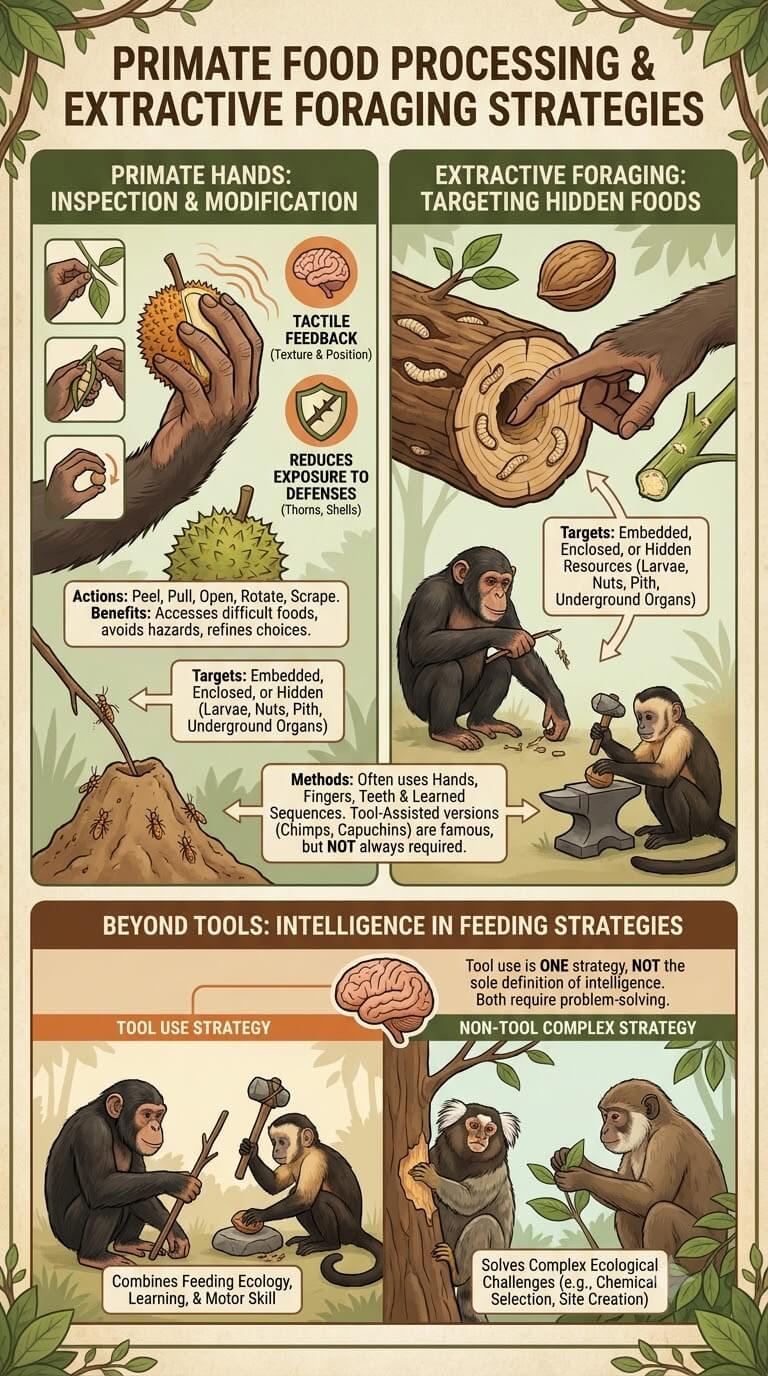
Hands let primates inspect and modify foods
Primate hands can peel fruit, pull leaves from stems, open pods, rotate objects, scrape surfaces, and remove unwanted parts. Tactile feedback helps an animal judge texture and position while processing food.
Manual processing can make foods accessible that would otherwise be difficult to bite directly. It can also reduce exposure to thorns, shells, or plant defenses.
Extractive foraging targets hidden foods
Extractive foraging involves obtaining food that is embedded, enclosed, or hidden within another material. Examples include larvae inside wood, nuts inside hard shells, plant pith inside stems, and underground storage organs.
Chimpanzees and capuchins are famous for some tool-assisted versions, but extractive foraging does not always require tools. Hands, fingers, teeth, and learned sequences can solve many hidden-food problems.
Tool use is one feeding strategy, not the definition of intelligence
Some chimpanzee communities use sticks to access insects or plant foods, and some capuchin populations use stones to open hard foods. These behaviors combine feeding ecology with learning and motor skill.
Other primates solve equally important feeding problems without detachable tools. A leaf specialist choosing chemically suitable foliage or a marmoset creating gum-feeding sites is also responding to a complex ecological challenge.
Feeding Competition and Social Context
Food patch size affects competition
A large fruiting tree can feed several animals at once, while a small high-quality patch may be monopolized more easily. The size, density, and renewal rate of food patches can therefore shape aggression and group spacing. Food distribution and competition can reshape primate social behavior and group spacing.
Rank may affect access to concentrated resources in some primate groups, especially when food can be defended. Widely dispersed leaves may be harder for one individual to control.
Group size changes foraging costs
More group members can mean more competitors at feeding sites. Large groups may need to travel farther or spread out more to find enough food.
At the same time, group living can improve predator detection and provide social information about food. Feeding ecology and social behavior are tightly linked. Lemurs, lorises, and tarsiers provide useful examples of how feeding strategies diverge among major primate lineages.
Young primates learn by watching others
Juveniles can observe where adults feed, which plant parts are selected, how hard foods are opened, and how dangerous prey or defended foods are handled.
Social exposure is particularly important for feeding techniques that take years of practice. Young chimpanzees and capuchins spend extensive time interacting with the objects used in adult foraging.
Primate Diets and Seed Dispersal

Fruit eating can move seeds away from parent plants
When primates swallow fruit and later defecate intact seeds elsewhere, they can move plant offspring away from the parent tree. This can reduce crowding near the parent and place seeds in new recruitment sites.
Research on seasonal seed dispersal by tamarins shows that primate movement and changing fruit use can alter where and when seeds are deposited.
Seed dispersal quality depends on behavior
A primate is not automatically a useful disperser simply because it eats fruit. Seed survival, gut passage, travel distance, deposition site, and whether the seed is swallowed or destroyed all matter.
Large-bodied primates can sometimes swallow seeds too large for smaller frugivores, while small primates may move seeds into different parts of the forest. The ecological effect depends on plant and primate traits together.
Seed predation is also ecologically important
When primates chew seeds, they may reduce the number available for germination. That can influence which plant species recruit successfully and how plant communities change over time.
One primate species can disperse some plants and prey on the seeds of others. Feeding ecology therefore creates both mutualistic and antagonistic relationships with plants.
Common Mistakes and Myths
Monkeys mainly eat bananas
False. Wild monkeys encounter the foods produced by their natural habitats, not the cultivated grocery-store bananas familiar to people. Depending on species, monkeys may eat wild fruits, leaves, flowers, insects, seeds, gums, and many other foods.
All primates are mostly fruit eaters
False. Fruit is important for many species, but leaf monkeys, gum-feeding marmosets, insect-oriented small primates, seed predators, and mixed feeders show how broad the order’s diets are.
Folivores eat only leaves
Usually false. Many leaf-oriented primates also eat fruit, seeds, flowers, buds, or other foods. “Folivore” describes dietary emphasis, not a universal one-food menu.
Tool-using primates have the most advanced diets
No. Tool use is one method of obtaining food. A primate can have a highly specialized and demanding feeding ecology without using detachable tools.
Zoo diets show what primates normally eat in the wild
No. Captive diets are designed around nutrition, health, husbandry, and practical food availability. They should not be used as direct evidence of what a species naturally selects, processes, or searches for in the wild.
How Habitat Shapes What Primates Eat
Forest structure determines available foods
Canopy height, tree species composition, rainfall, elevation, and disturbance all influence which fruits, leaves, flowers, gums, and insects are available. A primate’s locomotion determines which parts of that food supply it can reach efficiently.
Small arboreal species can exploit thin terminal branches that may not safely support a large ape. Terrestrial primates can use foods on the ground that highly arboreal species encounter less often.
Body size changes feeding economics
Small primates can profit from tiny insects or small food patches because each item represents a larger fraction of daily energy needs. Large primates require greater total intake and may depend more on large fruit crops, foliage, or widespread resources.
Large bodies can also process some fibrous foods differently because gut volume and retention time change with body size.
Diet flexibility can help in changing environments
Generalist feeders can sometimes shift among foods when one resource declines, but flexibility has limits. An animal still needs appropriate feeding anatomy, digestive physiology, and access to alternative resources.
Specialists may be highly efficient at a narrower set of foods yet become vulnerable when those resources disappear. Diet breadth is therefore one part of how primates respond to habitat change.
FAQ
Do primates eat meat?
Some do. Insects and other invertebrates are common animal foods for many primates, and vertebrate prey is eaten occasionally by several species. Chimpanzees sometimes hunt mammals, while some monkeys may eat small vertebrates or eggs. The amount varies widely and is often small compared with plant foods.
Do all monkeys eat fruit?
Many monkeys eat at least some fruit, but the importance of fruit differs greatly. Some species are strongly frugivorous, while others depend heavily on leaves, seeds, insects, gums, or mixed foods.
Why can leaf monkeys digest so many leaves?
Colobine monkeys have specialized multi-chambered stomachs containing microbes that ferment fibrous plant material. Their teeth and feeding behavior also help process leaves before and during digestion. Even so, they often select particular leaves rather than eating all foliage equally.
Why do marmosets chew holes in trees?
Many marmosets gouge bark to stimulate the flow of plant gums and other exudates. Their front teeth and jaw mechanics are adapted to repeated gouging. These exudates can be an important food, especially where fruit availability changes seasonally.
Final Thoughts
Primate diets are diverse because primates occupy many habitats and solve very different feeding problems. Fruit, leaves, insects, gums, seeds, flowers, hard foods, and occasional vertebrate prey can all matter, but the proportions differ among species, populations, seasons, and individuals.
The most useful way to understand what primates eat is to connect food type with feeding strategy. Teeth and guts process foods, hands manipulate them, memory helps relocate seasonal resources, tools can open hidden or encased foods, and social behavior affects access. Those feeding choices also shape forests through seed dispersal and seed predation. There is no universal primate menu, only a wide set of anatomical and behavioral solutions to finding enough nutrition in changing environments.

Ethan Walker is the founder and research editor of Animal Fact Central. He creates and reviews educational animal facts content using trusted wildlife, pet care, and science-based sources. His work focuses on making animal behavior, adaptations, habitats, and species facts clear, accurate, and engaging for everyday readers.
Read More Details About Ethan Walker: https://animalfactcentral.com/ethan-walker/