
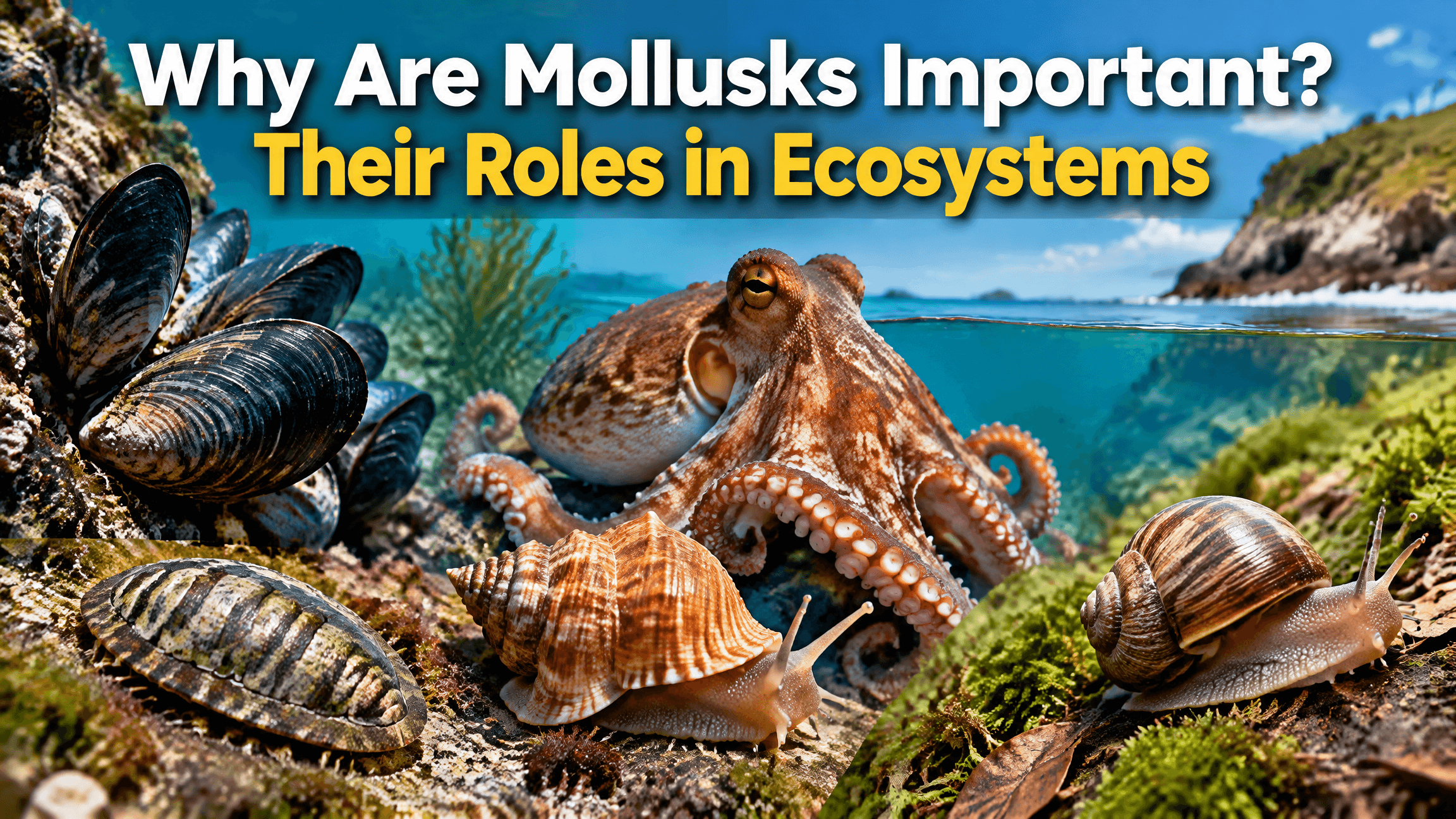
Mollusks matter because they do far more than occupy space in oceans, rivers, forests, and shorelines. Across the phylum Mollusca, different species graze algae, filter suspended particles, consume detritus, hunt other animals, recycle nutrients, create habitat, and feed predators. Their effects can be easy to miss because many mollusks are small, slow-moving, buried in sediment, or active at times people rarely notice.
There is no single ecological job performed by every mollusk. A freshwater mussel anchored in a riverbed affects its surroundings differently from a land snail in leaf litter, a chiton on a rocky shore, or a squid hunting in open water. Understanding why mollusks are important means looking at the many ways their feeding, movement, shells, life cycles, and relationships with other organisms shape local ecosystems.
Quick Answer
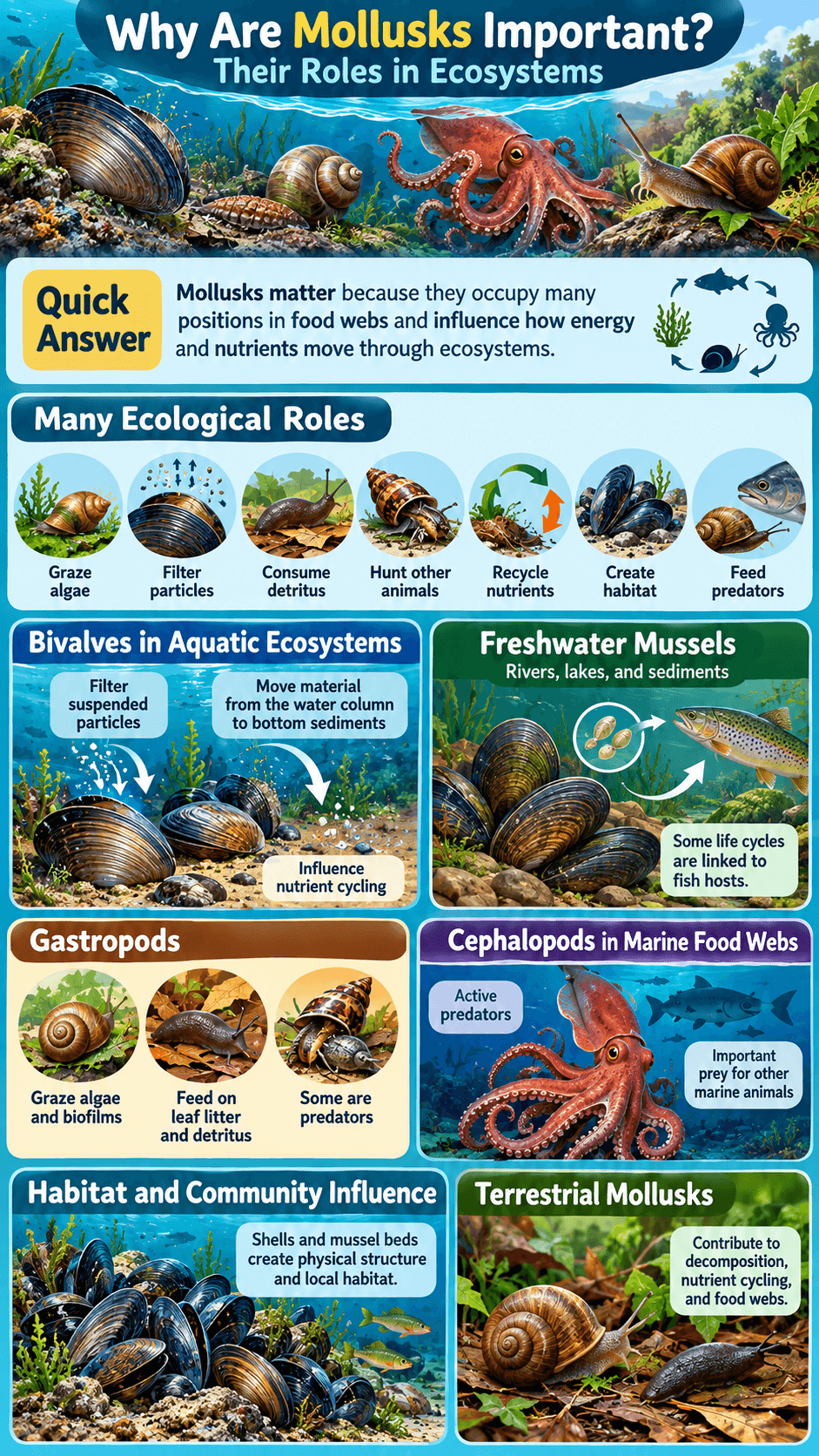
Mollusks are important because they occupy many positions in food webs and influence how energy and nutrients move through ecosystems. Gastropods can graze algae or consume decomposing material. Bivalves can process suspended particles and move material between the water column and bottom sediments. Cephalopods are active predators and also important prey. Land snails and slugs participate in decomposition and nutrient cycling. Dense beds of mussels or oysters can add physical structure that shelters other organisms.
These roles vary by species and habitat. A mollusk can be ecologically important without performing every one of these functions, and the strength of any effect depends on abundance, body size, water flow, food supply, season, and the surrounding community.
Mollusks Occupy Many Ecological Roles
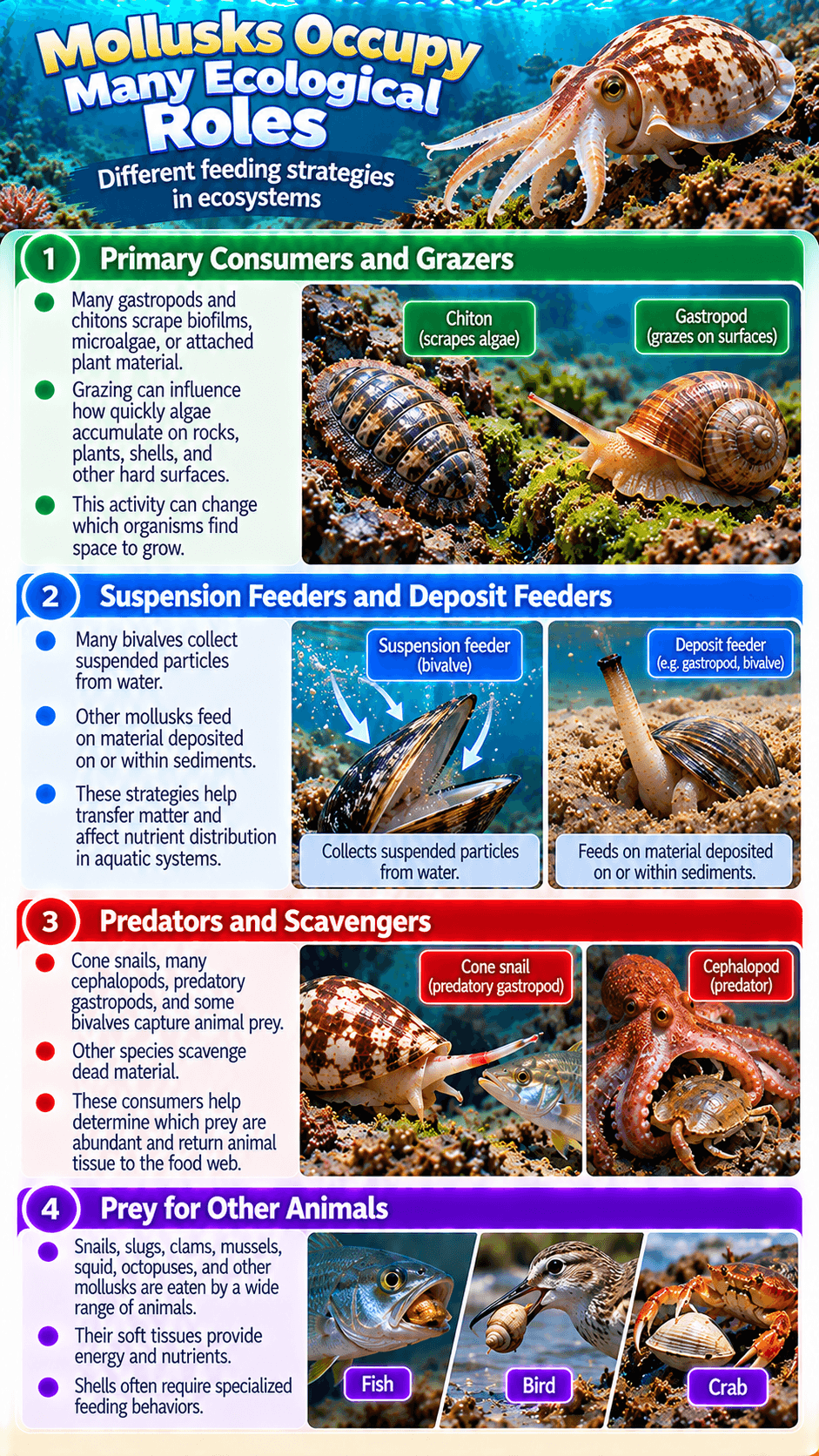
The diversity of mollusks is reflected in the diversity of their ecological roles. Some are primary consumers that feed directly on algae or plant material. Others consume suspended particles, sediment-associated organic matter, carrion, or animal prey. Still others become prey for fish, birds, mammals, reptiles, amphibians, and invertebrates. Because these roles occur at different points in food webs, mollusks can move energy both upward toward predators and sideways among habitats and nutrient pools.
Primary Consumers and Grazers
Many gastropods and chitons scrape biofilms, microalgae, or attached plant material from surfaces. Grazing can influence how quickly algae accumulate on rocks, plants, shells, and other hard surfaces. On rocky shores, this activity can change the balance between bare rock, microscopic films, larger algae, and newly settling organisms. Grazers therefore do more than remove food. They can alter which organisms find space to grow.
The effect is not identical across species. Some chitons and snails specialize on particular food sources, and some mollusks commonly described as grazers also consume animals or detritus. A Journal of Molluscan Studies analysis of chiton diets found substantial differences among species living in the same rocky habitat, including both algal feeding and predation on small animals. That variety is a useful reminder that feeding category and ecological role are not interchangeable labels.
Suspension Feeders and Deposit Feeders
Many bivalves collect suspended particles from water, while other mollusks feed on material deposited on or within sediments. These strategies connect different parts of aquatic systems. When a mussel captures suspended particles, digests some material, and deposits waste near the bottom, it helps transfer matter from the water column to the benthic zone. Benthic simply means associated with the bottom of a water body.
Deposit feeders influence a different route. By consuming organic matter mixed with sediment, they process material that has already settled. Together, suspension feeding and deposit feeding show why mollusks can affect nutrient distribution without needing to be large or highly mobile.
Predators and Scavengers
Mollusks also occupy higher feeding levels. Cone snails, many cephalopods, predatory gastropods, and some bivalves capture animal prey. Other species scavenge dead material. These consumers help determine which prey are abundant and how animal tissue is returned to the food web after death.
Predation by mollusks is especially visible in cephalopods, but it is not limited to them. Predatory snails can drill, rasp, engulf, or otherwise subdue prey depending on the lineage. The ecological result is the same basic process seen in other predators: energy stored in prey is transferred to the predator, and changes in predator abundance can affect the organisms they consume.
Prey for Other Animals
Mollusks are also food. Snails, slugs, clams, mussels, squid, octopuses, and other mollusks are eaten by a wide range of animals. Their soft tissues provide energy and nutrients, while shells often require specialized feeding behaviors to break, pry open, drill, crush, or swallow.
Bivalves in Aquatic Ecosystems
Bivalves are often highlighted when people ask why mollusks are important because their feeding can have visible effects on aquatic environments. Mussels, oysters, clams, and related animals interact continuously with the water around them, but the phrase “natural water filter” needs context. Filtration is a biological feeding process, not a universal promise that bivalves make any body of water clean.
Suspension Feeding and Particle Processing
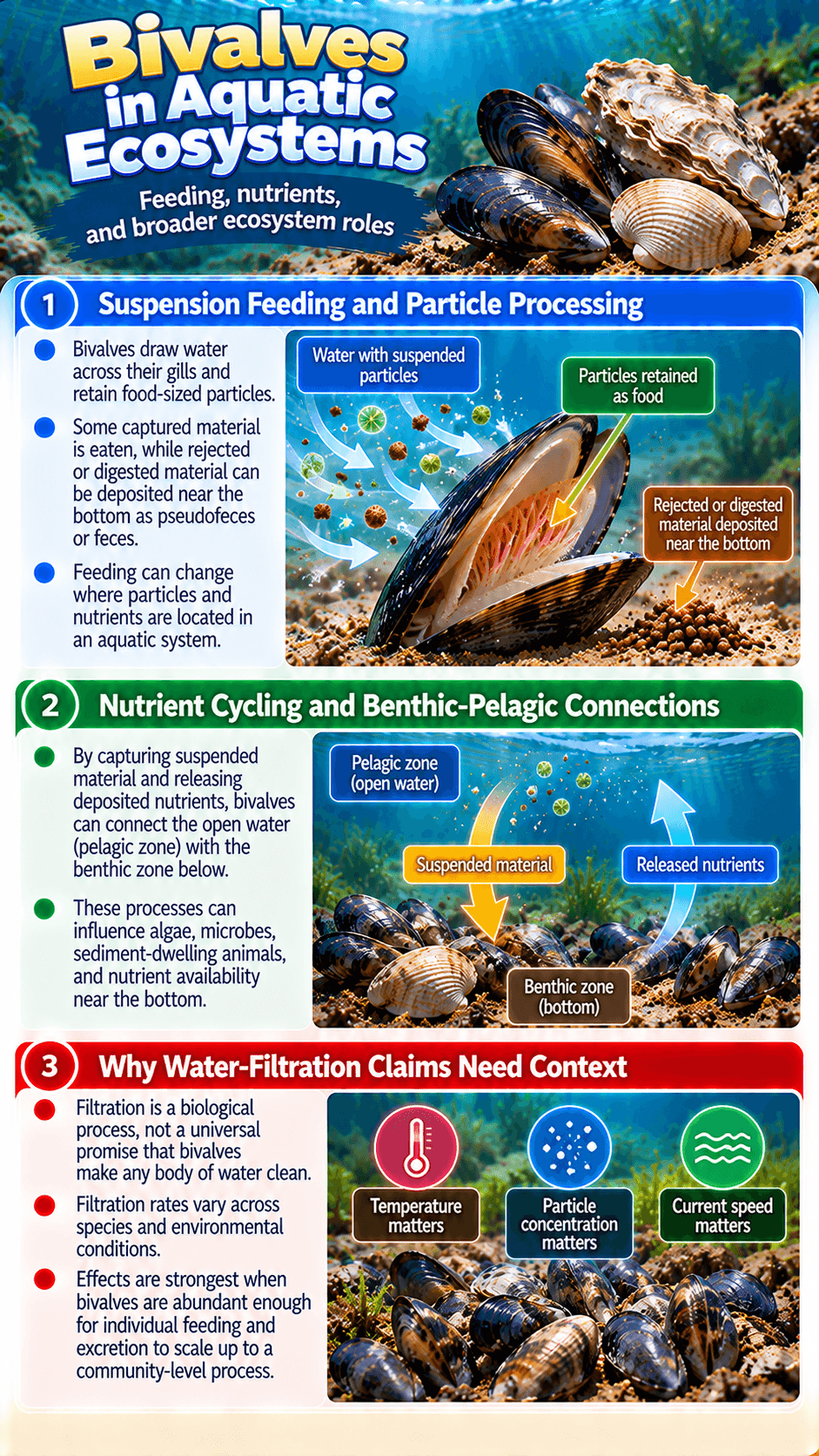
Many bivalves draw water across their gills and retain food-sized particles such as phytoplankton and other suspended material. Some captured material is eaten, while rejected or digested material can be deposited near the bottom as pseudofeces or feces. This means bivalve feeding can change where particles and nutrients are located in an aquatic system.
The ecological effect depends on many conditions. A dense mussel bed in a shallow, slow-moving area may process a meaningful portion of the local water volume, while sparse animals in a large, fast-flowing river may have a smaller measurable effect at the whole-system scale. Temperature, particle concentration, species, body size, and current speed can all matter.
Nutrient Cycling and Benthic-Pelagic Connections
By capturing suspended material and releasing dissolved or deposited nutrients, bivalves can connect the pelagic zone, the open water, with the benthic zone below. This connection can influence algae, microbes, sediment-dwelling animals, and nutrient availability near the bottom.
The U.S. Geological Survey science vision for freshwater mussels describes mussels as important consumers of suspended particles that influence particle dynamics, nutrient cycling, habitat for other bottom-dwelling invertebrates, and sediment-water interactions. These effects are strongest when mussels are abundant enough for individual feeding and excretion to scale up to a community-level process.
Why Water-Filtration Claims Need Scale and Species Context
It is tempting to convert filtration into a single number, such as gallons per mussel per day, and then treat that value as universal. That is misleading. Filtration rates vary across species and environmental conditions, and laboratory measurements do not automatically predict what happens across an entire river, lake, or estuary.
Filtration also does not mean pollutants simply disappear. Some substances can be transformed, deposited, accumulated in tissues, or passed through food webs. Native and invasive bivalves can also have very different community effects. The useful ecological point is that bivalves process suspended material and can strongly alter aquatic systems when conditions and abundance make that process significant.
Freshwater Mussels
Freshwater mussels deserve special attention because they combine several ecological roles in rivers and lakes. They live at the sediment-water boundary, where they feed, excrete nutrients, interact with currents, and provide hard surfaces in places that may otherwise be dominated by sand, gravel, or mud.
Roles in Rivers, Lakes, and Sediments
Native freshwater mussels can influence water-column particles, nutrient recycling, bottom sediments, and the animals living around them. Their shells add small patches of firm structure. Their feeding moves suspended particles downward. Their waste products can make nutrients available to algae and microbes near the bottom. Dense assemblages can also affect sediment stability and small-scale flow conditions.
USGS researchers describe freshwater mussels as ecosystem engineers because filtration, biodeposition, and nutrient cycling can modify local physical and chemical conditions for other organisms. “Ecosystem engineer” does not mean an animal intentionally builds an ecosystem. It describes measurable changes created by the animal’s presence and activities.
Interactions With Fish During Some Life Cycles
Many unionid freshwater mussels have a larval stage called a glochidium. In these species, glochidia temporarily attach to a suitable fish, or in some cases another aquatic vertebrate, before completing metamorphosis and leaving the host. This unusual life cycle links mussel reproduction to the presence and movement of compatible host animals.
The relationship is biologically specific. Different mussel species use different hosts, and it is inaccurate to say that every freshwater mussel uses the same fish or that every glochidial attachment has the same effect. The U.S. Fish and Wildlife Service overview of freshwater mussels and fish explains how host relationships can help juvenile mussels complete development and disperse through river systems.
Why Ecosystem Importance Does Not Mean Every Species Has the Same Function
Freshwater mussel communities can contain species with different feeding rates, body sizes, reproductive schedules, host relationships, habitat preferences, and tolerances. Two mussel species living in the same river may therefore contribute differently to filtration, nutrient release, physical habitat, or food-web interactions.
Gastropods as Grazers, Detritivores, and Predators
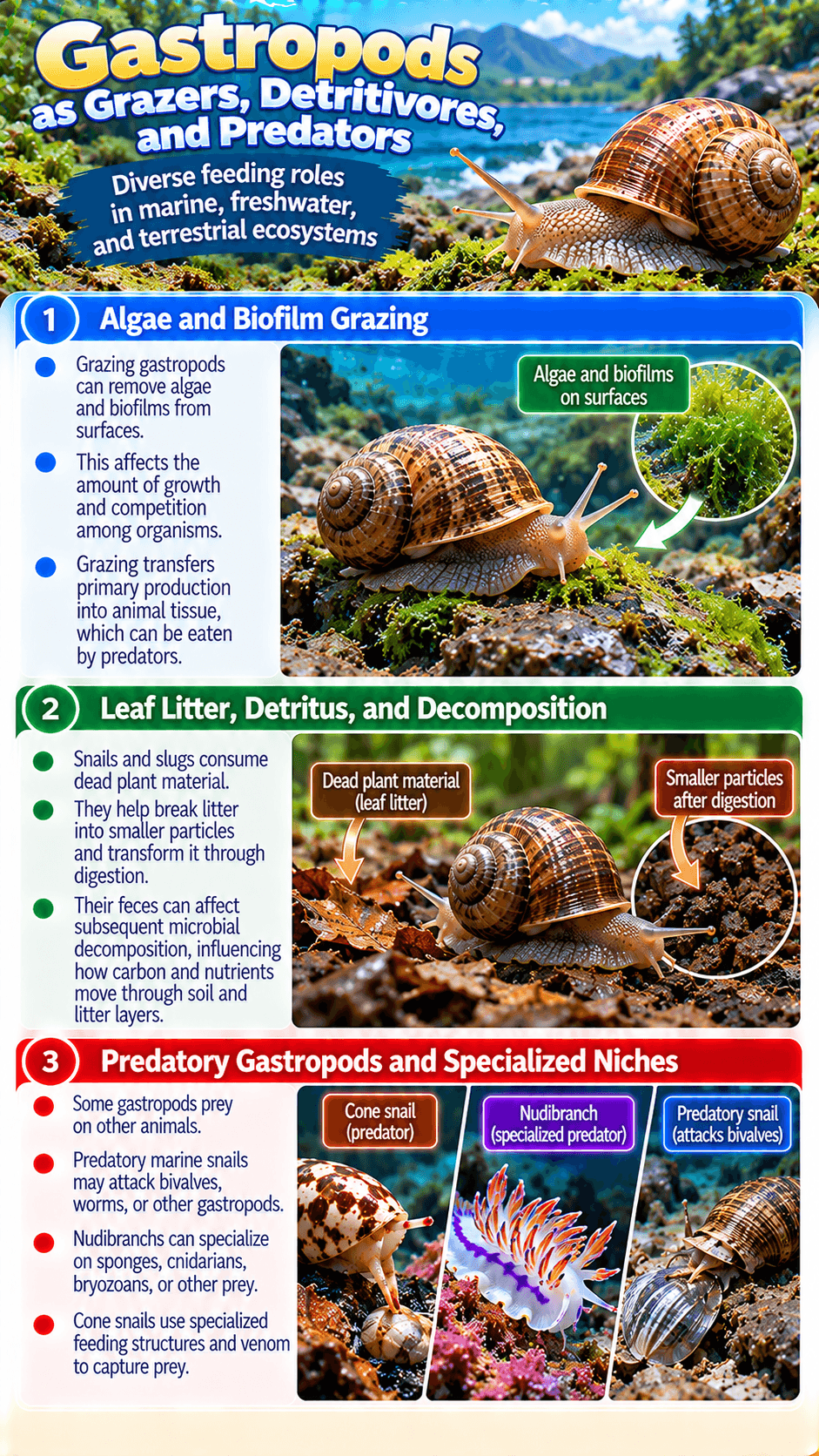
Gastropods, including snails and slugs, occupy an enormous range of ecological roles. Some scrape algae, some consume fungi and decomposing plant matter, some browse living plants, and some prey on other animals. This range makes gastropods important in marine, freshwater, and terrestrial food webs.
Algae and Biofilm Grazing
On rocks, aquatic plants, logs, and other surfaces, grazing gastropods can remove films of algae and microbes. That feeding affects both the amount of growth present and the competition among organisms using the same surface. In streams and shorelines, grazing pressure can also influence how quickly biofilms recover after disturbance.
Grazing is not simply “cleaning.” Algae and biofilms are themselves important parts of food webs. A snail that consumes them transfers primary production into animal tissue, which can then be eaten by predators. The ecological role is therefore better understood as energy transfer and community regulation than as surface cleaning.
Leaf Litter, Detritus, and Decomposition Context
Snails and slugs that consume dead plant material can contribute to decomposition by breaking litter into smaller particles and transforming it through digestion. Their feces can differ physically and chemically from intact leaves, which can affect subsequent microbial decomposition. In this way, detritivorous mollusks can influence how carbon and nutrients move through soils and litter layers.
A broad experiment on litter-feeding soil animals found that converting leaf litter into detritivore feces, including feces produced by snails, could increase the lability and subsequent decomposition of organic matter. The size of this effect depends on the litter and detritivore involved, so it should not be reduced to the idea that every land snail speeds decomposition by the same amount.
Predatory Gastropods and Specialized Niches
Some gastropods occupy roles that look very different from familiar garden snails. Predatory marine snails may attack bivalves, worms, or other gastropods. Nudibranchs can specialize on sponges, cnidarians, bryozoans, or other prey. Cone snails use highly specialized feeding structures and venom to capture prey.
These examples show why gastropods cannot be treated as a single grazing guild. Their ecological importance includes both bottom-up processes such as moving plant-derived energy into food webs and top-down processes in which predators influence prey populations.
Cephalopods in Marine Food Webs
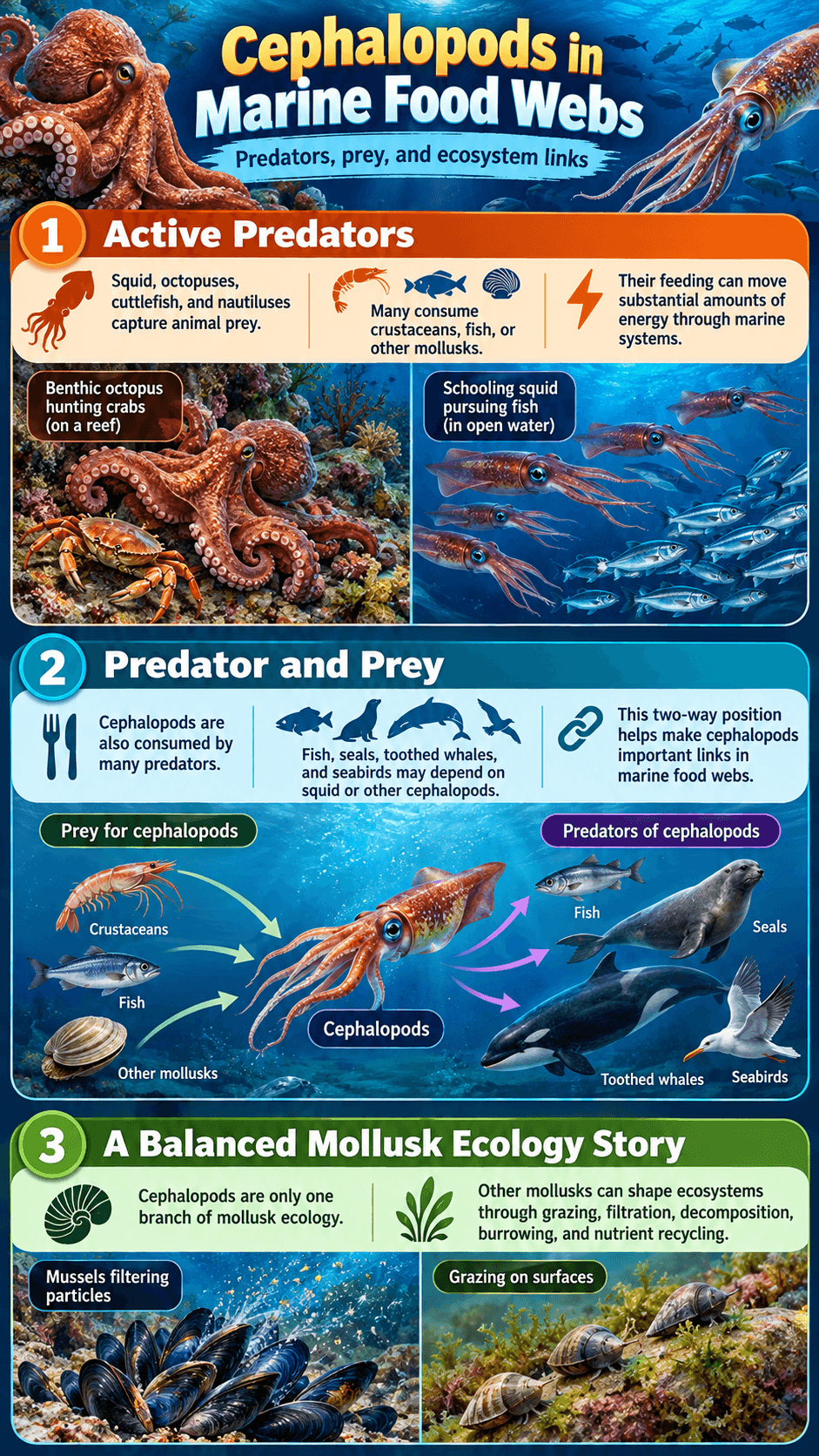
Cephalopods are among the most active mollusks, and their fast growth, mobility, and predatory behavior can make them prominent in marine food webs. Even so, they represent only one branch of mollusk ecology and should not be used as the model for the entire phylum.
Active Predators
Squid, octopuses, cuttlefish, and nautiluses capture animal prey, though their diets and hunting methods differ. Many consume crustaceans, fish, or other mollusks. Because cephalopods can be abundant and metabolically active, their feeding can move substantial amounts of energy through marine systems.
Predatory effects are local and species-specific. A small benthic octopus hunting crabs on a reef interacts with its environment differently from a schooling squid pursuing fish in open water. Treating all cephalopods as one ecological unit hides these differences.
Prey for Fish, Marine Mammals, Seabirds, and Other Predators
Cephalopods are also consumed by many predators. Fish, seals, toothed whales, seabirds, and other marine animals may depend on squid or other cephalopods as part of their diets. This two-way position, predator and prey, helps make cephalopods important links between smaller organisms they consume and larger predators that consume them.
The Smithsonian Ocean overview describes cephalopods as both active predators and important prey in marine food webs. Their hard beaks can even remain in predator stomachs after soft tissues are digested, giving researchers clues about feeding relationships that would otherwise be difficult to observe.
Why Cephalopods Should Not Dominate the Mollusk Ecology Story
Cephalopods attract attention because they swim, hunt, change appearance, and show complex behavior. Ecologically, however, a mussel bed processing suspended particles or a community of small grazers controlling biofilm can influence an ecosystem just as meaningfully through entirely different mechanisms.
A balanced view of Mollusca therefore includes both dramatic predator-prey interactions and quiet, repeated processes such as grazing, filtration, decomposition, burrowing, and nutrient recycling.
Chitons and Other Less Familiar Mollusks
Chitons, tusk shells, monoplacophorans, solenogasters, caudofoveates, and other less familiar mollusks remind us that ecological importance is not limited to species people commonly see. Some live on hard surfaces, some in sediments, and some in deep water where their interactions are difficult to observe directly.
Rocky-Shore Grazing and Specialized Feeding
Many chitons use a radula to graze material from rocky surfaces, helping shape the microscopic and algal communities growing there. Others have more specialized diets that include small animals. This variation means chitons can occupy different trophic roles even within the same broad habitat.
Because rocky shores are crowded and space-limited, feeding that removes algae or newly settled organisms can influence which species gain a foothold. The effect depends on the chiton species, density, tide level, and local community.
Diversity of Smaller Ecological Roles
Small or obscure mollusks can matter through many modest interactions. They may consume microorganisms, move particles through sediment, serve as prey, or transfer nutrients at small spatial scales.
Terrestrial Mollusks
Land snails and slugs are often noticed only when they feed on garden plants, but wild terrestrial gastropods occupy broader roles in forests, grasslands, wetlands, caves, and rocky habitats. Many interact with fungi, leaf litter, living vegetation, soil microbes, and predators.
Decomposition and Nutrient Cycling
By feeding on dead leaves, fungi, algae, and other organic material, terrestrial gastropods can fragment litter and alter material before microbes continue decomposition. Their mucus and feces also add organic compounds to the soil surface. These effects are one part of a much larger decomposer community that includes fungi, bacteria, insects, worms, millipedes, and other soil animals.
It would be inaccurate to call snails the main decomposers in most terrestrial ecosystems. Their importance is better understood as participation in a network of organisms that break down material and recycle nutrients under conditions that vary by climate, soil chemistry, vegetation, and gastropod abundance.
Food-Web Roles for Birds, Mammals, Reptiles, Amphibians, and Invertebrates
Land snails and slugs are prey for many animals. Their tissues supply energy, and snail shells can be an important source of calcium for some predators. Because gastropods often concentrate calcium into shells, their movement through food webs can influence how this mineral becomes available to animals that consume them.
Predation can also shape gastropod behavior. Hiding under logs, remaining active in humid conditions, and using shells or mucus as defenses affect when and where predators can find them. These interactions tie mollusk behavior directly to ecosystem food-web structure.
Mollusks as Habitat and Community Influencers
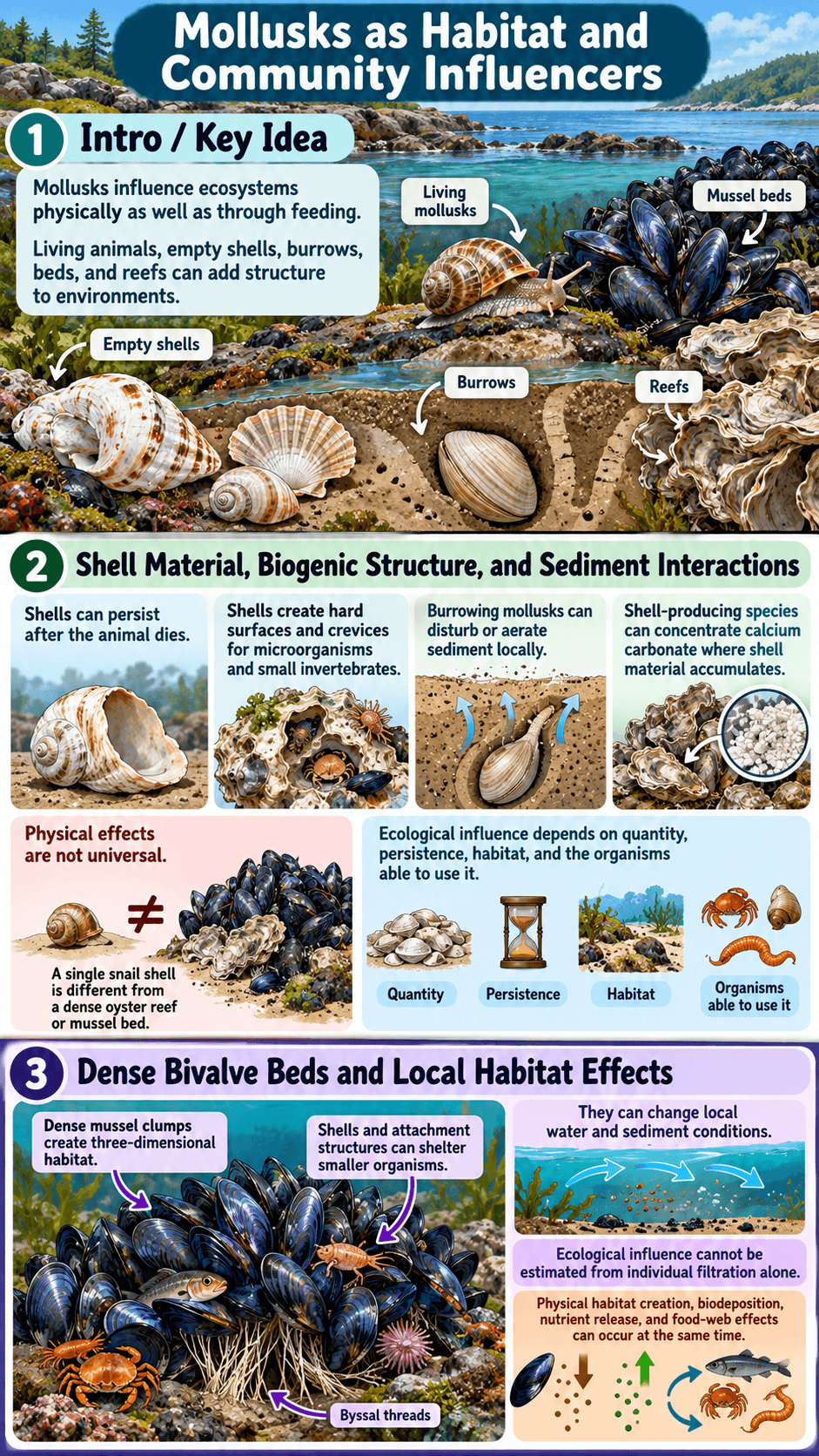
Mollusks can influence ecosystems physically as well as through feeding. Living animals, empty shells, burrows, beds, and reefs can add structure to environments that would otherwise be flatter or less complex.
Shell Material, Biogenic Structure, and Sediment Interactions
Shells can persist after the animal dies, creating hard surfaces and crevices for microorganisms and small invertebrates. Burrowing mollusks can disturb or aerate sediment locally, while shell-producing species can concentrate calcium carbonate in places where shell material accumulates.
These physical effects are not universal. A single snail shell on a forest floor is different from a dense oyster reef or mussel bed in shallow water. The ecological influence of shell material depends on quantity, persistence, habitat, and the organisms able to use it.
Dense Bivalve Beds and Local Habitat Effects
When mussels occur in dense clumps, their shells and attachment structures can create three-dimensional habitat that shelters smaller organisms and changes local water and sediment conditions. A study of mussel clumps describes how living and dead shells plus byssal threads can increase structural complexity and provide secondary habitat for associated animals.
This is one reason the ecological influence of a bivalve population cannot be estimated from individual filtration alone. Physical habitat creation, biodeposition, nutrient release, and food-web effects can occur at the same time.
Relationships With Hosts and Microbes
Some mollusk roles emerge from close relationships with other organisms. These associations can affect reproduction, digestion, nutrient acquisition, and the movement of animals across habitats.
Freshwater Mussel Larval Host Relationships
The temporary attachment of glochidia to host fish links the reproductive success of many freshwater mussels to fish communities. Host movement can also help young mussels reach areas they could not reach by adult movement alone. Because compatibility is often species-specific, changes in fish communities can influence where mussel populations can successfully reproduce.
This is a useful example of ecological importance working in both directions. Mussels influence river conditions, while fish can be necessary for the mussels’ own life cycles. Ecosystems are built from such dependencies rather than from isolated species performing separate jobs.
Microbial Symbioses in Specialized Feeders
Some mollusks depend on microbes for access to unusual food sources. Shipworms are wood-boring bivalves whose gill symbionts contribute enzymes involved in breaking down components of wood. This partnership allows the animals to exploit submerged wood that many other animals cannot digest efficiently.
By processing woody material in marine environments, shipworms participate in the breakdown and transfer of plant-derived carbon entering the sea. Their example shows how a mollusk’s ecological role can depend partly on microorganisms living within its body.
Common Ecology Misunderstandings
Bivalves Simply Clean All Water
Bivalves filter water as part of feeding, but ecological outcomes depend on species, abundance, hydrology, particle type, temperature, and many other factors. Some particles are consumed, some are deposited, and some substances can accumulate in tissues. It is more accurate to say that bivalves process suspended material and can alter water-column and sediment dynamics.
Mollusk Importance Is Only About Seafood or Pearls
Human uses are only one part of the story. Wild mollusks influence food webs, sediments, nutrient cycles, decomposition, and habitat structure whether or not people harvest them. A species can have little direct commercial value and still play a meaningful ecological role.
Every Mollusk Performs the Same Ecosystem Service
Mollusca includes animals as different as clams, slugs, squid, chitons, and tusk shells. Their ecological functions reflect that diversity. Some are grazers, some predators, some suspension feeders, and some specialized detritivores. Even closely related species can differ in habitat, feeding, abundance, and interactions with other organisms.
Ecological Roles Change With Feeding, Habitat, and Life History
Feeding Strategies Shape Ecosystem Effects
What a mollusk eats determines which pool of energy it taps into. Grazers connect algae to predators. Suspension feeders connect particles in the water column to bottom communities. Detritivores help process dead organic material. Predators transfer energy from prey populations and can influence their abundance.
Habitat Changes What a Mollusk Contributes
The same broad feeding strategy can have different effects in a river, estuary, forest, or rocky shore. Water flow changes particle delivery to mussels. Moisture changes when land snails are active. Wave exposure affects how rocky-shore grazers feed. Sediment type determines whether burrowing species can occupy an area.
Losing Species Can Remove Ecological Functions
When mollusk populations decline, the result can be more than the loss of individual animals. Local ecosystems may also lose some filtration, grazing, prey biomass, nutrient processing, or habitat structure. How much function is lost depends on whether other species perform similar roles and whether the remaining community can compensate.
This is why ecological importance and conservation are connected without being the same subject. Understanding what a species does helps researchers evaluate what may change if that species becomes rare, but conservation status must still be assessed species by species and region by region.
FAQ
Why are bivalves important in aquatic ecosystems?
Many bivalves process suspended particles, recycle nutrients, deposit organic material near the bottom, serve as prey, and create physical structure when they form dense beds or reefs. Their effects vary with species, abundance, water flow, and habitat, so it is better to describe them as ecosystem processors and habitat modifiers than as universal water-cleaning machines.
What role do snails and slugs play on land?
Terrestrial snails and slugs can consume fungi, dead plant material, algae, living plants, and other food sources depending on species. They participate in decomposition and nutrient cycling, alter organic material through digestion, and provide food for many predators. Some also influence plant communities through herbivory.
How do cephalopods fit into marine food webs?
Cephalopods are both predators and prey. They consume fish, crustaceans, mollusks, and other animals depending on species, while fish, marine mammals, seabirds, and other predators consume cephalopods. This places them in the middle of many marine food webs, linking smaller prey to larger consumers.
Final Thoughts
Why are mollusks important? Their importance comes from diversity of function rather than one universal service. Mussels can process suspended particles and shape bottom habitats. Snails and slugs can graze, decompose organic material, and feed predators. Chitons influence rocky surfaces. Cephalopods connect prey and larger predators in marine food webs. Other mollusks perform quieter roles in sediments, forests, reefs, and deep water.
Seen together, these animals help move energy, nutrients, minerals, and organic matter through ecosystems. Their ecological influence depends on species, abundance, habitat, and interactions with other organisms, which is exactly why broad claims about “what mollusks do” need to be replaced with a more accurate question: what does this mollusk do in this ecosystem?

Ethan Walker is the founder and research editor of Animal Fact Central. He creates and reviews educational animal facts content using trusted wildlife, pet care, and science-based sources. His work focuses on making animal behavior, adaptations, habitats, and species facts clear, accurate, and engaging for everyday readers.
Read More Details About Ethan Walker: https://animalfactcentral.com/ethan-walker/