
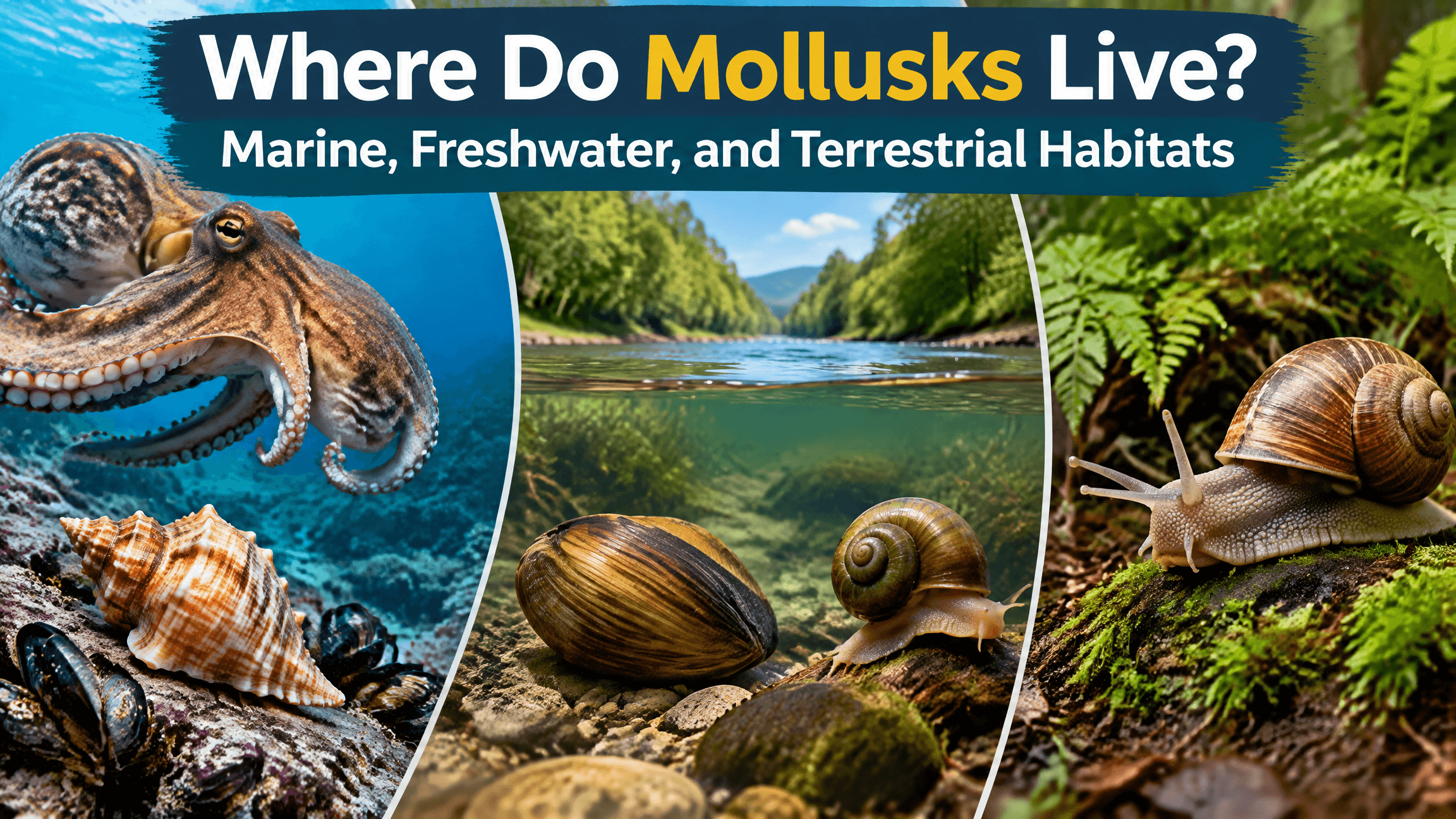
Mollusks live in an unusually wide range of habitats. Most mollusk lineages are marine, but the phylum also includes freshwater snails and mussels, land snails and slugs, open-ocean cephalopods, intertidal chitons, deep-sea monoplacophorans, and many species that spend their lives buried in sediment. The question “where do mollusks live?” therefore has more than one answer.
The clearest pattern is that the sea contains the widest spread of mollusk classes. Freshwater habitats are especially important for gastropods and bivalves, while fully terrestrial mollusks are overwhelmingly gastropods. Habitat has also helped shape how mollusks breathe, move, avoid drying, find food, reproduce, and protect themselves.
Quick Answer
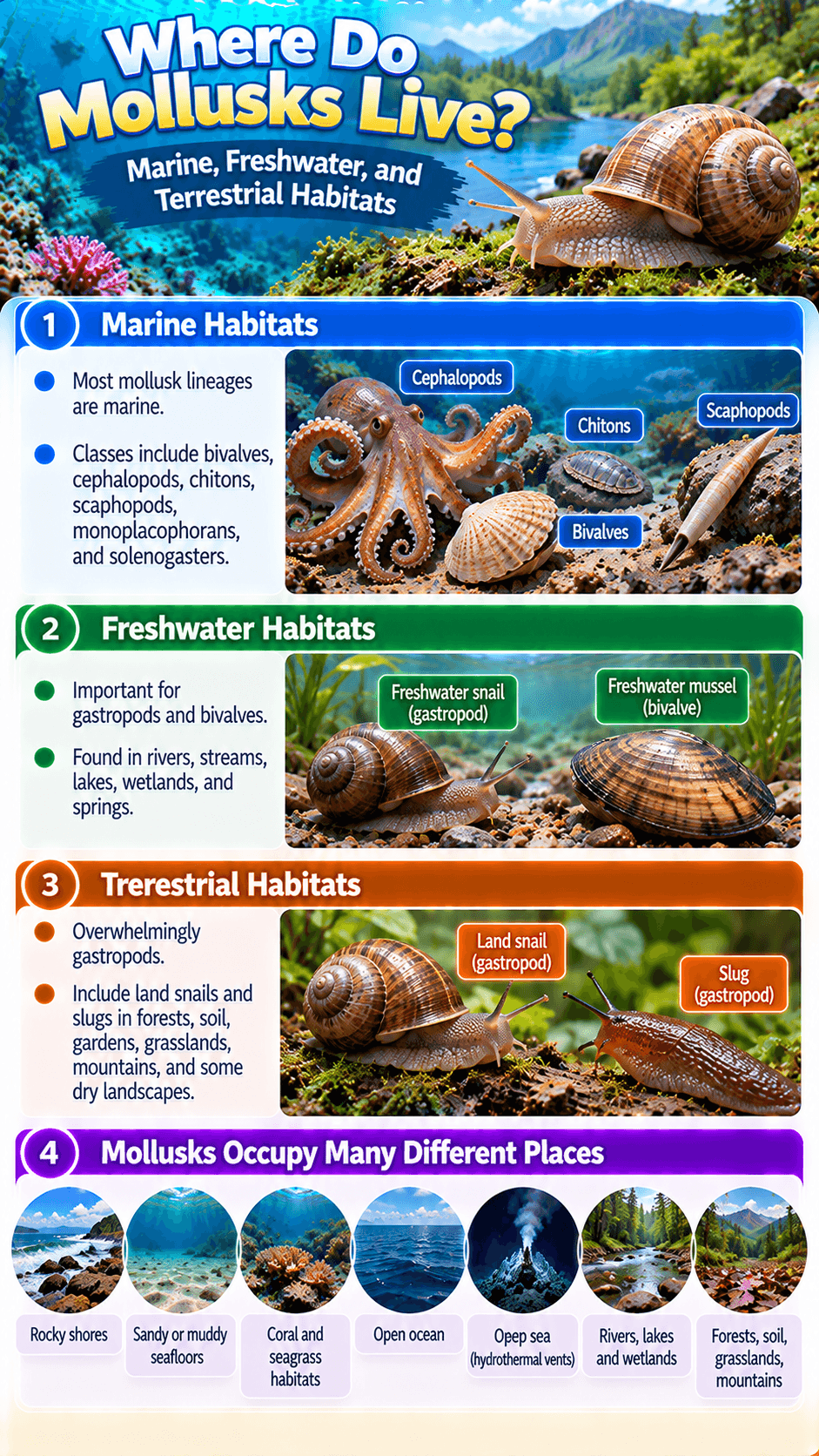
Mollusks occur in marine, freshwater, and terrestrial environments. Gastropods have radiated into all three. Bivalves occur in marine and freshwater systems but do not have a comparable fully terrestrial radiation. Living cephalopods, chitons, scaphopods, monoplacophorans, solenogasters, and caudofoveates are marine.
Within those broad categories, mollusks can live on rocky shores, sandy or muddy seafloors, coral and seagrass habitats, the open ocean, the deep sea, hydrothermal-vent regions, rivers, streams, lakes, wetlands, springs, forest leaf litter, soil, gardens, grasslands, mountains, and some dry landscapes. The exact habitat depends on the lineage and species.
Mollusks Live in More Than the Ocean
Mollusca is often introduced through familiar marine animals such as clams, oysters, squid, octopuses, and seashell-producing snails. That marine emphasis is understandable because many of the major mollusk groups are ocean animals. It is incomplete, however, because gastropods and bivalves have also established major freshwater lineages, and gastropods made repeated evolutionary transitions onto land.
Marine, Freshwater, and Terrestrial Lineages
A useful way to see this distribution is to compare class with environment rather than assuming every class occurs everywhere. Current MolluscaBase statistics separate accepted mollusk records into marine, freshwater, and terrestrial categories and show the strong environmental contrast among major classes. Gastropods account for most terrestrial mollusk diversity, while bivalves contribute substantial marine and freshwater diversity but no comparable land fauna.
This pattern also explains why “mollusk habitat” cannot be reduced to one biome. A limpet on wave-washed rock, a freshwater mussel buried in river gravel, a slug under damp forest litter, and a squid swimming offshore are all mollusks, but the physical problems they face are very different.
Why Distribution Is Uneven Across Classes
Moving from seawater into freshwater or from water onto land requires more than simply tolerating a new location. Salinity, water balance, oxygen availability, temperature variation, reproductive conditions, and the mechanics of movement all change. Different mollusk lineages inherited different body plans and solved these challenges in different ways.
Gastropods were especially successful at crossing environmental boundaries. Some lineages remained marine, others colonized freshwater, and still others became terrestrial. Bivalves diversified extensively in oceans and inland waters but remained aquatic. Cephalopods retained a marine distribution even while spreading from shallow coastal habitats into open-ocean and deep-water environments.
Which Mollusk Classes Live Where?
Gastropods Across Marine, Freshwater, and Land Habitats
Gastropoda has the broadest environmental reach among the major mollusk classes. Marine gastropods include limpets, abalones, whelks, cowries, conchs, sea hares, nudibranchs, and many other forms. Freshwater gastropods occupy rivers, streams, ponds, lakes, springs, wetlands, and groundwater-associated systems. Terrestrial gastropods include land snails and slugs living wherever their water-balance requirements and food needs can be met.
Even within one environment, gastropods may occupy very different microhabitats. One marine snail may graze on rock exposed at low tide, another may crawl across deep soft sediment, and a pelagic gastropod may spend much of its life in open water. On land, some species remain close to humid litter and soil while others can persist in seasonally dry areas by reducing activity and water loss.
Bivalves in Marine and Freshwater Systems
Bivalves such as clams, mussels, oysters, scallops, and shipworms are primarily aquatic. Marine species live from sheltered estuaries and coastal beds to offshore and deep-sea habitats. Freshwater bivalves occur in rivers, streams, lakes, and other inland waters, often partly buried in sediment.
Freshwater mussels are not simply marine mussels living farther inland. Their ecology can depend strongly on current speed, substrate stability, host availability during larval development, and water quality. Habitat suitability may therefore change over short distances within the same river.
Cephalopods, Chitons, Scaphopods, Monoplacophorans, Solenogasters, and Caudofoveates
Several other living mollusk classes are marine. Cephalopods occupy coastal seafloors, reefs, continental shelves, open water, and deep environments. Chitons are benthic animals often associated with hard surfaces, including rocky shores. Scaphopods are sediment-dwelling tusk shells. Monoplacophorans are marine bottom dwellers, many known from deep water. Solenogasters and caudofoveates are small, worm-shaped marine mollusks that live on or within the seafloor.
An Oxford zoological overview of five smaller mollusk classes describes Caudofoveata, Monoplacophora, Polyplacophora, Scaphopoda, and Solenogastres as exclusively marine, benthic or infaunal groups. That distinction matters because a broad statement such as “mollusks live on land and in water” is true for the phylum but not for every class.
Coastal and Shallow-Marine Habitats
Rocky Shores and Intertidal Zones
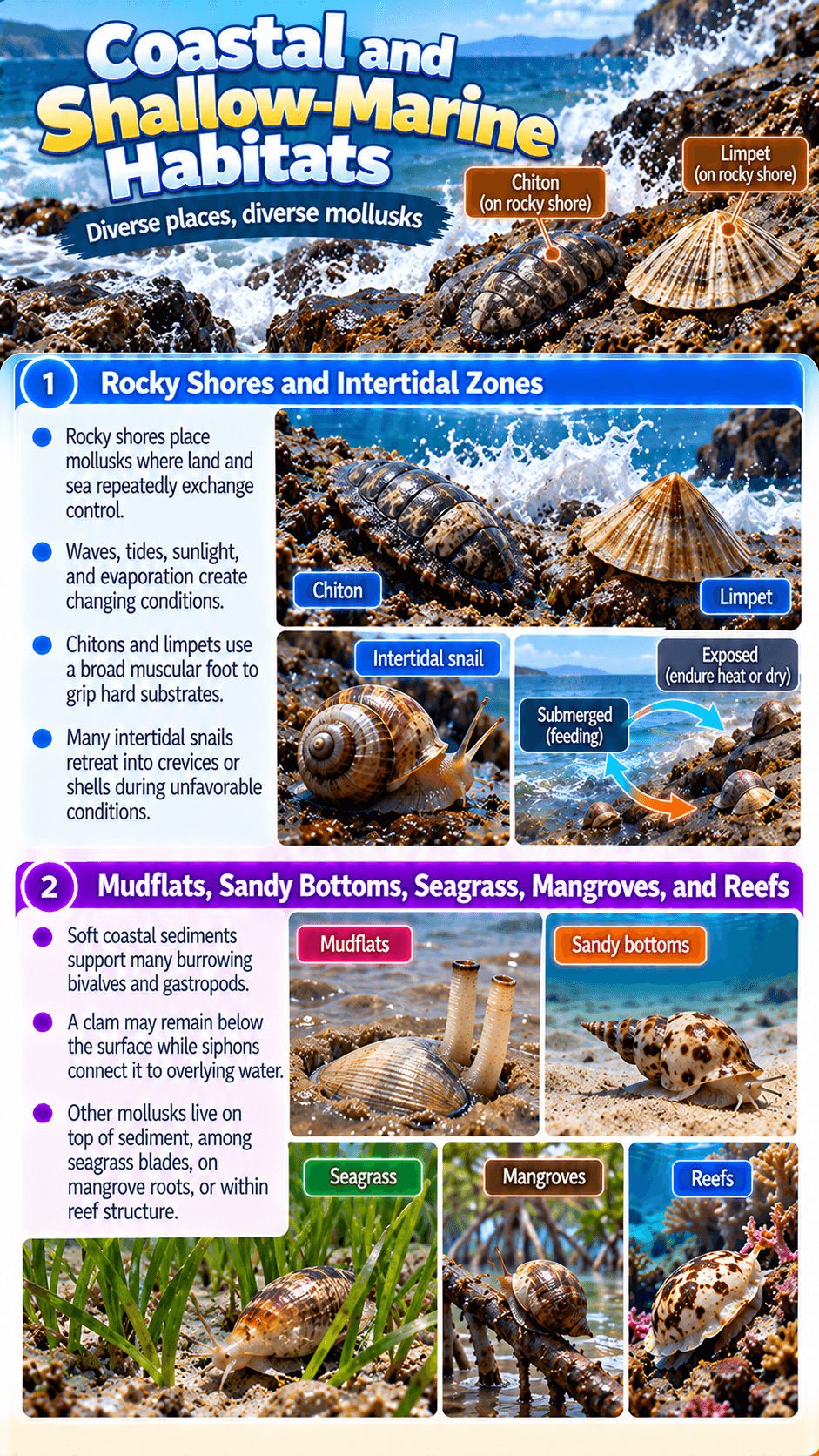
Rocky shores place mollusks where land and sea repeatedly exchange control. Waves create strong mechanical forces, tides change immersion time, sunlight can heat exposed surfaces, and evaporation can remove water. Chitons and limpets are well known examples of animals that use a broad muscular foot to grip hard substrates. Many intertidal snails also retreat into crevices or shells during unfavorable conditions.
These habitats reward attachment, compact body shapes, protective shells, and behavior timed to tides or moisture. Yet even closely related species can occupy different heights on the shore because their tolerance of drying, heat, wave action, predators, and feeding opportunity differs.
The intertidal zone also changes over hours rather than seasons alone. A mollusk may feed while submerged, seal itself against water loss as the tide falls, then endure heating or freshwater from rain before seawater returns. That repeated cycle favors flexible behavior. It also explains why a species found on an exposed rock platform may be poorly suited to a nearby sheltered mudflat even though both locations are technically coastal.
Mudflats, Sandy Bottoms, Seagrass, Mangroves, and Reefs
Soft coastal sediments support many burrowing bivalves and gastropods. A clam may remain below the surface while siphons connect it to overlying water. Other mollusks live on top of sediment, among seagrass blades, on mangrove roots, beneath stones, or within reef structure.
Shallow marine habitats can be physically complex. Seagrass beds provide surfaces, shelter, and detrital food pathways. Reefs add crevices and hard surfaces. Mudflats change with tides and sediment movement. Mangrove margins combine roots, mud, changing salinity, and periods of exposure. Mollusks living there are therefore selected by local combinations of substrate, salinity, oxygen, food, water movement, and shelter.
Open-Ocean and Pelagic Habitats
Cephalopods and Pelagic Gastropods
Not all mollusks live on the bottom. Squid and some octopods occupy the water column, and various gastropod lineages are also pelagic. Living cephalopods are entirely marine, and the Smithsonian Ocean overview of cephalopods describes a group ranging from benthic coastal forms to open-water species and deep-sea animals.
Life in open water changes the value of body shape and movement. There may be no rock to cling to and no sediment to burrow into. Swimming, buoyancy, camouflage, sensory ability, and access to moving prey become especially important. Pelagic mollusks also encounter strong vertical differences in light, temperature, oxygen, and food availability.
Some pelagic species migrate vertically through the water column over a daily cycle, while others remain associated with particular depth ranges. The point is not that every open-ocean mollusk follows one pattern, but that the water column itself is structured habitat. Light near the surface, darkness at depth, oxygen conditions, prey layers, currents, and temperature can divide what looks like open water into very different ecological zones.
Larval Dispersal in the Water Column
Many marine mollusks that live on the bottom as adults have planktonic or partly planktonic young. A larva in the water column can be transported away from the adult habitat before settling, although dispersal distance varies widely among species and depends on development, behavior, currents, and larval duration.
This creates an important distinction between adult habitat and life-cycle habitat. An oyster reef, rocky shore, or seafloor sediment may be the adult home, while early development occurs in open water. Other mollusks develop more directly and do not rely on a long planktonic phase.
Deep-Sea Mollusks
Deep Benthic Habitats
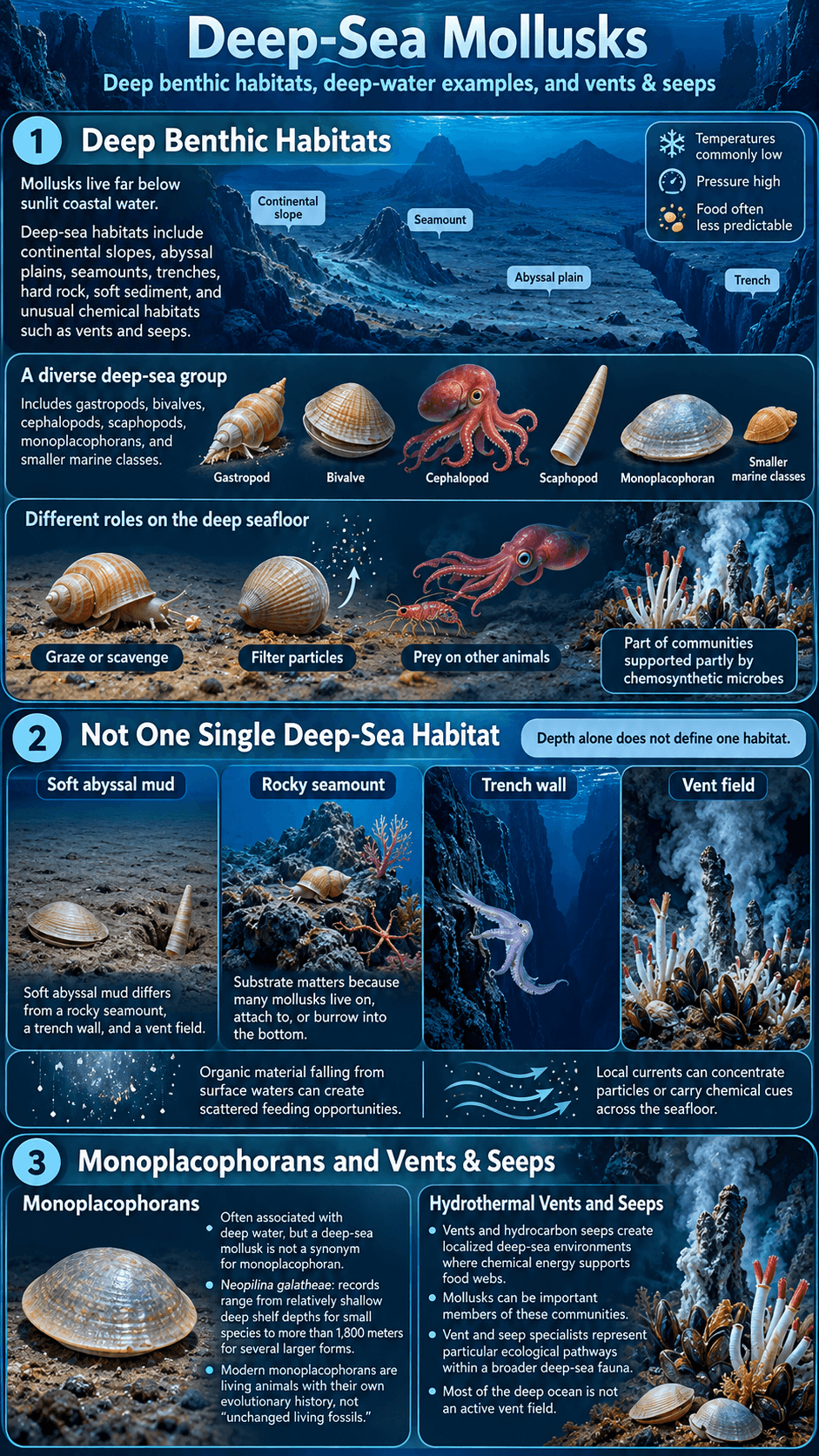
Mollusks live far below sunlit coastal water. Deep-sea habitats include continental slopes, abyssal plains, seamounts, trenches, hard rock, soft sediment, and chemically unusual places such as vents and seeps. Food is often less predictable than in productive shallow water, temperatures are commonly low, and pressure is high.
Deep-sea mollusks include gastropods, bivalves, cephalopods, scaphopods, monoplacophorans, and members of smaller marine classes. Their ecological roles vary just as strongly as those of shallow-water species. Some graze or scavenge, some filter particles, some prey on other animals, and some participate in communities supported partly by chemosynthetic microbes.
Depth alone does not define a single habitat. Soft abyssal mud differs from a rocky seamount, and both differ from a trench wall or a vent field. Substrate matters because many mollusks live on, attach to, or burrow into the bottom. Food delivery also matters. Organic material falling from surface waters can create scattered feeding opportunities, while local currents concentrate particles or carry chemical cues across the seafloor.
Monoplacophorans and Other Deep-Water Examples
Monoplacophorans are often associated with deep water, but “deep-sea mollusk” should not be treated as a synonym for “monoplacophoran.” A 2024 Journal of Molluscan Studies report on Neopilina galatheae documented the living species during an ROV dive and reviewed records ranging from relatively shallow deep shelf depths for small species to more than 1,800 meters for several larger forms.
The same study is a reminder to avoid the old “unchanged living fossil” story. Modern monoplacophorans are living animals with their own evolutionary history. Their present-day habitat tells us about where surviving lineages occur, not that they are frozen copies of ancient mollusks.
Hydrothermal Vents and Seeps
Hydrothermal vents and hydrocarbon seeps create localized deep-sea environments where chemical energy supports food webs. Mollusks can be important members of these communities. For example, an MBARI expedition to Gulf of California vents and seeps specifically targeted bivalve and gastropod mollusks associated with chemosynthetic habitats.
That does not mean deep-sea mollusks as a whole depend on vents. Vent and seep specialists represent particular ecological pathways within a much broader deep-sea fauna. Most of the deep ocean is not an active vent field.
Freshwater Habitats
Rivers and Streams
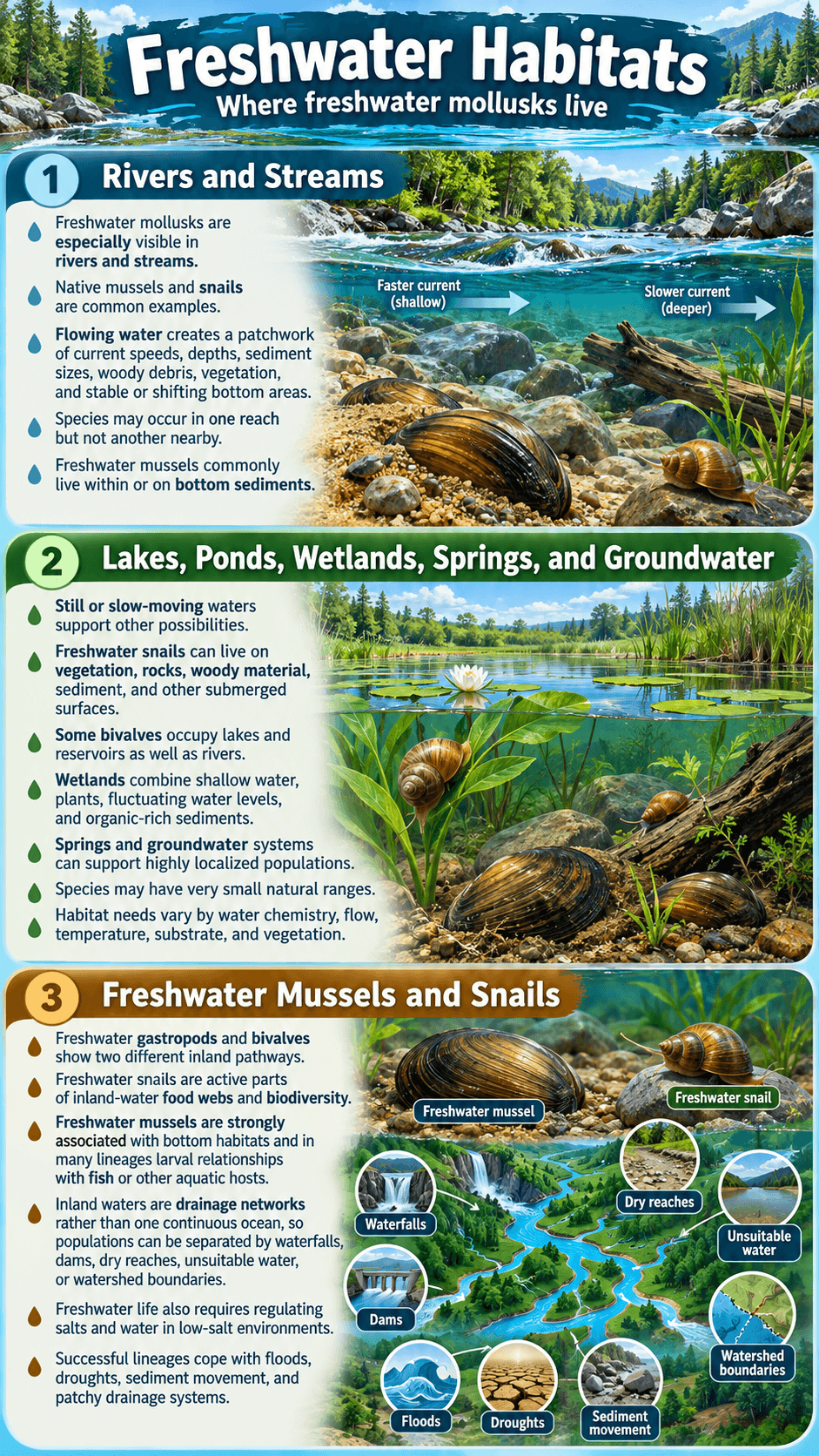
Freshwater mollusks are especially visible in rivers and streams through native mussels and snails. Flowing water creates a patchwork of current speeds, depths, sediment sizes, woody debris, vegetation, and stable or shifting bottom areas. A species that performs well in one reach may be absent from another reach only a short distance away.
Freshwater mussels commonly live within or on bottom sediments. Research by the U.S. Geological Survey on native mussel habitat emphasizes the importance of riverbed stability and physical stream dynamics for understanding where mussel beds persist.
Lakes, Ponds, Wetlands, Springs, and Groundwater
Still or slow-moving waters add other possibilities. Freshwater snails can live on vegetation, rocks, woody material, sediment, and other submerged surfaces. Some bivalves occupy lakes and reservoirs as well as rivers. Wetlands combine shallow water, plants, fluctuating water levels, and organic-rich sediments, creating habitat for species adapted to those conditions.
Springs and groundwater systems can support highly localized mollusk populations. Because these environments may be isolated, a species can have a very small natural range. That makes broad statements about “freshwater snail habitat” risky because different lineages may depend on very different water chemistry, flow, temperature, substrate, or vegetation.
Freshwater Mussels and Snails
Freshwater gastropods and bivalves illustrate two different ways mollusks have diversified inland. Freshwater snails are active parts of inland-water food webs and biodiversity, while freshwater mussels are strongly associated with bottom habitats and, in many lineages, larval relationships with fish or other aquatic hosts.
Because inland waters are connected as drainage networks rather than one continuous ocean, populations can be separated by waterfalls, dams, dry reaches, unsuitable water, or watershed boundaries. That geographic structure is one reason habitat disturbance can have very different effects from place to place.
Freshwater also presents a chemical challenge that marine ancestors did not face in the same way. Mollusks must regulate salts and water across body surfaces while remaining functional in water that contains far fewer dissolved salts than seawater. Successful freshwater lineages solve that physiological problem while also coping with floods, droughts, sediment movement, and the patchy nature of inland drainage systems.
Terrestrial Mollusks
Forests, Leaf Litter, Soil, Gardens, Grasslands, Mountains, and Deserts
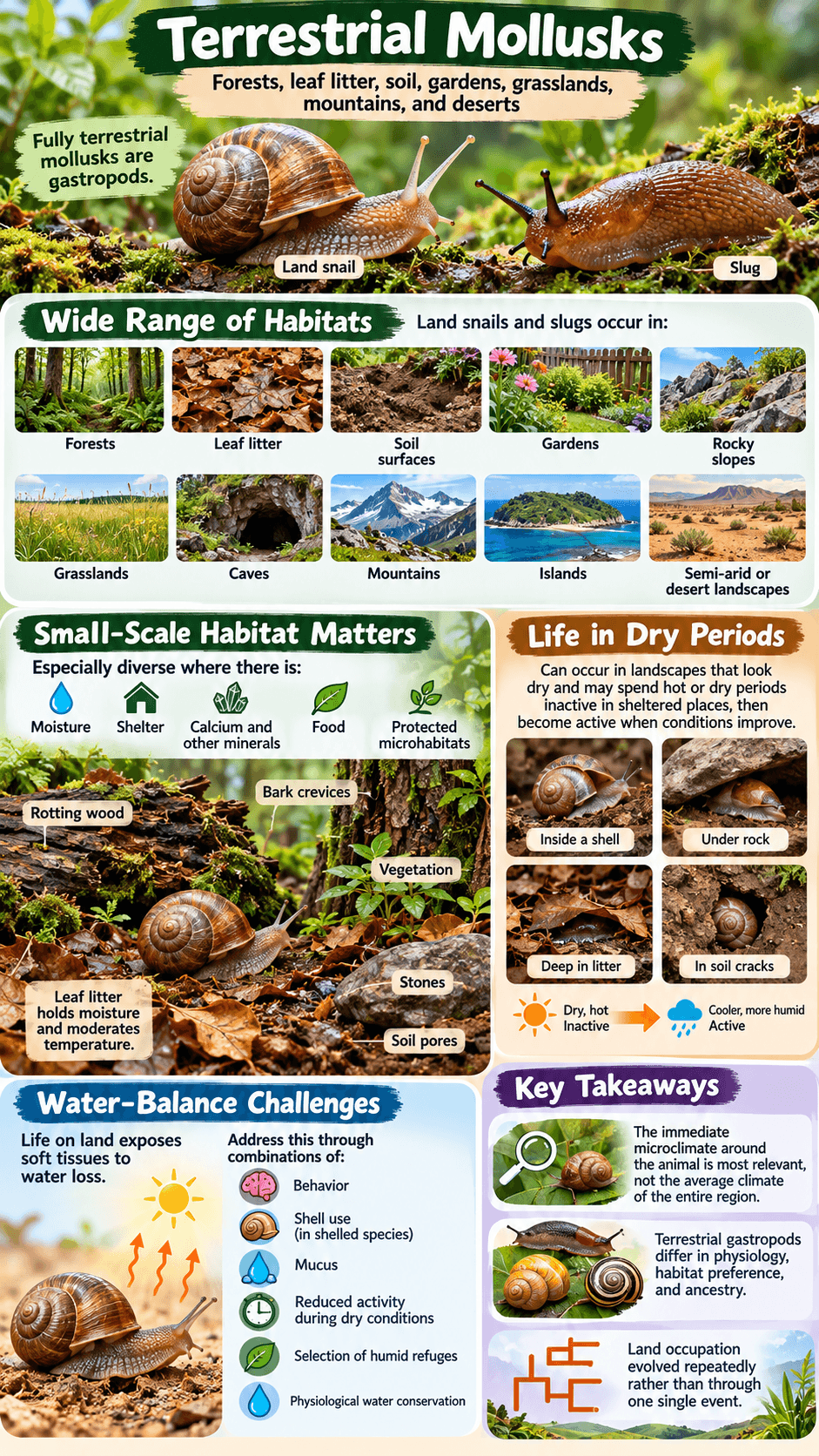
Fully terrestrial mollusks are gastropods. Land snails and slugs occur in forests, leaf litter, soil surfaces, gardens, rocky slopes, grasslands, caves, mountains, islands, and some semi-arid or desert landscapes. They are especially diverse in places that provide usable moisture, shelter, calcium or other needed minerals, food, and protected microhabitats.
A forest floor is a good example of how small-scale habitat matters. Leaf litter can hold moisture and moderate temperature. Rotting wood, bark crevices, stones, vegetation, and soil pores create shaded refuges. A land snail may experience those few centimeters of protected space very differently from the drier air above the litter.
The same principle helps explain how terrestrial gastropods can occur in landscapes that look surprisingly dry. The animal may spend hot or dry periods inactive inside a shell, under rock, deep in litter, within soil cracks, or attached in a sheltered position, then become active when temperature and humidity improve. The relevant habitat is therefore often the microclimate immediately around the animal, not the average climate of the entire region.
Moisture, Shelter, and Water-Balance Challenges
Life on land exposes soft tissues to water loss. Land gastropods address that challenge through combinations of behavior, shell use in shelled species, mucus, reduced activity during dry conditions, selection of humid refuges, and physiological water conservation. These traits do not make every land snail equally drought tolerant.
A review of terrestrialization in gastropods identifies many separate evolutionary transitions onto land and emphasizes that land occupation evolved repeatedly rather than through one single event. This helps explain why terrestrial gastropods differ so much in physiology, habitat preference, and ancestry.
How Mollusks Adapt to Different Habitats
Shell and Body Responses to Drying
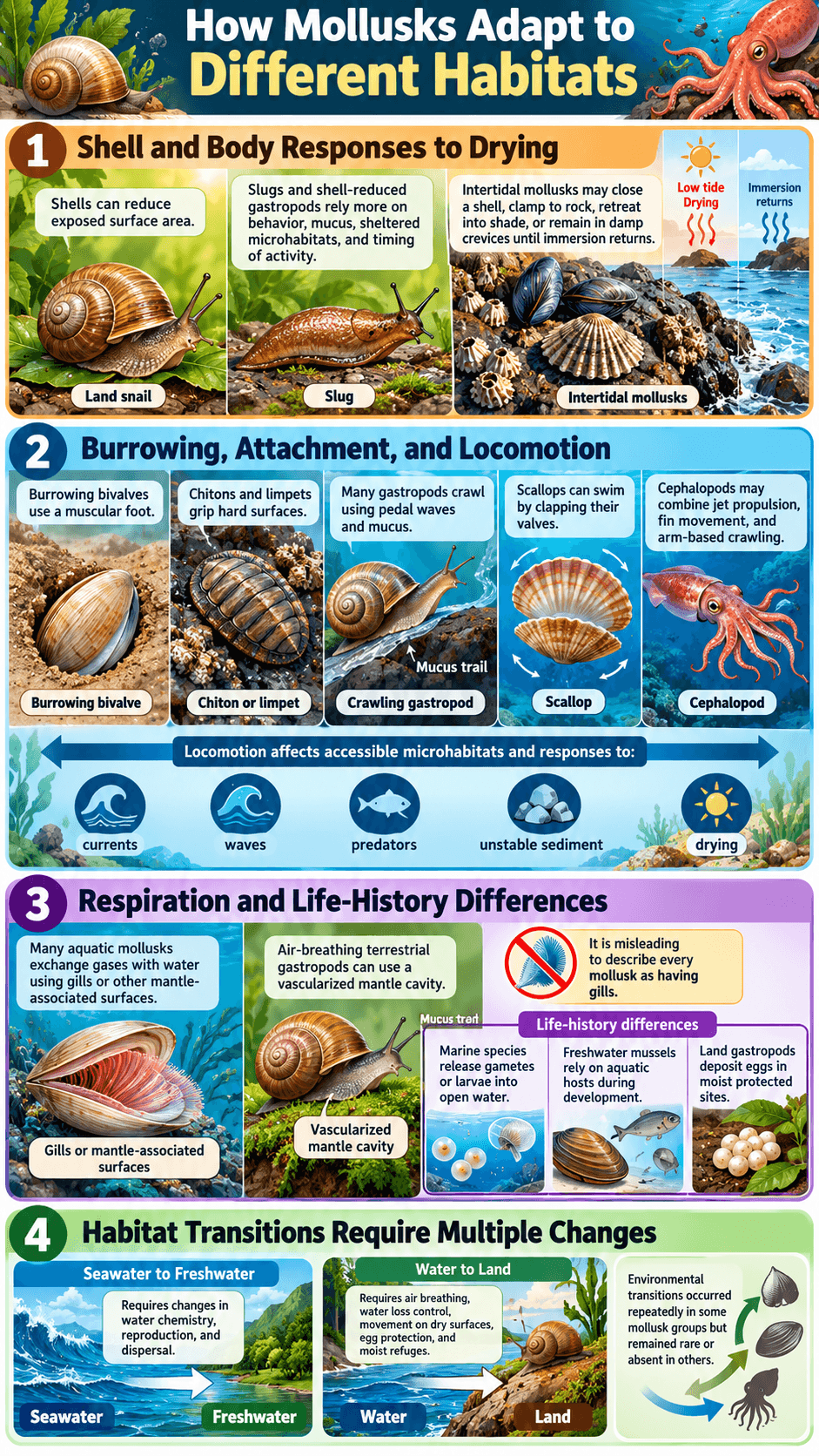
A shell can reduce exposed surface area when a snail withdraws, but shell presence is only part of terrestrial water balance. Slugs and shell-reduced gastropods rely more heavily on behavior, mucus, sheltered microhabitats, and timing of activity. Even shelled land snails can be vulnerable when temperature and humidity move beyond the range they tolerate.
Intertidal mollusks face a different version of the same problem. They may be aquatic animals that become temporarily exposed to air at low tide. Closing a shell, clamping to rock, retreating into shade, or remaining in damp crevices can reduce water loss until immersion returns.
Burrowing, Attachment, and Locomotion
Habitat strongly influences how movement works. Burrowing bivalves use a muscular foot to work through sediment. Chitons and limpets grip hard surfaces. Many gastropods crawl using pedal waves and mucus. Scallops can swim by clapping their valves, while cephalopods may combine jet propulsion, fin movement, and arm-based crawling depending on the species.
These are not just different ways to travel. Locomotion determines which microhabitats are accessible and how an animal responds to current, waves, predators, unstable sediment, or drying. A body suited to clinging tightly to rock faces a different set of opportunities from one specialized for burrowing through mud.
Respiration and Life-History Differences
Respiration also reflects habitat. Many aquatic mollusks exchange gases with water using gills or other mantle-associated surfaces. Air-breathing terrestrial gastropods can use a vascularized mantle cavity, while other gastropods use different respiratory arrangements. It is misleading to describe every mollusk as having gills.
Life history can be just as habitat-dependent. Some marine species release gametes or larvae into open water. Some freshwater mussels rely on aquatic hosts during development. Many land gastropods deposit eggs in moist protected sites and develop without an extended oceanic larval stage. There is no single mollusk reproductive pathway that works across all environments.
Habitat transitions can therefore require several biological systems to change together. An animal that moves from seawater into freshwater must deal with water chemistry as well as reproduction and dispersal. A lineage moving onto land must cope with air breathing, water loss, movement on dry surfaces, egg protection, and finding moist refuges. That combination helps explain why environmental transitions occurred repeatedly in some mollusk groups but remained rare or absent in others.
Common Habitat Myths
All Mollusks Live in the Sea
This is false. Marine diversity is enormous, but freshwater snails and bivalves are well established, and terrestrial gastropods include thousands of land snails and slugs. The correct statement is that Mollusca as a phylum spans marine, freshwater, and terrestrial environments, while many individual classes remain marine.
Every Mollusk Class Occurs in Freshwater or on Land
This is also false. Gastropods span the broadest environmental range. Bivalves have important freshwater radiations but are still aquatic. Living cephalopods and the smaller classes discussed earlier are marine. A class-level view therefore gives a much more accurate picture than treating environmental range as a property shared equally by all mollusks.
Land Snails Have Vertebrate-Style Lungs
Some terrestrial gastropods breathe air through a vascularized mantle cavity, often casually called a “lung.” That term is useful as a functional analogy, but the structure is not a miniature mammalian or vertebrate lung. It evolved from molluscan mantle anatomy and should be explained in that context.
How Habitat Shapes the Rest of Mollusk Biology
Anatomy and Respiration
Habitat helps make sense of mollusk anatomy. A mantle cavity that handles water flow in an aquatic species may be modified for air breathing in a terrestrial gastropod lineage. Siphons are useful in many buried bivalves because they maintain contact with overlying water. Shell form can reflect the need to resist waves, move through sediment, reduce drying, or remain light enough for an active lifestyle.
Movement and Defense
The environment also changes how movement and defense interact. Burrowing can be both locomotion and protection. Strong attachment can resist waves and predators. Camouflage may depend on the visual background. A shell can protect soft tissues while also influencing water balance or buoyancy. The same anatomical feature can therefore matter for several habitat-related problems at once.
Habitat-Sensitive Species
Some mollusks tolerate broad environmental conditions, while others depend on narrow ranges of flow, moisture, salinity, substrate, oxygen, host availability, or temperature. That difference becomes especially important when habitats are fragmented or altered. Freshwater species confined to connected river systems and terrestrial species restricted to humid microhabitats may have limited ability to relocate when conditions change.
For readers observing mollusks in nature, the most useful principle is to treat habitat as part of the animal rather than as background scenery. The place where a mollusk occurs often explains much of its movement, respiration, shell form, behavior, and life cycle.
FAQ
Are there freshwater mollusks?
Yes. Freshwater mollusks include many snails and bivalves, especially mussels and clams. They live in rivers, streams, lakes, ponds, wetlands, springs, and other inland-water habitats. Their requirements vary widely, so the presence of water alone does not make a site suitable for every species.
Which mollusks live on land?
Fully terrestrial mollusks are gastropods, mainly land snails and slugs. They occur in humid forests, leaf litter, soil, gardens, grasslands, mountains, islands, caves, and some dry regions. Terrestrial life requires ways to limit water loss and find protected microhabitats.
Do any mollusks live in the deep sea?
Yes. Deep-sea mollusks include gastropods, bivalves, cephalopods, scaphopods, monoplacophorans, and other marine groups. Some live on soft sediments or hard rock, some occur in the water column, and selected species are associated with hydrothermal vents or cold seeps. Deep-sea mollusks are therefore ecologically diverse rather than one specialized type.
Final Thoughts
Where mollusks live depends strongly on which mollusk group you are asking about. The ocean contains representatives of every living class, including lineages found nowhere else. Freshwater supports major gastropod and bivalve radiations, while land was colonized repeatedly by gastropods. Across those environments, mollusks have adapted through changes in respiration, water balance, movement, shell use, behavior, development, and interactions with the substrate.
The result is a phylum that stretches from rocky tide pools and muddy rivers to forest litter, open water, and the deep seafloor. Understanding those habitats is one of the best ways to understand why mollusks look and live so differently while still sharing the same broad evolutionary heritage.

Ethan Walker is the founder and research editor of Animal Fact Central. He creates and reviews educational animal facts content using trusted wildlife, pet care, and science-based sources. His work focuses on making animal behavior, adaptations, habitats, and species facts clear, accurate, and engaging for everyday readers.
Read More Details About Ethan Walker: https://animalfactcentral.com/ethan-walker/