
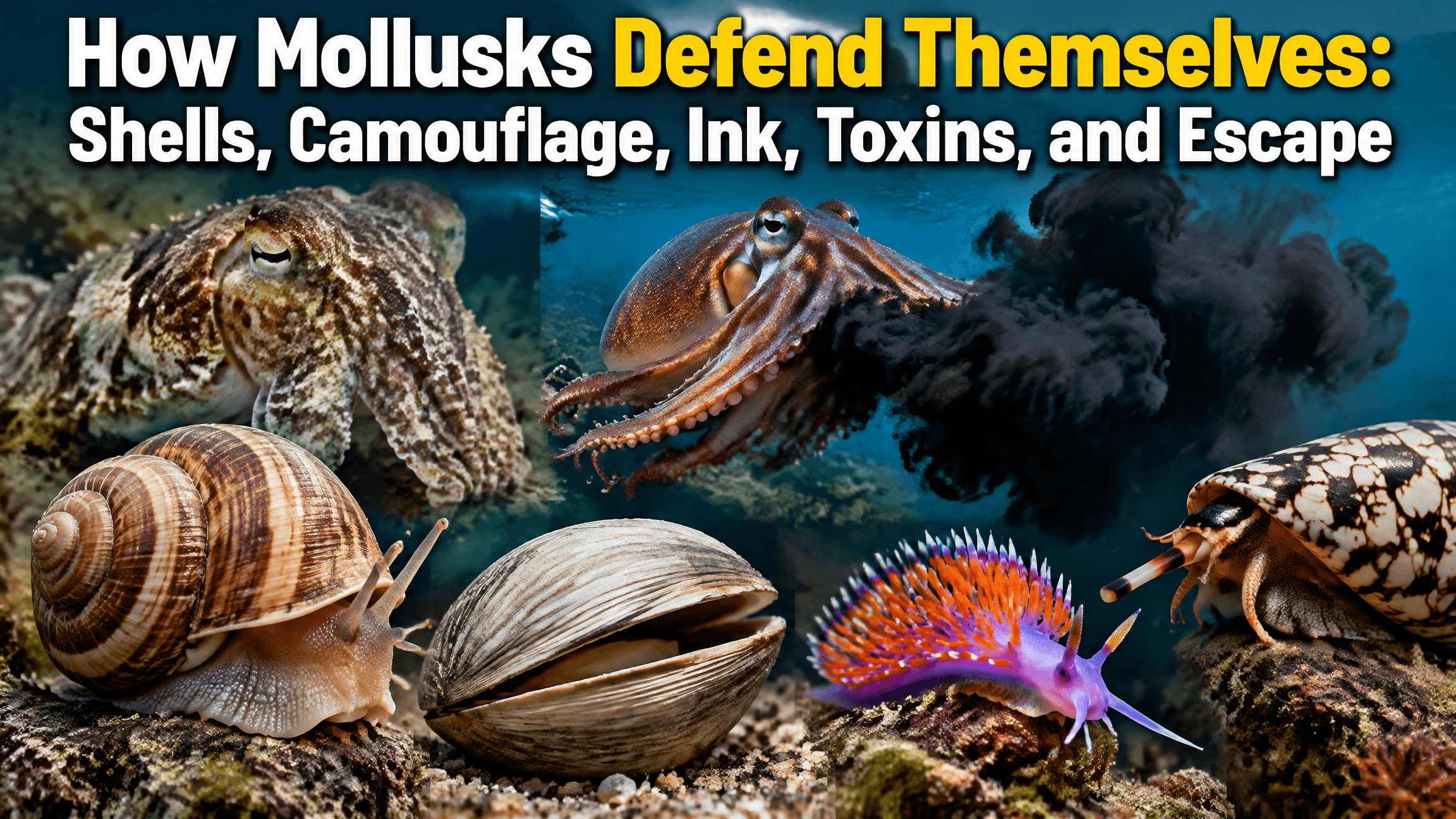
Mollusks defend themselves in many different ways because the group includes animals with radically different bodies and lifestyles. A clam may close its valves and stay buried, a snail may withdraw into a shell, a cuttlefish may change color and texture, a squid may release ink while fleeing, and some sea slugs rely heavily on chemical deterrents. There is no single defense that defines Mollusca.
The most useful way to understand mollusk defense is as a toolkit. Structural protection, hiding, rapid escape, sensory detection, warning displays, mucus, venom, toxic compounds, and defenses acquired from prey can work alone or in combination. Which tools matter most depends on the animal’s anatomy, habitat, predators, mobility, and evolutionary history.
Quick Answer
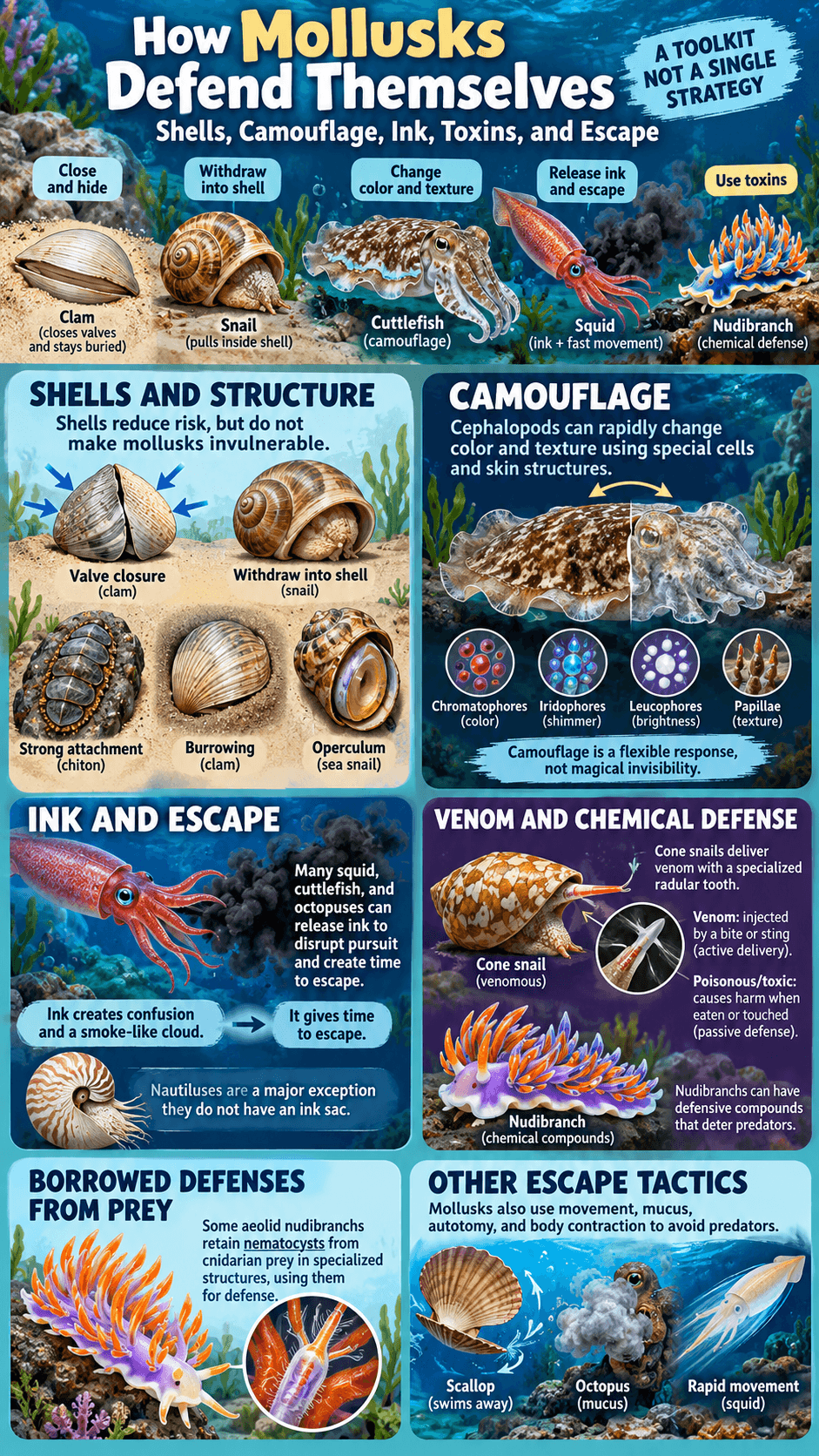
Mollusks can defend themselves with shells, valve closure, opercula, burrowing, strong attachment, camouflage, rapid color or texture change, ink, jetting or swimming, mucus, chemical deterrents, venom, and in some cases defensive structures acquired from prey. A shell is only one possible strategy. Many mollusks have reduced shells or no external shell at all, while some shelled species still depend on behavior and chemistry when a predator gets past the first layer of protection.
The defenses also come with limits. A shell can be crushed or drilled, camouflage works only when it fits the visual situation, ink usually helps create an opportunity to escape rather than physically stopping a predator, and chemical defenses vary greatly among species. Defense is therefore better understood as risk reduction than as invulnerability.
Mollusk Defense Is a Toolkit, Not One Strategy
Mollusks occupy marine, freshwater, and terrestrial environments, so predators encounter very different defensive systems. A limpet clinging to rock faces different threats from a burrowing clam, a pelagic squid, or a brightly colored nudibranch. The animal’s body plan sets the possibilities, but behavior and habitat determine how those possibilities are used.
Structural Defenses
Hard parts can make a mollusk more difficult to bite, crush, pry open, or swallow. External shells are the most obvious example, but shell thickness, shape, sculpture, spines, and the ability to retract soft tissues can matter as well. In bivalves, two valves surround much of the soft body. Chitons carry a series of dorsal shell plates while keeping a broad foot tightly attached to the substrate.
Structural defenses are not free. Building and maintaining mineralized tissue requires biological resources, and shell designs reflect more than predator pressure alone. A recent Journal of Molluscan Studies analysis of bivalve shells highlights how shell thickness, sculpture, body space, and ecological function can be linked in complex ways rather than following one simple rule.
Behavioral Escape and Hiding
Many defenses depend on what the animal does when danger approaches. Snails may retract, limpets may clamp down, clams may close or dig deeper, scallops may swim by rapidly moving their valves, and cephalopods may accelerate away. Hiding in crevices, under sediment, inside a shell, or beneath rocks can prevent a predator from making effective contact in the first place.
These behaviors often involve trade-offs. Closing a shell may reduce feeding or gas exchange for a time. Leaving a feeding site may mean giving up access to food. Burrowing can lower exposure but also changes what the animal can sense and how quickly it can respond to new conditions.
Chemical and Visual Defenses
Soft-bodied mollusks demonstrate especially clearly that a hard shell is not required for effective defense. Some species produce or store compounds that make them distasteful or harmful to predators. Others use bold warning patterns, background matching, disruptive coloration, or rapid skin changes. In many nudibranchs, bright coloration is associated with chemical or physical defenses, although appearance alone should not be used to assume a particular species is toxic.
Shells as Defense
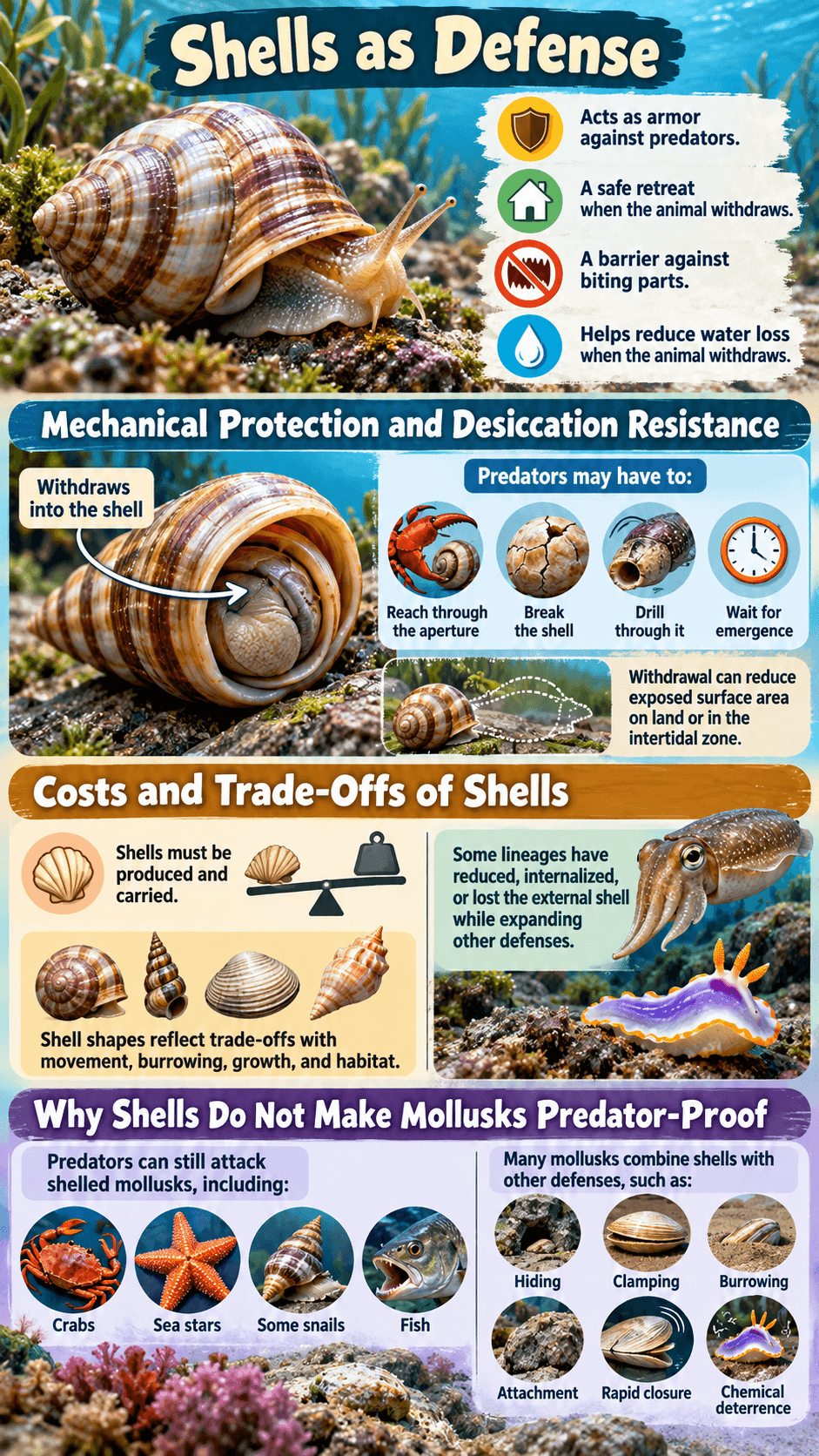
A shell can act as armor, a retreat, a barrier against biting parts, and in terrestrial or intertidal species a way to reduce water loss when the animal withdraws. The protective value depends on shape, thickness, mineral structure, opening size, the animal’s ability to retract, and the type of predator involved.
Mechanical Protection and Desiccation Resistance
For many snails, withdrawing soft tissues into the shell changes the problem a predator faces. Instead of grasping exposed flesh, the predator must reach through the aperture, break the shell, drill through it, or wait for the animal to emerge. Some shell forms allow deeper withdrawal than others, and some have narrow apertures or additional barriers that make access harder.
On land and in the intertidal zone, withdrawal can also reduce exposed surface area. That makes the shell useful in situations where the animal faces both predators and drying conditions. Defense against predation and protection from the physical environment can therefore overlap.
Costs and Trade-Offs of Shells
More shell is not automatically better. Mineralized structures must be produced and carried, and the best shape for resisting one kind of attack may not be best for movement, burrowing, growth, or living in a particular habitat. Some lineages have reduced, internalized, or lost the external shell while expanding other defenses.
This is why shell loss should not be described as a failure to make a shell. In groups such as nudibranchs and octopuses, shell reduction or loss is part of an evolved body plan accompanied by other ways of avoiding or surviving attack.
Why Shells Do Not Make Mollusks Predator-Proof
Predators can specialize on shelled prey. Crabs may crush or peel shells, sea stars can exploit the opening between bivalve valves, some snails drill into other shells, and fish may swallow small shelled animals whole. A shell changes the predator-prey contest, but it does not end it.
Many mollusks therefore combine a shell with hiding, clamping, burrowing, attachment, rapid closure, or chemical deterrence. The combination can matter more than any single feature.
Bivalve Valve Closure and Attachment
Clams, mussels, oysters, scallops, and other bivalves protect much of their soft body between two shell valves. Closing those valves can reduce a predator’s access, while attachment or burial can make the animal harder to dislodge.
Adductor Muscles and Ligament Mechanics
Bivalves generally use adductor muscles to pull the valves together. The hinge ligament contributes to opening when the muscles relax. The result is a mechanically simple but effective system: active muscle contraction closes the shell, while elastic structures at the hinge help reopen it.
Closure can be part of a graded response rather than an all-or-nothing reflex. Experiments with blue mussels have shown changes in gaping behavior under perceived predation risk, including rapid valve closure during strong responses. The Journal of Molluscan Studies mussel experiment also illustrates the cost of this tactic because staying more tightly closed can conflict with feeding.
Burrowing, Byssal Attachment, and Other Contexts
Burrowing bivalves gain protection by placing much of the shell below the sediment surface. Mussels often use byssal threads to attach to rock or other firm surfaces, which can make removal more difficult. Oysters may cement themselves to a substrate. Scallops follow a different pattern and can use rapid valve movements for locomotion.
These differences show why it is misleading to describe a single “bivalve defense.” Even within one class, protection can depend on closure, burial, attachment, movement, shell form, habitat, or several of these at once.
Opercula in Some Gastropods
An operculum is a lid-like structure found in some gastropods. When the animal withdraws, the operculum can close much of the shell opening. Depending on the species, it may help reduce access by predators, slow water loss, or protect against unfavorable environmental conditions.
Closing the Shell Aperture
The operculum is attached to the animal rather than being a loose object picked up from the environment. As the snail retracts, the structure can be drawn against the aperture. In species with a firm or calcified operculum, the barrier can be especially conspicuous.
Its value depends on fit, thickness, shell shape, and the kind of threat involved. An operculum does not make a snail impossible to eat, but it can add another obstacle after withdrawal.
Why Not Every Snail Has a Trap Door
Opercula are not universal among gastropods. Many familiar land snails lack them, and shell-less gastropods obviously cannot close an aperture in this way. Some gastropods rely more heavily on retraction, mucus, hiding, chemical defense, or behavior.
Calling the operculum a “trap door” can be a useful visual analogy, but it should not imply a hinged architectural door or a feature present in every snail.
Camouflage and Rapid Appearance Change
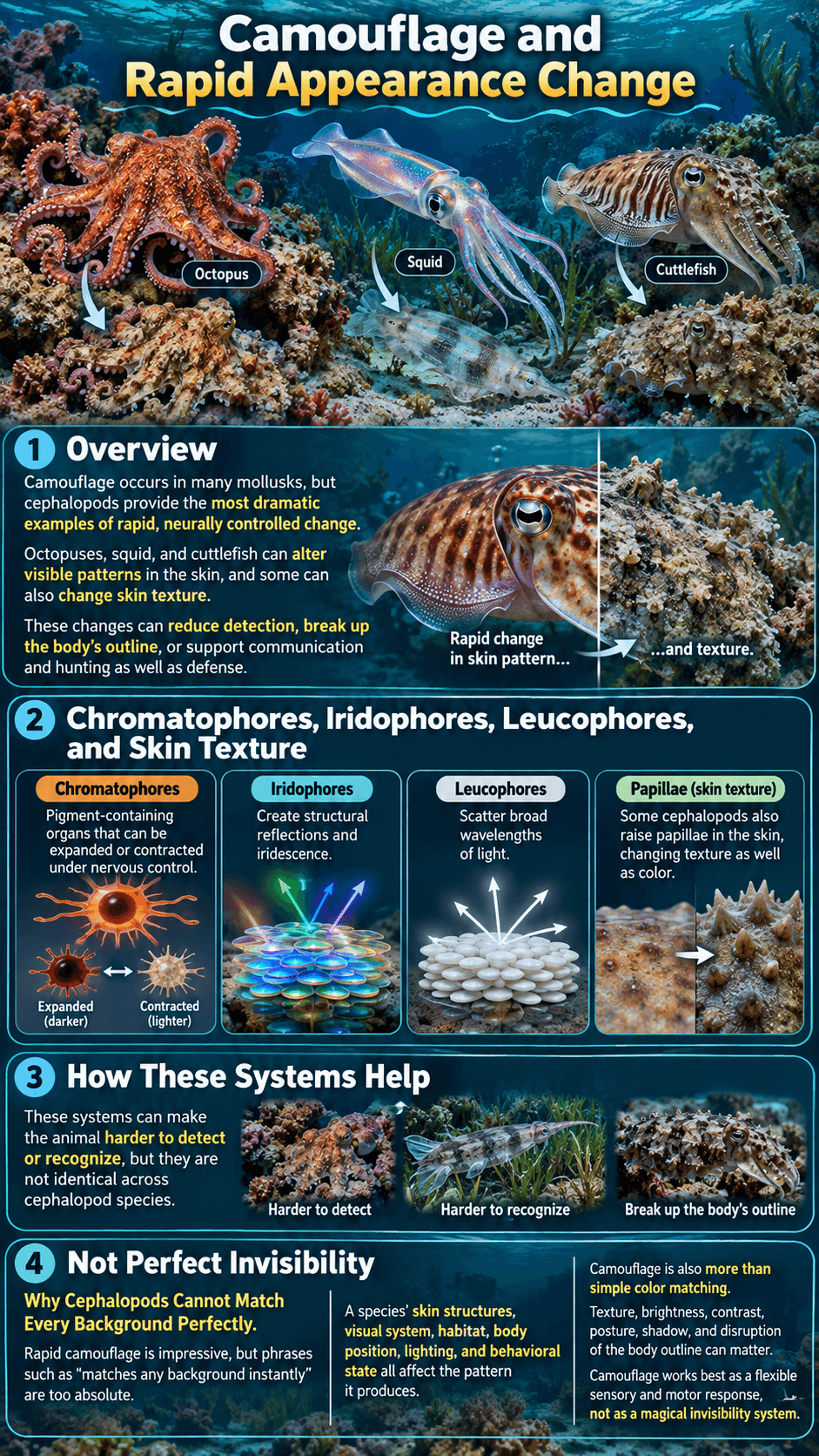
Camouflage occurs in many mollusks, but cephalopods provide the most dramatic examples of rapid, neurally controlled change. Octopuses, squid, and cuttlefish can alter visible patterns in the skin, and some can also change skin texture. These changes can reduce detection, break up the body’s outline, or support communication and hunting as well as defense.
Chromatophores, Iridophores, Leucophores, and Skin Texture
Chromatophores are pigment-containing organs that can be expanded or contracted under nervous control. Reflective cells below them can add other optical effects. Iridophores create structural reflections and iridescence, while leucophores scatter broad wavelengths of light. Some cephalopods also raise papillae in the skin, changing texture as well as color.
The Smithsonian Ocean overview of cephalopods describes how chromatophores, iridophores, leucophores, and papillae contribute to rapidly changeable appearance. These systems can make the animal harder to detect or recognize, but they are not identical across cephalopod species.
Why Cephalopods Cannot Match Every Background Perfectly
Rapid camouflage is impressive, but phrases such as “matches any background instantly” are too absolute. A species’ skin structures, visual system, habitat, body position, lighting, and behavioral state all affect the pattern it produces. Camouflage is also more than simple color matching. Texture, brightness, contrast, posture, shadow, and disruption of the body outline can matter.
Camouflage works best when considered as a flexible sensory and motor response, not as a magical invisibility system.
Ink as a Defense
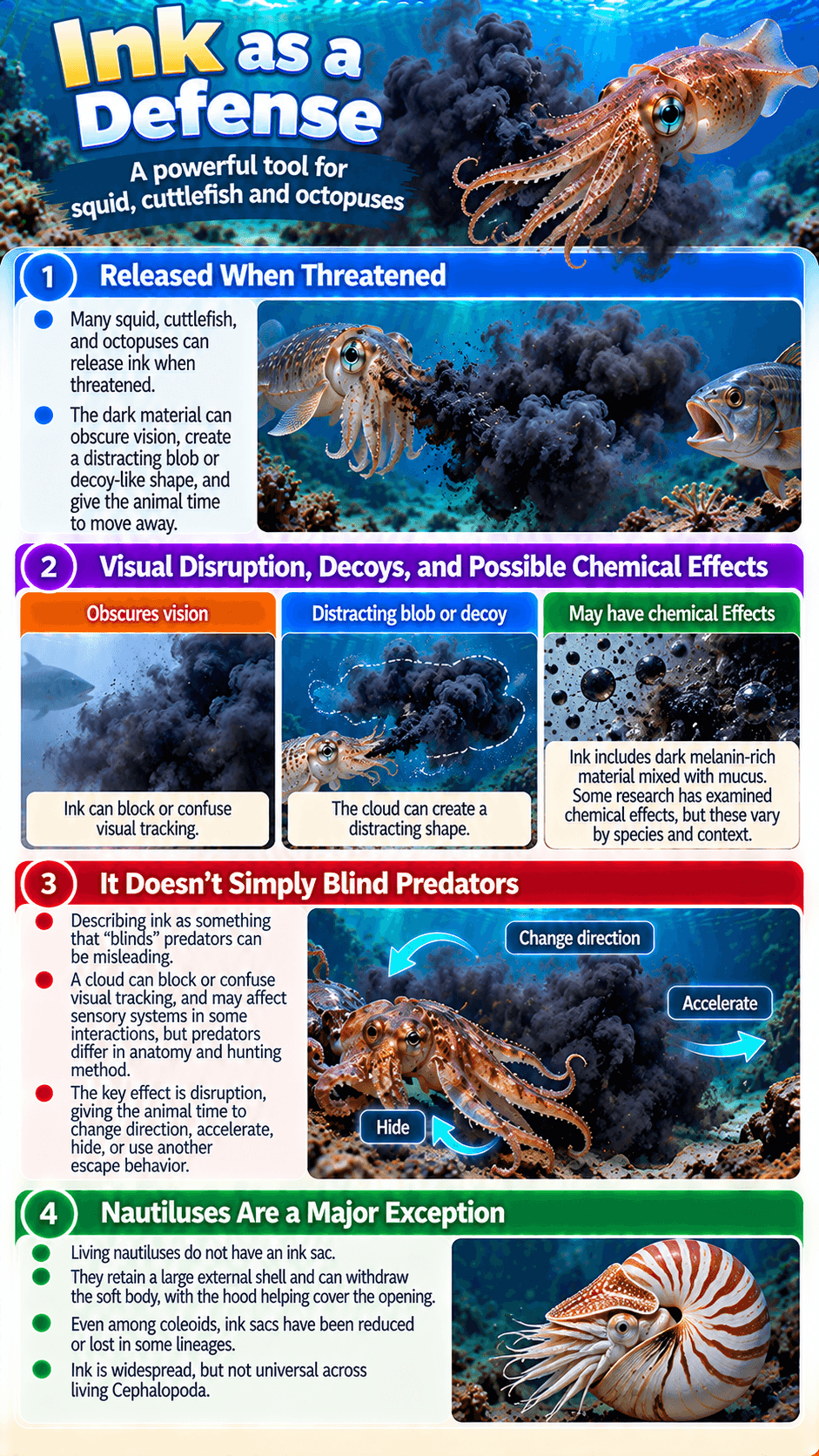
Many squid, cuttlefish, and octopuses can release ink when threatened. The dark material can obscure vision, create a distracting blob or decoy-like shape, and alter the sensory environment long enough for the animal to move away.
Visual Disruption, Decoys, and Possible Chemical Effects
Cephalopod ink typically includes dark melanin-rich material mixed with mucus. Depending on how it is released, the cloud may spread like a screen or remain more compact. Some research has examined chemical effects on predators and on other cephalopods, but the importance of those effects varies by species and context.
A broad review of cephalopod ink biology emphasizes that ink is a multifunctional defense rather than a single-purpose substance. The safest general interpretation is that it can interfere with pursuit while the animal changes direction, accelerates, hides, or uses another escape behavior.
Why Ink Does Not Simply Blind Predators
Describing ink as something that “blinds” predators can exaggerate what usually happens. A cloud can block or confuse visual tracking, and chemical components may affect sensory systems in some interactions, but predators differ in anatomy and hunting method. An animal that hunts mainly by touch, smell, or water movement may respond differently from a strongly visual predator.
The important defensive effect is disruption. Ink can buy time, create uncertainty, and separate the predator’s attention from the escaping mollusk.
Why Nautiluses Are a Major Exception
Living nautiluses do not have an ink sac. They retain a large external chambered shell and can withdraw the soft body so that the hood helps cover the opening. They therefore remind us that “cephalopod defense” is not synonymous with inking.
Even among coleoids, the group containing most living octopuses, squid, and cuttlefish, ink sacs have been reduced or lost in some lineages. Ink is widespread, but it should not be presented as universal across living Cephalopoda.
Venom, Toxins, and Chemical Defenses
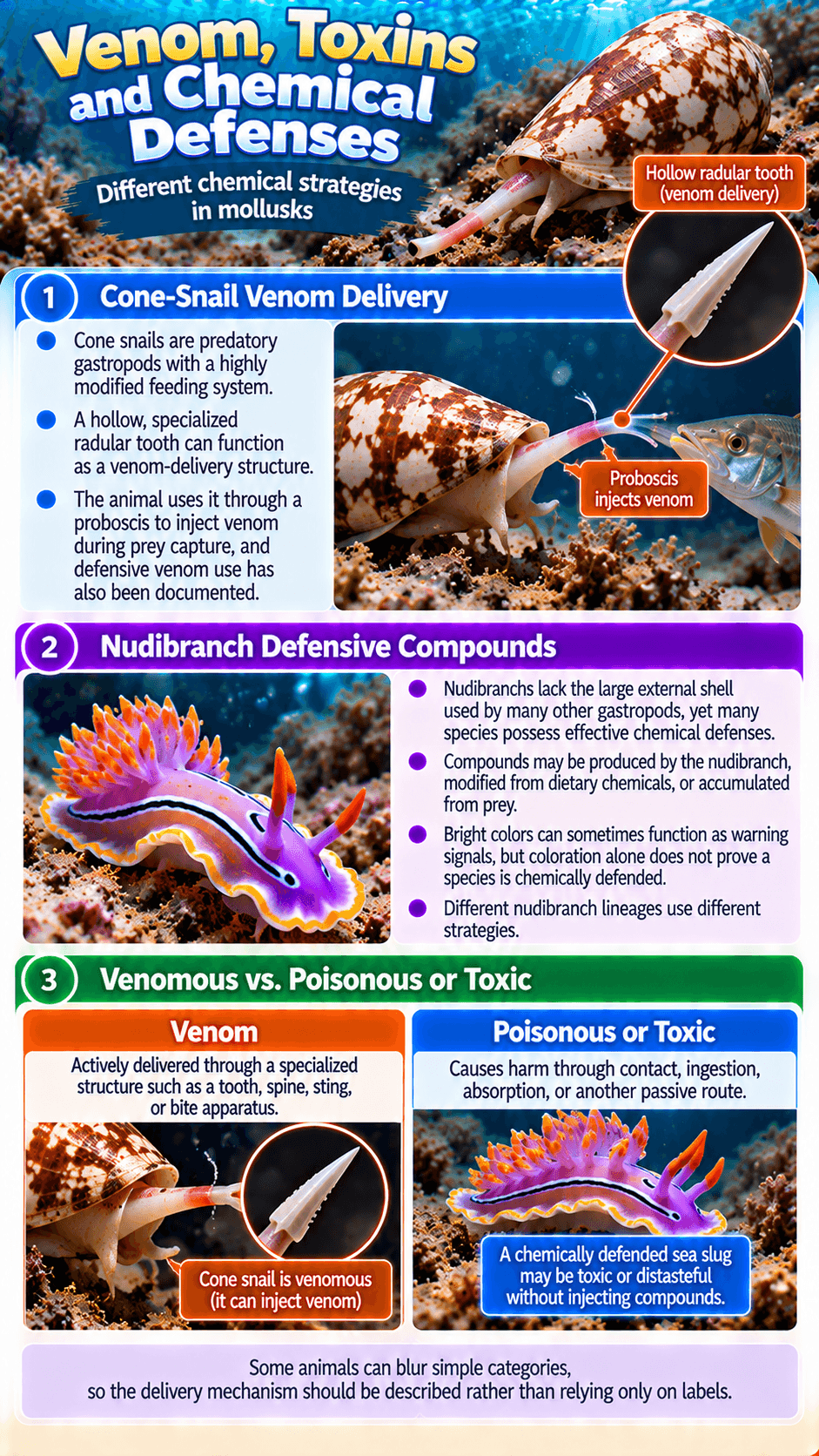
Mollusk chemical defenses range from internally produced compounds to chemicals acquired from food. Some species use venom delivered through a specialized structure, while others deter predators through substances in tissues, mucus, secretions, or exposed body parts.
Cone-Snail Venom Delivery
Cone snails are predatory gastropods with a highly modified feeding system. A hollow, specialized radular tooth can function as a venom-delivery structure. The animal uses it through a proboscis to inject venom during prey capture, and defensive venom use has also been documented within the group.
A peer-reviewed review of cone-snail venoms and venom apparatus describes the venom duct and harpoon-like radular tooth used for delivery. The details differ among species and prey types, so it is inaccurate to describe every cone snail as hunting in exactly the same way.
Wild cone snails should be observed without handling. Their defensive biology is interesting because it shows how a feeding structure can become part of a potent chemical-defense system, not because people should test or provoke the response.
Nudibranch Defensive Compounds
Nudibranchs lack the large external shell used by many other gastropods, yet numerous species possess effective chemical defenses. Compounds may be produced by the nudibranch, modified from dietary chemicals, or accumulated from prey. Bright colors can sometimes function as warning signals, but coloration alone does not prove a species is chemically defended.
Different nudibranch lineages use different strategies, so broad statements such as “nudibranchs are poisonous” erase important biological variation.
Venomous vs. Poisonous or Toxic Terminology
Venom is actively delivered through a specialized structure such as a tooth, spine, sting, or bite apparatus. Poison or toxic tissue causes harm through contact, ingestion, absorption, or another passive route. The distinction matters when describing mollusks.
A cone snail is venomous because it can inject venom through a specialized radular tooth. A chemically defended sea slug may be toxic or distasteful without injecting those compounds. Some animals can blur simple everyday categories, so the delivery mechanism should be described rather than relying only on labels.
Borrowed Defenses From Prey
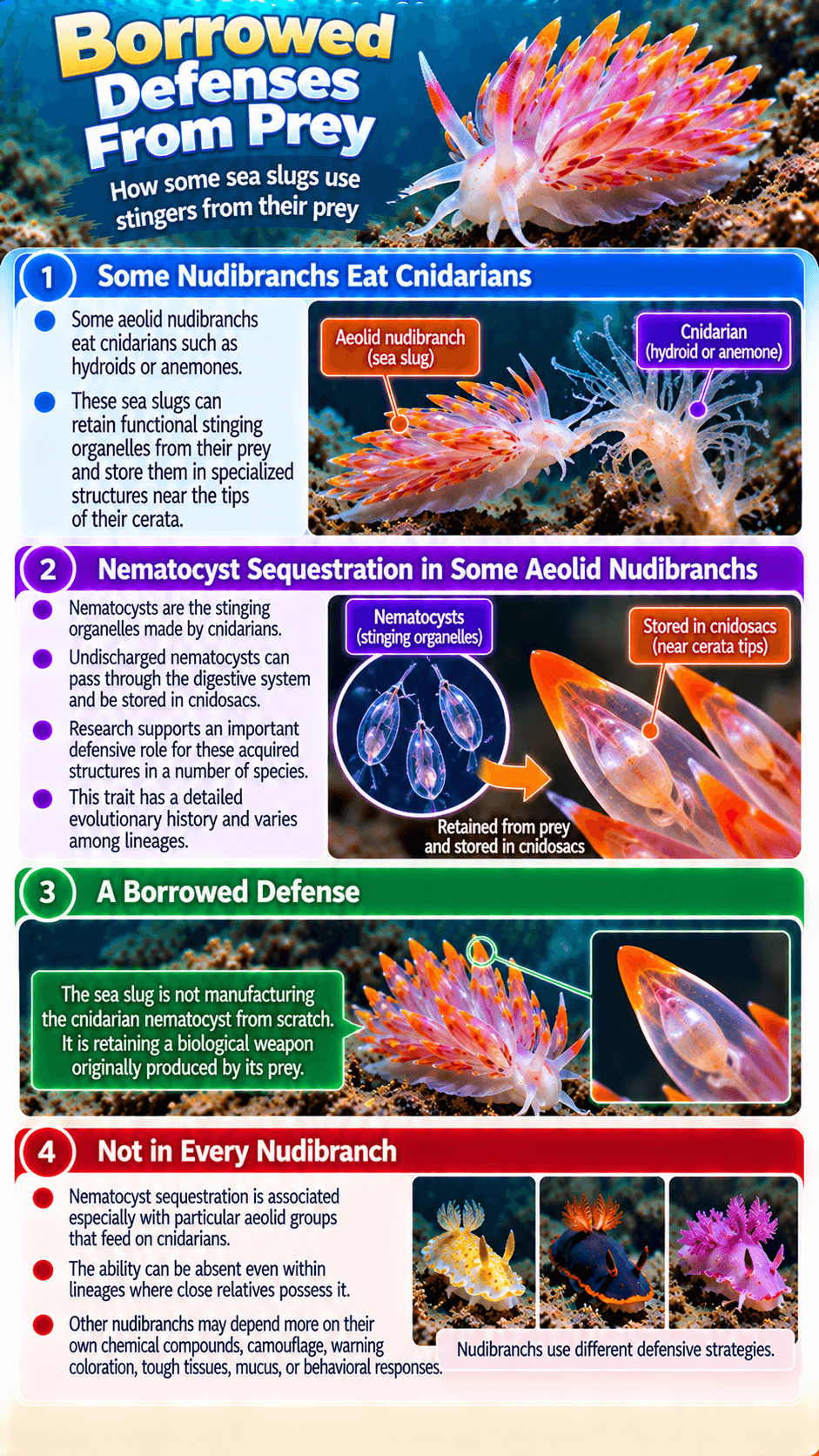
One of the most unusual mollusk defenses occurs in some aeolid nudibranchs that eat cnidarians such as hydroids or anemones. These sea slugs can retain functional stinging organelles from their prey and store them in specialized structures near the tips of their cerata.
Nematocyst Sequestration in Some Aeolid Nudibranchs
Nematocysts are the stinging organelles made by cnidarians. In nematocyst-sequestering aeolids, undischarged nematocysts can pass through the digestive system and be stored in cnidosacs. Research supports an important defensive role for these acquired structures in a number of species.
Modern studies of nematocyst sequestration in aeolid nudibranchs also show that the trait has a detailed evolutionary history and varies among lineages. The sea slug is not manufacturing the cnidarian nematocyst from scratch. It is retaining a biological weapon originally produced by its prey.
Why This Does Not Apply to Every Nudibranch
Nudibranchia contains many feeding strategies and defensive systems. Nematocyst sequestration is associated especially with particular aeolid groups that feed on cnidarians, and the ability can be absent even within lineages where close relatives possess it.
Other nudibranchs may depend more on their own chemical compounds, compounds obtained from other foods, camouflage, warning coloration, tough tissues, mucus, or behavioral responses. “Sea slugs steal stingers” is therefore a memorable example, not a definition of nudibranch defense.
Escape, Autotomy, Mucus, and Body Contraction
Defense does not always require armor or toxins. Sometimes the most effective response is to reduce contact, shed a grasped body part, change position, or make the body difficult to hold.
When Rapid Movement Matters
Cephalopods can combine sudden acceleration with camouflage or ink. Scallops can clap their valves and move through the water. Some gastropods perform rapid crawling, twisting, swimming, or detachment responses when they detect predators. The value of speed depends on the animal’s normal lifestyle, so a “fast” response for a snail should not be compared casually with the speed of a squid.
Escape behavior also depends on sensing the threat early enough. Chemical cues, touch, vibration, shadow, water movement, and vision can trigger different defensive responses in different mollusks.
Other Defensive Responses Across Classes
Some mollusks produce abundant mucus that makes them slippery, sticky, distasteful, or harder to handle. Some sea slugs can shed body structures, a process called autotomy, although this is not universal and the structures involved differ among species. Chitons can clamp tightly to rock, while many bivalves reduce exposure by digging or remaining attached in protected positions.
Body contraction itself can be protective. Pulling vulnerable tissues inward, flattening against a substrate, or reducing the part a predator can grasp may be enough to prevent an attack from succeeding.
Common Defense Myths
Every Mollusk Is Protected by a Shell
Many mollusks have shells, but slugs, nudibranchs, octopuses, and several other lineages lack a large external shell. Other species have internal or reduced shell structures. Shell presence is therefore not a universal defense and should not be used as the defining feature of the phylum.
Every Cephalopod Produces Ink
Ink is common among squid, cuttlefish, and many octopuses, but it is not universal. Living nautiluses lack an ink sac, and loss or reduction has occurred in some coleoid lineages. A safer statement is that inking is a widespread cephalopod defense with notable exceptions.
All Nudibranchs Are Poisonous
Nudibranch defenses are diverse. Some contain potent defensive chemicals, some sequester nematocysts or dietary compounds, some use camouflage, and others combine multiple tactics. Toxicity, the chemicals involved, and the route of exposure are species-specific questions.
How Defense Depends on Body Structure, Movement, Senses, and Habitat
Mollusk defense makes the most sense when it is connected to the rest of the animal’s biology. A defense must work with the structures the animal has, the way it moves, what it can detect, and the physical environment around it.
Shell Formation and Anatomy
Shell-based defense depends on mantle-produced shell material, shell geometry, muscles that retract or close the body, and the position of vulnerable tissues. A bivalve’s paired valves, a gastropod’s coiled shell, a chiton’s plates, and a nautilus shell do not function in exactly the same way even though each can contribute to protection.
Movement and Sensory Systems
Escape only works if the animal detects danger and produces an effective response. Cephalopod vision can help guide camouflage and rapid movement. Gastropods and bivalves may respond to chemical cues, touch, vibration, shadow, or water movement. The defensive act is therefore often the final step in a chain that begins with sensing a predator.
Habitat-Specific Trade-Offs
Burrowing is useful only where suitable sediment exists. Strong attachment matters on wave-swept rock or other firm surfaces. Camouflage depends on the visual environment. A shell that reduces drying can be especially valuable in intertidal or terrestrial settings. The same basic defensive feature can therefore have very different value in different habitats.
FAQ
Do all mollusks use shells for defense?
No. Many mollusks use shells as part of their defense, but others have reduced shells, internal shells, or no large external shell. Octopuses, nudibranchs, and slugs show that mollusks can rely strongly on camouflage, hiding, escape, mucus, chemical deterrence, or other strategies. Even shelled species often combine the shell with behavior such as retraction, valve closure, burrowing, or attachment.
Why do squid and octopuses release ink?
Ink can disrupt a predator’s pursuit. A cloud may obscure the animal, produce a distracting mass, or alter sensory conditions while the cephalopod changes direction or escapes. Ink is best understood as part of a sequence of defensive actions rather than as a substance that automatically stops or blinds every predator.
Are mollusks venomous or poisonous?
Some mollusks are venomous, some are chemically toxic or distasteful, and many are neither in any meaningful human-safety sense. Cone snails are a clear example of venomous mollusks because they deliver venom through a specialized radular tooth. Some sea slugs contain or store defensive chemicals without injecting them. The correct term depends on the species and how the defensive substance is delivered.
Final Thoughts
How mollusks defend themselves depends on far more than whether they have a shell. Across Mollusca, protection can come from armor, withdrawal, valve closure, burial, attachment, camouflage, ink, escape, mucus, venom, toxic compounds, warning signals, or even defensive structures retained from prey. These tactics work because they fit particular bodies and environments.
The most important takeaway is that mollusk defense is diverse and layered. No shell is perfect armor, no ink cloud is a universal solution, and no chemical defense represents the whole phylum. Looking at structure, behavior, senses, and habitat together gives a much more accurate picture of how these animals survive repeated encounters with predators.

Ethan Walker is the founder and research editor of Animal Fact Central. He creates and reviews educational animal facts content using trusted wildlife, pet care, and science-based sources. His work focuses on making animal behavior, adaptations, habitats, and species facts clear, accurate, and engaging for everyday readers.
Read More Details About Ethan Walker: https://animalfactcentral.com/ethan-walker/